



Abstract
This study examines racial disparities in emotional expression within online football fandom by analyzing sentiment in YouTube comments referring to white players and players of color across different match contexts (previews, wins, losses, and draws). Using a two-way ANOVA with 239 observations derived from 5,819 comments, we identify significant racialized patterns in sentiment expression. White players received significantly higher sentiment scores than players of color overall, with disparities most pronounced following wins and in previews: contexts where praise and positive evaluation are typically expressed. Notably, following losses, sentiment was equally negative across racial groups, indicating that racial bias operates primarily through the withholding of praise rather than the attribution of blame. These findings align with social identity theory’s distinction between in-group favoritism and out-group derogation, suggesting that bias in football commentary manifests predominantly through preferential allocation of positive sentiment to white players rather than through explicit negativity toward players of color. The results reveal that affective inequalities persist in online football discourse despite formal diversity initiatives, and that racial bias operates not only through overt hostility but through subtle, patterned inequalities in the distribution of emotional rewards.
Keywords
Introduction
Racism in professional football has been a persistent and extensively documented phenomenon, shaping the experiences of players, fans, and institutions across decades of English football culture (Back et al., 2001; Kick It Out, 2020). Although high-profile anti-racism campaigns and governing body interventions have brought the issue into public discourse, evidence consistently suggests that racial prejudice remains embedded in football fandom, having evolved rather than diminished over time (Cable et al., 2022; Cleland & Cashmore, 2014; Kilvington et al., 2022). Further, the landscape of racist expression has undergone a significant transformation: while overt abuse in stadium environments may have declined in visibility, digital platforms have created new spaces in which racial bias is expressed through subtler, more diffuse, and harder-to-regulate forms (Keum & Volpe, 2023; Kilvington & Price, 2019).
This shift to digital spaces is theoretically important. Online environments such as YouTube comment sections afford users a degree of anonymity and reduced social accountability that lowers inhibitions around prejudiced expression (Suler, 2004). As a result, racial bias in fan-generated content may not manifest as explicit slurs, which are increasingly flagged and removed by automated moderation, but rather as covert evaluative patterns: disproportionate negativity directed at players of color, the withholding of praise following good performances, or heightened blame attribution following poor match outcomes (Coates, 2008; Kessaris, 2006). These forms of bias are both theoretically significant and practically difficult to detect, as they lack the explicit racial markers that content moderation systems are designed to identify.
Despite extensive qualitative and theoretical work on racism in football, there remains a notable absence of quantitative evidence demonstrating how race systematically shapes affective evaluations in fan-generated online discourse, and, critically, how these effects interact with contextual factors such as match outcome. Fan commentary is not produced in a neutral context: it is shaped by emotional investment in match results, team loyalties, and the psychological dynamics of in-group and out-group identity (Crawford, 2004; Tajfel, 1974). Understanding how racial bias operates at the intersection of these contextual factors is essential for both theoretical accounts of online prejudice and for developing more effective approaches to content moderation.
To address this gap, the present study examines whether race systematically predicts the sentiment expressed in YouTube comments directed at English Premier League (EPL) players, and whether this relationship varies as a function of match outcome. By analyzing fan-generated commentary across win, loss, draw, and preview contexts, the study aims to provide quantitative evidence of how racial bias manifests in digital football discourse, and to assess the extent to which emotionally salient match outcomes moderate the expression of that bias. In doing so, it contributes both to scholarship on covert racism in sport and to ongoing debates about the adequacy of platform moderation practices.
Racism in English Football Culture
The “Kick It Out” organization was founded in 1993 to combat racism in football (Kick It Out, 2020), initially focusing on stopping the racist abuse players of color faced from spectators (Harris, 2021, p. 57). The emergence of such an initiative reflects the persistence of racism within English football culture, particularly among certain fan subcultures. Research by Back et al. (2001) demonstrates that while football clubs share common fan practices, the expression and intensity of racism vary substantially between clubs, shaped by local histories, traditions, and symbolic practices. These findings suggest that racism in football is systemic, but unevenly expressed across contexts rather than uniformly distributed.
Subsequent research has consistently shown that racism remains embedded in contemporary football culture (Cable et al., 2022; Cleland, 2014; Cleland & Cashmore, 2014; Kilvington et al., 2022). Cleland (2014) found that half of fans surveyed had witnessed or experienced racial abuse, yet governing bodies often relied on ineffective “color-blind” responses. Cleland and Cashmore (2014) further revealed that fans frequently minimize racism by recognizing only its most overt forms, a tendency that limits meaningful anti-racist action. More recently, Kilvington et al. (2022) showed how allegations of racial abuse, such as those involving Chelsea defender Antonio Rüdiger in 2019, were often dismissed by fans as exaggeration or as “playing the race card,” rather than being treated as credible instances of racism.
Importantly, football fandom is not culturally homogeneous. Back et al. (2001) highlight how race, nation, and identity are negotiated within distinct football cultures, positioning football as a key site for the articulation of racist and xenophobic attitudes. These dynamics are shaped by localized club identities rather than shared uniformly across fandom. Supporting this, File and Worlledge’s (2023) linguistic ethnography of Burton Albion supporters demonstrates the existence of multiple fan subcultures within a single club, each governed by different norms, expectations, and communicative practices. This work challenges reductive portrayals of football fans as a single group and suggests that racist practices are reproduced within specific subcultural contexts rather than being inherent to football support per se.
Social Identity Theory, Fandom, and Race
A key theoretical framework for understanding how racial bias operates within football fandom is Social Identity Theory (SIT) (Tajfel, 1974). SIT proposes that individuals derive a significant component of their self-concept from membership in social groups, and that this group-based identity motivates both in-group favoritism, the tendency to evaluate members of one’s own group more positively, and out-group derogation, the corresponding tendency to evaluate members of other groups more negatively. These processes serve to maintain and enhance positive social identity. Importantly, SIT predicts that in-group/out-group dynamics become more pronounced under conditions of emotional salience or perceived threat, such as competitive contexts.
Crawford’s (2004) conceptualization of sports fandom as “imagined communities” situates intergroup dynamics within football culture. Fan identity produces both belonging and exclusion: to identify as a supporter of a given club is simultaneously to position rival clubs and their supporters as out-groups. In this context, SIT predicts that negative evaluations of rival players will be amplified by tribal loyalties, with fans attributing positive performances to situational factors and negative ones to stable dispositions of rival players.
However, the application of SIT to racial bias in football requires careful specification of the relevant in-group and out-group boundaries. In a football context, these boundaries can operate at multiple levels simultaneously: fans of a specific club versus fans of rival clubs; supporters of the national team versus foreign players; and, critically, racial groups. Back et al. (2001) argue that whiteness has historically functioned as the unmarked and dominant in-group position within English football culture, shaping who is perceived as belonging to the community of football and whose performances are more readily praised, excused, or celebrated; a dynamic consistent with broader theorizations of whiteness as a normative, self-concealing category that operates as the invisible standard against which others are evaluated (Long & Hylton, 2002; Nakayama & Krizek, 1995). Players of color have historically been positioned as outsiders relative to this norm, even when playing for the fans’ own club (Kilvington et al., 2022).
It is important to acknowledge, however, that the demographic composition of English professional football has changed significantly. In 2022, approximately 43% of EPL players were black (Statista, 2022), meaning that the traditional alignment between racial in-group membership and team membership is no longer straightforward. This demographic shift complicates any simple mapping of racial identity onto team-based intergroup distinctions. One theoretical implication is that racial bias in fan discourse may operate more subtly than overt in-group favoritism; rather than directly praising white players and denigrating players of color, fans may express differential patterns of blame attribution, criticism intensity, or the withholding of positive evaluations, particularly in emotionally charged contexts such as match losses. This aligns with broader theorizing on covert prejudice, which suggests that bias increasingly operates through evaluative disparities rather than explicit hostility (Coates, 2008; Kessaris, 2006).
Empirical work by Goldie and Wolfson (2014) demonstrates how SIT-consistent processes manifest as illusory superiority in fan communities, whereby fans exaggerate their own team’s virtues while homogenizing and disparaging rivals (Hoorens & Harris, 1998). These dynamics are routinely enacted through chants, symbols, and online commentary, where emotional investment in match outcomes intensifies evaluative language. Within this framework, racial bias may serve as an additional dimension along which evaluative disparities are organized: players of color may be subject to disproportionately negative evaluations not only as rival players, but as members of a racially defined out-group whose performances are scrutinized and attributed differently from those of white players.
Based on this theoretical account, and consistent with evidence that covert racial bias operates through disproportionate negativity rather than explicit slurs (Cleland & Cashmore, 2014; Coates, 2008), the following hypothesis is proposed:
Average sentiment expressed towards players will differ significantly by race, with white players receiving more positive sentiment overall than players of color.
Race and Stereotyping in Sports Media
While professional sports journalism is not the primary focus of this study, the framing of athletes by mainstream media is a relevant context for understanding the evaluative frames that fans bring to online commentary. Research on race and sports reporting has consistently documented the use of racially differentiated tropes in the coverage of athletes: players of color, black players in particular, are more frequently described in terms of physical attributes (speed, power, athleticism), while white players are more commonly discussed in terms of cognitive or leadership qualities (tactical intelligence, work ethic, composure) (Campbell & Bebb, 2022; Deeb & Love, 2018; McCarthy et al., 2003; McCarthy & Jones, 1997; van Sterkenburg et al., 2012). These framing differences are not merely descriptive; they reflect and reinforce broader racial stereotypes that position black athletes as naturally gifted but cognitively limited, and white athletes as cerebral and dependable.
If mainstream media consistently applies racially differentiated evaluative standards, fan commentary on social media platforms may reproduce, amplify, or contest these framings, particularly in the emotionally charged context of match outcomes. The present study does not directly examine media framing but acknowledges that its effects may constitute a background condition shaping the patterns of sentiment detected in fan-generated content.
Digital Platforms, Covert Racism, and Online Disinhibition
While racism in football has historically been associated with overt abuse in stadiums, digital platforms have reshaped how racial prejudice is expressed and sustained. Online environments such as YouTube allow for more covert forms of racism, where anonymity and reduced accountability facilitate indirect, affective, and evaluative expressions of bias rather than explicit slurs (Burgess & Green, 2018). Research shows that anonymous or semi-anonymous platforms encourage more aggressive and prejudiced communication (Forestal & Philips, 2020; Perbawani et al., 2018), a pattern explained by Suler’s (2004) online disinhibition effect, whereby invisibility and the absence of immediate consequences lower social restraints (Barlett & Scott, 2023).
Although overt racism in stadiums may have declined (Kilvington & Price, 2019), digital spaces increasingly host racialized discourse that is subtle, ambiguous, and difficult to regulate (Keum & Volpe, 2023). YouTube defines hate speech as content that promotes violence or hatred toward protected groups, including race and religion (YouTube, n d), and relies on a combination of automated detection and user flagging to enforce these policies. However, such systems are poorly equipped to identify covert prejudice, including microaggressions and affective bias, which lack explicit racial markers but nonetheless perpetuate discriminatory evaluations (Coates, 2008; Kessaris, 2006; Nkrumah, 2022). As a result, racial bias may persist online not through direct abuse, but through disproportionate negativity, blame, or the withholding of praise.
File and Worlledge’s (2023) finding that distinct subcultural communities within a single fan base operate according to different communicative norms is relevant here: online comment sections may similarly host heterogeneous evaluative practices, with racial bias concentrated within particular subcultural modes of engagement rather than evenly distributed across all fan commentary. The intersection of racial bias and fan partisanship presents particular challenges for content moderation. Negative evaluations of a rival team’s player of color may reflect racial prejudice, team rivalry, or a combination of both, yet existing moderation systems are unable to reliably distinguish between these motivations. Consequently, racialized sentiment can remain visible and socially consequential while falling outside the boundaries of policy-defined hate speech.
Match Outcomes, Emotional Intensity, and Racial Bias
SIT predicts that intergroup dynamics intensify under conditions of emotional salience, and match outcomes represent a primary source of emotional arousal for football supporters. Research on fan behavior consistently demonstrates that losses produce heightened negative affect, increased blame attribution, and more aggressive evaluative language directed at players (Hylton et al., 2024). Wins, conversely, tend to produce elevated in-group glorification and more positive evaluations of associated players. Draws occupy an ambiguous affective space, often characterized by frustration when a positive result was anticipated, or relative satisfaction when a negative result was avoided.
These emotionally differentiated contexts are theoretically important for understanding racial bias in fan discourse. If racial bias operates through covert evaluative disparities rather than explicit prejudice, it is likely to be most clearly expressed when emotional arousal is highest, that is, in the aftermath of losses, when the motivation to attribute blame is strongest. Under these conditions, players of color may be subject to disproportionately negative sentiment relative to white players, as racial out-group membership compounds the motivational dynamics of blame attribution that loss contexts already activate. Following wins, by contrast, in-group celebration may produce more uniformly positive sentiment, potentially attenuating racial disparities, though still not eliminating them if in-group favoritism along racial lines remains operative.
On this basis, the following hypotheses are proposed:
Average sentiment expressed towards players will differ significantly by match outcome, with commentary following losses being significantly more negative than commentary following previews, wins, or draws.
The effect of race on sentiment will vary significantly depending on match outcome, such that differences in average sentiment between white and players of color will vary significantly across outcomes.
Following a win, white players will receive significantly more positive sentiment than players of color.
Method
Design and Data Source
This study employed quantitative content analysis to examine linguistic elements in YouTube comments from “Fan Channels,” defined as supporter-run channels dedicated to a single football club. The primary focus was on the sentiment expressed in comments in relation to the perceived race of the individual being discussed, as well as the type of content (e.g., match preview, or post-match review following a win, loss, or draw for the club supported by the channel). The EPL was selected as the context for this study due to its global prominence, the diversity of its playing personnel, and its well-documented history of racial discourse both on and off the pitch (Back et al., 2001; Cleland & Cashmore, 2014; Kick It Out, 2020). Fan channels on YouTube represent a particularly relevant site of analysis, as they host large volumes of organically produced supporter commentary that is publicly accessible and largely unmoderated.
Data Collection
Channel and Club Selection
The study focused on YouTube fan channels associated with Premier League clubs from the 2023/2024 season. Each club was listed according to its official channel’s subscriber count on the date of selection to identify the most prominent clubs by audience size. This resulted in the selection of the top five clubs: Liverpool, Manchester United, Manchester City, Arsenal, and Chelsea.
Five separate searches were then conducted on YouTube using the term “ [Club Name] Football Club Fan Channel.” The top 100 videos from each search were reviewed and the originating channel recorded, producing five lists of 100 channels. These lists were filtered using the following exclusion criteria, each applied to improve sample homogeneity and ensure comparability across channels: • Duplicate channels were removed to avoid double-counting content. • Channels not dedicated solely to a single club were excluded to ensure commentary was club-specific in its framing and audience. • Channels without at least one human presenter were removed, as the study required video content in which players were discussed verbally or referenced in the commentary, prompting audience response. • Channels whose presenters were not from the UK or Ireland were excluded to control for linguistic and cultural variation in both the content and the resulting comment discourse.
The subscriber count of each remaining channel was recorded and the top two channels per club were identified. The combined subscriber counts for the top two channels were then compared across clubs. Manchester City was excluded at this stage as its top two channels had a substantially lower combined subscriber count than the other four clubs. This decision was made to maintain a degree of comparability in channel reach and audience size across the sample, and to keep the overall dataset manageable for the scope of this analysis. This left four clubs in the final sample: Liverpool, Manchester United, Arsenal, and Chelsea.
Video Selection
Once eligible channels were established, a record of fixtures between these four clubs during the 2023/2024 season was compiled. Only fixtures between the selected clubs were included to ensure that both competing clubs had dedicated fan channel coverage of the same match, allowing for consistent cross-club comparison. For each fixture, videos produced by eligible channels were collected, focusing on content created within seven days before (match previews) and after (match reviews) the fixture, capturing both pre-match expectations and post-match reactions.
Videos were further filtered using the following exclusion criteria: • Videos that did not reference the opposing team or a player from the opposing team in the title were removed, as such videos were unlikely to contain substantive comparative commentary on players from both clubs. • Videos featuring supporters of rival clubs were excluded to ensure commentary reflected the perspective of the channel’s intended supporter base. • Videos consisting only of clips from other channels were eliminated, as these did not constitute original fan commentary. • Videos combining match previews or reviews with content related to an ineligible club were removed to avoid confounding the match context variable. • Videos containing only reactions to social media posts were excluded, as these responses are directed at third-party content rather than the match itself.
Breakdown of the Types of Final Eligible Videos
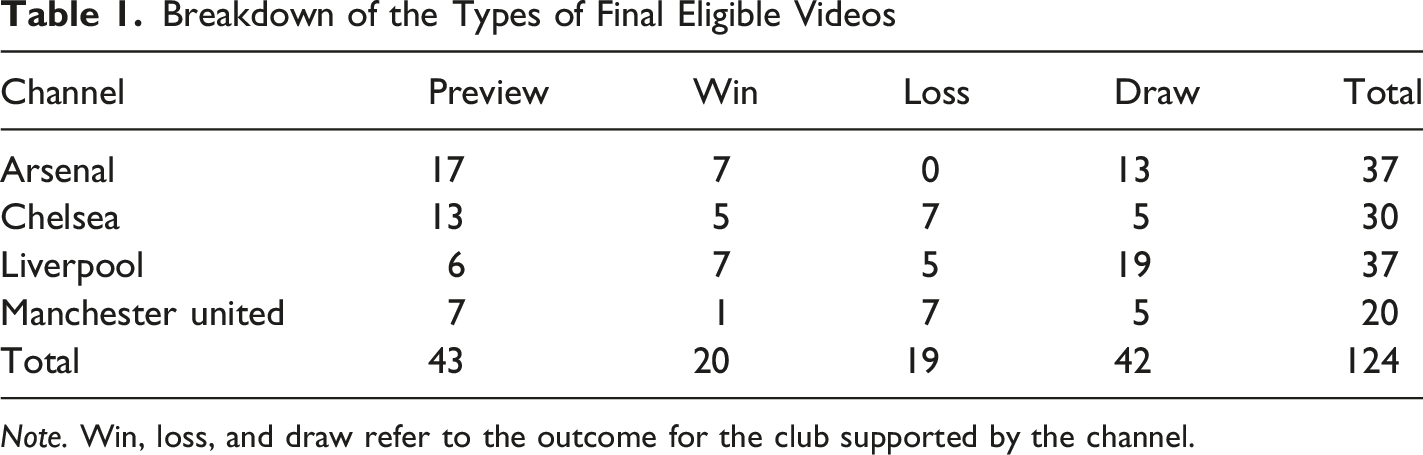
Note. Win, loss, and draw refer to the outcome for the club supported by the channel.
Comment Extraction and Race Classification
Comments were extracted from the eligible videos using Python code executed in Jupyter Notebook 7.3.2 and compiled into an Excel spreadsheet, yielding an initial dataset of 21,111 rows. Race classification was based on publicly available information and reflects socially perceived racial categorisation rather than self-identified ethnicity. A predefined lookup table was created in Excel, mapping players’ surnames to racial categories (White; Players of Color) based on publicly available sources such as club profiles and media representation, which was then applied using conditional formatting.
The following decisions were made to improve coding consistency and reduce ambiguity, though their implications are acknowledged: • Comments referring to players by first name only or with a misspelled surname were excluded, as these could not be reliably matched to a player in the lookup table. It is acknowledged that this exclusion may introduce a degree of bias, as informal or derogatory references, which may be more prevalent in certain match contexts, such as following a loss, are more likely to fall into this category. • Comments referring to more than one player were removed so that each unit of analysis reflected sentiment directed at a single, identifiable individual.
Illustrative Examples of Coded Comments by Sentiment Category and Racial Group
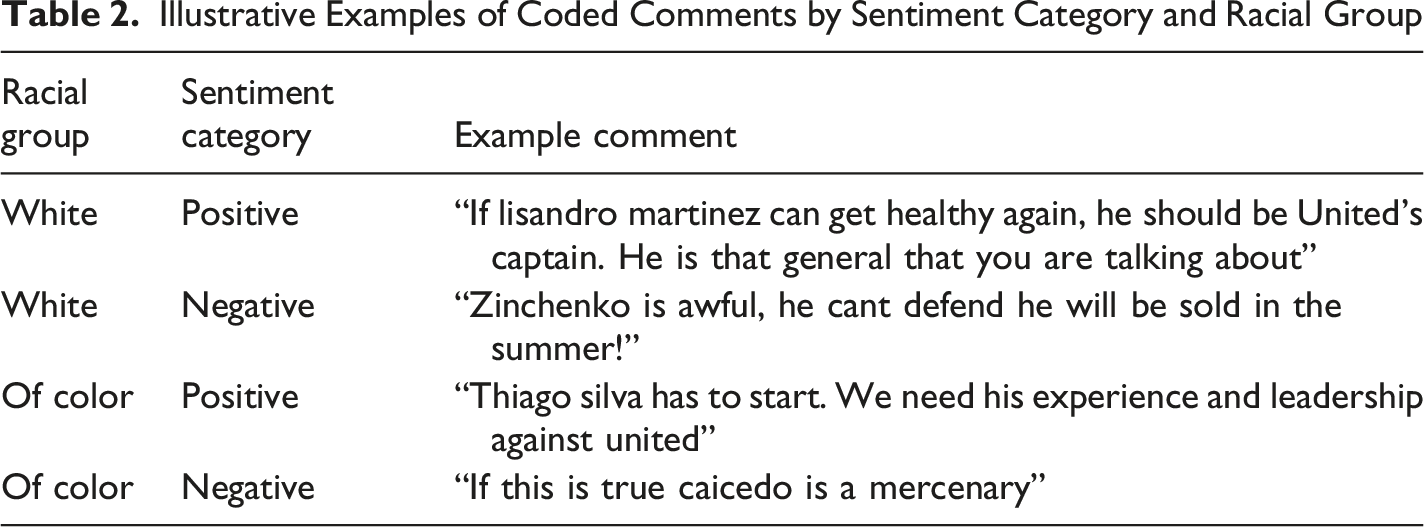
To assess intra-rater reliability, the coder re-coded a 10% subset of the data. Agreement between coding rounds was high (Cohen’s κ = .98, N = 582, p < .001). Intra-rater reliability of this magnitude is widely regarded as sufficient to establish the stability of a single coder’s classifications in content-analytic research (Krippendorff, 2004), particularly where a comprehensive, predefined coding scheme is employed, as is the case here. Inter-rater reliability between two human coders was not assessed in this study; as discussed in the limitations, this represents an acknowledged constraint on the robustness of the race classification procedure.
Variables
The following variables were used in the analysis: • Race of the Individual: A nominal variable with two levels (Players of Color, White). • Match Outcome: A nominal variable with four levels (Preview, Post-Match Win, Post-Match Loss, Post-Match Draw). • Sentiment Score: A continuous dependent variable derived from VADER (Valence Aware Dictionary and sEntiment Reasoner) (Hutto & Gilbert, 2014) compound sentiment scores. VADER is a lexicon- and rule-based sentiment analysis tool developed specifically for social media text. It accounts for features common in online discourse, including capitalization, punctuation, and colloquial expressions, and produces a compound score ranging from −1 (maximally negative) to +1 (maximally positive). VADER has been validated against human raters across multiple social media datasets and has been applied extensively in studies of online comment sentiment. For each video, comments were first classified by the perceived race of the player mentioned. VADER compound scores were then calculated for each individual comment, and these scores were aggregated by computing the mean sentiment score separately for comments directed at White players and comments directed at Players of Color within each video. This produced two video-level sentiment scores per video, one per racial group, which served as the dependent variable for analysis. For descriptive purposes, scores of +0.5 or higher were classified as Positive, scores of −0.5 or lower as Negative, and scores between −0.5 and +0.5 as Neutral, though the continuous compound score was used in all inferential analyses.
One acknowledged limitation of the automated sentiment approach concerns the validity of VADER scores relative to human judgment in this specific context. While VADER has demonstrated strong performance on general social media text, it was not specifically trained on football fan commentary and may not fully capture domain-specific expressions of praise, criticism, or irony. No human-versus-automated reliability check was conducted in this study, which represents a limitation. Future research should seek to validate automated sentiment coding against human annotations within this domain.
Data Analysis
The data were analyzed using a two-way between-subjects ANOVA to examine the effects of Race (White Players vs. Players of Color) and Match Outcome (Preview, Win, Loss, Draw) on video-level mean sentiment scores. This method was selected to test for the main effects of each factor and their potential interaction, allowing assessment of whether racial disparities in sentiment vary as a function of match context. The final dataset comprised 239 observations (White Players: N = 120 videos; Players of Color: N = 119 videos), reflecting the number of videos in which at least one comment directed at an individual player of that racial group was identified.
Ethics
The study received ethical approval in accordance with the BPS Ethics Committee guidelines (2021). Permission was granted to use YouTube content, with measures in place to maintain the anonymity and confidentiality of commenters throughout the study. While the ethics of using publicly available online data have been subject to ongoing debate (Hookway, 2008), the approach was considered ethically justifiable given that all videos and comments were publicly accessible and shared within the public domain (McGovern, 2016).
Results
A two-way between-subjects ANOVA was conducted using SPSS (version 29.0.1.0) to examine the effects of Match Outcome (Preview, Win, Lose, Draw) and Race (White Players, Player of Color) on sentiment scores. The analysis included 239 observations. Assumptions of normality and homogeneity of variance were considered acceptable for ANOVA.
Overall Model
The overall model was significant, F (7, 231) = 5.46, p < .001, accounting for approximately 14.2% of the variance in sentiment scores, R2 = .142 (adjusted R2 = .116).
Hypothesis 1: Main Effect of Race
Supporting Hypothesis 1, there was also a significant main effect of Race, F (1, 231) = 4.81, p = .029. Sentiment scores were significantly higher for White players (M = .174, SE = .032, 95% CI [.110, .237]) than for players of color (M = .072, SE = .033, 95% CI [.007, .138]), with a mean difference of .101 (SE = .046, p = .029).
Hypothesis 2: Main Effect of Match Outcome
Supporting Hypothesis 2, there was a significant main effect of Match Outcome on sentiment, F (3, 231) = 7.90, p < .001. Estimated marginal means showed that sentiment was highest for Wins (M = .258, SE = .055, 95% CI [.149, .367]), followed by Previews (M = .196, SE = .036, 95% CI [.125, .267]) and Draws (M = .112, SE = .037, 95% CI [.040, .185]), with the lowest sentiment observed for Losses (M = −.075, SE = .053, 95% CI [−.181, .030]).
Post hoc pairwise comparisons using the Least Significant Difference (LSD) procedure revealed that Wins elicited significantly higher sentiment than Losses (p < .001) and Draws (p = .029). Previews also yielded significantly higher sentiment than Losses (p < .001) but did not differ significantly from Wins (p = .348) or Draws (p = .104). Losses produced significantly lower sentiment than all other match outcomes (all ps ≤ .004).
Hypothesis 3: Interaction Between Race and Match Outcome
Supporting Hypothesis 3, the interaction between Match Outcome and Race was statistically significant, F (3, 231) = 2.96, p = .033, indicating that the effect of race on sentiment varied significantly depending on match outcome.
Hypothesis 4: Racial Differences Following Wins
As shown in Figure 1, supporting Hypothesis 4, sentiment following Wins was notably higher for White players (M = .387, SE = .074) than for players of color (M = .129, SE = .082). This pattern was also observed for Previews, where White players received higher sentiment (M = .295, SE = .051) compared to players of color (M = .097, SE = .050). In contrast, sentiment following Losses was equally negative for both racial groups (M = −.075), while sentiment following Draws showed a smaller racial difference, with slightly higher sentiment for players of color. Estimated marginal means of sentiment by race and match outcome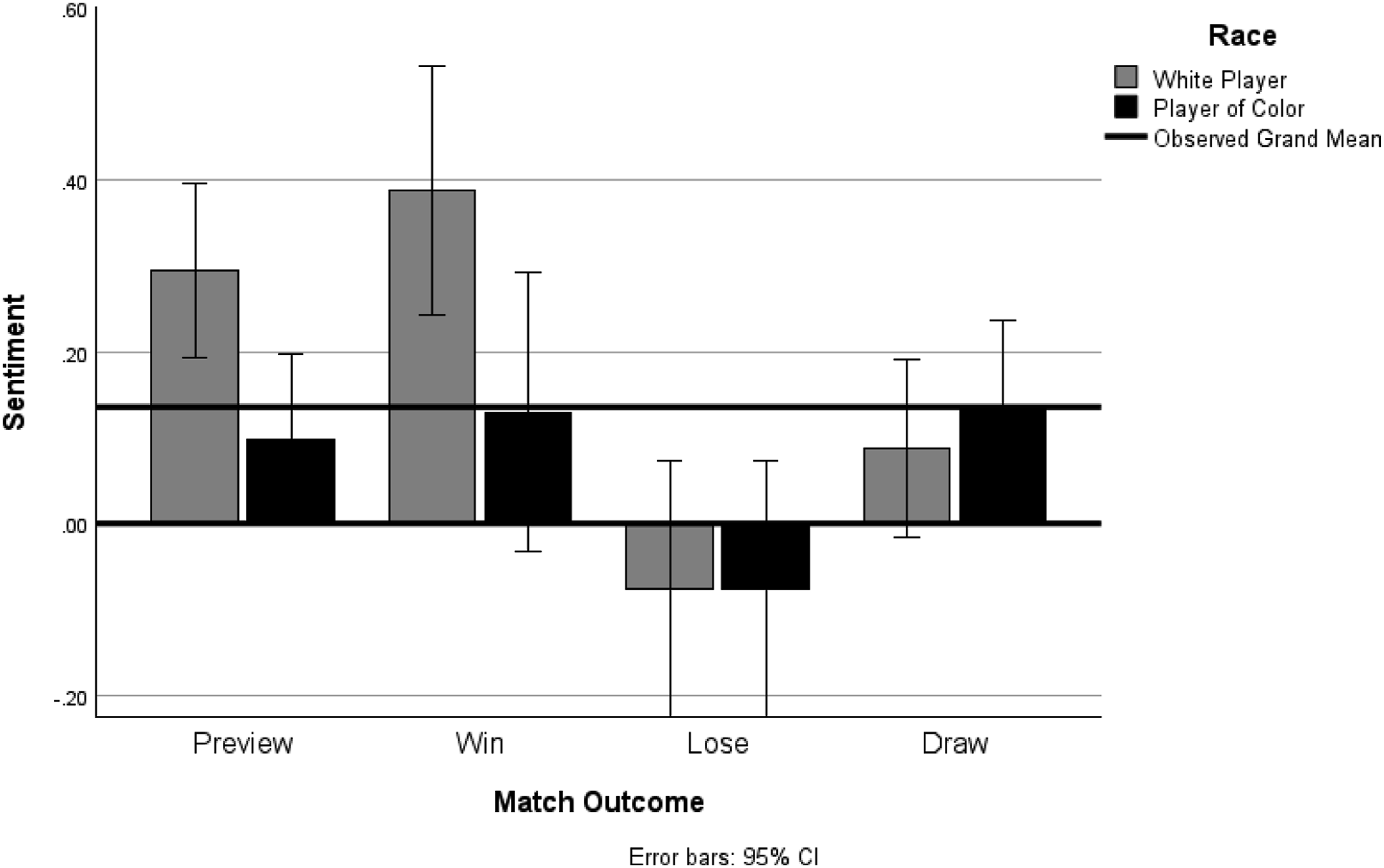
Discussion
This study examined whether sentiment expressed in YouTube comments on English football–related content varied as a function of race and match outcome. Using a two-way ANOVA, the analysis revealed both main effects of race and match outcome, as well as a significant interaction between the two, indicating that racial differences in sentiment were contingent on the match context. Overall, the findings suggest that racialized patterns in fan sentiment are most evident in positive evaluative contexts, rather than in responses to negative outcomes.
Across all the hypotheses, the data reveal a consistent pattern: players of color received less positive sentiment than White players across match contexts, with disparities most pronounced in situations where praise and positive evaluation were likely. Following wins, White players were discussed in markedly more positive terms, while players of color were more frequently associated with neutral or comparatively less enthusiastic sentiment. Even in moments of celebration, their contributions were less likely to be recognized. Notably, following losses, sentiment was equally negative across racial groups, indicating that racial bias in fan commentary operates primarily through the allocation of praise rather than the attribution of blame.
This disparity points to a troubling phenomenon: the inclusion of individuals of color in high-visibility roles does not necessarily signal egalitarian cultural attitudes. Rather, underlying cultural scripts that may associate success, leadership, and praise with Whiteness continue to shape public discourse, at least as reflected in the patterns of fan sentiment observed here (Cleland, 2014; Hylton et al., 2024). This finding is consistent with Felix’s (2020) argument that representation in media can coexist with the persistence of negative or limiting stereotypes, particularly of Black men, and aligns with wider critiques of diversity initiatives that emphasize symbolic inclusion without challenging deeper ideological structures (van Sterkenburg et al., 2012; van Sterkenburg & Knoppers, 2012).
Quillian et al.’s (2017) findings that labor market discrimination against Black and Latino individuals has not improved since 1989 reinforce the idea that access does not equal acceptance. Similarly, the present findings suggest that even when players of color achieve prominence in football, they may not be afforded the same interpretive generosity or emotional rewards as their White counterparts, though caution is warranted in generalizing from sentiment scores to the full range of evaluative practices in fan culture. In moments of success, their contributions are less likely to be celebrated, suggesting that racial bias is expressed not primarily through heightened criticism, but through muted recognition.
These observations raise the question of how such disparities persist despite increased visibility. Social identity theory offers a useful framework for understanding the mechanisms at work. The pattern observed in this study, where racial disparities emerge primarily through differential allocation of praise rather than blame, aligns with social identity theory’s distinction between in-group favoritism and out-group derogation (Brewer, 1999; Tajfel, 1974). The findings suggest that bias in YouTube-based football commentary operates predominantly through in-group favoritism: fans disproportionately direct positive sentiment toward White players (the presumed in-group in this predominantly White fan context) rather than through explicit out-group derogation of players of color.
This pattern has important theoretical implications. While out-group derogation involves actively negative evaluations of those outside one’s group, in-group favoritism manifests as preferential treatment, recognition, and emotional rewards for in-group members, a more subtle but equally consequential form of bias (Greenwald & Pettigrew, 2014). The absence of heightened negativity toward players of color following losses, coupled with diminished positivity following wins, indicates that racial bias operates less through hostility than through unequal distribution of praise and celebration.
This distinction matters because in-group favoritism is often perceived as more socially acceptable than out-group derogation, making it harder to identify and challenge (Balliet et al., 2014). Fans may not consciously intend to diminish players of color; rather, they may simply feel greater affinity, identification, and emotional connection with White players, leading them to celebrate White contributions more enthusiastically. This form of bias can persist even among fans who explicitly reject racist attitudes, as it operates through affective mechanisms rather than overt prejudice.
Moreover, the focus on in-group favoritism helps explain why diversity initiatives that emphasize representation may fail to address underlying inequalities. Simply including players of color does not automatically extend in-group status or the emotional generosity that accompanies it. Without actively disrupting the racial boundaries of who counts as “one of us,” representation may coexist with persistent affective hierarchies in which White players remain the primary recipients of fan identification, admiration, and praise.
Together, the present results suggest that unequal sentiment toward footballers of color is not merely a reflection of individual prejudice. Rather, the findings are consistent with the view that it is symptomatic of broader patterns in which race shapes who is granted emotional generosity and who receives recognition for success. Even in seemingly trivial spaces like comment threads, these dynamics may reproduce the same racial hierarchies evident in traditional media and broader social life, though the scope of the present study does not permit claims about the generality of these patterns beyond the specific contexts examined.
Limitations and Further Research
While this study provides important insights into racial disparities in sentiment within football commentary, several limitations must be acknowledged, along with opportunities for future research to address these gaps.
First, the analysis was restricted to YouTube comments from four Premier League clubs with the largest digital fan channel presence, which may not fully capture the spectrum of fan sentiment across the entire English football community. These clubs likely have fanbases with specific demographic and cultural characteristics that may differ from smaller clubs, potentially limiting the generalizability of the findings. Future studies should expand the sample to include a broader range of clubs, including those outside the Premier League, to assess whether the observed patterns hold across different levels of football and fan cultures.
Second, platform-specific norms may influence how racial biases manifest. YouTube’s emphasis on video engagement differs from Twitter’s brevity or Reddit’s threaded discussions, potentially shaping the tone and content of comments. Future research should adopt a multi-platform approach, comparing sentiment patterns across Twitter, Reddit, and fan forums to assess whether racial disparities persist universally or are mediated by platform culture. Longitudinal analysis could also reveal whether sentiment biases fluctuate over time, particularly in response to real-world events such as social movements (e.g., Black Lives Matter) or shifts in team composition. For example, studies tracking sentiment before and after the hiring of a high-profile coach of color or manager could test whether increased representation reduces bias or if negative stereotypes persist.
Third, the treatment of race as a binary variable (White Players vs. Players of Color) obscures important intersectional dynamics. Factors such as nationality, player position, age, or media visibility may compound or mitigate racialized sentiment. Future research should employ more fine-grained demographic coding to examine these intersections, potentially supported by natural language processing tools capable of capturing more nuanced patterns of bias. For instance, sentiment toward Black British players may differ from that directed toward Black players from continental Europe or Africa, reflecting distinct racialized narratives shaped by nationality and migration.
Fourth, automated sentiment analysis, while efficient, remains limited in its ability to detect irony, sarcasm, or coded language. Phrases such as “Great job, as usual…” may be classified as positive despite sarcastic intent. Although advances in context-aware transformer-based language models (e.g., BERT) show promise in addressing these challenges, manual validation remains crucial. Future studies may benefit from mixed-method approaches that combine machine learning with qualitative discourse analysis to better identify masked or indirect forms of racial bias, including microaggressions and dog-whistle language that evade automated detection. A complementary future direction would be to adopt a qualitative or discourse-analytic approach to examine how evaluative and emotional terms are used in context, exploring the specific linguistic strategies through which fans construct praise, criticism, or indifference toward players of different racial groups. Such work would allow researchers to move beyond aggregate sentiment scores and trace the discursive mechanisms by which racial hierarchies are reproduced or resisted in fan commentary.
Finally, future work should explore interventions to mitigate racialized sentiment. Potential strategies include platform moderation policies that flag racially disproportionate negativity, fan education programs that challenge stereotypes (e.g., workshops on racial bias in sports fandom), and partnerships with clubs to amplify counter-stereotypical narratives about athletes of color. Experimental research could assess the effectiveness of these interventions in reducing bias in fan discourse.
Addressing these limitations requires interdisciplinary collaboration, combining computational linguistics, critical race theory, and psychology, to advance both methodology and theory. By expanding platform scope, integrating intersectionality, refining sentiment detection, and testing targeted interventions, researchers can better understand how race shapes digital discourse in sports and beyond, and develop evidence-based strategies to foster more equitable fan cultures.
Conclusion
This study demonstrates that racial identity significantly shapes the emotional tone of fan discourse in online football commentary. Players of color received less positive sentiment than White players across match contexts, with disparities most pronounced following wins and in previews, contexts where praise and positive evaluation are typically expressed. Importantly, these patterns were not driven by disproportionate negativity directed at players of color following losses; rather, racial bias operated primarily through the withholding of praise in moments of success. This finding suggests that racial disparities in fan sentiment are characterized more by in-group favoritism toward White players than by explicit out-group derogation of players of color.
The findings contribute to a growing body of literature highlighting the persistence of affective inequalities in sport and digital spaces. While professional football continues to promote diversity and inclusion on the field, these efforts are undermined when public discourse reflects enduring racial hierarchies in emotional expression. The unequal distribution of praise and recognition, even in celebratory contexts, reveals that the present findings are consistent with the view that racial bias is embedded not only in overt discrimination but also in the subtle, often unconscious, mechanisms through which social identity and emotional investment shape evaluative language, though the quantitative design of this study does not permit causal inference about the psychological processes underlying these patterns.
As platforms like YouTube serve as key sites of cultural exchange and identity expression, addressing these biases requires both technological innovation, such as more sophisticated tools for detecting racialized sentiment and coded language, and broader cultural interventions that challenge the norms underpinning online commentary. Fan education programs, platform moderation policies, and partnerships with clubs to amplify counter-stereotypical narratives may help disrupt the affective hierarchies that persist despite formal commitments to equality.
Ultimately, this study highlights the need to treat fan sentiment not as a neutral or spontaneous expression of enthusiasm, but as a site where deeper social biases are articulated and reinforced. Understanding and addressing the racial dynamics of emotional expression in sport is essential for creating genuinely inclusive fan cultures; ones in which all athletes, regardless of race, are equally recognized, respected, and celebrated.
Footnotes

Funding
The authors received no financial support for the research, authorship, and/or publication of this article.
Declaration of conflicting interests
The authors declared no potential conflicts of interest with respect to the research, authorship, and/or publication of this article.