




Abstract
Using a 12-months-long constructed week sampling strategy, this study relied on a dataset of 456 media articles about the 2022 FIFA World Cup to take an initial step toward operationalizing the concept of sports diplomacy. A preliminary measurement approach was derived from the literature and examined through a content analysis of articles published during the year leading up to the event. Subsequently, the fit of this initial instrument as an empirical measure of sports diplomacy was assessed, and modifications were proposed. In tandem, the study examined sourcing patterns in media articles, focusing on the relationship between sources and sports diplomacy. Findings reveal that mentions of sports diplomacy indicators were scarce and that the construct, as theorized in literature, faced scale reliability issues. Reliability measures improved modestly when we reconceptualized the construct. Importantly, in the rare instances sports diplomacy was used to describe the 2022 World Cup, it was FIFA that advanced this notion, relying primarily on political sources. Sports officials dominated as a source category ahead of businesspeople and political officials. Based on these limited findings, the paper offers a cautious analysis of the construct, drawing on interpretivism to explain the results while inviting further refinement of future measurement efforts.
As a mega sports event, the FIFA World Cup has always attracted widespread attention. The Qatar 2022 edition, however, garnered unprecedented scrutiny as the first time the tournament was held in the Middle East and only the second time in Asia. Following the announcement of the winning bid in December 2010, a mix of negative and positive media and public conversations ensued. Whereas negative discourse questioned whether the small Gulf state of Qatar, considered “a relative newcomer to the global sporting arena” (Jedlicka et al., 2020, p. 13), was fit to host the event (Amnesty International, 2013; Bull & Younes, 2022; Gibson, 2014), positive reactions hailed the tournament as a win for the region (Dalloul, n.d.; Vivarelli, 2022). Popular discourse aside, the connection between the country’s ruling elites and the tournament meant the Qatar World Cup was more than just a football competition. This was first evident in the massive efforts the state made to secure the hosting rights, appointing H.E. Sheikh Mohammed bin Hamad bin Khalifa Al-Thani, the son of the Father Emir, as the head of the Qatar bid, culminating in the presence of the royal family in Zurich for the announcement. Importantly, the FIFA World Cup Qatar 2022 formed a central component of the state’s development program, the Qatar National Vision 2030 Government Communications Office, n.d.), and was part of the royal family’s broader development plan for the country (Jedlicka et al., 2020). This investment in sports was further amplified through the creation of the FIFA World Cup Qatar 2022 Sustainability Strategy whose goal was adhering to the pillars of the vision to produce a lasting legacy for Qatar (GCO, n.d.). Through official communications, the consistent message delivered by various state and sports bodies highlighted the active role the state played in placing sports high on the national priorities agenda.
For scholars of international relations, this speaks sports diplomacy. Rooted in international relations and diplomacy studies (see Murray, 2012, 2018; Rofe, 2016, 2021), the concept of sports diplomacy refers to governments’ use of sports as a tool to achieve foreign policy goals (Merkel, 2016; Murray, 2016). While sports and politics have always been tightly connected, further entanglement exists between sports and diplomacy, both of which compete publicly on the international stage through sportspeople and diplomats who are “physical representatives of their state in the international relations system” (Murray, 2018, p. 62). Examining this connection is crucial to our understanding of the impact international sports have on society (Murray & Pigman, 2014) and the ability of sports governing bodies to influence the political decisions of countries (Kobierecki, 2019). The Qatar World Cup presents a unique opportunity to examine the extent to which sports diplomacy was at play at this mega event. After all, the competition was being held for the first time in a small country outside the dominant footballing nations, the national government was heavily invested in this World Cup and transformed the country’s infrastructure to accommodate it, and the event generated negative scrutiny against the country’s human rights records.
While the literature is ripe with studies on sports diplomacy (e.g., Kobierecki, 2017; Merkel, 2016; Murray, 2012, 2016, 2018; Murray & Pigman, 2014; Pigman & Rofe, 2014; Postlethwaite et al., 2023; Rofe, 2016, 2021), existing research is largely conceptual and has yet to test the construct of sports diplomacy empirically. Taking the FIFA World Cup Qatar 2022 as a case study, this research aims to assess the robustness of existing conceptualizations of sports diplomacy by testing their applicability in media accounts of the tournament. To achieve this goal, a measurement tool for the sports diplomacy construct is created based on the literature and tested through a content analysis of a sample of articles published during the year leading up to the event. Subsequently, the fit of the instrument as an empirical measure of sports diplomacy is assessed, and modifications are proposed. In parallel, the analysis explores the extent to which media articles reflect the construct from a social constructivism approach. The study is significant as a first step towards operationalizing sports diplomacy, with the aim of creating a standardized measurement instrument that could be applied in future studies of sports mega-events and in sports communication research more broadly. Understanding how small-state sports diplomacy manifests in the news is important, as it fulfills one of Murray’s (2018) recommendations for further theorization of sports diplomacy efforts of governments of smaller nations.
To complement the analysis of sports diplomacy in the news, we examined sourcing patterns in media articles, focusing on the relationship between sources and sports diplomacy. To date, research on journalistic sourcing patterns in sports is scarce. Studies that have assessed dominant voices in the news have found athletes and coaches to be the most frequent sources (Horky & Nieland, 2013; Kozman, 2017; Sadri et al., 2022; Schultz-Jorgensen, 2005; Whiteside et al., 2012), with official representatives in politics and sports bodies playing a significant role when a sports story intersects with politics and law (Kozman, 2017; Petrotta, 2025). In what concerns the current study, examining the relationship between sports diplomacy and sources promises to be a fruitful contribution to the modest body of research on sourcing in sports. Alongside deepening our understanding of sourcing habits in sports journalism, it provides insight into what voices journalists relied on to tell the story of the Qatar World Cup. The latter is increasingly important given the political and diplomatic value of hosting a mega event and the role state actors and other representatives play in facilitating the connection between diplomacy and sports (Murray, 2018).
Theoretical Framework
“Sport has the power to change the world. It has the power to inspire. It has the power to unite people in a way that little else does. Sport can awaken hope where there was previously only despair. Sport speaks to people in a language they can understand.” - Nelson Mandela
From Nelson Mandela’s often cited phrase to Grant Jarvie’s comment “there is nothing like sport for breaking down barriers” (Murray, 2016, p. 257), sports have been used by various entities to achieve multiple goals. As “a universal language… the manifestation of a global consciousness,” (Murray, 2018, p. 253), “sport is a hallmark of civilization, a way to avoid conflict, and a powerful yet neglected diplomatic device that effortlessly brings people closer together” (p. 2). Considering the large space that sports occupy in society, sports-related activities have drawn the attention of different fields of research. The disciplines of history, political science, public relations, business management, marketing, sociology, urban studies, and psychology have approached the concept of sports from their own angles (Pigman & Rofe, 2014), using the terms public diplomacy, nation and place branding, and national identity to describe a sporting phenomenon, such as a mega event (Dubinsky, 2019). Of specific interest to this study is the relationship between sports and diplomacy. From the perspective of international relations, the two are intertwined as a reflection of the significant role diplomacy plays in mediating the social, political, economic, and social relations among nations, individuals, and organizations (Rofe, 2016).
Sports Diplomacy
Sports and politics have been entangled for centuries (Bairner et al., 2016), based on the premise that “when sport provides a function ‘beyond the game’ it is often always exploited by elites” (Murray, 2018, p. 1). Although historians have traced the connection between sports and politics back to at least the 1500s (Murray, 2018), it wasn’t until the 1936 Olympics that the relationship was cemented due to “the unprecedented politicization of the Games” (Keys, 2013, p. 134). And while this relationship has been long standing, scholarship into diplomacy as the means “for enacting the relationship” had been missing (Murray & Pigman, 2014). As a result, the second decade of the 21st century witnessed more focused efforts into understanding sports diplomacy, sparked mainly by a call from Stuart Murray to better theorize the term (Murray, 2012, 2018; Rofe, 2016).
Generally, sports diplomacy is viewed as a “prominent activity” that involves multiple actors, assets, and tactics unique to the specific country in question (dos Santos, 2024, p. 664). What makes sports and diplomacy so similar is that they “purport to embody ideal human qualities” and rely on individuals high up in the hierarchy of society—sportspeople and diplomats—as representatives of their country in international relations (Murray, 2018, p. 62). Grounded in these similarities, sports and diplomacy have been studied in literature along two different paths: “sport as diplomacy” and “diplomacy in sport” (Murray & Pigman, 2014; Postlethwaite & Grix, 2016). Whereas the latter views sports as a site where diplomacy occurs without necessarily involving the state or national interests (Postlethwaite & Grix, 2016), the former approaches the relationship from a traditional diplomatic theory perspective that places the nation state at the center of diplomacy and thus emphasizes how governments use sports as an instrument to fulfill their diplomatic and political agenda (Postlethwaite et al., 2023). Through this view, sports diplomacy is defined “as a form of public diplomacy that treats sport as an arena of diplomatic activity” (Kobierecki, 2017, p. 136). It follows that regime types affect the approaches a government takes in implementing its sport policy (Jedlicka et al., 2020). Sport as diplomacy, effectively, emphasizes government collaborations with non-state actors in sports and civil society where sportspeople are viewed as powerful diplomatic actors (Murray, 2012). However, sports can be a powerful diplomatic tool only when it is sustained over a long period of time and across grassroots and professional levels (Merkel, 2016; Murray, 2018).
While most scholars treat sports diplomacy as one of the many manifestations of diplomacy (see Constantinou et al., 2016), others refer to it as public diplomacy (Pamment, 2014). Still more important is the rift that exists in academia about how to approach the study of sports diplomacy. Rofe (2021) counts himself and Stuart Murray as part of a group of scholars who advocate for studying sports diplomacy as “a distinct body of scholarship and practice, which provides a framework for enabling and enhancing sport policy” and not as a subset of the different forms of diplomacy, including public diplomacy, cultural relations, and soft power (p. 10). Murray (2018) went as far as merging the terms, referring to the concept of “public sports diplomacy – the use of sport to consciously build relations between publics of estranged nations” (p. 113, italics original) based on Pigman and Rofe’s (2014) argument that international competitions are “perceived increasingly as an ideal channel for nations, regions and cities to share their identities, their merits and ‘brands’ with the rest of the world” (p. 1096). In this sense, public sports diplomacy is a “doctrinal term” (Murray, 2018, p. 114) that describes how foreign ministries rely on sport to construct a favorable image of their nations among foreign publics in an efficient manner that helps said nations advance their foreign policy and diplomatic objectives (Murray & Pigman, 2014).
Sports Diplomacy, Soft Power, and Qatar
While the focus of the current study is on sports diplomacy, we cannot ignore the noteworthy body of literature on soft power and its connection to diplomacy. Coined by Richard Nye (1990) to explicate the relationship between states and international society, the term soft power is aligned with the strategies of public diplomacy that “seeks to exercise influence by building positive and resilient affiliations” (Brannagan & Giulianotti, 2018, p. 1141, italics original). In sports, the two terms are related in that the use of sport for soft power has sparked “a systematic investigation of sports diplomacy” (Murray & Pigman, 2014, p. 1109). Sports diplomacy is viewed as an instrument of soft power that is “an important staple of foreign policy” and plays a central role in the mechanisms of persuasion (Nygård & Gates, 2013, p. 237). The concept of soft power has also informed scholarly endeavors to examine sports diplomacy, with dos Santos (2024) borrowing the tactics of soft and sharp power to operationalize the practice of sports diplomacy. Similar to sports diplomacy, two of the most common means to achieve soft power are sports club sponsorships, as in the cases of Azerbaijan, Qatar, and the United Arab Emirates (Krzyzaniak, 2018) and the hosting of mega sports events (Brannagan & Grix, 2023).
Qatar’s heavy investment in various sports competitions has signaled to scholars the prospects of investigating these state-led ventures as tools of soft power that allowed the country to sculpt a positive image of itself for domestic (Al-Emadi et al., 2022; Brannagan & Grix, 2023) and international audiences (Grix et al., 2019). Furthermore, Qatar’s approach to widespread scrutiny regarding the rights of migrant workers, through accountability and commitment to international human rights standards, “facilitate[d] the state’s soft power and branding aspirations” (Al Thani, 2021, p. 1748). Inviting Korean and American celebrities to join Qatari nationals in the World Cup opening ceremony and veiling Lionel Messi with the traditional bisht are considered nation branding strategies that had a positive impact on the country’s image and soft power goals (Hassan & Wang, 2024). Lastly, signing leading football players to clubs sponsored by Qatar have been major contributors to the country’s soft power plans (Chadwick & Anagnostopoulos, 2024).
Sports Diplomacy Goals and Functions
The functions and goals of sports diplomacy have been defined in similar ways in extant literature. Nygård and Gates (2013) identified four mechanisms through which sport is used as a tool of soft power: image-building, building a platform for dialogue, trust-building, and reconciliation and integration. Synthesizing the various definitions reviewed above yields two main goals: country image and cultural goals, on the one hand, and political and diplomatic goals, on the other. Within goals related to the country and its culture, sports diplomacy “transcends cultural differences,” “unites people through a mutual affection for sport,” “uses sportspeople and sporting events to engage, inform and create a favourable image among foreign publics and organizations,” (Murray & Pigman, 2014), “provides insights into the host country and educates others about it,” “bridges cultural and linguistic differences among nations,” and “creates a legacy for the host country, improving its image in the world” (Trunkos & Heere, 2017, p. 8-13). For political and diplomatic goals, sports diplomacy provides avenues for dialogue (Murray & Pigman, 2014), builds a platform for dialogue, builds trust among nations, builds peace through reconciliation, integration and anti-racism within a country (Nygård & Gates, 2013), “provides an unofficial reason and location for international leaders to meet and begin a dialogue,” “creates a platform for new trade agreements or legislation,” “creates awareness for the international relationship through sport ambassadors,” and “uses sport to provide legitimacy for a new nation” (Trunkos & Heere, 2017, p. 8–14).
Moving beyond what is sports diplomacy, Murray (2018) distinguished between two types of sports diplomacy. He viewed the “old practice of… [using] sport to realise goals, minimise friction and – generally – bring strangers closer together” as traditional sports diplomacy (p. 3). Research in international relations has shown that small countries could benefit from having friends, using sports as one of the ways to achieve that goal (Jarvie et al., 2017. p. 11). This is achieved through the hosting of mega events, the appointment of sports people as ambassadors, and focus on bilateral relationships between two nations (Murray, 2016). The end of the Cold War, however, signaled a clear shift in diplomacy, allowing non-state actors, led by inter-governmental organizations, civil society organizations, multinational corporations, and celebrities, to assume the role of diplomatic actors (Murray, 2016). Consequently, in the context of the world’s new diplomatic environment, sports diplomacy has evolved to mean more (Murray, 2016), giving rise to the new form of sports diplomacy he labeled Version 2.0 (Murray, 2018). Basing his theorization of sports diplomacy 2.0 on the multi-stakeholder paradigm, Murray (2016, 2018) contends this new sports diplomacy operates within a network of traditional diplomats who work alongside CSOs, IGOs, sports actors, and business corporations to produce a positive image among foreign publics (Murray & Pigman, 2014). Importantly, while the new sports diplomacy retained some elements of the old (the continued use of sports envoys, for example), it has shifted to become “proactive, regular and inclusive” instead of the traditional way of being “sporadic, inconsistent, elite and reactive” (Murray, 2016, p. 621).
Sources in the News
Sources play a significant role in journalism as one of the primary shapers of news (Gans, 2004). Their power comes from their ability to determine what is news (Lacy & Coulson, 2000), oftentimes shifting journalists’ attention to a topic (Gans, 2004), ultimately influencing how a story is framed (Andsager, 2000). Attribution provides credibility to a news story (Hamilton & Lawrence, 2010), whereas the frequency and diversity of sources are a marker of quality journalism (e.g. Horky & Nieland, 2013; Mathisen, 2023). While the study of sourcing has been a staple of journalism research, the sub-discipline of sports journalism has not paid much attention to sources in the news.
The few studies that have examined journalistic sourcing patterns in sports have found a propensity of the media to feature sports personnel, mainly athletes and coaches in stories from across the world (Chari et al., 2022; Horky & Nieland, 2013; Kozman, 2017; Kozman & Liu, 2025; Sadri et al., 2022; Schultz-Jorgensen, 2005; Whiteside et al., 2012). In some instances, sports teams (Chari et al., 2022; Nölleke et al., 2017) and social media accounts (Oelrichs, 2022) have also served as prominent sources in sports news. This is in direct contradiction to research in journalism that has consistently revealed journalists’ reliance on official sources, such as authoritative political elites and official representatives of institutions, in a wide array of topics (e.g. Cook, 1989; Fernandes & De Moya, 2022; Freedman & Fico, 2005; Gans, 2004). Unsurprisingly perhaps, political and sports officials have been the go-to sources in the media’s coverage of sports stories that intersect with politics and law (Kozman, 2017; Kozman & Liu, 2025; Petrotta, 2025).
Study Context: FIFA World Cup Qatar 2022
In 2010, the small Gulf state of Qatar won the rights to host the 2022 FIFA World Cup, becoming the first country in the Middle East to do so. For the 12 years leading up to the tournament, public and media discourse about the hosting rights varied widely. Mired in corruption, FIFA witnessed a series of accusations and indictments, some of which revolved around bribery related to the 2018 and 2022 tournaments (Al Jazeera, 2015). Negative conversations related to Qatar primarily focused on the controversies surrounding human rights violations, specifically the treatment of migrant workers (Amnesty International, 2013) and the LGBTQ community (Bull & Younes, 2022), as well as the ban on alcohol use (BBC, 2022). In parallel, Qatar’s official discourse centered on the value of hosting the tournament for development purposes (GCO, n.d.), oftentimes citing the state’s heavy investment in sports, a move that scholars have linked to nation branding (Campbell, 2011; McManus & Amara, 2021). The FIFA World Cup 2022 was one of the various contexts through which sports rose in prominence within the country’s National Vision 2030; Jedlicka et al., 2020). At the local level, the state has worked extensively to promote different types and facets of sports (McManus & Amara, 2021). Such investments have played a central role in Qatar’s human capital development, focusing on the positive impact sports have on the health of the local population (Brannagan & Grix, 2023). Its investment at the global level was through the transnational sport talent labor market, specifically naturalizing athletes and recruiting well known coaches (Amara, 2013; Campbell, 2011), as well as investing financially in famous sports clubs through sponsorships (McManus & Amara, 2021; Reiche, 2015). These efforts suggest Qatar has been using sports as a domestic and foreign policy tool “to develop a healthy society and… build relations… [as a form of] soft power” (Reiche, 2015, p. 489).
The broad research questions the study examines are: how well does the existing conceptualization of sports diplomacy lend to operational definitions? To what extent is the construct of sports diplomacy depicted in the news? Does the construct of sports diplomacy differ across countries and regions? And what is the relationship between sources and sports diplomacy?
Method
This study is a content analysis of online media articles in the year preceding the FIFA World Cup Qatar 2022.
Sampling Procedure
The population for this study were all Google-indexed English-language stories using the word “Qatar” for one year before the start of the World Cup, from November 20, 2021, to November 23, 2022, appearing in any media outlet worldwide. The articles were collected by placing a Google alert for new English-language blog and media content containing the word “Qatar” in September 2021, and collecting the stories identified by Google throughout the year. From the resulting population of 18,064 stories, we sampled 2,374 stories for analysis. The stories were selected using a 12-months-long constructed week sampling method (Hester & Dougall, 2007; Riffe et al., 1993). We selected one day from each week of the year, for a total of 52 days, starting with a random day from the first week (November 20 to 26, 2021) chosen through a random digit generator. We then sampled the following day from the next week, repeating this procedure 52 weeks (e.g., Tuesday of the first week, Wednesday of the second week, Thursday of the third week, etc.). This type of constructed week sampling approach avoids problems arising from cyclicity (by capturing an equal number of Mondays, Tuesdays, …. Saturdays, Sundays throughout the year), and has other advantages over alternative methods (e.g., Riffe et al., 1993). From the 2,374 stories, we accepted the ones that are about the World Cup, excluding duplicates, YouTube videos, broken links, stories that were a list of events (one of which was the World Cup) and stories 1 about qualifiers to the World Cup. This resulted in a final sample of 456 stories. The unit of analysis was the individual news story or blog.
Conceptualization and Operationalization of Sports Diplomacy
To measure the concept of sports diplomacy, we relied on existing conceptualizations recognized in the literature. The initial conceptualization was based on the leading authority on this topic, Stuart Murray’s (2018) book Sports Diplomacy (163 Google Scholar citations). For further refinement, we identified the two most cited scholarly articles on sports diplomacy (according to Google Scholar and the publishing journals’ websites), at the time of designing this study in the spring of 2024. They were Murray and Pigman (2014) and Nygård and Gates (2013), with 229 and 124 Google Scholar citations, respectively. After collating all sports diplomacy conceptualizations in these three publications, we identified 30 studies that cited each of the three, and examined those studies to further understand how sports diplomacy has been conceptualized and operationalized in the literature. We obtained additional clarification from four of those citing studies (Kobierecki, 2017; Murray, 2012; Postlethwaite et al., 2023; Trunkos & Heere, 2017). The others simply referenced the three seed publications.
Presence of Sports Diplomacy Indicators in Articles
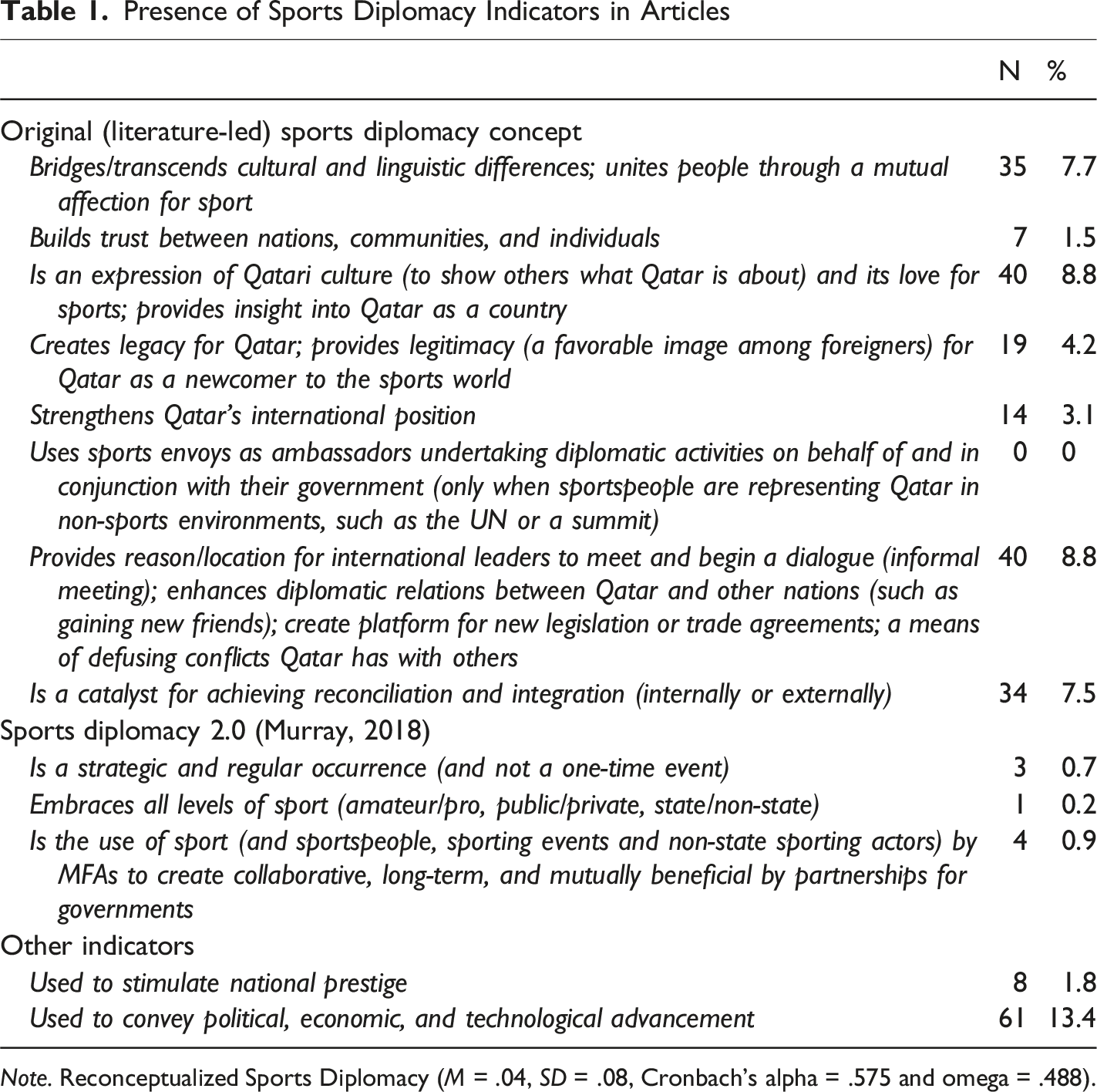
Note. Reconceptualized Sports Diplomacy (M = .04, SD = .08, Cronbach’s alpha = .575 and omega = .488).
Measures
The 27 variables in the codebook were organized in three groups: (1) Story specifications: date, story length (in number of words), outlet, byline (staff, news agency, other media, blog, mix of staff and wire service, external contributor such as professor or expert, and unable to identify), type (journalistic story, opinion piece or editorial, and blog), and focus (whether QWC was the main focus of the story). (2) Sports diplomacy: Frequency of the term sports diplomacy; presence of eight indicators and three indicators for Version 2.0. (3) Sources: Frequency of each of nine source types (athlete/coach; sports; state/political; business/company/NGO; expert such as academic or medical or legal; media/journalist; citizen/fan; anonymous; and other).
Intercoder Reliability
Two graduate students in journalism/communication underwent several hour-long training sessions. Each session was followed by a pre-pilot testing. Once coders were deemed ready, they coded the intercoder reliability sample independently. The intercoder reliability sample of 47 stories, representing 10% of the sample, was selected from the main sample through a systematic sampling approach of every 10th story starting from the first one. The intercoder reliability coefficients using Krippendorff’s alpha for 21 variables (excluding outlet name and date, which were provided in the classification file) were an average of .944, ranging from .81 to 1.0. The remaining four variables (Version 2.0 and ambassadors) were constant, since coders did not find any instance of their presence. For variables whose alpha could not be computed because they were constant, we calculated Holsti’s percentage and achieved 100% agreement on each.
Findings
Descriptives show that all articles in the sample were journalistic news stories (98.9%), with only five opinion pieces or editorials. Their length ranged from 18 to 4784 words, with an average of 613 words and a median of 480. The focus of the majority of the stories was the Qatar World Cup (93.2%). Slightly less than half the stories were written by staff (47.6%), with an additional 25.4% written by a mix of staff and wire service. The byline of a quarter of the stories (24.35%) was other media (such as the New York Times). The remaining 7% came from news agencies and wire services, and 5% from external contributors.
Regarding geographic regions, the biggest number came from Europe (36.2%), followed by North America (25.2%), and South/Southeast Asia (11%). Less common were stories from hosts Qatar (8.6%) and Arab countries (6.6%), with the rest coming from Australia/New Zealand (2.9%), Africa (2.6%), Latin America (2.4%), Non-Arab Middle East (2.2%), FIFA (0.9%), unidentified online ownership (1.3%) and a single story from Azerbaijan.
As for sourcing, the most common were sports officials, who appeared at least once in 47.6% of the news stories, followed by businesspersons (40.8%), state/political sources (38.6%), media (30.7%), athletes/coaches (16.9%), citizens (16.7%), experts (11.2%), anonymous (5.3%), and other (2.2%). The highest number of the same source type to appear in one article was 11 citizens, 8 businesspeople, and 6 state officials, sports officials, and media sources.
Testing Sports Diplomacy as a Construct
Mentions of sports diplomacy indicators were scarce (Table 1), with the most common indicators, “providing insight into the culture” and “serving as a platform for dialogue,” appearing equally in 8.8% of stories. The exact wording, “sports diplomacy” was used only twice in the sample.
To measure sports diplomacy as a construct, we attempted to create a scale by averaging its seven indicators. The low Cronbach alpha coefficient (α = .467) indicated the scale lacked reliability, and therefore, the variables could not be combined. Breaking down each concept into its smaller components—as per the recommendation of Tavakol and Dennick (2011)—which were country image goals, cultural goals, political and diplomatic goals, did little to provide a reliable sub-scale. Alternately, conducting a categorical principal component analysis could not be completed due to the presence of many cases with a 0 value. Important to note here is that although Cronbach’s alpha is an accepted measure of reliability in the social sciences, the field of statistics has criticized its use—mainly due to violations of alpha assumptions that yield smaller estimates, “making measures look less reliable than they actually are” (McNeish, 2018, p. 412). Instead of the alpha, psychometric literature recommends the omega as a more accurate alternative to measure internal consistency of items, pending assumptions are met (see Malkewitz et al., 2023; McDonald, 1978; McNeish, 2018). Still, the debates within statisticians revolving around the conceptualization of reliability, and consequently the positions some take regarding items on vectors and their meanings (Zinbarg et al., 2005), do not reject the use of either measure. Like the alpha, we faced limitations with the omega. Either omega could not be computed, or it gave a low coefficient.
Reconceptualizing Sports Diplomacy?
The low reliability levels of the attempted sports diplomacy scale mean either that the construct has not been conceptualized well in the literature, or that media articles did not cover the Qatar World Cup from a sports diplomacy perspective. To investigate these two possibilities, we engaged with each of these alternatives through an empirical approach.
Assuming the first possibility is indeed the case (i.e., the concept is undertheorized in the literature) and keeping in mind that scale construction is based on theory and data where “the structure of the factors [in the model] is examined, improved, then tested on other data and, if necessary, modified” (Kohring & Matthes, 2007, p. 241), we attempted to reconceptualize sports diplomacy. In addition to relying on conceptualizations in literature, as detailed above, we added Murray's (2018) theorization of Version 2.0, and incorporated elements from the sportswashing literature (Boykoff, 2022), those that align well with the concept of sports diplomacy. Although sportswashing is a negative concept often used as a “pejorative term” to describe controversial actions of political certain regimes outside the West (Skey, 2023, p. 755), its theorization is entangled with that of sports diplomacy due to the common focus on the “manipulation of soft power through sports” (Chen & Doran, 2022, p. 3). Importantly, the concept of soft power also brings about disempowerment, as in the case of Qatar (Brannagan & Giulianotti, 2018), further complicating the relationship between sport, soft power, and diplomacy. As such, sportswashing definitions include some neutral indicators, albeit with underlying negative connotations, such as the two we borrowed from Boykoff (2022): the event is used to stimulate national prestige and is used to convey political, economic, and technological advancement. 2
Our reconceptualized sports diplomacy originally consisted of 13 variables, including Version 2.0. However, we removed the variable “uses sports envoys as ambassadors” because it was constant, ending up with Cronbach’s alpha of .575 and omega of .488 based on 12 items (Table 1). Although the lower than the acceptable alpha value of .7 points to the unsuitability of the variables to form the construct, we went ahead with it for three main reasons. First, the literature in the field of statistics on how these coefficients are interpreted (e.g., Tavakol & Dennick, 2011) indicates there is some wiggle room in our ability to use lower than optimal values versus a complete rejection of the scale based on pure statistical rationale. Second, the fact that some variables in our data were mostly absent suggests that the low alpha/omega values could be the result of too few data points rather than a non-reliable scale. Third, this study is a first attempt to measure a concept many scholars work with, but which surprisingly has not been so far operationalized, raising the problematic possibility that the literature has applied the same label to different constructs—a situation that warrants attention as the field matures and contemplates theory-building. Combining these reasons, we decided to compute the scale and assess its relationship with other variables for exploratory purposes. As we do so, we acknowledge the statistical limitations turned our analysis into an interpretivist exercise, different from the quantitative, generalizable analysis we had expected at the outset—but nonetheless an informative one.
The findings confirmed the rare use of the reconceptualized sports diplomacy construct in the sample (M = .04, SD = .08). Nevertheless, it was positively but weakly correlated with the frequency of the phrase “sports diplomacy,” r(454) = .179, p < .001, suggesting the relationship between the indicators of the construct and the actual usage of the term exists. As for the indicators, the major focus was on Qatar as a country, how the event provided insight into Qatari culture and the people’s love of sports, showed how well advanced the country was in various areas, and equally provided a platform for international leaders to meet, fulfilling political and diplomatic goals.
Next, we examined whether any differences existed in the use of sports diplomacy across the world through an analysis of variance. Considering the cases in each country were too few to yield meaningful results, we grouped USA, UK, Europe, Australia and New Zealand to form Western countries, kept Qatar and FIFA separate as they are, and grouped the rest of the countries (Arab, Middle East, Russia, Latin America, Southeast Asia, and Africa) under the non-Western group, excluding the six online articles that did not disclose their ownership or country of origin. The ANOVA reveals FIFA (M = .17, SD = .22) significantly led Qatar (M = .09, SD = .13), non-Western countries (M = .05, SD = .07), and the West (M = .03, SD = .06), respectively, Welch’s F(3, 13.77) = 3.987, p < .05. LSD post-hoc tests revealed all categories differed significantly from one another.
Lastly, considering the importance of sources in shaping a story, we examined whether any correlations existed between sports diplomacy and the frequency in which each source type appeared. The only significance was in the use of state/political sources that were positively but weakly associated with sports diplomacy, r(454) = .106, p < .05.
Turning to the second possible meaning of the near absence of sports diplomacy indicators in the news, we can conclude from the data that the media did not concern themselves with the World Cup being a tool for diplomacy, covering the events surrounding the tournament as is, without providing additional information that takes it beyond sports. Interestingly, the rare cases when sports diplomacy was present, it was FIFA that pushed that agenda significantly more than all countries, including hosts Qatar. And out of all source types, quoting political or state actors raised the level of sports diplomacy in the news stories. Combined, these findings point to the active role FIFA and political actors played in ensuring their efforts in showing how sports can be used a tool for diplomacy are not wasted. It seems more than Qatari media, FIFA was keen on linking the World Cup to diplomacy, perhaps to salvage its image that had been tainted since the corruption allegations and indictments rocked the world’s wealthiest international sporting organization in 2011 (Al Jazeera, 2015). Qatari media, as well, highlighted the value of the World Cup beyond sports through the use of various sports diplomacy indicators.
Yet a third probable reason could be that the framing, if any, happened before our sampling period. It is possible that world media exhausted their efforts into showing how sports can be used for diplomacy during the first few years following the announcement of the hosting rights, but closer to the tournament, they turned their attention to the sports events themselves.
Discussion
The importance of developing standardized measurement tools that enable the replicability of findings cannot be overstated, as it facilitates systematic advancement of knowledge in any field. This article presents a systematic, theory-driven attempt to move from the well-theorized concept of sports diplomacy to an operational definition that allows it to be measured empirically, for the purpose of theory-building in the maturing fields of sports communication and sports diplomacy studies. A second goal was to assess the extent to which the ideas and practices of sports diplomacy, as reflected by the 12 indicators of its operational definition, were present in the international coverage of the FIFA World Cup 2022 Qatar in the year leading up to the mega-event’s official start date.
The outcome of this exercise provides a hopeful but cautious outlook for the future of this important endeavor. Although our attempt to create a measure using traditional definitions of sports diplomacy did not produce a reliable scale, there was promising progress once we reconceptualized the construct to include elements of Murray’ s (2018) Sports Diplomacy 2.0 formulation, which led to a scale that approached reliability and performed better than the original, but still didn’t reach the desired statistical coefficients. Approaching reliability is a good starting point that we hope encourages other researchers to further test and refine the scale on larger samples and different major events, in line with scale construction literature (e. g., Clark & Watson, 1995; Kohring & Matthes, 2007).
Furthermore, the progress observed after incorporating contemporaneous indicators of sports diplomacy into the original scale suggests that future efforts to operationalize the sports diplomacy concept should focus on developing a more comprehensive initial list of potential indicators, this time by combining deductive and inductive methods. Specifically, enhancing deductive insights (as in the current approach) with inductive, data-driven insights may allow researchers to identify sports diplomacy indicators that have been overlooked here. Machine learning methods like topic modeling might prove to be especially useful for developing a large initial pool of sports diplomacy indicators. A large initial pool is critical for concepts best measured with multi-dimensional scales, which might be the case of sports diplomacy. Indeed, our findings suggest that constructing a multi-dimensional measure, rather than insisting on just one latent factor, may be the correct way to approach operationalizing sports diplomacy.
Data from one year of media coverage showed that the maturity of the concept of sports diplomacy in scholarship was not reflected in media accounts of the mega event. The low occurrence of the 12 indicators suggests that sports diplomacy wasn’t a relevant angle for how international media outlets and bloggers approached the Qatar FIFA World Cup 2022. Nevertheless, the lack of co-occurrence of indicators even in stories when one indicator was present should not be seen necessarily as undermining the 12-indicator conceptualization, but rather as evidence that in pre-event media coverage, those facets of sports diplomacy may not co-occur at the level of single stories. Prior to the event, the media likely prioritized logistical aspects and immediate controversies, underrepresenting larger goals and outcomes that only become apparent post-event. As the literature warns, “specific content must result from a careful diagnosis and strategic analysis of sport diplomacy in each country” (dos Santos, 2024, p. 665).
It may be the case that the concept we label “sports diplomacy” is not only multidimensional but also context-contingent, therefore expecting media to reflect multiple of its facets at the article level is misguided. If so, researchers interested in public discursive aspects of sports diplomacy may need to shift the unit of analysis upwards to a corpus of texts or to the communication flows of interested actors, such as FIFA communication or government communication, rather than examine media discourse alone. This idea is supported by our findings that revealed the sports diplomacy frame was present in the coverage almost exclusively when institutional actors advanced it. While most of the pre-event coverage used other frames, when the sports diplomacy concept was used, it disproportionately highlighted FIFA and political elites.
Arguably, ignoring the sports diplomacy angle when covering mega events that are widely recognized tools of sports diplomacy, such as the FIFA World Cup, is problematic given the role that media play in society. If we are to subscribe to the notion that media do exercise some power and have some effects on the public, as hundreds of studies have shown, then we need to think deeper about how well the media told the story of the Qatar World Cup. Indeed, there was a missed opportunity for newsrooms to reveal to the public the interconnectivity between sports, politics and policy, and particularly how political agendas shape sports governance and legacy, on the one hand, as well as how mega sports events shape political reality, on the other hand.
On the flip side, the concept of sports diplomacy in relation to the World Cup might be nothing more than an abstract concept the state of Qatar and FIFA strived to make part of their narrative. Looking at it from this perspective begs the question of whether face validity, embodied in the media’s limited demonstration of sports diplomacy, is enough and that the complex theorizations in scholarship do not well reflect public discourse. Our counterargument as media scholars would however dismiss this thought as premature considering a concept needs to be developed further methodologically and tested for construct validity and reliability in several iterations before it is deemed ready for replication (Clark & Watson, 1995).
Interpreting the results through the lens of social constructivism provides an interesting explanation for why media coverage did not reflect the concept of sports diplomacy. For decades, research has shown that the media do not reflect reality; rather, the news is a “realitymaking activity” (Lester, 1980, p. 984) a socially constructed representation of reality (Lawrence, 2000; Molotch & Lester, 1974; Tuchman, 1978). Journalists, after all, decide what is news through promoting one newsworthy event over another and communicating these choices through publishing the news story (Barnhurst & Mutz, 1997). Hence, the discourse of constructivism is useful to accept journalistic stories as products of what journalists observe, which is far from the realist idea of journalistic objectivity (Poerksen, 2008). In conclusion, the vast rift we observed between sport diplomacy scholarship and journalistic products suggests the field of sports journalism is out of tune with scholarship, much like the broader discipline of journalism (Wunderlich et al., 2025) and the sports diplomacy discipline is not much aware of current journalistic practices of reporting on sports mega events.
Lastly, we turn to the limitations of the study, which we have outlined in detail throughout the discussion. The main limitation is related to the statistical issues we faced with achieving scale reliability. Another limitation is relying on data from the year prior to the event. As previously suggested, we encourage scholars to refine the construct of sports diplomacy by using a variety of conceptual and methodological measures and testing their applicability on different datasets and events to move us closer toward building theory.
Footnotes
Acknowledgements
The authors would like to thank the two graduate students J. E. A. and N. S. for their assistance in data collection and the university statistician J. W. for her consult.

Funding
The authors disclosed receipt of the following financial support for the research, authorship, and/or publication of this article: This work was supported by the NU-Q Dean’s Seed Fund; Open Access funding is provided by the Qatar National Library.
Declaration of conflicting interests
The authors declared no potential conflicts of interest with respect to the research, authorship, and/or publication of this article.
Data Availability Statement
The data for this study are available upon request.