




Abstract
Social media is a central arena for the articulation of values, shaping what people around the world deem important and desirable. However, traditional value typologies struggle to capture the dynamic nature of value expression in digital spheres and overlook new communication-related values prevalent in these environments. Addressing these gaps, we developed an analytical framework for investigating value expression on social media, comprising three general value orientations (Do well, Do good, and Feel good) and four communicative value orientations (Inform, Influence, Bond, and Express). We drew on extensive cross-national research to construct the framework and examined its utility through a study of TikTok videos related to the FIFA World Cup in Qatar. Our analysis shows how value orientations enable the identification of patterns that underpin complex discourses. Ultimately, our framework offers a pathway to understand what people present as valuable on social media, as well as the broader value ecosystem platforms cultivate.
Values are fundamental to being human. In every civilization throughout history, people have decided on principles worth acting upon, working toward, and even dying for. The relationship between values and society is cyclical: values shape thoughts, actions, and social structures, which shape values in return. While myriad values exist within every culture, understanding and theorizing their dynamics across diverse contexts requires higher-order categorization. Indeed, the quest to create value typologies has been an enduring pursuit in the social sciences and humanities, leading to the development of three seminal value classifications, widely cited and applied to diverse cultural and political settings (Hofstede, 2003 [1984]; Inglehart and Welzel, 2005 [2004]; Schwartz, 1992).
The rise of social media poses a challenge to these influential frameworks. Like other forms of human interaction, communication on social media is value-laden. Every YouTube video, Facebook post, and Instagram photo signals what users care about (Gillespie, 2018), amounting to a value ecology significant to the lives of billions. However, when we try to apply established typologies to social media content, two main problems emerge. First, existing classifications position values as either inherently compatible or oppositional and thus fail to capture the messiness of expression in digital spheres. Second, these theories overlook the pivotal role that values related to communication, such as authenticity, sharing, and transparency, play on social media.
Addressing these gaps, we constructed an analytical framework that facilitates a systematic yet sensitive investigation of value expression on social media. Our endeavor unfolds in three major parts, the first of which focuses on the analytical framework. After outlining the limitations of applying seminal value typologies to social media content, we delve into three bodies of scholarship on “good communication” that date back to Aristotle’s writings on rhetoric. Next, we detail how we compiled and categorized a comprehensive list of values pertinent to transnational social media content to develop our analytical framework. The framework features a new higher-level construct—“value orientation”—which we developed to designate the overarching purpose that specific values advance through discourse. We identified three general value orientations (Do well, Do good, and Feel good), and four communicative value orientations (Inform, Influence, Bond, and Express).
The second part demonstrates the utility of our framework through the case study of popular TikTok videos pertaining to the FIFA World Cup Qatar 2022. Major international sports events constitute rich sites for examining value expression, as they feature organized competition between national groups that open “up a series of major ideological differences to the international public gaze” (Miller et al., 2001: 3). The 2022 Qatar World Cup was an especially intriguing case (Brannagan et al., 2023; Dun et al., 2022), as the event was clouded long before kickoff by major controversies surrounding worker’s rights, LGBTQ acceptance, and East-West relations writ large. We focused on TikTok as a vibrant site with diverse audio-visual material, showing how our framework enables the identification of patterns within the complex discourse surrounding the games.
In the article’s concluding section, we highlight the contributions of the framework, focusing on the nature of its primary components, its double-layered structure examining both specific values and broad value orientations, and the patterns of expression linked to value orientations. We suggest that future comparative studies could apply our framework to expose the conditions under which certain alliances between values and value orientations emerge, ultimately leading to a new theory of value expression on social media.
The promises and perils of value classifications
Like most complex concepts, the meaning of “value” varies within and between disciplines (Rohan, 2000). In a broad sense, values are core beliefs about the desirable that guide social actors’ behaviors, evaluations, and justifications (Schwartz, 2012). As such, values navigate two complicating factors. First, they are located between individuals and collectives. While values can be viewed as personal principles, they are never formulated in a void. Cultural constellations such as nationality, class, and religion fundamentally shape the creation and negotiation of values. As such, there is a close connection between values and ideologies, conceptualized as sets of beliefs that link values with specific interpretations of the social world (Oliver and Johnston, 2005). Second, while values have been defined as abstract perceptions, their existence depends on dissemination through words, texts, and behavior—in short, on communication.
Studies of personal values focus on individuals’ motivations. Shalom Schwartz’s (1992) influential work in this area yielded a model of ten “basic human values”: power, achievement, hedonism, stimulation, self-direction, universalism, benevolence, tradition, conformity, and security (further expanded into a 19-value model (Schwartz, 2012)). Each value is located on two axes: openness to change versus conservation and self-enhancement versus self-transcendence. Within this structure, some values conflict (e.g., seeking personal power is negatively associated with benevolence), and others are compatible (e.g., individuals who score high on conformity also value security). While the model’s reliance on universally validated values fosters robust cross-cultural comparisons, it is limited by the exclusion of locally relevant values that are interpreted differently across contexts (see Sagiv and Roccas, 2017).
A tradition of work on cultural values, or the values particular to collectives, has been developing since the 1980s. Geert Hofstede’s (2003 [1984]) milestone transnational study of IBM employees organized values into six “cultural dimensions”: power distance, individualism versus collectivism, masculinity versus femininity, uncertainty avoidance, long-term versus short-term orientation, and indulgence versus restraint. According to Hofstede, attitudes toward these six axes explain cultural differences. The extensive research influenced by this theory demonstrates both the model’s strengths and some of its shortcomings, with critics pointing to its essentialist understanding of culture (Macfadyen, 2011) and highlighting the need to augment the model with additional values and contextual information (Kirkman et al., 2006).
The political scientist Ronald Inglehart (1990) conducted a similarly ambitious effort to map values cross-nationally and investigate the broad sociopolitical implications of value change (Inglehart and Welzel, 2005 [2004]). His studies generated two main axes for comparing values: survival versus self-expression and traditional versus secular. Inglehart’s analysis identifies a correlation between economic development and an intergenerational shift from materialist survival values (order, economic security, and conformity) toward postmaterialist values of self-expression (participation, individual freedom, and personal autonomy). This model has been applied to diverse issues relating to the public sphere, including diplomacy (Sheafer et al., 2013) and environmental attitudes (Manfredo et al., 2003).
The rise of social media poses several challenges to these highly influential value categorizations. First, digital platforms represent new arenas of “socially mediated publicness” (Baym and boyd, 2012) and “vernacular creativity” (Burgess, 2006) where individual and collective values and identities are co-constructed through mundane interactions. Hence, new media environments call for a shift from examining the perception of values via surveys to their expression and negotiation via the analysis of mediated text. Based on this premise, we follow a strand of sociological research that looks at values as discursive constructs expressed and debated in particular social, cultural, and technological contexts (Heinich, 2020; Lamont, 2012). The discursive formulation of values reflects ideological stances, with social actors ascribing different meanings to similar values. For example, capitalistic and feminist discourses may, respectively, frame “freedom” as “freedom of the market” and “freedom from oppression” (Van Dijk, 1998).
Second, examining content on social media challenges existing perceptions about the relationships between values. Indeed, values that previous research has conceptualized as conflicting, such as survival and self-expression or individualism and collectivism, are intertwined in user-generated genres like cue card confessions about sexual harassment (Shifman, 2016). Thus, analyzing social media requires an approach that acknowledges the multifaceted nature of value expression.
Finally, while studies based on the theories of Schwartz, Hofstede, and Inglehart typically use lists of values developed in the late 20th century, the detection of values in social media requires an inductive approach to account for values that have emerged as central in the last decades. These include “communicative values” (Shifman, 2019), broadly defined as normative ideals about how we should communicate with others.
Mapping communicative values
Questions about good communication have occupied scholars for centuries, long before the establishment of the discipline. The divergent answers to this query reflect different understandings of the “good,” grounded in notions of effectiveness, morality, or well-being. Reflecting this diversity, we suggest that the extensive bodies of knowledge on “good communication” can be classified into three main approaches: instrumental, ethical, and interpersonal. Although the approaches emerged at different points in history, they remain highly relevant to contemporary research on social media platforms.
An instrumental conceptualization of “good” communication has effectiveness as the main evaluative parameter. This strand of thought can be traced back to the three pillars of persuasion in Aristotle’s “rhetorical triangle” (in Demirdöğen, 2010), famously distinguishing between logos (persuasion through proof or logic), ethos (persuasion through the credibility of the speaker), and pathos (persuasion through emotional appeal). Millennia later, this model continues to inform literature on advertising, everyday life, and political persuasion (Kuchel and Rowland, 2023; Talaue, 2022). Effective persuasion is also a central concern in digital spheres, as epitomized by the figure of the influencer who seeks to convince other users to follow them and purchase the products they advertise (Abidin, 2018), as well as the widespread use of social media platforms for electoral campaigning (Vaccari, 2013).
In contrast to this instrumental focus, the body of knowledge concerned with “communication ethics” explores the use of communication to promote the common good. As explained by Lipari (2017), “Communication ethics concerns the creation and evaluation of goodness in all aspects and manifestations of communicative interaction.” Thus, “good communication” is one that “does good” in the world. Championed by key figures such as John Dewey (1927) and Jürgen Habermas (1989), scholars adopting this perspective investigate how communication can enhance democratic structures, facilitate a just distribution of societal power, build trust between individuals and groups, and increase the visibility of minority groups. The ethical connection between “good communication” and societal benefit is evident in diverse strands of research on social media, exploring, for example, the negative effects of online misinformation (Grohmann and Ong, 2024) or the merits of incorporating ethical considerations in the design of digital interfaces (Flanagan et al., 2008).
The last body of knowledge that focuses on “good communication” relates to its constitutive role in interpersonal relationships and personal well-being. Emerging in the second half of the 20th century as part of the “communication culture” turn (Cameron, 2000; Katriel and Philipsen, 1981), this strand reflects on the rise of meta-discourse depicting communication itself as fundamental to self-realization, bonding, and professional success. Such studies focus, for example, on the “communication industry,” a new class of professionals that train people to communicate better (Fialkoff and Pinchevski, 2021). The perception of communication as intrinsic to sociality and well-being has been highlighted in multiple studies on social media: for example, John’s (2016) work on “sharing” as a keyword that social media parent companies widely used to capitalize on the disclosure of personal information, Meier et al.’s (2020) investigation of the positive “inspirational” effects of upward comparison with others on Instagram, or Abidin and Zeng’s (2020) ethnographic study of the East Asian diaspora’s use of Facebook groups to cope with anti-Asian hate in the wake of the Covid-19 pandemic.
While the three aforementioned perceptions of “good communication” are highly relevant to social media, they were crafted long before their emergence. As such, they may not fully capture communicative values endemic to digital environments, such as connectivity (Van Dijck, 2013) and authenticity (Cunningham and Craig, 2019; Marwick, 2016). Studies that explore these new communicative values often focus on one or two values and do not take a holistic approach to mapping them, a gap we aim to fill in the current study.
An analytical framework of value orientations on social media
In response to social media’s challenges to existing value typologies and the lack of an integrative account of communicative values in these spheres, we developed a new framework to facilitate a systematic yet sensitive investigation of value expression on social media. To do so, we combined bottom-up and top-down approaches in two interlinked stages:
Stage 1: generating a comprehensive list of values expressed on social media
We developed our framework in the context of an ongoing large-scale project on the expression of values on social media (see Hallinan et al., 2022; Trillò et al., 2023). In the previous stages of this project, we created a comprehensive list of values based on three main sources:
1. Existing literature: We generated a list of the values invoked in general value theories (Hofstede, 2003 [1984]; Schwartz, 2012) and the detailed value lexicon from Christen et al. (2016), which features 78 groups of value-related terms cross-linguistically applicable to English and German.
2. Users: We conducted 100 in-depth interviews with social media users from five countries (Japan, South Korea, the United States, Germany, and Italy), featuring diverse age groups and a balanced gender composition. During the interviews, we showed users popular social media genres (e.g., beauty tutorials, family photos) and asked them to name three values they associated with the content. We then analyzed over 1100 values invoked by the interviewees in a series of meetings, inductively bundling them into 60 higher-level value categories (e.g., combining “altruism,” “kindness,” and “helpfulness” into “care for others”).
3. Social media content: In a series of studies (e.g., Hallinan et al., 2021; Trillò et al., 2022; Trillò, 2023), we analyzed social media content (e.g., photos, videos, and Tweets) in five languages spanning genres such as protest photos, review videos, good morning memes, and mom vlogs. In these studies, we relied on the abovementioned value lists as the main analytical tools, occasionally adding new values that emerged inductively.
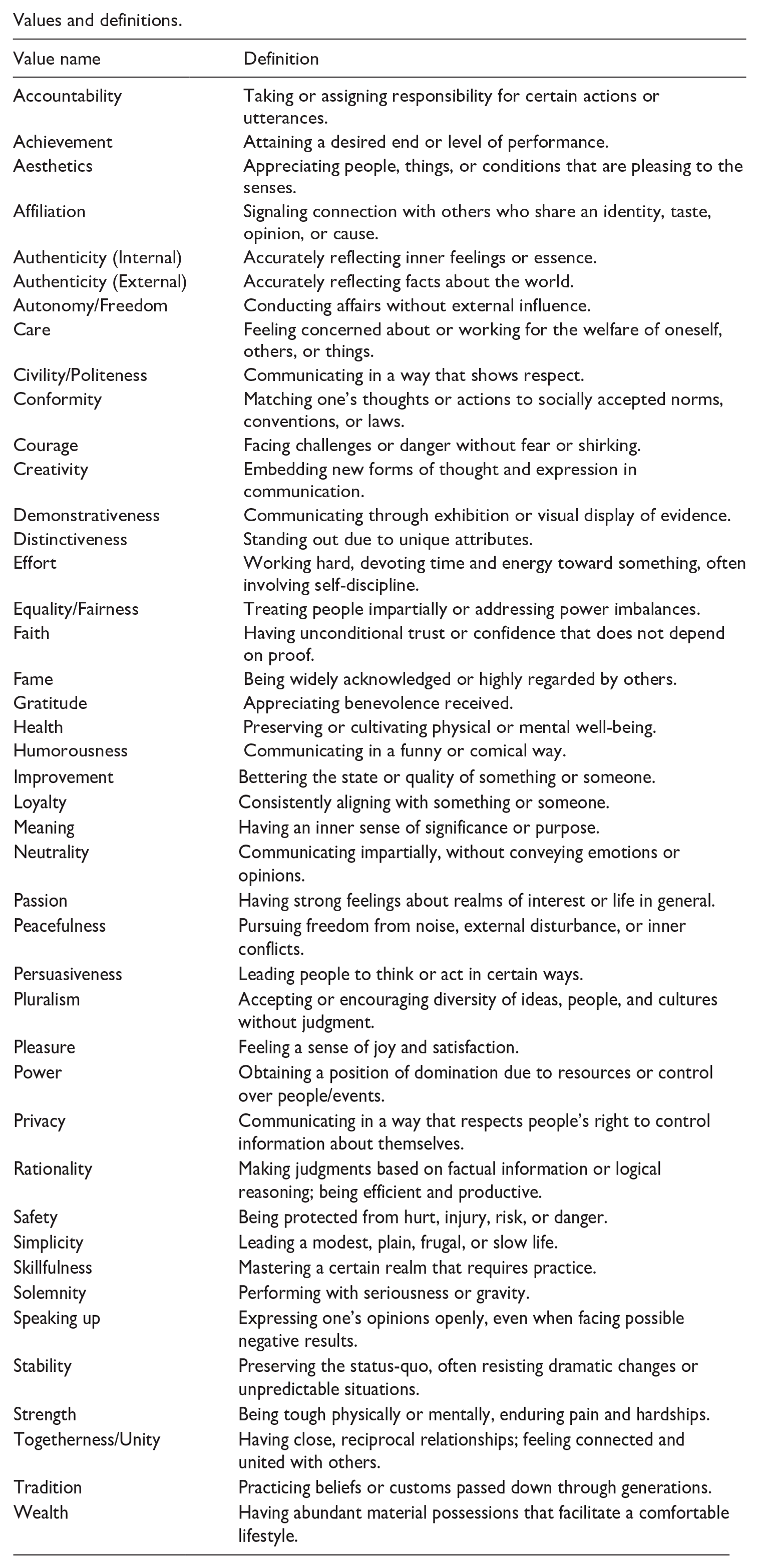
Our research team, composed of members from Western Europe, the Middle East, East Asia, and North America, sorted the values generated through these diverse methods in a series of meetings. We systematically evaluated the uniqueness of each value in comparison to others and developed cross-culturally salient labels and descriptions. For example, reflecting on the Japanese Kanji character 美 (bi), which embodies “beauty” and “aesthetics,” we merged these two value terms into a single category, recognizing their interconnected nature. This process led to a list of 43 general and communicative values informing the analysis of the current paper (see Appendix 1).
Stage 2: creating an analytical framework of value orientations
To develop our analytical framework, we followed modified principles of the grounded theory approach (see Kelle, 2007). At the initial stage, we aimed to build higher-order categories to classify the values in our list. We followed the practice of constant comparison: an iterative process of abstract classification that weighs concepts against each other, the literature, and the data (Biaggi and Wa-Mbaleka, 2018). We thus compared the values on our list with the main classifications of values and theories on “good communication” surveyed above, seeking to detect overarching features that allow for meaningful distinctions between them. During this process, we identified new categories and re-labeled old ones, resulting in three higher-order general categories (Do well, Do good, and Feel good), and four higher-order communicative ones (Inform, Influence, Bond, and Express).
The conceptualization of these higher-order categories as “value orientations” to which specific values are “tightly” and “loosely” anchored (detailed below), emerged during the ongoing discussion among the members of our research group. By “value orientation,” we refer to the overarching purpose that values advance within a discursive sphere. Orientations are thus ascriptive rather than descriptive terms, broad goals underlying collective and individual pursuits that energize the expression of specific values.
An exercise of individual coding in which we tried to neatly sort all of the values from our list into the identified higher-order value orientations revealed that the relations between them are dynamic and nonexclusive. On one hand, team members were unanimous about the association between some values and orientations, for example, locating “achievement” and “wealth” in the category of Doing well. On the other hand, members pointed out the complexity of values such as “freedom,” “aesthetics,” or “health,” which can be associated with several orientations depending on how they are invoked. Thus, our framework moves away from mutually exclusive associations between values and overarching categories, proposing a context-sensitive approach to interpreting value expression.
The framework: general and communicative value orientations
Our proposed analytical framework comprises three general value orientations (Do well, Do good, and Feel good) and four communicative value orientations (Inform, Influence, Bond, and Express (see Figure 1)). The relationship between specific values and value orientations falls on a spectrum of tightly to loosely anchored values. At the tightly anchored end, we locate values that are conventionally close to one of the orientations—for example, caring for others is often used almost synonymously with Doing good. At the other end of the spectrum, loosely anchored values lack strong conventional associations with specific orientations. In these cases, the positioning of a value vis-à-vis an orientation relies more strongly on its particular discursive framing. For example, the value of freedom might be framed as contributing to social justice (Do good) or personal satisfaction (Feel good). Unlike the relatively stable meaning of specific values within established ideologies (e.g., a capitalist interpretation of freedom), the relationship between values and value orientations is more dynamic. Furthermore, value orientations are broader than ideologies, concerned with deeply rooted motivations rather than particular interpretations of the world.
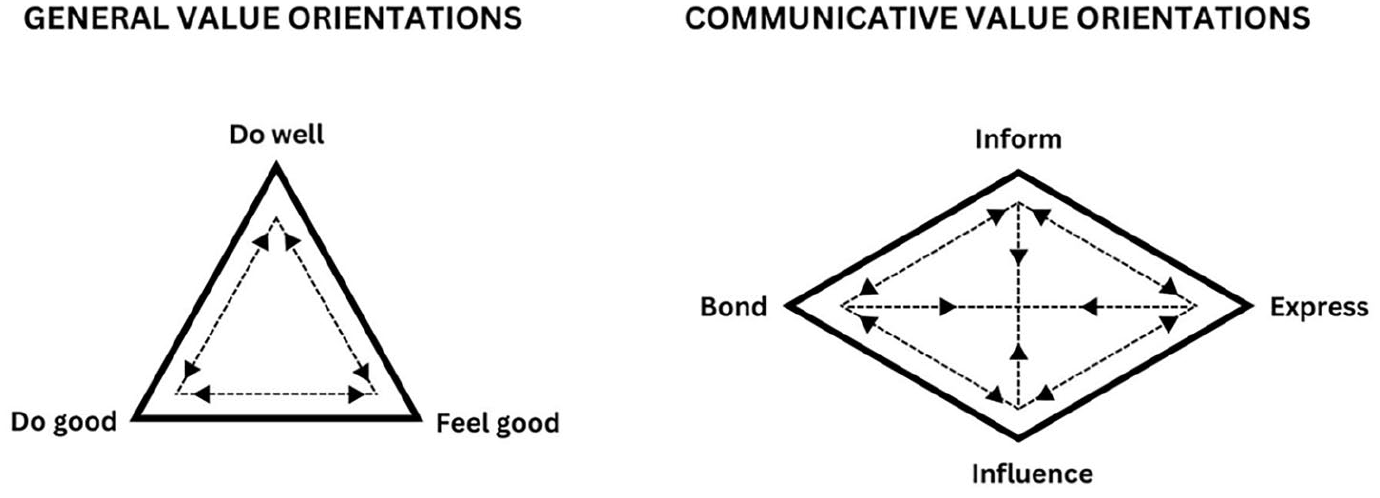
An analytical framework of value orientations on social media. The bidirectional arrows reflect possible flows between value orientations, as each orientation can be framed as leading to others.
General value orientations
Aspirations to do well, do good, and feel good are probably as old as humanity. A plethora of evidence demonstrates the multitude of ways people have strived to achieve personal success, help each other, and enjoy their lives. Yet, the history of defining these domains as values—in the sense of principles that should guide actions and evaluations—reflects dynamic sociocultural configurations. In what follows, we first present these orientations and then situate them in relation to existing value theories and historical contexts.
Do well
Succeeding according to societal standards. Such standards vary between cultures yet consistently set a bar against which individual performance is measured. Values tightly anchored to this orientation include wealth, achievement, fame, power, and skillfulness. These values embody different ambitions: a desire for achievement, for instance, is not necessarily accompanied by the valuation of wealth, even as they share an underlying orientation toward success.
Do good
Contributing to the benefit of others. We frame the notion of “being helpful” in the broadest sense, as the domains of assistance vary greatly in scale and scope. This elasticity can be readily illustrated through the value of loyalty, where one can be loyal to a spouse, a football club, or a nation. In addition, the specific values associated with this orientation may express contrasting political stances—doing good can be geared toward social change or embedded in efforts to preserve traditions. The complexity of this orientation is reflected in the values tightly anchored to it, which include more consensual values long associated with human virtues (e.g., loyalty and care), as well as values at the heart of heated political debates (e.g., fairness and pluralism).
Feel good
Obtaining an internal sense of satisfaction or well-being. Values tightly anchored to this orientation include pleasure, happiness, and passion. While feeling good is probably the most coherent value orientation, diverse values are loosely anchored to it in everyday communication, reflecting various routes to achieving satisfaction. For example, people might frame having a sense of purpose or the satisfaction yielded through aesthetics as forms of feeling good.
Communicative value orientations
The four basic communicative value orientations relate to the question of “good communication,” namely, desirable modes of interacting with others.
Inform
Conveying information or knowledge. This orientation can be tied to values such as external authenticity (referring to a truthful account of the world (Shifman, 2018)) or demonstration (communication through a visual display of evidence (Trillò et al., 2022)).
Influence
Creating change by affecting social actors. The value of persuasion (defined more narrowly as directly leading people to think or act in certain ways) is tightly anchored to this orientation, yet other communicative values could be associated with it in specific contexts. For example, external authenticity might be invoked as a tool for augmenting influence.
Bond
Creating and maintaining social relationships. This orientation includes values that are associated with strengthening connections and/or reducing the potential for broken ties. Thus, the communicative value of affiliation cultivates connections through markers such as nicknames or group symbols, while the communicative value of civility mitigates social divides based on the assumption that politeness is necessary to maintain social harmony.
Express
Displaying personal or collective feelings, thoughts, and characteristics. Values associated with this orientation include creativity, humor, and passion. In addition, this orientation is closely related to the value of “internal authenticity” (Shifman, 2018), which focuses on the correspondence between communication and a person’s inner essence (simply put, the imperative to be “true to yourself” when communicating).
Positioning the analytical framework vis-à-vis existing typologies
The three general value orientations featured in our model both resonate with and veer away from existing value classifications. Schwartz’s typology is the closest to our framework, as the Do well and Do good orientations partially overlap with his distinction between “self-enhancing” and “self-transcending” values. However, Do good captures both the “openness to change” and “preservation” dimensions of Schwartz’s model. Furthermore, the Feel good orientation is central to our framework, while Schwartz’s model subordinates it to the higher-level category of “openness to change.”
This difference arguably stems from our object of analysis: expression on social media. While charting a history of value orientations is beyond the scope of this article, Do good values have been widely acknowledged as “moral” across contexts. Our framework, however, suggests that Do well and Feel good are equally important when examining digital content. The centrality of Do well reflects a broader societal trend where individuals are encouraged to invest in their human capital (Weidner, 2009) and publicly compare their progress via applications with social metrics (Neff and Nafus, 2016). Relatedly, the emphasis on Feel good reflects the attitude of unconditional positivity and self-love originally promoted by the self-help industry and popularized on social media as a strategy to overcome structural issues such as unrealistic body standards or the decline of real wages (Gill and Orgad, 2015). It also relates to the role of sensory pleasure and impulse gratification characterizing consumer culture (Campbell, 1994), as well as the frequent use of “well-being” as a marketing strategy (Ayachi and Jallouli, 2022).
A similar blend of continuity and change can be found regarding communicative values. The Influence orientation is close to the veteran instrumental approach toward communication, and both Bond and Express can be evaluated as manifestations of the interpersonal strand mentioned above. While the “ethical” trajectory is not reflected directly in our model, we anticipate that it comes up in real-world discussions about truthfulness, which are closely related to the communicative orientation of Inform, or in discussions about social impact, which echo the Influence orientation. Given the context of its creation, the close connection between two of our communicative value orientations and the perception of communication as fostering social relationships and personal well-being is not coincidental. Connecting with others and expressing oneself have been considered core elements of social media since its inception (boyd and Ellison, 2007), ingrained in the infrastructure of various platforms and highlighted in popular corporate slogans such as “Broadcast Yourself” (YouTube) or “More Together” (Facebook).
Connecting communicative and general value orientations
While we have thus far treated communicative and general orientations as separate entities, in this section we discuss possible associations between them. Broadly speaking, we argue that general value orientations represent higher-order categories since communicative values may be framed as pathways to enact them. However, we also contend that the relationship between communicative and general orientations is shaped through discursive framings and therefore cannot be determined in the abstract. In what follows, we propose a range of potential connections between these two orientation types based on the above-surveyed literature on “good communication” and its application to social media.
Table 1 outlines different ways communicative orientations—Inform, Express, Bond, and Influence—can serve the broader goals of Doing good, Doing well, or Feeling good. As the table demonstrates, each communicative orientation can potentially serve all three general orientations. For example, informing can be framed as improving society through knowledge, giving individuals or groups a competitive edge, or providing pleasure. Expressing can involve speaking up to reveal injustices, building a personal brand in competitive environments, or deriving pleasure from self-expression. Bonding may serve the greater good by fostering social cohesion and harmony, contribute to personal or collective success by leveraging unity, or generate warm feelings of belonging. Finally, influencing can involve activism aimed at improving the world, persuading others for personal benefit, and even the pleasure derived from affecting others through trolling.
Possible framings of communicative orientations as serving general orientations.

Applying the framework: the 2022 FIFA World Cup on TikTok
Having developed our analytical framework, we sought to evaluate its utility with new data likely to reflect a broad spectrum of values. Social media expression around the 2022 FIFA World Cup in Qatar provided an ideal case for this purpose, for three main reasons. First, sports are “probably the most universal aspect of popular culture” that “crosses languages and countries to captivate spectators and participants” (Miller et al., 2001: 1), making them a central arena for constructing and negotiating values (Brownell and Besnier, 2019). Major international sporting events like the FIFA World Cup add a layer of complexity, introducing contestation over national and cultural values (Brownell and Besnier, 2019; Miller et al., 2001). Second, communication about sports “functions to promote social and cultural values” (Kassing et al., 2004: 359), since fans create interpretive communities online where they assign meaning to the games and negotiate their identity (Billings et al., 2017; Sanderson and Kassing, 2014). Research into the online discourse surrounding previous World Cups demonstrates the analytic richness of these exchanges (e.g. Kim et al., 2015; Toffoletti et al., 2021). Finally, the 2022 FIFA World Cup was particularly contentious, as it sparked international disputes over migrant workers’ rights, LGBTQ visibility, and the power dynamics between the East and the West (Dubinsky, 2024). Rather than take a side in these debates, we explored whether our value orientations could be detected in a new context and if they provide effective tools to gain new insights into specific discussions. Upon an initial exploration of content on popular platforms, it was evident that TikTok contained an abundance of relevant and diverse audio-visual material. Consequently, we decided to focus our investigation on this platform.
Methods
We utilized the Zeeschuimer Firefox extension (Peeters, 2024) to construct data sets based on three TikTok browsing sessions. In our initial search, we employed the general terms “World Cup 2022” and “Qatar,” resulting in a data set of 299 entries. Subsequently, we sorted this data set based on likes and screened the top videos (above 200,000 likes), excluding ones not in English or unrelated to the World Cup. Given that the videos from the initial search seldom delved into the debates surrounding the tournament, we expanded our search by adding two terms highly associated with these debates—“human rights” and “LGBTQ.” The list generated from these searches yielded 144 videos, which we again sorted by likes and screened for relevance. Since we aimed to examine the utility of our model through an in-depth analysis of a small sample, we selected the top 50 videos generated by these two rounds of searches.
The article’s first three authors proceeded to analyze the data in accordance with our framework, assisted by a detailed value codebook developed by our multinational team (available upon request). The codebook features definitions for 43 values identified in our previous studies (see Appendix 1) as well as value-specific lists of potential verbal, visual, and audial cues, refined to account for the subject matter and platform of our case study. For example, the value of “wealth” can be signified through direct verbal endorsement or through a photo of a luxury car, while “authenticity” can be signified through a person criticizing dishonesty or shaky-amateurish footage. Given the complexity of identifying value-related cues in audiovisual texts, the coding process adhered to the principles of consensual qualitative research (Hill et al., 1997), a method that enables the analysis of complex texts in a robust and sensitive manner.
The first two stages of coding were conducted independently by the three coders:
1. For each video, coders identified verbal, visual, or audial “value cues,” defined as communicative signals that convey information about what people find desirable. Following the protocols established in earlier stages of our project, the coders leveraged the definitions in our codebook to assign a value for each of the identified value cues. Verbal cues include spoken or written utterances signifying support of values, for example: “It is important to stand up for your beliefs,” (speaking up) or “Wow, what an epic win!” (achievement). Visual cues include signifiers such as people smiling (happiness), trophies (achievement), traditional dresses (tradition), or luxury shopping centers (wealth). Finally, audial cues include signals such as sound tracks of laughter and upbeat music (pleasure). In this process, the same cue can be affiliated with two or more values; for example, a coordinated dance could be coded for both “skillfulness” and “aesthetics.” Given the more open-to-interpretation nature of visual and audial cues, we only included cues in the codebook when our multinational team reached full agreement on their connection to specific values. When further cues were identified in the inductive coding process, we marked them and discussed their possible interpretations in stage 3, incorporating them into the final analysis if and when full consensus was reached.
2. In the second stage, we coded for the association between each value identified in the previous stage with one of the seven broader value orientations. We coded for value orientations in two cases: when a value was presented as equivalent to an orientation or when featured as leading to the fulfillment of a higher purpose. An example of the former is a trophy that signified “achievement,” which is equivalent to Doing well. An example of the latter is a woman stating that wearing a hijab makes her happy, in which the value of tradition is framed as leading to Feeling good.
Once all the videos were coded individually, the coders met and worked together on three further stages:
3. In accordance with the protocols of consensual qualitative research, the coders engaged in thorough discussions to resolve any disagreements.
4. The coded data set was further analyzed to look for possible patterns of association between communicative and general value orientations. For this aim, we reviewed all instances in which the same cue was coded for both communicative and general values (n = 23) and evaluated whether the former was invoked in service of the latter.
5. Finally, we reviewed the assigned value orientations holistically, looking for recurrent combinations between them. In this process, we identified four types of videos featuring particular combinations of orientations (see the findings section). Our analysis revealed robust patterns in the corpus, with over 80% of the videos falling into our four identified categories. A further review of 20 additional videos sampled randomly did not yield new categories, leading us to conclude that we had reached what Saunders et al. (2018) label “inductive thematic saturation.” We thus based our analysis on the coding of the 50 videos sampled in the initial round.
Findings: values at play in the Qatar World Cup
The analysis revealed that all value orientations were relevant to this data set; at least two orientations were detected in each video and many videos incorporated more. As noted above, we identified four types of videos featuring distinct configurations of value orientations, visualized in Figure 2.
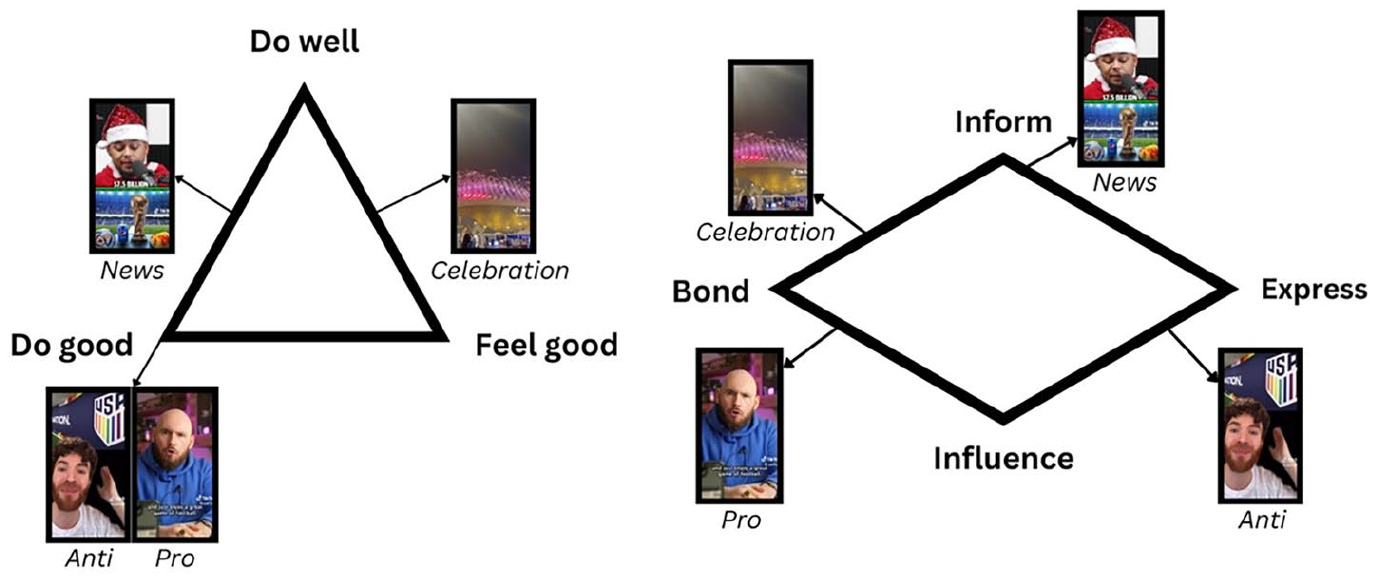
Video types positioned in relation to general and communicative orientations.
The first type of video, which we dub “Celebrations,” includes footage of the games and ceremonial events accompanied by upbeat music. These extremely popular videos feature ecstatic players, coordinated dancers, spectacular fireworks, and stunning stadiums. The ceremonies make frequent references to Qatari traditions and leverage the visual appeal of performers from heterogeneous backgrounds. Doing well and Feeling good are intrinsically linked in these clips. To do well—namely, to be skillful, successful, and rich—is tied to a sense of pleasure and enjoyment. This powerful framing guides the interpretation of loosely anchored values visually cued in the texts such as tradition, diversity, or togetherness. Furthermore, this joint orientation toward Feeling good and Doing well also overlaps with cues for the communicative value orientation of Bonding and Expressing exemplified by the popular visual cue of crowds chanting in unison to celebrate their team’s success.
While celebration videos are highly consistent in their overarching message of valuing achievement, videos with a primary orientation to Do good are divided into two types: one critiquing and one defending Qatar. Critical videos underscore the importance of equality, condemning Qatar for violating the basic human rights of LGBTQ individuals and migrant workers. Conversely, the pro-Qatari stance emphasizes values of conformity and tradition, calling on attendees to embrace pluralism by respecting the host country’s culture and faith. Interestingly, both sides argue that imposing specific values on others is unjust, albeit with different interpretations. Critics invoke human rights to assert that Qatar should not impose its values on attendees, while pro-Qatari speakers argue that so-called “universal values” actually represent a particular set of Western values that should not be imposed on the hosts.
The strongest and analytically clearest division between the sides relates to communicative values. Pro-Qatari videos invoke civility as a desired behavior, framing “not insulting” the hosts’ culture as a prerequisite for cultivating harmonious global ties and, in turn, doing good. On the other hand, anti-Qatari videos valorize the communicative value of speaking up—expressing one’s opinions and authentic self even in trying conditions. Recognizing that speaking up might upset people or disrupt social harmony, these speakers stand by the importance of expression for creating a more just world and, thus, doing good. As such, both sides present clear routes from communicative to general value orientations: Bonding and Expressing are framed as ways of serving the greater good, with contrasting notions of what “good” entails. Several pro-Qatari videos also frame Informing as promoting the greater good, exposing “real life” in Qatar to cultivate a more just attitude toward the country. At a broader level, all of these videos embed the idea of Influencing others to do good, with speakers from both sides claiming moral standing and social benefit.
Whereas the two parties diverge in what they say about how others should communicate, there is significant convergence in their own communicative practices. Pro- and anti-Qatari advocates both use verbal and nonverbal cues to inform, influence, and express themselves, and, in the process, bond with their audiences. This tendency reflects the centrality of affiliation on TikTok (Abidin and Zeng, 2020; Literat and Kligler-Vilenchik, 2019), and, more broadly, how communicative values associated with digital platforms cross ideological divides.
The fourth type of videos, “News,” focuses on the communicative value orientation of Inform. In contrast to the previous types, the creators of these clips do not take a normative stance and their tone varies from utterly serious to seriously playful. The updates provided in these clips are anchored between Do good and Do well, featuring stories of success (such as winning a game or generating revenue for FIFA) and updates on the protests surrounding the games. Surprisingly, we did not identify clear connections between communicative and general values in most of these videos. The cues for the two orientation types appeared in separate places in the videos, with only one clip making an explicit claim about the importance of revealing the truth to better society.
An overarching analysis of the four categories that attends to the values invoked and their modes of presentation reveals a further split between contested and uncontested value orientations. While Doing good was almost always invoked verbally through talking head-style videos highlighting disagreement, “Celebration” videos articulated feeling good and doing well through visual and audial modalities. Such clips valorize capitalist ideologies of success and promote the conspicuous consumption of luxury experiences characterizing Qatar’s nation-branding (Dubinsky, 2024). “Celebration” videos thus naturalize capitalism as a given, an uncontested state of affairs in which economic success equals happiness.
Discussion: what is the framework good for?
Like any analytical framework, the merit of this one will be realized through future research leveraging its dimensions to surface novel insights about the world. In what follows, we detail four potential contributions to such studies.
First, the primary components of this framework may facilitate a more accurate understanding of value expression that aligns with everyday communicative practices. Social media users promote not only “moral” values such as justice and equality but also beauty, success, and excitement. While behavioral patterns associated with the latter set of values are commonly invoked to decry the narcissism and consumerism of social media, our model recovers the worth of Do well and Feel good and forefronts their capacity to capture what people care about. Ultimately, recognizing them as central value orientations will enable us to create a more truthful and comprehensive map of social media’s value ecology. Furthermore, the general and communicative orientations may help explain success and failure on social media, shedding light, for example, on why some initiatives struggle to gain traction despite promoting noble values such as diversity or transparency. According to our framework, such failure may be due to insufficient emphasis on facets such as feeling good or bonding.
Second, the framework’s double-layered structure, which positions specific values in relation to orientations, allows for a nuanced account of value expression on social media. As our case study demonstrates, the model’s simple breakdown into seven orientations enables the systematic evaluation of complex discourses, cutting through a massive flow of content to identify the main patterns underpinning it. Simplicity, however, does not necessitate being simplistic. Since the analytical process we suggest involves examining various values vis-à-vis higher-order orientations, it enables us to portray the social world with nuance, tracing which specific values are associated with broad orientations. This dual structure is also ideal for comparative analysis. While understanding that what makes someone feel good or how they perceive doing good is inevitably subjective, our model is designed to account for discursive and culturally inflected modes of expression. For example, in some cultural contexts feeling good might be associated with freedom, and in others, it may be framed as an outcome of following traditions. Interestingly, in our case study, we found instances where feeling good was associated with both values, for example, when following the tradition of wearing a hijab was portrayed as a free choice leading to a sense of empowerment and happiness.
Third, exploring the modes of expression associated with different value orientations may help shed light on explicit and implicit dimensions of value construction (Hallinan et al., 2022). For example, in our case study, the Feel good and Do well orientations were overwhelmingly expressed through visual and auditory modalities, while Do good was almost always verbalized. A systematic examination of this pattern across contexts may yield valuable insight into which values are accepted as “public values,” widely endorsed in discourse, versus those that are often framed as personal “interests” (Heinich, 2020). Values articulated nonverbally are powerful precisely because they may not be acknowledged as values, making it much harder to critically evaluate their implications.
Finally, the framework’s fourth contribution relates to the relationships between orientations. Unlike previous theories, we do not assume a priori that the value orientations in our model either align with or contradict each other. In some cases, a value orientation may be framed as a means to achieve another orientation. For instance, feeling good about oneself might be framed as a precursor to doing good, or vice versa. The same is true for communicative values orientations which might be framed as means for achieving general orientations; for example, when social media activisits depict Influence and Express as a path for doing good. In other cases, discourse might present orientations as opposed; for example, when conveying the message that doing good requires one to transcend beyond personal satisfaction. A systematic analysis of such associations, building on a large number of case studies, can help us move from framework to theory, revealing the conditions under which alliances between value orientations emerge.
Conclusions
The main aim of this study was to develop a framework that facilitates systematic and context-sensitive analysis of values expressed on social media platforms. Building on data gathered from a series of cross-linguistic and cross-national studies, we formulated a framework comprising three general and four communicative value orientations. Our analysis of videos about the FIFA World Cup on TikTok demonstrated that using these orientations can yield new insights into the multifaceted discourse surrounding the games and expose both contested and taken-for-granted values.
While the previous section presented the advantages of our framework, we now wish to discuss two shortcomings that will hopefully be addressed in future research. First, the Do good orientation is very broad and can encompass ideologically opposed values. This was evident in our case study, which featured a split between the discourse promoting tradition, conformity, and bonding as a way to do good and the discourse in which doing good was associated with equality and self-expression. We debated whether to offer subcategories to Do good, yet concluded that in other cases, controversies may bear different features and that there is thus value to leaving the category open.
A second shortcoming concerns the relationship between general and communicative value orientations. When we outlined potential connections between these types of orientations, we hypothesized that any communicative orientation can serve any general orientation, creating a layer of complexity in real-world analyses. However, our case study highlighted a division of labor between semiotic modes expressing different value orientations and governing the relations between general and communicative orientations. Doing good was verbally framed as connected to all communicative orientations, whereas Feeling good was visually and audially connected to bonding and expressing. Future large-scale studies can build on our schema of possible connections between the two to offer further evidence for the recurrence of some associations over others.
Despite these limitations, our framework offers a pathway for examining the values expressed on social media platforms. The seven orientations can help map diverse and multifaceted discursive spheres, reveal similarities and differences across cultures and platforms, and elucidate the success and failure of new initiatives. While our framework was developed primarily with digital platforms in mind—drawing on social media content and user evaluations and tested via an analysis of TikTok videos—future studies could investigate how these orientations manifest in other realms of human interaction. This trajectory has the potential to foster a deeper understanding of how people navigate their desire to do good, feel good, and do well in various contexts, and how communication itself is treated as an arena for realizing values. Ultimately, such an analysis may challenge dichotomies invoked when thinking through ideological lenses, revealing unexpected commonalities between seemingly opposed groups.
Footnotes
Appendix 1
Values and definitions.
| Value name | Definition |
|---|---|
| Accountability | Taking or assigning responsibility for certain actions or utterances. |
| Achievement | Attaining a desired end or level of performance. |
| Aesthetics | Appreciating people, things, or conditions that are pleasing to the senses. |
| Affiliation | Signaling connection with others who share an identity, taste, opinion, or cause. |
| Authenticity (Internal) | Accurately reflecting inner feelings or essence. |
| Authenticity (External) | Accurately reflecting facts about the world. |
| Autonomy/Freedom | Conducting affairs without external influence. |
| Care | Feeling concerned about or working for the welfare of oneself, others, or things. |
| Civility/Politeness | Communicating in a way that shows respect. |
| Conformity | Matching one’s thoughts or actions to socially accepted norms, conventions, or laws. |
| Courage | Facing challenges or danger without fear or shirking. |
| Creativity | Embedding new forms of thought and expression in communication. |
| Demonstrativeness | Communicating through exhibition or visual display of evidence. |
| Distinctiveness | Standing out due to unique attributes. |
| Effort | Working hard, devoting time and energy toward something, often involving self-discipline. |
| Equality/Fairness | Treating people impartially or addressing power imbalances. |
| Faith | Having unconditional trust or confidence that does not depend on proof. |
| Fame | Being widely acknowledged or highly regarded by others. |
| Gratitude | Appreciating benevolence received. |
| Health | Preserving or cultivating physical or mental well-being. |
| Humorousness | Communicating in a funny or comical way. |
| Improvement | Bettering the state or quality of something or someone. |
| Loyalty | Consistently aligning with something or someone. |
| Meaning | Having an inner sense of significance or purpose. |
| Neutrality | Communicating impartially, without conveying emotions or opinions. |
| Passion | Having strong feelings about realms of interest or life in general. |
| Peacefulness | Pursuing freedom from noise, external disturbance, or inner conflicts. |
| Persuasiveness | Leading people to think or act in certain ways. |
| Pluralism | Accepting or encouraging diversity of ideas, people, and cultures without judgment. |
| Pleasure | Feeling a sense of joy and satisfaction. |
| Power | Obtaining a position of domination due to resources or control over people/events. |
| Privacy | Communicating in a way that respects people’s right to control information about themselves. |
| Rationality | Making judgments based on factual information or logical reasoning; being efficient and productive. |
| Safety | Being protected from hurt, injury, risk, or danger. |
| Simplicity | Leading a modest, plain, frugal, or slow life. |
| Skillfulness | Mastering a certain realm that requires practice. |
| Solemnity | Performing with seriousness or gravity. |
| Speaking up | Expressing one’s opinions openly, even when facing possible negative results. |
| Stability | Preserving the status-quo, often resisting dramatic changes or unpredictable situations. |
| Strength | Being tough physically or mentally, enduring pain and hardships. |
| Togetherness/Unity | Having close, reciprocal relationships; feeling connected and united with others. |
| Tradition | Practicing beliefs or customs passed down through generations. |
| Wealth | Having abundant material possessions that facilitate a comfortable lifestyle. |
Acknowledgements
We are grateful to Giselinde Kuipers, Roberta Sassatelli, Naama Weiss Yaniv, and our students in the “Digital Values” class for their insightful comments during the framework development process. We also thank the anonymous reviewers for their important feedback on the manuscript and our research assistants for their valuable support throughout various phases of this project.
Author Note
Saki Mizoroki is also affiliated to the University of Tokyo, Japan. Rebecca Scharlach is now affiliated to the University of Bremen, Germany.
Funding
The author(s) disclosed receipt of the following financial support for the research, authorship, and/or publication of this article: This project has received funding from the European Research Council (ERC) under the European Union’s Horison 2020 research and innovation program [Grant Agreement No. 819004 8].
