




Abstract
This article is the first to examine how praise comments and narratives within women’s soccer matchday commentary differ for Black and White female footballers and the ways these mediated framings reproduce the misogynoir logics that shape Black and White women’s experiences within the sport. It draws on approximately 4,800 minutes of matchday-commentary gleaned from the 52 televised matches at the 2019 FIFA Women’s World Cup Finals (on the British Broadcasting Corporation and Independent Television Channels), to conduct a systematic exploration of the variations in verbiage used by commentary-teams to praise and describe the on-field actions, performances, behaviours, talent, and physical appearances of women soccer players from different racialised backgrounds. Findings show: (1) clear differences in the ways in which visibly Black and White women soccer players were praised and discussed, which aligned with ‘natural athlete’ discourse. (2): That natural athlete framings became more pronounced when Black and White women played alongside each other. (3) The natural athlete frame when applied to women extended to include talk about perceived inherent emotional dispositions, that were demarcated by race. (4) The othering of Black women footballers, and football, also occurred via a consistent over-celebration of aspects of Black sports-womanhood and sporting culture as ‘exotic’.
Introduction
Anti-black racisms that make deviant, exoticize, exclude, and limit employment and participation opportunities are embedded within the systems and cultures of all sports, including women’s Association Football (henceforth this will be referred to as either football or soccer). For example, the discriminations experienced by Eni Aluko, Renee Hector, Bunny Shaw and Jess Carter provide useful examples of the kinds of overt racial abuse Black-heritage women professional footballers routinely face from their coaches, peers and fans. Additionally, there exists a noticeable and persistent lack of racial diversity within the England senior team’s playing squad since 2021, and the Women’s Super League (WSL). This absence was especially noticeable within what Nwonka and Harle (2024) described as the ‘Black’ Arsenal club and their all White 2023 playing squad. This is in stark contrast to Arsenal women’s teams throughout the 1990s, 2000s, and 2010s, which all boasted Black heritage players, such as Hope Powell, Mary Phillip, Rachel Yankey, Alex Scott and Leanne Sanderson. Similarly, England’s women’s teams during the 1980s and 1990s were arguably leading examples of racial representation in football at the national level, boasting England’s first Black manager of the senior national team (Hope Powell) and England’s first open-age Black-heritage goalscorer, Kerry Davis. These examples point to some of the structural barriers manifest within talent recognition and access at the academy level for current generations of Black and Brown female talent in the UK (Mahmood et al., 2025), which mirror the socio-economic and cultural barriers embedded within the US’ current ‘pay to play’ system, that stymy the pathway of young Black and Brown working class talent from accessing girls’ soccer academies in the US (Brennan, 2019).
Traditional forms of sport media are powerful sites for the reproduction of existing, and construction of new, sport specific logics and fantasies of race in White Western imaginaries (Van Sterkenburg, 2013). For example, Zenquis and Mwanki (2019) argue that the tendency for mediated images to portray and frame Black sportswomen as either powerful, hyper-masculine, or ‘angry’ have long contributed to a historical degradation of Black women in White Western states.
Sports commentary, these are the words used to explain and describe a sporting event, also play a key role in the (re)production of racial stereotypes and myths held about athletes from different racialised backgrounds. They help to make race make sense, as Campbell and Bebb (2020, p. 2) elaborate: The ways in which the performance of [Global Majority] athletes are discussed and explained and by whom, are also important components within the (re)construction of racialized stereotypes and myths. In this sense, language is not neutral but discursive. It both reflects and shores up the dominant ideas that are contained within a particular cultural setting, in this case sport.
For the last three decades, scholars interested in race, professional football and matchday commentary have examined the ways in which the words used by matchday commentators align with, and reproduce, ideas and fantasises about the natural athlete (inherent Black brawn and inherent White intellect), race, nationalism and national identity, and Whiteness meaning making within specific White European communities and countries (see, for example, Campbell & Bebb, 2020; van Lienden & van Sterkenburg, 2022; van Sterkenburg et al., 2012). Thus far, however, no studies have explored the ways in which Black and White women footballers are framed within matchday commentary. This is despite women’s football representing the largest growing sport in terms of participation, spectatorship and financial clout over the last two decades (Campbell et al., 2025).
This, so far, exclusively male centred canon means that we currently have no knowledge of the ways in which women from different racialised groups are described in soccer matchday commentary. Or how the linguistic framings and descriptors employed by matchday commentators to narrate women’s professional football challenge or reproduce the race and misogynoir logics that shape White and Black women’s experiences within sport and wider social life. Drawing on approximately 4800 minutes of matchday commentary taken from the 2019 FIFA Women’s World Cup finals, this article is the first to respond to this lacuna.
Framing Black Sportswomen in Sport Media
Despite the exponential growth of participation in, and viewing of, women’s sport over the past decade, Bell (2019) proffers that the experience, framing and positioning of women within sport media still remains predominantly that of ‘intruder’, and/or that their presence is trivialized and bodies objectified by male audiences (Toffoletti & Thorpe, 2018). Conversely, scholars such as Petty and Pope (2019) point to the positive coverage of women’s international football tournaments since 2015, as an indication of sport and sport media entering a new and more progressive age for female athletes. However, this thesis generally appears to be applicable to the experiences and mediated framings of women athletes who are White.
Sport media is a key site for the (re)production and communication of discourses to global audiences that not only influence how they see the world, but how they understand, react and interact with it. It is also recognized as a powerful site for the promotion of, and at times challenge to, White hegemonic narratives around gender, race, and ethnicity that both other and make deviant women of colour and their on-pitch performances (Douglas & Jamieson, 2006).
Campbell and Bebb (2020) assert that sports commentators (these are sport experts, pundits, journalists and ex-players) play a critical role in fixing what Barthes (2000) might describe as the myth of the mediated sporting event (or ‘sign’). Their descriptions of the unfolding drama leave audiences in little doubt as to what happened, why it is happening or how it should be read. Additionally, the combination of commentary being delivered in-real-time and during moments of high-emotion, results in commentators being more prone to unwittingly share unfiltered and unedited views, and race and gendered biases. In turn, these narratives provide audience with ‘suggestions for why subordinate groups deserve their assigned positions’ as less than (Ramasubramanian, 2011, p. 500). These mediated raced myths, biases and stereotypes are often understood by viewers as common sense, and influence their own understandings of self and of the other in sport and wider social life (van Sterkenburg et al., 2012). For the purpose of this study, we can surmise that sport media actively influences real world beliefs, behaviours, and reactions to minoritised women of colour in sport (Ramasubramanian, 2011).
Black Sportswomen and Misogynoir
Crenshaw’s (1989, p. 140) concept of intersectionality posits that race and gender are neither mutually exclusive nor static aspects of Black women’s identities. Instead, they are ‘reciprocally constructing phenomena’ (Hill Collins, 2015). As a conceptual frame, it accounts for the amalgamation of multiple intersecting identities that coalesce around race, which result in Black women having unique experiences of discrimination, which are distinct to those experienced by White women or Black men. Misogynoir exclusions stem from this unique interlocking of forms of anti-gender and anti-Black based oppressions (Bailey & Trudy, 2018). It refers to the unique violence against Black women which not only shape the sporting realities of Black female athletes in White Western nation states, but also how they are framed in sport media.
Misogynoir in sport manifests in multiple ways. It includes the presentation of Black women athletes as angry, aggressive and exotic both linguistically and pictorially. It also includes their omission and exclusion from certain spaces and levels of governance, as Edwards (2007, p. 282) connotes: Black women are ‘‘invisible’ at levels of institutional power and influence’.
Misogynoir also includes being celebrated or marked deviant depending on their proximity to White European gender ideals (Razack & Joseph, 2021). For example, DeLongoria (2018) found that Black women were often more likely to receive positive praise if they possessed features and complexions that were closer to White European beauty ideals. The reverse was the case for Black women who wore their hair naturally or had darker skin.
Research on Black sportswoman and media, however, is largely absent in much of the ‘sport and gender’ and ‘sport and race’ literature over the last 60 years. The former has predominantly focused on White women and the latter on Black men. Black feminist scholars in the US have been more attuned to the ways in which Black women are frequently framed in media discourse during this period (Bailey & Trudy, 2018). Patricia Hill Collins (2000), for example, connotes that Black African American women tend to be framed in general media discourse as either the emasculating angry Black women, the welfare mother, or the jezebel. More recently, Black feminists in sport in the US and UK have drawn parallels between the stereotypical framings of Black women outlined by Hill Collins and the framing of Black women in sport, as innately angry, unfemininely strong, lacking intelligence (low IQ), aggressive and animal-like (Adjepong & Carrington, 2014). Furthermore, within sport media, Black sportswomen are often positioned as the antithesis to White female athletes who embody hegemonic feminine ideals, such as notions of ‘purity, grace, and delicacy’ (Carter-Francique & Richardson, 2016, p. 16). Furthermore, any attempts to challenge or highlight the exclusionary nature of these portrayals by the very Black sportswoman they discriminate, is taken as further evidence of Black women’s innate uppity, rude, and overly aggressive nature, by White gatekeepers. Consequently, Allen and Brown (2021) surmise that Black female athletes are granted access in sport on the strict conditions that they solely ‘entertain the primarily White audience[s]’ - not challenge them, or challenge the normative structures of Whiteness that shape this sub-cultural environ. The negative media portrayals of Black sportswomen in the ways outlined here, have lead authors such as Ahmed (2014) and Manno (2023) to conclude that ‘sport and sport media are spaces where widespread narratives of the defeminised Black- and feminine White- female binary are [continuously] (re)reproduced’ (Campbell et al., 2025, p. 4).
Natural Athlete, Black Sportswomen and Soccer Commentary
The concept of ‘race’ and many of the stereotypes about Black women discussed above emerged out of the enlightenment-era sciences (Hoberman, 1997). This ‘classification’ system separated and hierarchised racial groups, placing White Northern Europeans as the most inherently intelligent and culturally civilised race, and Black races with ‘negroid’ features as the most intellectually limited but physically endowed. They were also considered inherently violent and childlike. Their inherent Black brawn and limited intellect was seen to make them ideal for servitude and for physically demanding work. By the middle of the 20th century, the same race logics that typically framed Black men as ‘good’ for physically demanding labour within the White cultural imaginary, now also framed them as naturally suited to, or ‘natural athletes’ for, sports that required power, or the ability to run fast or jump high (ibid.).
Campbell et al. (2025) explain that similar race fantasies were applied specifically to Black women who were framed as possessing hyperphysical and overly masculine bodies during this period. This was explained as a genetic outcome, caused by the harsh conditions of slavery, during which only the strongest Black people had survived to produce physically enhanced off-spring. Cahn (1994) asserts that these race and gendered myths underpin many of the mediated images of current Black sportswomen, and how their talent is spoken about and explained in sport. The dominant... [W[]hite culture drew a direct correspondence between stereotyped depictions of black … “manly” athletic and physically gifted females [to]… a number of persistent historical myths: the linking of African… women’s work history as slaves [and] their supposedly “natural” brute strength and endurance inherited from their African origins… (Cahn, 1994, p. 127)
McCarthy and Jones (1997) assert that mediated images of global majority athletes and how their talent and performances are discussed, framed and praised by commentators, have a powerful influence on the maintenance of the kinds of racial explanations, myths and stereotypes in sport observed by scholars such as Cahn.
The majority of early work on the relationship between sports commentary and race took place in the US, and in relation to various sports such as athletics, basketball and American Football in the US and, more recently, within sports such as Australian Rules Football (see Billings & Eastman, 2002; Denham et al., 2002; Macleod & Newall, 2022; Rada & Wulfemeyer, 2005; Sabo et al., 1996, respectively). There were comparatively few studies specifically on soccer commentary and race-framing in England or Europe prior to the mid-2010s (see, for example, McCarthy & Jones, 1997; van Sterkenburg, 2013). The consensus across the entire canon was that Black athletic performances were largely discussed, praised and read in relation to their inherent physical attributes, and less so for their intellect. The reverse was the case for White athletes, whose performances were much more likely to be explained as the result of their cognitive-related qualities, such as leadership, technical proficiency and bravery, and less so for physical attributes.
The last decade has witnessed more attention given specifically to race and soccer commentary. This body of work has widened knowledge on how the natural athlete stereotypes within commentary are complicated by soccer players’ ‘mixed-race’ and national identities, and how ideas of race and otherness are framed, seen and understood by commentators and audiences respectively, across different White European countries (Campbell & Bebb, 2020; Longas Luque & van Sterkenburg, 2022; van Lienden, 2023; van Sterkenburg et al., 2012).
Another feature of the race and soccer commentary canon is that, thus far, all studies have solely focused on how male soccer players from different racialised backgrounds are framed in commentary. Thus, we currently have no empirically informed comprehension as to how women footballers from different racialised groups are framed, praised or discussed within matchday talk. Or to the ways in which commentator talk about Black and White women footballers (re)produce or disrupt the kinds of existing misogynoir fantasies that permeate sport and sport media. The remainder of this discussion represents one of the first in the world to provide a direct response to this final point.
Methods
This paper is drawn from a larger study which examined how race and gender were framed and (re)constructed within matchday commentary in relation to women who were visibly White, Black (including dual Black and White heritage), Latin X, and East Asian during the 2019 FIFA Women’s World Cup Finals. In line with previous studies, we conducted a verbal content analysis of all 52 televised matches of the finals shown on the British Broadcasting Corporation (BBC) and Independent Television (ITV) (terrestrial and related online) channels.
This generated a sample of more than 4,800 minutes (or 80 hours) of in-game commentary (this included extra time and stoppages). Where applicable, an unspecified number of pre- and post-match, as well as half-time commentary were also captured and analysed. The final sample covered all 24 competing countries, with a confederation breakdown of – Asian Football Confederation (5), Confederation of African Football (3), Confederation of North, Central American and Caribbean Association Football (3), South American Football Confederation (3), Union of European Football Associations (9), and Oceania Football Confederation (1).
Data was analysed via a systematic exploration of the variations in verbiage that were used by commentary teams to praise and describe the on-field actions, performances, behaviours, talent, and physical appearances of women soccer players from different racialised backgrounds (Campbell & Bebb, 2020; McCarthy & Jones, 1997; Rada & Wulfemeyer, 2005). We also examined how and in what ways variations in praise differed for teams that were constituted by one visibly raced group or contained players from visibly different race backgrounds (henceforth described as mono- and multi-racial teams respectively).
Following other commentary analysis studies (McCarthy & Jones, 1997; van Lienden & van Sterkenburg, 2022), commentary teams were defined as the play-by-play announcers, on-field reporters, and the studio panel of experts (which was usually constituted by ex- and current professional players and coaches, pundits and presenters). One consequence of viewing commentary teams as homogenous entities is that it makes it difficult to identify or account for any potential differences in the perceptions, or framings, of race that may exist in the verbiage offered by pundits (typically ex-players and coaches) and broadcasters/sports announcer, or see any differentials in the framings of players by commentators who are from different race or gender backgrounds (see Campbell & Bebb, 2020).
Our study specifically tracked positive praise as earlier works have shown that there is a greater variation in praise comments given to players of different race/ethnic backgrounds compared to criticisms (MacLeod & Newall, 2022). Additionally, as explained previously, the combination of highly emotional moments in the sporting drama being commented on in real-time reduces commentators’ ability to self-regulate their speech. This makes match commentary an especially fertile site for monitoring and capturing short-circuit ideas about race and gender (Billings & Eastman, 2002).
Unlike other discourse analysis studies on match commentary, we did not transcribe match commentary verbatim (see, for example, McCarthy & Jones, 1997). Instead, we employed a similar tallying approach to register individual units of positive praise, used in Campbell and Bebb’s (2020) examination of natural athlete framings within soccer commentary, to generate ‘a more quantitative sample’. This generated a total of 2,905 praise comments for players from different raced backgrounds.
Comments were manually counted, tabulated, logged, organised, and assigned (without use of a statistical analysis software) according to the following 5 categories of praise established by Campbell and Bebb (2020). (1) Natural attributes: These were praise for perceived ‘innate’ qualities. Comments include: ‘She’s a ‘magician’’ or ‘great pedigree’ (2) Learned attributes: These were praise for sporting-actions that are acquired through practice. Typical comments include: ‘Lovely technique’ or ‘great pass’ (3) Cognitive attributes. These were praise for qualities related to a player’s cognitive acumen. For example: ‘Brilliantly positioned’ or ‘terrific vision to pick out that cross’ (4) Physical attributes: These were praise for qualities or actions related to a player’s physicality, such as: ‘Searing pace’ or ‘pure strength’ (5) Character related attributes: These were praise for qualities related to a player’s personality or dispositions, that are perceived to positively impact on the chances of sporting success. For example: ‘She has ‘ice’ in her veins, she’s ‘’cool’ in pressure situations’ or ‘what a remarkable character, truly inspirational’
Previously, Campbell and Bebb recorded a tally of praise in relation to each team. We go further. For each match, the descriptive words, phrases, and sometimes full sentences praising each on pitch player were also recorded. This enabled us to track trends at the level of each team but also log the ways in which individual players were framed.
Thus far, there are no similar studies that examine matchday commentary and race within the women’s format of professional football. The borrowing of Campbell and Bebb’s frame here was especially useful then for enabling us to analyse the ways in which, in this case, the framing of Black and White female footballers aligned with, or deviated from, the natural athlete framings present within matchday commentary discourses generated from methodological and analytical models originally designed, developed and tested for tracking race discourse within the verbiage around men.
We also acknowledge that any attempts to adequately capture and comprehend the Black female experience via the employment of methodological tools designed for capturing men’s realities, are fraught with conceptual and analytical challenges and limitations.
To account for any such limitations, space was left for qualitative descriptions that fell outside of the predetermined categories offered in Campbell and Bebb’s frame for analysing the men’s matchday commentary, to also be captured and analysed. This qualitative data set was collated and analysed through a manual process of thematic coding. This produced a number of qualitative themes specific to our study of race and gender in football related to raced bodies and the practices around women’s football. This included the exoticisation of the Black female body and of Black female fandom, respectively (see discussion).
Our decision to manually code the qualitative accounts was informed by Braun and Clarke’s (2013) assertion that this approach to analysis forces the researcher to become deeply familiarised, and in turn, more fully immersed within their data. They argue that this immersion technique enables the researcher to more easily see and capture nuanced meanings and narratives that are sometimes more difficult to locate via the use of software-based analysis alone (see also Braun & Clarke, 2022; Davis, 2025).
Through a process of familiarisation and ‘coding’, whereby data was coded via a continual and cyclical process of labelling, reflecting, mining, and relabelling (and it begins again), emergent themes were generated. Given the authors’ liminal in-and-outsider proximities to the area of study and material, for validity we extended what Davis (2025, p. 93) describes as the final ‘refining, defining and [re]naming’ stage of coding, to include a process of internal arm’s length checking between the authors (one an ex- college-level women’s soccer player and researcher of women’s football and the other a specialist in the sociology of race, sport and media), to check the accuracy of our interpretations of these emergent themes.
A process of external arm’s length checking was also employed. This took place through obtaining feedback from external sport, race and gender academics and footballers from within the target communities to check the validity of our interpretations in relation to their academic, lived and sporting experiences. We would encourage this process of community checking for validity for all researchers who conduct research with communities to whom they are not directly connected.
When assigning players a race or ethnic group, the researchers relied on our own knowledge (one author is also an expert on women’s professional football and community), as well as information such as, official player photographs, extra video segments shown either before or after the match, player profiles and online information.
Both researchers categorically reject essentialist ideas about race and of identifying a person’s racialised category via such crude methodology (moreover, we also accept that there is more variation within race groups than between people of visibly different racial backgrounds). Nonetheless, we also understand that within global sports media, identity is often based and read (by White gatekeepers and lay persons) on the visible differences in the levels of melanin in a woman’s skin rather than a more nuanced understanding of her heritage. Put simply, the visible colour of one’s skin is a short-circuit code upon which most commentators, and people of all racial backgrounds more broadly, assign a racial category, upon which racialised stereotypes and causal logics are applied and enacted to make sense of her sporting performance. Recognizing this and wanting to capture and report this phenomenon as it relates to the framing of women in commentary, players in our study were categorized as either White or Black in the findings discussed below, with dual-heritage players also categorized as Black.
Lastly, all ethical considerations were adhered to, followed and approved through the authors’ host institution.
Findings
Positive Praise for Black and White Players
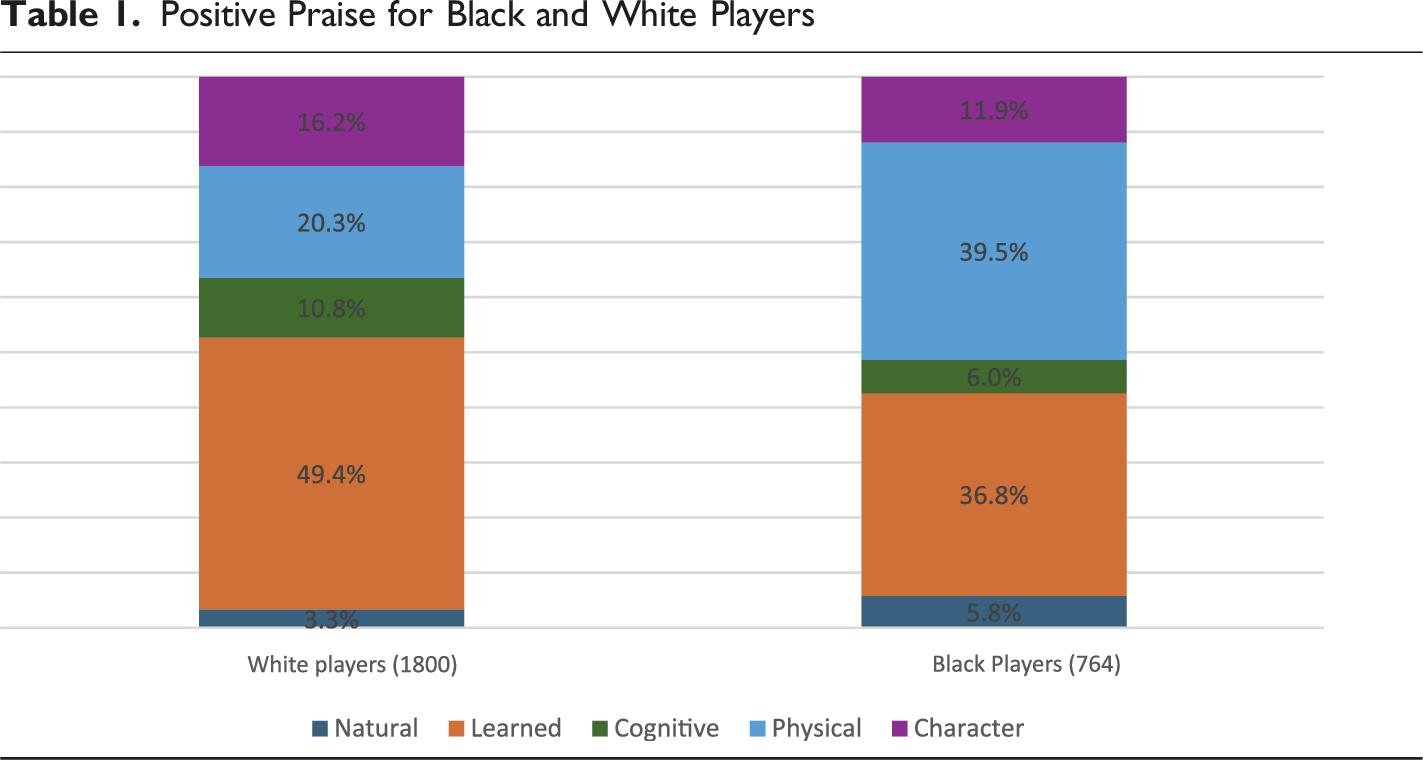
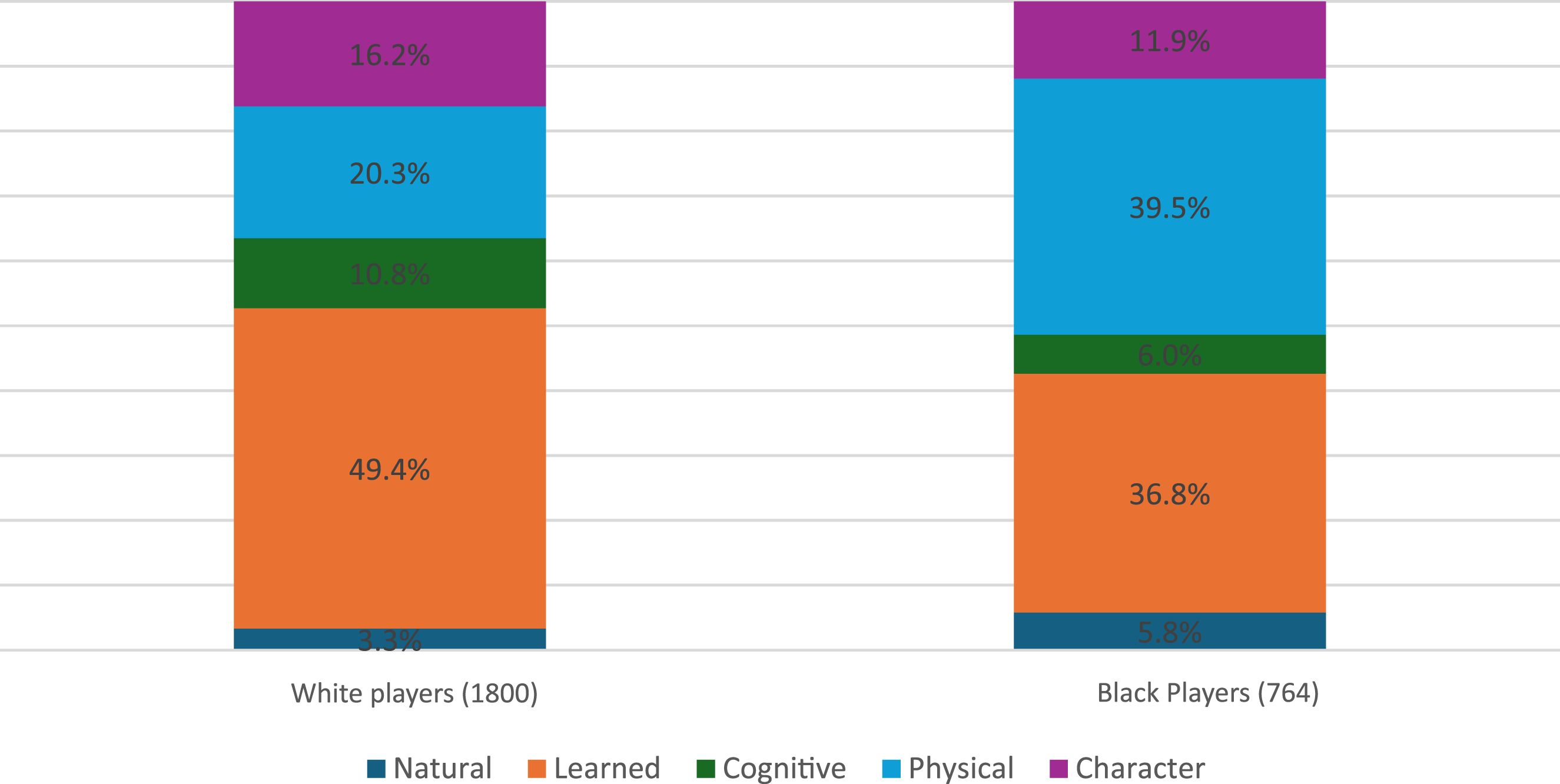
White players were most frequently praised for learned attributes (49.5%), followed by physical (20.3%), character (16.2%), cognitive (10.8%), and natural (3.3%). Comparatively, with regards to the percentages of praise received in relation for different attributes, Black players received almost double the amount of praise for their physical prowess (39.5%) and noticeably fewer praise comments for learned abilities (36.8%). They also received comparatively lower amounts of praise for character (11.9%) and cognitive attributes (6.0%), which was 26.5% and 44.4% less than those given to White players, respectively.
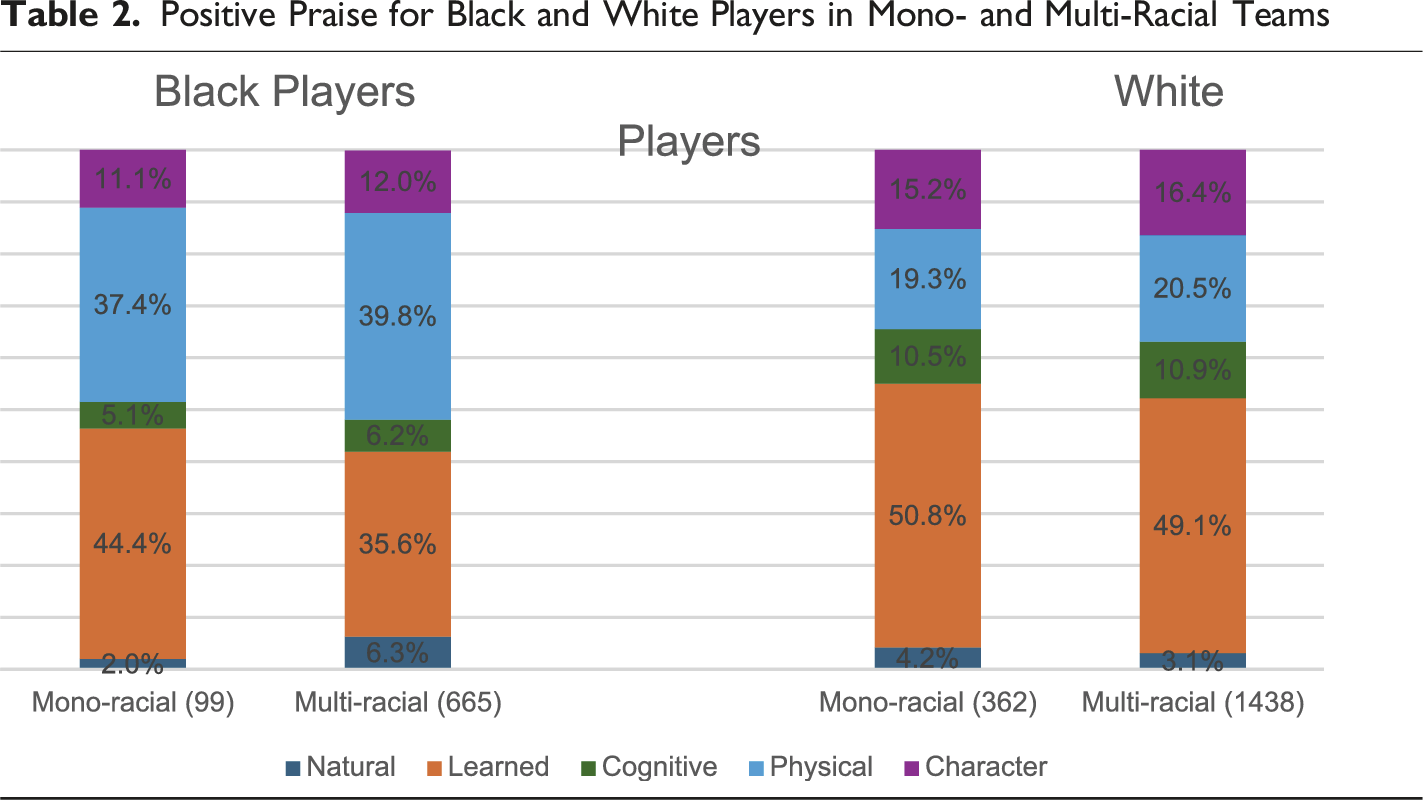
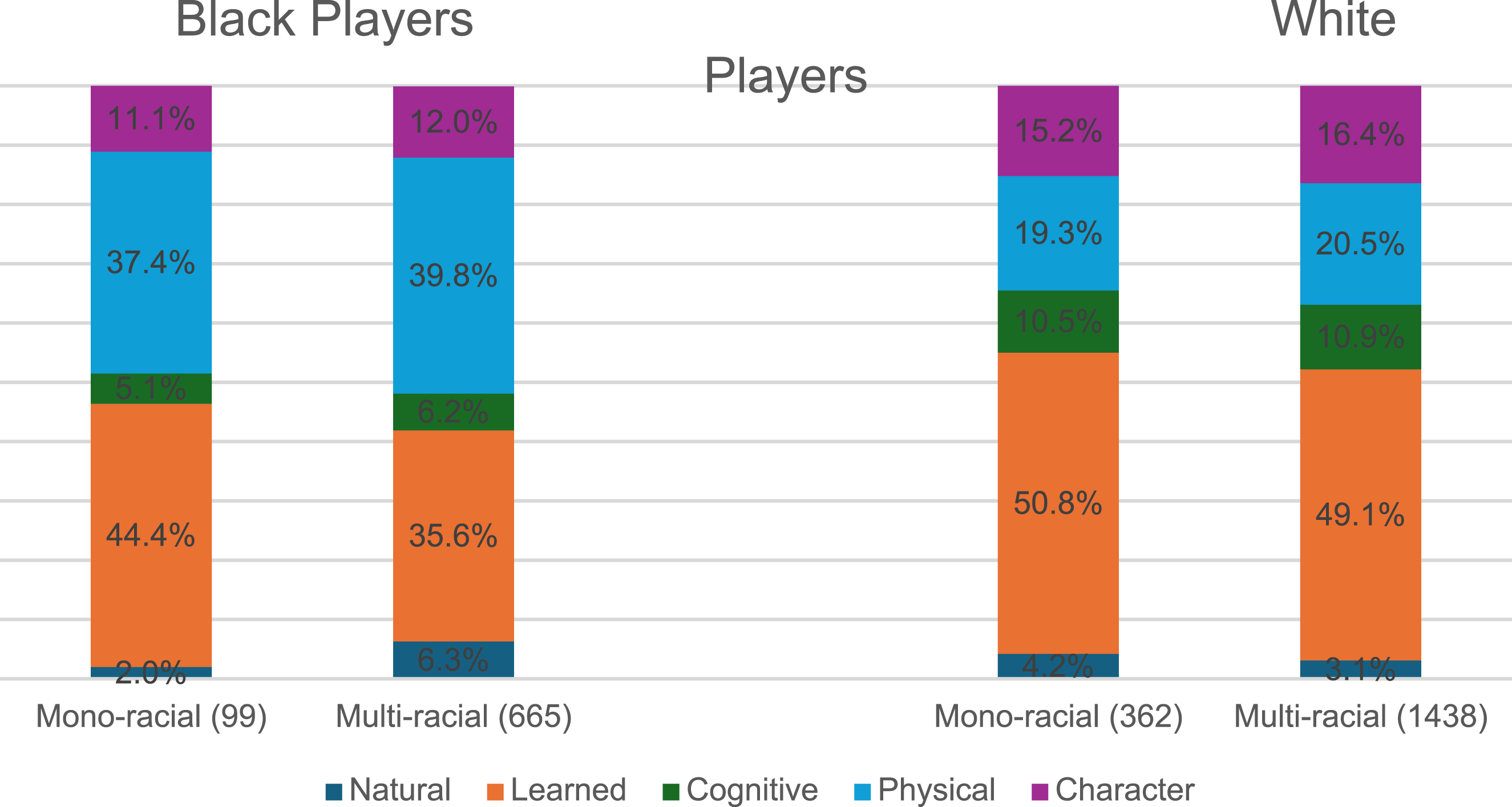
Our findings rehearse those of previous studies whereby there is a greater variation between praise comments received depending on whether that player was part of a mono- or mixed-racial team (Campbell & Bebb, 2020; Rada & Wulfemeyer, 2005). While praise given to White players was fairly consistent, Black players in mono-racial teams saw a significant increase in learned praise, while both their natural and physical praise decreased.
Positive Praise for Black and White Players in Mono- and Multi-Racial Teams
Positive Praise for Black and White Players in Individual European National Teams with more than one Black Player (England, France, Netherlands)
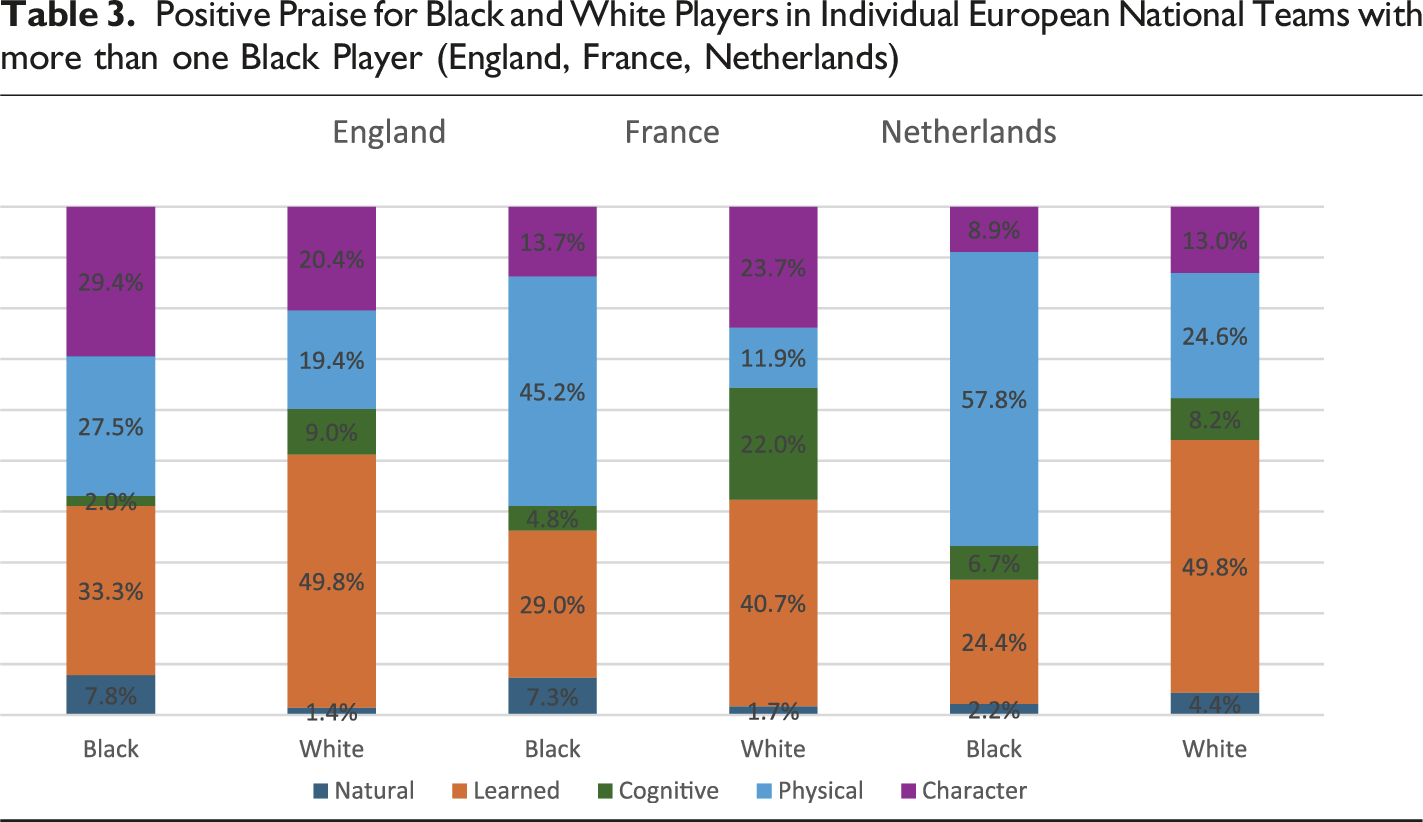
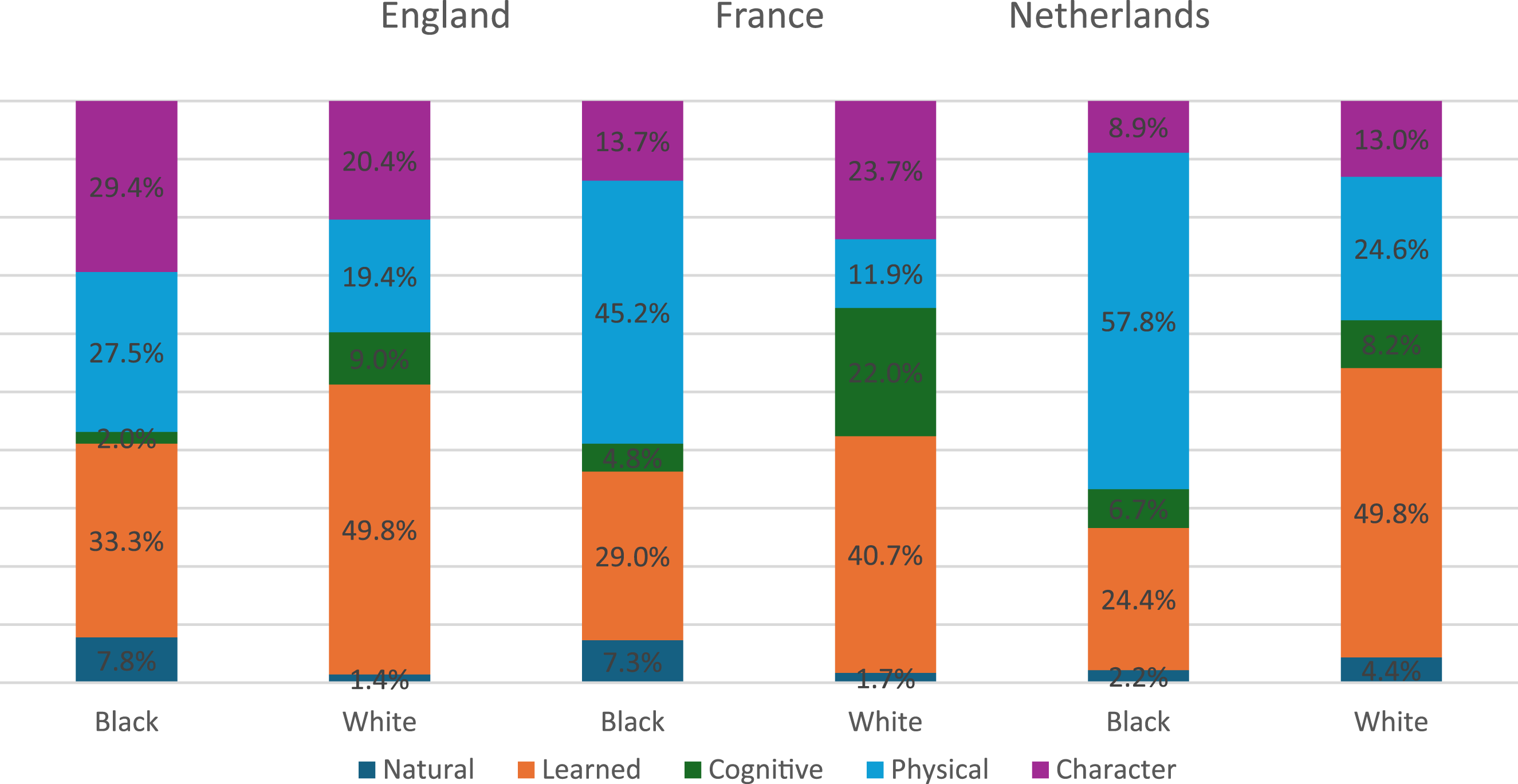
Commentary for the Netherlands followed a similar pattern. Here, Netherlands’ two Black-heritage players received more than a third of all the physicality-oriented praise (34.0%) given to the entire team during the tournament. While 85%, 90.4% and 87.1% of the team’s total praise received for cognitive-, learned- and character-attributes, respectively, were assigned to their White teammates.
France possessed the most racially diverse pool of players, but praise comments followed a similar pattern outlined above. For example, France’s Black players accounted for 43% of the team but disproportionately received 90% and 85% of the team’s total praise for natural and physical attributes, respectively. The reverse was the case for White French players, who similarly constituted 43% of the playing squad, but received 68% of the teams’ total praise for cognitive attributes. Conversely, they received only 10% of the celebratory remarks given to the team in relation to what were perceived to be natural attributes.
Discussion
Soccer Matchday Commentary and the ‘Naturally’ Athletic and Emotionally Deviant Black Female Footballer
How and in what ways are the praise comments and narratives within women’s matchday commentary different for Black and White female footballers? How do these framings challenge or reproduce the race and misogynoir logics that shape White and Black women’s experiences within sport and wider social life?
The findings are illustrative of how many of the same misogynoir and race logics that frame, marginalise and pathologize Black womanhood within wider social life are present within sport. They also shone light on how sport (re)makes its own specific and race-based discourses for framing, reading and constructing Black women as physiologically and pathologically deviant (Razack & Joseph, 2021).
For example, data highlighted clear differences in the ways in which visibly Black and White women soccer players were praised, discussed and framed within matchday commentary at the 2019 Women’s World Cup finals, which aligned with the ‘natural athlete’ discourse. Teams that were constituted entirely by Black athletes were more frequently praised in categories related to their physiological prowess and less so for intellect. For example, while commentating on South Africa vs China, Kevin Keatings explained to audiences that the ‘one thing African teams always show is their pace and [their] power!; The reverse, however, was the case for teams populated entirely by White players.
Interestingly, natural athlete race logics were even more pronounced when Black and White women played together in multiracial teams. It suggests that within the White female sporting imaginary, the closer the proximity between White and Black female players, the fewer the scripts available for interpretating and comprehending the value of Black talent and sporting contribution among commentators. The allocation and frequency of praise for female players along the axes of Black brawn and White intellect signalled a clear and racialised division of sporting labour within women’s soccer commentary and imaginary, which mirrored some of the race logics previously found within the men’s format of the game. These were typically held and proffered by White gatekeepers, such as, the late ex-Crystal Palace Chairman, Ron Noades and more recently, the ex-West Ham Head of Player Recruitment, Tony Henry. Noades infamously proclaimed that in multiracial men’s teams, White players are needed because they ‘give the team some brains’. Henry warned his club’s then first-team manager, David Moyes, to avoid signing too many African players because: ‘they [all] have a bad attitude’ (ESPN, 2018).
Within women’s matchday commentary, the natural athlete frame also included perceived inherent emotional tendencies. This is not entirely unique to framing Black sportswomen. McCarthy and Jones (1997), for example, demonstrated that within the male sporting imaginary, the natural athlete discourse holds White bodies as inherently brave, and Black sporting bodies as naturally hyperaggressive (and even violent). In our sample, the natural athlete logic extended to also include talk about Black female athletes as gendered bodies that were inherently angry, and which possessed an inclination for caprice. White sportswomen were seen to be more instinctively calm. For example, commentators Sue Smith and Jonathan Pearce warned viewers of Black-heritage England player, Nikita Parris’ inability to maintain her composure during games, and her tendency to frequently ‘make her feelings known!’ During the Norway v Nigeria match, commentator John Roder, similarly remarked how Nigeria’s Black forward, Desire Oparanozie, ‘was playing with a bit of anger’. He also described her team’s play as especially ‘careless’.
Predominantly White European teams’ ability to remain calm and not react to the ‘overzealous’, or overly ‘physical’ play of Black African national teams, was another frequently rehearsed talking point in matches between the two groups of sportswomen. During Cameroon’s match with the Netherlands, commentary team, Lucy Ward and Robyn Cowen, pointedly remarked that the African side was ‘lacking discipline’. During the England v Cameroon match, Smith and Pearce, praised the almost entirely White England team for keeping their composure and not ‘reacting’ to ‘unseemingly things going on the pitch’ by the African players.
The consistent framing of various Black women as angry and disorganised within soccer commentary contributes to a broader pattern of stereotyping, violence and degradation of Black women in sport and in social life within White nation states more widely (Razack & Joseph, 2021). Campbell and Bebb (2020, p. 2) astutely assert that within the male imaginary, sport helps to ‘make race make sense’. Our findings extend their thesis. Within the White female imaginary, mediated narratives in sport make race-based causal logics about women’s racialised bodies, and beliefs about inherent racialised gendered emotions, make sense – and especially to White sporting audiences. Moreover, our findings add weight to Razak and Joseph’s (2021) cautionary assertion that any analysis of the experiences of Black sportswomen along a singular axis of either race or gender are only ever partial. Violence experienced by Black women in sport can only be adequately comprehended through the employment of an overlapping race and gendered – or misogynoir - lens.
Women’s Soccer Commentary, Misogynoir and the Sporting Exotic
The misogynoir framings of the Black sportswomen in our sample were not always so obviously negative. They also took place through a more subtle process of othering via a consistent celebration of Black womanhood and Black sporting culture as ‘exotic’. This was manifest via a particular fixation on Black women’s hair and the practices of the fans of Black African women’s national teams by commentators and commentary teams.
Black women’s hair has long been a site of politics, resistance and contest within White Western spaces (Thompson, 2009). By the same token, it has also been a space for White policing, intrusion and objectification in society and in sport (Joseph et al., 2024). These acts of violence are often disavowed by White perpetrators as innocent curiosity (O’Brien-Richardson, 2019). Our examples are indicative of the processes within matchday commentary by which Black female athletes are simultaneously celebrated and made peculiar. More importantly, Black hair is stripped of its political significance and reduced to an object for White gaze and bewilderment, while simultaneously positioning its wearer as the ‘exotic’ sporting other.
For example, Nigeria’s Asisat Oshoala’s decision to wear Cowrie Shells in her hair was a particular point of awe and bemusement for commentary teams during the tournament. So much so, that during the Nigeria v Korea match, commentator Steve Wilson even drew attention to her decision not to wear them for the game. During the same match he pivoted and amazed instead at what he described as Nigerian forward, Francisca Ordega’s ‘extravagantly coloured ponytail’. The attention to Black hair was not reserved solely for Black heritage women who played for African national teams. During the Netherland’s match against Cameroon, Gary Bloom marvelled at the Dutch striker, Shanice van der Sanden’s rather routine short-cut bleached hair, as particularly ‘distinctive’ and ‘colourful’.
The fascination with Black hair was noticeably contrasted with a general and comparative lack of attention given to the ways that White women players wore and coloured their hair during the tournament in match commentary in the UK. This was despite high profile players such as US striker and poster player of the tournament, Megan Rapinoe, and England player, Toni Duggan, wearing their hair bright pink and in braids, respectively.
The predominantly Black fan-base of African women’s national teams at the tournament were similarly singled out for special attention by commentators. This included African fans routinely being described as especially ‘effervescent’ and ‘energetic’. In their match against Germany, commentator Clive Wilson fawned how South Africa were ‘colourful’. Mark Tompkins, went further stating as a matter of fact: ‘African nations always have a splash of colour’ (Canada v Cameroon).
Clearly, the use of language here is not simply descriptive. Campbell and Bebb (2020, p. 2) explain that soccer commentary ‘reflects and maintains’ ‘dominant ideas’ and racialised logics, and is ‘part of a broader and nuanced experience of race and racism in the UK and elsewhere … which includes the subtle ways that people react to’ race and difference in sport. In this case, the references to colourful fans acts as a short-circuit code which leaves the audience in little doubt about how to read the embodied cultural performances of large groups of Black fans and Black African fandom of the women’s teams during the French finals.
Any doubt as to the use of language to distinguish between the sporting normality and differences between the fans of the women’s national teams along race lines was expunged by the absence of verbal references to the energy or colour of the fans of European nations within our sample. This was despite the partying antics and dress of the predominantly White Swedish, Italian and Dutch fans within stadia, who were often and quite literally dressed almost entirely in yellow, blue and orange, respectively.
On the surface, commentators’ descriptors of Black fandom as inherently magical and extraordinarily energetic and thus colourful appear complimentary and even inclusive. However, this process of exoticisation simultaneously celebrates African fan bases, while its noteworthiness reminds audiences that these kinds of embodied performances sit outside of the White normative boundaries of sporting fandom. Put simply, the commentary double talk celebrates the exotic Black fan and others them, and both at the same time.
In all cases, Blackness was often contrasted with, or seen through the normative gaze of White femininity, White soccer imaginaries and White fandom. van Lienden (2023, p. 27) describes Whiteness as the dominant, ‘albeit silent, system in which White people constitute the seemingly obvious, normative and invisible via which all other race and ethnic groups are compared’. It does not simply or only normalise White bodies, but, make ‘normal’ all aspects of White personhood, including, White cultures, gender-performances and sporting practices’ (Campbell et al., 2025, p. 15).
Within women’s soccer commentary, Whiteness acts a norm and in almost all cases White players and fans of women’s teams are presented as the de facto norm and antithesis of Black sports-womanhood through direct reference, and, importantly, through the absence of references (van Lienden, 2023). Thus, our data illustrates how, within the White cultural imaginary, Whiteness is so pervasive and understood by commentators and audiences that it acts as the normative ‘mark’ upon which all metrics of gender and race normality are constructed within women’s soccer commentary, and even without having to be said at all.
Similarly to other studies on race and soccer commentary, this study has shown how words contribute to the construction of normative Whiteness and deviant Blackness making in sport. It adds to this canon by also demonstrating how commentary is a dual space of celebration and violence for Black women. In doing so, our findings echo Campbell’s (2024) concept of the ‘transfigured postracial’ space, whereby the inclusion of Black women in sport-media is never complete, but only, and always, an experience that is contested and liminal.
Concluding Comments
Studies on gender, race and sport in the Global North powerfully demonstrate the myriad ways in which Black sportswomen of colour experience exclusions on the pitch, in terraces, and leadership, and along what Scraton et al. (2005) described as an ‘interlocked’ axis of both anti-race and anti-gender barriers (see also Bell et al., 2024). Engh et al. (2016), for example, illustrate the ways in which Black Nigerian immigrant players in Scandinavian football leagues are seen, over-policed and made deviant within the imaginaries and actions of White officials and coaches. Likewise, Ratna’s (2014) earlier work illustrated how what we might describe as the perceived to be ‘doubly deviant’ raced and gendered identities of the Black and Brown female supporters of the England national team in her study, meant their statuses as legitimate fans were always partial and contingent (see also Leslie-Walker et al., 2023). Similar exclusions were observed in Black and Brown women’s attempts to access ‘White’ sports boardrooms a decade later, by Leslie-Walker and Chikh (2025), who found that resistance to the women’s race and gender identities took the form of microaggressions and microinvalidations, leaving them on the peripheries of decision making processes.
This paper rehearses and extends this literature by providing, what is to our knowledge, the first paper to demonstrate some of the complex and exclusionary ways in which Black sports-womanhood is talked about, framed and mediated within soccer matchday commentary. It has demonstrated how commentary contributes to the mediated presentations of Black women as physically and emotionally deviant and exotic that were, in turn, consumed by over 1.12 billion viewers during the 2019 World Cup finals.
Postdigital feminist scholars have observed how the negative effects of exclusionary discourses generated within digital spaces are not confined to, or remain locked within, online experiences (Faber & Coulter, 2023). They also have a direct influence on the realities and exclusions people experience in their offline worlds (Mendes, 2023). Applying this thesis here, we argue that the negative effects on Black sportswomen caused by the misogynoir logics, words and frames within soccer commentary are not just noise on television that can be easily blocked out, or ignored by Black female soccer players, by turning off the television or mobile phone.
These frames contribute to the formation of powerful sporting stereotypes and prima facie knowledges that inform the race and gendered exclusions present within their sporting opportunities and careers in the ‘real’ world. The following quotes from African American US Soccer player, Lynn Williams Biyendolo and Black British ex-England player, Anita Asante, demonstrate: [When it comes to Black women we hear] Okay she’s fast, she’s strong, she’s tough... Why don’t you say she’s skilful, her field-vision is great? Those words are never used and it’s disheartening … And so I feel like my whole career I’ve been trying to fight this … battle, where I know I’m good enough! I know I have foot-skills. But the outside world is like no she’s only fast, so I’m [even] trying to overcompensate sometimes [when I’m playing]. “ (cited in Biyendolo and Mewis 2021) You have to check yourself to make sure people don’t view you in that light. Maybe on that particular day in a training session, I am that sassy person, or I am that competitive person that comes across a bit more feisty – but because there is an association with being a [B]lack woman and having that energy and boldness is not always seen a positive thing, [so] I might refrain from being that person and contain more of my emotions (cited in Kopczyk & Walker-Khan, 2024).
Both women’s words provide insight into the ways in which Black-heritage women are frequently identified, read and framed within White sporting imaginaries as emotionally and physiologically deviant and masculine (respectively) in sport. It illustrates how not only are they cognisant of these frames, but of the personal importance they place in challenging them through their embodied race and gendered performances both on and off the pitch.
They also illustrate the circular and dialogic process between mediated presentations of sport and the sport as a profession (and vice versa). How misogynoir ideas and frames in sports media (in this case (re)constructed within sports commentary), align with and shore up many of the preexisting race and gendered stereotypes held by White gatekeepers within professional soccer in the real world. It also shows how they directly influence the opportunities and exclusions Black women experience within the game, as footballers, coaches and as fans.
Finally, this work is the first to document how women’s soccer commentary contributes to the reproduction of racial logics in sport and social life. It specifically highlights how it contributes to a wider process of the degradation of Black women in sport, via the uneven ways in which it celebrates, describes or draws attention to aspects of Black women in either anti-Black, overly-masculine or exoticizing ways.
We end by alerting policy makers and those in sport-media and journalism, that such tabulating exercises, as we have conducted here, double as tools(kits) for industry reflection, learning and anti-racism training. They help to illustrate to those working within media the frequency and ways in which gender and race biases can unintentionally manifest in our mediated cultural products. In doing so, these exercises aid the production of a more anti-racist media discourse – these are narratives that actively disrupt the preexisting racial logics that exist in sport, instead of reproducing them.
Footnotes

Author Contributions
Funding
The authors received no financial support for the research, authorship, and/or publication of this article.
Declaration of Conflicting Interests
The authors declared no potential conflicts of interest with respect to the research, authorship, and/or publication of this article.