




Abstract
The literature on sport event leveraging suggests that these events can play an important role in addressing social inequities when planned carefully and utilizing the media to promote key messages. However, relatively little is known about how effectively sport event organizers and their partners make use of social media platforms to achieve these ambitions and what dominant discourses are perpetuated in the process. Drawing on a case study of the 2023 UCI Cycling World Championships held in Scotland, this paper explores how event organizers and their partners used strategic social media messaging to promote equality, diversity and inclusion (EDI) discourses before, during and after the event. We draw on leveraging theory and a Foucauldian Discourse Analysis (FDA) of social media posts by event stakeholders and find that while EDI messaging was evident, it was inconsistent, overly generalized and failed to recognize the systemic injustices faced by marginalized groups. We conclude that, given the resources available to organizers and their partners, greater attention needs to be paid to how coherent social media messaging can be utilized to more effectively address social inequities.
Keywords
Sport events can make significant contributions to the economic health of the places that host them, attracting investment, incoming visitors and extensive international media coverage. These events also contribute to other policy imperatives, including health and wellbeing, urban redevelopment, and soft power (Dickson et al., 2021; Schulenkorf et al., 2024). Sports are recognized for providing a platform to “raise awareness and promote conversations around important social issues” (Kwak et al., 2023, p. 1). Furthermore, sport events also provide a platform to communicate strategic messages domestically and internationally, for both the rights holder and its host city counterparts.
Over the last two decades, the sport event literature has shown how these events can be leveraged (O’Brien & Chalip, 2008) as communication vehicles to achieve outcomes not concerned with the event itself, operating as a platform to promote strategic messages that the host city and right holders want to convey. A good example is the Paralympic Games, which generates extensive media coverage to raise awareness about people with disabilities and, more importantly, seek to influence attitudes and practices (McGillivray et al., 2021; McPherson et al., 2016; Misener et al., 2018). This mediating role is important because organizing bodies allocate significant resources to the marketing and promotion of the event to progress policy agendas that they hope will lead to positive outcomes, including increasing sport participation. In this paper, we are interested in how the communicative power of sport events can be utilized to advance equality, diversity and inclusion (EDI) agendas. While terms like equality, diversity and inclusion are often used interchangeably, they are distinctive (Gardner et al., 2023). Equality is about providing the same resources or opportunities to everyone. Diversity relates to recognising socially meaningful differences among members of a group, while inclusion is the intentional action of creating communities where everyone is accepted and can belong (Gardner et al., 2023). In the sporting field, there is a growing body of literature critical of the commitment of National Governing Bodies of Sport (NGB), and sport event owners, to EDI beyond the superficial and rhetorical (Gardner et al., 2023; Kwak et al., 2023; Shaw & Penney, 2003; Spurdens & Bloyce, 2022). It is suggested that organisations only commit to EDI policies to secure funding (Shaw & Penney, 2003), for impression management, and for public relations purposes (Gardner et al., 2023). Others argue that commitments are too often an exercise in equality proofing, which refers to symbolic acts that pay lip service to structural change (Spurdens & Bloyce, 2022). This is problematic because generating the perception that EDI is done or completed can “present a veneer of valuing diversity while failing to address an inequitable status quo” (Gardner et al., 2023, p. 356).
This paper is timely, because in Scotland, EDI issues have become increasingly politicized, following the UK government blocking the Scottish Parliament’s proposed Gender Recognition (Reform) Bill, initially passed in 2022. The proposed reforms sparked years of debate over women’s rights but also focussed public attention on other protected characteristics enshrined in the 2010 Equality Act. The Scottish Government has been pursuing an EDI agenda for several years, and it sought to translate its political commitment into practical action in the 2023 UCI Cycling World Championships (hereafter CWC) context by stating that publicly funded sport events have a public duty to comply with the requirements of the Equality Act 2010 in their planning and delivery. This public duty extended to organizers being expected to recognize and promote opportunities for a range of protected characteristics (including LGBTQI, people with disabilities, and minority ethnic communities) and ensure that these events are used as a platform to support wider equality goals.
The first major event to be subject to the public duty was the CWC, a ‘mega’ cycling event bringing 13 separate cycling disciplines together in August 2023 for the first time. The Scottish Government provided more than half the original £50million budget (£30 million) and with that significant national funding came an expectation and responsibility to embed EDI in its governance processes, funding decisions and promotional efforts. Practically, the CWC explicitly outlined a commitment to EDI in the development of an EDI Framework and Pledge. Within the Pledge, partners and key stakeholders signed up to five key commitments: promoting inclusion through the power of the bike; improving wellbeing, and building a fairer, more inclusive society for all; committing to the growth and sustainability of women and girls cycling in Scotland; embedding inclusivity and accessibility into event planning for each of the 13 UCI World Championships; and building partnerships, initiating conversations, and seeking out opportunities to activate programmes in support of EDI.
In this paper, we focus on how sport events can utilize their media profile to address social inequities through a commitment to EDI, including which discourses are promoted in the process. While there has been work on the power of the media, in general, there are few studies that have considered the role of social media platforms in event-related strategic messaging to help address systemic social inequities. Our study fills this gap and is guided by the following research question: “How do event organizers and key stakeholders use strategic social media messaging to promote equality, diversity and inclusion agendas before, during and after the event?” In addressing this research question, our empirical enquiries draw on social media content published by event stakeholders before, during and after the CWC was held across Scotland. Our study identifies opportunities to deliver a more strategic approach which ensures EDI messaging is embedded within all event related communications, building on the event’s celebratory and catalytic effects.
Sport Event Leveraging and Communicative Action
In theory, sport events represent a means of focusing stakeholders’ attention on important social inequities through their celebratory and unifying nature (Misener et al., 2018; O’Brien & Chalip, 2008; Schulenkorf & Edwards, 2012; Schulenkorf & Schlenker, 2017; Thomson et al., 2024). In their systematic review of event leveraging, Schulenkorf et al. (2024) define it as “strategically planning for the maximization of business, social, or other types of event impacts” (p. 786). Previously, Schulenkorf and Edwards (2012) have highlighted how sport events can be used to combat issues including racism, sexism and homophobia when regular sport-for-development programmes are combined with the event itself. Thomson et al. (2024) focused on how the Gold Coast 2018 Commonwealth Games were employed to raise awareness about violence against women. Misener et al. (2018) have shown how integrated sport events and those that separate disabled and non-disabled athletes could be utilized to raise awareness and influence attitudes about people with disabilities.
The strategic element of leveraging focuses on intentionality, whereby “event organizers, community officials, and partners need to strategically plan in order for these outcomes to eventuate, launching tactics to capitalize on the events’ specific potential” (Schulenkorf et al., 2024, p. 786). Each of these leveraging studies has a shared concern with the role and effectiveness of event-related media in shining a light on social inequities, generating wider public attention and providing a catalyst for change. Some years ago, O’Brien and Chalip (2008) drew attention to the power of events and their media influence to advance social issues. They argued that event planners could use tactics to lever the excitement around an event, the liminal experience, to advance positive social outcomes, including aligning sport events with targeted social inequities. They suggested that media plays an important role here, because events attract the interest of journalists and organizers, and their stakeholders can exploit them to place stories that they wish to promote. While O’Brien and Chalip (2008) acknowledge the importance of not distracting from the main event, they also emphasize the opportunity to plant seeds and raise awareness of social inequities. Similarly, Geurin et al.’s (2025) study of disability inclusion focused on the role of the media in understanding sports relationships with social movements. Dickson et al. (2021) also emphasize the importance of inter-organizational partnerships for successful event leverage. This view is further reinforced by Schulenkorf et al. (2024) who suggest that “consideration of contextual nuances and bespoke partnership engagements are critical when designing and realizing event leverage opportunities with strategic intent” (p. 788). In the sport event context, this can be operationalized as exploiting the convening power of influential partners coming together to plan and coordinate marketing and communication campaigns that maximize visibility for social inequities through the media power of the event.
However, while the literature suggests that there are opportunities arising from the use of sport events to leverage the media to help address social inequities, this process is not without its limitations. For example, Thomson et al. (2024) highlight the problem with presuming that promoting an initiative will lead to greater awareness and change. When discussing a campaign that focused on reducing violence against women, they found a lack of a narrative throughout official reporting and media, meaning that the intent of the initiative was poorly understood. Moreover, they concluded that because of a lack of coherent and consistent messaging coming from key stakeholders, and at times a degree of superficial reporting, the leveraging potential of the initiative was limited, despite good intentions. This is important, because as Thomson et al. (2024) suggest, “effective event leverage is dependent on a clear purpose for leveraging, coherent messaging for the social issue, and symbolic alignment between the issue and the event” (p. 1177).
In the sport (event) and EDI literature, several studies also highlight problems with the ‘performative’ dimension, whereby the utterances of sport organisations fail to effectively challenge systems of structural inequity. For example, in their study of sport governing bodies and their commitment to gender equity, Shaw and Penney (2003) suggest that there is a tendency for window dressing, with policies being produced to give the impression of commitment but without clear actions. Along similar lines, Spurdens and Bloyce (2022) argue that equality policies are too often commodified and “producing policy is seen as an inherent good regardless of whether it achieves the realities it outlines” (p. 516). They suggest that equality proofing become a tick box exercise, with sporting bodies simply indicating that they are doing something while little clear actions are outlined.
Looking at elite US sporting organizations, Gardner et al. (2023) also explore the disparity between words and actions around diversity and inclusion. They suggest that organizations often create policies and programmes that convey an image of being attentive to diversity. However, that image management is rarely translated into organizational accountability practices, with clear goals, fixed deadlines or mechanisms to evaluate success or failure. Critically, they posit that diversity policies “become the new standard through which equity is demonstrated, operating as a public relations or impressions management tool, without having to commit to meaningful institutional change” (p. 343). Importantly for this paper, the literature suggests that EDI-related policies within sport and sport event organizations are used as a means of publicly signalling a commitment to EDI without actually challenging structural inequities (Gardner et al., 2023).
Sport (Events) and (Social) Media Messaging
Despite legitimate concern in the literature over the commodification of equality policies, there is a more optimistic body of work that focuses on the opportunity that sport and sport events present as a strategic messaging tool. In this work, sport, and sporting events, are viewed as attractive social marketing tools because of their positive moral status and the ability to transmit pro-social values including non-discrimination and solidarity (Shi & Bairner, 2022). Lundberg et al. (2024), in their study of communicating inclusiveness through major sporting events, suggest that prospective hosts are facing pressure to promote inclusivity in their messaging due to the criticism these events have faced over infringements to human rights in the past. Focusing on Olympic Games candidate files, they suggest that, to be effective, inclusiveness needs to be made visible from the earliest possible stage of event visioning and planning and that this must be clearly stated in words (i.e. policy documents) and actions (implementation plans).
Beyond published documents, social media is also now recognized as a valuable space to promote inclusive and social justice-related agendas by sport organizations, including sport event organizers. Sport and sporting events represent a popular topic among social media users (Stoldt et al., 2020), allowing sports organizations to reach out to the public directly. Social media provides organizations with the opportunity to undertake strategic messaging, at a relatively low cost, with a high degree of control and to a targeted audience. This can form part of a wider communications strategy and provides the opportunity to publicly link with stakeholders and interact with audiences. Organizational social media use can be viewed as a form of public relations activity, where the content is owned, approved and published by the organization, thus deemed to be authentic and trustworthy, while offering interactivity, relationship building and two-way communication with stakeholders and the wider public (Fill & Turnbull, 2023). Saxton and Waters (2014) suggest three areas of importance in building relationships with the public using social media: the ability to regularly update content and messaging, interactivity and a formalized network. The use of social media messaging can work in parallel with traditional media while empowering followers to engage with the online content. The type of messaging (for example videos, hyperlinks) affects the levels of engagement with posts (Kwok et al., 2022; De Luca et al., 2022) and timing is crucial too. In an event context, considering strategies for different phases of the event lifecycle is important because the success of event leveraging is time dependent, with arrangements having to be put in place as early as possible to be effective. To advance a social cause or initiative, this means that media messages also need to be agreed as early as possible, with a clear strategy in place to separate it from general event promotion.
In sum, while there is evidence that sport events can be leveraged to raise awareness of important social inequities, the role of social media in activating key messages remains under-researched.
Theoretical Framework
This study is guided by two theoretical approaches which inform the forthcoming analysis of data and discussion. First, we utilize the concept of leveraging (Misener et al., 2018; O’Brien & Chalip, 2008; Schulenkorf & Edwards, 2012; Schulenkorf et al., 2024) which suggests that sport events represent a powerful means of committing resources to enact desired social change, and that the temporal dimension is crucial to the success of policies or programmes, including media activation. For this study, we propose that strategic partners can be convened to utilize social media as a powerful form of leveraging if there is clear agreement on the form and format of messaging and its deployment to reach desired audiences.
Alongside the focus on leveraging, we draw on a Foucauldian Discourse Analysis (FDA) to analyze the forms of EDI discourse promoted by event organizers and their partners using social platforms and how those were operationalized in practice before, during and after the CWC event. Sveinson and Wagner (2024) suggest that for Discourse Analysis (DA) to be meaningful there needs to be “cohesion between the theoretical underpinnings, the methodology, and method used” (p. 301), warning that “DA cannot be reduced to a method separated from its theoretical foundation” (p. 309). To ensure our approach is underpinned by theory, it is necessary to outline our understanding and use of a Foucauldian framework of discourse and power before detailing the technical operationalization of the FDA.
The idea of discourse is central to Foucault’s theoretical examination. As Spurdens and Bloyce (2022) suggest, “discourse consists of a group of related statements which cohere in some way to produce both meanings and effects in the real world: they effect, they are productive, they produce” (p. 510). Discourse then produces an expression of power through statements (Foucault, 2002) which “construct knowledges about practices which reinforce or reconstitute power relations” (p. 510). Posbergh (2022), drawing on a Foucauldian conception of power, suggests that it is “relational rather than possessed…particularly focused on how interactions created, constrained, and normalized behaviours” (p. 1354). In a similar vein, Sveinson and Allison (2021) suggest that discourses are both socially shaped and social shaping, reproducing the status quo or potentially transforming it. In the Foucauldian conceptualisation, power is produced and transmitted through discourse but “it is also through discourse that power can be shifted or changed” (Sam, 2019, p. 339). In this sense, discourses can be utilized by different individuals, groups or organizations to advance and reinforce certain ideas, values or narratives (Foucault, 1983).
To illustrate, in the sport event context, a diverse range of organizational actors are subjected to power, influenced by other institutions which impact on their own strategies and policies - for example in the EDI sphere. Referring to National Governing Bodies of Sport (NGBs) in the UK and their commitment to equalities discourses, Spurdens and Bloyce (2022) demonstrate how “from their subject-positions, organisations’ policymakers operate power tactically and contingently through further discourse and produce knowledges which in turn actualise, modify, stabilise and redistribute power” (p. 510). Knowledge is an expression, and mechanism, of power and what is taken to be understood as true at any given time is implicated in a complex assemblage of power relations that produce certain truth claims.
Methodology
Informed by leveraging theory and FDA, we sought to explore how organizers promote EDI narratives associated with the CWC via social media. Building on the Foucauldian focus on discourse and power and Sveinson and Wagner’s call for cohesion between theory, method and analysis, we employed an FDA because it focusses on power dynamics (Arribas-Ayllon & Walkerdine, 2017; Sam, 2019). This focus on power in FDA also brings to the fore the possibility of resistance and domination (Sam, 2019). In their review of different types of DA, Sveinson and Wagner (2024) highlight the increasing prevalence of social media or netnographic approaches being utilized as an empirical foundation for sport-related research.
In conducting an FDA, Arribas-Ayllon and Walkerdine (2017) suggest that the researcher should select a corpus of statements, samples of text, while Bourke and Lidstone (2015) argue that “statements have material existence, a place, a date, a status, a field of emergence” (p. 8535) and someone who produced it. Arribas-Ayllon and Walkerdine (2017) set out some exemplar criteria for selecting statements, within which they include print and new media. Sam (2019) argues for a FDA using social media, because truth games are played out over these platforms at a rapid pace and they provide a fertile space where organizations and individuals articulate their ideas and share them with an intended audience. As he suggests, “on Twitter, the medium takes place in different forms such as a tweet, retweet, or subtweet…these posts become a matter of record (oftentimes public record) and their contents are rich with qualitative data with text, images, photographs, and videos” (Sam, 2019, p. 337). As social media includes text, photos, and videos, our FDA approach considered these as different forms of utterance, designed to generate specific responses, or attract an alternative audience to engage with the content.
The corpus of statements that we chose as the focal point of our analysis were derived primarily from policy documents and social media posts. We sought to uncover the dominant discourses captured in the CWC EDI Framework and Pledge documents alongside exploring how these were carried via social media, promoted by which institutional accounts. Foucault’s genealogical approach, focussing on the power-knowledge relationship, was utilized for analysis, looking to understand who has power, authority and legitimacy and how it is exercised (Sam, 2019). In assessing policy documents and social media posts, we considered who generated social media posts about the CWC and its EDI commitments, and how influential they were (i.e. the number of followers they had and the number of retweets). We also grouped key stakeholders together and looked at whether social media practices changed over time with some organizations tweeting more than others, and with what purpose. Here, we were interested in examining “the interdependencies and operations of power between organisations” (Spurdens & Bloyce, 2022, p. 513) to better understand how and why policies are constructed and who had authority to communicate about them.
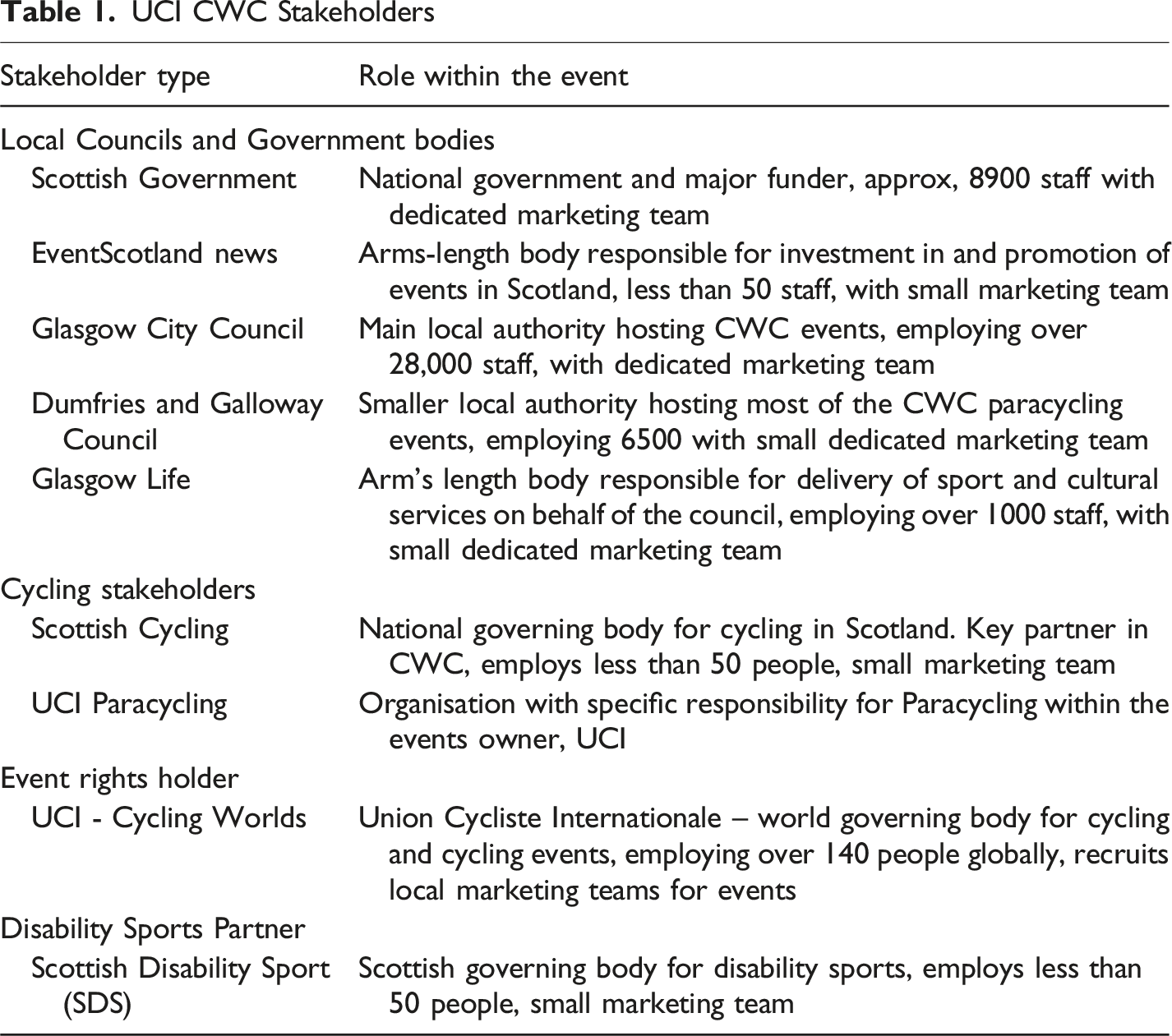
UCI CWC Stakeholders
Dataset Inclusion Process
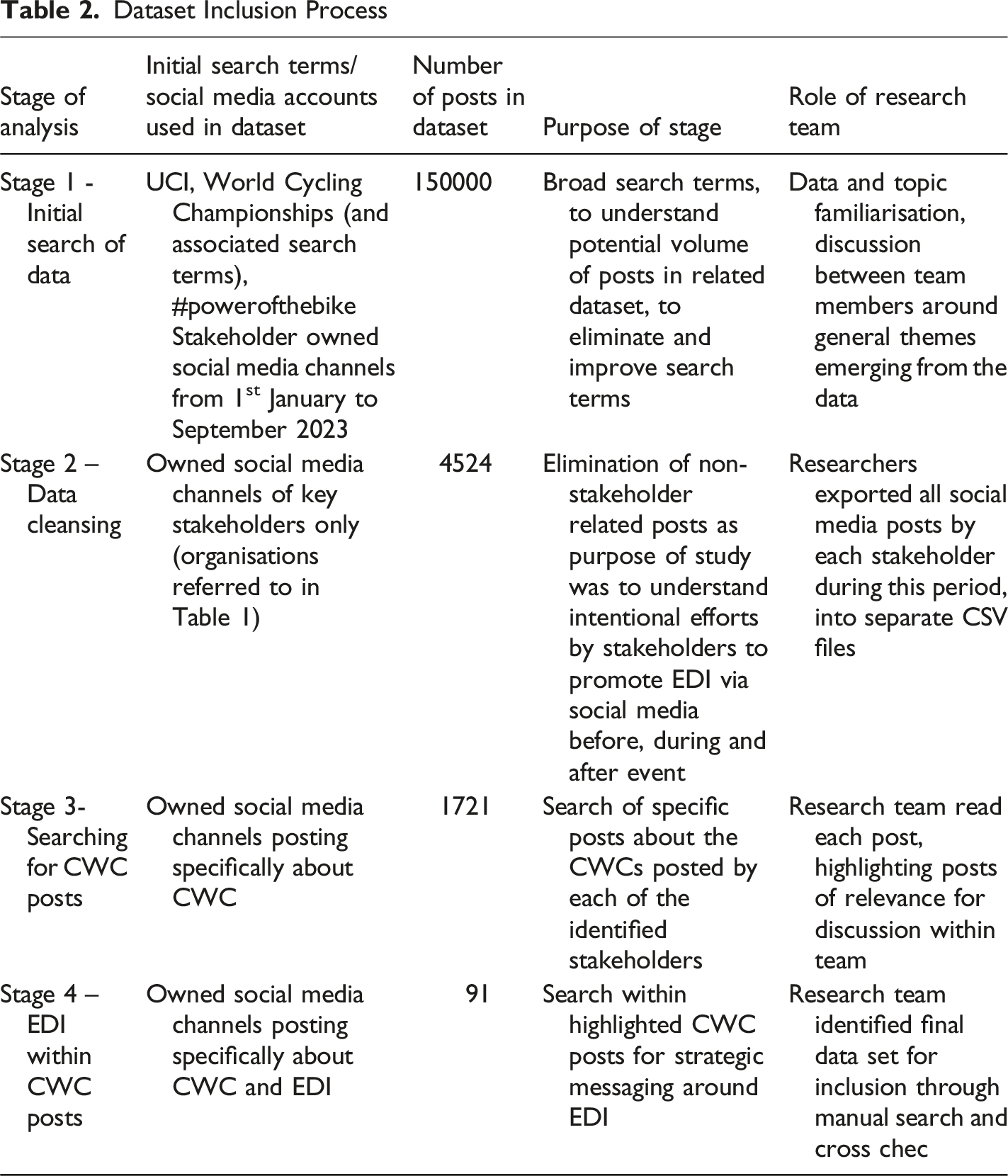
In the initial collation of social media posts, we used the Boolean search term “UCI World Championship”, and the Twitter handles for each of the identified stakeholders as these can be viewed as strategically leveraging social media to target a specific agenda (O’Brien & Chalip, 2008).
Descriptive Statistics of the Twitter Data (1 January to 1 September, 2023)
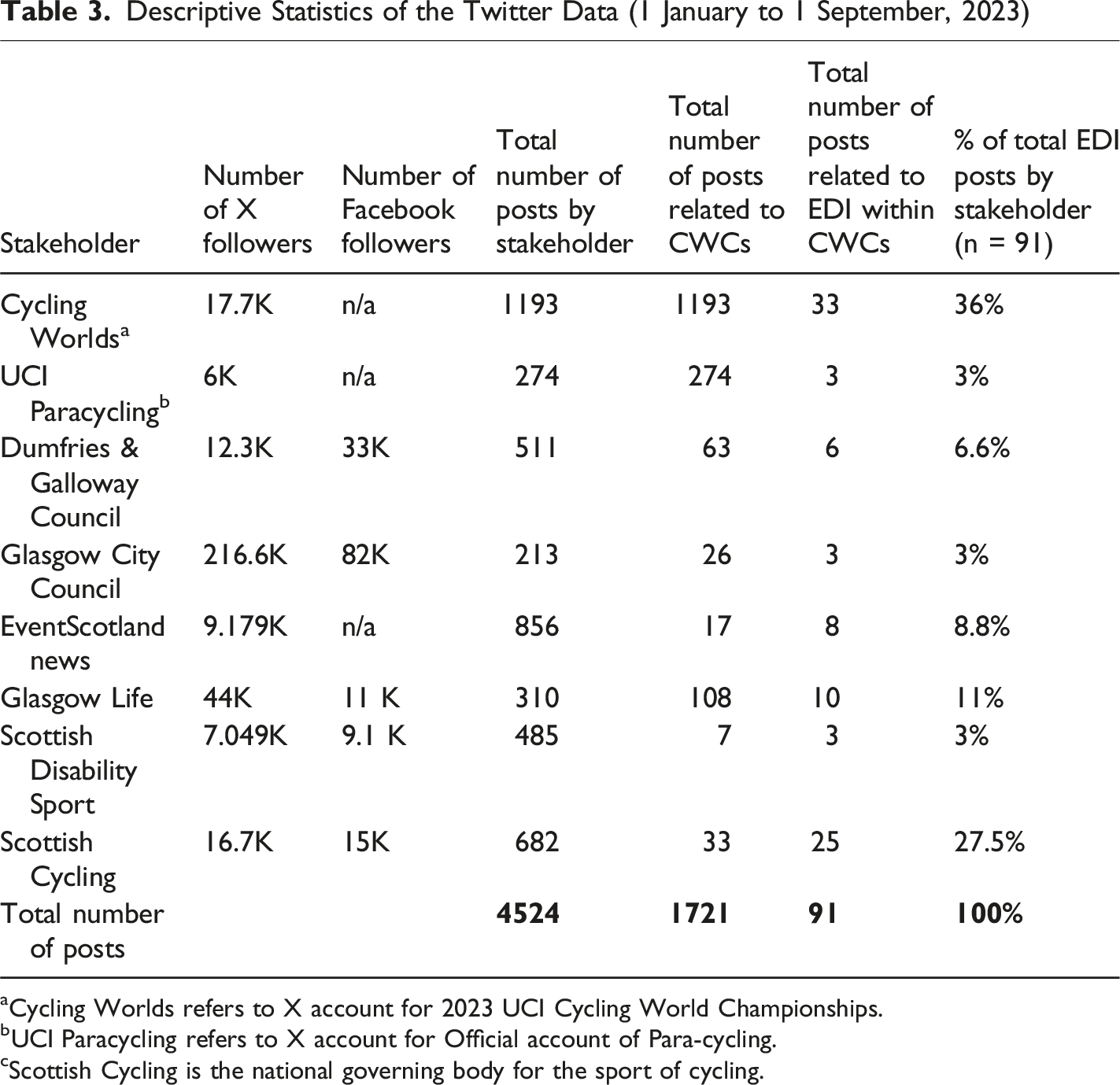
aCycling Worlds refers to X account for 2023 UCI Cycling World Championships.
bUCI Paracycling refers to X account for Official account of Para-cycling.
cScottish Cycling is the national governing body for the sport of cycling.
Our final phase (Phase 4) reduced the number of posts again by focusing on stakeholders actively promoting EDI messages. In this process we were interested in the extent to which commitments made in the EDI Framework and Pledge were visible in social media activation, including how girls and young women, people with disabilities, or minority ethnic communities were discussed, as these were the target groups identified in the event’s EDI commitments. In total, we identified 91 social media posts made by stakeholders which specifically referenced EDI related content associated with the CWC. These posts included textual, video and photographic content. Engagement with posts is influenced by the content type and we know that there is growing use of video content on X, increasing by 35% year on year (McNamee, 2025). We sought to assess engagement with posts as a proxy for potential reach and influence and included the number of views, where available alongside likes, comments and shares, as these represent efforts by the stakeholders to create awareness and generate discussions about EDI. At this point, it is important to acknowledge that we did not secure interviews with the organising committee’s media and marketing personnel as intended. The nature of sport event organizations is that personnel move on soon after the event ends, which is part of the problem associated with effectively leveraging events for sustainable change.
We structure our findings temporally as the leveraging framework suggests that social inequities can only be effectively addressed through sport events if planned in from the earliest possible stage as that is when the opportunity to get partners to collaborate is at its greatest (Misener et al., 2018). Therefore, we consider how social media was used as a means of promoting EDI pre-Games, during and afterwards.
Pre-event Leveraging: Performative Posting
The EDI Framework and Pledge provided the CWC with a platform through which a particular discourse was enacted, though this was primarily a ‘generic’ set of ambitions and commitments, other than a targeting of girls and young women, people with disabilities, and minority ethnic communities. We found that social media posting activity in the period before the CWC was largely reacting to the publication of the Framework and Pledge but that, over time, the communication of a focussed narrative waned. In our sample of social media posts, 68% (58 posts) were made before the event, which on first view represents a positive signal of strategic leveraging in action. However, the pre-emptive, collective promotion of EDI commitments also conceals power relations, reducing systemic injustices to poorly defined ‘future’ plans.
As expected, the institutional stakeholder most active and focussed in its activity was the official event organizer, the Cycling World Championships Limited (@CyclingWorlds). This was the official account of the CWC on X, with 19.1 K followers. This was the main social media account for sharing news and updates related to the CWC and had the highest proportion of EDI content shared on its page, with a mix of both original content, likes, and reposts of other stakeholder X posts. This initially suggests a degree of coordination to how the CWC approached the strategic use of social media in promoting EDI discourses. However, given our interest in discourse and power, it is important to also consider what the content included and who said it.
Spurdens and Bloyce (2022) have shown that NGBs perpetuate a dominant discourse that ‘we are doing something’ despite not articulating clear policy objectives in the equalities space. Our findings in the pre-event period indicate that in relation to EDI and the CWC, a similar situation exists. While the aforementioned EDI Framework and Pledge expressed a series of ‘commitments’ to relatively uncontested and non-specific EDI ambitions, we found little evidence of which individuals and groups were included and how this agenda was being actioned through a deliberate social media messaging strategy. As Spurdens and Bloyce (2022) argue, “if NGBs do not express how they are going to implement equality for LGBT + persons, it is unlikely they will be able to operate power in a way that will achieve the apparently desired outcomes” (p. 517). Drawing on the idea that to leverage media effectively it needs to align with a clear strategy (Thomson et al., 2024), we examined which EDI discourses were reflected in posting content and activity, by whom and with what purpose when considered from an analysis of power.
Pre-games, our findings show that stakeholders’ social media activity focused primarily on raising awareness of the diversity of athletes competing in the CWC event, in terms of race and ethnicity, or disability. For example, in July 2023, the @CyclingWorlds shared the experience of an Afghan cyclist participating in the CWC: @Cycling Worlds (2023 UCI Cycling World Championships). “I want to represent my country, for every Afghan girl that doesn't have that opportunity.” For the first time, a team of female cyclists who fled the Taliban regime in Afghanistan will take part in an international cycling competition. #GlasgowScotland2023 #PowerOfTheBike.” (7736 Views, 33 Retweets)
The Cycling Worlds account also focused on the success of para-athletes as a way of promoting its inclusion agenda: @Cycling Worlds “On Wednesdays we support World Champs! Get to know Scottish Para-Cycling Track legend @neilfachie better in this Power of the Bike video and find out what competing in front of a home crowd at the Sir Chris Hoy Velodrome will mean this August... #PowerOfTheBike.” (12900 Views, 12 Retweets)
However, while these posts represent recognition of inclusion as a priority, emphasizing acceptance and belonging for those on the margins, they almost wholly focused on the ‘event’ itself and contained little information to inform the wider audience of how the CWC was advancing opportunities for those experiencing social inequities. Here, there is a sense of equality proofing in action (Gardner et al., 2023), whereby the organizers signal a generalized interest in valuing inclusion but without evidence of any focused actions to translate this information into opportunities in the host environment.
There was some evidence that other official stakeholders promoted their support for the EDI Pledge as part of their communications, pre-event. On 7 March 2023, Cycling Worlds promoted the EDI Pledge on its X account: @Cycling Worlds (2023 UCI Cycling World Championships). “Along with our partners & key stakeholders, we've just signed our Equality, Diversity and Inclusion pledge, committing to creating an inclusive, diverse, and accessible event in Glasgow and across #Scotland this August! #GlasgowScotland2023” (4334 Views, 11 Retweets)
While promoting the Pledge itself can be viewed as window dressing (Shaw & Penney, 2003), or an exercise in impression management without words being turned into actions (Gardner et al., 2023), there was some evidence that specific EDI initiatives were promoted on the Cycling World’s X account in the lead up to the event. For example, on 24 July 2023, the account posted about free period products and sensory bags at all venues, highlighting the emphasis on girls and young women and people with disabilities, reaching almost 10,000 users: @Cycling Worlds (2023 UCI Cycling World Championships). “ICYMI: Last week, as part of our commitment to Equality, Diversity and Inclusion, we announced that period products & sensory bags will be available for free at all Championship venues. You can find out more via the story” #GlasgowScotland2023.” (4334 views, 11 Retweets)
This example illustrates a clear, directed strategy to highlight commitment to EDI, followed through with concrete actions and initiatives that go beyond virtue signalling (Gardner et al., 2023) to address specific needs - in this case for period products and sensory bags for neurodiverse audiences. Building on this, we also found evidence of the growth and sustainability of women and girls cycling in Scotland being amplified by several CWC stakeholders, actively promoting events and initiatives that took place in the build-up to the event. This area represents the best example of strategic messaging around the EDI agenda. For example, on International Woman’s Day (8 March 2023), the Cycling World’s X account took the opportunity to share updates on the EDI Pledge: @Cycling Worlds (2023 UCI Cycling World Championships). “We will commit to the growth and sustainability of women and girls cycling in Scotland. That’s what we and partners have signed up to as part of our brand-new EDI Pledge! #Embrace Equity #IWD2023.” (2427 views, 2 Retweets)
In terms of embedding inclusivity and accessibility into event planning for each of the 13 cycling World Championships. Dumfries and Galloway Council, an important stakeholder that hosted paracycling events, posted on X on July 28, 2023, to promote the para-CWC to encourage inclusion and awareness within the local community and shared a video showcasing their commitment to disability cycling: @DGCouncil (D&G Council) “In the build up to the UCI Para-Cycling World Championships next week, our Disability Sports Team have been facilitating cycling sessions, like the one featured in this video, at Annan…” 1:24PM (707 views and 3 Retweets).
Pre-Games, this was one of the few posts that went beyond textual content to engage the audience with video, which the literature suggests can generate more engagement. However, the number of views and engagements with the content was quite low, and this was one of few posts by the local authority that was not related to event logistics.
In the CWC EDI Pledge there was a commitment to building partnerships, initiating conversations and seeking out opportunities to activate programmes in support of EDI. This is strategic event leveraging (Schulenkorf et al., 2024) in action, and in the build-up to the event there was some content shared encouraging collaboration between cycling clubs in Scotland. The most popular post of the pre-event sample, from Cycling Worlds just before the start of the event, emphasized the positive relationships between event stakeholders and indicated the joint focus on the legacy of the CWC 2023 for Scotland, though not explicitly related to EDI issues: @CyclingWorlds (UCI World Championships) “What an afternoon with @transcotland and @scotgov yesterday. On the eve of the first day of sporting action at the 2023 UCI Cycling World Champs we celebrated the #PowerOfTheBike and the joy and the legacy of #everydaycycling. The event included a showcase of some of Scotland’s brilliant community cycling organisations that aim to get as many people benefiting from #PowerOfTheBike as part of their everyday journeys!” #GlasgowScotland2023 (39900 views, 17 Retweets)
To address social inequities through strategic event leveraging the literature suggests that it is important to have a clear campaign strategy, including agreed content, style of communication and intended outcomes that can be assessed (Misener et al., 2018). Pre-event, we found evidence that the main organizer, Cycling Worlds, led on messaging around the stated EDI ambitions of the event, assisted by Scottish Cycling, the national agency. However, there was little evidence of a clear strategy behind the frequency of posting, the style and content of posts, or use of hashtags and links to drive audiences to find out more about the EDI issues being promoted. When the organizers did emphasize the importance of the EDI Pledge and Framework, it was largely as a promotional vehicle to highlight that EDI was ‘done’ or ‘achieved’ (Gardner et al., 2023), sitting in the realm of impression management rather than concrete actions. We found little evidence that other strategic partners supported, reinforced, or helped extend the message’s reach and potential impact. For example, Glasgow City Council, who signed the EDI Pledge and identified as a key stakeholder in the event, shared a consultation on a new Cycling Strategy a month before the event which secured 14,200 views, yet contained no mention of the CWC or how this could contribute to its legacy. This example illustrates a missed opportunity in the crucial pre-event phase to leverage strategic social media messaging. The posting that was undertaken was largely performative, signalling a commitment-free awareness of EDI without “enunciating intended actions and positions” (Spurdens & Bloyce, 2022, p. 520).
It was also striking in many of the tweets that collective language was utilized (i.e. ‘we’ and ‘our partners’). While this appears to demonstrate a shared commitment to make a difference in the EDI space, from an FDA perspective the use of the language of teamwork, partnerships and collaborators also acts to avoid individual responsibility and accountability. Publishing an EDI Framework and Pledge and securing signatories from strategic partners gives the impression of progress which deflects from the need for action on behalf of each institution. This is further exacerbated in the use of hashtags like #powerofthebike which represents a useful marketing slogan for partners to symbolically demonstrate their commitment to change, while avoiding investing in concrete policies or initiatives to address the systemic inequities faced by those intended to benefit. For example, the ‘power of the bike’ for people with disabilities is only meaningful if access to bikes is accompanied with access to resources, policy changes, and other means of addressing powerful systemic barriers. The effect is to leave EDI in a state of ambiguity and abstractness which reproduces the status quo in respect of the systematic inequities that marginalized groups experience.
Delivery Phase Messaging: Ad Hoc and Uncoordinated
In this section, we assess the nature of strategic social media messaging of EDI content during the CWC delivery phase from August 3 to August 13, 2023. Of the 91 posts relating to EDI in our sample, only 21% (19 posts) were published during the event. This is unsurprising given that Müller (2015) suggests the ‘event takeover’ skews focus onto delivery at the expense of wider benefits, but others emphasize that the media attention generated by the live event can represent a unique opportunity to activate key strategic messages (Thomson et al., 2024). We found that during the event there was some content posted that affirmed the importance of the inclusion message but primarily in one region and without clear coordination, further reinforcing the notion that individual accountability for addressing systemic barriers was lacking. Most of the CWC para-cycling events took place within Dumfries and Galloway in the South-West region of Scotland, therefore most of the X posts by the strategic partner, Dumfries and Galloway Council, related to these events. While most of the content we assessed was textual, the Council account posted a 35 second video focusing on the inclusiveness of the events for people with disabilities: @dgcouncil (Dumfries and Galloway Council) “As well as getting the chance to cycle the home straight of the route, our Disability Sports Team were also giving the VIP star treatment & interviewed after they'd finished. Stars of now & stars of the future, for sure. :)” (768 Views and 1 Retweet)
The decision to use a visual representation was a potentially powerful means of providing a platform to raise awareness of the disability inclusion agenda that the event’s EDI Framework and Pledge talked to. McPherson et al. (2016) have shown how important positive representations can be in raising awareness and encouraging people with disabilities to contemplate accessing sporting opportunities, but this post focused only on the presence of people with disabilities on the route rather than being part of coordinated event-focused messaging strategy. The social media post was effectively a publicity stunt designed to visibly demonstrate the event’s commitment to supporting people with disabilities. Yet, we know that systemic discrimination is based on ableist assumptions, institutions and structures that disadvantage people with disabilities (Misener et al., 2015). Engagement with the post was quite low, with no other event stakeholder taking the opportunity to lever this story to amplify its reach. This, again, highlights a lack of (social) media leveraging strategy and a failure to recognize and address the systemic barriers that people with disabilities face. The Dumfries and Galloway Council account shared content focusing on local people with mobility issues getting the opportunity to try bikes used by para-cyclists: @dgcouncil (Dumfries and Galloway Council) “As part of the UCI Paracycling World Para-Cycling Championships, we are giving local people with mobility issues the chance to try out a specially adapted bike. Mary here was one of the first to try :)” (668 Views and 1 Retweet)
This post represents a more concrete example of promotion linking to action, addressing the criticism of EDI policies for being overly performative, public relations exercises (Spurdens & Bloyce, 2022). It focuses on material actions available in the local area for disabled people to access. However, while these specific initiatives indicate that organizations are doing something (Spurdens & Bloyce, 2022), the absence of other influential stakeholders using their powerful platform highlights a lack of strategic coordination and the low importance given to people with disabilities within the event communication strategy. In a related example, Glasgow City Council has over 200,000 X followers and yet made no posts during the event period related to its EDI ambitions.
On 7th August, the Scottish Government, the event’s major funder, sought to activate elements of the sporting spectacle (the BMX Medal presentation) to highlight the multi-stakeholder approach taken to encourage inclusion in cycling through activities for young people in Scotland, posting a 38-s-long video: @Scotgov (Scottish Government) “The first @CyclingWorlds BMX medals will be awarded today! Find out how @glasgowlife and @ScottishCycling are encouraging young people to try the sport and have fun #Powerofthebike #GlasgowScotland2023.” (18400 Views and 16 Retweets)
This approach aligns with the main tenets of leveraging theory which suggests that you can activate the event by “launching tactics to capitalize on the events’ specific potential” (Schulenkorf et al., 2024, p. 786). However, while the example video was viewed 18,500 times, this paled into insignificance when compared to some examples of user-generated content (UGC) that generated much more attention and engagement. For example, a video of a winning para-athlete amputee receiving a wristwatch as part of the race prize quickly went viral, without any contribution or response from the official event organizers or key stakeholders. The TikTok post of Ricardo Ten Argilés’s ceremony was liked 436,000 times, generated over 4000 comments and was viewed 12 million times. Discussions around the appropriateness of the prize afforded the event organizers an opportunity to tap into a trending discussion around disability rights and perhaps raise awareness and reflection on the event organization. However, there was no strategic response to this moment by official partners, further emphasizing the largely symbolic, surface-level engagement with equalities issues in the communication strategies for the event.
While the EDI Pledge commitments focused on encouraging diversity and inclusion and minority ethnic communities were identified as a key target group, again we found very little evidence that awareness of the systemic inequities that minority ethnic communities experience were foregrounded in the social media activities of organizers and their partners during the event. Due to para-cycling events being hosted in the Dumfries and Galloway area, messages about people with disabilities were more visible, though relatively infrequently and often focused on event logistics rather than emphasizing the area’s commitment to disability sport or opportunities to participate. Considering a Foucauldian conception of power, it is important to go beyond what is said to consider how it is said, and what is not said. In terms of the social media posting during the event CWC, there was a predominance of generic EDI discourse emphasizing the importance of ‘talking’ publicly about equality, diversity and inclusion, but also avoiding explicitly recognizing the complex and systemic barriers facing underserved and equity-deficit groups. Our findings suggest that organizers and their partners communicated about generalized EDI commitments but shied away from addressing the more heavily politicized equalities issues, especially those associated with race and ethnicity. Especially in the increasingly toxic environment of social media, the absence of focus on race and ethnicity itself represents an expression of power, reinforcing an equalities hierarchy. During the CWC event itself, where there was an opportunity to draw attention to systemic inequities associated with the rights of people with disabilities to access sport, but this was also missed, with the social media messaging reinforcing ableist assumptions by emphasizing only the ‘opportunity’ afforded to a disabled sport club to ride on the competition course.
In summary, during the delivery phase there was, again, only limited evidence of EDI messages being amplified across the partner stakeholder community. Despite all the key stakeholders signing the EDI Pledge and the CWC having a detailed EDI Framework in place, there were few social media posts specifically referencing these initiatives. There was little evidence that social media was used strategically to help activate the EDI message in a coherent and planned manner during the delivery phase when the world was watching.
Post-Event: A Collective Silence
Only 15% (14 posts) of EDI-related posts were made post-event, and we found very limited evidence of strategic messaging related to any of the EDI Pledge Commitments, or reflection on the legacy ambitions of the event for girls and young women, people with disabilities and minority ethnic groups. Instead, the content shared by official organizers and their partners emphasized the global legacy of the event for those marginalized from cycling in some parts of the world. For example, Cycling Worlds posted about support for those using bicycles in vulnerable communities: @cyclingworlds (UCI Cycling) “Donate to @PowerofBicycles now & your gift will be MATCHED, making 2x the impact! You can help support those using their bicycles to get to school, deliver healthcare & build better lives for their communities. (8050 Views and 11 Retweets)
Scottish Cycling posted content more focused on the inclusivity of the event, including examples of recreation group rides that those interested could follow up with, but this post did not garner a significant number of views or retweets: @Scottish Cycling (Scottish Cycling) “From performance to participation, inspiring and supporting more people into cycling. Find out more about how our ride leaders led recreational group rides on the ground across the @CyclingWorlds.” (1214 Views and 4 Retweets)
Cycling Worlds also re-shared relevant content on initiatives introduced to encourage participation and create a legacy from the event which receive a reasonably good level of viewership and engagement: @CyclingWorlds (UCI Cycling World) “RT @CyclingUKScot The Cycle Share Fund is open for applications! This £1m fund provides grants for schemes that give people affordable, easy and convenient access to a bike that they don’t own. Delivered by Cycling UK and funded by @transcotland”. (9498 Views and 19 Retweets)
The organizers also shared content, showcasing one of the few instances of promoting a club that provides cycling access to the visually impaired and had benefited from investment leveraged by the CWC. However, the content was posted by a local councillor rather than an owned stakeholder account. Locally, Dumfries and Galloway Council posted on X to thank the local community for their participation and patience in dealing with disruption caused by the event, but there were no mentions of opportunities to continue cycling or referral to resources or clubs where these opportunities could be realized: @dgcouncil (Dumfries and Galloway Council) “UCI Para Cycling World Champs - completed it! To all the athletes, support teams, volunteers, stewards, frontline and behind-the-scenes workers - well done for a superb effort. To anyone affected by route closures - thank you for your understanding. D&G has been the perfect host.” (1759 Views and 0 Retweets)
For social media to have been used strategically to advance equalities agendas through a major sport event backed by the Scottish Government and other influential partner organizations, we would expect to see a much more systematic promotion of opportunities, post-event. Moreover, addressing the systemic injustices associated with race, ethnicity, disability and gender inequity cannot be reduced to promoting feel-good stories and receiving likes and retweets on social media platforms. The coalition formed for this event could quite easily have leveraged investment to address systemic barriers to change, but instead the focus appears to be on promotional gloss, where easily communicated EDI discourses are shared on social media platforms.
While it is fair to recognize that some of the stakeholders involved in this study are relatively small organizations with limited marketing teams (see Table 1), others have a significant following on social media and the resources to produce high quality textual, photographic or video content were that have been a strategic priority. A final point in this findings section is the absence of some key EDI Pledge signatories using social media to communicate clear messages. Scottish Disability Sport, the national agency, made only three posts related to EDI during the study period as did Glasgow City Council, the local authority area where most of the events were located. Finally, the Scottish Government was also largely absent in using its social channels, which is surprising when it initiated the EDI Framework and Pledge process as part of its commitment that publicly funded sport events have a public duty to comply with the requirements of the Equality Act 2010 in their planning and delivery. However, the absence of some key voices is more understandable when examined as a set of discursive practices. The dominant, and acceptable, EDI discourse produces meanings and effects. So, the formation of an EDI Framework and Pledge for the CWC represented a largely symbolic act, generating a set of commitments that provided a veneer of progress, while remaining largely performative. Some elements of the Pledge were reflected in social media posts but represented a comfortable consumable narrative that satisfied the political desire to ‘do something’ without addressing the basis of systemic inequities and challenging unequal power relations.
Discussion
The research question guiding this paper asked, “How do event organizers and key stakeholders use strategic social media messaging to promote equality, diversity and inclusion agendas before, during and after the event?” Based on the evidence garnered from the CWC event, we have demonstrated that the organizers and their principal stakeholder partners largely paid lip service to the EDI Pledge and Framework commitments, missing an opportunity to leverage the event to more effectively address systemic social inequities. We know from previous studies the importance of contextual nuances and bespoke partnership engagements (Schulenkorf & Edwards, 2012) if strategic ambitions are to be realized. In the case of the CWC event, the lead organizer shared content related to the EDI ambitions of the event relatively consistently, pre, during and post-event. However, there was little evidence of a coordinated campaign with shared multi-institutional ownership designed to amplify messages, extend reach and maximize engagement with the public. Those stakeholders with the greatest reach and engagement focused on practicalities around the event, failing to give recognition to, and address, more challenging, and contested, EDI topics. More problematically, the frequent use of collaborative terminology like ‘team’ and ‘partnership’ within event-related social media activity, served to deflect from the individual responsibility of organizations to address systemic inequities themselves.
There were missed opportunities to promote the EDI initiatives of the CWC within social media content with concrete programmes and projects that recognize the injustices marginalized groups face. The reduction in social media activity relating to EDI immediately following the event, demonstrates the lack of commitment to systemic change. Strategic partners focused their social media communications on either a hyperlocal agenda or on an overly general sense of the event being for all, failing to align this focus with the CWC EDI Framework and Pledge commitments and on targeted groups including girls and young women, people with disabilities and minority ethnic communities. For example, the national disability sport governing body used its social media channels to emphasize the paracycling component of the event but that did not extend to emphasizing the accessibility advancements made by the event, or to opportunities to promote clubs and activities open to disabled people, more generally. Conversely, local councils used social media to communicate local cycling initiatives but rarely linked this to the CWC or legacy of event for their areas.
The CWC event offered an opportunity to use effective social media messaging to promote the causes highlighted as key EDI commitments for the event. In theory, social media can drive highly targeted and timely messaging and offer opportunities for interaction between stakeholders and wider publics. While O’Brien and Chalip (2008) recognize that organizers need to be careful not to promote social issues to the detriment of the main event, they also stress that there is an opportunity to agree on realistic issues to progress and to use the event energy to drive that agenda. Major sport events can shine a light on participation opportunities that the public become aware of through the demonstration effect (Weed et al., 2015). While social media channels were used to encourage underrepresented groups to become involved in cycling, including opportunities for women and girls and people with disabilities, the focus was on feelgood stories that draw attention away from the systemic barriers that continue to exist. There was little or no promotion of programmes or activities for those whose interest was spiked by the event in the post-event period, crucial if greater awareness is to be translated into action (Misener et al., 2018).
Critics of debates about EDI, sport and sport events highlight a performative problem, whereby broad commitments to doing something (Spurdens & Bloyce, 2022) like producing policies and ticking equality proofing checklists “create an image of being attentive to diversity” (Gardner et al., 2023, p. 340). Our findings suggest that in terms of leveraging social media to help advance opportunities for women and young girls, people with disabilities and minority ethnic communities through a cycling event, the CWC EDI Framework and Pledge remained largely performative. Like any commodified process, it was relatively easy for organizations to sign up to a Pledge without consequence, penning fine words but failing to act to challenge systems of structural inequity by investing resources (in this context social media). We found insufficient evidence of concrete practices like goals, deadlines or measurement strategies to assess the success of social media campaigning from an EDI perspective. Instead, we posit that strategic actors engaged in virtue signalling, making public commitments without the necessary investment in the allocation of resources to translate words into actions. At a time when equalities issues are heavily politicized in Scotland and beyond, the governing agency and major funder of the CWC privileged an accessible, publicly consumable discourse of EDI. In planning and delivery of an event like this there are “complex interactions between actors and institutions privileging some discourses over others” (Sam, 2019, p. 337). Those easily consumable EDI discourses promoted via social media by event organizers are welcome, but without recognition of the power imbalances that continue to exist and perpetuate inequities then messaging operates to maintain the status quo rather than challenge it.
Conclusion
Evidence from the literature suggests that intentionality, strategic planning and astute tactics need to be in place for positive social outcomes to be realized, benefitting from the specific potential of the event. Cycling is a relatively accessible sport and active transport pastime. The CWC event provided the perfect opportunity for the advancement of EDI agendas because of its alignment with wider governmental and sporting governing body policy drivers, alongside concurrent investment in cycling facilities and active transport networks around the host country. However, this study demonstrates that the event syndrome is still a powerful distraction for event organizers, with the emphasis of the powerful media resources at hand used to promote the event itself instead of advancing other policy opportunities. While there is powerful rhetoric about the convening power of events to bring partners together to operate strategically, the evidence presented here suggests that this does not extend to the strategic management of social media. If organizations seek to use a major event to address social inequities, then this needs to be accompanied by well-resourced campaigns designed to advance this messaging, with assets and agreed scheduling in place. Buy-in from other delivery stakeholders to present a coherent approach to advancing EDI is also essential to the success of this activity. In the context of EDI, building it into the constitution of organizing committees is imperative to ensure that it moves from the periphery to the centre of planning and delivery, including how media will be used to promote the agenda pre, during and post-event. In most cases, event owners can mandate this requirement when the award the rights to host.
We recognize the limitations of the study, focusing primarily on the X platform. In an increasingly diverse social media landscape, future studies will need to consider how organizers use other platforms for promoting the event and related social issues. We also acknowledge that most of our data was generated from stakeholder-owned social media channels. Considering user generated content, including the conversations initiated and followed up after the event, would also be a fruitful area for further research. Finally, future research should also explore the decision-making process around social media posts from the stakeholder media and marketing teams involved in the event.
However, despite these limitations, this paper makes a strong contribution to our understanding of the potential value of social media in addressing social inequities around major sport events. Based on our findings, we propose three practical recommendations to ensure that the resources available to event organizers are utilized more effectively. First, organizers and their partners need to approach their social media campaigning more strategically, agreeing on the content they wish to push out to tackle the social inequities they want to address. The organizing committee, as the most powerful and influential convening power needs to coordinate this activity, bringing in other influential actors to agree a set of planned outcomes from the event opportunity. Second, organizers and their partners need to collaborate more closely to implement a strategic social media campaign that includes agreed content, clear roles and, crucially, a detailed timeline of activity before, during and after the event. Related to this, resource allocation must be considered as a campaign is being developed, to address potential inequities between the marketing or media capacities of stakeholders. Third, while organizers and their partners should continue to make use of their owned social media accounts to push content, they also need to embrace user generated content and more effectively use hashtags to engage with potential audiences that are the target of the social inequities being addressed.
Theoretically, this paper contributes to the sport communication field in its utilization of FDA and strategic leveraging. Others can draw on our systematic implementation of FDA to analyse the power dynamics that exist as organizations intentionally promote certain discourses via their social media channels. While we are critical of the overly superficial engagement with EDI discourses in the case of the CWC, just like other forms of media, social media can be fruitfully utilized to promote progressive, pro-social agendas. However, for systemic change to be realized, it needs to be leveraged intentionally, exploiting the convening power of major events to maximise the individual responsibilities of influential partners.
Footnotes

Ethical Approval
The University of the West of. Scotland School of Business and Creative Industries Academic Integrity and Ethics Committee approved the study in 2023, review reference 2023-21508-16669.
Funding
The authors disclosed receipt of the following financial support for the research, authorship, and/or publication of this article: This work was supported by Spirit of 2012.
Declaration of Conflicting Interests
The authors declared no potential conflicts of interest with respect to the research, authorship, and/or publication of this article.