




Abstract
During the Tokyo 2020 Paralympic Games, the International Paralympic Committee launched a global campaign called WeThe15 to draw attention to the 15% of the global population with a disability with the hopes it would become the largest human rights movement in history. Utilizing framing theory, this study sought to understand how the mass media framed WeThe15 in its coverage during the Tokyo 2020 Games and the subsequent Paralympic Games, Beijing 2022, and to determine if any differences existed between the two Games. Using qualitative document analysis, we examined English-language articles about WeThe15 during both Games. There were stark differences in the amount of coverage, with our search uncovering 177 articles from 22 countries during Tokyo 2020, and only 10 articles from six countries during Beijing 2022. Three broad frames and four overarching themes were used to contextualize the WeThe15 campaign during the Tokyo Games: basic campaign information, partners leveraging the campaign, athlete narratives, and amplifying disability visibility. Basic campaign information was identified in coverage from the Beijing 2022 dataset. Our findings highlighted the need for sustained media coverage and engagement for growing social movements and offered both theoretical and practical implications of media framing of social movements related to sport.
Just before the Tokyo 2020 Paralympic Games began in August 2021, the International Paralympic Committee (IPC) announced the launch of a global campaign called WeThe15, which was designed to represent the 15% of the global population with a disability. In a press release announcing the campaign, the IPC stated that WeThe15 “aspires to be the biggest ever human rights movement” (IPC, 2021a, para. 1) and “aims to end discrimination towards persons with disabilities and act as a global movement publicly campaigning for disability visibility, accessibility, and inclusion” (IPC, 2021a, para. 2).
Working alongside several international partners such as the International Disability Alliance, UN Human Rights, UNESCO, The Valuable 500, Special Olympics, and the Invictus Games, the IPC activated the campaign through a wide variety of initiatives. For example, a 90-s campaign film was released to broadcasters in 60 countries, over 125 famous landmarks were lit up in the campaign’s signature color, purple, and a hashtag, #WeThe15, was introduced on social media platforms. The campaign press release stated that it would continue to build momentum during the Paralympic Games in Beijing, Paris, Milan, and Los Angeles (IPC, 2021a).
To further understand the significance of the IPC’s WeThe15 campaign, it is important to also understand the significance of the Paralympic Games within the broader sport ecosystem. While parasport competitions took place as far back as the 1940s, the first Paralympic Games held at the same site as the Olympic Games (after the conclusion of that event) was at the 1988 Seoul Summer Games, featuring 3,057 athletes from 60 nations (Olympics.com, n.d.). Holding the Paralympic Games in the same city and near the same time as the Olympic Games helped legitimize the Paralympics as a major international mega sporting event, which now garners sponsorships from multinational corporations, television broadcast rights deals, and significant media coverage (Rocha et al., 2023). The success of the Paralympic Games has also helped to normalize disability sport in many parts of the world, although research indicates that the Paralympics are not always empowering to disabled people who do not participate in parasport (Purdue & Howe, 2012). Thus, the WeThe15 campaign aimed to be as inclusive as possible and positively impact disabled people all over the world regardless of their status as an athlete.
Along with the IPC’s and its partners’ efforts to draw attention to WeThe15 via the previously mentioned activations, during its launch the campaign was also highly reliant on the mass media to help disseminate key information to global audiences (IPC, 2021b). The ways in which topics or issues are presented, or framed, by the mass media can influence the perceptions and interpretations of such topics by audiences (Goffman, 1974). Further, according to Tuchman (1978), media frames can construct reality for audiences rather than constructing a “picture of reality” (p. 12) and can in turn have a strong influence on media consumers’ beliefs. Therefore, it is important to understand how WeThe15 was framed by the mass media to understand the reality presented to global media consumers about the campaign. This reality can impact consumers’ perceptions of and attitudes toward disability, which can therefore influence policies and legislation relating to disability rights. Along with these potential implications of the framing of WeThe15 coverage, media coverage of the Paralympic Games has historically perpetuated stereotypes of disabled athletes (Beacom et al., 2016) such as the super-crip narrative, which focuses on the athlete’s triumph over adversity by highlighting attributes such as their courage and perseverance (McGillivray et al., 2021). By portraying disabled athletes as heroes and suggesting that disability can be overcome by hard work and determination, such coverage undermines disabled people by diverting attention away from the very real everyday barriers they face (Silva & Howe, 2012). Rees et al. (2019) called for further investigation into the media’s portrayal of disabled elite athletes, especially given the power of media in shaping societal views and perceptions towards disability. Their systematic review highlighted that gender, nationality and disability type all influenced the level of coverage received by disabled athletes and although athleticism was a focus, the ‘supercrip’ and medicalized description of disability was evident. It is important to understand whether media coverage of WeThe15 continued to perpetuate such stereotypes, or whether the campaign was effective in its goal of shifting the narrative about disability to one that is non-discriminatory and inclusive in nature.
The purpose of this study was to examine mass media coverage of WeThe15 during the first two iterations of the campaign, the Tokyo 2020 and Beijing 2022 Paralympic Games, in order to understand the media framing of the campaign and whether any differences existed from one Games to the next. As the campaign is set to run through to at least the 2028 Los Angeles Paralympic Games, examining media coverage from the campaign launch (Tokyo 2020) and the subsequent edition of the Games (Beijing 2022) will add to the scant literature on media framing of social movements relating to sport, and specifically disability sport. From a practical perspective, the findings could assist the IPC and its partners in understanding how the campaign has been presented to the public thus far and allow them to confirm or revise their media relations strategy for WeThe15 during subsequent Paralympic Games. Analyzing coverage of the campaign will also provide insights on how disability was portrayed during these two Games, which can be compared to the findings of previous research on Paralympic Games media representations (e.g., Beacom et al., 2016; McGillivray et al., 2021; Silva & Howe, 2012). Furthermore, this research will provide much needed insight into the development and framing of a social movement specifically, and the role that sport and media play in supporting a social movement that aimed to elicit societal change in the perceptions of and attitudes toward disability.
The following section expands on framing theory (Goffman, 1974) and reviews relevant literature relating to the framing of disability sport and social movements.
Literature Review
Framing Theory
Framing theory posits that the ways in which mass media present topics and events help to create meaning for mass media consumers (Goffman, 1974). Frames are defined by Altheide (1997) as “very broad thematic emphases” (p. 651) that form parameters or boundaries when discussing a specific topic. Altheide (1997) uses the example of illegal drug use and some media outlets’ decision to frame the topic as an issue of public health, while others may frame it as an issue of criminal justice. For example, research on media framing of Russian sport doping scandals found that American media framed it as an issue of morality (Reed & Harker, 2022). According to Entman (1993), frames define problems, diagnose causes, make moral judgments, and suggest remedies.
The frames used by journalists when reporting on events help to construct reality for audiences (even if it is not a fully accurate reality) and can have implications on the meaning that such consumers attach to topics and events (Tuchman, 1978; Zaharopoulos, 2007). Billings (2008) noted that that while framing incorporates which aspects of an event to cover (selection), it also includes the amount of coverage devoted to certain aspects (emphasis), as well as what aspects are left out of news coverage entirely (exclusion). Billings (2010) used an example of American television network NBC’s decision to show every minute of gymnastics in its Olympic broadcast (selection and emphasis), while showing far less of the boxing competitions (exclusion), to illustrate these aspects of framing within media coverage.
Along with Billings (2008, 2010), numerous other studies have utilized framing theory to study mass media coverage of sporting events such as the Olympic Games (e.g., Billings & Eastman, 2002; Eagleman, 2015; Johnson et al., 2022; Zaharopoulos, 2007). Such research exposes the reality created for media consumers and the potential societal consequences of the frames presented; for example, the perpetuation of long-held stereotypes (Eagleman, 2011, 2015). Several studies have encouraged researchers to examine media frames in different contexts and involving diverse issues to expose and understand the way these issues are framed, and the reality presented to media consumers (e.g., Eagleman, 2011, 2015; Lewis & Weaver, 2015; Zaharopoulos, 2007).
As this study was guided by framing theory, the following research questions were developed to understand how the global mass media framed the IPC’s WeThe15 campaign in both Tokyo 2020 and Beijing 2022:
What frames were used by the mass media in coverage of the WeThe15 campaign during the Tokyo 2020 Paralympic Games?
What frames were used by the mass media in coverage of the WeThe15 campaign during the Beijing 2022 Paralympic Games?
How did the mass media frames of the WeThe15 campaign differ, if at all, from Tokyo 2020 to Beijing 2022?
Media coverage is inextricably linked to the concept of framing, therefore the following section reviews literature relevant to media coverage and framing of disability sport.
Media Coverage of Disability Sport
The Paralympics has an unrivalled opportunity to influence societal attitudes surrounding disability, challenge perspectives, and shift dominant stereotypes (Hodges et al., 2014). However, previous coverage of disability sport has been extremely limited or overly focused on the impairment and personal resilience of disabled people, utilizing frames such as having to overcome challenges and being superhuman (Beacom et al., 2016; Kearney et al., 2019; Silva & Howe, 2012; Smith & Thomas, 2005). The dominant disability discourse revolves around the medical model, which is rooted in ableist narratives (Berger, 2008; Pearson & Misener, 2019; Purdue & Howe, 2012). Ableism as a concept is framed through a non-disabled person’s perspective, resulting in disability portrayed as being inferior, relegating these narratives “to the social margins” (McGillivray et al., 2021, p. 5). Paralympic athletes have long been depicted using a supercrip narrative (Cherney & Lindemann, 2019; Pullen et al., 2018), and are celebrated for “their courage, grit, and perseverance” (McGillivray et al., 2021, p. 3), as a way to construct the superhuman discourse. The supercrip portrayal has been criticized for ignoring the structural barriers that many people with disabilities face, by suggesting a simplistic narrative that one needs only to work hard in order to achieve success (Silva & Howe, 2012).
In an examination of British coverage of the 2016 Rio Paralympic Games, McGillivray et al. (2021) noted a slight shift in media coverage from previous iterations of the Games, which at times addressed policy failures relating to people with disabilities and reflected on the everyday circumstances and challenges faced by people with disabilities in the UK. This resulted in calls for further research to determine whether the shift in Paralympic coverage was long-lasting. A recent study by Holland et al. (2024) found that some traditional news outlets still deployed hegemonic practices “that focus on nondisabled athletes, popular sports, and representing disabled athletes and individuals through ableist and charity focused narratives” (p. 210).
Critically, through its reach and exposure as one of the largest sport events globally, the Paralympics has an opportunity to influence social norms towards disability, and shift stereotypes through the intersection of disability and elite sport (Silva & Howe, 2012). Gold and Gold (2007) emphasized the power of the Paralympics as a vehicle for social change, to alter attitudes, and accelerate recognition and integration of disability athletes. Yet, they acknowledged that not all disabled athletes are viewed equally by society, raising the question of how an event such as the Paralympics could be used to create a social movement around disability equality? This question leads to our next section, focused on literature related to social movements and media coverage.
Media Coverage of Social Movements
A social movement is an act usually undertaken by individuals, groups and/or organizations, who through networks of informal interactions share collective identities and engage in political or cultural conflicts, to achieve a specific objective (Diani, 1992). In recent years, many social movements aiming to create change have received global attention such as the #MeToo movement, BlackLivesMatter, and LGBTQ + rights. Following the work of Harvey et al. (2013), a “social movement combines the idea of change with the notion of a strategy or intentionality and the coming together to dominated or minority social groups in efforts at social transformation” (p. 9). Social movements go through a series of development stages, which evolve within a larger historical context. Sport often has a connection to social movements and has itself been influenced by such movements (Harvey et al., 2013). Furthermore, sport, and mega-events in particular (i.e., Paralympics, Olympics, FIFA World Cup), can be used as platforms for activating social activism efforts (Cornelissen, 2012).
Shifting media environments have altered the ways in which people engage, participate, and mobilize around social movements (Caren et al., 2020), and new media platforms and technologies have not only accelerated their global spread, reach and awareness, but have shifted power structures regarding who and how social movements can be formed and disseminated. Social media offers new opportunities for activism and social movements through global interconnectivity, instantaneous engagement, as well as offering a dynamic way to disseminate messages, mobilize participants, and amplify alternative narratives (Mundt et al., 2018).
Research has examined the role of social media as a vehicle for various social movements (i.e., feminism, Black Lives Matter, justice, and democracy issues) (Gallagher et al., 2018; Harlow, 2012; Horeck, 2014; Ince et al., 2017). One post can capture the attention of millions, ignite and reignite conversations with different audiences about deep-rooted societal issues, and influence journalistic media coverage (Noetzel et al., 2023). Garnering media coverage has been identified as key strategy employed by social movements both internally to build the movement, but also externally to communicate with different audiences, legitimize the movement’s cause and promote the movement’s claims to broader audiences (Caren et al., 2020). Research has specifically examined the media framing of social movements (Caren et al., 2020; Elliott et al., 2016; Noetzel et al., 2023), resulting in calls for further research to examine how media alter, enhance, or inhibit social movements’ ability to shape attitudes, mobilize support, and influence authorities and key stakeholder groups (Caren et al., 2020). The way in which journalists communicate information, however, informs audiences’ understanding, social acceptance, and the perceived importance placed on a certain issue (Johnston et al., 2015).
For example, Noetzel et al. (2023) examined how journalists framed sexual violence in the news surrounding the #MeToo movement. A content analysis of four US newspapers across a two-year period illustrated how media frames evolved during this time from reporting on a single incident, to informative reports, to broader discussions around systemic issues. Sport is often interwoven with political and social movements, as demonstrated by Boykoff and Carrington (2020), who examined the media framing surrounding NFL star Colin Kaepernick in 2016 when he knelt during the national anthem. Kaepernick did so as a political statement against racial inequality and police brutality towards people of color in the USA. Examination of five USA newspapers across a two-year period found that print media framed Kaepernick’s protests in a largely favorable manner, with the topic more frequently being presented through ‘patriot’ and ‘legitimate levelling of grievances’ frames, as opposed to ‘traitor’ and ‘shut up and play’ frames. This meant that athletes, including Kaepernick, were able to present their concerns around racial inequality within the media spotlight, yet political celebrities, notably then-President Trump, successfully changed the media framing, shifting the discourse away from athlete grievances towards a narrative around the US military and disrespecting the national anthem (Boykoff & Carrington, 2020).
Research has illustrated the role that media can play in constructing the realities of audiences and their perceptions towards a social movement, and in some cases media attention related to a social movement can influence political agendas (Caren et al., 2020; De Bruycker, 2019), although this is reliant on the media framing. Therefore, it is necessary to consider how the IPC’s WeThe15 campaign, which aims to create a social movement, is framed in mainstream media.
Method
In order to achieve the purpose of this study and answer the three research questions regarding the framing of WeThe15 in media coverage during the Tokyo 2020 and Beijing 2022 Paralympic Games, a Qualitative Document Analysis (QDA) method was employed. QDA focuses on the discovery and description of contexts, underlying meaning, and patterns and processes (Altheide et al., 2008). It is meant to be a systematic and analytical process in which a sample of documents is identified, a specific problem or issue is investigated within those documents, researchers become familiar with several examples within the sample to begin developing a protocol for coding the data, and then data are coded accordingly (Altheide et al., 2008). The following sections describe the process used to carry out a QDA for the current study.
Sample Selection
This research sought to understand how WeThe15 was framed by global media outlets, therefore two searches were performed using the Lexis Nexis database to identify relevant documents. Both searches used the keywords “WeThe15”, “#WeThe15”, and “We The 15” and were limited to English-language news sources only due to the language fluency of the researchers.
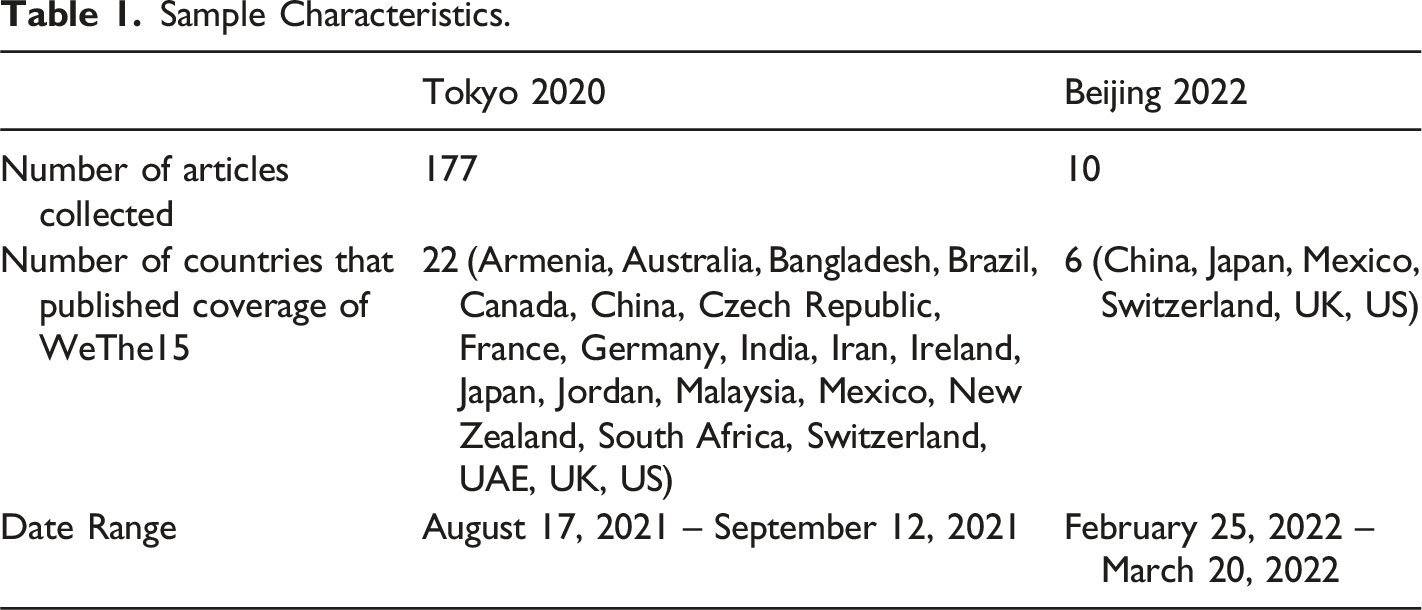
The first search included the timeframe of August 17, 2021 to September 12, 2021, which represented two days before the official launch of the campaign to one week after the Tokyo Paralympic Games. The IPC conducted a soft launch of the campaign on June 15, 2021, so we originally searched as far back as this date, but August 17 was the first date that any articles relating to WeThe15 appeared. The initial search yielded 253 articles. The lead researcher examined all articles and removed any duplicates (i.e., when a newswire service such as the Associated Press published an article, it often appeared in multiple newspapers; in these instances, the original article was retained, and duplicates were removed). After this process was complete, the final dataset consisted of 177 articles from 22 individual countries, with two region-specific publications (Asia/Latin America), and nine publications considered ‘worldwide.’ Although many of the articles in our sample were from newspapers, it is important to note that these articles were not limited to hard-copy newspaper publication formats, as all were also published in online formats allowing for greater consumption by media users.
The second search utilized the same keywords and covered the timeframe of February 25, 2022 to March 20, 2022, which represented one week prior to the 2022 Beijing Winter Paralympics through to one-week post-Beijing. This search resulted in a total of 13 articles, three of which were duplicates of other articles. Therefore, the final dataset for the Beijing Games consisted of 10 articles. This was a noticeably smaller sample than the Tokyo sample. While we are unsure of the exact reason for the drop in coverage of WeThe15 from Tokyo to Beijing, it should be noted that neither the IPC nor the WeThe15 website published any official press releases or information about the campaign between December 10, 2021 (a press release about the campaign winning an award) and April 7, 2022 (a press release about a tax break in France for Para sport). Therefore, the lack of official campaign communication likely impacted the amount of media coverage during the Beijing Games.
Sample Characteristics.
Coding and Data Analysis
QDA was employed to code and analyze the data. Two coders were initially utilized for the Tokyo 2020 data, and both coded a subset of 17% (n = 30) of the total sample. Coding involved entering information into a spreadsheet including the article title, date of publication, author(s), country in which it was published, and notes about the key information covered in the article to assist in the development of themes. At times when new topics or potential themes emerged from an article, the researchers would go back to previously coded articles to ensure they had accurately captured all relevant information. This is known as the constant comparison method and is commonly used in QDA (Altheide et al., 2008). Following this initial coding process, the researchers met to compare their notes and discussed the themes they believed to be present in the data thus far. Once it was agreed that the coders were analyzing the data similarly to one another, they divided the remaining articles and independently coded the remainder of the dataset.
A third coder joined the research team during the Beijing 2022 analysis and completed several training sessions with the original two coders to understand the coding process and the themes that emerged from the Tokyo data. After all data analysis was completed, the three researchers held peer debriefing sessions (Krefting, 1991) to discuss their interpretations of the data and clarify any points of confusion, thus helping to establish trustworthiness in the data analysis (Merriam & Tisdell, 2016). According to Creswell (2014) peer debriefing enhances accuracy of interpretations and adds validity to the results.
The following section presents the results of our research, organized around the three research questions guiding the study, which aimed to understand media framing of the WeThe15 campaign during the Tokyo 2020 and Beijing 2022 Paralympic Games.
Results
Of the 187 total articles collected across both the Tokyo 2020 and Beijing 2022 Games, three overarching frames were uncovered within our data analysis: (1) informative/awareness, (2) human interest, and (3) educational. These were supported by four more detailed themes within the coverage: (1) basic campaign information, (2) partners leveraging the campaign, (3) athlete narratives, and (4) amplifying disability visibility. Though a total of four themes were developed, only one of them was present in both the Tokyo and Beijing Games coverage – basic campaign information. This finding is discussed in greater detail later in this section. Our research questions parsed out the narratives in Tokyo 2020 and Beijing 2022 separately, therefore, this section presents the results for each Games individually. The following sections are organized to answer each of our three research questions.
Framing of WeThe15 During Tokyo 2020
The first research question asked what frames were used by the mass media in coverage of the WeThe15 campaign during the Tokyo 2020 Paralympic Games. To answer this question, we identified three broad frames and four supporting themes in the 177 articles analyzed. The following sub-sections describe each theme in greater detail and the three frames are also discussed where relevant.
Basic Campaign Information
The first theme encompassed general information about the WeThe15 campaign such as its aims, duration, and partnerships, formed the first major theme that emerged from the Tokyo 2020 data. This was the most encompassing theme within the Tokyo dataset, as all 177 articles mentioned key information about the campaign. This included that 15% of the world’s population is disabled and WeThe15 is a 10-year campaign across multiple partnerships (IPC 2021a). For example, an article from the Associated Press International stated, The opening next week of the Paralympic Games in Tokyo is being used as a stage to launch a human-rights movement aimed at the world’s 1.2 billion people with disabilities. The campaign is called “WeThe15” and gets its name from World Health Organization estimates that persons with disabilities represent 15% of the global population. The campaign is being spearheaded by the International Paralympic Committee, UN Human Rights, the International Disability Alliance, and others (Wade, 2021, para. 1–2).
Within this theme, much of the coverage focused on the variety of activations used by the campaign. Specific activations included a focus on the 90-s campaign film broadcast in over 60 nations, the fact that over 115 global landmarks were lit in the campaign’s signature color purple and discussing the use of the hashtag #WeThe15 on social media. For example, an article from the UK-based news outlet Derby Telegraph stated, Hardwick Hall in Derbyshire was lit in purple to mark the launch of a new human rights movement to represent the world’s 1.2 billion people with disabilities. Hardwick was one of more than 115 iconic landmarks spanning multiple countries and time-zones to light up in the international colour of disability on Thursday (Derby Telegraph, 2021, para. 1–2).
An additional example of a focus on activations came from an article published by Canada NewsWire that said, In addition to the purple light-up, a 90-s-long campaign film that is a proud, loud, and vibrant celebration of persons with disabilities was also launched. The film will air across multiple digital channels, as well as worldwide TV channels, from today with the aim of reaching at least half a billion people by the end of September (Canada NewsWire, 2021, para. 5).
The information about basic campaign facts and the specific campaign activations appeared to be disseminated to the news media via the IPC using press releases and published speeches. Much of the information in news articles seemed to be copied and pasted directly from a press release written by the IPC, and the following quote from the press release was included across multiple sources, with 15 articles in our sample using it verbatim: “WeThe15 brings together the biggest coalition ever of international organisations from the worlds of sport, human rights, policy, business, arts, and entertainment” (IPC, 2021a). IPC President Andrew Parsons made the following comment about campaign, which then dominated the news relating to the campaign: “WeThe15 aspires to be the biggest ever human rights movement for persons with disabilities and aims to put disability right at the heart of the inclusion agenda, alongside ethnicity, gender and sexual orientation” (WeThe15, 2021). Both quotes provided exposure, awareness, and basic facts about the campaign through repetition across articles.
Partners Leveraging the Campaign
As mentioned in the original press release (IPC, 2021a), the campaign brought together “a coalition of 20 organisations including UN Human Rights, UNESCO, Special Olympics, and the Valuable 500” (Kiefer, 2021, para. 4). The second major theme we identified in WeThe15 coverage from Tokyo was partners leveraging the campaign through media coverage. This included both official campaign partners, such as those listed in the quote above, as well as unofficial partners, such as sponsors of the IPC (but not specific sponsors of the campaign), Paralympic Games broadcasters, and unaffiliated organizations that pledged support for the campaign.
Regarding official campaign partners, many of these organizations appeared to garner coverage via their own press releases about their involvement in the campaign, which were then reprinted by news outlets. Of the 20 official campaign partners, 18 used press releases to showcase their involvement with WeThe15 during Tokyo. These articles framed campaign partners in a positive light, often highlighting their role in the WeThe15 campaign and discussing the partner organization’s values relating to inclusivity and disability. For example, a press release from the United Nations High Commissioner for Refugees (UNHCR), which was reprinted in Swiss-based States News Service, mentioned the launch of WeThe15 and then stated, “Together with the IPC and other partners, UNHCR is leading a global call for a world in which all displaced people, including those with disabilities, can equally access and participate in sport” (States News Service, 2021, para. 11).
Other organizations that were not officially affiliated with the campaign, but were partners of the IPC, used the launch of WeThe15 as an opportunity to introduce their own disability-specific initiatives. For example, Toyota introduced its accessible, self-driving cars, and Coca-Cola introduced a new diversity initiative in its hiring practices. An article from AdWeek stated: Numerous brands, including Coca-Cola, Allianz, Facebook, Twitter, Intel, BP and Visa, are also supporting the campaign through various ways, from creating content to updating their logos to represent the 15%. For example, Coca-Cola is issuing a special edition “#WeThe15” bottle, Visa is running a content series showing Paralympians in a new light, Intel is hosting a drone show and Twitter has made a bespoke emoji (Kiefer, 2021, para. 12).
Another article highlighted a new podcast introduced by multinational corporation and IPC partner Proctor and Gamble (P&G) designed to “shine a light on the biggest challenges faced by the disabled community and start a conversation about what is needed to drive equality” (Business Wire, 2021, para. 3).
Some organizations that were not official campaign partners nor IPC partners attempted to align themselves with WeThe15 via media coverage as well. This sometimes bordered on ambush marketing; for example, global asset management company Schroders issued a press release that was published in Contify Investment News, in which Schroders publicly announced its support for WeThe15 and stated, “We believe everyone can play a part in creating the change needed. We are committed to supporting a truly inclusive culture and this is at the heart of our people strategy” (Contify Investment News, 2021, para. 7–8). Another example of this came from British telecommunications company BT, which issued a press release published in Impact Financial News, reminding readers that it had been a sponsor of the 2012 Paralympic Games in London, pledging its support for WeThe15, and explaining two of the company’s new strategic goals relating to disability (Impact Financial News, 2021).
Finally, while not a widespread phenomenon, we found two local governments in the U.S. that leveraged the campaign to draw awareness to their cities and disabled communities. These cities, Mesa, Arizona, and Salt Lake City, Utah, were both described in news articles as developing localized movements, strategies, and resources for their disabled communities. Each of these credited the WeThe15 campaign as part of the catalyst for change in their cities, with the article about Mesa stating, “through this campaign, Mesa commits to removing barriers faced by persons with disabilities and promote respect and inclusivity” (US Fed News, 2021, para. 1). The article about Salt Lake City listed local organizations providing adaptive sport programs for disabled people (Jag, 2021).
With so many organizations attempting to capitalize on the campaign as a vehicle to highlight their own disability awareness and inclusion efforts, exposure of the actual campaign via official partners was somewhat diluted. It is likely, however, that overall exposure of disability awareness messages was greater as a result of this non-partner involvement.
The first two themes uncovered in our analysis, basic campaign information and partners leveraging the campaign, contributed to the first overarching frame within the coverage – informative/awareness, which specifically focused on presenting information to audiences in a way that would heighten their awareness and understanding of the WeThe15 campaign. The themes identified provided background insight into the fundamental components of the campaign, and explanatory information about how partners were associated with the campaign.
Athlete Narratives
The third major theme identified in media coverage of WeThe15 was that of athlete voices. This theme was marked by the inclusion of parasport athletes’ personal narratives within coverage about the campaign. Some coverage was overtly focused on the campaign, such as an interview with British Paralympian Anne Wafula Strike on a BBC News television broadcast, where she talked about the societal and systemic barriers that disabled people face, then stated, “I have always said that what we want is opportunity and I think We The 15 is a thing going to put disability at the heart of the inclusion agenda” (BBC News, 2021, para. 2). Another example linked an athlete with a campaign activation, with the Associated Press publishing a story about U.S. Paralympian Jack Wallace visiting the Empire State Building, one of the landmarks lit in purple to commemorate WeThe15 (Associated Press, 2020).
Along with stories linking athletes directly to the campaign, some coverage focused much more specifically on disabled athletes’ personal stories of disability, its impact on their lives, and the importance of disability inclusion in society, with WeThe15 then linked to these stories. One such article took the form of a feature story focused on Daniel Nunes, a young man from Brazil who was involved in a serious traffic accident and had his left leg amputated. The article talked about how Nunes found the sport of amputee soccer via a social media connection and how participating in it helped him change his outlook on life. By focusing on Nunes’ story and the opportunity for him to be involved in sport, the article humanized disability and provided a tangible narrative with which to connect the WeThe15 campaign, as Nunes appeared in a series of videos about the campaign.
Similarly, three-time Japanese Paralympic gold medalist Miki Matheson was also the subject of a long feature article published by Impact News Service. The article discussed Matheson’s desire for a societal shift in perceptions of disabled people, as she experienced discrimination due to her use of a wheelchair. She offered her thoughts on how change could be accomplished, noting that she personally worked with over 10,000 Japanese teachers on disability education, and spoke positively of the WeThe15 campaign’s potential in impacting such change, stating: All these years, I felt that we were leaving the large section of people behind. Some kids with disability couldn’t feel a connection to the Paralympics. With WeThe15 campaign, we will scoop up all those population of persons with disabilities. So, I believe it has a huge potential (Impact News Service, 2021, para. 8).
The inclusion of athletes’ narratives related to disability sport and the WeThe15 campaign supplemented facts about the campaign in some instances, while offering real-world experiences to help illustrate the importance of disability inclusion in other instances. The examples provided in this section demonstrate how athletes’ narratives contributed to the framing of the WeThe15 campaign in the Tokyo dataset.
The third theme of athlete narratives aligned with the second frame used within the coverage: human interest. By focusing on personal stories, the human interest frame aimed to make narratives engaging and relatable to the reader, while eliciting an emotional reaction.
Amplifying Disability Visibility
As a campaign, WeThe15 sought to bring visibility to a variety of issues for the greater disabled community. The fourth major theme uncovered in our analysis was amplifying disability visibility, which was evident in coverage that focused on bringing disability to the forefront of the inclusion agenda, highlighted perception issues regarding the disabled community, and exposed disability through the lens of current events related to the Paralympic Games.
Some media coverage compared disability inclusion to other social movements, calling for a greater societal focus on disability inclusion. For example, a New York Times article quoted IPC President Andrew Parsons as saying, “We have seen other movements like L.B.G.T.Q., Black Lives Matter, the #MeToo movement … and we need a similar movement for persons with a disability” (Knapp, 2021, para. 27). The same article talked about the extensive coverage of the 2012 Paralympic Games provided by British television’s Channel 4 and noted that this led to more people with disabilities appearing on television newscasts and hosting current affairs shows. Another example came from an article published in Malaysia General News, in which the Malaysian Minister of Youth and Sports, Ahmad Faizal Azumu, referenced WeThe15 and called for public support for legislative change in Malaysia to expand accessibility in areas such as welfare assistance, digital services, and employment opportunities for disabled people. Azumu said, “We must take the right action, right now” (Malaysia General News, 2021, para. 5).
While some coverage included overt calls for inclusivity such as the examples in the previous paragraph, our dataset also contained numerous articles noting the barriers to successful change within the disability inclusion movement, some of which also included calls to action. IPC employee Craig Spence illustrated the gap in societal perceptions of disability, stating that, “At one end of the spectrum is pity--you feel sorry for them. On the other end is what you see in the Paralympic Games: athletes doing remarkable things” (Kiefer, 2021, para. 5). Coverage from Australian news outlet ABC Premium News echoed this, quoting Australian Paralympian Kurt Fearnley saying, “In Australia we have a very strong disability rights movement, we have grounds that we still need to make, but when travelling internationally often you see disability completely on the fringes of life” (Campanella & Edmonds, 2021, para. 20). Another article published in Mexico’s CE Noticias Financieras English pointed out numerous barriers that disabled people face daily, such as museums not having information cards in Braille and sidewalks with obstacles and uneven pavement (Rodriguez, 2021). The article went on to state, Governments and companies must begin to include people with these types of difficulties in the priorities of their inclusion agendas, along with gender and sexual diversity issues, among others. However, it is up to all of us to work on erasing the barriers that exist in the system that prevent people with disabilities from reaching their professional potential and being active members of society, as well as fostering spaces that ensure their representation in different social and political spheres (Rodriguez, 2021, para. 2).
Another finding within the theme of amplifying disability visibility was the framing of the disabled community through the lens of current events surrounding the Paralympic Games. In Tokyo, this was predominately evidenced in coverage related to Covid-19 protocols and the pandemic’s impact on disabled people. An article from the UK’s Daily Mail noted that many Paralympians have underlying health conditions that render their immune systems more vulnerable to the risks of Covid-19 (Herbert, 2021). Journalists also commented on social issues such as the Paralympic Refugee Team (Japan Economic Newswire, 2021) and the death of Iranian para-athletes (Tehran Times, 2021). Commentary about these current events centered on the need for the public to understand how such issues disproportionately affected the disabled community. For example, an article by Impact News Service (2021) stated, “Their [refugee athletes’] participation helps to challenge stigma and negative perceptions of displaced people, including those who live with disabilities” (para. 3) and noted that displaced disabled people tend to be at greater risk of discrimination, violence, and exploitation.
This theme of amplifying disability visibility aligned with the third frame identified in our analysis: educational. Critically, this frame focused on informing and enriching audiences’ understanding and knowledge of disability, presenting the realities and complexities of this social issue through an inclusion lens.
In summary, the Tokyo 2020 dataset provided a framework for understanding the launch of the WeThe15 campaign via four major themes. These themes provided straightforward information about the campaign and its activations surrounding the Tokyo 2020 Games, highlighted the participation from key stakeholders from both within and outside the WeThe15 campaign, allowed Paralympic athletes’ voices to contribute to the conversation about disability inclusion, and brought greater visibility to the challenges faced by the disabled community and the social movement for disability inclusion.
Framing of WeThe15 During Beijing 2022
Coverage of WeThe15 during the Beijing 2022 Paralympic Games was markedly different from that of Tokyo 2020 in terms of its depth and breadth. Whereas 177 articles comprised the Tokyo dataset, this number was only 10 for Beijing. Two of the articles collected were simply transcripts of portions of the Opening Ceremony. Such a small dataset limited our ability to identify overarching themes within the media coverage. Further, the majority of articles coded during the Tokyo 2020 Paralympic Games were specifically focused on WeThe15, with the campaign playing a central role in the coverage. In contrast, the articles collected from the Beijing Games did not have an overt focus on WeThe15, and instead the campaign was briefly mentioned in articles that focused on other aspects of the Paralympic Games.
One theme from the Tokyo dataset appeared within the limited coverage of the WeThe15 campaign during the Beijing 2022 Games – basic campaign information. Most of the articles in the Beijing dataset included the statistic that 15% of the world’s population has a disability and that WeThe15 aimed to draw attention to disabled people and promote greater inclusiveness. Other articles mentioned the campaign name and pointed out the use of the campaign logo within the Opening Ceremony or the use of the color purple to commemorate the campaign, but did not then explain what the campaign was. This seemed to indicate that those outlets assumed the public was already familiar with the campaign from the Tokyo Games.
These infrequent and brief mentions of WeThe15 in media coverage of the Beijing 2022 Paralympic Games were a sharp contrast from the in-depth focus on the campaign during the Tokyo 2020 Games. The following section discusses these differences in more detail.
Differences in Framing Between Tokyo and Beijing
Our third research question asked how media frames of WeThe15 differed between Tokyo and Beijing. As noted in the previous section, there were distinct differences between the two editions of the Paralympic Games. Most notably, the number of articles published for each edition of the Games (177 vs. 10) made it challenging to identify and construct a clear narrative for WeThe15 in Beijing. This also contributed to the scope of exposure of the campaign being markedly different; during the Tokyo Games, WeThe15 was heavily promoted, with press releases from the IPC and numerous global partners contributing to the breadth of coverage, along with the campaign activations such as lighting landmarks in the color purple. These externally facing activities seemed to offer a newsworthy guise from which to elicit media attention for the campaign, whereas in Beijing the IPC did not appear to undertake such targeted or comprehensive activations for WeThe15.
During the Tokyo Games, coverage related to WeThe15 was much deeper in terms of exposing and explaining the importance of disability visibility, bringing in voices such as those of athletes to share their experiences with disability, and campaign partners explaining the importance of disability inclusion and their organization’s initiatives to enhance inclusion. While coverage in Tokyo began with basic campaign facts and information, it evolved into a more nuanced discussion of disability awareness and inclusion in all aspects of society and was not solely focused on the campaign in relation to the Paralympic Games. In contrast, the coverage provided to WeThe15 in Beijing was limited to basic campaign facts and straightforward quotes about the campaign from Opening Ceremony transcripts. Coverage of the campaign did not extend beyond the Opening Ceremony, either. As noted, press releases and campaign activations were missing from the IPC in Beijing. As a result, media coverage of WeThe15 was severely limited during the 2022 Beijing Paralympics and the opportunity for the IPC to capitalize on the momentum that WeThe15 developed during the Tokyo Games was not realized. These findings and their implications will be discussed in greater depth in the following section.
Discussion
The purpose of this study was to examine mass media coverage of the IPC’s WeThe15 campaign during the Tokyo 2020 Paralympic Games and the Beijing 2022 Paralympic Games in order to understand the media framing of the campaign and whether any differences existed from one Games to the next. Our findings revealed stark differences between coverage of the campaign in Tokyo and Beijing, and the following section discusses these findings in relation to previous literature as well as the most critical implications from both a practical and theoretical perspective.
The first point worthy of further discussion is the IPC’s stated desire for WeThe15 to become the largest global social movement and the role of the mass media in drawing attention to this movement based on our findings. WeThe15 was created by the IPC in an effort to garner attention and positive change for the 15% of the world with a disability. While some social movements are developed at the grassroots level and then later embraced by more formalized levels of society (i.e., businesses, governments, industries), WeThe15 took more of a top-down approach, as it was created by a powerful international sport organization with the hopes that it would spread downwards to more localized and grassroots levels. In line with previous research, the IPC was highly reliant on the mass media to help educate the public about the campaign and its purpose (Caren et al., 2020). With 177 unique English language articles published over a 26-day time period in 22 countries worldwide, the IPC’s efforts achieved fairly widespread coverage during the Tokyo 2020 Games, although we are unable to compare this coverage to what might have been achieved via a grassroots campaign effort. Coverage ranged in depth from presenting basic campaign facts and drawing attention to the campaign’s activations to coverage that educated media consumers about the importance of greater disability visibility and how this could impact the global disabled community. To our knowledge, this has not been highlighted in previous literature relating to disability sport. Based on our findings, the framing of WeThe15 during the Tokyo Paralympics was overwhelmingly supportive regarding the campaign and the need for greater disability inclusion within society, thus presenting a positive picture of the social movement to global media consumers. This framing can contribute to more widespread social acceptance and understanding of the campaign (Johnston et al., 2015). It is also important to note that our analysis did not uncover stereotypical portrayals of disabled athletes, which offers support for McGillivray et al.’s (2021) finding that media narratives about Paralympic athletes is shifting from the antiquated supercrip portrayal (Silva & Howe, 2012).
The next major finding worthy of discussion was that despite the widespread, varied, and in-depth media coverage of WeThe15 during the 2020 Tokyo Paralympic Games, coverage for WeThe15 during the 2022 Beijing Games was virtually non-existent. The scant coverage that the campaign received during the Beijing Games consisted of surface-level framing in which the campaign name was mentioned, or a basic campaign fact such as its purpose or its signature color was mentioned. The IPC as an organization did not promote the campaign to the same degree prior to Beijing, which was reflected in the dismal media coverage. It was clear that the social movement the organization hoped to start via its efforts in Tokyo were not quickly adopted and acted upon by businesses, governments, or more localized grassroots organizations or groups. Had the movement gained traction with these non-IPC groups during Tokyo, coverage of the campaign may have continued to a greater extent during the Beijing Games. This reveals a crucial finding relating to top-down social movements such as WeThe15 – without sustained effort to garner media coverage and attention by the organization(s) that developed the movement, interest from the media will be difficult to maintain, and public interest in the campaign is also likely to wane. This idea is supported by Staggenborg (2016), who stated, “Movements need to spread their messages ‘beyond the choir’ of their own supporters to broaden their influence” (p. 49). This also draws into question whether top-down approaches by large global companies and organizations are able to achieve the same effectiveness in terms of sustained media coverage and stakeholder involvement as efforts driven by grassroots movements and everyday members of society. Media coverage from Tokyo revealed numerous entities engaging with the campaign, ranging from official campaign partners to unofficial campaign partners, Paralympic athletes, and in some instances local governments. Within the Beijing coverage, though, none of these entities were mentioned alongside the campaign, indicating that their involvement in it was likely short lived, especially as due to Covid-19 the Beijing Games took place only six months after Tokyo.
For a top-down campaign such as WeThe15, it is important for the campaign and leading partner organizations to show continued dedication to the movement and its objectives; otherwise, there is a risk WeThe15 could appear tokenistic in nature without clear public-facing communication and commitment to the movement’s aims to global audiences. Additionally, without consistent media coverage of the movement, it is unlikely the WeThe15 campaign will achieve its desired outcomes relating to disability inclusion in society. Such coverage must be achieved not only via the IPC’s own messaging (i.e., press releases, media relations team), but also through long-term, sustained engagement with the campaign by third parties. This point raises the question of referring to WeThe15 as a ‘campaign’, which was consistently used throughout all the media framing of WeThe15 in our study. While campaigns tend to be meticulously planned and organized, movements stem from longstanding injustices and are often more spontaneous (Fletcher & Davidson, 2023). Based on what we know about WeThe15, it certainly fits the description of a campaign, as it was planned well in advance of the Tokyo 2020 Games along with a host of global activations. The issue it addresses, however, is one of a longstanding injustice towards disabled people. We argue that reframing the media narratives from WeThe15 as a ‘campaign’ to a ‘movement’ could result in greater acceptance and engagement from groups of varying size and scope throughout the world.
We also argue that media coverage of and messaging about WeThe15 should not be limited to the three-week time periods in which the Paralympic Games take place every two years, but instead the IPC should attempt to keep the movement at the forefront of the public’s minds during non-Paralympic Games times as well. Doing so will generate longstanding awareness of WeThe15 and its purpose, thus reducing the IPC’s need to re-educate audiences every two years. Doing so will also likely lead to more sustained engagement from the public, turning WeThe15 into more of a true social ‘movement’ and less of a ‘campaign’, as social movements succeed through the collective effort of individuals who have a shared purpose to address an inequality or injustice (Nardini et al., 2021).
From a theoretical perspective, our findings contribute to knowledge relating to the framing of social movements, specifically the intersection of social movements and sport. According to Darnell et al. (2021), “sport and social movements overlap and inform each other” (p. 60), which can occur by sport influencing a social movement or vice-versa. While the IPC’s stated hope for the campaign was to transcend sport, the campaign is inevitably linked to one of the largest global sport organizations and mega-events, and therefore sport played a large role in the framing of the campaign. The use of athletes’ voices to provide examples of disabled people’s experiences helped the campaign to shift media framing beyond simple basic facts and information (informative/awareness framing) to narratives that were personal, relatable, and/or allowed audiences to empathize with the athletes (human interest framing). Amplifying disability within the broader social inclusion agenda provided a space in media narratives to critically present the broader social realities and complexities for disabled individuals, which aligns with the heart of the campaign’s agenda (educational framing).
While the specific outcomes of athletes’ competitions at the Paralympics was never a central focus of WeThe15 coverage, the use of athletes’ voices offered critical firsthand accounts of the importance of what WeThe15 was aiming to achieve. Conversely, framing that focused on corporate partners of the campaign often touted what these businesses were doing to address disability inclusion. This coverage added to the framing of WeThe15 as a well-planned and organized campaign rather than a more organic movement, and perhaps provided media consumers with a less personal feeling about the campaign than the disability narratives directly from athletes. While some coverage offered deeper and more personal framing of the issue of disability inclusion, our findings showed that overall, the parameters used by the mass media to discuss WeThe15 framed it as a campaign created by the IPC, a large global organization, along with numerous other global corporations and organizations. This framing allowed global media consumers to develop a specific perception of reality relating to the campaign and had implications for the ways in which society viewed and chose to engage with WeThe15 in Tokyo and Beijing, and will continue to have implications for this involvement and engagement during future editions of the Paralympic Games (Zaharopoulos, 2007).
Conclusion
This study offered new insights on the use of sport to help frame and launch a global social movement. Using a top-down approach to create a movement for greater disability inclusion, the IPC relied heavily on the mass media to inform and educate society about WeThe15. Our results indicated that the IPC was fairly successful in garnering broad global coverage that framed the campaign in a positive light during the first iteration of the campaign in 2021 but failed to capitalize on this momentum in the next iteration of the Paralympic Games in 2022. Other budding social movements can learn from the lessons of the IPC’s WeThe15 campaign in Tokyo and Beijing to develop more long-term sustained interest and engagement in their movement. Additionally, our findings offer new theoretical insights regarding the framing of social movements within the context of sport. Utilizing firsthand accounts from athletes about how the specific social issue impacts them personally is a powerful tool for creating in-depth coverage that moves beyond basic, factual information about the issue or movement. Involving partners of the movement in media coverage can also provide greater visibility and is likely to be mutually beneficial for both the social movement and the partners involved. Three complementary media frames were used, starting with the foundational informative frame, building into an emotive human-interest frame alongside the use of an education frame, which provided an opportunity to educate audiences about disability. Media frames highlight certain topics and frame public discourse; the use of the educational frame to enhance audiences’ knowledge and understanding of disability offers the possibility of shifting perceptions of disability as a broader social inclusion issue.
While our study offers useful practical and theoretical implications and adds to the scant sport management and sport communication literature focused on media coverage of sport and social movements, it is not without its limitations. First, due to the language spoken by our research team, we were only able to collect and code English-language news reports about WeThe15. Had we been able to include multiple languages our dataset would have been larger and more robust. Still, we believe our findings would be largely the same in terms of the amount of coverage of the campaign from one Paralympic Games to the next. Along with this constraint, we also limited our research to studying traditional media reports on the campaign (i.e., written articles from newspapers or news websites; television and radio broadcast transcripts) in an effort to focus solely on media coverage of the campaign. We did not expand our data collection to include social media narratives about WeThe15, which would have revealed more insights about what individuals in society said about the campaign and how widely the campaign’s hashtag was used. We encourage future research focused on social movements and sport to analyze social media data in addition to traditional media reports to develop a clearer picture of both the framing from mass media organizations and the framing from individual social media users. Finally, our study compared media coverage of WeThe15 from a Summer Paralympic Games and a Winter Paralympic Games, which are different in terms of their size and scope. For example, the Tokyo Summer Paralympic Games featured 4,393 athletes from 164 countries competing in 22 different sports, compared to the Beijing Winter Paralympics with 564 athletes from 46 nations competing in six sports. We recommend that future research examines additional Summer and Winter iterations of the Paralympic Games and WeThe15 movement to understand whether any differences in coverage are consistent with the type of Paralympic Games taking place.
Although our research focused on the first two iterations of the WeThe15 campaign, we also encourage researchers to continue studying this campaign during and outside of future Paralympic Games (i.e., Paris 2024, Milano Cortina 2026, Los Angeles 2028) to understand whether the movement grows in line with the IPC’s goals for WeThe15, or if engagement with the campaign remains stalled, as it was during the Beijing 2022 Paralympics. The involvement of global partners (e.g., UNESCO, UN Human Rights, International Disability Alliance) within the WeThe15 campaign would be worth further investigation by researchers to understand the role and influence such organizations can have on the social movement’s reach and success, especially with audience spaces that extend beyond the sport sphere.
If successful, this campaign has the potential to change widespread beliefs and treatment of disabled people not only within sport, but also in greater society. Therefore, it is incumbent upon researchers to study whether it is successful in achieving its goals or not, and to understand the implications of this success or failure for future social movements rooted in sport.
Footnotes
Declaration of Conflicting Interests
The author(s) declared no potential conflicts of interest with respect to the research, authorship, and/or publication of this article.
Funding
The author(s) disclosed receipt of the following financial support for the research, authorship, and/or publication of this article: This work was supported by the International Paralympic Committee.
