




Abstract
This study explored how nationalism was perpetuated by the Seven Network’s broadcasting of the 2020 Tokyo Olympic Games during a time, in which much of Australia was in various forms of Covid-19 lockdowns. Self-categorization theory was used to analyze all the primetime coverage of the Seven Network’s main channel for name mentions, description of success or failure, and personality and physicality of the Olympians. Results of this study underscore large differences in the way in which the Seven Network portrayed Australian and non-Australian athletes. Whilst the majority of the top-20 most-mentioned athletes list were Australian, non-Australian athletes received the bulk of the name mentions. There were also differences in the ways in which Australian and non-Australian athletes’ success and failure were portrayed. This study contributes to the literature by uncovering how a major sporting event was covered by a national broadcaster during the Covid-19 pandemic and shows that Australian media catered its coverage to its home audience, who were in lockdowns. Thus, interest and viewership of the Tokyo Olympics was high, which might have been the impetus for the Seven Network to create a largely partisan program.
The Olympic Games are watched by billions of people through television broadcasts. As Billings (2008) asserted, the “Olympic telecasts render the biggest of stories on the grandest of stages” (p. 1). With thousands of hours of live competitions that occur simultaneously, even the most fanatical Olympic viewer will only see part of the event. The 2020 Tokyo Olympic Games took place during the Covid-19 pandemic, during which, much of the globe and Australia were in various forms of lockdown. In Australia, the Seven Network served as the official free-to-air broadcaster of the 2020 Games, and approximately 20 million Australians watched the Olympic Games via this network (Ward, 2021) out of a population of 26 million (Australian Bureau of Statistics [ABS], 2023). In addition, the total viewership was up 50% in comparison to the 2016 Rio Olympic Games (Ward, 2021). Miller (2021) noted that the various Covid-19 lockdowns in Australia might have contributed to increased viewership of the Olympic Games on the Seven Network, as the Olympics might have “provided the world with a much-needed distraction from the pandemic” (Miller, 2021, para 7). The Tokyo Games were a ratings boon for the Seven Network due to the achievements of the Australian athletes, a similar time zone as Australia, and prolonged lockdowns in much of the eastern states in Australia (e.g., New South Wales, Victoria, and Queensland) (Samios, 2021).
Many studies have been conducted on Olympic Games coverage that have explored the content of the Olympic Games from many perspectives. These studies ranged from the narratives and metaphors embedded into the coverage involving nationality, sex, race, and ethnicity from the amount of coverage a nation receives, the top-20 most mentioned athletes, and the storylines embedded into the coverage (Angelini et al., 2017; Billings et al., 2017; MacArthur & Smith, 2021; Scott et al., 2019; Xu et al., 2019). Television broadcasters feature home content, which has been described as “intelligent programming” (Billings, 2008, p. 65), and this line of inquiry has been the focus of many studies to understand how a national broadcaster focuses on home or foreign athletes (Billings et al., 2011, 2017; Ličen & Billings, 2013; MacArthur & Smith, 2021; Scott et al., 2022). Further, understanding how major sporting events from an Australian context is advancing (Billings et al., 2019; Scott et al., 2019, 2022; Scott & Kunkel, 2016), which allows for increasing understanding of how major events are broadcast in Australia.
Focusing on the Australian narrative of the primetime telecasts of the Summer Olympic Games from a nationalized perspective could be insightful, as Australia is described as a sport-loving nation and Australia has been very successful in terms of medals won at the Summer Olympic Games. Further, sport takes a prominent place in societal life (Australian Competition and Consumer Commission, 2006) and Australians are keen sport fans (Rowe, 1999), which is reflected in their viewership and spectatorship of sporting events (Gill, 2018; Ward, 2009), and enthusiasm for sport has been described widely as characteristic of “being [italics original] Australian” (Adair & Vamplew, 1997, ix). This study breaks ground by focusing on quantitative measures of salience and description, advancing important insights as to the nature of home versus “other” distinctions within Australian Olympic media content, which has only been studied once (Scott et al., 2019), allowing for comparisons to be made between the 2016 and 2020 Summer Olympic Games.
Related Literature
In studies of nationalistic focus of major sporting events, one salient theoretical focus is self-categorization theory (SCT, Turner et al., 1987), which is based on social identity theory (Tajfel & Turner, 1979). SCT primarily highlights “the social identity theory of the group” (Turner et al., 1987, p. 42). Thus, this theory unpacks an individual’s perceived in-groups and out-groups and their membership in these groups, which are based on demographics, sociological characteristics, psychographics, or a blend of these elements. SCT dictates that one category can become more salient for individuals to identify themselves as in-group members (Turner et al., 1987) and the salience can change based on evolving circumstances (Stott et al., 2001). SCT is useful to employ in sport media studies, as the nationality of consumers can be made salient when broadcasters focus on home nation athletes and consumers may perceive high levels of similarity between themselves and the athletes they see on TV, in print, or online.
Consumers of the Olympic Games may have more favorable attitudes toward athletes who share in-group characteristics, such as nationality, culture, and language (Tajfel & Turner, 1979), which may also influence an individual’s behavior and attitudes (Hogg & Terry, 2000). In major sporting events, a sense of antagonism is frequently embedded into the coverage that pits one nation over another, resulting in a dichotomy of “us versus them” (Billings et al., 2017). Comparisons with other out-groups can make the in-group membership more salient (Hornsey, 2008). Thus, the media’s emphasis on the home nation may also help to unite a nation under its flag and increase interest in the event (Alabarces et al., 2001).
During broadcasted sporting events, national media attempt to foster connection with consumers through additional emphasis on the home nation and its athletes. Dimmock and Grove (2005) suggested that identifying oneself with one’s nation is likely if “the team is involved in a number of games within a short period, the team is involved in a playoff or finals series, or the team is playing against a fierce rival” (p. 44). Further, Bairner (2001) suggested that nationalism and sport “form arguably two of the most emotive issues in the modern world” (p. xi), and feelings of supporting the home nation can be a sufficient stimulus for non-fans of sport to watch sporting events (Billings & Hundley, 2010). Thus, in settings where nationality can be highlighted, such as Olympic coverage, the salience of one’s in-group membership may be higher than it is in daily life.
Complimentary to SCT, framing theory has also been extensively studied to understand the mass media’s influence on discourse of sporting events. Originally conceptualized by Goffman (1974), framing occurs when the media highlights certain aspects of a story to report on at the expense of other storylines (Entman, 2007). Framing provides an understanding of the “process by which a communication source constructed and defined a social or political issue for its audience” (Nelson et al., 1997, p. 221). Thus, understanding the framing processes of a national broadcaster, in this case the Seven Network, is particularly useful due to the network’s potential influence on audience attitudes and beliefs. It is further beneficial to understand how the 2020 Tokyo Olympic Games were framed because of the various lockdowns that were occurring in Australia at the time, which meant that much of the country was forced to stay home. As sport commentators provide meaning to their audiences about what occurs during a sporting event, which includes the announcer’s own description of both the event and the athletes, there exist many opportunities for audiences to be presented with a biased narrative of an event or participant. The media can create cultural meaning beyond the bounds of sport (Tudor, 1992); thus, it is important to understand how sporting events are framed because of the media’s role in construction, reporting, and emphasizing the various storylines. During major sporting events, the media often communicate shared meanings and values to its viewers as viewers will often share common characteristics as the home nation athletes that they are seeing during the 17 days of the Olympic Games.
Nationalized Sporting Events
Mass media frequently use the home nation to promote interest in a sport event in an attempt to unite a nation around its flag and increase consumption of these events (Alabarces et al., 2001). Thus, the media may increase its focus on home nation athletes and teams; along with events in which the home nation typically performs well, such as swimming in Australia (Scott et al., 2019, 2022) rather than featuring athletes and teams from different countries. Viewers in the home nation will presumably have more in common with those athletes and teams from the same nation; thus, there might also be an increased sense of loyalty to support athletes from their country (Rothi et al., 2005). People living in the same nation “will never know most of their fellow-members, meet them, or even hear of them, yet in the minds of each lives the image of their communion” (Anderson, 2006, p. 6), which Anderson termed the imagined community. Yet, the power of the idea of nationalism lies in its ability to find a person’s identity (Greenfeld & Chirot, 1994), which enables people to have a salient connection with others.
Citizens can often have a salient connection with the nation that they are from and national media seek to capitalize on this connection through the use of culture and language (Rowe et al., 1998), the national flag (Billings et al., 2017), and even the choice of the sports shown (Scott et al., 2019). Using these nationalistic characteristics, the media can create a sense of commonality between viewers during sporting events via highlighting national identity to encourage sustained consumption of the event (Billings et al., 2019; Billings & Hundley, 2010). For example, Canadian media has been described as creating storylines in the press during major sporting events that contribute “to an identity for Canadians that was strongly linked to success in winter sports” (Milasincic, 2017, p. 1). Thus, nationalism and the promotion of the nation may be used by the media to generate support from citizens during important (sporting) events (Milasincic, 2017).
Salience of Name Mentions During Sport Broadcasts
Broadcasters of major sporting events, such as the Olympic and Commonwealth Games must choose which sports and athletes to feature during primetime coverage of these events. However, there are many limits to how much home content can be shown to the home nation, based on the number of athletes competing for the home nation and what sports or events these athletes participate in. As a result, scholars have used the number of name mentions of home and foreign athletes to measure the salience of nationality during the coverage of these events, with the bulk of the work focusing on the Olympic Games (Angelini et al., 2017; Billings et al., 2017). Additionally, much of the work in this domain has focused on the American broadcaster, NBC, (e.g., Billings et al., 2017) and the work in this area in the Australian context is growing (Scott et al., 2019, 2022; Scott & Li, 2023). This section will review the relevant scholarship of Olympic and Commonwealth Games analyses with a focus on the work that’s been conducted in the Australian context to illustrate how the analysis of name mentions is an exemplar for how nationalism plays out in the coverage of these events.
Results of the coverage of the Seven Network’s broadcasts of the 2016 Rio Olympic Games revealed that the majority of name mentions were Australian Olympians, as 14 of the top 20 most mentioned were Australian and Australians represented seven of the top 10 athletes in Rio (Scott et al., 2019). At the 2018 PyeongChang Winter Olympics, Australians made up seven of the top 20 most mentioned athletes, yet, four of the top 10, and the top two most mentioned were Australian Winter Olympians (Scott et al., 2022). At the 2018 Commonwealth Games, Australians made up 16 of the top-21 most mentioned athletes and eight of the top-10 most mentioned athletes (Scott & Li, 2023). Thus, it appears that the Seven Network focused more on Australian athletes during summer-based sporting events, when Australia sends more athletes to these events and Australians, generally, win more medals than at winter-based events.
In a global context, Billings et al. (2017) has examined nationalism in the Olympic broadcasts since 2000 and found that American athletes featured no less than 60% of all places in the top-20 lists of name mentions. This indicates a substantial favoritism to American athletes as American Olympians tend to win between 11% and 13% of the medals at a Summer or Winter Games. Thus, Americans are overrepresented in how often their names are mentioned by announcers during these events. Similar findings were found by Xu et al. (2018) in the analysis of the gymnastics events at the Rio Olympics in the Chinese coverage. They found that 40% of the top-20 most mentioned athletes were Chinese even though China only sent 10 of the 196 competitors to the Games. Further, Guo and Xu (2023) found that the Chinese broadcaster devoted more name mentions to Chinese athletes, even though their performances were not superior to foreign athletes in figure skating, freestyle skiing, and short-track speed skating at the 2018 Winter Olympics. In the Canadian context, Angelini et al. (2017) found that the entire top-20 most-mentioned athletes were Canadian.
As noted in the reviewed literature, there appears to be a trend in many countries of biasing the home nation and describing home nation athletes more than their achievements should warrant. Two hypotheses are posed to examine the name mentions of Australian and foreign Olympians at the 2020 Olympic Games:
More than 50% of the 20 most-mentioned athletes in Australian prime time broadcasts of the 2020 Olympic Games will be Australian.
More than 50% of the total athlete mentions will be Australia athletes of Australian prime time broadcasts of the 2020 Olympic Games.
Nationalistic Commentary in Olympic Media Coverage
Name mentions can be described as measuring the partiality that media outlets have toward home nations, and then the qualitative bias of media outlets can be measured by the commentary and description of home and foreign athletes by media broadcasters. Previous work in this area has found stark differences in the way that success and failure were characterized by announcers and two areas are generally studied: (1) the attribution of success and failure and (2) the description of athletes’ personality and physicality (Billings et al., 2017). Since the 2002 Winter Olympic Games, these two foci have been tracked in numerous studies in settings such as Australia (Scott et al., 2019, 2022; Scott & Li, 2023), Canada (MacArthur et al., 2017), USA (Billings et al., 2017; MacArthur & Smith, 2021), and others (Guo & Xu, 2023; Ličen & Billings, 2013). The success or failure of home nation athletes has been typically described in subjective terms, such as being more composed, consonance (luck) or having superior commitment; whereas foreign athletes have been described in objective terms, such as being more experienced or more skillful (Billings et al., 2017). These finding suggest that announcers may be more familiar with home country athletes, and they are able to provide viewers with a more well-rounded discourse of their success and failures, because announcers are more familiar with athletes from their home nation. As foreign athletes might not be as well-known to announcers, their athletic history and biographical information may need to be researched by announcers and producers, thus, foreign athletes are described in more objective terms (Billings et al., 2017).
In the studies on the description of personality of physicality by announcers of elite athletes, findings in previous research have found that announcers tend to portray home athletes as outgoing and extroverted (Billings et al., 2017), and these findings are similar in Australia (Scott et al., 2019, 2022). Conversely, foreign athletes have been described as modest or introverted at the 2016 Summer Olympics gymnastics events in the Chinese context (Xu et al., 2018), and non-American athletes were also described as modest or introverted during NBC’s coverage of the 2018 Winter Olympics (MacArthur & Smith, 2021).
In the growing analyses of the Seven Network’s coverage of Olympic and Commonwealth Games, results have found that Australian athletes were described as outgoing (Scott et al., 2019, 2022), while non-Australian athletes were described by announcers in more neutral terms. The Australian Olympic Committee has encouraged athletes to express themselves and show their personalities as part of the Australian Olympic Team’s set of values (Australian Olympic Committee, 2024; “Rio, 2016”). At the 2016 Rio Olympic Games, Australian athletes were described as more skillful and composed compared to foreign athletes despite Australian Olympians not achieving much medal success in Rio (Scott et al., 2019). Similar findings were found at the 2018 Winter Olympics when Australian athletes were more likely to receive more comments about their personality (Scott et al., 2022). In addition, Australian athletes had praise heaped on them by announcers at the 2018 Commonwealth Games that was also broadcast on the Seven Network (Scott & Li, 2023). Outside of televised broadcasts of major sporting events, studies have also found that Australian newspapers focused more on the home nation (Rowe et al., 2010; Scott & Kunkel, 2016). Further, Eagleman et al. (2014) found that the Australian Nine News website to be free from nationalistic bias at the 2012 London Olympic Games. More recently Slater et al. (2023) both found that online portrayals of nationalism in Australia to be free from nationalistic bias on the Seven Network’s Twitter (now known as X) account at the 2022 Beijing Olympic Games. The differences between the two studies are important to note as Australia tends to send a large team to the Summer Olympics and win more medals, so there are more opportunities for Australian media outlets to feature home content. Whereas, Australia sends far fewer athletes to the Winter Olympics and has won far fewer medals. So it is understandable that the Seven Network would feature foreign athletes more, which was also found by Scott et al. (2019) at the 2018 Winter Olympics, when foreign athletes were named and described more frequently by announcers.
From the noted analyses of the Seven Network’s coverage of two Olympic Games and one Commonwealth Games, it appears that the Australian network tends to favor home nation athletes, which has similarities to studies in other nations, such as China, USA, Canada, and Slovenia. To understand how Australian and foreign athletes were characterized by announcers at the 2020 Olympic Games, three hypotheses are posed:
The Seven Network will attribute athletic successes differently for Australian athletes than for foreign athletes in fewer than one-third of all categories.
The Seven Network will attribute athletic failures differently for Australian athletes than for foreign athletes in fewer than one-third of all categories.
The Seven Network employees will employ different emphases when describing personality or physicality of Australian athletes than when describing foreign athletes in fewer than one-third of all categories.
Methods
The Seven Network was the official broadcaster in Australia for the 2020 Tokyo Olympic Games. The Seven Network broadcasted the Olympics on its three channels: Seven, 7Two, and 7Mate. The Seven Network also holds the rights to numerous other sport events. For a detailed description of the Seven Network, Scott et al. (2019; 2022) have written detailed descriptions of its broadcast structure. During the Tokyo Olympic Games, the primetime coverage on Seven started around 7PM and ended between 11PM and 12PM. In total, 54 hours, 15 minutes, and 50 seconds of coverage formed the dataset for this study.
Only comments spoken by network-employed individuals were included for analysis for descriptions and mentions of athlete names because this dialogue can be frequently scripted and supervised by producers and directors of the Seven Network (see Billings, 2007). These network employees included host commentators (e.g., Hamish McLachlan, Abbey Gelmi), on-site reporters (e.g., Mark Beretta, Nathan Templeton), special assignment reporters (e.g., Jason Richardson), color commentators (e.g., Andrew Bogut, Ian Thorpe), and all play-by-play announcers for both individual and team sports (e.g., Anna Meares, Leisel Jones).
The unit of analysis used was the name of the athlete and the verbal descriptors, including all adjectives, adjectival phrases, adverbs, and adverbial phrases spoken by Seven Network employees. All descriptors were coded for (a) the sex of the athlete, (b) the ethnicity of the athlete (Asian, Black, Indian, White, Pacific Islander, or other), (c) the nationality of the athlete (Australian or non-Australian), (d) the athlete’s sport, and (e) the word-for-word descriptive phrase. Following this, the Billings (2008) taxonomy was used to classify all descriptors used. Based on this taxonomy, the commentary was divided into three categories: (a) attributions of success or failure in the athlete’s performance, (b) depictions of an athlete’s personality of physicality, including those external variables that are not attributable to the athlete’s performance, and (c) neutral comments, which often included play-by-play dialogue.
Descriptors were classified into one of 16 categories, which include comments about (a) concentration, (b) strength-based athletic skill, (c) talent/ability based athletic skills, (d) composure, (e) commitment, (f) courage, (g) experience, (h) intelligence, (i) athletic consonance, (j) outgoing/extroverted, (k) modest/introverted, (l) emotional, (m) attractiveness, (n) size/parts of the body, (o) background, and (p) other. In addition, a second type of coding looked at the commentators’ use of the athlete’s names, counting every mention of every athlete, by name, by any on-air employee of Seven Network.
Three researchers from the research team coded the dataset. All coders have completed content analysis projects in the past using this taxonomy. An initial sample of approximately 15% of the total dataset was coded by each coder. After completion of the coding, the lead researcher coded the three coders’ samples to calculate for intercoder reliability using Cohen’s (1960) formula and reliabilities were determined for the following variables: (a) the sex of the athlete [K = 1.00], (b) the ethnicity of the athlete [K = .96], (c) the nationality of the athlete [K = 1.00], (d) the sex of the announcer [K = 1.00], (e) the word-for-word descriptor or descriptive phrase [K = .87], and (f) the name of the sport being discussed [K = 1.00]. Intercoder reliability scores using Cohen’s Kappa exceeded .97 for all seven categories, an acceptable level of intercoder reliability (Riffe et al., 2019). These scores represent a good level of reliability between the researchers for their coding of the broadcasts into the appropriate categories. Once this process was completed, each coder coded their sample in isolation.
Once all data were analyzed and tables created, chi-square analysis was employed to determine significant differences between groups by using the percentage of overall comments as expected frequencies. For example, because 41.63% of all attributions for personality/physicality were about Australian athletes, it was expected that roughly the same proportion (41.63%) of comments about outgoing/extroverted, modest/introverted, emotional, attractiveness, and so on should be established as expected frequencies for Australian athletes and that significant deviations would be substantially more meaningful than employing .50 as an expected frequency for each category.
Results
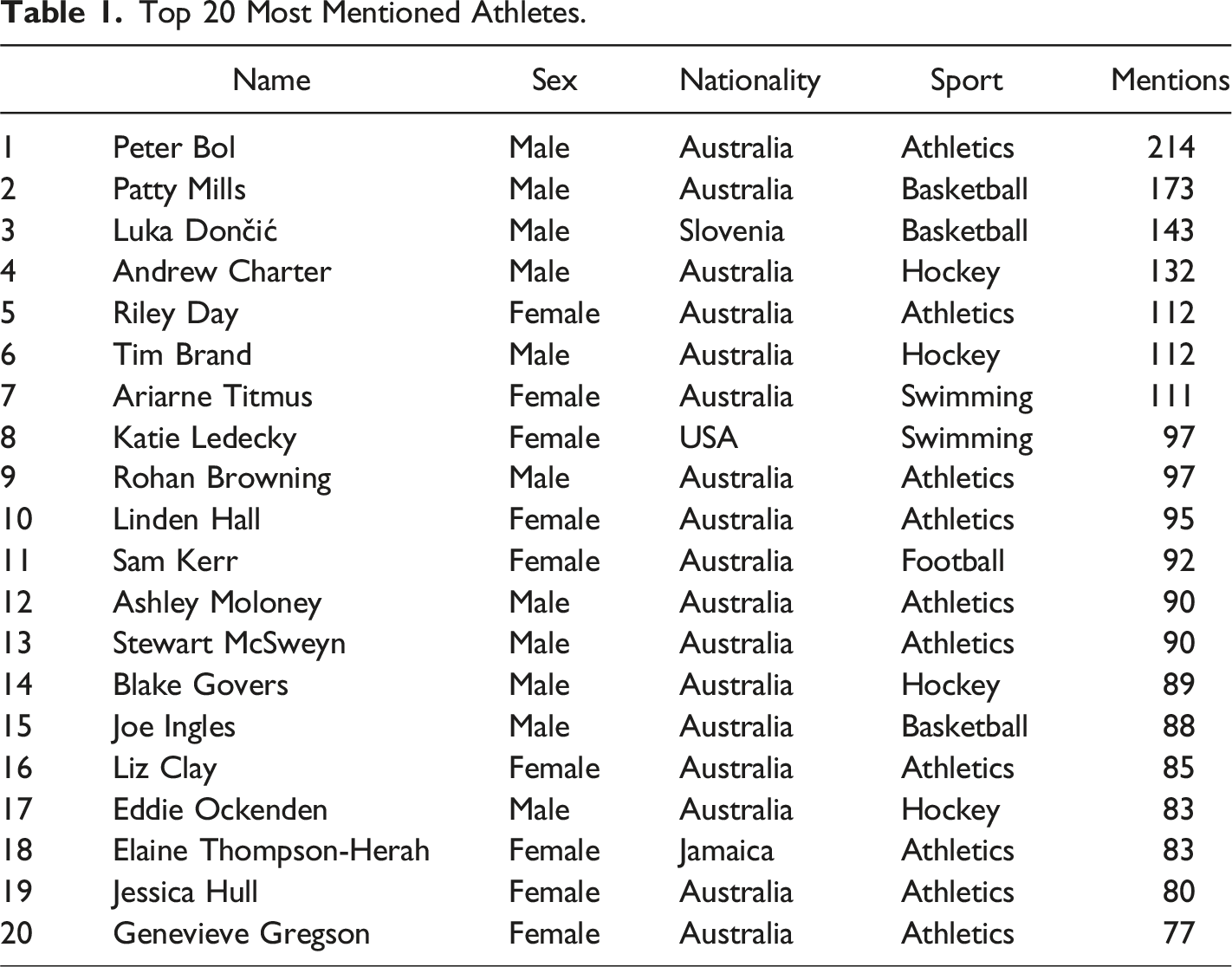
Top 20 Most Mentioned Athletes.
Total Name Mentions by Nationality.
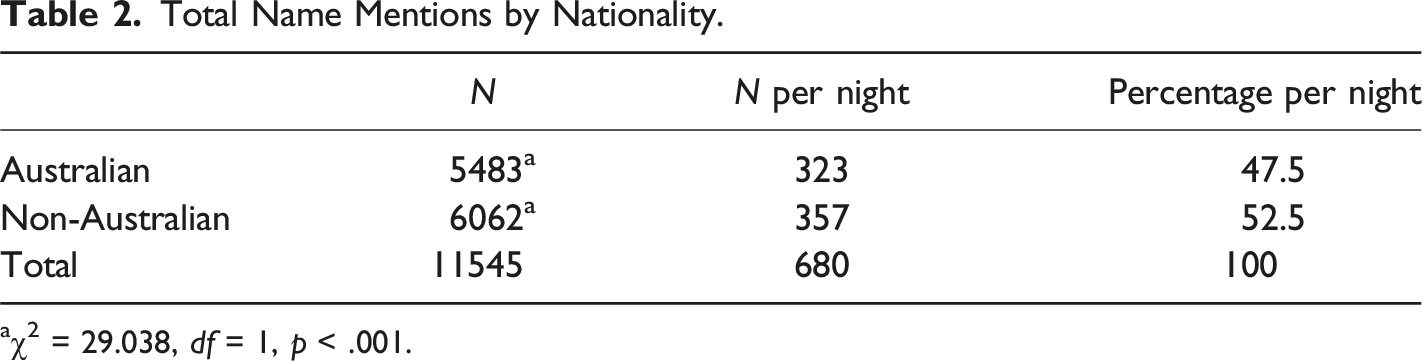
aχ2 = 29.038, df = 1, p < .001.
Descriptive Analysis of Success/Failure by Nationality.
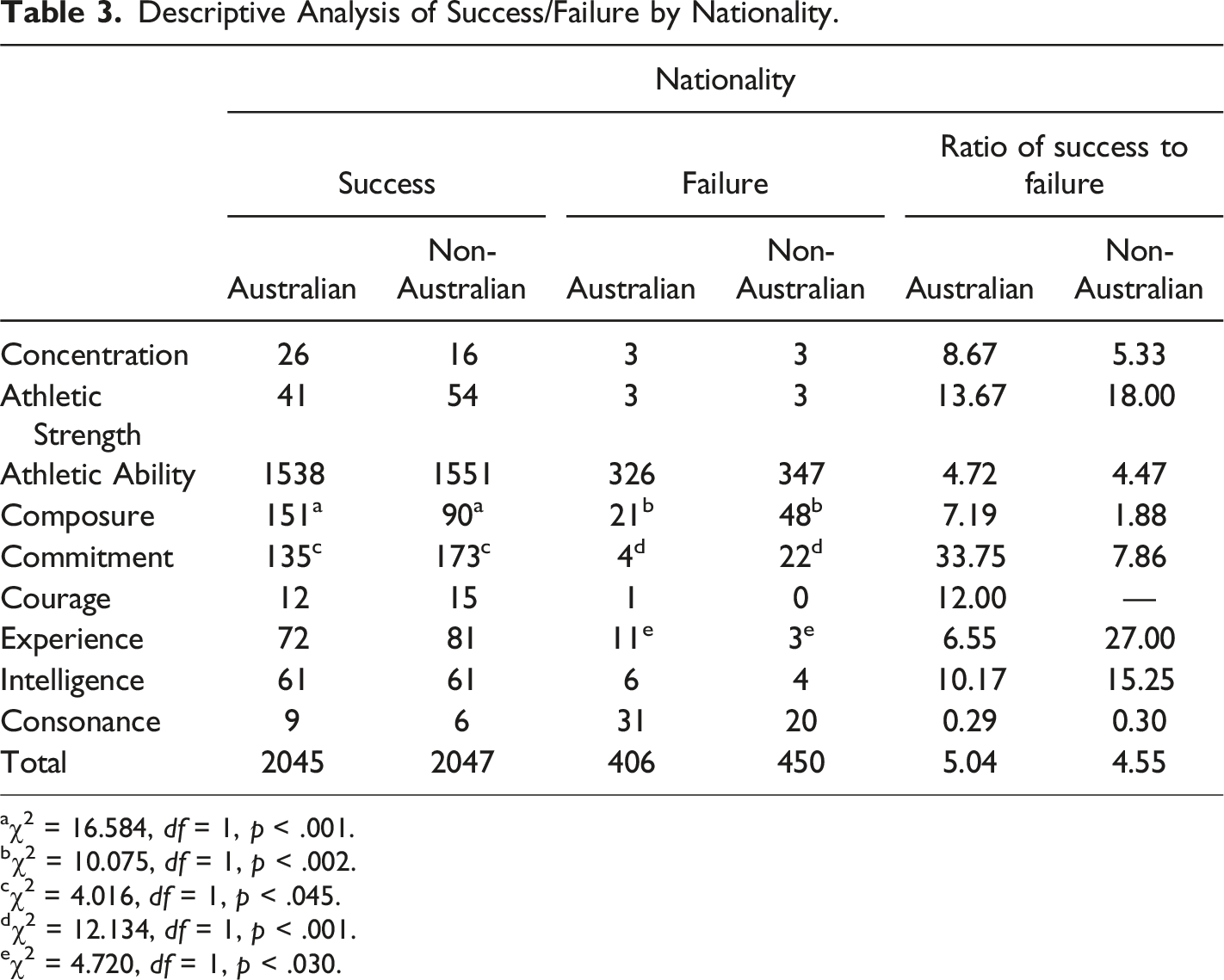
aχ2 = 16.584, df = 1, p < .001.
bχ2 = 10.075, df = 1, p < .002.
cχ2 = 4.016, df = 1, p < .045.
dχ2 = 12.134, df = 1, p < .001.
eχ2 = 4.720, df = 1, p < .030.
Descriptive Analysis of Personality/Physicality Descriptors by Nationality.
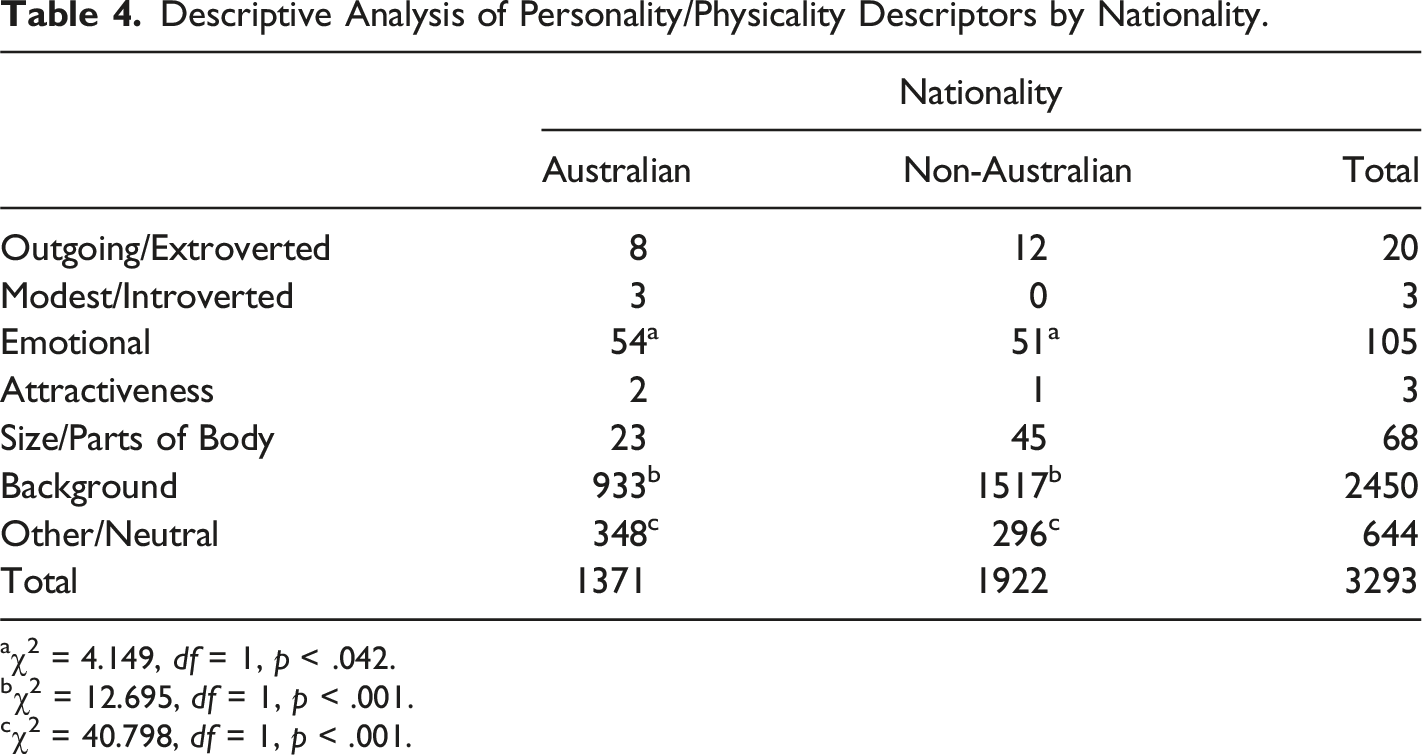
aχ2 = 4.149, df = 1, p < .042.
bχ2 = 12.695, df = 1, p < .001.
cχ2 = 40.798, df = 1, p < .001.
Discussion
This study analyzed how the official free-to-air broadcaster in Australia portrayed nationality during the coverage of the 2020 Tokyo Olympic Games. This study advances the previous work in the Australian context (Scott et al., 2019, 2022; Scott & Li, 2023) and the work of Billings et al. (2017), who have extensively studied the American context and created the taxonomy that this study utilized. Results of this study revealed significant insights into the five hypotheses. Findings in this study showed that Australians received the bulk of the top-20 most mentioned athletes list and 47.5% of all name mentions despite only sending 478 competitors out of 11,420 total athletes (International Olympic Committee [IOC], 2023a), which represents 4.19% of all athletes. In this section, each of the five hypotheses is discussed and then future directions and conclusions are outlined.
Hypothesis 1 posited that the more than 50% of the top-20 most mentioned athletes would be from Australia. Australians made up 17 of the top-20 athletes, representing 85% of the list. This percentage represents an increase in home nation focus when compared to the 2016 Rio Olympics (70%) (Scott et al., 2019) and the 2018 Commonwealth Games (76%) (Scott and Li, 2023). Upon closer inspection of the top-20 list, it is noteworthy that many Australians from athletics (track and field) were among the most mentioned, as only 3 medals were won by Australian athletes in athletics. Yet, Peter Bol, an 800-metre runner, nearly won a medal in the final, after he finished first in his semi-final heat. There would have been many opportunities for Seven Network announcers to mention Bol, as he ran three times in Tokyo and each race lasted about 1 minute and 45 seconds. Further, Bol set two Australian records during the Tokyo Games, making his performances newsworthy (ABC, 2021). Further, Ashley Moloney won bronze in the men’s decathlon and he was the first Australian to ever medal in this event. In decathlon, each athlete participates in ten events taking place over 2 days. Thus, there also were ample opportunities for Moloney to be discussed by announcers.
Additional inspection of the top-20 list revealed that four men’s hockey players made the list, which is not surprising as the men’s hockey team, known as the Kookaburras, won silver in Tokyo and played eight games throughout the tournament. There were a further two basketball players on the list, Patrick Mills and Joe Ingles, who were also on the top-20 most mentioned list at the Rio Olympics (Scott et al., 2019). Both players have played for the national team numerous times and were both playing in the NBA in 2021. At the Tokyo Games, the men’s national team, known as the Boomers, won bronze and this was the first time that Australia had ever won a medal in the men’s basketball tournament at the Olympics.
Framing theory supports the claim that broadcast networks can shape discourse and images to attract as large an audience as possible. This study shows that the Seven Network emphasized Australian athletes at the expense of foreign athletes in order to capture the largest number of viewers during the 2020 Olympic Games. As Australian Olympians were quite successful at the Tokyo Olympics, the Seven Network was able to cater its coverage of the event in a largely partisan manner. Further, Australian Olympians share many group characteristics of everyday Australians, thus, the broadcaster was able to show many athletes from the home nation to its citizens, who share many in-group characteristics. When discussing the number of medals won by Australians, the total medals won by Australian Olympians in Tokyo was 4.26% of all available medals and 5% of all gold medals (IOC, 2023a). When inferences were made using the proportion of Australian athletes who competed in Tokyo, Australians made up 4.19% of total participants, so Australians were described 9.5 times (gold medals) and 11.15 times (total medals) more than their performances would justify if name mentions were based solely on medal counts (Billings et al., 2017). The Seven Network was able to craft their programming around Australian success and overemphasize these storylines to a larger captive audience who might not have had other recreation or leisure options during the Covid-19 lockdowns.
In the Australian context, the overemphasis on Australian Olympians is lower when compared to the 2016 Rio Olympics coverage (Scott et al., 2019). At Rio, Australian Olympians won 8 gold medals (2.61%) and 29 total medals (2.98%) out of 973 available medals and 307 gold medals. The Seven Network emphasized Australian athletes between 14.04 and 16.03 times what would be expected if using the number of medals to compare with name mentions. At the 2018 Commonwealth Games, which is another mega summer sporting event, Australians won 80 gold medals (23.57%) and 198 total medals (29.09%). At this event, Australian athletes made up 10.71% of total participants, so the Seven Network exaggerated its focus on Australians by 2.04 (gold medals) and 2.52 (total medals) times than their performances would justify (Scott & Li, 2023). Results of this study indicate that the Seven Network exaggerated its focus on Australian athletes when using medal counts as the gauge.
When compared to other nations’ coverage of Olympic Games, the percentage of coverage devoted to Australian athletes was more than what was found in the American coverage in 2016 (Billings et al., 2017). The Australian broadcaster was criticized for being quite nationalistic in the coverage of the Olympic Games (Billings, 2008), and results of both the 2016 Rio Games and the 2020 Tokyo Games continue to uphold this notion based on the number of comments by Seven Network announcers about Australian athletes.
During the 2020 Tokyo Olympic Games, much of Australia was in various forms of lock down, which led Miller (2021) to suggest that the Olympic Games were a welcome distraction for Australians who were largely confined to their homes during this event. Many sporting leagues, tournaments, and global mega-events were either cancelled or paused by the Covid-19 outbreak (Frawley & Schulenkorf, 2022), and the media televised many major sporting events during the Covid-19 pandemic to a largely captive audience (Ordway & Anderson, 2022). As the Tokyo Games were a ratings winner for the Seven Network (Samios, 2021), it is not a surprise that the Seven Network would feature Australian Olympians more often than foreign athletes, as much of Australia was looking for activities to do at home and the distraction of the telecasts of the Olympics was welcomed (Miller, 2021).
In the discussion of the over exaggeration of focus on Australian athletes, it is not unusual for a broadcaster to cater its coverage of an event to its intended audience in order to capture the largest share of viewers. Many of the group characteristics of Australian athletes would presumably be shared by viewers (Oakes et al., 1991). Thus, the Seven Network might intentionally cater its telecasts to Australian viewers to appeal to the greatest number of potential viewers, thereby raising ratings and potentially increasing the value of advertisements and sponsorships of the telecasts. In the international context, other studies have also found that the home nation’s media will feature home nation athletes substantially more (Billings, 2008; Li et al., 2016; Rowe et al., 2010).
The Tokyo Olympic Games provided the Seven Network with an event that it could leverage, because Australians were largely at home and the telecasts featured an Australian team that finished sixth in the medal table with 17 Gold medals (46 total medals), which was its highest ever gold medal haul equal to 2004 Athens. Thus, the broadcasts were able to showcase Australian success and highlight the feats of Australian Olympians. Self-categorization theory also posits that one’s identity is in flux and various elements can become more salient depending on the setting. In the case of Australia’s success at the Tokyo Olympic Games, the salience of being Australian might have been heightened in both hardcore Olympic viewers and those who were only tuning in to be distracted because of the lockdown. The Rio Olympic Games were watched by 17 million out of 24 million, which equates to 70.83% of the nation, while 20 million out of 26 million tuned in to the Tokyo Games, which represents 76.92% of the nation. Thus, there was increased interest in the consumption of the Tokyo Games and the salience of being Australian might have been made more noticeable in 2021, more than it normally would be for the Australian population. In addition, most viewers in Australia would share many of the same characteristics with fellow Olympians, such as nationality, culture, and language (Tajfel & Turner, 1979), which might influence viewers to identify more readily with their nation. Dimmock and Grove (2005) suggested that identifying with one’s nation is readily amenable when the major sporting event is of a shorter duration and the 17 days that the Olympic Games take would fulfil their proposition. Further, the Seven Network’s emphasis on Australian athletes may have helped to capture a greater percentage of viewers to unite under the Australian flag and increase interest in the Tokyo Olympic Games (Alabarces et al., 2001).
Implications, Limitation, and Future Directions
On a grander scale, this study contributes to both theory and practice equally. First, this study continues an important line of inquiry into how the Australian Olympic broadcaster, the Seven Network, portrayed Olympians during the Tokyo Olympic Games. Results of this study found that Australians were discussed more than their performances or team size warranted, with 85% of the top 20 most-mentioned athletes being Australian, and 47.5% of all name mentions were toward Australian athletes as well. In terms of the research in the Australian context, it seems that the broadcaster will favor Australian athletes during summer-based events, such as the Summer Olympics and Commonwealth Games, at which Australians tend to have good success (Scott et al., 2019, 2022). In the global context, the results of this study mirror those from China, America, and Canada in the analyses of the home broadcasters in those nations (i.e., Angelini et al., 2017; Billings, 2008; Billings et al., 2017).
This study also collected the number of name mentions of the top 20 athletes and overall names mentioned, but we did not control for the duration of an event or the number of competitions or heats an athlete competed in. Upon inspection of the list, only 5 sports were featured on the top 20 list, and each athlete was from a sport where either the matches or games are long (football, hockey, and basketball) or where athletes could have competed in numerous events (athletics and swimming). Thus, the number of name mentions of these athletes could be inflated based on the number of medals on offer and the number of heats or competitions that occur in athletics and swimming or the number of games and the length of games in football, hockey, and basketball. Further, Australia has had success at the Olympic Games in both hockey and swimming and Australians performed well in athletics and the men’s basketball team won its first Olympic medal in Tokyo; whilst footballer, Sam Kerr, is one of the top ranked footballers in the world. Thus, it is not surprising that there would be substantial focus on these sports and athletes from the Australian broadcaster at the Tokyo Olympics.
Limitations and future directions are acknowledged. This study continues the analysis of Australia’s broadcaster at the Olympic Games, but this research did not conduct analyses of either the Seven Network’s online platform or either its free or paid version of its mobile phone app. If possible, analyzing both the online streaming platform and its app versions would be particularly useful as legacy media is changing and streaming services are continually adopting sporting properties and coverage. With the continued fragmentation of the media environment, understanding how people consume sports and where they consume them will be beneficial to scholars and practitioners. Li et al. (2023) found that different generations of Chinese Olympic viewers consumed different platforms, but the same sports were popular amongst the different generations. Thus, understanding the platform utilization and gratifications of Australian, American, Japanese, or other nationalities would be important to study.
In addition to the analysis of online and app offerings, Australia’s Olympic rights-holding broadcaster will change in 2024 from the Seven Network to Nine Entertainment covering all the Olympic Games between Paris 2024 and Brisbane 2032 (International Olympic Committee, 2023b). Future studies are warranted to understand if the change in broadcaster leads to a change in focus from being Australia-centric to less focused on Australian athletes and whether there are differences in the portrayal of biological sex. Further research could also be conducted on a single nation’s athletes to uncover how those who were born in the nation and those who naturalized are portrayed by announcers. It would be beneficial to understand whether one’s place of birth influences how announcers depict these athletes who are participating for the same nation.
Conclusion
Broadcasters have the ability to influence their public’s perceptions of what events or who is presented during their coverage of major sporting events. It is, therefore, imperative that the study of broadcasters continues to understand how events and people are framed to their audiences. This study found that Australian athletes were again mentioned more often than foreign athletes and success and failure were also differently described by announcers of the Seven Network. The current study advances the growing body of literature around the framing of mega events by Australian broadcasters and the portrayal of in-group and out-group athletes.
Footnotes
Declaration of Conflicting Interests
The author(s) declared no potential conflicts of interest with respect to the research, authorship, and/or publication of this article.
Funding
The author(s) received no financial support for the research, authorship, and/or publication of this article.
