




Abstract
In the span of four years from 2018 to 2022, three consecutive Olympic Games were held in East Asia – namely PyeongChang 2018 in South Korea, Tokyo 2020 in Japan and Beijing 2022 in China. Given the geographic concentration of global multi-sports mega-events in the Far East, this period has been referred to as the ‘East Asian era' of the Olympic Games. This introduction to the special issue outlines two major themes of the changes during the East Asian era: (1) the shift of economic and geopolitical power from the West to the East; and (2) the changes and challenges offered by the Olympic Agenda 2020 reforms and the COVID-19 pandemic within East Asia. After that, each contribution will be introduced and briefly described. Overall, by collecting contributions focusing on the 2018–2022 Olympic Games, this special issue critically analyses the state of play in the formations of dominant and emerging discourses during the East Asia era and offers its implications for a broader understanding of the continuity and changes to the economic, political, social, cultural and ecological dimensions of the Olympic Movement.
In the span of four years from 2018 to 2022, three consecutive Olympic and Paralympic Games were held in East Asia – namely PyeongChang 2018 in South Korea, Tokyo 2020 in Japan and Beijing 2022 in China. Given this geographic concentration of global multi-sports mega-events in the Far East, Horne and Whannel (2016) referred to this period as the ‘East Asian era’ of the Olympic Games. The ‘East Asian era’ alludes to an important question about whether it epitomises a shift in economic and geopolitical power from the West to the East or the further incorporation of the Far East into the global order characterised by Western hegemony (Lee, 2016). Incidentally, it emerged against the backdrop of dissenting voices of protest and critics, mainly found in Western society, that opposed the hosting of the Games and, in turn, resulted in the withdrawal of candidacies as seen in the cases of Sweden, Germany and Norway for the 2022 Olympic Winter Games (Gruneau & Horne, 2016). In an attempt to overcome the crisis of its legitimacy, the International Olympic Committee (IOC) initiated a set of reform policies called Olympic Agenda 2020 in 2014. The initiative aimed at increasing the IOC’s level of sustainability and social responsibility by, for instance, reducing the costs of bidding, promoting the use of existing and demountable venues and allowing events to be held outside the host city or even host country (MacAloon, 2016). In early 2021 ahead of the opening of the postponed Tokyo 2020, additional policies called Olympic Agenda 2020+5 were adopted to further extend the reform effort in line with the original aspirations. As such, the 2018–2022 Olympic and Paralympic Games in East Asia coincided – and perhaps not so coincidentally – with this transformative process of Agenda 2020 (and +5) and therefore served as its testing ground. Consequently, theoretical and empirical inquiries into the ‘East Asian era’ are expected to offer much needed insight into the contested terrains and future shaping of the Olympic and Paralympic Games, including the subsequent Games ‘going back to the West’ in 2024 (Paris), 2026 (Milan-Cortina d’Ampezzo) and 2028 (Los Angeles). In reflecting on ‘Together’ as the fourth word added to the modernist imagination of the Olympic motto ‘Faster, Higher, Stronger’, it is timely to investigate how the emerging narratives of the 2018–2022 Games and their legacies have been framed, contested and articulated.
This special issue of Communication & Sport is a collection of eight cutting-edge scholarly works on the East Asian era of the Olympic Games. Out of the eight contributions, three focus on Beijing 2022, four on Tokyo 2020 and one on PyeongChang 2018. This introduction is structured as follows. It begins by outlining two major themes of the changes during the East Asian era: (1) the shift of economic and geopolitical power from the West to the East; and (2) the changes and challenges offered by the Olympic Agenda 2020 reforms and the COVID-19 pandemic within East Asia. After that, each contribution will be introduced and briefly described. Overall, by collecting contributions focusing on the 2018–2022 Olympic Games, this special issue critically analyses the state of play in the formations of dominant and emerging discourses during the East Asia era and offers its implications for a broader understanding of the continuity and changes to the economic, political, social, cultural and ecological dimensions of the Olympic Movement.
The Shift of Economic and Geopolitical Power From the West to the East
The Location of Hosting Cities Within the West and the Non-West Since 1964.
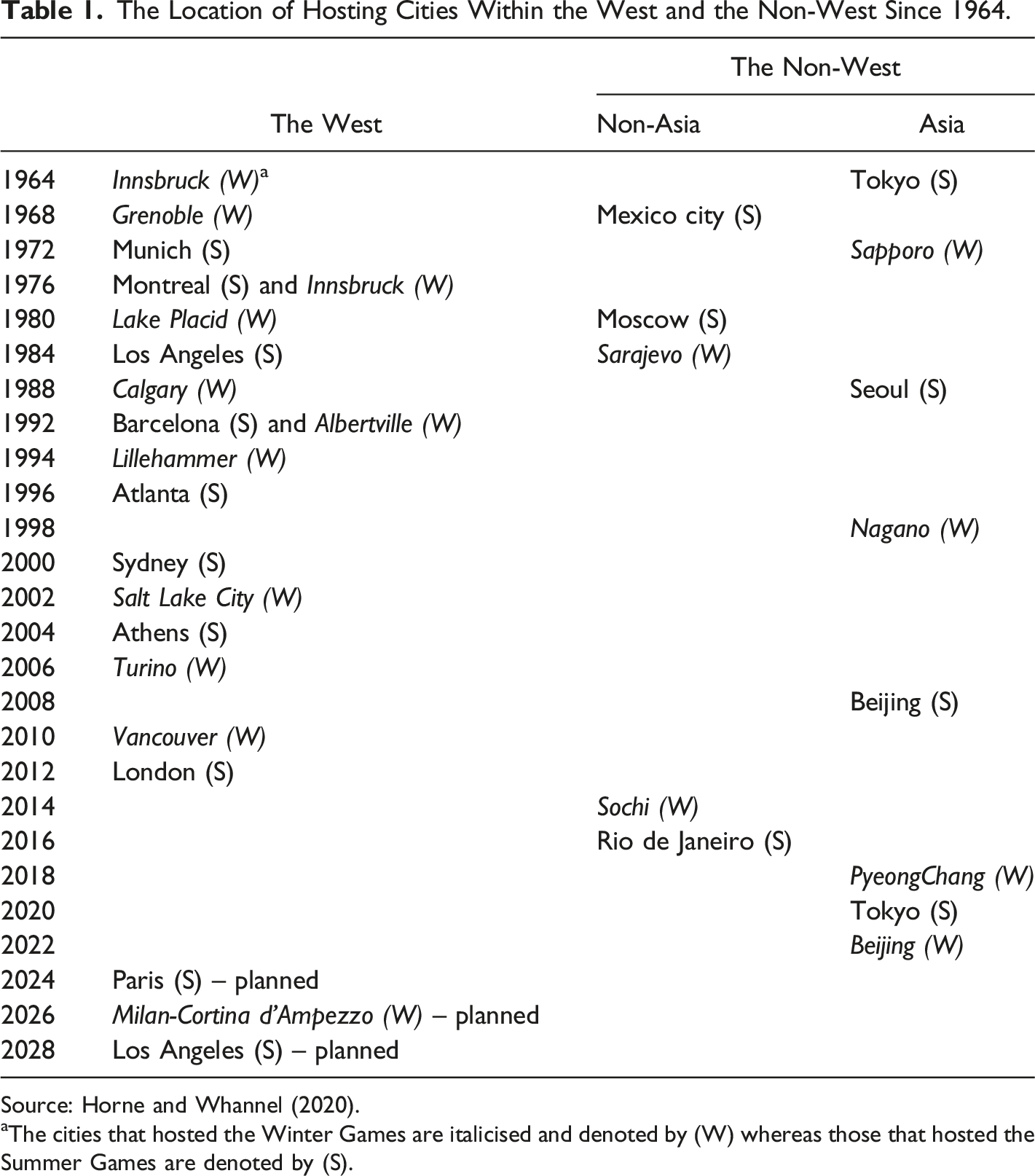
Source: Horne and Whannel (2020).
aThe cities that hosted the Winter Games are italicised and denoted by (W) whereas those that hosted the Summer Games are denoted by (S).
From this list, the concentration of three consecutive Olympic Games in East Asia from 2018 to 2022 can be viewed as particularly striking and peculiar given the path dependent nature of hyper-bureaucratic institutions such as the Olympic Games, and arguably this did not happen by accident. When seeing the broader picture beyond the East Asian era, it is also recognisable that the longer period, from 2014 to 2022, can be interpreted as the non-Western era of the Olympic and Paralympic Games due to the 2014 and 2016 Games also being hosted outside the West.
The Proportions of Host Cities Located Within the West and the Non-West Across Different Periods.
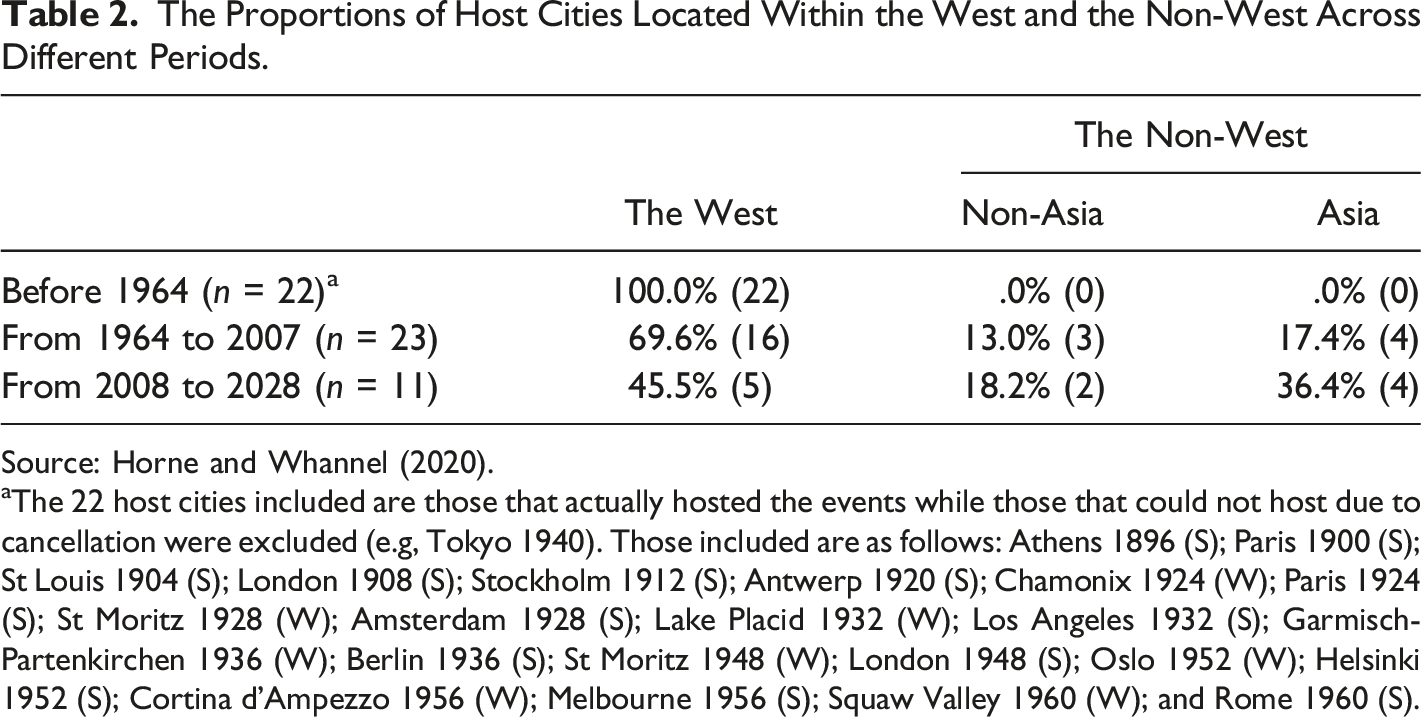
Source: Horne and Whannel (2020).
aThe 22 host cities included are those that actually hosted the events while those that could not host due to cancellation were excluded (e.g, Tokyo 1940). Those included are as follows: Athens 1896 (S); Paris 1900 (S); St Louis 1904 (S); London 1908 (S); Stockholm 1912 (S); Antwerp 1920 (S); Chamonix 1924 (W); Paris 1924 (S); St Moritz 1928 (W); Amsterdam 1928 (S); Lake Placid 1932 (W); Los Angeles 1932 (S); Garmisch-Partenkirchen 1936 (W); Berlin 1936 (S); St Moritz 1948 (W); London 1948 (S); Oslo 1952 (W); Helsinki 1952 (S); Cortina d’Ampezzo 1956 (W); Melbourne 1956 (S); Squaw Valley 1960 (W); and Rome 1960 (S).
Politically, the East Asia era was most notably marked by China’s rise as an established global superpower and its impacts on geopolitical tensions and relations within East Asia and beyond (Mearsheimer, 2014). China surpassed Japan as the world’s second largest economy in 2010 and continued its fast-paced growth to turn itself into the only country of comparable economy with the U.S. in the world. According to the 2022 GDP figures published by The World Bank Group (2023), China recorded 18 trillion USD in comparison with 25 trillion USD of the first-ranked U.S. and 4 trillion USD of the third-ranked Japan. Also, it is reported that about 40% of the global economic output were produced by the U.S. and China alone (Swanson, 2023). While Brownell (2023) is sceptical of an emerging discourse of the US-China relations forming ‘a New Cold War’, it is clear from these economic figures that the world has entered an era of the bipolar dominance by these two superpowers. The political tensions between the U.S. and China were brewing underneath over the past decade or so but have surfaced more recently in a rather explosive manner after Donald Trump became the U.S. President in 2017 and defined China as its strategic competitor and a threat to its security and prosperity. As contended by Boykoff in this special issue, the adversarial relationship between the U.S. and China did not change even after the change of presidential leadership from the Republican Party to the Democratic Party in 2021 and was further reinforced by the U.S. media discourses of China as a human-rights abuser and therefore not an acceptable host of the 2022 Winter Olympic Games. This was even more dramatised by U.S. President Joe Biden’s initiative of a ‘diplomatic boycott’ of Beijing 2022 and call for other nations to join the collective effort in condemning China. Interestingly, China’s neighbours and the hosts of the preceding Olympic Games, South Korea and Japan, acted rather ambiguously on the matter and walked on a tightrope to appease both parties. For instance, Japanese political leaders tried to strike the middle ground by deliberately avoiding the use of the word ‘diplomatic boycott' in their speeches and sending no ministerial delegation but instead the heads of Tokyo 2020 Organising Committee, the Japanese Olympic Committee and the Japanese Paralympic Committee to the Beijing 2022 opening ceremony. Likewise, the then South Korean president, Moon Jae-in, already ruled out his attendance at the Olympic ceremonies before the Games. Instead, Seoul tactically dispatched the Minister of Culture, Sport and Tourism to Beijing. This also coincided with the suspension of North Korea from competing in Beijing 2022 and an increasing political distance between North and South, which marked a stark contrast to the burst of inter-Korean collaboration and dialogue seen in 2018 through the PyeongChang Olympic Games and the Jakarta-Palembang Asian Games (Lee, 2021b; Lee & Cho, 2023). In this special issue, inter-regional tensions and relations are explored and examined by English and Murray with respect to the narratives of North Korea within East Asia through PyeongChang 2018.
What does this shift of economic and geopolitical power mean to the ways in which the Olympic and Paralympic Games are governed, organised and delivered? While an adequate answer to this question will only be revealed by more research in the future, what is clear is that the Olympic and Paralympic Games, or sports mega-events more generally, continue to serve as contested terrains for a range of ideals and values to be re-defined and fought over (Horne et al., 2023; Jackson & Kobayashi, 2023; Kobayashi et al., 2023). From one point of view, the power shift could mean that it provides stronger platforms for national governments in East Asia to showcase their soft power and harness their capability of nation branding – as Dubinsky illustrates in this special issue with respect to judo diplomacy through Tokyo 2020. Or it may cut both ways. In examining the political contexts of both 2008 and 2022 Beijing Olympic Games, Brownell (2023) asks ‘did the Olympics change China or did China change the Olympics?’ She is critical of the preoccupation of most Western politicians, journalists and activists in focusing on the former while overlooking the latter because “it is modernist and colonialist for the Western critics to fixate on whether the Olympic Games will propel China toward a more Western-style democracy” (Brownell, 2023, p. 24). In contrast, she points out the need to adopt a view of recognising the changes taking place on both sides of China and the Olympic Games. One such change to the Olympic Games that she highlights relates to how the IOC’s stances and policies on human rights were shaped in reaction to the surge of concerns and criticism of China’s hosting of the Games. Consequently, as part of the revision of the bidding process, a particular clause requiring host cities to adhere to the UN Guiding Principles of Business and Human Rights was added to the Host City Contract, which comes in effect with the 2024 Olympic Games. On the other hand, Brownell (2023) illustrates the cases of Eileen Gu and other naturalised Chinese athletes as evidence of the drastic changes that China accepted in cultivating its own stance on the ‘openness to the world’. This is of course not unique to China as South Korea and Japan have longer histories of allowing foreign-born athletes to represent their countries through naturalisation (Shin et al., 2022). In this special issue, the dynamics of political, social and cultural dimensions of these naturalised Chinese athletes at Beijing 2022 is explored by Li et al. and Zhang and Shi.
The Changes and Challenges Offered by the Olympic Agenda 2020 Reforms and the COVID-19 Pandemic Within East Asia
The absence of the Olympic Games in the West from 2014 to 2022 arguably signalled the crisis of the Games and the IOC’s governance, and of the Western hegemony more generally. In recognising this crisis, the IOC initiated a set of reform policies called Olympic Agenda 2020 in 2014. Derived from growing public discontent over the seemingly ever-increasing costs of hosting and mistrust of the IOC in governing the world’s largest sporting events, the lack of public interest in and support for bidding – as evidenced in the withdrawal of several European cities in relation to the 2022 Olympic Games – forced the IOC to re-consider its relationships with host cities and countries. In response, and to paraphrase the words of the senior IOC member Dick Pound, the previous business model of ‘the made in Switzerland approach’ was replaced with a ‘partnership’ approach on a ‘win-win basis’ (cited in MacAloon, 2016, p. 772). As such, the main thrust of Olympic Agenda 2020 was to reduce the burdens on host cities in bearing extravagant financial costs by promoting the use of existing, temporary and demountable venues and allowing events to be held outside the host city or even host country (MacAloon, 2016). Additionally, several of the adopted recommendations were oriented towards the promotion of Western-driven concepts such as ‘sustainability’, ‘transparency’, ‘good governance’, ‘gender equality’ and ‘human rights’. As discussed by Robertson in this special issue, it is within this context that critical stances and perspectives have been adopted and incorporated not just by academics and critics but also more widely by journalists in the mainstream media. At the IOC session held in March 2021, the Olympic Agenda 2020 Closing Report was presented to conclude their formal evaluation of the organisational and interorganisational efforts in implementing the recommended changes over the six years. Of the 40 recommendations, it was reported that 35 were ‘achieved’, two ‘mostly achieved’ and three ‘partially achieved’. In the report, the IOC President Thomas Bach proclaimed that: The achievements demonstrate that we have reached the objectives that we have set for ourselves in 2014. With the whole picture now in full view, we can say with satisfaction: we have changed. We have strengthened the IOC and the Olympic Movement by making the Olympic Games fit for the future; we have safeguarded the Olympic values; and we have strengthened the role of sport in society (International Olympic Committee, 2021, p. 10).
While it is not within this introduction’s scope to examine the validity and generalisability of these sweeping claims, it is fair to consider that the changes undertaken during this period were tangibly noticeable especially in terms of the bidding process and events structure. Nevertheless, what is omitted from the partial picture of a seamless transformation purported in the Closing Report is that these recommended changes inevitably caused tensions, contestations and negotiations as they were applied to the host cities and countries during the East Asian era. For instance, the Western-driven concepts have by no means been readily embraced and practiced without being challenged by the strong hold of traditional values, principles and systems that underpin the political, economic and social foundations of the East Asian host cities and countries. In particular, critical perspectives that are essential in intellectually engaging with such concepts as sustainability, gender equality and human rights have been largely resisted within the Confucian-based societies where the cultivation of social harmony through obedience to and respect for authorities are regarded as the characters of a virtuous person (Kobayashi & Jackson, 2020). For this reason, it should come as no surprise to find gaps between the ideals proposed by Olympic Agenda 2020 and the actual practices of the East Asian host cities and countries. For instance, on ‘sustainability’, as Yoon and Wilson (2019) reveal in relation to PyeongChang 2018, the development of an alpine skiing venue on Mount Gariwang drew a wide range of criticism from the left-leaning media and environmental activists yet was nonetheless prioritised over the protection and conservation of an ancient forest. Furthermore, most newly built winter sport facilities such as ski jumping hills and sliding tracks were hardly used after the Winter Olympics, and some of the world-class ice rinks in the Gangneung Olympic Park had to be repurposed as storage spaces because only a few visited these arenas in the post-event setting (Lee, 2021a). While the local government hopes that the 2024 Youth Olympic Winter Games in Gangwon can revitalise the popularity of winter sports in the region, it is unclear how this relatively low-profile international sporting competition sustainably attracts more people to the winter sport venues when this event is over.
With respect to Tokyo 2020, Kietlinski (2023) asserts that “the Olympics is increasingly guilty of ‘greenwashing,’ and the postponed Tokyo 2020 Olympics were the most glaring example yet of stated environmental concern being misaligned with environmental reality” (p. 49). One of the best illustrations of this, as she points out, is the construction of a new National Stadium, which was a cause of several controversies from the beginning – with its original design being criticised for being environmentally destructive and unnecessarily expensive – to the end – with its final construction being criticised for using unethically sourced timber linked with deforestation in Malaysia. In this special issue, Abe similarly identifies the patterns of the national newspapers – that sponsored Tokyo 2020 – for concealing or downplaying the issue of environmental contamination and concerns emanating from the Fukushima nuclear disaster in justifying the hosting of the postponed Games. Similar concerns over sustainability are also found in relation to Beijing 2022 that itself represents a legacy of Beijing 2008. Several Olympic venues made for the Summer Olympics 14 years ago were recycled into the sites for its winter counterpart in 2022. The transformation of the National Aquatic Centre, namely the ‘Water Cube’, into the ‘Ice Cube’, an Olympic curling rink, exemplified the connection between the two Olympics. Again, the opening and closing ceremonies of this winter sports mega-event were also performed in the ‘Bird Nest’ Olympic Stadium as in 2008. Moreover, the Chinese government claims that nearly 350 million people across the country have taken up winter sport since the Winter Olympics (CGTN, 2022). The IOC subsequently praised the Chinese effort to deliver one of the, if not the, most sustainable Winter Olympics ever (IOC News, 2023). Nevertheless, it was revealed that this Olympic Games entirely relied on artificial snow to stage skiing events. Indisputably, the provision of human-made snow for the major competitions required the consumption of a huge amount of electric power and water resources. In this respect, Orr (2022) argues that not only did the generation of fake snow in such a gigantic scale inevitably leave numerous carbon footprints on earth, but it also had an adverse impact on the water supply in the local areas. Therefore, the ecological sustainability of Beijing 2022 is highly questionable.
On ‘transparency’ and ‘good governance’, Tokyo 2020 could not be a better counter-example. In this special issue, Wong and Meng-Lewis describe the organisers’ responses to the COVID-19 pandemic as characterised by the lack of consideration of the public interest and the denial of responsibility in crisis communications. To make the matter even worse, the conclusion of the Games was followed by the exposure of a series of bribery scandals involving a member of Tokyo Olympic Games Organising Committee, which further highlighted the absence of ‘good governance’ and ‘transparency’. On ‘gender equality’, while a record number of female athletes and mixed-gender events were celebrated as an indicator of the success at Tokyo 2020, gender inequality and discrimination were unexpectedly brought into sharp focus when Yoshiro Mori, then President of the Tokyo Olympic Organising Committee and former Prime Minister, resigned from the role after being criticised over his discriminatory remarks about women. This led to a wider public debate about gender inequality in Japan – the country ranked 120th out of 150 countries in the global gender gap index and the lowest among the world’s leading economies in 2021 (Kyodo News, 2021). In this context, the organisers’ effort to recover their reputation by replacing Mori with female politician and Olympian Seiko Hashimoto and appointing female tennis star Naomi Osaka to light the cauldron at the opening ceremony appeared as no more than a mere symbolic gesture (Kobayashi, 2021). On ‘human rights’, the issue has been discussed above in relation to Beijing 2022 in China and is detailed in Boykoff’s article in this special issue.
In addition to all these challenges was the COVID-19 pandemic, especially for Tokyo 2020 and Beijing 2022 that undertook counter-measures including the restriction of the number of spectators, the establishment of testing regimes and the isolation of the participants from the rest of society. In many ways, the COVID-19 pandemic presented the public with a windfall of critical reflections on the hosting of the Olympic Games in the midst of the worst global health crisis in centuries, thereby prompting an outpouring of critical questions within public discourses including ‘what is the real value of hosting the Games?’ and ‘whose interests are served by them?’ This was particularly true in Japan in relation to the postponed Tokyo 2020. There was an unprecedented level of public discontent and resentment against the authorities in every corner of society, from a major newspaper publicly calling for cancellation, major sponsors expressing their dissatisfaction by withdrawing from attending ceremonies, celebrity torch runners withdrawing from their participation to notable figures openly voicing their objections to the opening of the Games. In other words, Tokyo 2020 offered a wake-up call for the nation to develop critical consciousness and recognise a range of latent social injustices (Kobayashi, 2021). As Kim et al. (2023) note, transnational coalitions of anti-Olympic movements between Korean and Japanese groups of activists were also strengthened through exchanges of their expertise, strategies and resources during the East Asian era. Even though the Japanese mainstream media were quick in turning its attention to narratives of national triumphalism with the record number of medals for the host country during Tokyo 2020, public scepticism and mistrust in the organisers were prolonged or even amplified over the ensuing exposure of the bribery scandals in connection with the Games. Notably, Sapporo, which was the frontrunner in the bidding to host the 2030 Winter Olympic and Paralympic Games, had to stall its campaigns due to a growing public backlash as evidenced by a local poll conducted in April 2022 by Hokkaido Shimbun (2022). This indicated that a majority of residents (57%) in Sapporo either ‘objected’ or ‘somewhat objected’ to hosting. Against the backdrop of Tokyo 2020, it is clear that residents in Sapporo were enticed to re-evaluate the costs and the benefits of hosting the Olympic and Paralympic Games by adopting a more critical perspective. Nevertheless, East Asia, and Asia more widely, is likely to keep hosting the Olympic and Paralympic Games and other sports mega-events in the foreseeable future while “the bidding and hosting of the sports mega-event will be ‘contested’ and continue to offer a strategic site through which to understand political and social struggles – and changes – in particular places at particular times” (Horne et al., 2023, p. 16). We hope that this special issue, with a valuable collection of scholarly accounts on the East Asian era of the Olympic Games, will be of assistance to our field in extending its engagement with Asia as well as advancing critical inquiries into sports mega-events.
Contributions to the Special Issue
This special issue comprises the introduction and eight cutting-edge original research articles on the East Asian era of the Olympic Games. The articles are collated in descending order with three on Beijing 2022, four on Tokyo 2020 and one on PyeongChang 2018. To begin with, Jules Boykoff offers analysis of U.S. newspapers’ coverage of the Beijing 2022 Winter Olympic Games and reveals the ways in which the Games was framed predominantly by U.S. political interests and agendas. As political tensions between the U.S. and China as two of the world’s largest economies were intensified, the U.S. news outlets used the Games to criticise China for its human rights violations, which constituted the most prevalent frame (47%) from his analysis. Boykoff further tracked where the sources of the featured articles were obtained and identified the use of authority figures – such as U.S. government officials, human-rights advocates, academics and thinktank members – as a major tactic of journalists in justifying their political views and stances. Boykoff explains that one of the reasons for the predominance of this frame is its ‘cultural congruence’ with popular political ideas and stances which eventually led to the U.S. government’s action of the ‘diplomatic boycott’. In this context, there was a very little reported about China as a rising superpower in an affirmative light while its handling of the COVID-19 pandemic was highlighted not to complement its effort in keeping the number of infections low but to condemn its reportedly draconian measures.
In the second article, Bo Li, Olan K. M. Scott, Liang Zhao and Su Jin delve into the issue of athlete naturalisation in China. China had been reluctant to embrace the policy to allow foreign-born athletes to naturalise and represent the country until the 2022 Games where 30 naturalised athletes, accounting for 17% of the total, were included in ‘Team China’. In order to investigate how the Chinese public reacted to this sudden increase of naturalised Olympians, Li et al. conducted sentiment and thematic analyses of comments about these athletes on the Chinese social media site Weibo. Li et al. found that the users of the Chinese social media expressed generally positive emotions towards these naturalised athletes, especially those – like Eileen Gu – who met or exceeded public expectations of their performance. To a lesser degree, there were some notable comments questioning the legitimacy of representation as Chinese or concerning the neglect of home-grown Chinese talent. Furthermore, Li et al. emphasise that the users accepted these naturalised athletes more favourably when they had at least partial Chinese ancestry or heritage or when those without Chinese ancestry demonstrated their love for, or competency in, Chinese language and culture.
Staying on the same topic of athlete naturalisation, the third article by Liwen Zhang and Lin Shi focuses on Eileen Gu (or Gu Ailing, her Chinese name) and provides comparative analysis of her representation between Chinese and American news media. By combining frame analysis and critical discourse analysis, Zhang and Shi illustrate how differently the American-born, naturalised-as-Chinese athlete was mobilised to reinforce the discourses aligned with political interests and ideological orientations of each nation. For instance, the selected Chinese newspapers portrayed Gu as a Chinese cultural icon even with specific reference to a ‘descendant of the dragon’ and a role model for Chinese youth. In contrast, the selected U.S. newspapers emphasised her status as a global sport celebrity with a range of commercial endorsements and her primary affiliation with San Francisco and California as her place of birth and roots. Consequently, Zhang and Shi conclude that the differentiated representations of Eileen Gu between the Chinese and U.S. media serve as a potent source of nationalism, and the re-construction of national identity, within each nation while epitomising wider ideological tensions between the East and the West.
In the fourth article, we turn our attention to Tokyo 2020. Cerianne Robertson provides an analysis of journalists’ perspectives and experiences with respect to their perceived opportunities and challenges for reporting from a ‘critical stance’ at the Games. By conducting interviews with journalists who reported on Tokyo 2020 for major English-language publications, Robertson identifies three themes of dominant perspectives shaping the content in reporting: the role of awe in reporting; impressions of what readers want; and the role of reporters’ experiences at past Olympic Games. Robertson then examines what counts as critical reporting and reveals how a critical stance could be interpreted differently among the journalists. Even when a critical stance was adopted by members of the Olympic press corps, Robertson asserts that there was a general tendency for a few storylines and topics such as COVID-19 and human rights violations to dominate the coverage, thereby leaving out other issues that were equally worthy of public attention. Consequently, Robertson considers that it is more challenging to report on the structural problems of the Olympic Games under the current norms and conditions of journalism and calls for media scholars and journalists alike to reflect on their stances of critical writing in terms of what and whom they render as legitimate objects of critique.
One of the critical questions in relation to Tokyo 2020 was undoubtedly around the handling of the COVID-19 pandemic. In this respect, Donna Wong and Yue Meng-Lewis provide analysis of the crisis communication strategies implemented by the organisers – both Tokyo Olympic Games Organising Committee and the IOC – in responding to the evolving situations under the worst global health crisis in centuries. By deploying the situational crisis communication theory as their framework, Wong and Meng-Lewis seek to explore the connections between crisis management in a sports mega-event and organisational response strategies. In examining a range of information collected from policies, press releases and publications of government and official sources as well as English-language newspapers in Japan and overseas, Wong and Meng-Lewis develop a chronological timeline, comprised of five phases of the pandemic’s development with accompanying themes of the organisational responses. In doing so, Wong and Meng-Lewis identify the organisational responses as being characterised by indecision, incoherence, misjudgement and denial of their responsibility. As a result, the authors conclude that the reputation and image of the organisers were severely hampered by their lack of consideration and apparent obliviousness to public concerns and opinions about cancellation or postponement of the Games.
In the sixth article, Yasuhito Abe focuses on another crisis in relation to Tokyo 2020 – the state of nuclear emergency emanating from the nuclear disaster in Fukushima. When the Tokyo 2020 bid was pitched at the IOC sessions in 2013, the Games were framed as the ‘Recovery Olympics’ to symbolise a recovery from the devastations caused by 2011 Great East Japan Earthquake and Tsunami. Although discourses surrounding Tokyo 2020 were eventually dominated by the COVID-19 pandemic and its impacts on the timing and modes of operation for the events, Abe reminds us that the Games were held under a double state of emergency with the pandemic and nuclear disaster. By analysing major Japanese national newspapers, Abe found that the discursive practices of newspapers downplayed the potential nation-wide impact of radioactive materials from Fukushima and instead used the crisis as a chance to promote food safety in legitimising the hosting of the Games. Abe argues that the issue of environmental contamination was so ‘depoliticised’ by the newspapers – that also sponsored the Games – to an extent that the state of nuclear emergency was forgotten in the public memory.
Also on Tokyo 2020, Yoav Dubinsky turns our attention to a topic of nation branding and sports diplomacy. By having internal access with press credentials to media zones, press conferences and media-related materials at the Games, Dubinsky conducted thematic analysis of the coverage of judo competitions and examined the ways in which journalists’ reporting contributed to an improvement of Japan’s image on the world stage and strengthened its nation branding through its connection with judo as the country of origin. The significance of the Nippon Budokan perceived and reproduced by athletes and journalists as the ‘holy’ place of judo is particularly notable here. On the other hand, Dubinsky also points out that judo diplomacy is not immune to a potential backlash from its association with the controversies of the Iranian Judo Federation forcing their athletes to forfeit matches against Israelis for political reasons and the accusations of sportswashing through the hosting of sports mega-events.
In the final article in this special issue, Peter English and Richard Murray offer analysis of regional narratives of North Korea in relation to PyeongChang 2018. The marching of North and South Korea under one flag at the Olympic opening ceremony was celebrated as a step towards greater harmony, stability and cooperation within the East Asian region. By examining online newspapers from North Korea, South Korea, China and Japan, English and Murray identify some similarities in the cautious early wishes and optimism for further reconciliation across the regional outlets. In contrast, differences were found particularly with respect to how differently ‘peace’ was interpreted by the four nations’ coverage. For instance, it included a reference to the denuclearisation of the North for the South Korean newspaper on one hand and the cessation of the South-Korea-US joint military exercises for the North Korean newspaper on the other hand. Subsequently, English and Murray conclude that the hope generated by North Korea’s participation in 2018 was a false dawn for long-term aspirations of peace on the peninsula and in East Asia more generally.
Footnotes
Acknowledgments
We would like to thank the Editors-in-Chief Andrew Billings and Marie Hardin for their exceptional guidance and assistance with the special issue. We are also grateful to those who served as anonymous reviewers to assist with the selection and improvement of manuscripts submitted to the special issue.
Declaration of Conflicting Interests
The author(s) declared no potential conflicts of interest with respect to the research, authorship, and/or publication of this article.
Funding
The author(s) disclosed receipt of the following financial support for the research, authorship, and/or publication of this article: The JSPS Grants-in-Aid for Scientific Research C (21K11412), the 2022 Korean Studies Grant Program of the Academy of Korean Studies (AKS-2022-C-004), the Hankuk University of Foreign Studies Research Fund and the Waseda University Special Research Project Fund: Project Number: 2019C - 364.
