




Abstract
This paper explores how narrative storytelling converts individuals into sport fans. Data were collected through content analysis of Netflix’s Formula 1: Drive to Survive. Rhetorical criticism was applied to narrative elements identified in this popular docuseries. The conceptual framework drew from existing theories to detail how narrative storytelling effectively engages audiences and facilitates information exchange to achieve sport fandom. Findings show that the main narrative elements used in Drive to Survive were the plot types of adventure, ascension/descension, rivalry, and sacrifice, as well as the character type of hero. These narrative elements fostered sport fan conversion by providing multiple opportunities for information exchange, emotional connection, and inter-fan relationships. Ultimately, this study provides insight into conversion-through-narrative, strengthening the theoretical link between narrative storytelling and sport fandom by examining how narrative elements function in a successful case of sport fan conversion.
Introduction
Many contemporary and popular sport television/streaming shows feature narrative storytelling as a constitutive feature of their production (e.g. Fearless, Sunderland ‘Til I Die, The Last Dance). Some of these programs, in addition to being immensely profitable, generate significant interest in particular sports, teams, and athletes – even converting newcomers into devoted fans.
According to the major consulting firm PwC, the North American sports market is worth over $70B USD. Original sport content/documentary consumption grew by 75.7% in 2020 alone (Fagot et al., 2021), and the demand for it grew by 88% between 2020 and 2021 (Sports Business Advisory Team, 2021). The market for fan viewership has never been more lucrative nor competitive. Consequently, sport organizations’ ability to leverage original content determines their ability to reach new audiences and thereby win a larger share of the market, maximizing profit and sustainability.
Anecdotal and financial evidence demonstrates a strong correlation between original narrative content and fan conversion (Callaghan, 2021; Hill, 2021; Smith, 2021). However, while extant scholarly literature identifies different narrative elements (Kent, 2015; Propp, 1968; Tobias, 1993; Woodside, 2010), or how and why audiences connect with them (Aristotle, 350/2008; Fisher, 1984), it remains difficult to pinpoint the moment enjoyment of, or connection to, narrative storytelling translates into the cognitive or conative shift required to identify as a fan. To address this relative gap in the academic literature, we explored the relationship between narrative theory and sport fandom using the Netflix docuseries Formula 1: Drive to Survive as an empirical point of reference.
Formula 1 (F1) was purchased in January 2017 by Liberty Media Corporation (Liberty Media), which has a strong background in media communications (Liberty Media Corporation, 2017). Liberty Media targeted a larger, more diverse audience through a digital media strategy that included: the Formula 1 Esports Series, which brought the sport to a younger gaming audience (Formula One World Championship Limited, 2017; Southwell, 2021); bolstered social media with tailored content that introduced the sport’s main players and demystified its technical aspects (Misra, 2021); and teams and drivers leveraged as content stars and creators who could expand the content’s reach (Southwell, 2021).
The most sensational element of the new digital media strategy was the creation of Drive to Survive (Smith, 2021). The show provided a behind-the-scenes look at the greater world of F1, from driver backstories to factory woes, with interview commentary from drivers and team principals. Eight of the ten teams – Haas F1 Team, McLaren, Racing Point Force India F1, Red Bull Racing, Renault F1 Team, Sauber F1 Team, Scuderia Torro Rosa, and Williams Racing – participated in the first season, with the remaining Mercedes AMG Petronas F1 Team and Scuderia Ferrari joining for season two onwards.
Drive to Survive and its ancillary marketing elements have been credited with penetrating regions such as the United States and China, with significant increase in the North American F1 fan base (Callaghan, 2021; Formula One World Championship Limited, 2022a; Hill, 2021; Smith, 2021; Sturm, 2023). Nielsen Sports found that in 2020 alone, interest in F1 grew by 73 million people – 20% of its 2019 numbers – across ten markets. 77% of that growth was attributed to those aged 16–35 (Yeomans, 2021); in addition to increasing the sport’s youth audience (Sturm, 2023), Drive to Survive is also credited with increasing the number of female fans (Cooper, 2022). This enlarged fan base directly translated into increased profitability and growth, including significant expansion of the race calendar in the United States (Formula One World Championship Limited, 2021, 2022b, 2022c). ESPN is rumored to have renewed their F1 broadcast rights deal for exponentially more than they were paying previously, from about $5M per year to between $75–90M (Ourand & Stern, 2022).
The concept of an all-access sport docuseries was not new when Liberty Media took charge; however, Drive to Survive succeeded in a way that similar content had not. For example, the National Football League (NFL) had featured similar content for years (e.g., Hard Knocks, All or Nothing), without the same effects as Drive to Survive. The Super Bowl battled declining ratings (Sherman, 2021), and users of NFL social media pages grew only 8.2% in 2019, compared to 32.9% for F1 (Formula One World Championship Limited, 2020). Because Drive to Survive harnessed the power of original sport content to such an unparalleled level of success, it warrants in-depth exploration to understand how its narrative composition might have produced the related effects. To this end, two questions framed our research:
What elements of narrative storytelling are used in the process of sport fan conversion?
What role does narrative storytelling play in the process of sport fan conversion? To answer these questions, this qualitative, exploratory study adopted a theoretical framework of sport fan conversion through narrative constructed by bridging narrative storytelling and sport fandom theories. The research method used was a content analysis of Drive to Survive, using rhetorical criticism for data analysis to illustrate the theoretical framework in practice. It is important to underscore that our purpose with this exploratory analysis is to set a benchmark of themes and key nodes in the narrative devices used in the series. More specifically, our exploration is intended to provide an empirical foundation for explaining the link between viewing the series and the rise of new F1 fans, though it is by no means explicit. Our findings provide a fruitful starting point for more directed investigations of audience reception of Drive to Survive and the link to audience growth as captured in industry research.
Literature Review
Narrative Storytelling
Narrative theory is predicated on the idea that humans communicate using symbols arranged into stories (Burke, 1966; Fisher, 1984), and that storytelling played an instrumental role in human development (Fisher, 1984; Kent, 2015). Fisher’s (1984) foundational narrative paradigm posits that the predictable and meaningful arrangement of communicative symbols – a narrative – facilitates sense-making, and thus cognitive and conative shifts through narrative probability and fidelity. The predictable arrangement of communicative symbols referenced in “homo narrans” manifests in elements of form and function that have been explored throughout history (Aristotle, 350/2008; Boyd et al., 2020; Kent, 2015; Propp, 1968; Tobias, 1993; Woodside, 2010). The wide spectrum of possible elements – which includes structure, plot, and character type – allows for customization within the recognizable confines of narrative (Boyd et al., 2020). These recognizable patterns help us make sense of the past, explain the present, and predict the future. Creating these opportunities for sense-making allows for information exchange, explained by Aristotle as recognition representing the “change from ignorance to knowledge” (350/2008): once achieved, information exchange enables real-world changes in beliefs and behaviors.
Narrative storytelling engages audiences through two primary mechanisms (Borum Chattoo & Feldman, 2017). Transportation functions as a distinct mental process, an integrative melding of attention, imagery, and feeling that leaves audiences vulnerable to persuasion through absorption (Green & Brock, 2000, p. 701). Meanwhile, increased engagement with a narrative’s characters is known as identification. This concept is treated as a separate component of transportation by Cohen, who defines identification as “an imaginative process through which an audience member assumes the identity, goals, and perspective of a character” (2001, p. 261). Rich emotional connection with a character provides opportunities for identity development, the enjoyment of vicarious experiences, and the understanding of new perspectives, and helps keep related information top of mind.
Sport Fandom
While an explicit definition of sport fandom remains elusive, despite extensive ethnographic studies, current research often places fandom in a social identity framework (Bodet & Bernache-Assollant, 2011; Brown et al., 2020; Kirkwood et al., 2019; Osborne & Coombs, 2013). In this framework, identities develop through self-categorization and subsequent group association. In a sport context, fan identities develop through association with a particular sport or team, and its greater supporting community. The inter-fan relationship in particular sets fandom apart from fanship, which is understood as the direct relationship between a fan and sport or team without the social context (Reysen & Branscombe, 2010).
In addition to the psycho-social causes of fandom encompassed by social identity theory, Raney (2012) identified two additional causes: Environmental identification is related to a fan’s historical exposure to a team due to circumstantial conditions such as socialization, geographic proximity, or even identification with the team’s stadium. Team-related identification refers to the connection that a fan may feel to “organizational characteristics, team performance, and player attributes” (p. 365). Consequently, induction of newcomers into fandom is a product of both socialization and circumstantial social factors such as geographic location (Brown et al., 2020; Conway, 2004; Raney, 2012).
Another often-discussed component of fandom in the social identify framework is consumption. Consumption of mass media related to the sport or team in question is described as a particular effect of sport fandom (Conway, 2004). Brown et al. (2020) expanded this concept to explain how media consumption directly relates to the continuum of fan identification. The findings showed that the selection of media channels (televisual, digital, social, or print), as well as feelings of national identity, can be predicted by fandom type, as determined by self-categorization and identification level.
Giulianotti (2002), however, suggested that the hyper-commodification of the modern sports market fundamentally changed fandom. He proposed that sport spectators are split into four categories – supporter, follower, fan, and flâneur – based on whether their relationship with a team is motivated by culture (traditional) or the market (consumer), as well as their level of identification (hot or cold). While, the traditional/hot nature of the supporter most closely aligns with the social identity framework, the consumer/hot fan deepens and demonstrates their relationship with a team or athlete through product consumption, and the consumer/cool flâneur defines their identification with virtual relationships, particularly interactions with the cold media of television and the Internet. This reorientation of fandom around consumerism gives direct power to sport organizations as both broadcast and commercial rights holders.
Linking Narrative Storytelling and Sport Fandom
Most sport fandom theories focus on consumption as an effect of fandom for established fans, rather than how consumption can turn someone into a fan. This missing link inspired the research questions, the purpose of which is to investigate whether narrative consumption can inspire sport fandom and how narrative theories work towards that end.
Fisher’s narrative paradigm is comprised of three core components: a narrative that facilitates sense-making, which in turn results in a cognitive and/or conative shift, referred to as a behavioural change. This research therefore begins with RQ1 to identify which communicative symbols – understood here as narrative elements – comprise Drive to Survive. RQ2 investigates sense-making of the narrative elements identified in RQ1 by relating them to the theories detailed above. The desired behavioural change towards which this sense-making should lead viewers of Drive to Survive is newfound fandom of F1, its related teams, and/or participants.
Several sense-making links between narrative storytelling and sport fandom are evident through the literature. For example, Cohen’s research directly relates identification “to audience perceptions of liking, similarity, and affinity to characters” (2001, p. 253). He states that when audience members like or have an affinity towards a character, opportunities for fandom increase. There is also a symbiotic relationship between community and information exchange (Kirkwood et al., 2019) that creates the inter-fan relationships necessary for fandom as understood in the social identity framework. Put plainly, information exchange strengthens and grows fan communities, which, in turn, facilitate further information exchange. Therefore, narratives that facilitate information exchange fuel the cycle of fan community growth.
Method
Season one of Drive to Survive was chosen for this research rather than studying multiple data sources or engaging in a formal case study research design. As there are countless narrative constructions in existence, focusing on one recent example credited with successful sport fan conversion through narrative made the research manageable. The study focused only on the first season, which follows the 2018 F1 season, out of the five available at the time. Season one acted as an appropriate standalone sample, as it was the starting point for many viewers of the show: narrative elements would need to be operationalized in those first episodes to compel continued viewership. Due to the need to watch complete seasons of Drive to Survive to adequately capture the complete narrative arc of a racing season, the first season was analyzed in its entirety. Consequently, there was no need to choose a sample of episodes representative of season one. Each episode was watched a minimum of four times to validate accurate coding of the key variables.
Rhetorical criticism was used to interpret how each narrative element might work towards the goal of fan conversion. Kuypers (2009) explained that rhetorical criticism is when we look closely “at how rhetoric operates to persuade and influence us,” with rhetoric characterized as strategic and goal-oriented, and criticism as a “reason-giving activity.” This study fits neatly into this definition, as it looks at how Drive to Survive operated towards the goal of encouraging audiences towards F1 fandom through the strategic use of narrative elements. Rhetorical criticism addressed the research questions by juxtaposing the presence of narrative elements within existing narrative and sport fandom theory.
It is worth noting the importance of subtlety and nuance in reading across these broadcast texts to broader interpretive questions about viewer reception. Care must be taken to avoid over-interpreting key findings and attributing exclusive explanatory power to the docuseries for the dramatic rise in the F1 audience. Indeed, a number of underlying factors contributed to the growth the F1 over the past few years, not least among them the COVID-19 pandemic, whose lockdown contributed significantly to the amplification of its audience (Evans et al., 2023; Sturm, 2023).
Results and Discussion
Drive to Survive used multiple elements of narrative storytelling. The most prominent were the plot types of adventure, rivalry, ascension/descension, sacrifice, and the character type of hero.
Adventure
Adventure was heavily featured in Drive to Survive. This is perhaps unsurprising, as the coding definition of adventure (“A series of events leading to the completion of a goal”) matches a driver’s journey through the motor racing system, from karting to F1, and then, throughout each season, competing for the World Drivers’ Championship. Teams undergo a similar journey building a racecar capable of winning the World Constructors’ Championship, progressing through key steps such as securing investments, and selecting an engine provider or driver.
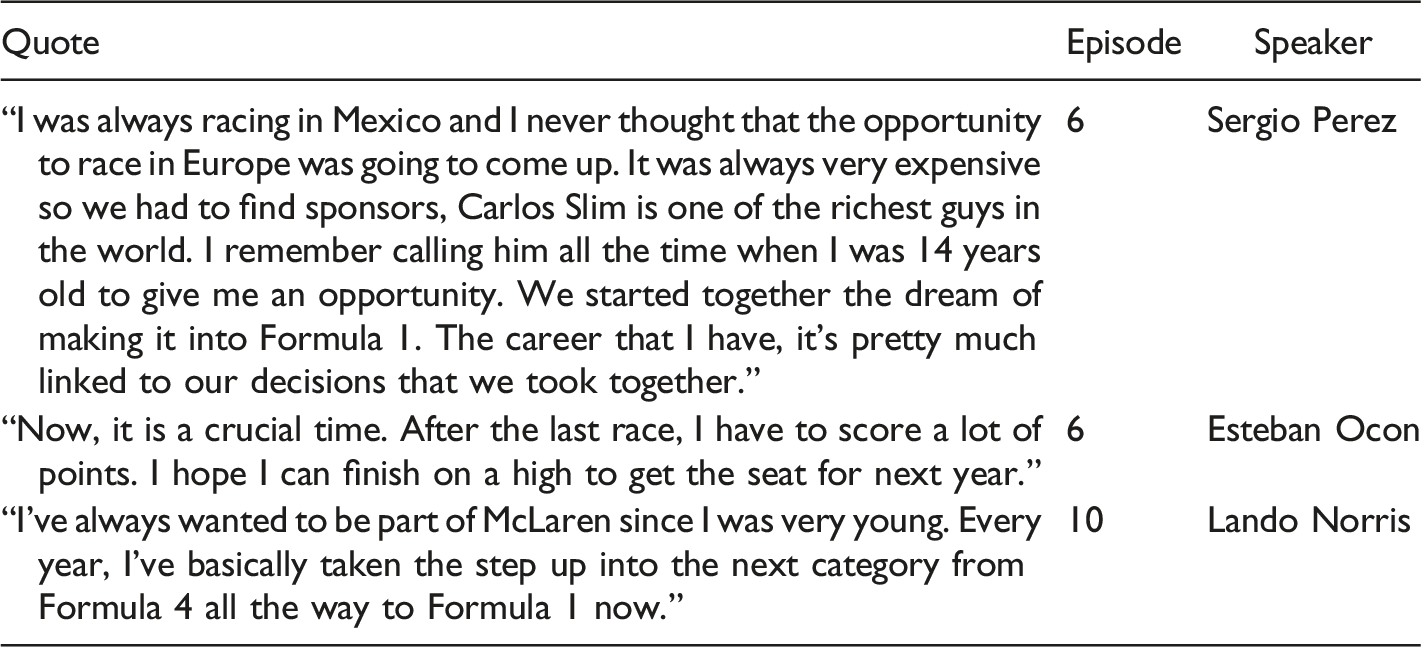
In addition to these typical sport journeys, season one exposed adventure plotlines that might be less obvious. For example, Williams Racing Deputy Team Principal Claire Williams wanted to improve team performance not just to win a championship, but also to preserve the legacy built by her father, Frank Williams. She stated, “I’ve got this whole history that I need to protect. If under my watch that were to all go horribly, horribly wrong, it would be my fault” (Episode 3). The show then followed Williams Racing’s progress (or lack thereof) in achieving that goal.
In Episode 3, Claire decided to bring on Canadian billionaire, businessman Laurence Stroll, as an investor, which in turn changed Williams’ driver lineup: “I think it’s no great secret that Laurence has made an investment based on his son having a seat. I don’t think it can be underestimated the impact that can have but I also have to believe that he has the best interest of the team at heart” (Claire Williams). An unintended consequence of Claire’s pursuit of improved car performance was that a driver was forced out by Laurence’s son, Lance Stroll. This snowball effect illustrates how adventure can create unexpected excitement for the viewer, operating as a catalyst that exposes hidden facets of the sport and opportunities for significant information exchange. Through Claire’s adventure plotline, the viewer learned about the history and family-run nature of Williams Racing, the importance and influence of investors, the father-son relationship between Laurence and Lance Stroll, and how quickly a driver can lose his seat for reasons other than performance. These new subjects can pique the viewer’s curiosity, encouraging them to delve deeper into the sport motivated by a desire to close their knowledge gap, or seek new experiences or feelings (Park et al., 2011).
Other examples of adventures plotlines highlighted in season one were the desire of Renault F1 Team’s Carlos Sainz to establish himself as a racing driver independent from the influence of his father, who was also a successful F1 driver (“Obviously, I know that my dad is a very famous name. I’m incredibly proud to be his son but me personally, I want to create my own name, my own career in Formula 1”, Episode 2) and Sauber F1 Team driver Charles Leclerc’s pursuit of a Scuderia Ferrari seat in honor of his late godfather, Jules Bianchi (“What Charles is doing is a continuation of Jules’ legacy. Charles has a mission, a mission to do what Jules should have done”, Episode 8, Voiceover). All three examples highlight important interpersonal relationships as the motivating factor for adventure, presenting compelling opportunities for identification, which can be highly informed by interpersonal contexts (Cohen, 2001).
Ascension/Descension
F1 team employees experience constantly changing circumstances reflecting the ascension/descension plot type, which was often seen in Drive to Survive in relation to the teams’ expectation of their standing in the World Constructors’ Championship based on historical performance or available resources.
The unexpected tumble of McLaren down the midfield rankings was highlighted in season one. In Episode 2, F1 journalist Will Buxton explains to viewers that “the stakes have really never been higher for McLaren. They are trying to rebuild themselves into a competitive, championship-winning team after so many years of disappointment. If they don’t get it right this year, they’re going to lose their driver.” McLaren driver Fernando Alonso laments that “when I joined the team, we were fighting for the world championship and that was a different goal than what we have now, which is trying to fight back and bring the team to the top positions.” Team Principal Zak Brown offers a telling anecdote that captures the essence of the descension plot line: We have a lot to offer at McLaren, we’ve been absolutely dominant over the years… But it’s been pretty hard to cheer for us because we’ve not been anywhere near racing at the front. It’s been a difficult five-year run. I felt I could contribute to making a difference and so I wanted to get into an environment that I had some work do to as opposed to maybe joining a team that’s on the top and you’ve got kind of only one way to go.
While most ascension/descension plot lines in Drive to Survive followed teams, several depicted the rise and fall of individuals across various roles. Haas F1 Team Principal Guenther Steiner described his successful progression up the ranks (“I started off in the bottom as a mechanic. I’m doing it a long time, over 30 years. Setting up a Formula 1 team in the US was my idea and I persuaded Gene Haas to do this”, Episode 1), while the team’s driver, Romain Grosjean, battled a steady loss of performance following a crash in 2012 (“He’s so experienced, on his day he is so good but he’s falling apart this year. You’re only as good as your last race and right now Romain’s last races are not that much to write home about”, Will Buxton, Episode 7).
The duration of an ascension/descension also varied: Racing Point Force India F1 driver Esteban Ocon’s transformation from underdog to elite athlete started in childhood (“Esteban’s story’s amazing. He’s come from nothing to having the potential to be not just a race winner but a championship contender”, Will Buxton, Episode 6), while Red Bull Racing driver Max Verstappen experienced dramatic improvement in just one season (“It’s been a challenging year in the beginning but since Monaco I’ve been driving a lot better, I’ve been really strong compared to Daniel so definitely turned around the season”, Episode 10, Max Verstappen).
These plot lines leverage identification, which leads viewers to adopt the attitude and goals of a character and consequently experience emotion related to the achievement of those goals (Hoeken & Sinkeldam, 2014). A fall from power or status suffered by a F1 team or individual might trigger disappointment, sympathy, or anger on the part of the viewer, as they watch the character’s goal become more difficult to achieve. Conversely, a rise in power or status might inspire elation, satisfaction, or relief as the viewer sees the character successfully advance.
Drive to Survive’s ascension/descension plots also played a key role in information exchange. Because ascension/descension concerns rises to or falls from power, they must explain various histories to illustrate how power has shifted over the years. For example, Team Principal Christian Horner explained how Red Bull Racing progressed from underdog to champion, then back to a fall from grace: “To take on all the great teams at that time was really the start of a totally dominant period for Red Bull racing. We’re an energy drinks manufacturer, we’re the maverick of Formula 1. We’ve won eight world championships but in the last few years we’ve lagged behind. We need to challenge the big teams. Our Achilles heel has been the engine and that’s been immensely frustrating for us. We have to raise our game” (Episode 4).
What Horner does here is inform the viewer of Red Bull Racing’s identity as informed by its parent company, whose well-known, global brand is defined by living life on the edge; Red Bull Racing’s goals for the 2018 season to improve engine performance and earn top-three placings; and that a parallel story is ongoing between Red Bull Racing and their engine provider, which happened to be the competing Renault F1 Team. This knowledge helped the viewer understand why certain race results mattered beyond points and placings, as well as identify and follow storylines with which they could relate.
Rivalry
When watching a F1 race, there are the obvious rivalries of the World Drivers’ and Constructors’ Championships. But similar to the adventure plotline, Drive to Survive revealed that more varied and nuanced rivalries exist than what first meets the eye.
The fiercest rivalry that exists in F1 is the one between teammates. “Your teammate is your worst enemy,” says Kevin Magnussen in the first episode. In Episode 6, journalist Chris Medland explains, “No driver likes to be beaten by their teammate. They’re their first reference, they’re in the same car, and that’s the person you’ve got to beat.” This, in a sense, is the purest athletic matchup in F1 because it is the only scenario in which drivers compete using the same racecar design and technology, which offers a more accurate skill-based comparison between two athletes. Season one highlighted many teammate rivalries, most notably between Daniel Ricciardo and Verstappen of Red Bull Racing, and Ocon and Sergio Perez of Racing Point Force India F1.
In addition to driver rivalries, Drive to Survive explored rivalries amongst the teams themselves. A large focus was put on the battle for fourth place between Haas F1 Team, McLaren, and Renault F1 Team, educating fans that exciting competition exists outside of the battle for first. These rivalries are significant on many levels, including: financial (“Midfield this year has been one of the most thrilling battles we’ve had in a long time. There’s millions of dollars to play for and all of it has really bogged down to just two teams, Renault and Haas”, Chris Medland, Episode 9); reputational (“We are currently fourth in the championship and Red Bull is third. Red Bull is obviously a great brand but a drink. Renault is one of the largest car makers in the world. We are here for building the reputation of our brand. It’s all about playing catch up against Red Bull”, Episode 4, Cyril Abiteboul); personal (“This battle for fourth place, it’s brilliant and brutal and here’s the mad thing, their drivers don’t get along”, Will Buxton, Episode 9); and even cultural (“It’s old Europe vs. the new world, French royalty vs. raw American power”, Will Buxton, Episode 9).
The above rivalries are diverse in their underlying motives, offering multiple avenues for identification. Subsequently, the identification that viewers develop with a team or driver allows them to differentiate themselves from the opposition. This opens a door to sport fandom as understood by the social identity framework: “Differentiation can quickly lead to deep emotional attachments to in-groups” (Kruger et al., 2018, p. 338), meaning that by aligning themselves with one member of a rivalry and against another, viewers deepen the relationship they have with others who feel the same. Rivalries help forge inter-fan relationships, which, in turn, foster the development of a social identity centered around a team or driver – i.e., fandom.
Sacrifice
Another plot type featured in Drive to Survive was sacrifice. The show allowed for deeper dives into the hard work and commitment required to participate in F1. The idea of sacrifice was introduced early in the first episode with Ricciardo, who said, “For my family, my dream involved sacrifices. My dad was building his own business but also taking me karting on the weekends and spending the money he’d made to then put into me.” Midway through the season, focus is turned to Ocon. In Episode 5, the Renault driver speaks bluntly about the various sacrifices required to get him to this point, ranging from the financial, physical, and emotional: “I remember where I come from, a lot of sacrifices, so I’m not going to let anything stop me… From the first race basically I’m here, training hard and just improving all the aspects mentally, physically. From my point of view here is the best way, there is nothing expect sport here, no girls, no drinks, no distractions.”
Without sacrifice, an individual could not attain the amount of training necessary to reach the required level of performance for an F1 driver. Even naturally talented drivers like Ocon couple their talent with exclusive focus and perseverance in pursuit of a seat, no matter the cost. In this way, sacrifice almost becomes a requirement of the career path, demonstrating the enormous difficulty of the task at hand and unique mastery achieved by drivers. Ocon also speaks about the sacrifices his parents made: “My parents, they don’t have a lot of money. My dad, he’s a mechanic. It’s really hard to describe the hours he was doing when I was going to sleep, sometimes he was working all night and I still saw him in the morning on the same thing. My dad always was saying, ‘I want a better life for you than I have for me.’” The drivers are motivated to generate performances and maintain a career that justifies the sacrifices made by them and their families.
Another important aspect of sacrifice referenced throughout the show is the drivers’ compromise of their safety in pursuit of points. Horner commented, “I’m very conscious that when I look into a driver’s eyes, the risk that he’s taking on. You have a car going in excess of 200 miles an hour racing wheel-to-wheel” (Episode 1). Every sport has a certain level of associated risk, but F1 is exceptionally dangerous, even fatal, given the introduction of cars traveling in close quarters at high speed. The sacrifice plot is defined as “giving up something of consequence for the sake or in pursuit of something else.” There is nothing of greater consequence than life itself, therefore F1 demands that its drivers consent to the highest possible level of potential sacrifice every time they sit in a racecar. These highest of stakes translate into added excitement for viewers, who are now watching F1 races not only to find out who will win, but also to see if consequences arise from the dangerous situation in which the drivers have agreed to participate.
The recurring theme of sacrifice relates to Green and Brock’s concept of transportation (2000) because it plays on the viewer’s emotions to draw them into the narrative. Learning about Ocon’s backstory might prompt feelings of admiration or respect; the constant threat of danger under which drivers operate might inspire fear or worry; or showing F1 parents spending their hard-earned money and limited time to make their children’s dreams come true might tap into a viewers’ feelings about their own families. As “transported individuals may have a greater affinity for story characters and thus may be more likely to be swayed by the feelings or beliefs expressed by those characters” (p. 719), the emotional responses of viewers to sacrifice may affect the impact of other narrative elements. For example, affinity for Ocon due to his sacrifice storyline could encourage viewers to adopt his negative feelings towards teammate and rival Perez, strengthening association with Ocon through differentiation and consequently, the viewer’s fandom.
Hero
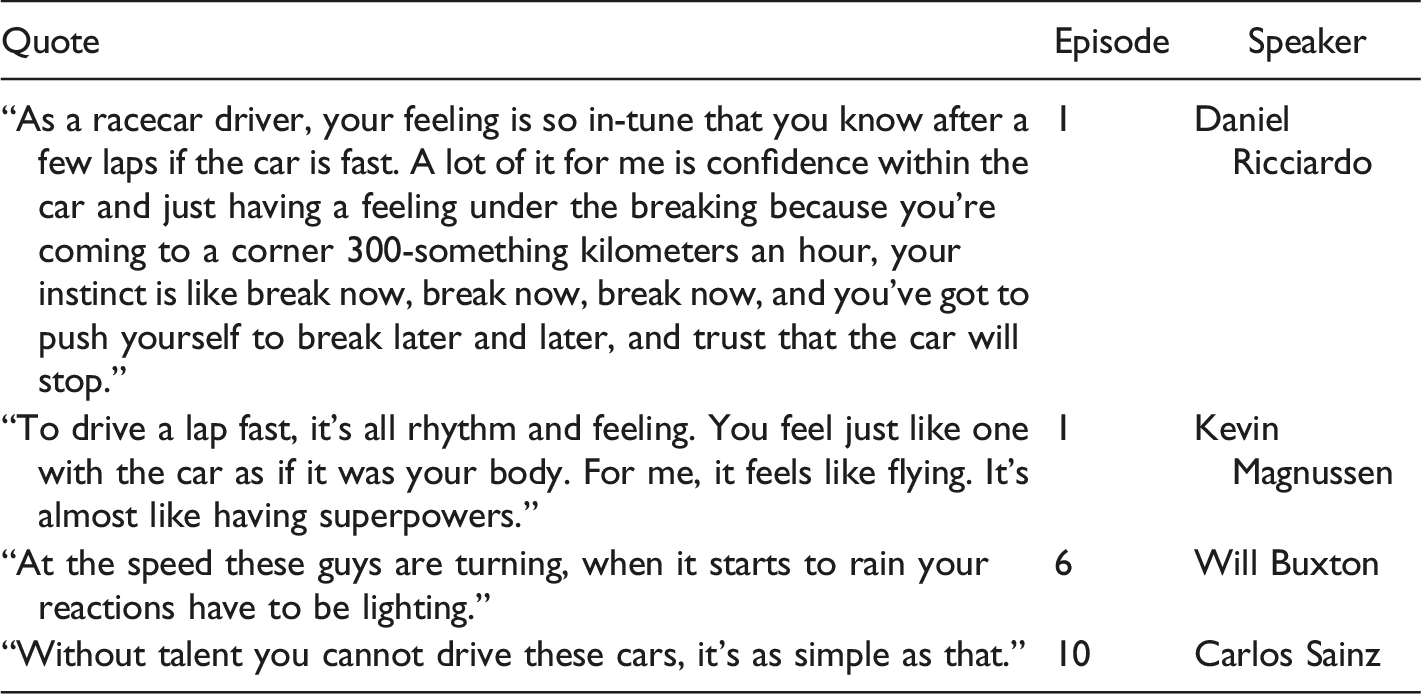
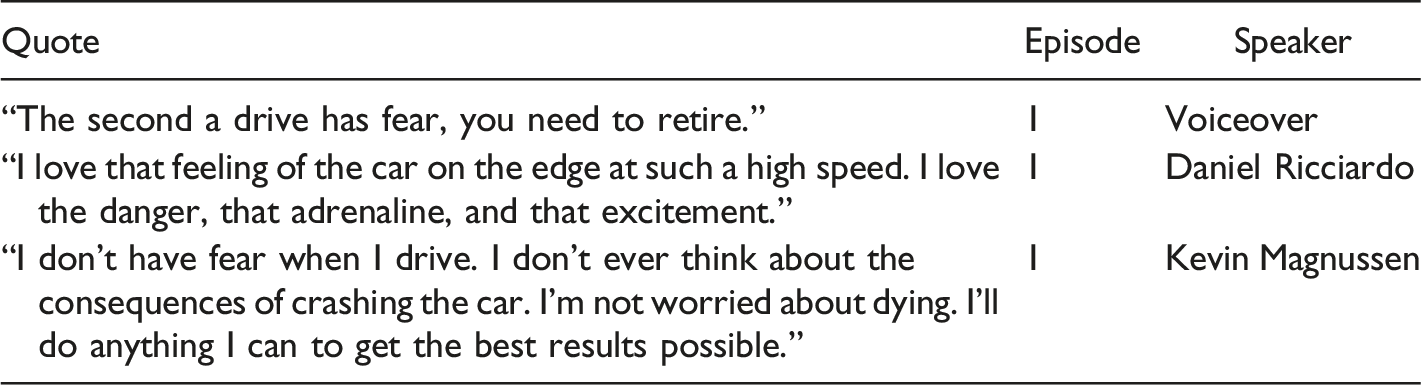
F1 features the fastest cars and competitive driving in the world: if individuals with the talent and skill to drive F1 cars did not also possess the courage to do so, not only would the above-described plot of sacrifice not exist, but the man-and-machine contests available for mass consumption would operate at a much lower level of performance, translating into lower levels of excitement and entertainment. It is due to the driver’s unwavering courage, even in the face of their own mortality, that the sport exists in its current form.
Other exceptional personality traits mentioned throughout the show included the drivers’ resilience and persistence. In Episode 8, Buxton described a scenario concerning Leclerc that painted a picture of the mental fortitude required to succeed in F1: One moment stands out for me, which is in Formula 2 when he got to Baku and he’d lost his father earlier in the week, and we’re talking literally 48 hours later he was in the car. He then went out, fell to last place, fought his way through, and won the race. This was a kid who just lost his father, and he was a kid at the time, he’s a teenager. To have that kind of mental strength, I’d never seen anything like it.
Managing emotion in the face of life-threatening danger or through terrible loss is incredibly difficult, and can feel insurmountable or paralyzing for many people on its own. F1 drivers are not only able to effectively manage challenging emotions, but concurrently maintain an incredible level of performance in a high-pressure environment. Indeed, they might even harness the emotions that come out of adversity and turn them into motivation, demonstrating even greater levels of focus and self-discipline. Leclerc’s example shows how drivers can prioritize F1 performance above all else and demonstrates how their level of control is much greater than that of the everyman.
It is helpful to understand these heroic characteristics within the social identity framework. If “individuals seek to maintain or improve their self-esteem by belonging to a successful group” (Wonseok et al., 2018, p. 65), and drivers can be understood as the individual around whose performance an F1 team operates, then extoling the virtues of drivers helps viewers identify which groups might be successful. Narrative examples, such as Leclerc’s perseverance and commitment through great loss, illustrate characteristics of a driver that might contribute to a successful athletic performance or career. Therefore, the viewer might be more inclined to belong to that driver’s fan community.
Additional Narrative Elements
Additional narrative elements that appeared in the data included the plot types of revenge and underdog, the character types of the helper and hometown hero, and narrative arc.
The inclusion of the revenge plot type facilitated information exchange because past relationships or events had to be explained to justify why an individual felt wronged, and therefore sought retribution. Episode 9 introduced the tension between Haas F1 Team’s Magnussen and Renault F1 Team’s Nico Hülkenberg, which became a story of revenge rather than simple rivalry due to past team politics. Medland explained: There’s a bit of history between Magnussen and Hülkenberg and part of it stems from Magnussen’s own history with Renault. He used to drive for that team and felt Renault didn’t put enough faith in him to try and keep him. He was replaced by Nico, so Kevin Magnussen’s definitely had a point to prove.
If the viewer did not understand the reason behind Magnussen’s dislike of Hülkenberg, Magnussen would seem unsportsmanlike and hostile to his peers for no apparent reason: he would become a villain rather than a hero. But by explaining the need for revenge, the viewer understands that Magnussen’s attitude is informed by past injustice, which is forgivable, or even understandable. Therefore, Magnussen remains relatable and likeable as a character.
The underdog plot type is also similar to rivalry but features a competitor at a disadvantage. This narrative element was largely used to highlight the difference between teams in terms of size and budget, and how that difference impacts performance. Medland succinctly described the situation in Episode 1: In Formula 1 we’ve got 10 teams and each team is trying to develop the best car possible. The more money you spend, the better your car is likely to be. But there’s a massive difference in budgets in Formula 1. The smaller teams are quite often operating on a budget that’s a fraction the size of the very biggest teams like Ferrari and Mercedes, so it’s not a level playing field.
After Medland set the scene, the show featured many of the smaller teams. Haas F1 Team and Williams Racing were often described as disadvantaged teams with fewer resources, the former because of its newcomer status and the latter because of constant underperformance. These examples of the underdog plot type facilitated information exchange by depicting the complicated financial realities of F1. By understanding the impact of finances on performance, viewers better understand how the sport operates and can predict results based on their knowledge of the teams’ capabilities.
Another important facet of F1 was communicated through the character type of the helper. While the driver plays the essential role of pilot, the car’s abilities are determined by a large staff that includes owners and investors who pay for it, developers and mechanics who build it, and race engineers who help manage it. Despite the large number of individuals whose skill is required to compete a F1 car, there are limited opportunities to recognize the wider team during a race (“In the pit stops, that’s the only time you really get in touch with your team. You’re all alone on the track, everything is depending on you. When you pit, that changes completely, that’s when you realize how much of a team effort it is”, Kevin Magnussen, Episode 1). The behind-the-scenes of Drive to Survive therefore becomes the perfect opportunity to show the importance of different roles.
The hometown hero relates to an important characteristic of F1 – its inherent internationality. F1 hosts races across the globe, and its drivers and teams represent over a dozen nations. The international nature of F1 provides opportunities for viewers to relate to shared nationality, which might translate to similar backgrounds, life experiences, or values, and promotes team-related identification as described by Raney (2012). For example, Team Manager Beat Zehnder introduces Alfa Romeo Sauber F1 by tying its defining characteristics to Sauber’s country of its origin (“We are based in Switzerland. We are very punctual, very precise. We’re very honest, sometimes too honest”, Episode 8). Meanwhile, Steiner calls on the drivers of Haas F1 Team, which is based in Kannapolis, North Carolina, to embody “American passion” (Episode 9). In this way, both the teams and their drivers become extensions of a country’s attitudes and attributes, with which viewers may already have preexisting identification.
Also of note is narrative arc. Most narrative elements identified in the research fall under plot or character type; narrative arc is the only one that falls into a third category, structure. This suggests that in addition to containing recognizable themes in terms of content, it is important for a narrative to follow the traditional beginning-middle-end format. This familiar structure is reflected in multiple layers of F1: the overall season, a race weekend, and the race itself. In Episode 1, Medland expanded on the progression of a race weekend: One of the most special things about Formula 1 is the way the weekend builds. Friday is practice, that’s when the teams and drivers get out on track to try and set their cars up and make sure it’s performing the best it can. Saturday there’s qualifying to set the order that the cars will start the race in, and on Sunday we have the race itself.
This description shows how a race weekend mimics narrative arc by including the “three primary processes in the unfolding of a story” (Boyd et al., 2020, “Introduction”). Friday’s practice is staging, which provides context by establishing team, driver, and car performance; Saturday’s qualifying represents plot progression by determining starting order for the race, therefore advancing the storylines and building character interaction; and Sunday’s race provides resolution by determining a race winner. Using this beginning-middle-end format breaks down a complicated sport into manageable segments that help the viewer make sense of narrative progression.
Conclusion
The RQ1 findings showed that the plot types of adventure, rivalry, ascension/descension, and sacrifice, as well as the character type of hero, characterized Drive to Survive, appeared with frequency throughout season one. They were complemented by a handful of additional elements featured with less regularity and prominence. Narrative elements spanned multiple categories: character, plot, and structure. The inclusion of numerous and varied narrative elements suggests that variety is key: the more elements that exist in a narrative, the more opportunities viewers have for connection.
Analysis pertaining to RQ2 then contextualized RQ1 findings within narrative storytelling and sport fandom theories. The identified narrative elements brought opportunities for information exchange, emotional connection, and the creation of inter-fan relationships, which are contributing factors to sport fan conversion. These narrative elements were intricately layered across many levels, such as different timelines or individual versus team. Content focus also varied from technical or operational details regarding the sport, to interpersonal relationships. Providing multiple combinations of plotline, character, and thematic focus exponentially increased the number of narratives available to audiences.
The narrative elements identified in the research have been established features of storytelling for centuries or longer. By relying on recognizable constructs, Drive to Survive leverages probability and fidelity as described in Fisher’s narrative paradigm, helping the viewer make sense of a new sport and all of its intricates. It is from this place of knowledge from which viewers can become fans. By illustrating how narrative elements function in a sport context and relating that data to existing narrative and sport fandom theories, this study reinforces the concept of “homo narrans”, and contributes to the idea of narratives as a tool for cognitive and conative change. Fundamentally, this is a process of persuasion, with narrative acting as a rhetorical tool. This research shows this process in action and therefore helps shed light on the psycho-social motivations behind conversion-through-narrative.
Building on these empirical findings, future research specifically informed by contemporary audience studies is needed to more rigorously explore and firmly establish the links found between viewing Drive to Survive and the expansion of the F1 fanbase. Another line of research building on this exploratory analysis would be to undertake a comparative study across multiple seasons of the docuseries exploring how the producers adapted their approach to narrative storytelling over time.
Footnotes
Declaration of Conflicting Interests
The author(s) declared no potential conflicts of interest with respect to the research, authorship, and/or publication of this article.
Funding
The author(s) received no financial support for the research, authorship, and/or publication of this article.
