




Abstract
This article provides an overview and analysis of how the study of sport at the intersection with the media has developed in the Slovenian context over the last three decades. The first part of the article briefly explains the importance and role of sport and media in the broader social context. By looking in particular at sports journalism and introducing the Slovenian context, the purpose of the study is clarified. The second part identifies and reviews all academic research contributions published on the highlighted intersection and during the selected period. Based on a quantitative and qualitative analysis of the most frequently addressed aspects of the sports media system, the main research topics identified and the media outlets studied, the main findings are summarized and highlighted. While studies addressing different aspects of nationality predominate, attention to gendered nationalism is highlighted as particularly valuable in the context of studies focusing on gender and its intersections. Event-oriented and decontextualized sports content is problematized in the context of recent studies focusing on some aspects of sports journalism. In the final section of the article, some guidelines are formulated to encourage further research in (and of) this geographical area (and beyond).
Introduction
In the last issue of “Kurji šus”, the humorously conceived but no less “serious” Slovenian student sports newspaper in terms of the variety of content and genre as well as the problem-oriented texts, the author of the editorial writes: “Do not expect articles about who won this or that game, what the result was and what this or that athlete said after the game. We present sport through social, political, economic and media relations. Which is basically what sports journalism should be about,” (Saksida, 2019). Kurji šus was published in only two editions, as the sports journalism course within which it was written was dropped from the country’s leading university journalism education program (we will return to this below), but the highlighted quote nevertheless gives us an indication of the role of sport and sports journalism in a broader social context. Namely, and in the most straightforward way – they both matter. Although both have been labeled “trivial” or “unserious” for various reasons in the past, it would be all too easy to reduce their role to that of entertainment, of something that exists in a vacuum, isolated from the wider social context and is designed primarily to distract, numb, and temporarily withdraw from everyday social life.
Beginning in the mid-1960s, and especially between the 1970s and 1980s, as the notions that sport – by virtue of its relationship to the body – was either entirely “natural” or – in a broader social context – a relatively “trivial” phenomenon were gradually overcome and sport gained legitimacy as a social phenomenon, it became the subject of more critical approaches, and social scientists and humanists began to produce knowledge that offered insights into previously neglected aspects of culture and society (Coakley, 2021; Hargreaves, 1994). Similarly, within the broader journalistic field, sports journalism has been and continues to be confronted with the need to legitimize its own subfield (McEnnis, 2020) and is often referred to as the “toy department” or “sandbox” of the newsroom, “the world’s best advertising agency” and journalists as “fans with a typewriter/laptop” (Bien-Aimé et al., 2017; Boyle, 2006; English, 2016; Weedon & Wilson, 2020; Wenner, 2017a). While criticism is not always entirely unwarranted (Hardin et al., 2009; Rowe, 2007; Rowe & Boyle, 2023; Wenner, 2017a), sports journalism (as well as sports media more broadly) has been shown time and again to play an important role in sustaining, challenging, and changing the social institution of sport as well as other sociocultural, economic, and political developments of societies (Boyle, 2013; Rowe & Boyle, 2023; Wenner, 2021).
Through the processes of agenda-setting and framing, sports media, for example, tell audiences what to think about, while also playing a key role in creating meanings around various sociopolitical issues (Bien-Aimé et al., 2017; Billings, 2008; Ličen, 2017). Several studies in this area have addressed the questions of who is represented in sports media and how, as well as the role played by factors such as race, ethnicity, national identity, gender, and (dis)ability (Ganz, 2011). Among them, and along with some minor (recent) improvements, are several problematizations of media portrayals that reproduced racial and ethnic stereotypes and portrayed black athletes as inherently athletic and white athletes as intellectually gifted and hard workers (Billings, 2004); of sporting events as a channel for the establishment of nationalisms and the consolidation of national identities (Billings, 2008); of the marginalization and stereotyping of disabled athletes (Antunovic & Bundon, 2022); of the underrepresentation, trivialization, and sexualization of female athletes (Bruce, 2016; Cooky & Antunovic, 2022).
Thus, although the sports space is often portrayed as apolitical and its content as value-neutral by alluding to its supposed triviality, frivolity, and fun, this “obscures the ways in which social values and norms are produced through even the most seemingly banal sports media content” (Bien-Aimé et al., 2017, p. 224). The relationship between sport and the media is a special one (Boyle, 2013), the symbiotic nature of which can be illustrated by the metaphor “match made in heaven”. Today, elite sport practically no longer exists without the media; most people follow sport through the media (Billings, 2008). Conversely, sport, which plays an important role for the media in attracting audiences, consequently also attracts advertisers (McEnnis, 2020; Weedon et al., 2018), i.e., capital, which then generates even more capital and even more sport through the production and distribution of media texts (Bien-Aimé et al., 2017). In the narrower context of sports journalism, this framework also opens up various ethical dilemmas (Wenner, 2017a) and establishes routine practices that can negatively impact journalists’ independent work (Bien-Aimé et al., 2017; Rowe, 2007) and is also complicated by new trends, new media and technologies, new demands, and new ways of doing sports journalism (Boyle, 2013; Ketterer et al., 2014; McEnnis, 2020; Rowe & Boyle, 2023).
It is therefore nothing unusual that in the face of various social changes and upheavals, be it new technologies, the Covid-19 pandemic, or the increasingly tangible climate change, leading scholars in the field are returning to the fundamental questions of what “good” journalism is, and how and in what direction it is worth promoting the development of sport journalism in the narrower sense and sports media in the broader sense. Their answers seems to be quite consistent: sports journalists, as active shapers of society, must adhere to the same high ethical standards as their journalistic colleagues in other fields, They are primarily accountable to the public and the public good. Sports journalism best meets modern challenges when it recognizes the role of sport in society and is more problem-oriented, critical, reflective, investigative, and – in the sense of asking difficult questions – “unlovable” (Antunovic & Bundon, 2022; Bien-Aimé et al., 2017; Hardin et al., 2009; Rowe & Boyle, 2023; Weedon et al., 2018).
Although it could be said somewhat simplistically that the basic characteristics and guidelines of “good” (sports) journalism can be universal to a certain extent, at least on a normative level, it is of utmost importance in research practice to also consider and pay attention to the specificities of different social, cultural, national, and local contexts. As Rowe (2007) points out, sports journalism has a different occupational status in different national and institutional contexts. Furthermore, the dominant patterns that emerge at the level of prevailing broader media practices and media systems as such in one social, political-economic, cultural and geographical context may differ from those that emerge in other contexts. Finally, there are also differences and asymmetries in the context of academic research (Coakley, 2021). Perhaps the most obvious and relevant, for the purpose of this paper, are the global inequalities at the level of knowledge production, where North American and (Western) European authors and study contexts in particular dominate, which has already led to calls for globalization and the need for (also) critical cross-national approaches in an effort to expand and diversify knowledge, to integrate it within and across locations (Antunovic, 2023; Wenner, 2017b). Literature reviews of studies from less dominant geopolitical contexts can be useful in this regard, not only as a potential tool to shed additional light on otherwise less visible knowledge production in a condensed form, but also from the perspective of potential limitations and challenges that the inaccessibility of literature from other geographic contexts and languages sometimes pose for Anglo-American and other researchers. This study focuses on Slovenia, which, similar to some other transitioning societies in Central and Eastern Europe, has received some scholarly attention in the past but remains generally under-researched. As this is a literature review of studies on a single country, the contribution of this article to broadening the horizons of knowledge production is relatively small, but potentially greater if it succeeds in initiating and generating other similar studies in the region and beyond.
The Slovenian Context and Media Landscape at the Intersection of Sports Media Research
Slovenia is a relatively young country having emerged in its current political form of parliamentary democracy after the collapse of socialist Yugoslavia in 1991. Until then, its national identity developed in the absence of an autonomous and sovereign structure (Kotnik, 2007), and even after gaining independence, it remained important to (re)imagine and (re)invent the national community and identity. If the nation, both as a historical reality and as an ideological construct, is today the dominant form of political organization on a global scale, language and culture/literature played the most important role in the creation of the Slovenian nation (Velikonja, 2002). The Slovenes are supposedly a “cultural nation,” whereby this term is embedded in the context of so-called cultural nationalism (also called ethnic, “German”, communitarian), which is based on the “blood principle” and is oriented towards the organic connection of the national community (Velikonja, 2002, pp. 285, 291–293). The distance in relation to the “others,” the “not-us,” has been persistently established in modern Slovenian public discourse primarily through the ethnocentric binary division into Slovenes and non-Slovenes, and through the reproduction of stereotypes about individual groups (e.g., southerners, easterners, refugees) that have allegedly repeatedly threatened and continue to threaten Slovenes and their culture (Velikonja, 2002; Črnič, 2019). This also applies to the field of sport, whose role cannot be ignored in the context of creating a national identity (Doupona Topič & Coakley, 2010), and within the processes of various mythologizations, where skiing in particular has played a role as a marker of Slovenian-ness (Kotnik, 2007, 2008, 2009; Starc, 2005), and soccer as its opposite (Stankovič, 2004; Starc, 2007a, 2007b).
The development of Slovenian journalism, in the context of the Central European information environment, occurred initially with a delay due to the multiple fragmentation of the Slovenian ethnic space, which pushed it to the margins of social influence, especially in the early periods of the construction of national identity (late 18th to mid-19th century) (Amon, 2004). Journalism was subordinated to the respective political authority both in the period of Slovenian history in the Habsburg monarchy and in the two Yugoslav countries, Since Slovenia’s independence in 1991, the role of subordination to politics has been replaced by the role of service to capital (Amon, 2004). Different perceptions of the social role of journalists and different conceptions of reality have also influenced different paradigms of journalistic objectivity in the Slovenian context (Vobič, 2014), which is not insignificant, especially from the point of view, that – since journalistic work is anchored in the human right to freedom of expression and the consequent absence of restrictions on entry to the journalistic profession with licenses (Milosavljević, 2004) – the norm of objectivity otherwise largely determines the way journalists self-regulate their profession and claim jurisdiction (McEnnis, 2020). The demise of socialism and the subsequent reversal of the foundations of Slovenian journalism were characterized by various non-transparencies from the beginning of independent Slovenia (Milosavljević, 2004); and the social role of journalists changed from socio-political workers to the role of “detached communicators accountable to the public” (Vobič, 2014, p. 11). In practice, market-oriented social dynamics force(d) journalists to provide services for the benefit of consumers rather than the public (Vobič, 2014, p. 13).
Although journalism in Slovenia has been studied since the early 1960s (Vreg, 2004), and although scholars in this geographical area are not late in addressing its recent trends, structural changes, new dynamics, practices, norms, etc. (e.g., Kaluža & Slaček Brlek, 2020), sports journalism and sports media in general are relatively absent from journalism (and kinesiology) education programs. In the past, journalism students at the Faculty of Social Sciences in Ljubljana could learn about some aspects of sports journalism and sports media in general through the elective course “Specialized Journalism”, which was held three times (in the academic years 2017/18, 2018/19, 2020/21), but since the reaccreditation of the program, the course is no longer offered. Similarly, at the Faculty of Sport in Ljubljana, students could choose a concentration in sports media in their final years of undergraduate study, which meant that their curriculum included a “Sports and Media” course. The course was offered between 2001/2002 and 2011/2012, but since then and as a result of the Bologna reform of the program, this option no longer exists.
Moreover, the Slovenian context remains relatively unexplored, invisible, and underdeveloped at the level of research in the otherwise increasingly fertile and expansive field of sports media studies (Wenner, 2021). The studies that have been conducted in or about the Slovenian context in this field are scattered among scholars from different academic backgrounds (most of whom are either not primarily researching journalism, media, and communication studies, or are not based in Slovenia), as well as across different aspects of the sports media system they address, different research foci, and media outlets studied. Thus, the basic aim of this literature review dealing with the intersection of sport, media, and the Slovenian context is first, to identify relevant previous studies in this framework, and, through their analysis, to present their basic trends and shortcomings in a condensed form, and second, to formulate some guidelines for future work and research priorities. In addition to the already emphasized desire to contribute at the level of potential future cross-national endeavors, the article aims to stimulate critical research on the intersection of sport, media, and society also in the geographical environment of Slovenia and among researchers who have only marginally engaged with it so far.
Methodology
To accurately and comprehensively identify contributions suitable for our purpose, the PRISMA flowchart for systematic literature reviews (Page et al., 2021) shown in Figure 1 was followed. The aim was to identify all scientific articles or scholarly chapters in monographic publications dealing with the intersection of sport, media, and the Slovenian context from the perspective of journalism, media, and communication studies, sociology, cultural studies, anthropology, history and philosophy, written in either English or Slovenian.
1
PRISMA flow diagram.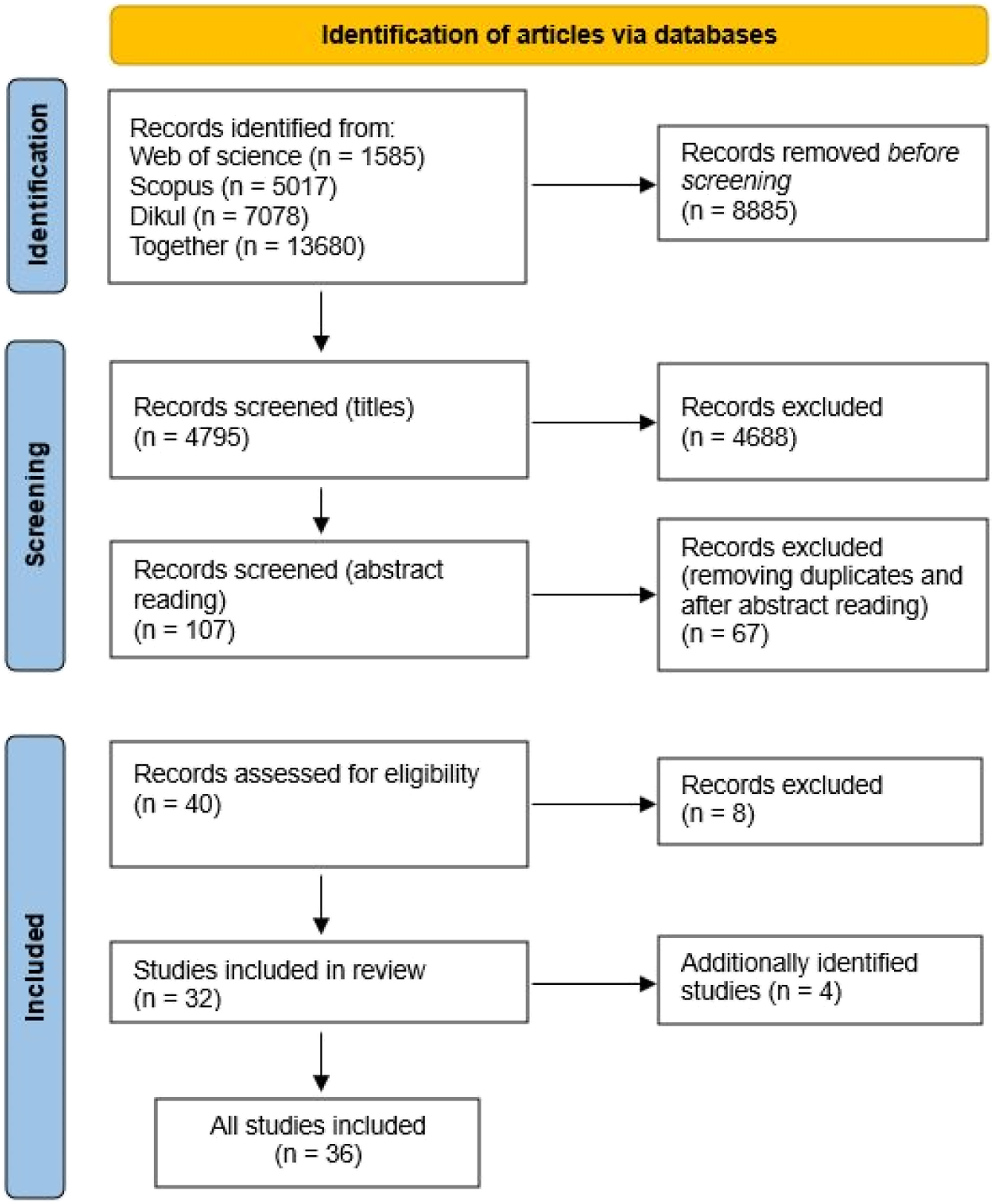
Three databases were searched (Web of science, Scopus and DiKUL). 2 The search term used for all contributions published up to August 2023 was as follows: (“media” OR “news” OR “coverage” OR “journalism” OR “journalistic” OR “broadcast*” OR “social media” OR “reporting” OR “tv” OR “television” OR “telecast” OR “radio” OR “newspaper*” OR “press” OR “representation*”) AND (“sport*”) AND (“slovenia*”). The total number of hits was 13,680. Due to technical limitations of two databases (Scopus and DiKUL), which did not allow to screen all hits, the hits were first sorted by relevance, and then the titles of the remaining 4795 were screened. Of these, 4688 irrelevant hits were excluded. For the remaining 107 hits, duplicates were first excluded and then their abstracts were read. In this way, 40 hits were obtained, which were assessed for eligibility. Another 8 papers were excluded after reading, either because media and sport were not their main focus, or this intersection was mentioned only in passing and sporadically in a few sentences or paragraphs, or the specifics of the Slovenian context were either not discussed or played a marginal role in the overall work. When reading the studies included in the review, a further 3 articles suitable for the purpose were identified and included in the review. Another study was identified and included on the recommendation of an academic colleague. In total, 36 studies were included and analyzed in the review.
In addition to some other quantitative findings highlighted below, after reading the articles, they were first classified according to which of the three basic structures of the sports media system (i.e., media production, media texts, media audiences) was their starting point or object of analysis, and their main findings were summarized in a special table. The inductive process was also used, from which four basic categories were derived (nationality, gender, sports journalism, other), which designated the most frequent and approximate research foci or topics in the articles and with which the articles were coded accordingly. In addition, the articles were organized according to which media outlets across the media landscape they examined. These aspects of the analysis are presented below in the quantitative part of the Results and discussion section. In the qualitative section, the main research priorities are presented in a condensed form, along with some findings and highlights of the studies included in the review. The guidelines are then derived from all the results together in the final part of the article.
Results and Discussion
Quantitative Aspects
The time span of the research publications analyzed in this review goes back to 1995, 3 when the first empirical research on this geographical context was published as part of a larger international research project (Splichal, Basic & Luthar in de Moragas Spà, Rivenburgh & Larson, 1995), up to the more recently published studies (before August 2023). Most of the contributions analyzed were written in English (26), 9 of them in Slovenian and 1 in Croatian. It seems somewhat surprising that the scholars developing the field of journalism, media, and communication studies in Slovenia today have not published a single scientific article in the field of sports journalism, or at the intersection of sports and media studies. 4 Apart from one researcher who has not been based in Slovenia in recent years, the authors of the included studies who have worked or are working in Slovenia are primarily trained kinesiologists or anthropologists who also interweave their work with the fields of sociology, cultural studies, sports anthropology, and sports management. It also seems important to point out that most of the studies examined and published in the last 10 years have been conducted by researchers not based in Slovenia (apart from 2 papers that were collaborative). However, they have either been educated in or are culturally close to the context they (also) study and/or work from the diaspora.
The studies examined were first broadly classified into three groups based on the basic structures of the sports media system, i.e., according to whether they primarily derived and analyzed aspects of (a) media production, (b) media texts, or (c) media audiences. Furthermore, the studies within these groups were divided according to their research agenda, i.e., the primary topics/issues they addressed (Figure 2). Classification of research trends in the Slovenian context: the intersection of the basic structures of the sports media system and the research agenda.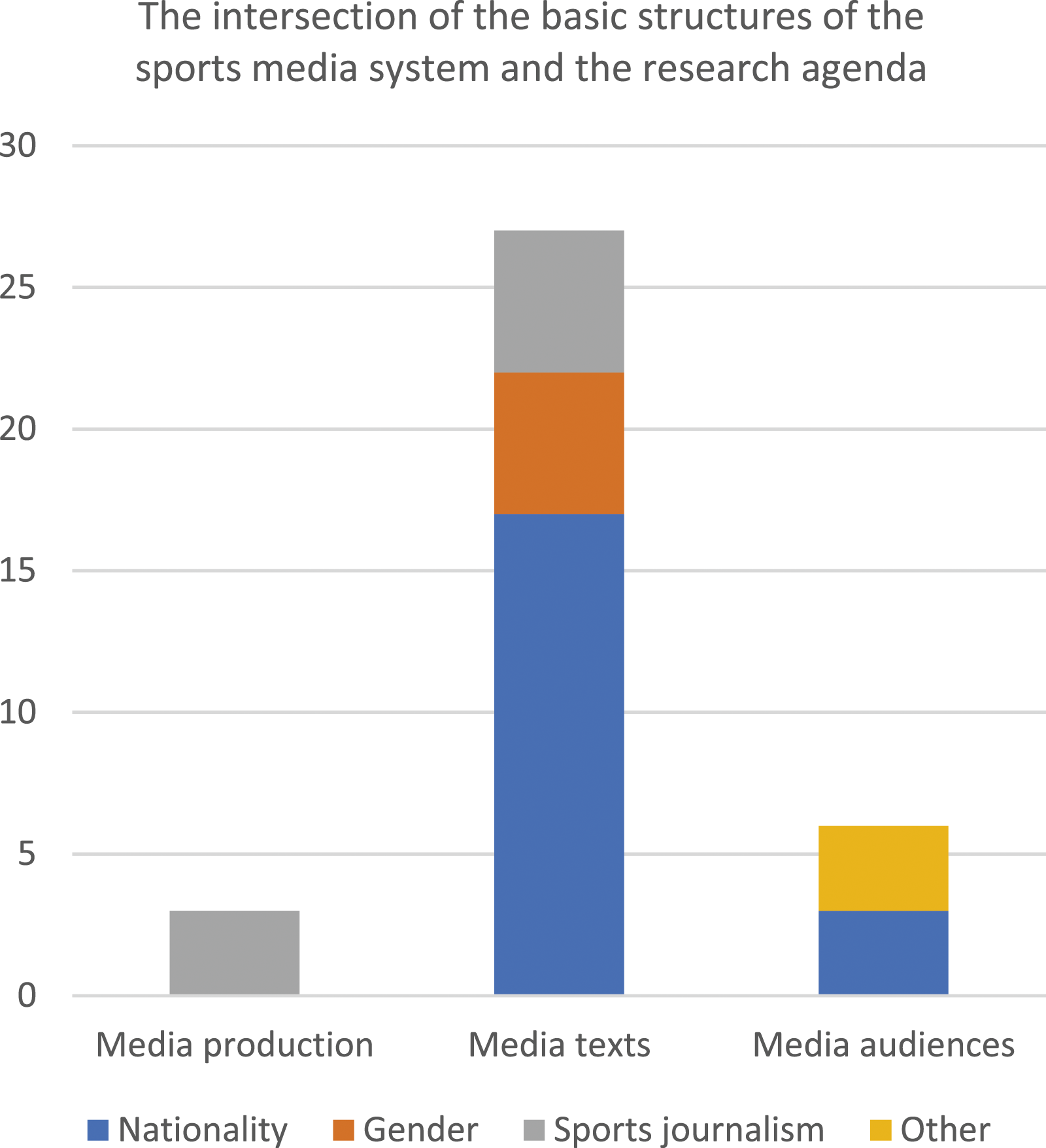
In the papers, media texts were analyzed most frequently (27 papers), aspects of media production concerning the conditions of producing media texts were dealt with in 3 papers, and media audience was the starting point of 6 papers. At the level of selected topics and research focus, most attention (17 articles) in the study of media texts (as well as 3 on media audiences) was devoted to various aspects related to nationality (national identity, national identification, nationalism, national promotion, national success); somewhat less frequently, studies dealt with media texts at the intersection of gender issues (7 studies), 5 media texts and media production were also examined to reflect some aspects of sports journalism (8 studies), and a total of 3 remaining studies dealt with media audiences in the intersection with other issues (here, the focus was either on determining the relationship between sports media consumption and sports participation (2 studies) or the intersection between media and athletes’ well-being (1 study).
As can be seen in Figure 3, studies most frequently relied on analysis of television texts (17 studies), analysis of newspapers formed the basis of 11 studies, 6 studies relied on mass media in general, and 2 studies drew empirical data from social media. No study analyzed radio or primary audio texts (e.g., podcasts). The somewhat stronger emphasis on television is understandable for at least two reasons: Firstly, since the 1960s and even more intensively in the late 1980s and early 1990s, when Slovenia became an independent state, its public service broadcaster was one of the most important cultural and political instruments in the “re-imagining,” “re-inventing” and strengthening of Slovenian national identity (Pušnik & Starc, 2008; Volčič, 2005), in which sports also played an important role (Doupona Topič & Coakley, 2010). Most studies based on empirical evidence from television focused on the role of selected aspects of sports media either in relation to the construction of national identity (e.g., Kotnik, 2001, 2002, 2007, 2008, 2009) or, and this is the second reason, analyzed major or mega sporting events such as the Olympics and Eurobasket (e.g., Billings et al., 2013; Brown et al., 2017; Ličen, 2013, 2019; Ličen & Billings, 2012b, 2013), where television remains the main medium of consumption despite modern changes in the media landscape (Billings, 2008; Markula, 2017; Real, 2011; Rowe, 2011). Classification of research trends in the Slovenian context: the intersection of the basic structures of the sports media system and the type of media studied.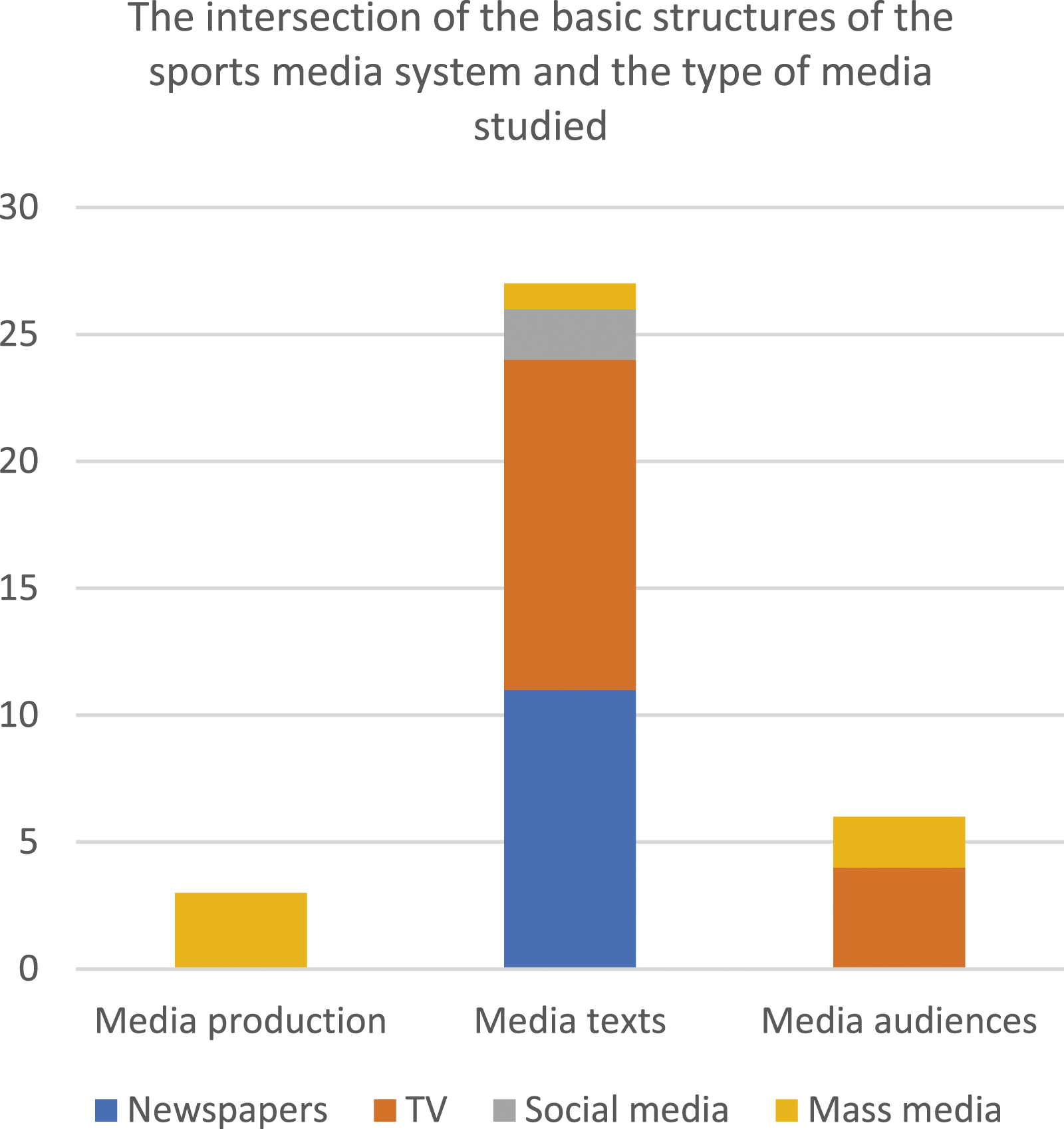
Qualitative Aspects
Before presenting the main research foci of the studies reviewed and a more qualitative unfolding of their findings, the following should be emphasized: Since the review included only papers that fell into the category of “(original) research articles” or constituted a scholarly chapter in a monographic publication, i.e., texts that had already undergone various peer-review processes prior to publication, it was not the intent of this review to examine papers for possible theoretical, methodological, or empirical shortcomings. The final selection was intended to be as inclusive as possible, and did not exclude papers in which such deficiencies were indeed identified. 6 It should be noted, however, that such studies are only mentioned to a limited extent below.
Nationality and Gender
In the quantitative part of the results, we have already mentioned that within the studies of this review and in relation to their research focus, the studies on various aspects of nationality and national identity dominate and maintain the position of the leading research focus throughout the period of research. In the first two decades – in addition to the first empirical examination (Splichal, Basic & Luthar in de Moragas Spà, Rivenburgh & Larson, 1995), which used an analysis of television broadcasts to show how the Olympic Games were an instrument for promoting national sentiment immediately after Slovenia’s independence – two researchers published papers in this field, underpinning in their studies the role and changing meanings of the two most prominent sports in the formation of Slovenian national identity, namely skiing and soccer. Kotnik (2001, 2002, 2007, 2008, 2009) has deconstructed the myth of Slovenia as a skiing country and Slovenes as a skiing nation, especially through various analyzes of TV broadcasts, and has shown how skiing was established as a supposedly autochthonous national sport and an instrument of Slovenian nationalism. Its opposite, until the turn of the millennium, was soccer (Starc, 2005), which was perceived in the analyzes of Slovenian newspapers (Starc, 2007a; 2007b, 2009) as a non-Slovenian phenomenon associated with various “others,” which was especially expressed in the 1980s and 1990s, when Slovenia’s independence required a clear demarcation, especially from the other Yugoslav countries.
In the period from 2010 to 2023, 10 studies were published in which various aspects of nationality and national identity became the subject of more diverse articulations. Highlighted and studied were differences in the use of nationality in marking the identity of non-Slovenian and Slovenian athletes, both in the context of national competitions and at the Olympic Games (Ličen, 2013, 2015); the role of Slovenian athletes' national identity in the context of competitions where national affiliation otherwise has no formal meaning (Ličen & Billings, 2012a); the complexity of national identity when athletes change the flag under which they compete (Bartoluci & Doupona, 2020); the labeling of Slovenian athletes with “our(s)” in the context of the Olympics (Ličen & Billings, 2013); and, during the Olympics, the influence of national interest and success on the amount and characteristics of public media content on social media (Antunovic & Bartoluci, 2023). In addition, a relationship between Olympic media consumption and some aspects of national identification has been identified (Billings et al., 2013), and a more sophisticated study has identified the impact of national identification and protectiveness on fans’ engagement with the Olympics and, in turn, their media consumption habits (Brown et al., 2017). Also studied and rejected was the impact of hosting the 2013 Eurobasket on national identification (Ličen, 2019), and analysis of international newspaper coverage of the same event rejected the claimed impact on greater recognition and promotion of Slovenia as well (Ličen et al., 2017).
At the level of gender representation, early studies in the Slovenian context have revealed patterns previously identified in other studies (e.g., Bruce, 2016), namely gender imbalances both at the level of technical production of TV media content (Bon & Doupona Topič, 2004) and at the level of quantity and quality of newspaper coverage of women’s sports in the selected month (Lavrinc & Doupona Topič, 2006) and in Olympic broadcast (Ličen & Billings, 2013). The Olympics were also the subject of a recent study that highlighted the gender imbalance in the intersection with nationalism in media content published on the public media’s Facebook profile, with women receiving attention exclusively when they represented the home nation at the Olympics (Antunovic & Bartoluci, 2023). The last two studies also make a ‘sui generis’ contribution to sports media research by examining gendered nationalism (finding, for example, that nationalism influences coverage of female athletes (Antunovic & Bartoluci, 2023)) and raising questions that can potentially advance theory building in this area of research. In addition, women’s sports were also recently the focus of the only more holistic study in this review, which examined routine media practices (Ličen & Bejek, 2019), highlighting the underrepresentation of women’s sports in the Slovenian press (10.4%–12.5% vs. 74.9%–79.4%) and the generally shorter, less detailed coverage of women’s sports with a focus on other sports compared to men’s sports.
Sports Journalism
Among more salient findings of this review are also some reflections on sports journalism and some (previously) existing sports media practices in Slovenia. Most of these studies were conducted between 2008 and 2012 and are already somewhat outdated due to the rapid and constant changes in the field of (sports) media. However, the studies in this group reviewed some of the then current journalistic codes of ethics and also addressed the specific requirements of sports journalism (Ličen, 2008). While the need for journalists’ independence, accurate reporting and impartiality was emphasized here, some deviations from the general principles were also allowed and tolerated in Slovenia, especially at the level of bias and imbalance (Ličen, 2008, 2009). Biased reporting (Ličen & Doupona Topič, 2008) as a norm and despite different journalistic guidelines in Slovenia was also noted in studies where the focus was mainly on other topics (e.g., Ličen & Billings, 2012a), one of which also problematized the lack of editorial guidelines for TV commentary style and acceptable content at the time (Ličen, 2013). TV commentary and the comparison between play-by-play commentator and color commentator was the subject of another study using the Olympic Games as an example (Ličen & Billings, 2012b), otherwise this period was followed by a 10-year period marked by the absence of any study that had sports journalism as its primary research focus. In 2022, a study was published that examined the mediatization of sport in the social media of public service media and on the example of the Tokyo Olympics (Ličen et al., 2022), which concluded that the mediatization of sport is delayed in the absence of new content and new formats in the Slovenian context. As particularly problematic, both in terms of lagging behind colleagues from other countries (Broussard, 2020), and in terms of academic efforts and desired directions for the development of sports journalism (Antunovic & Bundon, 2022; Bien-Aimé et al., 2017; Hardin et al., 2009; Rowe & Boyle, 2023; Weedon et al., 2018), the mostly event-oriented and decontextualized sports content already noted in other studies (e.g., Ličen & Bejek, 2019), as well as the prevalence of traditional pro-national media bias were highlighted (Ličen et al., 2022).
Suggestions for Future Research Priorities
It must be emphasized that the results of this review and the condensed unfolding of some findings of the included studies do not and cannot represent all of the findings of the individual studies, but rather highlight in particular the aspects on which this review has focused, while nevertheless attempting to capture their basic emphases. Taken as a whole and despite some limitations, these works represent a significant contribution to Slovenian academic space, as they put the still “fragile scholary space” (Wenner, 2021) on its research map and demonstrate the inevitable intertwining and value of the study of sport with the study of its mediation, mediatization and/or – in an even broader sense – its communication.
On this basis, we would like to conclude the paper with some suggestions that may serve as a tool for future research priorities in this area. At the same time, it should be added that the suggestions should not be understood as something fixed and absolute. They are primarily the result of the gaps identified in this review and should therefore be constantly reflected upon.
In general, it can be said that the intersection of sports, media, and the Slovenian context is relatively little and sporadically researched. From the perspective of a contemporary social situation, there is a lack of both more basic studies that would update the existing literature and the quantity and larger scope of applied and empirically oriented studies. It is in this context that we would like to formulate our first suggestion, developing it from one of the most surprising and perhaps present findings of this review, which refers to what is actually absent: i.e., research of the “media sports cultural complex” (Rowe, 2004) by experts in the field of journalism, media and communication studies based in Slovenia. With their profound knowledge of the particularities of the national and local media space, they could contribute to knowledge production in this field of research – especially in transdisciplinary, multi-method and cross-national collaborations 7 – and thus also strengthen the role and social value of sports journalism in the narrower sense and sports media in the broader sense (the latter can also be achieved by integrating this academic field into related educational programs, which could also influence future sports journalists and equip them with the skills and willingness to pursue more than just sports-oriented, descriptive stories (Broussard, 2020)).
Due to the constant changes both in the sports media system, in which the structures of media production, media texts, and media audiences are constantly changing, and in the research practice in this field, it would be valuable (a) to research the entire sports media landscape (i.e., traditional, new, and other previously omitted media texts), (b) to research all structures of the sports media system (i.e., media production, media texts, media audiences, as well as their relationship to broader social structures). In Slovenia, for example, there is no thorough and in-depth research that would address questions about the understanding, perceptions, conditions, practices of sports journalism, etc., to sports journalists and media content creators themselves, which would allow for a more comprehensive understanding of the entire media system. One aspect that should be addressed – also exposed by some sports journalists (e.g., Grošelj, 2014) – and that seems particularly valuable in this context is the often precarious form of employment of both sports journalists and other workers in sports media, which limits the professional and independent work of these workers on a systemic level and, in practice, means that “an important part of sports journalists is linked to sports organizations in exchange for money” (Grošelj, 2014). Another could be, for example, an inquiry and analysis of the ownership structure of Slovenian sports media and an examination of the impact that this ownership structure has on the independence of journalistic work. In addition to a series of individual journal articles (as well as other projects) in English, which in their entirety and despite their potentially smaller individual contributions could ultimately form a stronger research agenda, a more in-depth book-length project addressing this complex and published in Slovene would also be desirable – this could be particularly useful from the point of view of developing the field and making knowledge more accessible to students, professionals, intellectuals and other potentially interested audiences.
On a different but also related level, the reconceptualization of what counts as sports media has proved particularly fruitful recently, as have attempts to rethink and overcome earlier epistemological limitations (see, e.g., Cooky & Antunovic, 2022). In this regard, it is worth emphasizing what has been demonstrated in one study in particular in this review, namely the value of intersectional approaches (e.g., Antunovic & Bartoluci, 2023) that address different sociocultural issues and different systems of inequality not separately but in their necessary interconnectedness. Another possibility is to reflect on some other long-used concepts in this field of research and reconceptualize them in the context of the existing social situation. Would it be possible, for example, following some studies on other social phenomena (e.g., Pušnik & Jontes, 2022), to consider a nation also in the context of sport and its communication in the sense of an ‘imagined commodity’ and not only as an ‘imagined community’? What implications could the combination of nation building and nation branding have?
With the exception of one study, the review also identified a significant lack of studies examining routine sports journalism coverage and practice in Slovenia, which, as studies from other geographic contexts have shown (e.g., Billings, 2008), generally differs from coverage of major or mega sporting events.
Last, but not least, with a deeper understanding of national and local particularities and in awareness of the increasing globalization of sport on the one hand and other current global challenges on the other, it would also be useful to examine sports journalism in particular and sports media in general with regard to the possibilities of its orientation and integration within the problem-oriented, critical, socially contextualized and “unlovable” framework. In addition to the scholars whose recommendations were briefly mentioned above, this is a desire that has already been expressed by journalists themselves (Broussard, 2020) and also reflects some attempts to develop new models of sports journalism, for example: environmental sports journalism (Wilson & Yoon, 2023). Unsurprisingly, female athletes themselves, despite being repeatedly marginalized and relegated to the second tier, can help us in these efforts. Recently, 44 players pledged to take climate action for the flights to and from the 2023 FIFA Women’s World Cup, making it the largest player-led climate action in soccer history (Sethna-McIntosh, 2023). How “interesting” this was for the sports media, how and whether it was articulated and why (not), is a topic for another article, but a brief look at the Slovenian context suggests that sports journalism in Slovenia, similar to the initial development of Slovenian journalism in the context of the Central European information environment (Amon, 2004), may at times be – late to the game.
Footnotes
Declaration of Conflicting Interests
The author(s) declared no potential conflicts of interest with respect to the research, authorship, and/or publication of this article.
Funding
The author(s) received no financial support for the research, authorship, and/or publication of this article.
