




Abstract
Various stakeholders have hailed the recently introduced “European Championships” – a multi-sport event comprising competitions for European titles in several sports – as a huge success, particularly because some previously overlooked niche sports received an extraordinary amount of media attention. Empirical evidence indicates that the event has elicited increased live broadcasting of the participating sports. However, retrospective coverage in popular news media also plays an important role in helping sports federations attract active members, fans, and sponsors. Based on mediatization and news value theory, we investigated whether “the European Championships” elicited increased coverage of the most popular German TV news show when compared with corresponding stand-alone competitions in previous years. We also assessed whether all participating sports benefitted equally from this mediatization strategy of aggregation. Employing quantitative content analysis using a quasi-experimental design with a non-equivalent control group in a field setting, we analyzed screen time from competitions during (the) European Championships, controlling for national success. The results overall indicate a significant positive aggregation effect, though not all sports profited equally. Our study contributes to a deeper understanding of aggregation as a mediatization strategy that might be particularly attractive to niche sports federations.
Moments after German track cyclists Mieke Kröger and Lisa Brennauer won the gold and silver medals, respectively, in the women’s individual pursuit race at the 2022 European Track Championships, they hugged each other and burst into tears of joy. One day earlier, they won the team pursuit competition together. During the evenings of these respective days, more than 10 million German TV viewers watched news coverage of these “magnificent” (Tagesschau, 2022a, 13:16, own translation) victories in extensive reports on the popular TV news show Tagesschau – along with coverage of other track cycling competitions that comprised the 2022 “medal rush on the cycling track” (Tagesschau, 2022b, 12:31, own translation). Professional sports in general – particularly sports outside the mainstream, like track cycling – continuously need this type of coverage in mass media to attract active members, fans, and sponsors (Billings & Buzzelli, 2023; Nicholson et al., 2015; Schmitz, 2012) to help sustain themselves. Coverage within established news shows is desirable for (niche) sports federations to reach audience segments beyond those who watch the action live, thereby overcoming time and attention constraints, and bypassing selective exposure (e.g., Schmitz, 2012; Wöhrer & Jungblut, 2022). However, when German track cyclists like Kröger and Brennauer achieved very similar results just 10 months earlier during the 2021 European Track Championships – including victories in the women’s individual and team pursuit competitions – the sports journalists of Tagesschau seemed less enthusiastic about presenting track cycling to their audience and did not even mention the event. How can this drastic difference in journalistic attribution of relevance to seemingly identical events be explained?
The key difference between the two events might have been that the 2022 European Track Championships were part of a newly introduced multi-sport event aggregating competitions for European titles in several sports – “the European Championships” (TEC) – while the 2021 event was staged as a regular stand-alone European Championship (SEC). By participating in a multi-sport event like TEC, (niche) sports might have a better chance of satisfying journalistic gatekeepers’ newsworthiness standards and attaining coverage in the news, as these events satisfy journalistic news factors such as continuity and magnitude (Galtung & Ruge, 1965; Harcup & O’Neill, 2001). When sports organizations use strategies like aggregation and thereby converge their behavior to a perceived media logic to gain more media exposure, scholars term this mediatization (Billings & Buzzelli, 2023; Birkner & Nölleke, 2016).
Based on mediatization and news value theory, we hypothesized that TEC competitions in Glasgow and Berlin in 2018 and Munich in 2022 generated substantially more coverage on popular news shows than the corresponding SECs in previous years. Furthermore, we aimed to answer the question of whether all participating sports benefit equally from such aggregation attempts. Therefore, we analyzed the screen time spent on coverage of TEC competitions on the most popular German TV news show Tagesschau, controlling for national athletes’ success. This study aims to contribute to a deeper understanding of the mediatization strategy of aggregation that niche sports in particular could employ to overcome attentional constraints and the strong media focus on soccer in Europe (Horky, 2010; Rühle, 2017; Wöhrer & Jungblut, 2022).
Mediatization of Sports
Various definitions of mediatization exist that emphasize particular aspects, e.g., time or technology, taking an institutional or cultural approach (Lundby, 2014). Broadly speaking, Hepp et al. (2010, p. 223) argue that “the concept of mediatization tries to capture long-term interrelation processes between media change […] and social and cultural change.” Consequently, mediatization research does not only focus on “the media” as a technological phenomenon, but as “agents of cultural and social change” (Lundby, 2014, p. 8). The media are said to have a transformative potential that has affected diverse areas of society, including politics, economy and education (Hepp et al., 2015). Thus, mediatization does not occur in a social vacuum. Instead, this metaprocess is interwoven closely throughout other trends, e.g., digitalization and individualization (Lundby, 2014). Regarding competitive sports, commercialization and globalization are important co-developments (Frandsen, 2019).
The term media logic – defined as the “modus operandi and characteristics” (Hjarvard, 2013, p. 17) of media – is key to assessing mediatization processes and follows an institutionalist approach, with an emphasis on operating dynamics (Lundby, 2014). Mediatization scholars do not imply that the entire media world operates based on the rules of a particular, uniform logic. Instead, the term comprises various formal and informal rules that exist within media organizations. It is assumed that nonmedia actors adapt their behavior to their perceptions of media logic to generate attention and media coverage (Birkner & Nölleke, 2016; Lundby, 2014; Strömbäck & Esser, 2014), even though the logic of the media may at times contradict the logic of their own social systems (Strömbäck & Esser, 2014). For instance, media organizations are primarily concerned with professional standards, commercialism, economic competition, and the profitable utilization of media technology. On the other hand, e.g., the logic of politics is shaped by institutional boundaries and aims for political power (Strömbäck & Esser, 2014). However, politicians rely on publicity to gain and maintain power, forcing them to invest resources like time, money, and energy into PR strategies (Strömbäck & Esser, 2014).
In a professional sports context, the focus is on generating public attention and consequently financial resources for organizations and athletes to invest in their sporting success. Therefore, they might professionalize their media relations, implement media training for athletes and coaches, or execute changes in rulebooks and competition scheduling to simplify broadcasting and increase their on-screen appeal, generating coverage time, broadcasting money and sponsorships (Billings & Buzzelli, 2023; Birkner & Nölleke, 2016).
Mediatization tendencies in professional sports have been assessed, e.g., for soccer (Birkner & Nölleke, 2016), tennis (Küpper et al., 2022), cycling (Frandsen, 2019), and winter sports (Hagenah & Meier, 2019). Successful media orientation of sports becomes particularly apparent in the context of so-called mega-events, e.g., the Olympic Games (Wenner & Billings, 2017). These mega-events, in turn, have certain characteristics that make them particularly appealing to the media and their audiences. Therefore, aggregation of smaller events into a larger and more spectacular one can be viewed as one mediatization strategy (Meier et al., 2020).
Aggregation as a Mediatization Strategy
One speaks of aggregation when smaller sports tournaments are united under a joint brand of a medium- or large-scale event (Meier et al., 2020) in an act of “transactional dependency” (Ličen et al., 2022, p. 799). The term refers to a certain implementation of mediatization in a sports context by “giving up autonomy to achieve exposure in media, which in turn generates both social recognition and revenues” (Ličen et al., 2022, p. 799).
Currently, diversity in sports coverage is still a rather distant normative ideal, as empirical studies have shown that – at least in Europe – soccer clearly dominates both live broadcasting (Rühle, 2017) and news reports (Horky, 2010; Wöhrer & Jungblut, 2022). These observations raise concerns for several reasons. Firstly, public broadcasters are (at least in Germany) obligated to provide a wide range of information and entertainment (including sports events of public interest; see e.g., Ihle, 2018), as outlined in the German Interstate Broadcasting Treaty (§26; §51 (2) RStV). Additionally, sports serve various social functions, fostering social integration at grassroots levels (Ihle, 2018), while professional sports provide means of identification (Whannel, 2013). Providing a more comprehensive portrayal of the various aspects of sports could offer a more accurate representation of the sport’s reality (e.g., Ihle, 2018), help in choosing healthy and low-risk recreational activities (e.g., Spiotta et al., 2012), and offer a wider and more diverse set of role models to identify with. This approach would not only mitigate potential cultivation effects but also assist (niche) sports organizations in attaining enhanced long-term economic stability (Ihle, 2018; Wöhrer & Jungblut, 2022).
Niche sports, that are still underrepresented in the media in Europe (Horky, 2010; Ihle, 2018; Rühle, 2017; Wöhrer & Jungblut, 2022), may therefore opt to sacrifice some of their organizational autonomy to increase public attention by participating in bundled events. In recent years, various examples for such aggregation can be traced. Several collaborative efforts in winter sports on weekends between November and March have been used to maximize TV exposure and can be viewed as a successful forerunner of this development (Hagenah & Meier, 2019). Consequently, European public broadcasters rewarded these sports with extensive coverage (Hagenah & Meier, 2019; Rühle, 2017). In recent years, various summer sports have aggregated their championships for mediatization purposes, e.g., several summer sports federations in Germany aggregated their annual national championships under the umbrella event “The Finals” (ZDF, 2022).
In the European context, a strong aggregation push can be observed in the newly introduced TEC, comprising popular and niche summer sports competitions. Under the slogan “The Whole Is Greater Than the Sum of Its Parts” (European Championships, 2018), the organizers intended to bundle formerly SECs in a multi-sport event that takes place every four years 1 “to build prestige and profile.” TEC were first staged in Glasgow (11 sports) and Berlin (track and field athletics only) in 2018, then again in Munich in 2022 (12 sports), with the explicit intent to improve media exploitation (European Championships, 2022; Meier et al., 2020). In Germany, the host country of (parts of) the first two TEC stagings, the event was celebrated retrospectively as a huge success by relevant stakeholders, as substantial attention was generated among both broadcasters and fans (ARD, 2022; European Championships, 2018). These positive effects from the aggregation strategy are backed by empirical research. Meier et al. (2020) found a significantly larger amount of live coverage of and audience interest in TEC 2018 compared with the corresponding SECs of the participating sports.
In addition to live broadcasting, retrospective news media coverage is important for sports organizations (Wöhrer & Jungblut, 2022). Historically, it has been demonstrated that “[c]overage in the newspapers attracted new practitioners at the same time as it attracted audiences willing to pay the entrance fees” (Frandsen, 2014, p. 531). A similar case can be made for TV news shows. Sports executives stress the importance of “being part of sports news on TV broadcastings, in newspapers and magazines” (Schmitz, 2012, p. 21). Furthermore, Meier et al. (2020) spotlighted recent developments within the German sports media landscape and viewer behaviors that provide additional reasons to focus on retrospective news coverage: Attempts to increase live broadcasting on specialized websites have not proven successful. Instead, general interest TV coverage remains crucial in creating initial audience contact with a sport. Furthermore, the number of sports magazine shows in Germany, which traditionally had dedicated some time to niche sports, has declined. Accordingly, niche sports need new points of contact with the public, and general interest TV news shows score exceptionally high audience numbers (Haddad et al., 2023). Furthermore, news shows can offer an alternative of keeping up with the action for those who cannot watch competitions live due to temporal constraints.
Sports, Aggregation, and Journalistic Selection
In communication research, theoretical perspectives, e.g., the gatekeeping approach and news values theory, provide answers to the question of why the mediatization strategy of aggregation may be successful in attracting journalistic attention. When producing news content for journalistic distribution channels that work under time and space constraints (e.g., a newspaper with a certain number of pages or a TV news show that lasts exactly 15 minutes), journalists must select certain events for coverage, while others are left out (Shoemaker & Vos, 2009). Such selection is necessary because the number of events occurring on any given day is nearly unlimited, while journalists have limited time and space resources at their disposal (Lippmann, 1922). This circumstance can be transferred to journalistic coverage of sports events, as the number of sports, competitions, and events far exceeds journalistic reporting capacities. Therefore, sports journalists must allocate their available resources to certain sports and events. In doing so, journalists function as gatekeepers (Lewin, 1947; White, 1950) who decide which events are newsworthy and are therefore presented to a (mass) audience (Shoemaker & Vos, 2009).
Undeniably, the (sports) media landscape has changed in recent years and decades. Digitization, the rise of social media and Web 2.0 have transformed the lives of individuals as well as the processes and structures of (sports) organizations and societies (Billings & Buzzelli, 2023; Frandsen, 2019; Ličen et al., 2022). However, even in today’s times of “digital plentitude” (Hutchins & Rowe, 2009), when the internet seems to offer unlimited space for presentation of journalistic content – including sports coverage – the importance of journalistic gatekeeping persists, as audiences’ attention and cognitive processing capacities remain constrained (Tandoc, 2018). Therefore, in their desire to reach relevant stakeholders, sports organizations still depend on journalistic editors’ selection decisions (Schmitz, 2012), even more so since these gatekeepers remain unequally more powerful than others (Shoemaker & Vos, 2009). As of today, this is still especially true for gatekeepers that are employed at public broadcasting news media due to their very high reach (Haddad et al., 2023).
Myriad micro-, meso- and macro-level influences affect these journalistic selection decisions (Shoemaker & Reese, 2014). Previous research (e.g., Shoemaker et al., 2001) has identified certain journalistic working routines as key influences on gatekeepers’ choices, e.g., journalistic gatekeepers may base their selections on expected audience interest by considering certain characteristics of the events themselves, that is, so-called news factors, e.g., magnitude, prominence, surprise, and continuity (Galtung & Ruge, 1965; Østgaard, 1965). The more these news factors are evident in an event, and the greater their intensity, the higher the news value assigned to the event (Kepplinger, 2008). High news value increases the chances of an event for crossing the “news barrier” (Østgaard, 1965, p. 51) by attracting journalistic attention and eventually attaining coverage. News value also influences how extensive the coverage will be (Sande, 1971). News value theory has been utilized in the context of sports, describing certain factors – e.g., proximity, prominence, and personalization – that make certain sports and competitions more appealing as media reporting prospects (e.g., Horky, 2009; Loosen, 1998; Wehden & Schröer, 2019).
Galtung and Ruge (1965) proposed the original list of news factors, which has been developed further since then (e.g., Harcup & O’Neill, 2001). Some of these news factors also can be found at high intensities in aggregated multi-sport events, e.g., TEC. An aggregated sports event bears a greater magnitude than SECs in terms of “the number of people involved or in potential impact” (Harcup & O’Neill, 2001, p. 279) because more athletes, officials, competitions, venues, fans, and spectators are part of it. Such a multi-sport event usually runs for a longer period of time than SECs, yet the time span remains pre-defined and very predictable, with individual competitions scheduled at nearly the same time on every competition day. This satisfies the news factor of frequency, as “the more similar the frequency of the event is to the frequency of the news medium, the more probable that it will be recorded as news by that news medium” (Galtung & Ruge, 1965, p. 66). In this way, the event further constitutes an established issue that journalists repeatedly can report on: “[O]nce something has hit the headlines and [has] been defined as ‘news’, then it will continue to be defined as news for some time” (Galtung & Ruge, 1965, p. 67). Therefore, an aggregated multi-sport event (e.g., TEC) that mimics popular mega-sports events like the Olympic Games (Horky, 2009; Meier et al., 2020) scores high on the continuity/follow-up news factor. Furthermore, already-popular sports included in such multi-sport events (e.g., track and field athletics, swimming; IfD Allensbach, 2022) can trigger coverage for niche sports that also are part of the event and usually would not elicit media coverage in their SECs. Journalists might pick up the multi-sport event for their coverage because of these popular sports’ presence, as they provide high news value on their own (e.g., by satisfying the prominence news factor), then also report on the other less-popular sports for reasons of continuity/follow-up.
Another news value that influences journalistic selection especially regarding sports events is national identity (Horky, 2009; Loosen, 1998). Empirical research shows that success of national athletes fosters media coverage (e.g., Horky, 2010; Loosen, 1998; Wehden & Schröer, 2019). In Germany, public broadcasters like Das Erste are even legally obliged to focus on national athletes: For instance, the list of sports events that are defined to be of public interest and therefore must be broadcasted include only the Olympic Games and soccer matches in which German national teams are involved (Interstate Broadcasting Treaty, §13 (2) RStV).
Research Interest
Consequently, aggregated sports events like TEC might be more attractive to journalistic gatekeepers than SECs. This should be true particularly for news media with daily publication cycles, e.g., TV news shows. Therefore, we hypothesize:
Competitions at TEC receive increased coverage within major TV news shows in Germany when compared with coverage of SECs.
It also is an open question as to whether all sports included in a multi-sports event benefit equally from such aggregation. Some of the sports at TEC already were popular before the aggregation (e.g., track and field athletics; IfD Allensbach, 2022; Rühle, 2017). The amount of media coverage allocated to these sports may even suffer from their inclusion in TEC in media formats that feature intense issue competition and heavy time constraints as to which (sports) events are spotlighted, e.g., major evening news shows. Thus, these sports might wind up forfeiting some coverage time to other sports that also are included in TEC. Thus, we propose the following research question:
Do all sports included in TEC profit in the same way from aggregation?
Method
Study Design and Research Object
We chose sports coverage within the evening news show Tagesschau, by the German public broadcaster Das Erste, as our research object (for a comparable approach, see Wöhrer & Jungblut, 2022). It is aired simultaneously on 13 German TV channels daily at 8 p.m. Tagesschau is by far the most popular news show in Germany, with an average daily market share of 39.6% and 10.1 million daily viewers in 2022; these exceptionally high audience numbers have remained stable for the last 20 years (Haddad et al., 2023). Furthermore, the concept of this general interest, prime time TV news show (including a sports section) with a fixed length of 15 minutes mainly has remained unchanged since the 1960s (bpb, 2021). In addition to being a popular show on linear TV, all Tagesschau editions are available online in their original form via livestream and on-demand. The respective videos and streams are prominently displayed on the website tagesschau.de, one of the top five news websites in Germany (Semrush, 2023). According to the Interstate Broadcasting Treaty (§11d RStV), the German public broadcasters must orient their online news content closely on their TV and radio shows and predominantly focus on audiovisual content. Therefore, audiovisual content that was broadcast in Tagesschau is often additionally shared via the corresponding distribution channels online (e.g., on the Tagesschau’s social media pages), so that journalistic selection decisions at Tagesschau are of particular importance.
In our study, we analyzed distinct competitions rather than sports (e.g., the women’s 100m race instead of track and field athletics) to facilitate inclusion of German success as a control variable (see below). We measured the TEC competitions’ coverage times on Tagesschau in a content analysis. We then compared these times with corresponding coverage times on Tagesschau during SECs. Therefore, our study used a quasi-experimental design with a non-equivalent control group in a field setting (Döring & Bortz, 2016).
Sample
During the first step, we included all competitions held at each staging of TEC in our sample (NTEC = 362). In 2018, this included competitions in the sports of track and field athletics (n = 50), swimming (n = 50), synchronized swimming (n = 9), diving (n = 13), road biking (n = 4), mountain biking (n = 2), BMX (n = 2), track cycling (n = 22), golf (n = 3), gymnastics (n = 12), rowing (n = 18), and triathlon (n = 3). In 2022, competitions in the sports of track and field athletics (n = 50), road biking (n = 4), mountain biking (n = 2), BMX (n = 2), track cycling (n = 22), gymnastics (n = 12), rowing (n = 22), triathlon (n = 3), beach volleyball (n = 2), canoe sprint (n = 42), sports climbing (n = 8), and table tennis (n = 5) were included.
Subsequently, we matched each of these competitions with similar competitions staged at SECs (NSEC = 362). Meier et al. (2020) followed a similar approach when comparing live coverage of TEC 2018 with live coverage of the most recent SECs in the respective sports. However, they did not account for intervening variables’ potential influence. Empirical data indicate that, among other things, national athletes’ success at large sports events makes a major impact on the amount of TV coverage that a competition elicits (e.g., Angelini et al., 2017). This is particularly relevant when examining retrospective, time-constrained forms of coverage, e.g., news. For instance, it has been demonstrated that news shows focused almost exclusively on national medal winners in their coverage of the Olympic Winter Games (Wehden & Schröer, 2019).
To account for this impact, we employed a matched sample technique (Döring & Bortz, 2016). To control for national athletes’ success, we paired all competitions from each staging of TEC with the most recent corresponding competitions held at SECs within the past 15 years in which German athletes achieved comparable results. 2 For instance, we paired Tagesschau’s coverage of Gina Lückenkemper winning the women’s 100m gold at TEC 2022 with coverage generated when Verena Sailer won the women’s 100m gold at the 2010 European Athletics Championships, which was the last time a German woman won the 100m gold at a SEC. Coverage times of competitions at TEC in which German athletes came up empty were compared with coverage times of the most recent corresponding competitions at SECs in which no German won a medal. When no competition could be identified that resembled an exact statistical twin, we looked for SEC competitions in which national success was most comparable (e.g., we matched a silver medalist at SEC with a bronze medalist at TEC). When this was not applicable (e.g., because no German won any medal within the past 15 years or because a competition was newly introduced), the respective competition was excluded from the sample. 3
This procedure elicited a sample of Ntotal = 640 competitions (320 pairs of competitions from TEC and corresponding SEC competitions with comparable German success). Most of these competitions occurred between 2018 and 2022, with some competitions dating back as far as 2010 when more recent statistical twin cases were not available (see Figure 1). German athletes won medals in 79 of these competition pairs (24.7%). Number of Competitions per Year in the Final Sample.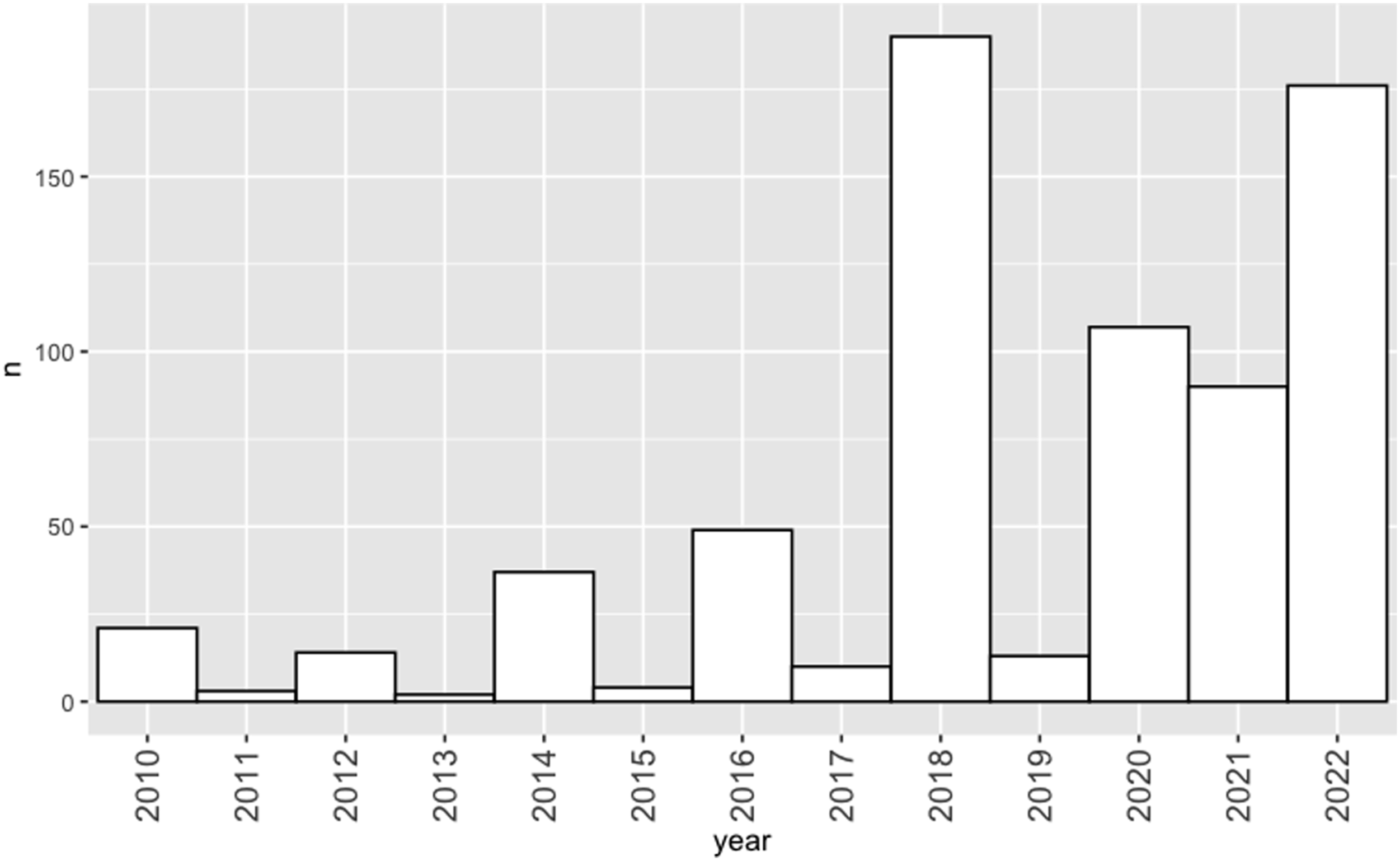
Data Collection
In the first step, relevant TEC and SEC competitions were identified, controlling for German success. To do so, TEC results were derived from the official event website. 4 Result lists for relevant SECs within the past 15 years were taken from the website Wikipedia. To ensure these result lists’ accuracy, several language versions (i.e., German, English, and Spanish) of the same Wikipedia articles were consulted to validate the data.
Using the TEC competition dates and the respective statistical twins at SECs, we created a list of relevant Tagesschau editions in which coverage of at least one of the competitions seemed likely. This included all respective TEC and SEC competition days and the days after competitions (because some late-night competitions might have been reported during the next day’s Tagesschau edition). The resulting list included 267 Tagesschau editions derived from the show’s digital archive. 5
To ensure intercoder reliability, three coders were trained on the codebook, and each individually coded the 15 identical editions of Tagesschau that were drawn randomly from the sample for the pretest. These 15 editions contained coverage of 22 relevant competitions. The identification of the relevant reports covering these competitions between coders was 100%. For each of these reports, coders identified the sport, and the exact competition from a list (by using the competition’s designation in combination with the athletes’ gender) and coded the timestamps for the report’s start and end times. Active coverage of a competition was defined as the time during which a competition was distinctly present visually, either as a standstill background image or as a video clip. Coders then calculated each report’s duration in seconds. The pretest elicited perfect simple percent agreement scores (Holsti, 1969) for sport and competition. Intercoder reliability was very good for the reports’ start time (.97), end time (.94), and duration (.91). Furthermore, all deviations were one second or less. Subsequently, one of the coders coded all the material.
Statistical Analysis
All analyses were conducted using R version 4.1.3 (R Core Team, 2018). To compare the percentages of TEC and SEC competitions, we first calculated some descriptive statistics. To compare mean coverage times between TEC and SECs, we calculated bootstrapped paired independent t-tests to account for data non-normality. In comparisons with unequal variances between groups, we used Welch’s test instead. Comparisons of means were conducted for all competitions, competitions in which German athletes won medals, and competitions from the 15 sports included in at least one TEC staging.
Results
Of the Ntotal = 640 competitions in our sample, 86 (13.4%) received Tagesschau coverage (Max. = 61 sec; M = 2.6 sec; SD = 8.1 sec). In accordance with previous research on TV news coverage during large-scale sports events (Wehden & Schröer, 2019), national athletes’ medal success was a prerequisite for satisfying journalistic gatekeepers’ newsworthiness standards, with 89.5% of the competitions covered to any extent during TEC and SECs featuring medal winners from Germany. Furthermore, coverage of medal winners (compared with competitions without German success) was significantly longer in both the TEC and SEC contexts.
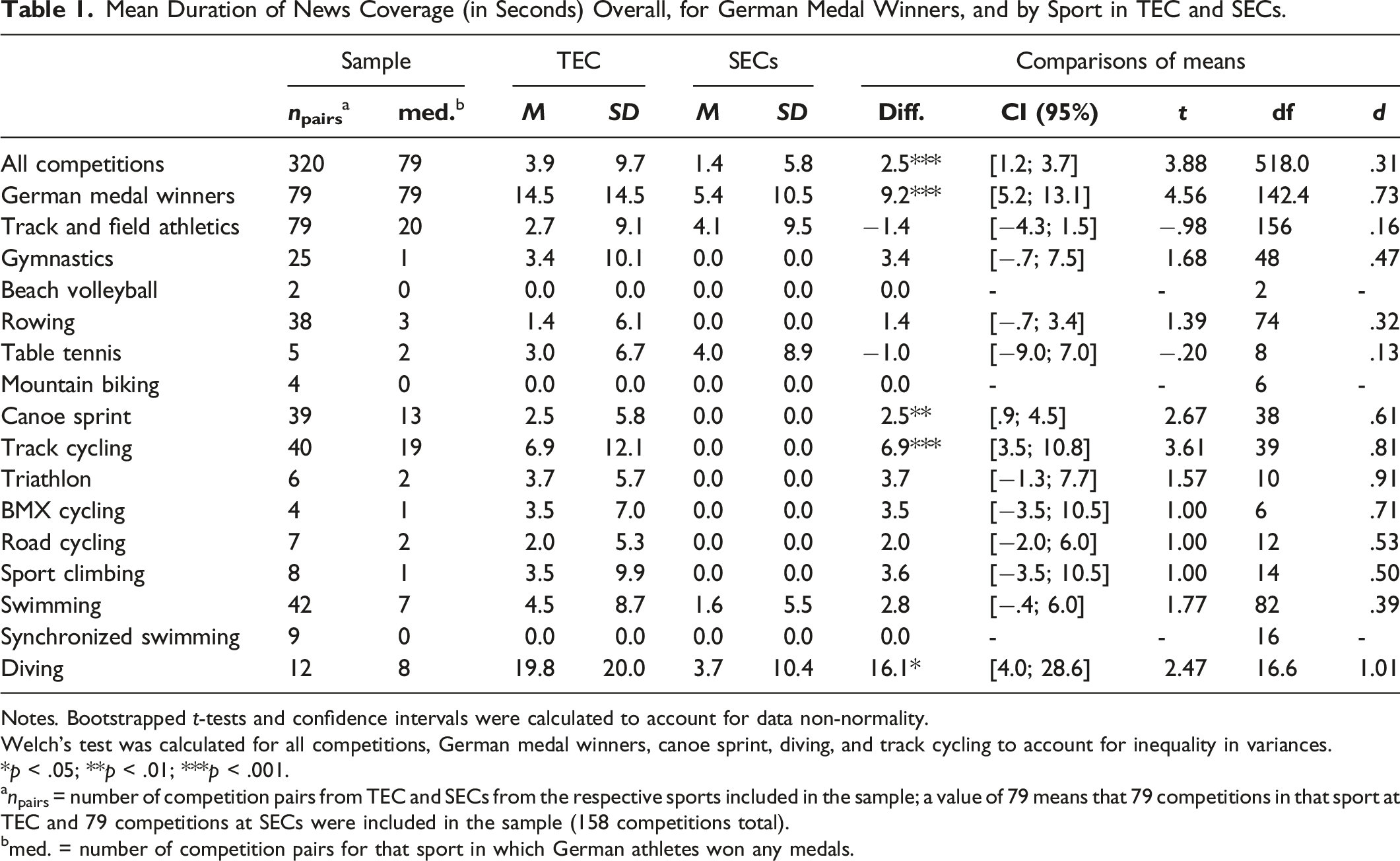
Mean Duration of News Coverage (in Seconds) Overall, for German Medal Winners, and by Sport in TEC and SECs.
Notes. Bootstrapped t-tests and confidence intervals were calculated to account for data non-normality.
Welch’s test was calculated for all competitions, German medal winners, canoe sprint, diving, and track cycling to account for inequality in variances.
*p < .05; **p < .01; ***p < .001.
anpairs = number of competition pairs from TEC and SECs from the respective sports included in the sample; a value of 79 means that 79 competitions in that sport at TEC and 79 competitions at SECs were included in the sample (158 competitions total).
bmed. = number of competition pairs for that sport in which German athletes won any medals.
News coverage times per competition were significantly longer during TEC compared with SECs, controlling for national athletes’ success. This finding holds true when examining all competitions, as well as when only considering competitions in which German athletes won medals (see Table 1). Coverage times per competition were nearly three times as extensive during TEC compared with SECs. Therefore, H 1 was confirmed.
However, not all sports profited to the same extent from their inclusion in TEC. When examining competitions from distinct sports (RQ 1 ), most sports received longer news coverage per competition during TEC compared with SECs. However, these differences were statistically significant only with canoe sprint, track cycling, and diving competitions (see Table 1). In our sample, track and field athletics and table tennis received less coverage during TEC compared with SECs, but the differences were not statistically significant (see Table 1).
Discussion and Conclusion
TEC, a large-scale sports event, used the mediatization strategy of aggregation to increase media coverage (European Championships, 2022; Meier et al., 2020). This strategy seemingly proved to be successful as TEC have generated significantly more live coverage and attracted a larger audience than comparable SECs in the respective sports (European Championships, 2018; Meier et al., 2020). Furthermore, our results suggest that the aggregation strategy was also successful when considering the media presence within retrospective forms of journalistic coverage, e.g., evening TV news shows. Competitions featured in TEC received significantly more news coverage than the same competitions elicited during SECs. Therefore, aggregated sports events like TEC seem to match the selection criteria of journalistic gatekeepers and their working routines well, as they satisfy traditional news factors, e.g., frequency, magnitude, and continuity/follow-up (Galtung & Ruge, 1965; Harcup & O’Neill, 2001). In the future, TEC might therefore act as a blueprint for additional cooperation between various sports federation. Here, various scenarios seem intriguing – from more national level events like the German “Finals” (ZDF, 2022), to a strengthening of the so far rather overlooked European Games (European Games, 2023) or recent efforts of the X Games, a multi-sport event that aggregates competitions in several extreme sports, to reach audience segments outside of the USA (Spangler, 2022). Regarding the social and cultural importance of sports (i.e., in terms of “social integration, promoting fairness, furthering health issues, and establishing social capital”, Ihle, 2018, p. 98), the image of sport conveyed by the media might in future benefit from reflecting more the actual diversity of the field (Ihle, 2018; Wöhrer & Jungblut, 2022). This is particularly true for public broadcasters, who are legally obligated to the normative ideal of diversity in Germany (Interstate Broadcasting Treaty, §26, §51 (2) RStV).
When assessing the question of when and why TEC-style events might be appealing to the media more precisely, it seems that a combination of aggregation and national success might elevate sports events over the “news barrier” (Østgaard, 1965, p. 51) of journalistic perception. Therefore, events like TEC might be a fruitful way to elicit extended media coverage and reach wider audience segments, particularly for niche sports federations with internationally competitive athletes. However, national athletes’ mere success at SECs without multi-sport aggregation seems to be insufficient to elicit media coverage of lesser-known sports. For instance, while German athletes are exceptionally successful in the sports of track cycling and canoe sprint, their victorious performances at SECs did not elicit any TV news coverage within our sample. However, when united under the joint brand of TEC, comparable performances by German athletes generated a substantial amount of news coverage within the same outlet. Therefore, the mediatization strategy of aggregation was needed to generate journalistic awareness eventually.
Despite all the enthusiasm connected to TEC, sports federations should keep in mind, however, that following media logic by participating in a multi-sport event might come at a cost. Scheduling conflicts; commitment to certain venues; limits on staged competitions, divisions, and participants; and reduced overall freedom in planning their respective continental championships may be consequences that federations must accept (Meier et al., 2020). On the upside, at least the presence or lack of competing sports events can be viewed partly as a consequence of the mediatization process itself, considering that aggregation not only might attract additional media attention, but also might deter other sports federations from scheduling their events at the same time as TEC (and vice versa; see, e.g., Horky, 2009; Meier et al., 2020).
What may be more problematic is the fact that some sports that already are more popular within a specific audience (e.g., track and field athletics in Germany; IfD Allensbach, 2022; Rühle, 2017) may even forfeit some news coverage time when they are included in an aggregated event. In our sample, track and field athletics received less coverage during TEC when compared with SECs, although this difference was not statistically significant. In the future, more research is needed to determine whether this finding indeed holds true. However, the mechanism seems logical, considering that, e.g., the European Athletics Championships are already a relatively large-scale sports event on their own that attracts media coverage in a stand-alone format (see Table 1). When included in a multi-sport event, journalistic gatekeepers must divide their attention between several sports, particularly in a setting determined by time constraints, e.g., TV news. They might decide to allocate some resources to less popular niche sports with successful national athletes – resources that usually would be used to report on additional track and field athletics competitions in SECs. This requires sports federations like European Athletics to decide whether to participate in aggregated sports events with the potential benefit of larger audiences during live broadcasts (Meier et al., 2020), or to preserve their traditional news media presence and organizational freedom at the cost of making the aggregated event altogether less attractive with their absence. In the near future, European Athletics may opt for the latter, as they have stated that they “think that we really need to make some important adaptations” (Sankar, 2022), consequentially awarding the 2026 European Athletics Championships to the host city of Birmingham (UK; European Athletics, 2022). This event currently is being planned independently of TEC 2026, which was seeking a host city at the time of this writing (Sankar, 2022).
Next to the aggregation level of an event, other factors may potentially influence the news coverage generated by specific sports competitions. One of these factors is the distribution of licensing rights, with journalists predominantly selecting such sports for news coverage for which they also hold the live broadcasting rights (Bertling & Schierl, 2020). In the case of the German news show Tagesschau, however, licensing rights should play a lesser role for three reasons. Firstly, the channel that produces Tagesschau (Das Erste) is part of the European Broadcasting Union (EBU) that holds the European broadcasting rights for both TEC and most of the SECs that were part of our sample (including track and field athletics, gymnastics, all cycling and aquatics disciplines, and rowing). 7 Further, according to the German Interstate Media Treaty (2021 version), any European broadcaster can report (sports) event news of public interest freely for 90 seconds without violating exclusive broadcasting rights (§14 (4) MStV). The maximum coverage within our entire sample was well below this limit. Lastly, selecting news based on broadcasting rights is less pronounced in public service media like Das Erste when compared to private channels (Bertling & Schierl, 2020). Therefore, a substantial influence of broadcasting rights on the amount of news coverage that certain events elicited seems unlikely.
Another potential influence relates to one of the traditional news factors (Galtung & Ruge, 1965) – proximity. Proximity in a sports context includes identification with national athletes (Loosen, 1998). We accounted for this influence by controlling for national success. However, proximity also has a geographic dimension. Therefore, one intervening factor might be the competition venue. While all TEC 2022 competitions and 2018 track and field athletics competitions took place in Germany – the study’s context – SECs were far more widespread across Europe. German journalists partly may have decided to focus more on TEC than SECs due to the news factor of geographic proximity. However, empirical research has shown that the regular sports coverage in Tagesschau (and especially non-soccer coverage) is not biased towards events that happen in Germany (Wöhrer & Jungblut, 2022). Therefore, to shed more light on the potential influence of geographic proximity, it would be interesting to replicate our study after the third staging of TEC, which is already scheduled to take place in 2026 (European Championships, 2022; Sankar, 2022), and most likely will happen outside of Germany. This event could serve as an interesting research case for further studies on the mediatization of sports. In this context, expanded research designs are desirable. For instance, a triangulation of methods in the form of additional interviews with journalistic gatekeepers may elicit a clearer picture of their selection criteria that influence which sports get covered in the news.
Limitations
Our study is not free of limitations. First, up until today, TEC were staged only twice, and some of the sports were included in only one staging. Therefore, for some sports, the group sizes in the comparison of means are rather small (see Table 1), limiting these tests’ statistical power to detect significant differences. Intensifying this limitation, some TEC competitions had to be excluded from our sample because no statistical twins from SECs could be identified. This included some rather surprising unprecedented German victories that elicited extensive Tagesschau coverage – particularly at TEC 2022 – e.g., the women’s 5,000m race, the men’s marathon, and several German gymnastics team performances. However, dropping these cases from our sample was necessary to account for the potentially influential intervening variable of national success (Angelini et al., 2017; Wehden & Schröer, 2019), thereby overcoming limitations from previous research on TEC (Meier et al., 2020).
Nevertheless, there might be additional intervening variables that we did not control for (most notably competition venue and year). Simultaneously controlling for national success and event venue was impossible, as it would have eliminated most statistical twins from our sample. The influence of the year of competition may be negligible, as most competitions in our sample occurred within the relatively short time span of only five years (see Figure 1), during which the characteristics of Tagesschau remained unchanged (bpb, 2021).
Finally, we focused on a single TV news show in one country (Germany, which represents the largest media market in Europe) for practical reasons (see e.g., Wöhrer & Jungblut, 2022, for a comparable approach). Data access in the form of a digital archive was needed to code coverage that was in part several years old. In the future, it would be desirable to include more news shows and different countries in the sample to contextualize the findings to a broader setting (see also Meier et al., 2020).
Footnotes
Acknowledgments
The manuscript was edited by a professional English language proofreading service. The authors would like to thank Nina Springer for providing the funding for the proofreading. Further, we would like to thank Annica Geldmacher for her work during the pretest and data collection.
Declaration of Conflicting Interests
The authors declared no potential conflicts of interest with respect to the research, authorship, and/or publication of this article.
Funding
The authors received no financial support for the research, authorship, and/or publication of this article.
