



Abstract
This study investigates the role of digital spaces in shaping and maintaining the collective identity around a university shuai-jiao (traditional Chinese wrestling) team, a niche sport with deep cultural roots but limited visibility. Utilizing symbolic interactionism and self-categorization theory, the study explores the dynamics and evolution of the team’s social media chat group, which includes current and former team members. The results offer insights into how identity and relationships are sustained over time and beyond physical interactions. The findings reveal that depersonalized harmony plays a crucial role in fostering group cohesion, as members prioritize group unity by avoiding divisive topics. Additionally, former members’ ongoing engagement through the chat group highlights how engaging via a digital platform preserves their sense of belonging and athletic identity. These mechanisms ensure the transmission of cultural heritage and support the team’s continuity. This research contributes to understanding online collective identity formation by emphasizing the importance of maintaining both common bonds and identity in niche sports. It offers practical insights into how sports organizations can use digital tools to sustain participation, build resilience, and ensure cultural continuity, even in the absence of face-to-face interactions.
Introduction
The dynamics of translating offline connections into online environments have revolutionized how social groups interact and sustain their identities. Social media, with its rapid evolution exemplified by the rise of Myspace in 2003 and Facebook in 2004, has become a vital platform for maintaining social ties and fostering group identity. While much attention has been given to team dynamics in physical settings within the realm of sports (Cruickshank & Collins, 2012; Thompson et al., 2017), fewer studies have explored how these dynamics manifest in digital spaces, particularly for niche sports that lack mainstream media exposure and institutional support (Davies & Mudrick, 2017). For niche sports such as shuai-jiao (traditional Chinese wrestling), which already struggles to maintain participant engagement, digital spaces provide opportunities for current and former team members to stay connected and preserve their sense of community, especially when in-person interactions are not feasible. Therefore, this study explores how a social media chat group helped shape and maintain the collective identity and relationships within a sport with deep cultural roots but limited visibility (Zhao et al., 2008). By examining everyday interactions in the group, this research aims to understand how digital spaces can support team relationships and help preserve the cultural heritage of a niche sport such as shuai-jiao.
The practical significance of this study lies in its focus on shuai-jiao, one of the oldest sports in the world with a history spanning thousands of years. Once regarded as a national treasure alongside other martial arts, shuai-jiao played a crucial role in China’s cultural heritage (Zhao et al., 2008). Therefore, exploring how participants maintain a strong sense of collective identity through online interactions is meaningful for understanding how folk sports, such as shuai-jiao, can sustain their vitality. Digital platforms, such as social media chat groups, serve as critical tools for fostering this sense of community, especially as team members graduate and lose the opportunity for regular in-person interaction. Without these online platforms, current and former participants, might struggle to maintain ongoing connections and emotional ties outside of the training environment, potentially leading to a further loss of enthusiasts, which poses a threat to the preservation of the sport 1 .
This article examines online group interactions within the shuai-jiao team at a Chinese university, conducted on WeChat, one of China’s most widely used instant messaging apps with features similar to WhatsApp and Facebook. The team was founded in 2016, generally consists of around 10 male and female members each year, and is led by a long-term coach who is a faculty member. The team’s membership typically arises from self-enrolment or invitations extended by the coach based on students’ performances in compulsory first-year physical education classes. The team’s online chat group was initially created for team management purposes but has expanded over time to include both current and former team members. During the study period, the chat group included 81 people: 12 current members, 68 former or short-term members, and the coach. The coach is usually called “laoda,” a respectful term meaning “boss” or “leader” that reflects Chinese teacher-centered traditions.
Beyond its practical significance, this study also extends the understanding of how symbolic interactionism (Blumer, 1986) and self-categorization theory (Turner & Reynolds, 1987) work together to explain how relationships and collective identities develop in digital environments. By applying symbolic interactionism, the study demonstrates how the WeChat members use shared symbolic elements—such as digital stickers, team-specific language, and everyday interactions in their online communication—to negotiate and reinforce their collective identity, even in the absence of physical participation. Furthermore, through the lens of self-categorization theory, the study discovered how personal identities are depersonalized in support of group cohesion. When the group identity becomes salient, individuals adopt group norms and behaviors, prioritizing the collective identity over personal expression. Prototypical behaviours of the team also offer newcomers clear participation guidelines, fostering integration. This alignment ensures that shared identity and values remain intact, helping both current and former members maintain meaningful connections and long-term involvement within the community.
Theoretical Framework
Symbolic interactionism (Blumer, 1986; Carter & Fuller, 2016) and self-categorization theory (Turner & Reynolds, 1987) were used in this study to investigate identity formation mechanisms in an online context. Symbolic interactionism argues that society is constructed through interactions in which symbols and meanings are manipulated (Blumer, 1986). This theory enabled examination of the shuai-jiao team’s online identity through the roles and identities assigned to members. Researchers using symbolic interactionism argue that social reality is a function of symbols and interaction, and what happens within a given community is their representation of reality—in both online and offline settings (Fernback, 2007). This perspective is exemplified in Mendelson and Papacharissi’s (2011) study, which found that college students used Facebook to perform their college-life identity. Through this online interaction and symbolic representation of their college experience, students were able to foster a sense of belonging via this shared digital reality.
Self-categorization theory explores the dynamic relationship between group membership and self-perception, including the impact of social identity processes in organizations and online groups (Hogg & Terry, 2000; Spears, 2011). It contributes the understanding that depending on how people align, or socially categorize, themselves, they can form a unified psychological group identity which leads to shared group behaviors (Hogg & Reid, 2006; Tajfel, 1974; Turner & Reynolds, 1987). For our analysis, three concepts of self-categorization theory were central: salience, prototype, and depersonalization. Salience refers to the boundaries determining how social and personal identity processes influence an individual’s behavior in specific situations (Hornsey, 2008). For salience to have an impact, people must identify psychologically with a specific group—such as the shuai-jiao team—which then becomes a category that shapes their self-categorization and group identity (Hogg & Reid, 2006). The concept of prototype typically describes exemplary members who represent the group or idealized versions of group characteristics (Hogg & Terry, 2000). The prototype highlights similarities within the group and differences from other groups. Prototypes are dynamically shaped, upheld, and adjusted through various situations, objectives, and interactions with others (Hogg & Reid, 2006; Hogg & Terry, 2000; Hornsey, 2008). Finally, depersonalization is the cognitive perception of individuals and members as embodiments of the attributes of their group prototype. Depersonalization can influence people to act in ways congruent with thoughts, feelings, perceptions, and behaviors associated with the group prototype, and contributes to the harmony and coherence of a group (Hogg & Reid, 2006; Hornsey, 2008).
Literature Review
Previous research examines the factors and mechanisms in online groups that enable and foster collective identities. These factors relate to member characteristics and two group types: common-bond groups and common-identity groups (Huo et al., 2018; Zhang, 2016), both of which are present in this study. Common-bond groups depend on pre-existing interpersonal connections between members (Schwämmlein & Wodzicki, 2012), which exist in this study through the connections of all WeChat members to the coach, and connections between members who competed on the same teams. In contrast, common-identity groups form stronger bonding ties through shared characteristics, topics values, or interests (Schwämmlein & Wodzicki, 2012), which is evident in this study through members’ everyday emotional exchanges within the WeChat group and shared identity as wrestlers.
Another distinguishing factor may be an offline relationship or hierarchy between group members (Cao & Li, 2018; Dixon, 2018; Zhang, 2016). For example, Huo et al.’s (2018) analysis of a running group demonstrated a clear hierarchy, in which beginning runners held a marginal status which meant they received few interactive responses, while the well-known runners occupied the core state and received the most responses. In a study of WeChat alumni groups, although the offline social status of Chinese middle-aged alumni differed, their online interactions were positive, as they followed unspoken rules and common social scripts, such as indicating disagreement by remaining quiet (Zhang, 2016). These studies suggest the importance of offline-established relationships in deciding the relevance of the group’s shared identity and cohesiveness.
Online groups, even those without offline connections, can provide an affective mooring to build a sense of community and create social bonds. Dixon (2018) found that WhatsApp chat groups enhanced community feelings by promoting a sense of collective presence and safety in urban areas despite the initial incentive being a neighborhood watch app where residents could monitor neighborhood safety. Similarly, Pimmer et al. (2019) found that assigning recent nursing graduates to a chat group for a 12-week professional immunity intervention had the potential to enhance their education and build their professional social networks. Additionally, specific chat mechanisms create opportunities for groups to form a shared identity online without never meeting in person. For example, female factory workers in China, despite having never met in person, collectively formed QQ chat groups and reidentified themselves as “decent workers”—a more respected and dignified term—to resist the media’s label of them as “machines” (Cao & Li, 2018, p. 300).
There has been extensive research on individual identity and personal relationships in chat group interactions on social networking platforms (Shafie et al., 2012). However, little attention has been paid to sports teams (Phua, 2010). Therefore, we investigated how collective identities are forged in the online chat group of a university shuai-jiao team. This empirical research bridges the current gap in the literature on how online chat group interactions forge a vital form of sports community. Consequently, the research question was: How do current and former members of a university shuai-jiao team form and maintain a collective identity in their online WeChat group?
Methodology
This qualitative case study employed digital ethnography and semi-structured interviews to understand the collective identity constructed by 81 members in the shuai-jiao team WeChat group, which has been active for six years. The study was approved by the Human Participant Ethics Committee of the researchers’ institution.
Digital ethnography examines the social and cultural contexts of digital media use, focusing on users’ experiences, narratives, and emotions, providing insights into online relationships, identities, and communities (Murthy, 2008; Underberg & Zorn, 2013). Digital ethnography was employed to examine the online interactions within the team’s chat group.
In September 2021, the principal investigator travelled to the team’s training site in China to liaise with participants and collect data. There, she gained permission from the coach to post recruitment materials on the team’s WeChat group. The lead researcher introduced the research on the WeChat group and asked members to contact her directly if they did not wish their chat logs to be recorded as part of her observations. No members withdrew. Thereafter, she monitored the group’s conversations for 10 months without responding to member posts to limit any disturbance to the group’s usual interactions that her presence might cause (Koteyko & Hunt, 2016). The analysis included 3000 chats produced by the coach, 12 current, and 68 former or short-term members, including text, voice, video, images, and links shared in the team’s main chat group. Content in links was not analyzed.
Half-way through online data collection, members were invited to participate in semi-structured online interviews through a recruitment message posted directly in the main chat group (Bryman, 2016; Cao & Li, 2018). Thirteen members agreed, including the coach and five current (38.5%) and seven former members (53.8%). Eight (61.5%) were male and five (38.5%) were female. Interview questions included: What topics do your team usually chat about? Who usually takes the lead in starting these topics? Is there a particular chat that stood out to you? Why?
Reflexive thematic analysis was conducted to understand the development of the shuai-jiao team’s collective identity through online interactions. This methodology enabled the extraction and comprehension of themes throughout the dataset to ascertain collective and shared meanings (Braun & Clarke, 2019). Inductive and deductive coding were used: text was first analyzed using a bottom-up approach and line-by-line coding, followed by a top-down, theory-driven coding approach. Rather than denotative meaning, the analysis centered on coding and reporting latent, hard-to-detect, and subtle meanings. Thematic analysis was first applied to the WeChat data, followed by the interview data. Finally, all data was translated from Mandarin to English.
Results
Four mechanisms were found to significantly contribute to the team’s online collective identity. Two mechanisms—depersonalized harmony, and the continuation of former members’ sense of belonging—contribute new insights to existing research. The other two mechanisms—coach as opinion leader and memorable topics—had a powerful impact on the team’s online collective identity.
Depersonalization for Harmony
A significant finding was that group members depersonalized their identities to care for others’ feelings in the main group. They moved discussions of more personal or controversial topics to subgroups outside the main chat. The main group chat transcripts showed that group members seldom had conflicts and quarrels. The atmosphere of the chat was harmonious—a sentiment echoed by many interviewees—with one member noting that “most people would probably avoid participating in a discussion that could disrupt the harmony of the group”. As the member explained, harmony is often the result of conscious or unconscious efforts to work together. The coach stated in the interview, “Everyone wants to maintain the group.” Maintaining harmony was manifested in relatively superficial conversations in the main group, which reflected an unspoken agreement to avoid getting deeply into personal views.
Topics to Avoid
Although members felt they could talk about anything in the main group, harmony was maintained in two main ways: avoiding gender-related or controversial topics, such as politics or personal comments about others. For example, during the interview, one member explained “It’s related to politics, I guess… Because there are so many people and so many opinions… it might also be easy to get into conflicts because of who supports some ideas or who doesn’t…” Another member felt the same way: “We usually avoid some political and sensitive topics.” The avoidance of political topics coincides with a characteristic of Chinese society, where political speech and debate are strictly regulated and limited by the government (Wright et al., 2016). In addition to political topics, openly criticizing others was also considered best to avoid. For example, one member explained that members need “to avoid discussing problems a member may have in training… This is human nature… Public criticism of other people is certainly not right.”
Members also highlighted gender as a sensitive topic, suggesting that gender issues should be avoided in discussions. A male member explained, If there is only a group of boys, you can talk about some things. Alternatively, if there is only a group of girls, you can talk about these things… But when both boys and girls are there, we won't discuss things that may not be appropriate.
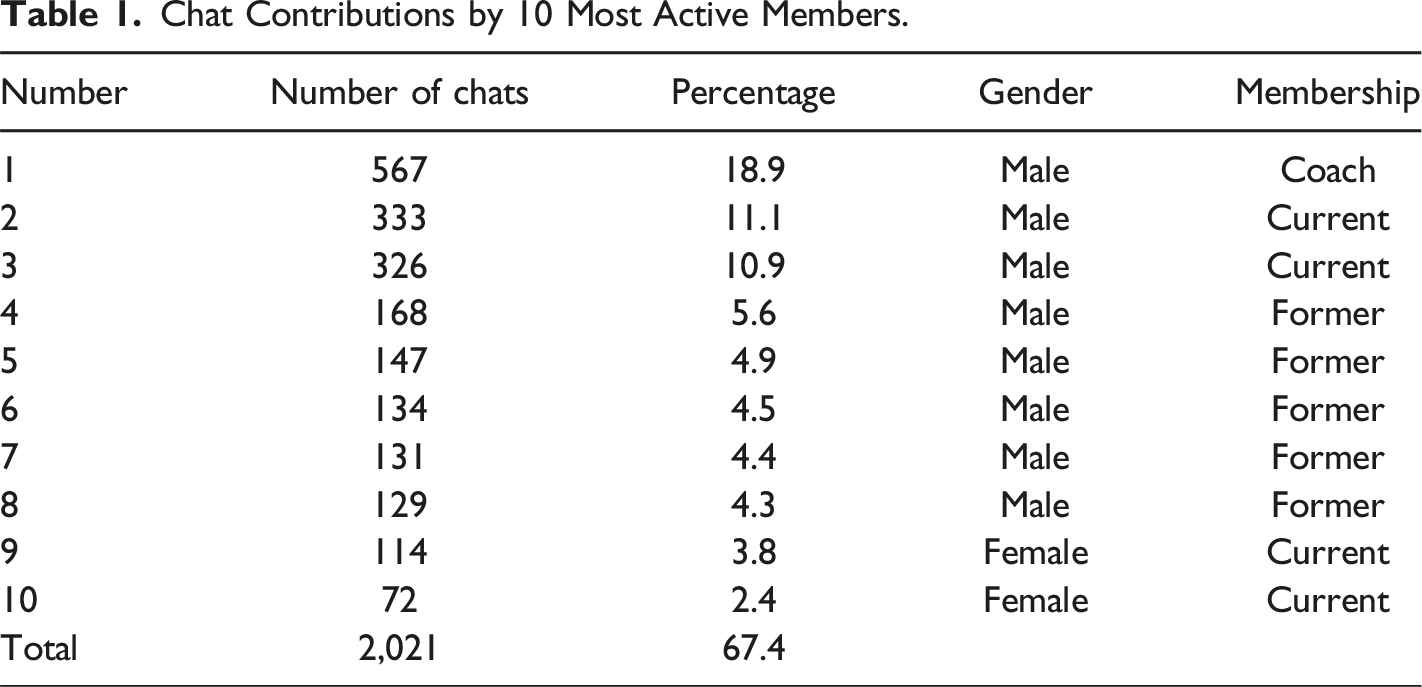
Similarly, a female member recalled that discussing gender-specific topics was complicated in the main group: “Girls would have a different voice as boys, opinions and arguments”. This cautious approach was likely due to the dominance of males in the chat group. The analysis showed that there were significantly more leisure-based topics, including fishing, cars and new video games (Figure 1), which are traditionally believed to be more interesting for males. Female members, meanwhile, were less engaged and seldom initiated new topics. This trend is further evident in the level of activity in the chat, where only two female members were among the top ten most active posters (see Table 1). Male Members Discuss Video Games and ESports. This screenshot captures a conversation among male team members during the 2022 Dota 2 International Tournament. The discussion revolves around the popular esports game, with specific mentions of RNG and TS, both of which were prominent teams in the competition. This interaction highlights the members' shared interests outside their primary focus on sports, showcasing the role of the group chat in fostering casual and inclusive engagement. Chat Contributions by 10 Most Active Members.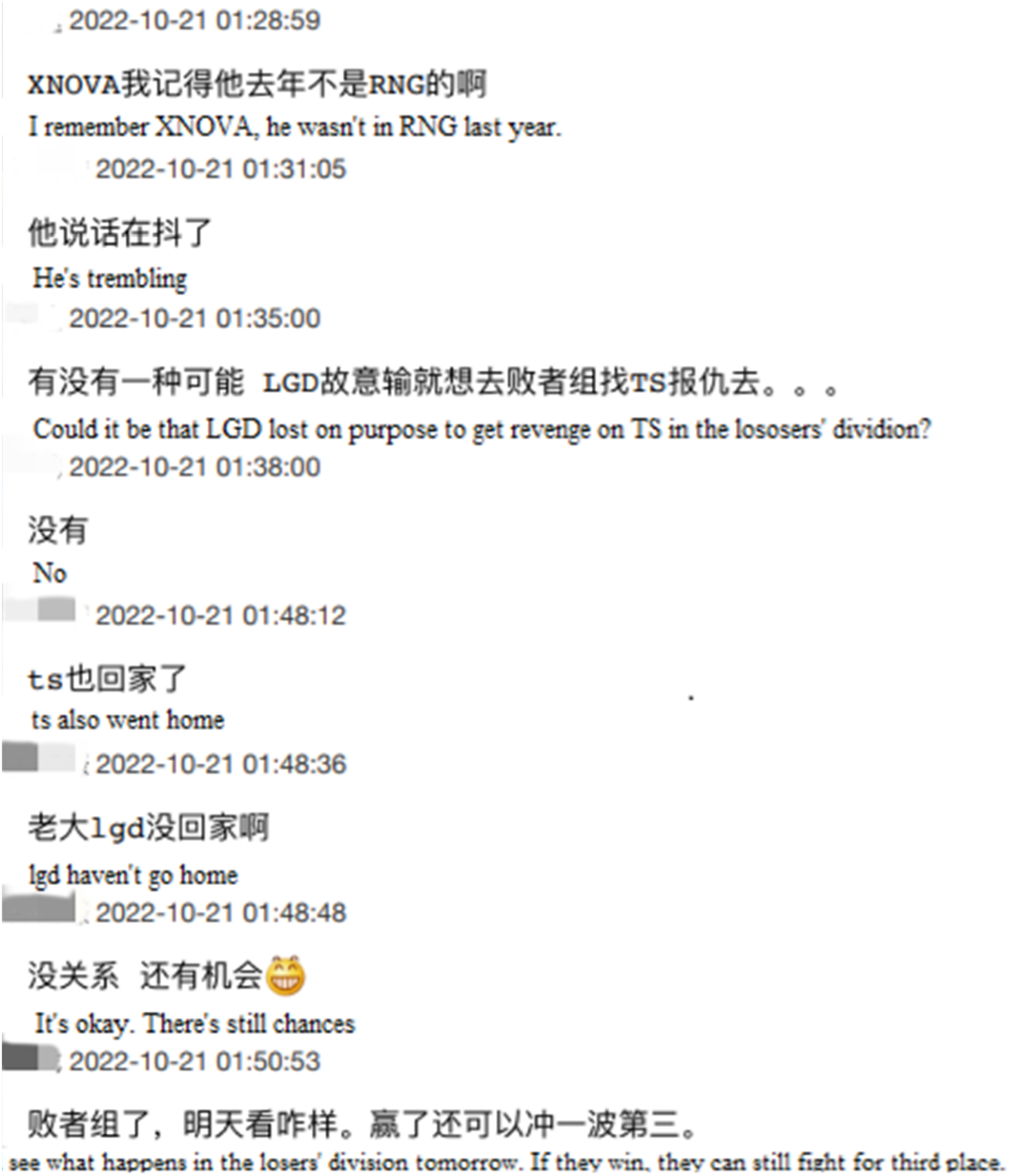
Other participants considered that members had the shared quality of being university students, understood the etiquette of online chatting and did not violate what one participant called the “public baseline”. For this reason, the main group was referred to as a harmonious and conflict-free space. However, it did not prevent members from engaging in deeper online interactions, as discussed next.
Open Discussions in Subgroups
To facilitate discussion on more personal or sensitive topics, members formed smaller subgroups to chat outside the main group. These subgroups ranged from those established by the coach for specific team management purposes, like organizing participation in competitions, to those created by members seeking deeper connections with other members, often teammates. This structure allowed for more open and intimate conversations, diverging from the main chat’s focus on maintaining a harmonious atmosphere. Interviewees reported varying levels of involvement, with some being part of one to three subgroups, while others participated solely in the main group.
Subgroups appeared to provide members with a sense of freedom for discussion that was absent in the larger main group. This contrast arose because of the main group’s diverse composition, including both current and former members from various backgrounds, many of whom had never met in person. One female member expressed, The audience in [the main group] is vast... with different majors, ages, and stages. There are a lot of senior students who have entered the workplace still in the group… So, I'm not used to expressing my opinions in such an unfamiliar environment.
This member then explained that she would be more active in a small group: “I talked a lot more in the small one than the main group.” Subgroups were not created to isolate others but as a consideration for current members to express themselves more freely and not disturb the larger audience in the main group. As one explained: “There are many people in the main group. There are senior students, and so on. Basically, if laoda is not over there to talk, I will not speak… Because I am afraid to disturb others.” Another said, That's because some team members might not be very familiar with each other... there's a significant age difference... they have never met before and don't know about each other's situations, so communication is not easy. To avoid awkward interactions, small groups were created.
While the phenomenon of members creating small chat groups within a bigger main group is rarely touched upon in existing research, this study demonstrates the importance of these subgroups in the development of the shuai-jiao team’s collective identity. To start with, most members reported feeling more relaxed, authentic, and active within small groups. One member explained that, Privately, we would establish several small groups, that is, a few people would chat well, and then quickly pull a group [together]. We basically chatted every day. There were times when I took a nap and woke up. It has hundreds of messages... Everything was shared in the small group.
More importantly, familiarity allowed for a wider and deeper scope of topics, even occasional minor conflicts, which contrasts with the highly harmonious atmosphere of the larger group. For instance, in one subgroup, a male member proposed creating a women’s sanda (Chinese kickboxing) team as part of a university business competition plan. However, some of his ideas conflicted with those of the female members, resulting in a lengthy debate that eventually escalated into a verbal disagreement. As one participant reflected, We argued for a long time without any results. Instead, it became a verbal battle... Maybe it is because men and women are different in their approach to things...
As much as the subgroup environment can expose people’s differing opinions and lead to arguments, it appeared crucial for preserving harmony in the main group. This is because the main group embodies the team’s identity and serves as the source of cohesion for the team.
Group Chat as a Representation of the Team
The chat group has evolved over time as a unique representation of the team. In interviews, more than half of the participants emphasized the significance of the chat group to the team. The two most salient features were enhancing the team’s relationships and sustaining a sense of belonging for former members.
Enhancing the Current Team’s Relationships
For current teammates, the chat group functioned as a social platform that fostered a strong and enduring bond beyond the training field. They deepened their connections by occupying what was described by one member as “fragmented time” during lunchtime or taking the bus. Using a well-known Chinese metaphor, one member explained how the main group felt like a safe space: “Without the group, the togetherness would only be when they were training together. . . But with the group, any time we want, we could help each other and share it. . . It is like a little tree hole 2 I put near my hands”.
Members felt that sharing was an additional opportunity to learn more about each other and thus become closer. One member explained that “chatting shows your preferences… You’re more likely to see more people… After all, it increases the chances of communication.” In addition to creating a deeper understanding of each other, sharing was also the agent that held the group together more tightly. One member observed that the chat group “is a medium to connect the shuai-jiao team members… When you have any life issues after the training, you will come here and share…and come closer.”
One specific instance further highlights how the chat group helped foster inclusivity, especially for new or shy members. A female member shared that she initially felt too shy to post online. However, through the support and encouragement of other members, she gradually became more active. On one occasion during the Mid-Autumn Festival, she expressed frustration about not being able to capture a clear photo of the full moon. A fellow team member noticed her frustration, shared a clear photo of the full moon, and tagged her in the chat. This small act of kindness made her feel valued and wanting to make a stronger connection with the team.
Extending Former Members’ Sense of Belonging
A surprising phenomenon that has received little attention in other studies was that former team members also found the chat group meaningful. Former members, typically those who had graduated, remained an important core of the shuai-jiao team, providing technical, emotional, and even financial support to current members. Thus, even after they left, they maintained a strong connection with the team. The existence of the main chat group supported their belonging, allowing them to continue to feel part of the team without participating in training sessions. Chat data shows that these former members make significant contributions to the chat group and account for half of the top 10 contributors by number of group chats. Consequently, the frequent interactions blurred the line between current and former members. As one former member claimed: It's so hard to get face-to-face communication after graduation… The existence of WeChat groups weakens the ‘former’ prefix for past members... It makes me feel like I'm still here despite being away from the team.
Another former player expressed the same feeling: “I always feel that I am on this team, I am in the university… I am not far from them… I feel like I am still on the team now.”
Although the coach created the WeChat group to assist in team management, he understood its importance for former participants. He understood the chat group as “a symbol of our team” and strived to maintain it. I created this group at that time just for communication convenience…I didn't expect it to be so meaningful. Now, this group is a window for graduated students to know about the team's progress… From a batch of former members to the present members, everyone can't ignore it, and everyone couldn't afford to let it go to waste.
The coach’s insights about the importance of the WeChat group proved especially significant during the COVID-19 pandemic. The interruption of wrestling-related events meant the team lost opportunities to prove its value. The team faced the risk of being downgraded by the university, thereby receiving less funding and fewer resources. To navigate this predicament, the coach decided to pursue achievements in sanda competitions. However, insufficient funds became a major obstacle for the team’s participation.
When former members learned of this situation in the main chat group, they organised fund-raising efforts which allowed the team to successfully participate in a national-level sanda competition. In an interview, one former member explained that: “My first reaction was definitely to donate, and to organize others to donate together..We didn’t want the new team members to have no competitions to participate in, so everyone was happy to contribute a little.” He added, “When we were on this team, we loved it very much—not just because we liked the sport, but because we cherished the feeling of being together at that time.”
The team ultimately lived up to expectations, winning a silver medal that proved its value. The main chat group once again reinforced the emotional connection between new and old team members when one member wrote: “The significance of you going to the competition is not just about chasing your dreams; behind you are many people who all hope that our shared family can thrive.”
The Coach as an Opinion Leader
The coach as an opinion leader was one of the most prominent identity formation characteristics that emerged from the data. In this case, the coach embodied the characteristics of opinion leaders, who usually more have extensive social networks, and higher levels of education, and social status (Li & Du, 2011) than the student team members. This characteristic is reflected in members’ perception that the coach was the most influential person in the group. During the interviews, almost every member referred to the coach as laoda, which is a term that acknowledges authority but also expresses affection.
The Coach as the Most Visible and Influential Person
Out of the 3000 chats during the sample collection period, the coach posted 567 times (19%), making him the most active in the group chat (see Table 1). In addition, most interviewees identified the coach as one of the most visible people. For example, when asked who spoke the most and got the most responses from the group, a former team member replied, “That would be the laoda, of course”. Members offered various explanations for why messages from the coach received the most replies, citing factors such as interest, importance, and the authority associated with the coach’s role.
Some thought that the coach’s messages always piqued the interest of the members, hence getting a high response rate. However, they also indicated that the coach’s messages were not a military order that must be obeyed. For example: It's not like it's mandatory to reply ... It could be true that there are some messages that he posts that are messages that people really want to reply to… such as fishing... because many people in the group do fish as well... and then there was much conversation about fishing.
Some members believed that what the coach posted was often important, so everyone needed to respond. However, they felt they could ignore messages they deemed as unimportant. For example: Coach may say some essential things whenever he speaks. For example, announcements about meetings and notifications about evening training. But the coach also posted some unimportant ones… he would suddenly post about a fish he had caught, and on that topic, I would not feel the need to reply.
In contrast, one member felt that the high response reflected the natural authority that the coach possessed. She explained: Since he's called laoda, he must be our leader... A community holds a natural attachment to their chief... If we don't embrace him... there's no way for us as a group to be cohesive and forward moving. It's natural behaviour.
Although different members experienced the reasons differently, it is evident that both the members and the coach recognized that his messages were influential for the whole group.
Coach Sets the Tone
In addition to the data above, the coach also perceived that his words carried some weight. He understood that his emotions could impact the group’s performance. He explained, “I’m kind of a connector or a middleman for the whole team, I guess… Or I could be kind of a leader… so that means my actions may affect the overall mood of the group.”
His awareness of being an opinion leader meant that the coach hid any negative backstage aspects of his life and actively utilized the opinion leader role to lead a positive atmosphere in the group. He added, “I usually share some interesting videos… Reminisce about old fun times… Propose group trips or get-together plans” to make the WeChat group more “harmonious, warm and inclusive.” The coach’s role as an opinion leader not only had control over shaping the group dynamics but also over the selection of the key topics, which was reflected in the team’s online collective identity.
Popular versus Memorable Topics
The thematic analysis of the online chats showed that the most popular topics were related to sports (22%), such as videos of various sports events and knowledge about wrestling techniques, with 85 interactions. However, in response to an interview question about most impressive or memorable topics, the discussions that most impressed the group members were almost always unrelated to sports. In direct contradiction to the chat analysis, a few members said they talked about everything but sports in the group. The interviews revealed two topics that particularly resonated with the members and were mentioned far more frequently than topics such as sports and wrestling. These were fishing and coach stickers. To create coach stickers, team members manipulated existing photographs of the coach by adding humorous text or graphics.
Stickers as Symbols of Intimacy
A notable insight from this study is how the creation of stickers symbolizes the team’s sense of intimacy. When asked about memorable interactions in the team’s online chat group, many members immediately mentioned creating stickers of their coach, highlighting these as standout moments. Most of the coach stickers were made from funny and playful photos of the coach in his daily life. Examples included the coach eating a chicken leg or standing in the stadium with a funny facial expression. These stickers ran counter to the seriousness with which the coach was observed during the training sessions. Team members attributed the creation of stickers about their coach to the strong sense of trust and close bond within the team. As one explained: The premise of making stickers for the coach and then sending it out is that our relationship with the coach is relatively close... After sending it out, it can increase the intimacy or bring the distance closer... And the coach, as a representative figure in the whole team, it may be funnier to make stickers with his photos.
The ease in making funny stickers for the coach was also brought about by team members’ perceptions of the coach’s down-to-earth and fun-loving personality in his everyday life. This perception was passed down from the older to newer members. For example: Hahaha, maybe the people who just joined the team weren't that open ... but being brought up by the older players, the newer players were all so open later [to posting funny stickers] ... Likewise, the coach did the same thing to us…
In the interview, the coach said he was not offended by the stickers. Like the team members, he considered such stickers to express intimacy: I don't reject or dislike it. First, being made a sticker is a sign that they are expressing intimacy with me. Secondly, I'm a person they all know in common, so it can make the chat closer to each other.
“We can Feel His Joy from Fishing”
Another memorable topic that aroused repeated responses from the members during interviews was fishing. This finding is especially interesting as fishing has no direct connection to wrestling. The coach, who loved fishing, often launched fishing discussions, which naturally invited contributions from other members who shared their own fishing tips and experiences (Figures 2 and 3). The Coach Initiates a Conversation about Fishing. This screenshot illustrates a moment where the coach starts a discussion about fishing. Such conversations, often sparked by the coach's enthusiasm for fishing, serve to build a lighter, more personal connection among team members, reinforcing the sense of community within the group. Team Member Initiates a Conversation about Fishing. This screenshot reflects interactions during members' online group chats outside of training hours. In these chats, members sometimes share their fishing experiences, offering insights and tips to others. These exchanges demonstrate how the group chat facilitates bonding over shared hobbies, strengthening interpersonal connections and the team’s collective identity.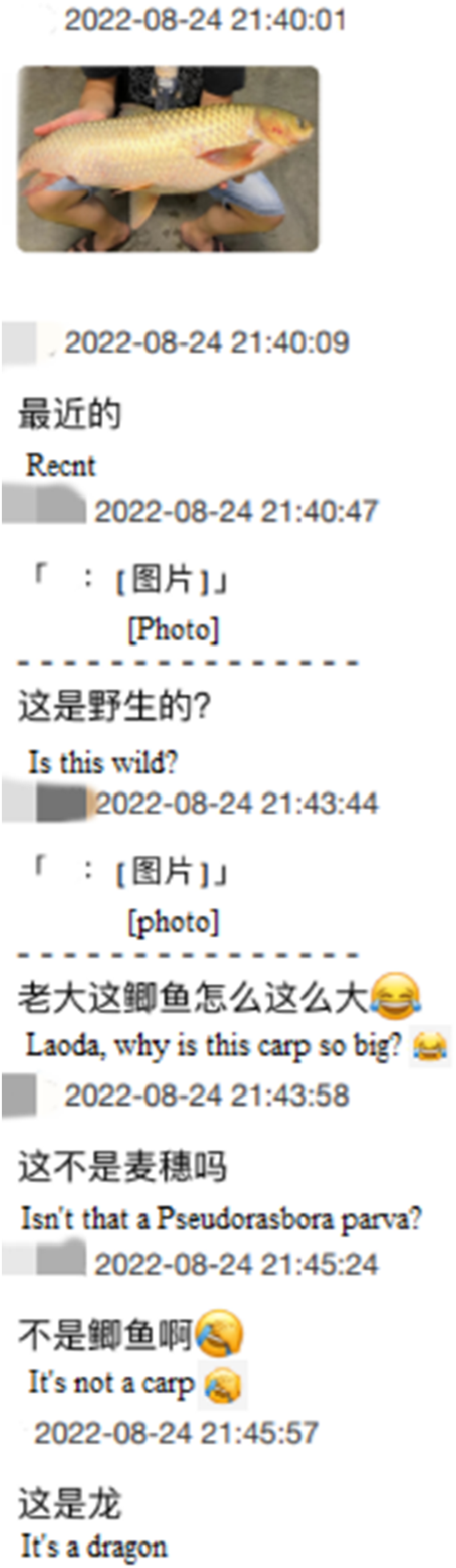

Again, reflecting the centrality of the coach as the prototype of the team, members agreed that the coach’s interests influenced the preference for fishing topics, as the coach liked to express his talent and share his experience of fishing in the chat group. His enthusiasm also led to many members becoming interested in fishing. For example, Because laoda is particularly fond of fishing, some people in the group were motivated by him to buy fishing rods, and they also started fishing. Then everyone would discuss the fish they caught, the weight of the fish, and so on in the group...
Another participant explained, “It was like every day laoda would put fish, rods, and fish in the group’s comments. Sometimes he seeks fishing dates, and sometimes buddies seek fishing dates…” Although the topic of fishing arose from the coach’s personal interest, it was not frowned upon by the team. Respondents identified these topics as part of the fun for members: This is what a leader brings to us... We can feel his happiness because he really loves fishing… Every day, his mouth is full of fish, fish, fish... We can feel his joy from fishing when he shares it with us ... He has passed his happiness on to us too!
Although the topics that impressed the members seemed unrelated to the sport, over time the habit of posting coach stickers and discussing fishing, had become a team-specific representation that conveyed the meaning of intimacy. These conversations served not just as surface-level exchanges but as a key element in forming common bonds among members by extending their connection.
Discussion
This study builds on research evidence that online interaction plays an increasing role in maintaining relationships in small group organizations such as a niche sport team. Understanding the online community environment of sports teams is particularly important for niche sports, where participants often feel isolated due to the lack of broader societal support and institutional regard. Even though this study found that most of the conversations within the group were light-hearted without deep engagement, these interactions still helped alleviate the sense of isolation and encouraged ongoing involvement with the team. Participants noted that these seemingly casual chats satisfied their need for belonging—which is a fundamental psychological need rather than an occasional desire (León, 2023), such as the person who described the chat group as “a little tree hole I put near my hands”, meaning a place for emotional expression and connection.
Supported by symbolic interactionism (Blumer, 1986) and self-categorization theories (Turner & Reynolds, 1987), this study identified four mechanisms of identity construction in the online group chat for the shuai-jiao team that sustained their collective identity and online interactions. Among these mechanisms, depersonalized harmony and the continuation of former members’ belonging, provide new insights for understanding online collective identity. These mechanisms are crucial in building a collective identity and reinforcing participants’ sense of belonging as members of the shuai-jiao team.
One of the more significant findings in this study is the role of depersonalization in maintaining group cohesion. While depersonalization of self-perception is a fundamental process of group phenomena (León, 2023), it has more far-reaching implications for our study. In the shuai-jiao group, depersonalization appeared to be an essential means of maintaining collective identity online to maintain a conflict-free atmosphere and ensure ongoing group harmony. Group members, through a shared understanding, avoided divisive topics such as politics and gender, thus ensuring that their conversations remained focused on maintaining unity rather than highlighting individual differences. This approach allowed members to prioritize their group identity over personal opinions, fostering the consistency within their online interactions (Turner & Reynolds, 1987; Zhang, 2016). Although many conversations within the group may seem superficial, often revolving around trivial topics, these neutral interactions help mitigate the risk of conflict. By avoiding discussions that emphasize individual differences, group membership becomes more prominent (Postmes et al., 2002), which discourages individuals from leaving, and thus preserves the common-identity group (Huo et al., 2018). Moreover, depersonalization is not merely a strategy for maintaining surface-level politeness; it is a culturally embedded practice that ensures the group’s long-term survival (León, 2023). In the context of Chinese culture, where harmony and respect for authority are highly valued, depersonalization becomes a natural way to negotiate group interactions. Through these depersonalized efforts, the members maintain their connection to shuai-jiao and preserve the qualities of its cultural heritage over time.
However, depersonalization does not necessarily mean a loss of individuality nor a reduction in personal identity. Rather, it responds to a shift of personalized characteristics to other sites (León, 2023). Beyond the main group, we identified important contribution of subgroups, a phenomenon that remains underexplored in sports media research. In these subgroups, members’ personal identities became more pronounced as they engaged in deeper discussions on personal topics. This shift reflects how symbolic interactionism operates in virtual spaces, where individuals use specific symbols to construct meaning and navigate relationships in different contexts (Olasina, 2014). As a strategy to adjust self-classification, subgroups enabled members to express themselves freely while maintaining the atmosphere and harmonious identity of the main group (Turner & Reynolds, 1987). It is important to note that the presence of subgroups does not decrease the significance of the main group. On the contrary, collective meaning-making takes place within the main group through shared, neutral discussions (Salvini, 2010). Only when the main group—including the shuai-jiao team itself—remains stable can members further develop deeper connections within subgroups based on their shared identity.
It is crucial to note that the functions of the main chat group in this study have transformed from assisting with team management into manifestations of affective mooring (Dixon, 2018). Although most members claimed face-to-face interaction to be engaging, their online chat group created off-field relationships, fostering connections beyond the training field (Xie, 2007). One particularly meaningful finding is how the chat group allowed members to establish an unbreakable bond through the sense of sharing and support. This bond reflects symbolic interactionism’s concept of how symbols and meaning are co-constructed through interaction (Carter & Fuller, 2016). As one member pointed out, the chat group enabled interactions during “fragmented time,” providing a space for continuous connection and support.
The most novel finding is that the chat group effectively preserves former members’ sense of belonging, incorporating them into the construction of an online collective identity. Although little published research has investigated this aspect, our findings suggest that online tools can bridge the gap between former and current members and reinforce former members’ ongoing sense of belonging and self-categorization as team members. As Carter and Fuller (2016) note, identity formation is an evolving process, where individuals continuously shape their self-awareness through interactions with others. In the online chat group, the ongoing interaction between former and current members, along with their virtual presence in the team’s online space, nurtured former members’ self-perception of continuing to be part of the team. Much like Smith and Whiteside’s (2021) findings, where former athletes sustained their athletic identity through media platforms, our results show that former team members, despite not being professional athletes, similarly used WeChat to maintain their athletic identity. This continued identity is crucial because, when social identity becomes salient, individuals are more likely to process information through the lens of that identity and respond more positively to information that aligns with it (Forehand et al., 2002). The enhanced sense of identity that former members gained from engaging in the chat group further strengthened their collective commitment, enabling them to provide crucial emotional and financial support during times of crisis.
It was clear that the coach played a vital role as an opinion leader in the group. In digital space, the role of opinion leaders is significant because of their ability to influence the attitudes and behaviors of other online users in informal and high-frequency ways (Li & Du, 2011). The coach’s mood and demeanor largely shaped the tone of the group discussion. In China, within the traditional framework of teacher-centrism (Huang & Leung, 2005), the coach naturally played the role of opinion leader in group chats, which embodied the values and behaviors of the team. Teacher-centrism emphasizes educators’ subjective status, decisive role, and authority, although it is currently weakening in contemporary China (Huang & Leung, 2005). This status has traditionally created a power distance between teachers and students. For example, team members refer to the coach as laoda, implying a leader. This title indicates the coach’s authority position and central role in uniting members in online group chats (Blumer, 1986). However, as discussed in the findings, this distance was narrowed in the WeChat group, as members felt comfortable to tease the coach and feel part of his life as evidenced in their playful use of stickers. This shift occurred because the coach not only served as the opinion leader but also as the team’s prototype, which embodies the group’s core values of intimacy, trust, and dedication. The coach’s status as the prototypical team member also enhanced his leadership influence. Members gravitated toward him not just because of his position as coach but because they saw him as an ideal representative of the group’s identity (Fielding & Hogg, 1997). His personal interests, such as his passion for fishing, became a shared experience within the team, further strengthening cohesion. Moreover, as Fielding and Hogg (1997) indicate, leaders who closely align with group prototypes tend to foster greater group cohesion. The coach’s consistent presence and leadership role defined the group’s norms and values, creating a familiar environment where members felt a strong sense of belonging (Fielding & Hogg, 1997).
Over time, memorable topics became vital to team cohesion, also acting as the prototype that symbolized the group’s unique relationship and collective identity. The creation of coach stickers and discussions about fishing both exemplified how group identity extended beyond sports and became powerful symbols of team intimacy. The coach stickers, in particular, represented a symbolic meaning of the team’s collective identity (Blumer, 1969), adding modern complexity to the changing nature of the teacher-student hierarchy. Team members, by creating and sharing playful images of their coach, forged deeper connections that transcended their athletic relationship, reinforcing the sense of closeness that bound them together (DeCook, 2018). In addition, as shown in the data, the practice of making coach stickers, adopted by newer members after observing older ones, also exemplifies prototype-based conformity. Prototypes are idealized representations of group behavior, beliefs, and values that provide normative guidance, especially in situations of uncertainty (Hogg & Terry, 2000). By creating and sharing these stickers, newcomers embraced the team’s prototype of intimacy and playfulness, facilitating their integration into the group (Moreland et al., 2014). Furthermore, although fishing is unrelated to wrestling, it demonstrates that group identity can transcend specific areas and create a unique sense of unity among members (Turner & Reynolds, 1987). This finding further supports the coach’s role as an opinion leader and a prototype who set the tone of the online chat. The coach’s interests shaped chat topics, helped to reduce ambiguity for team members, providing them with clear behavioral guidance even in activities unrelated to their sport. His regular discussions about fishing in the chat group gave members a sense of what was acceptable and encouraged in the group, reinforcing his influence as the team’s central figure. For this campus wrestling team, meaning may not come from primary functional information, such as wresting-specific knowledge, but from information that leaves a lasting impression on members, provides interactivity, and builds shared meaning. Ultimately, the WeChat group played a dual role in maintaining both common identity and a common bond among the team. The group served as a symbol of the collective team identity while also fostering personal relationships through shared everyday experiences.
Conclusion
This research, although only focused on a small university sports team, provides valuable insights into how members nurture relationships and construct collective identity. Although different sports teams may have unique characteristics, the findings offer a fresh perspective on understanding collective identity in sports organizations. Involving former team members not only ensures their continued sense of belonging but also fosters active engagement, allowing them to provide emotional and financial support to current members. Additionally, strategies for maintaining harmonious online communication are also vital to team cohesion. Equally important are the findings about the power of opinion leaders and the ways that trivial topics can capture the imagination of group members and come to represent the team prototype.
Moreover, this study demonstrates the critical role digital platforms can play in the preservation of niche sports, such as shuai-jiao. These platforms not only maintained connections among current members but also helped former members stay engaged, ensuring a continued sense of belonging. This is essential for niche sports, where the retention of both past and present participants fosters long-term involvement and development—an aspect often overlooked in existing research. The study also highlights that beyond common identity, common bonds play a crucial role in the transmission of sports culture, serving as key motivation for engagement and continuity.
Digital tools offer powerful opportunities not only for communication but also for fostering lasting connections to collective identity, even beyond active participation. Involving both current and former members helps ensure cultural continuity, reinforcing the team’s shared identity over time. This continuity is essential for niche sports, where sustained connection plays a critical role in long-term growth. Moving forward, future research could benefit from incorporating insights from community theory, which emphasizes the role of shared emotional connections and meaningful engagement in creating cohesive and sustainable groups, to further explore how digital platforms can facilitate collective resilience in sports teams.
Footnotes
Acknowledgments
The authors extend their gratitude to all participants for their invaluable contributions to this research.
Declaration of conflicting interests
The author(s) declared no potential conflicts of interest with respect to the research, authorship, and/or publication of this article.
Funding
The author(s) received no financial support for the research, authorship, and/or publication of this article.
