




Abstract
Identity in sports forms a key stage in which globalization is both constituted and resisted and where various contentions and nuanced dynamics remain to be unpacked. In this paper, we examined the media’s ability, from China and the US separately, to construct and deconstruct the national identity of a naturalized athlete, Eileen Gu (Gu Ailing), an American-born Chinese athlete, during the 2022 Beijing Winter Olympic Games. By combining frame analysis with critical discourse analysis (CDA), salient differences were found in terms of the media frames and discourses used by China and the US in their adoption and interpretations of “sports role”, “ethnic role”, “social role”, and “entertainment role”. Furthermore, we pointed out that the national media from both countries simultaneously attempt to legitimize their stance on Gu’s national identity and stress the maximization of each nation’s own interest. The findings shed light on our existing understanding of the complex identity of naturalized athletes in the context of globalization and argue that media discourses, as constructed by the two countries, remain deeply rooted in an overdetermined East-West binary.
Introduction
In 2019, then-16-year-old Eileen Gu (known in China by her Chinese name Gu Ailing) announced through social media that she would represent China in international competitions. Gu, born in the United States, lives in San Francisco, and is currently attending college at Stanford University, entered a new reality in which millions of global citizens who did not care about her citizenship before then asked, “Who is she”? The enormous attention given to Gu derives not only from her blurred national identity but also from her overlapping roles as a now-18-year-old gold medalist, a ubiquitous advertisement campaign model, her status as a fluent speaker of both Mandarin and English and her experience as a local teenager of both American and Chinese cultures.
In the Bid Report submitted to the International Olympic Committee (IOC) to host the 2022 Winter Olympic Games, the State General Administration of Sports (2018) announced the “Implementation Outline” of driving 300 million people to participate in winter sports. After winning the bid, China set the goal of “full participation” to have Chinese athletes in all sports featured at the Games (Shi & Zhang, 2022). Thus, China invited over twenty foreign athletes to compete on its behalf. In East Asia, a region historically threatened by invasion and colonization by Western powers, the confusion and frustration caused by foreigners with an ambiguous national identity that does not align with so-called ethnic nationalism can easily lead to public discontent.
Considering the current economic, social, and political tension between China and the US, a comparative study might illuminate how the Chinese and American media build Gu’s national identity to defend their national sovereignty. Therefore, this research aims to (1) examine and compare the media discourse of China and the US, two countries closely related to Eileen Gu (Gu Ailing)’s identity as a naturalized athlete, (2) methodically combine frame analysis with CDA to unpack how the media of these two countries adopted different strategic mechanisms to construct and deconstruct Gu’s identity, and (3) interpret the nexus between the media discourse and international/regional relations.
Literature Review
Athletes’ Identity Construction in Sports Communication
Identities in sports always undergo a process of construction. It is important to recognize the evolving meanings of sports and national identity and how the two interact to understand the particular context of Gu. In a constructivist sense, the concept of national identity involves a “process whereby a particular kind of socio-political entity is constructed, maintained, expanded or otherwise transformed” (Breton, 1988, p. 85). In the field of sports, the construction of national identity manifests when sports offer “important anchors of meaning for the people of a nation” (Maguire & Tuck, 1998, p. 114); thus, “the nation becomes more ‘real’ in the domain of sport” (ibid., p. 106).
As the world becomes increasingly interconnected, international sporting competitions, in particular, can be utilized as a tool for identity politics (Maguire & Poulton, 1999), such as in a hostile manner that emphasizes international rivalries by exploiting the idea of “us beating them” (Cho, 2009). Bairner (2008) proposed that international sporting competitions can best be described as “war minus the shooting” (p. 46, see also Orwell, 1945), and national athletes are similar to warriors or fighters in this war. In fact, numerous studies have been conducted on athletes, especially regarding their national identity and their role as global celebrities. For instance, Grainger et al. (2005), writing on David Beckham, a world-renowned English soccer player, elaborated on the multiple ways in which Adidas 1 utilizes sporting celebrities to promote particular products and services; Giardina (2005) wrote on the performative flexibility of Martina Hingis’ globally fluid identity and commercial value; and Toffoletti and Thorpe (2018) discussed five internationally distinguished female athletes from a gender perspective.
More studies have recently been conducted in East Asia to compensate for the lack of knowledge of the geographical areas outside of the West. For example, Pu and Giardina (2016) focused on the Chinese swimmer Ye Shiwen, Pu (2016) on the former Chinese NBA player Yao Ming, Pu et al. (2019) on the former Chinese professional tennis player Li Na, Shin et al. (2022) on the South Korean hockey team, and Yang (2023) on two Chinese Olympians, Eileen Gu, and Quan Hongchan.
Moreover, globalization and the prevalence of neoliberalism complicate the identity issue in sports and of national athletes by calling forth the concepts such as “naturalized athletes” or “borderless athletes” whereby athletes are granted the citizenship of another country to compete for it in international competitions (Chiba et al., 2001). Two challenges become inevitable in sports naturalization: the often-blurred line of national identity among transnational athletes and the increasingly commercialized value of athletes as celebrities. One astounding study by Shin et al. (2022) on the South Korean ice hockey team revealed a process of deconstruction and reconstruction of the ethnic and national identities of naturalized athletes, and they argued that ethnic cleavages are more fundamental and permanent than any other form. Within sporting competitions, where athletes are often identified by their national team or nationality, the expanding tension between ethnic-centered and state-centered national identity leads to the question of “who is eligible to represent the nation”. This research, therefore, hopes to offer nuanced perspectives on naturalized athletes, particularly in the context of the Olympics.
Geopolitics and Power Dynamics in Sports Naturalization
In East Asia, a region that has been historically invaded and colonized by Western powers, the naturalization of non-native ethnic immigrants has been almost impossible for decades (Lee et al., 2007). The strategy for naturalizing athletes from countries such as Canada, Kenya, and the United States to compete in sports for East Asian countries, such as China, Japan, and South Korea, arose much later than in other regions around the world and with many conditions. For example, Chiba et al. (2001) mentioned that due to lingering ethnic nationalism, it was mandatory for foreigners to reside in Japan for five consecutive years to be naturalized, while three consecutive years were required for foreigners of Japanese ancestry.
In China, although naturalization is regarded as a form of “honor outsourcing”, cultural differences and racial awareness are still major obstacles when it comes to the transactional and instrumental employment of such policies, as it is argued to lead to resentment and mass dissatisfaction (Huang, 2014; Wang & Li, 2014). Sullivan et al. (2022) studied Chinese football and found that the current FIFA regulations state that a naturalized player is only “eligible to play for a new association if at least one of their biological parents or grandparents was born in the territory of the relevant association or, depending on their age if they have lived in the territory for an extended period of three to five years” (p. 4).
Similarly, Shin et al. (2022, p. 2) found that for the majority of South Koreans, “nativism related to pure bloodline has played a fundamental role in demarcating the cultural meaning of Koreanness” in regard to naturalized athletes. This example is another sign of how South Korea, as a postcolonial nation-state, insists on constructing its ethnic-centered national identity. More recently, Park et al. (2021), and Park and Shin (2023) also discussed transnational power and coloniality in the sporting context.
Unlike other sports mega-events, the Winter Olympics is geared toward the global north, through which Western “white” cultural hegemony and privilege are continuously re-enacted (Lee, 2016; Leonard, 2008; Park & Shin, 2023). In this sense, East Asian countries have endeavored to bid on hosting the Winter Olympics and introducing more naturalized athletes worldwide in recent decades. For example, in PyeongChang 2018, seven foreign athletes without Korean ancestry played on the South Korean men’s national ice hockey team with 16 South Korean athletes of Korean ancestry. Analogously, although China’s practice of naturalization faced a number of obstacles and public pressure, a total of 42 naturalized athletes have been fielded in eight Olympic sports, including football and ice hockey (Ross, 2022), and naturalized athletes such as Eileen Gu, Zhu Yi, and Lin Xiaojun competed for China in Beijing 2022.
Undoubtedly, athletes’ individual identity is strongly tied to nationalized structures and politics (Carrington, 2007), especially in international sports events, which serve as a symbolic contest between nations. Denham (2004, 2008) argued that the construction work achieved through media framing can significantly shape sport-related public perceptions and subsequently affect the policy-building agenda. Specifically, regarding China and the US, two leading countries that have competed in sports for decades, conflicting frames are often created in media. Billings et al. (2011, p. 263), for example, found that national media outlets from these two countries covered the same athletic performances using “different nationalistic narratives” constructed for “explaining issues beyond sport”. In their successive study, Bie and Billings (2013) investigated the media coverage of Chinese swimmer Ye Shiwen in the 2012 Olympic Games and found that the US media exhibited more skepticism on Ye’s doping issue; in contrast, the Chinese coverage was firm in protecting its national image and national identity by defending Ye.
In this project, we propose that the media discourse of affirmation and contestation will reveal substantially how the two countries closely related to a naturalized athlete articulate the politics of national identity. Three research questions thus emerged:
What frames were adopted surrounding Eileen Gu’s identity by the Chinese and US national media?
How was Gu's national identity (re)constructed and deconstructed through the discourses between the Chinese and US national media?
How did the process of identity construction in the media articulate international power relations between China and the US?
Methodology
Data Collection
We performed a comparative study on the media content about Eileen Gu and the discursive frames between China and the US. In China, we chose the ruling Party’s mouthpiece, People’s Daily, and a market-oriented media outlet, Pengpai (also known as The Paper). Launched in July 2014 in Shanghai, The Paper is a digital news outlet with original news gathering and reporting and has become one of China’s most popular news sources. 2 In the US, we chose the New York Times and USA Today, the former a prestigious national newspaper with high circulation and significant influence, and the latter a middle-market newspaper focusing on light news gathering and entertainment. To capture how the media covered Gu comprehensively before and after Beijing 2022, the timeframe began from 1 January 2022 to just before the end of the data collection period, 1 November 2022, including the lead-up to the Games, the Olympic Games themselves, and the aftermath.
Regarding data collection, we used WiseSearch to retrieve Chinese news coverage and the Nexis News Database for those from the US. For newspapers, we retrieved media reports in both printed and online editions. As The Paper is online-only, we collected articles from its associated application. News articles were identified by searching for keywords such as “Gu Ailing (Eileen Gu)”, “Olympics”, and “guihua yundongyuan (naturalized athletes)”. Considering the limited news coverage on Gu in those selected media outlets and that some media reports did not necessarily associate Gu with the specific term “naturalization” when discussing Gu’s nationality or identity, we decided to retrieve all the coverage with the keywords “Gu Ailing (Eileen Gu)” and “Olympics” and later excluded those that were irrelevant. As a result, 117 news articles were selected, with 40 in People’s Daily, 24 in The Paper, 43 in New York Times, and 10 in USA Today.
Data Analysis
This study adopted an integrated approach combining frame analysis with critical discourse analysis (CDA) (e.g., Omrow, 2018; Teo, 2000). While frame analysis enables a comprehensive definition and presentation of an issue (De Vreese, 2005; Entman, 1993), CDA draws attention to specific forms of meaning-making to detect the power relations and prevailing hegemonies that are produced and reproduced (Fairclough, 2010, 2015). In this study, we first employed frame analysis to identify thematic topics regarding Gu’s identity and later utilized CDA to further interpret how media discursive practices articulate the power relations between China and the US. The combination of frame analysis and CDA helps to deepen our understanding of the multiple perspectives encountered regarding the media coverage of Eileen Gu’s identity.
Our qualitative analysis comprises two unit-levels (Shreier, 2012). The unit of analysis is an article, while the unit of coding refers to the words, phrases, or sentences related to Gu’s identity. We first examined all 117 articles (units of analysis) from both countries’ media outlets and coded the words, phrases, and sentences (units of coding) into a database for further analysis. In total, we collected 355 units of coding, with 190 in Chinese media and 165 in US media. Two coders were involved in the coding process where codes and themes are constantly compared, combined, and amended. The coders reached an agreement of 92% for the framing codes.
Findings and Discussion
The findings of this research will be broken down into three main parts. Firstly, we identify the individual media frames of each country surrounding Eileen Gu’s identity; secondly, we interpret how the national identity of naturalized athletes is (re)constructed and deconstructed through media discursive practices; finally, we discuss the complicated relationship between national identity, nationalism, and citizenship of naturalized athletes under the current geopolitical tension between China and the US.
Not Just an Athlete: Multi-Identities of Gu
Media Frames Surrounding Eileen Gu’s Identity in Chinese versus US Media.
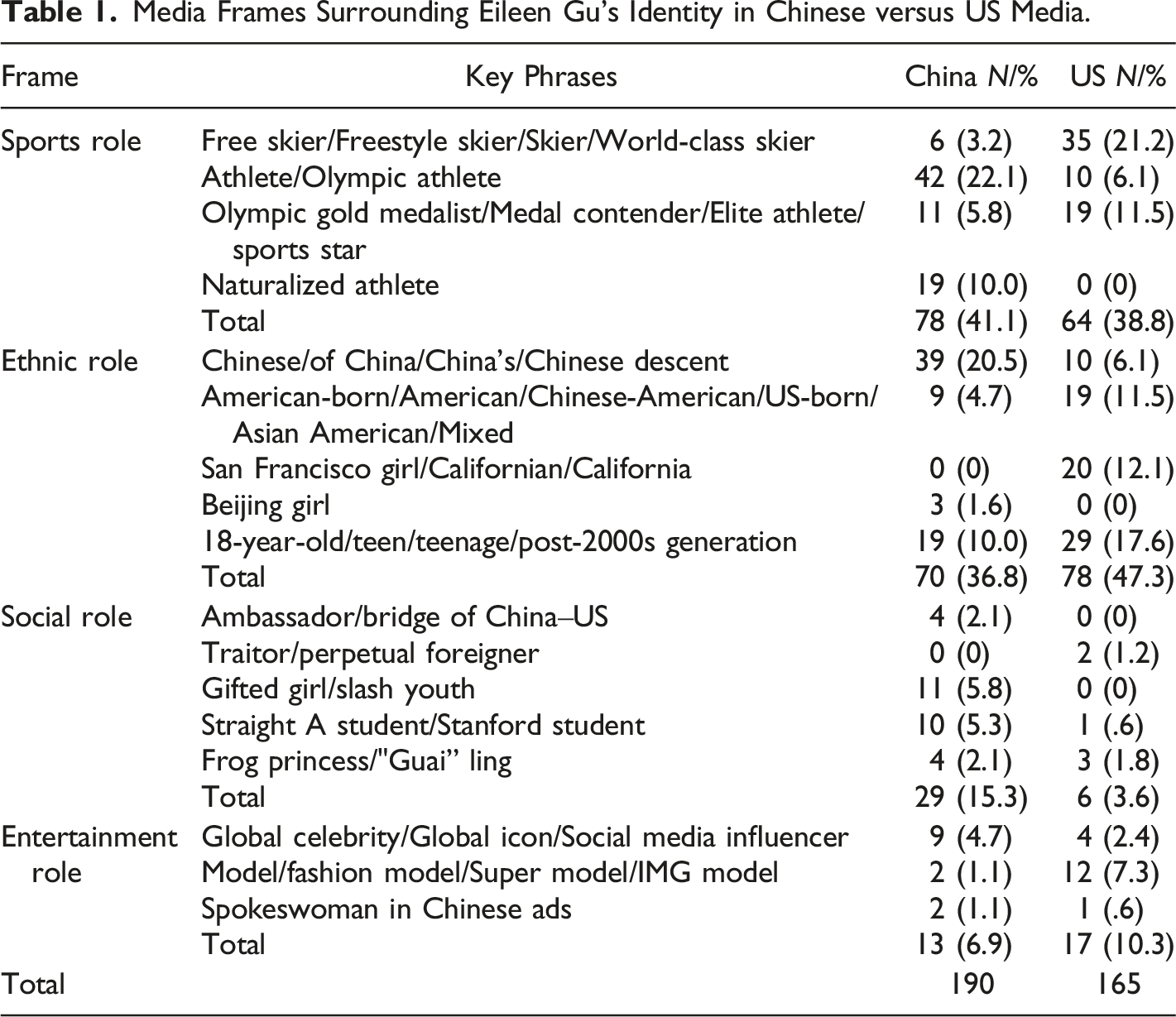
Howbeit, the prioritization of these four frames was distinct between the two countries. The sports role frame was the most commonly used in Chinese media (41.1%). Within this frame, Gu was mostly described as an athlete or an Olympic athlete (n = 42, 22.1%). “Naturalized athlete” was mentioned 19 times and accounted for ten percent of all the collected data in The Paper. The ethnic role frame (36.8%) was the second most commonly used frame among the four. Specifically, over 20 percent (n = 39) of the database clearly stated that Gu is a Chinese athlete or represents China, and only 4.7 percent mentioned that Gu was born in the US or is a Chinese-American. In addition, Chinese media used a more specific term, “Beijing girl” (1.6%), to label Gu as her mother is a Beijinger and they visited Beijing almost every summer as Gu grew up. In addition, age is an obvious element when talking about ethnicity. Ten percent of the phrases expressed that Gu is an 18-year-old girl or is a cohort of the post-2000s generation. A total of 15.3 percent of the phrases framed Gu in relation to her social role, mostly in a positive way. Gu was also labeled a gifted girl or a slash youth, focusing on her outstanding performance in both sports and study. She is also referred to by the nickname “frog princess” by the Chinese public. The entertainment role frame was the least used and accounted for 6.9%.
In American media, similarities, as well as differences, were distinctly demonstrated regarding frame construction. Nearly half of the data fell in the ethnic role frame (n = 78, 47.3%). Age was mostly mentioned in this frame (17.6%). Comparatively, the US media paid more attention to Gu’s city affiliation, and 12.1 percent of the database labeled Gu as a San Francisco or Californian girl while not mentioning Beijing or other related cities. The US media also described Gu as an American-born girl or Chinese-American instead of directly pointing out she is Chinese or of Chinese descent (11.5% and 6.1%, respectively). The sports role frame was the second most commonly used frame (38.8%), among which 21.2 percent of articles described Gu as a free skier or freestyle skier, and 11.5 percent as an Olympic gold medalist, elite athlete, or sports star. The entertainment role frame followed, accounting for 10.3 percent, including 12 expressions related to Gu as a fashion model and four as a global celebrity. Unlike in the Chinese media, the social role frame (3.6%) was least mentioned in US media, and half of the mentions had a negative tone, describing Gu as a traitor or perpetual foreigner.
In summary, sports and ethnic role frames were dominant in the Chinese (77.9% in total) and US (86.1%) media in the construction of Gu’s identity, whereas the priorities were the opposite. It makes sense to us, on the one hand, that sports identity would be essential to any individual athlete, and on the other hand, that competition in the media framing nationality and ethnicity is inevitable regarding a naturalized athlete like Gu, one of the most successful Olympians at Beijing 2022. In addition, it was also notable that Chinese media emphasized the social role of Gu (15.3%), while her entertainment role (10.3%) was salient in US media. In the next section, we further interpret the distinguishable media discursive practices between the two countries.
Discursive Contestation Surrounding Gu: Performance and Cultural References
Regarding the second research question, our media discourse analysis revealed that in essence, media from both countries tended to be more conventional and nationalistic in dealing with athlete naturalization in order to achieve their political ends and cultural signification. This is done through the generation of two main themes which help to construct and deconstruct Gu’s identity: (1) athlete performance and national pride and (2) cultural construction of “She is one of us”. In doing so, Chinese and American media exhibited clear-cut differences and contestations in their storytelling and narration.
The notable prevalence of the ethnic role frame, i.e., whether Gu is Chinese or American, points to the fundamental defense regarding her national identity and its association with national pride. The strategies adopted by the two countries’ media organizations, however, were discrete. Concerning Gu’s outstanding performance, while China constructed her as a Chinese youth representative of a positive and globalized China, the US accredited Gu’s achievement to the mature training that she received in the US and designated the urgency of localizing her currently ambiguous national identity which needs to be defined in a binary manner.
For instance, in one article by The Paper, the journalist attributed Gu’s success to her confidence and crafted her as a strong symbol of the great rejuvenation of the Chinese nation: Another key element is confidence among the young generation, like Gu Ailing, Su Yiming, and so on. They are very young, but particularly confident, proficient in Chinese and English, even in a variety of other languages and cultures. [Yet] they have a firm identification with [their native] country, and this is the style of the new generation of China … Of course, we don’t have to avoid the fact that there is criticism online around some naturalized athletes, especially in the western media. As I said before, we still need to look at this with a more open mind (Niu, 2022).
On the other hand, the US media reported that those difficult political identity questions directed toward Gu during press conferences and interviews were not about her identity. Instead, they were about her citizenship, a topic that is now at the “thrust of her story during an Olympics where it is impossible to glide over the political issues between the US and China as easily as Gu thrusts herself into the air and performs body-bending feats” (Wolken, 2022). In addition to blatantly addressing Gu as “Eileen Gu” instead of “Gu Ailing”, the media also often referred to her as a “Californian girl” or “an 18-year-old from San Francisco”, intentionally creating a spatial proximity by using a smaller geographical unit. In another case, Will Cain, a Fox News host, explicitly said that it was “ungrateful” of Gu to “betray the country that not just raised her, but turned her into a world-class skier” (Qin, 2022), denoting that she would not have achieved so much without the training she obtained in the US.
In short, the Chinese and American media perform a conscious act of globalization and localization according to their respective political needs. In other words, the US is more conservative in demanding a clear and localized citizenship of Gu and thus adopts a more binary approach. Conversely, China challenges the existing definition of national identity by promoting cosmopolitanism (Calhoun, 2008) and building a “global China” concept. As representative subjectivities, individual athletes and sports celebrities are often able to construct and crystallize cultural meanings and ideologies of a nation, and with deepening globalization, they now also offer an important insight into understanding the specific articulations of power relations between nations.
In order to establish Gu’s cultural affiliation, symbols such as language, food, and behavior were frequently used by the media in both countries to construct the mentality that “she is one of us”. Gu often expresses that she loves Chinese food in front of the Chinese media. On 14 February 2022, during the women’s slopestyle freestyle skiing qualification in Beijing 2022, a photo captured Gu eating a Chinese-style pie while waiting for her score and quickly became an Internet meme (Sina, 2022). Even China’s President Xi Jinping commented on it, as People’s Daily reported: At the award ceremony for Beijing Winter Games, President Xi said with a smile, “Gu Ailing loves to eat pie, foreigners also love to eat dumplings”. His vivid and kind words won warm applause from the audience. Gu Ailing, who had won two gold medals and one silver medal in the Beijing Winter Olympics, replied excitedly, “I feel honored to let more people know more about the Chinese culture” (Li et al., 2022).
In addition, the Chinese media frequently incorporated dragon, a significant Chinese cultural symbol, into the descriptions about Gu, such as “Gu, with a dragon print on the back of her outfit, touches the board with one hand and looks like she’s leaning on the Winter Olympics logo with the other” (Li, 2022), denoting that she is a “descendant of the dragon”. 3
Regarding the US media, a recognizable “Us versus Them” binary discourse was adopted by a way of addressing the distinction between Gu and her mother, Gu Yan. For instance, an article from the New York Times reported, “The 18-year-old Californian, competing for her mother’s home country, China, not her own, has become a global celebrity” (Branch et al., 2022). In furtherance of embracing Gu as an American, the media highlighted her cultural affiliation to the US by narrating that “After she won her first medal, Gu said she would celebrate with Ghirardelli chocolates, an obvious nod to San Francisco, her hometown” (Keh, 2022).
Moreover, media organizations tend to showcase certain cultural advantages of their host nation by emphasizing the different roles of Gu and their alliance with the nation’s spirit. The Chinese media, for instance, preferred to utilize a society-serving perspective when associating Gu with her social and cultural status. Thus, they prioritized Gu’s social role and constructed her as a “role model” from whom Chinese youths could learn. As a piece in The Paper covered: Gu Ailing surprises us by her proud profile. She is a sports talent, as well as a straight A student. She finished her high school a year earlier than her peers, and went to Stanford for college. More than that, she is very playful…in an age of 19, she could balance her study, sport, and entertainment life. Even her personality is unbeatable; she will cheer for other athletes when she doesn’t have any matches (Du, 2022).
In essence, this approach resonates with the Chinese political discourse of “positive energy” (zheng nengliang), which has embodied mainstream political ideology in China since 2012 (Chen et al., 2021).
The US media, on the other hand, addressed Gu’s entertainment role as a social media influencer/fashion model where she was used as a symbol to highlight the advantage of a market economy. In US society, where a pervasive individualistic culture is deeply rooted, the spirit of the American dream “where everyone has an opportunity to reach the fullest stature of which they are innately capable” is commonly shared (Shiller, 2017). As such, US media proudly addressed Gu’s entertainment role as a social media influencer/fashion model and owed her success to her self-interest or self-reliance. As the New York Times described:
Eileen Gu, raised by her mother in an upscale San Francisco neighborhood, has become a model, representing luxury brands like Louis Vuitton and Tiffany & Co. She has so many sponsorships in China that she is a ubiquitous presence in advertisements and receives glowing news coverage from the state media (Branch, 2022).
The Co-Opetitive Flow of Identity: Sport Naturalization in a Power Transition Era
Modern sport offers a critical lens through which to see and understand the nationalist moment that demarcates what Anderson (2006) calls an imagined community. As a result, people read nationalism as an ideological production that offers individuals a sense of belongingness. By the same token, nations use mega-sport events such as the Olympics as a platform to reflect their pride and superiority (Manzenreiter, 2015) through the symbolic power of athletes.
Although sport may generate a new version of flexible belonging in this contemporary transnational age, such flexibility is often restricted and unstable due to international tensions and hegemonic cultural logic. As Ong (1999, p. 6) argues, “individuals, as well as governments, develop a flexible notion of citizenship and sovereignty as strategies to accumulate capital and power”, and yet the practical experiences of flexible citizenship are constituted and completed by complex and intricate negotiations with the social factors of race, class, gender, sexuality, and nationality.
In particular, elite sports performance and the staging of mega-events are two potential sources of international prestige (Grix & Houlihan, 2014). In the case of China and the US, two major powers competing on the stage of the Winter Olympics, through their varied media practices and storytelling surrounding a well-known naturalized athlete, national media from both nations projected an association between the identity-making of its athlete and sporting nationalism. In such a manner, media organizations fulfilled their role to maximize their own national interest, and such tendencies were then augmented by geopolitical tensions.
Firstly, Gu’s successful performance and extraordinary profile as an 18-year-old Olympic gold medalist serve the interests of China and the US separately, so there is a distinguished frame of gain and loss between the two nations concerning the nationality of Gu. For China, Gu represents a successful policy decision and brings its national image to a brand-new level, specifically deployed by a more open, connected, positive, and global China. In contrast, in the US, the fact that such a capable athlete and commercially valuable individual is endorsing China, a country that is standing in an arguably rival position to the US, is a sign of loss. In other words, the unavoidable context of the Sino-US tension is undeniably playing a role in the construction of media frames that would be different if, for example, “Eileen Gu was Japanese-American” (Cao, 2022). As a result, the US seems to demand a more binary way of addressing Gu’s national identity, specifically her citizenship, to legitimize its dominant power in sports. In this process, we could see a substantial distinction in how Gu’s identity was constructed; that is, whereas Chinese media adopted cooperative frames by narrating Gu as a “Sino-US ambassador”, a “bridge” to propagate a peaceful rising China, American media applied competitive frames by using words such as “traitor” to sustain its narrative legitimacy.
Secondly, sports have been widely regarded as a source of “soft power”, a term first coined by Harvard scholar Joseph Jr Nye (1990) referring to the cultural and social attraction a country possesses in opposition to hard power like the military. One of the four components of soft power includes resources, which refers to culture, values, policies, and personalities (Ohnesorge, 2020). Clearly, both the Chinese and American national media reinforce the source of soft power and national identity by reaffirming various cultural symbols and values of their host countries. The Chinese media regards Gu as a “descendant of the dragon” and emphasizes Gu’s social role as a role model for Chinese youth to be learned and reproduced, indicating that her triumph is a result of China’s collectivist ideology. However, in the US, Gu is identified as a global celebrity, a fashion model, and a social media influencer, representing that she is a unique individual chasing the “American dream”.
In addition, the patterns of which the two countries embrace sport commercialization could also account for the differences. As Ma and Kurscheidt (2022) put it, China follows a politically-led logic that centers around the demands of the national government, while the US follows a media-driven logic based on sports commercialization. After all, the US is a mature actor in nurturing global sports celebrities, such as LeBron James, Tiger Woods, and Kobe Bryant; China, in contrast, is much more reserved, as it does not intend to completely drown itself in the so-called neoliberalism or global capitalism.
China and the US, which have represented the roles of “periphery” and “core” in international relations with a long history, start to show new characteristics in the current geopolitical tension. Specifically, while the US, a leading power, still takes the role of a hegemon and strives to maintain the existing power relations, China, a rising power, seeks further opportunities to fluctuate and reshape the old power dynamics. The role that international sporting competitions such as the Olympics serve is certainly not limited to contestations between countries, in this case, China and the US; in a broader context, it reveals the changing dynamics of relations among the East Asian region and the West.
Along with the development of globalization and shifts in international migration patterns, three consecutive Olympic and Paralympic Games have been held in East Asia in the last five years, including PyeongChang 2018 in South Korea, Tokyo 2020 in Japan, and Beijing 2022 in China. Whether we refer to the “East Asia era” of the Olympic Games, proposed by Horne and Whannel (2016), or the subsequent Games “going back to the West” (e.g., Paris 2024 in France, Milano Cortina 2026 in Italy, and Los Angeles 2028 in the USA), we can observe a symbolic shift in geopolitical and economic power between the West and the East or some disruption toward the long-held global order characterized by Western cultural hegemony (Lee, 2016).
Conclusion
When sports intertwine with factors such as politics and economics, sports-media discourse can be contentious, if not hostile, and this may worsen regarding sensitive issues such as nationality and identity (Denham & Desormeaux, 2008). As Castells (2004) put it, claiming identity is power-making. Mapping the media frames and discourses surrounding naturalized athlete Eileen Gu’s identity, we hope to further understand the (re)construction and deconstruction of identity in the current geopolitical tension.
In this article, a substantial divergence was witnessed between the media outlets from China and the US in terms of media frames and discourses. While the Chinese media constructed Gu from a more globalized and collectivist perspective, the American media adopted a relatively localized and individualist tone to narrate Gu’s national identity. However, as we dig deeper, we find that Gu’s multilevel identities resonate with the nation’s own social and political ends, indicating that media from both countries endeavor to maximize their own national interest. In this regard, our study reaffirms that instead of criticism, the media join the government to support whatever is needed to achieve the nation’s sporting goal. Furthermore, we conclude that this is also true for both the inflow and outflow of naturalized athletes. In short, media predominantly creates a competitive flow of identity in the era of sports globalization and naturalization.
Despite scholarly disagreement on the perceived relationship between sports and politics (e.g., in Coakley (2015) and Boykoff (2022)), this research attempted to discuss the role that media plays in oscillating the power dynamics between global players as epitomized in the field of sports. We argued that in the process of the media’s discursive construction, a Cold War mentality is still deeply rooted in the daily journalistic practices and channeled through the overdetermined East-West binary (Said, 1979) of both China and the US.
Due to the limitation imposed by our information collection database, we could not include conservative media in the US such as Fox News which frames Gu’s naturalization provocatively and distinctively compared to the two news outlets we studied. However, our analysis still presents meaningful findings and indicates that tension between cooperation and competition exists in the media framing of the two nations. Notably, we were surprised by how Gu self-identifies, which could potentially point to an interesting avenue of future research. We discovered that Gu seems to position herself in a neutral duality via two main mechanisms – focusing on the sports/Olympics spirit and claiming to be a friendly bridge between China and the US. This resonates with the notion of flexible citizenship proposed by some communication scholars, or toward a cooperative approach among states in international relations. As articulated in the motto of the Olympic spirit – “Faster, Higher, Stronger, Together” (IOC, 2022), for future studies, it would be meaningful to introduce the athletes themselves as a novel perspective in addition to the countries of their inflow and outflow to better comprehend the formation and meaning-making processes of national identity in sports communication.
Footnotes
Declaration of Conflicting Interests
The author(s) declared no potential conflicts of interest with respect to the research, authorship, and/or publication of this article.
Funding
The author(s) disclosed receipt of the following financial support for the research, authorship, and/or publication of this article: This work was supported by the National Office for Philosophy and Social Sciences (19CXW002).
