




Abstract
The purpose of the article is to explore the use of judo for nation branding, public diplomacy, and country image in the postponed Tokyo 2020 Olympic Games. Judo was founded in Japan in 1882 as a martial art that embodies educational values of peace, respect, and controlling mind and body. Judo made its Olympic debut in Tokyo 1964 and gradually became one of the most internationally diverse sports in the Olympic Games. The study uses theoretical lenses drawn from nation branding, public diplomacy, country image, and related fields. The qualitative research is based on content analysis of press conferences, media guides, and international coverage of the judo competitions held in July 2021 at the Nippon Budokan. Based on three coding rounds of manual thematic analysis, four themes emerged from the data: (a) the sport and the host, (b) universal values, (c) geopolitics, and (d) the individual and the collective. The study is significant as it expands literature and adds value to practitioners on the role of judo, nation branding, public diplomacy, and country image, during a global pandemic and as the Olympic Movement enters a new era.
Introduction
The purpose of the article is to explore the use of judo for nation branding, public diplomacy, and country image in the postponed Tokyo 2020 Olympic Games held in the summer of 2021. The connection between judo, the Olympic Movement, and diplomacy is very fundamental, going back to the peaceful educational values on which the sport was invented in Japan (Abel, 2012; Sato, 2013; Ueda, 2017), which are aligned with the philosophy of Olympism and the Olympic Charter (International Olympic Committee, 2021e) and the inspiration the Modern Olympic Games draw from Ancient Greece (Dubinsky, 2019; Murray, 2019). Since judo was introduced into the Olympic program in the 1964 Tokyo Olympic Games, it gradually became one of the most diverse global sports, with over 300 athletes from over 100 countries competing in each of the recent Olympic Games (IJF, n.d.). With over 200 national judo associations members in the International Judo Federation (IJF), the sport of judo embodies ample nation branding, public diplomacy, and country image opportunities, especially as it returned to its birthplace Japan. Considering the number of countries represented during the judo competitions in the Tokyo 2020 Olympic Games, this exploratory study contributes to scholars and practitioners.
The Tokyo 2020 Olympic Games were unprecedented, postponed to 2021 due to the COVID-19 pandemic and held under health restrictions, and without local or international fans (Dubinsky, 2022a; International Olympic Committee, 2021). When hosting the 1964 Olympic Games, Japan used the Olympics to showcase a technologically advanced country and disassociate its image from the devastations of World War II, the country’s imperialist history and committed war crimes, and sclerotic reputation (Abel, 2012; 2021; Traganou, 2011; Yoshimi, 2019). In 2013, The IOC chose Tokyo to host the 2020 Olympic Games over Istanbul and Madrid. After winning the bid, Japan planned to use the Games to show its recovery from the 2011 Tsunami, earthquake, and Fukushima Daiichi nuclear disasters, along with enhancing the innovative image of the country by acknowledging the heritage and legacy of Tokyo 1964, while also introducing new renovations and innovations (Dubinsky, 2022). Yet, COVID-19 changed the branding strategy of Tokyo 2020 twice: once when postponing the Games and announcing that Tokyo 2020 will be a victory for humanity over the pandemic, and when realizing this would not be the case, arguing it is important for the Games to happen for the sake of the athletes. Even before COVID-19, there was much backlash about the Tokyo 2020 Olympic Games, accusing the organizers of greenwashing and unsustainable planning (Boykoff & Gaffney, 2020). Yet, after the outbreak of the pandemic, the Japanese public was repeatedly against hosting the Olympics and there were ample anti-Olympics protests through the torch relay and the preparations. Tokyo 2020 was also unique as the IOC relaxed its anti-protest policies amid the wave of social activism that manifested through sports and allowed athletes more self-expression (International Olympic Committee, 2021b). With that said, Russian athletes competed under the flag of the Russian Olympic Committee (ROC) after Russia received a ban following the recommendation of the World Anti-Doping Agency (WADA) for systematic doping violations (International Olympic Committee, 2021a), North Korea did not send athletes to the Games (Morgan, 2021a), and the Iranian Judo Federation was banned for forcing an athlete to forfeit matches to avoid facing Israelis (IJF, 2021a). New sports were introduced in the Tokyo 2020 Olympic Games, including karate, which was held in the Nippon Budokan 5 days after the conclusion of the judo competitions (Tokyo 2020, 2021a). Tokyo was the last city to win the bid to host the Olympic Games through the traditional process of all eligible IOC members voting and choosing between different candidate cities. Due to lack of public support, lost referenda, and dropped bids, the IOC changed its selection process and awarded Paris, Los Angeles, and Brisbane the right to host the 2024, 2028, and 2032 Olympic Games in a different way (Dubinsky, 2022; Zirin & Boykoff, 2021). According to Dubinsky (2022), the pandemic, the change in the bidding process, the local and international backlash, and the new challenges arises from the waves of social activism, sustainability, and climate change, all made Tokyo 2020 a turning point for a new era in terms of the Olympic Movement, nation branding, and public diplomacy.
Theoretical and Conceptual Frameworks
Nation Branding, Sports, and Country Image
This study explores the manifestations of nation branding, public diplomacy and country image through judo in the 2020 Tokyo Olympic Games. Due to the popularity of the Olympic Games, being broadcast to billions around the world, hosting and participating countries have been trying to capitalize on them to shape their image in a favorable way to achieve social, political, and economic goals (Billings, Angelini, & McArthur, 2018), including through the introduction on new innovations (Billings, 2008). Fan (2010) defines nation branding as the “sum of all perceptions of a nation in the minds of international stakeholders, which may contain some of the following elements: people, place, culture/language history, food, fashion, famous faces (celebrities), global brands and so on” (p. 98). According to Fan (2010), nation branding includes export branding (also referred to as product-country-image), place branding (also referred to as destination branding), political branding (also referred to as public diplomacy), and cultural branding (also referred to as national identity). One of the outcomes of nation branding is country image (Buhmann & Ingenhoff, 2015; Fan, 2010). As country image results from nation branding, it is also a multidisciplinary field, studied through the lenses of marketing and nation branding, political science and soft power, socio-psychology and collective identity, and communication, agenda setting and framing (Buhmann & Ingenhoff, 2015; Dubinsky, 2019). According to Buhmann and Ingenhoff’s (2015) four-dimensional model, a country’s image is constructed through (a) a functional dimension that pertains to the competencies and competitiveness of a country, (b) a normative dimension that pertains to beliefs regarding the norms and values of a country, (c) an aesthetic dimension that pertains to the attractiveness of a country, and (d) a sympathetic dimension, that pertains to feelings and fascination for a country (Buhmann & Ingenhoff, 2015). All these fields are manifested in the ways countries, people and communities have been using sports, including the Olympic Games, to achieve social, political, and economic goals (Dubinsky, 2019; Murray, 2019).
Soft Power and Sports Diplomacy
Fan (2010) refers to public diplomacy as political branding. While traditional definitions of public diplomacy refer to the use of communication with foreign publics to achieve foreign policy goals (Cull, 2008), more contemporary definitions also analyze the roles of private citizens through people-to-people-diplomacy and of the business industry through corporate diplomacy as tools that influence the image of a country. Public diplomacy, as a subset of foreign policy, is part of soft power, a term coined by political scientist Joseph Nye (2008) that refers to countries trying to achieve a more favorable image through attraction, rather than using military force or economic sanctions (Nye, 2008). Beyond foreign policy that was directly manifested in the mass political boycotts in the 1980s during the Cold War (Dubinsky, 2019; Murray, 2019), soft power also includes political values and culture, for example, athletes from Arab and Muslim countries withdrawing from competitions if drawn to compete against Israelis after pressure from their governments or sports organizations in defiance of normalizing relations with Israel, usually under the pretense of an injury (Dubinsky & Dzikus, 2019). Another use of the Olympic Games as a form of soft power and cultural diplomacy is through the opening and closing ceremonies, in which hosting countries showcase their rich culture and history through artistic performance (Arning, 2013), and over 200 participating countries and delegations marching under their flags (Dubinsky, 2019; 2022).
Sports, Product-Country-Image and Tourism-Destination-Image
From marketing perspectives, nation branding uses the lenses of products associated with a country (Jaffe & Nebenzahl, 1993), also known as product-country-image (PCI) or country-of-origin (COO), which Fan (2010) refers to as export-branding, and countries as tourism destinations (Anholt, 2010), also known as tourism-destination-image (TDI) and referred to by Fan (2010) as place branding. From product-based lenses, Japan used the 1964 Olympic Games to reposition the country’s hawkish international image from the post-war era, to a modern and innovative country by using satellite broadcasting, introducing the bullet train, and reconstructing Tokyo after the war by building sports facilities instead of military facilities (Abel, 2012; 2021; Yoshimi, 2019). From communication lenses, according to Buhmann and Ingenhoff (2015), the “central role of mass media in the formation of country images has stimulated numerous content analyses evaluating images of certain countries as portrayed in foreign media” (p. 108). When Dubinsky (2020) conducted a content analysis of his own coverage of three summer Olympic Games, he identified that by using iconic venues such as the Maracanã stadium in Rio de Janeiro 2016 or the Wimbledon tennis courts in London 2012, organizing committees capitalized on the auras of the facilities to show the uniqueness of the countries’ cultures. One new sports venue that was built for Tokyo 1964 on the former base of the Imperial Guard was the Nippon Budokan (Yoshimi, 2019), which was designed based on an eighth-century Japanese temple (Olympics, 2020) and hosted the judo competitions - the first sport with Asian origin in the Olympic Games. Since then, the Budokan became known as “the spiritual home of Japanese martial arts” (Tokyo 2020, 2021b, p. 9) hosting judo competitions along with demonstrations of other traditional Japanese sports such as kendo, kyudo, and sumo (Olympics, 2020).
Sportswashing and Image Laundering
In his book “Power Games: A Political History of the Olympics”, Jules Boykoff (2016) criticizes the Olympic Movement and emphasizes the arising of social activism among different stakeholders, including communities resisting the Games and athletes taking a s stand. Another form of resistance is criticism over sportswashing (Chadwick, 2021), a term used to describe authoritarian regimes using sprots to launder their international image from human rights violations. Examples in the Olympic Games can include Nazi Germany hosting the Berlin 1936 Olympic Games, China hosting Beijing 2008, and Russia hosting the Sochi 2014 Winter Olympic Games (Dubinsky 2019; Murray, 2019). Despite trying to show flexibility in the bidding process and relaxing the hosting requirements through the recommendations of Agenda 2020 and Agenda 2020+5 (International Olympic Committee, n.d.), the IOC and hosting cities are still facing scrutiny and backlash for lack of transparency, greenwashing, and gentrification, among other issues from local communities, Nolympics pressure groups and other stakeholders (Boykoff & Gaffney, 2020). After local communities voted against hosting the Olympics in multiple referenda, the IOC changed its bidding process, bypassing the traditional election process that previous cities like Tokyo went through (Dubinsky, 2020; Zirin & Boykoff, 2021). In fact, Russian President Vladimir Putin was an honorary President of the IJF until the country invaded Ukraine violating the Olympic Truce of the Beijing 2022 Winter Olympic Games (Lloyd, 2022). These are part of the reasons why Dubinsky (2022) argues that the Tokyo 2020 Olympic Games mark a beginning of a new era for the Olympic Movement regarding nation branding and public diplomacy.
Methods
The study aims to explore the research question: How did nation branding, public diplomacy, and country image manifest through the judo competitions in the Tokyo 2020 Olympic Games? To answer the question the study uses content analysis (Flick, 2014; Krippendorff, 2004) of data collected during the Tokyo 2020 Olympic Games in Japan in the summer of 2021, and through online sources available to the author later. The data collection and coding followed previous methods used in nation branding, country image, and public diplomacy studies in mega sports events, including the Olympic Games (Dubinsky, 2020; 2022a; 2022b; Dubinsky & Dzikus, 2019).
The Tokyo 2020 Olympic Games took place between July 23 and August 8, 2021, and the judo competitions held between July 24 and July 31. The author received press credentials from the Organizing Committee of the Tokyo 2020 Olympic Games, granting access to competitions, media zones, and press conferences and to media-related materials. Furthermore, accredited journalists who attended the Tokyo Olympics had access to MyInfo (https://myinfo.tokyo2020.org) - a web-based service operated by the organizing committee that provides information to accredited media (Tokyo 2020, 2021a). As MyInfo was only opened between July 19 and August 11, 2021 (Tokyo 2020, 2021a), the author accessed the portal and copied the content of the translated transcripts of the highlights of all judo medalists’ press conferences from MyInfo during the Games in July and August 2020, including the URL links used to access the information. As the portal closed shortly after the conclusion of the Olympic Games, the links in the references will not be working. The data collection in this study is primarily based on content that was available to international journalists covering the Tokyo 2020 Olympic Games through MyInfo and independent international coverage through the Inside the Games website (https://www.insidethegames.biz). According to topics and issues identified, for contextualization purposes, the author also used media guides (Olympic Broadcasting Services, 2021; Tokyo 2020, 2021b), and publicly available sources such as official websites, further international coverage, and social media posts.
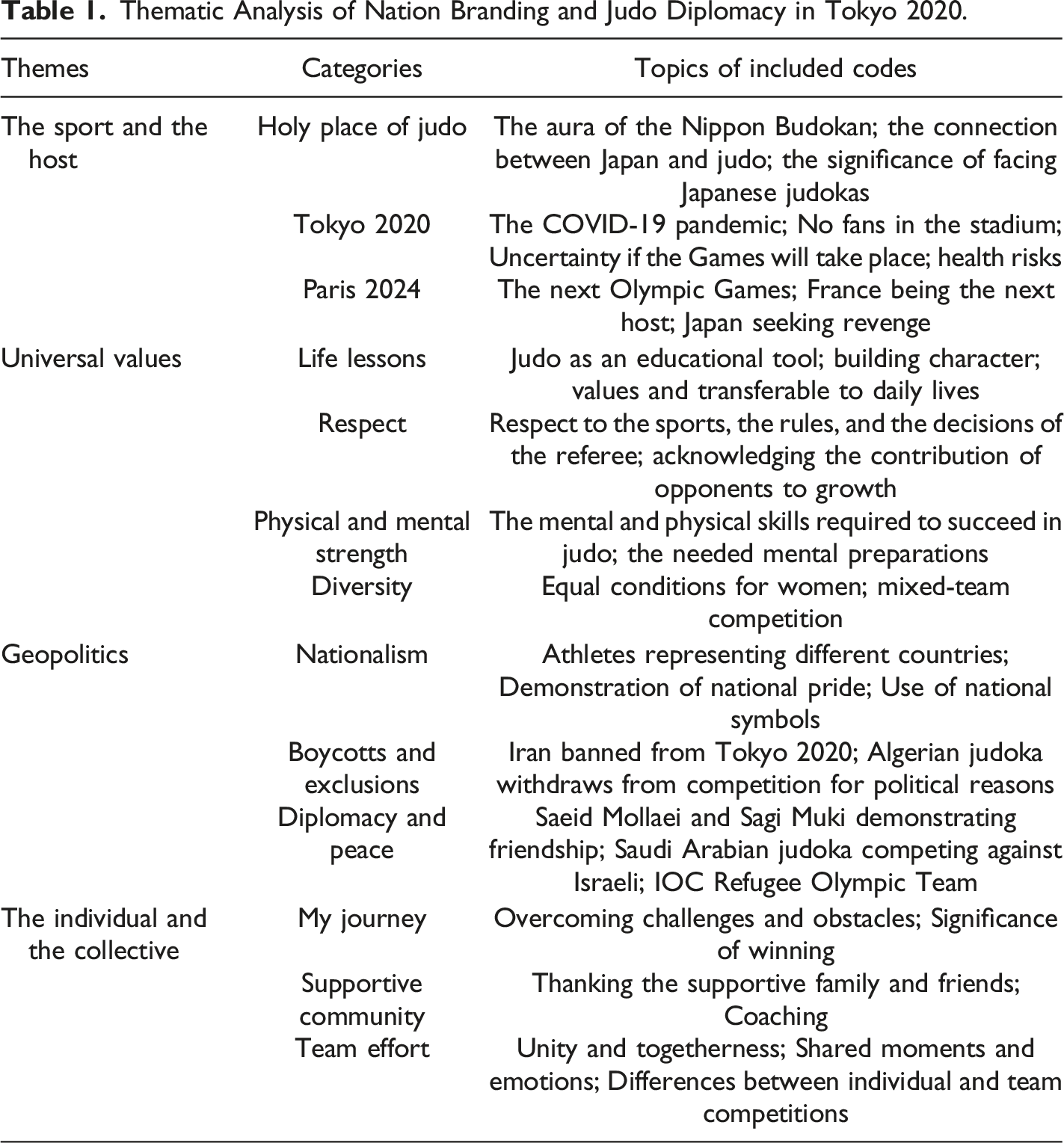
Thematic Analysis of Nation Branding and Judo Diplomacy in Tokyo 2020.
Findings
The judo competitions held in July 2021 at the Nippon Budokan were among the most internationally and socially diverse events of the Tokyo 2020 Olympic Games, with 393 athletes from 128 nations competing in 15 judo competitions divided into 7 weight classes for men, 7 weight classes for women, and one mixed-team competition (IJF, 2019; IJF, 2021b). Judokas from 26 different countries won at least one medal, with Japan topping the judo podium with a record setting of 9 gold medals and a record tying of 12 overall medals (Olympics, n.d.a; b). The only other countries that won gold medals in judo were France (2), Kosovo (2), and Georgia (1). Although the USA and China finished in the top two places in the overall medal rankings of the Tokyo 2020 Olympic Games, neither won any medals in judo, nor did any athletes representing countries from Africa and Oceania (Olympics, n.d.a). Four themes emerged from this study on the intersections between judo, nation branding, public diplomacy, and country image in Tokyo 2020: (a) the sport and the host, (b) universal values, (c) geopolitics, and (d) the individual and the collective.
Theme 1: The Sport and the Host
The first theme includes the categories; holy land of judo, Tokyo 2020, and Paris 2024. Both Japanese and international judokas saw special value in competing in the Nippon Budokan. After winning the gold medal in the −73 kg category, Japanese judoka Ono Shohei described the Budokan as “this holy place of judo” (OIS jk/bw/tb, 2021). After losing in the final of the −100 kg category to Japanese judoka Aron Wolf, the Korean silver medalist Guham Cho recognized the moment saying: “During the final match, I competed at the Budokan and competed against a Japanese judoka, so it is the greatest honor for me” (OIS mes/ns/bl, 2021). In the last judo event of the Tokyo 2020 judo competition, it was France that reigned supreme, overcoming Japan 4-1 in the first-ever Olympic mixed-team final. Japanese and French judoka emphasized the significance of the competitions happening in the Budokan, looking forward for a rematch in Paris 2024 (OIS jk/bl, 2021; OIS jk/kd, 2021b). Teddy Riner, one of the most recognized athletes in the sport, who won the bronze medal in the individual competition and a gold in the mixed-team event, acknowledged the achievement, “This medal is very, very, very, very important. To win here in the country of the judo during the Olympic Games in the Budokan is just amazing for me, for this team, for the Federation of Judo, for the people of France. It’s just great. Big day. Everybody is proud. I am very proud of this day. I don’t have words because it’s an amazing day. This is a dream. We win in the final against the Japanese team. Wow.” (OIS jk/bl, 2021)
Due to the COVID-19 pandemic and with the Games not having local or international fans, the Opening Ceremony of Tokyo 2020 was quieter and more sombre than usual. Cultural references to judo and Japanese martial arts traditions were minor, showing 1992 gold medalist judoka Koga Toshihiko in a video that traces the journey of athletes since Japan won the bid in 2013, or the Budokan in another video as an important landmarks Tokyo (Tokyo 2020, 2021c). Innovative digitalization were used in the production of the competitions as Japanese broadcaster NHK offered 8k SHV live coverage of selected judo competitions (Olympic Broadcasting Services, 2021), and the Olympic Partner (TOP) Japanese electronics company Panasonic used advanced technologies in the Budokan such as LED Large-Screen Displays and camera systems that were used in live broadcasting (Panasonic, n.d.a; n.d.b). Due to the COVID-19 pandemic, the organizing committee imposed restrictive health precautions through their Playbooks (International Olympic Committee, 2021c) to try and prevent mass infections and even ordered two Georgian judokas to leave the Games after breaking health protocols sightseeing (Morgan, 2021b). While locals and internationals criticized Japan for mishandling the pandemic and nevertheless hosting the Games, athletes were most thankful. Bronze medalist San Van Dijke (women, −70 kg) noted that “it came with a lot of insecurity on whether the Games would be held or not, but I am happy Japan could sort everything out so that we can be here” (OIS lem/lcm, 2021a).
Theme 2: Universal Values
The second theme that emerged from the data included the categories life lessons, respect, physical and mental strength, and diversity. The topics discussed through these categories help to explain why the sport of judo was adopted globally beyond its place of origin through the educational values behind the sport. As Belgian bronze medalist, Matthias Casse said, “I’m becoming a tougher person, and judo teaches me a lot of lessons and values I can use in my daily life” OIS jk/ic, 2021). Mayra Agular from Brazil, bronze medalist in the −78 kg class highlighted respect saying, “Most importantly, I need to acknowledge my adversaries. They are very tough and I know how much they train, so I am very proud to take part in this category and fight with them” (OIS mes/mr, 2021).
Medalists also referred to the different demands the sport has, requiring athletes to demonstrate both physical and mental strength through the competition, preparation, and way of life. Shamil Borchashvili who won the bronze medal in the −81 kg category for men explained, “I like to match with the other guys, because it’s not only physical, it’s about mental” (OIS jk/ic, 2021). Clarisse Agbegnenou was the only judoka to win two gold medals in Tokyo, one individual in the women’s −63 kg category and another as part of Team France in the mixed-team competition. She shared what it took to help her get physically and mentally prepared for the Olympics. “I’ve broadened my range. I’ve spent a year trying to improve on different things. I’ve tried to do yoga to be more relaxed, to do meditation to be more relaxed. I love to dance. I let the music carry me” (OIS jk/bw, 2021), she said.
Another attractive aspect of judo that makes it popular globally is the inclusiveness aspect of the sport, attracting people with different body types, different weights, from different nationalities, different races and ethnicities, and different genders. As a non-European sport, judo competitions were dominated by athletes of East Asian origins, but the diversity of the sport manifested through the different delegations. The French team that won the gold medal included athletes from different ethnicities, including Teddy Riner who was born in Guadeloupe (Riner, n.d.) and Clarisse Agbegnenou whose parents are Togolese and has dual citizenship (AP, 2021). Another member of the gold-winning French team, Amandine Buchard, who also won a silver medal in the −52 kg, contributed two medals to the 32 overall medals that openly LGBTQ athletes won in Japan - adding to the framing of Tokyo 2020 as “the Rainbow Olympics” (Avery, 2021). Yet, perhaps the most significant contribution of the addition of the mixed-team competition was cementing judo as a gender-balanced sport. Timna Nelson Levy, who won the bronze medal as part of the Israeli mixed team, explained the significance of gender diversity in the sport of judo: Judo is one of the most equal sports that there is today. The payment for winning is the same. The amount of athletes that can participate in the competition is the same. The number of weight categories for men and women is the same. Our sport is giving an example for the rest of the world to act. This competition is a representation of equality. I think it is amazing. (OIS jk/mr/km, 2021)
Theme 3: Geopolitics
The theme geopolitics includes the categories of nationalism, boycotts and exclusions, and diplomacy and peace. There is no shortage of geopolitical incidents in the Olympic Movement, including through the sports of judo. Nationalism was expressed and contested in different forms through the judo competitions in Tokyo 2020, including the naturalization of athletes who were born in one country and competed for another, such as German-born judoka Marie Branser who represented the Democratic Republic of Congo (Judo Inside, 2021), Saeid Mollaei fled Iran and represented Mongolia (Shefferd, 2021), Shamil Borchashvili moved to Austria as a young child as a Chechnyan refugee (Weiss, 2021), and the judokas from the Refugee Olympic Team came from different countries and nationalities and was part of a collaboration between the IOC and UNHCR (International Olympic Committee, 2021d). Other manifestations of nationalism can be seen through the significance of national symbols, such as Clarisse Agbegnenou carrying the French flag in the Opening Ceremony, or Russian judokas competing under the ROC flag (International Olympic Committee, 2021a) as Russians were not allowed to compete under their national flag following the sanctions on a systematic doping system.
The second category in the geopolitics themes includes boycotts and exclusions. Much like in the 2016 Olympic Games in Rio de Janeiro (Dubinsky & Dzikus, 2019), most of the political incidents in judo directly or indirectly targeted Israel. Beyond banning the Iranian Judo Federations and not having an Iranian judo delegation in Tokyo (IJF, 2021a), during the Olympic Games there were two incidents in which athletes from Arab and Muslim countries withdrew from competitions before facing Israelis. Algerian judoka Fethi Nourine and his coach Amar Benikhelef received a 10 years ban from the International Judo Federation after withdrawing from the first round of the Tokyo 2020 Olympic Games to avoid a potential clash with Israeli Tohar Butbul after the Algerian judoka justified his decision to Algerian television that he would not get his “hands dirty” as part of his support for the Palestinian cause (Iveson, 2021). The Sudanese judoka who was supposed to meet Nourine in the first round also did not show up to the competition against Butbul but did not justify it as a political protest. When the Israeli team won the bronze medal, Sagi Muki made direct connections to the ongoing violence in the Middle East, praising Israeli resilience. Muki said: “Israel is a small country with a lot of noise and many enemies around us. I think it says a lot that we survived so many wars” (OIS jk/mr/km, 2021).
Lastly, the third category related to geopolitics was diplomacy and peace. Former Iranian world champion Saeid Mollaei, who fled Iran and received refugee status in Germany before moving to represent Mongolia (Ruiz, 2021), won silver in Tokyo. The Iranian-born judoka dedicated his medal to Israel saying, “Thank you to Israel for all the good energy – this medal is dedicated to you as well and I hope Israel is happy with this victory” (Ruiz, 2021). The day after Muki won the bronze medal as part of the Israeli mixed team, he shared a photo on his social media accounts bumping fists with his friend Mollaei as the two former world champions were sitting next to the Olympic Rings in the Olympic Village, presenting their newly won Olympic medals (Muki, 2021). On the tatami, there was also a moment of fair play when Tahani Alqahtani from Saudi Arabia competed against Israeli Raz Hershko in the first round of the women’s −78 kg category, with the two shaking hands at the end of the match. The IJF praised Saudi Arabia’s progress related to gender diversity and for prioritizing the values of sports over political differences, stating: With what happened today at the Nippon Budokan, once again judo makes history and helps to build a better world, where respect is the core value of human relations. Saudi Arabia proves that, through sport, we can go beyond differences and make sport a force to unite the world. (Messner, 2021).
Theme 4: The Individual and the Collective
The fourth theme addresses the social identities of the judokas competing in a sport that is predominantly an individual one, while also taking part in a newly introduced team category and representing larger communities. The theme includes the categories my journey, supportive community, and team effort. When given the opportunity, multiple medalists used the winners' press conference to reflect on their long journey, the obstacles they needed to overcome, their perseverance and hard work, and what the medal meant to them. Idalis Ortiz, who won the silver medal in the women’s −78 kg class, shared how her training was affected by the outbreak of the pandemic and the strict health protocols in Cuba. She said, “I’ve had to train in my own house, in isolation centers. I also was sick with covid at a certain point” (OIS jk/kd, 2021a). Through winning medals athletes often felt that they represented larger communities, even associating some of the characteristics of their countries to their own experience. “Georgia is a small country but we have really big heroes”, said Georgian judoka Lasha Bekauri after winning the −90 kg judo competition (OIS lem/lcm, 2021b). The Georgian gold medalist glorified the fighting spirit of his country, saying, “We are a nation of warriors and fighters. It is a fantastic feeling that people in Georgia are happy for me” (OIS lem/lcm, 2021b). While Japan is a judo juggernaut and France also has long traditions of success, perhaps the most surprising results in judo came from Kosovo, the only other delegation to win two gold (Olympics, n.d.a). The success of Kosovo comes in contrast to Olympic powerhouses, such as the USA and China, who have not reached the judo podium in Tokyo, and even the Russian ones have settled for two bronze medals for the ROC (Olympics, n.d.a; b). The small Balkan country that is not even officially recognized as an independent state by many members of the UN (Murray, 2019) competed in the Summer Olympic Games for only the second time and in Japan Nora Gjakova and Distria Krasniqi added two gold medals to the one won by Majlinda Kelmendi in Rio 2016 (Murray, 2019; Olympics, n.d.a). After winning Kosovo’s second gold medal in Tokyo, Gjakova spoke about the process that led to success, giving much credit to her coach. She said, “Our work is not work overnight, but it is the work of 20 years. We have been working with the same coach for 20 years, so this is a result of his work” (OIS jk/lcm, 2021). With Russia receiving a doping ban (IJF, 2021a), Russian judokas competed in Tokyo under the flag of the ROC. Despite having modest success of winning only to bronze medals in judo, the ROC finished the Tokyo 2020 Olympic Games fifth in the gold medal ranking and third in the total medal rankings (Olympics, n.d.a). The ROC’s success led to interest from international media, including sharing a photo of a mural in Moscow of a judoka wearing a bear emblem on his kimono, flipping a competitor wearing the words WADA and the trending hashtag #WEWILLROCYOU written beneath (Kramer, 2021). This can perhaps be interpreted as a message that Moscow or Russians support the Russian delegation and to protest against the doping ban.
When it comes to representation and identity, Aaron Wolf, who won individual gold along with a silver team medal for Japan, represents multiple cultures having an American father and a Japanese mother. In the years before the Tokyo Olympic Games, the US Embassy in Japan even identified the diplomatic potential of Wolf, featuring an article about him titled “Aaron Wolf links Japan and U.S. through judo” (Oki, 2019). After winning his individual gold medal he addressed his background saying, “I didn’t struggle because of my parents’ nationalities, he said, “When it comes to judo, I can do judo like the Japanese do and I can do judo like non-Japanese do, so there are many positives” (OIS mes/ns/bl, 2021). Tokyo 2020 introduced a mixed-team judo competition, which was a new addition to a predominantly individual sport. Some of the repeated feelings that medalists expressed were about the team effort. Clarisse Agbegnenou, the only athlete to win both individual and team gold medals in Tokyo, shared the glory with her teammates, saying, “Team France, we were magic today. Thanks to the team, I got another gold medal. I’ll need to check again to make sure it sinks in” (OIS jk/bl, 2021).
Discussion
Judo, Nation Branding, and Japan’s Country Image
Even in Olympic Games in which Japan’s functional and perhaps also normative dimensions of Buhmann & Ingenhoff’s (2015) 4D country image model have been scrutinized (Boykoff & Gaffney, 2020; Dubinsky, 2022a; Zirin & Boykoff, 2021), judo added positive value and enriched the country’s image. Perhaps the most repeated issue related to nation branding that emerged from the data was the connection between judo and Japan, as presented in the first theme the sport and the host. The place branding or TDI approach (Anholt, 2010; Fan, 2010), of analyzing a place through its attraction as a tourism destination, is a subset of the aesthetic dimension (Buhmann & Ingenhoff, 2015) of a country’s image regarding its beauty, landscape, and cultural attractiveness. Based on the findings, this was perhaps the strongest dimension of Japan’s image as local and international judoka emphasized the significance of competing in judo, in Japan, and in the Nippon Budokan. Japanese judokas said that competing in the Budokan in the Olympics was their dream and even referred to it as “holy”. International judokas were not less enthusiastic, and also acknowledged how special it was to compete there against Japanese judokas. The repeating sentiments add to the aura of the Budokan as “the spiritual home of Japanese martial arts” (Tokyo 2020, 2021b, p. 9) and to the historical connection between Japan and judo, enhancing Japan’s cultural attractiveness and the aesthetic dimension of its country image.
From a purely PCI perspective (Fan, 2010; Jaffe & Nebenzahl, 1993), if only analyzing the manifestations of Japanese products through the judo competitions in Tokyo, the main intersections would be the Japanese TOP Olympic Partner Panasonic and Japanese broadcasting company NHK using highly developed technologies in the production and broadcasting of the Games. Although it was not the core of the findings, that does add to the branding of Japan as a highly technological and innovative country and will contribute to what Buhmann and Ingenhoff (2015) refer to as the functional dimension of the. Prior to the Olympic Games, Japan was highly criticized for not being able to contain the pandemic and being slow on vaccinations, which resulted in not allowing local or international fans to attend the Games and with Anti-Olympics protests on a variety of issues ranging from mishandling the pandemic, public spending to greenwashing and gentrification (Dubinsky, 2022a; Boykoff & Gaffney, 2020). These are all liabilities associated with Japan’s functional dimension and Tokyo 2020. The judokas speaking about their concerns, doubts, and uncertainties if the Games will be held or discussing the empty stands, also added to the ongoing criticism on the country’s capabilities. With that said, findings show that most of the direct criticism against Japan was softened, as judokas acknowledged that despite the challenges, the country did manage to host the Olympic Games and hold judo competitions after all.
The normative dimension of a country’s image pertains to norms and ethics associated with a country (Buhmann & Ingenhoff, 2015). The strong association between judo and Japan transcends also the second theme of universal values. Judo was created as a reflection of Japanese tradition, influenced by bushido, modernizing jujitsu, and educating towards mutual prosperity of self and others and peacefulness while teaching maximum use of energy and controlling mind and body (Sato, 2013; Ueda, 2017). Athletes associate judo with respect, self-improvement, hard work, and diversity, while strongly emphasizing the roots of the sport with Japan, which also contributes to these values being associated with Japan’s normative dimension. On the other hand, the ongoing criticism and backlash on hosting the Games during a global pandemic can negatively impact the normative dimension of the country’s image.
The fourth dimension of the 4D country image model (Buhmann & Ingenhoff, 2015) is the sympathetic dimension, constructed by the functional, aesthetic, and normative dimensions and pertains to feelings of sympathy and fascination of a country. This study does not analyze how the judo competitions changed views of Japan but based on how the findings from the data, both Japanese and international judoka were very thankful to Japan and Japanese people for hosting the Games. Furthermore, even losing to France in the mixed team competition, benefit Japan’s image as it increases the competitiveness in the sport and both the French and the Japanese indicated that an anticipated rematch is desired in Paris 2024. These sentiments of gratitude and mutual appreciation add to the sympathetic dimension of the country.
Soft Power and Judo Diplomacy
The study discusses the theme of geopolitics through the lenses of political branding, another aspect of nation branding (Fan, 2010), analyzed through concepts and theories from international relations such as public diplomacy (Cull, 2008) and soft power (Nye, 2008). Findings of the study show that the majority of the political incidents around the judo competitions in the 2020 Tokyo Olympic Games were directly or indirectly related to Israel, adding to existing research on the distancing image of Israel through sports (Dubinsky & Dzikus, 2019). Examples include the Iranian Judo Federations banned from Tokyo 2020 after forcing an athlete to forfeit a match in a world championship, an Algerian athlete and coach receiving a 10 years ban for not showing up to the judo competition to avoid a potential meeting with an Israeli judoka in the second round and justifying it with a political reason, and a judoka from Sudan not showing up to a match against an Israeli, without explaining. It is worth noting that while Sudan joined the “Abraham Accords” – a normalization agreement with Israel, also signed by the United Arab Emirates, Bahrain, and Morocco (Haaretz, 2021), at least by the end of 2021 Algeria did not. According to Dubinsky and Dzikus (2019), such political manifestations keep the discussion around Israel’s participation in the Olympic Games in the polarizing context of the Israeli-Palestinian and the Israeli-Arab conflict and limit Israel’s ability to distance its image from the conflict and use the Olympic Games for soft power purposes. The political incidents identified in the findings along with Muki’s comments in the press conference about Israel having many enemies and surviving many wars (OIS jk/mr/km, 2021) support that argument and add to the framing of Israel in a context of a polarizing conflict during the Olympic Games. With that said, from a people-to-people diplomacy perspective, the judo competitions provided an opportunity for an Israeli athlete, Sagi Muki, and an Iranian-born athlete, Saeid Mollaei, to show their personal friendship despite, or in-spite, of the ongoing tension in the region (Muki, 2021). Mollaei, who fled Iran, received asylum in Germany and moved to represent Mongolia, even thanked Israel after winning the silver medal (Shefferd, 2021; Ruiz, 2021). So, even in complex geopolitics where soft power has limited impact, people-to-people diplomacy can still add value.
Perhaps the most significant judo diplomacy moment in Tokyo 2020 occurred when a female judoka from Saudi Arabia competed against an Israeli judoka and the two shook hands at the end (Messner, 2021). This was contrary to the judo competitions in Rio 2016 when a Saudi female judoka withdrew from the competitions and avoided a potential clash with an Israeli judoka should she have won her match (Dubinsky & Dzikus, 2019). The IJF praised the Saudis both for demonstrating gender diversity and for prioritizing sports over political differences in Tokyo (Messner, 2021). The judo diplomacy moment can be analyzed through several lenses, especially in relation to Saudi Arabia, sports diplomacy, and geopolitics in the Middle East.
In the last decades, countries in the Persian Gulf, have been using sports for soft power purposes, including of course Qatar winning the controversial bid to host the 2022 FIFA World Cup (Chadwick, 2021; Murray, 2019). While the Saudis have been late to the party, in recent years Saudi Arabia has also been recognizing the potential of sports in shaping a country’s international image, hosting different international sports events, and even buying the English football club Newcastle United (Chadwick, 2021). Such initiatives have also brought criticism of sportswashing (Chadwick, 2021) accusations, especially around human rights violations, gender inequalities, and the assassination of journalist Jamal Khashoggi. Having a female judoka compete against an Israeli in the Olympic Games, that could perhaps be interpreted as an attempt to bypass these critics and show Saudi Arabia complies with international expectations. On the other hand, the judo diplomacy moment can be seen as a potential step towards normalization with Israel and perhaps as a foreign policy signal of Saudi intention of joining the Abraham Accords in the future.
In fact, backlash and social and political controversy were part of the Tokyo 2020 Olympic Games. Japan hosted the 2020 Olympic Games without fans and enabled thousands of athletes to compete and continue their careers, even though the Japanese people who funded much of the Games were not able to attend the party they paid for. Much of the backlash that the IOC and hosting cities have been receiving were from different communities and stakeholders whose needs were not met by the organizations and that the Olympics hurt their interests (Boykoff, 2016; Dubinsky 2020; Boykoff & Gaffney, 2020). Furthermore, diversity played a key role around Tokyo 2020, including the demand by athletes to have their voices heard about social and racial injustice (Dubinsky, 2020). The IOC is under growing public scrutiny on the way the Olympic Games are hosted (Boykoff & Gaffney, 2020; Dubinsky, 2022a; Zirin & Boykoff, 2021), despite the organization trying to create more flexible hosting solutions through Agenda 2020+5 (International Olympic Committee, n.d.).
Conclusion
The Olympic Movement has entered a new era (Dubinsky, 2022a), facing new and growing challenges, and this study provides lessons scholars, practitioners, and decision makers should consider in the contexts of nation branding and public diplomacy. The study identifies the value of judo to Japan’s image and the role the sports plays in public diplomacy, soft power, and national identity. The study uses judo to analyze the complexity of Middle East politics and sports, but also to identify potential ways of collaborations through people-to-people diplomacy and maybe even a potential path to normalization through a judo diplomacy moment. Yet, the study also recognizes the threats of using judo for sportswashing and image laundering purposes.
The study is significant as it adds value not only to scholars by expanding literature on nation branding and related fields, but also for practitioners facing ongoing practical challenges. The judo competitions were one of the most internationally diverse sports in the Tokyo 2020 Olympic Games - Olympic Games organized during a global pandemic under unprecedented challenges (Dubinsky, 2022). Yet, the study has several limitations and delimitations. The data collected from the press conferences and used in the analysis consist only of athletes who won medals in the judo competitions. There are hundreds of judokas whose voices are not included in the thematic analysis. The study does not argue the judo competitions in Tokyo 2020 changed perceptions of the images of Japan or any other country. Also, the study focuses only on the Tokyo 2020 Olympic Games and not on the 2020 Tokyo Paralympic Games held later in the summer of 2021. Due to language barriers, the study also uses data in English or translated into English, which mean that cultural or linguistic nuances could have been lost. Future studies are encouraged to fill these gaps. Future research should further explore and analyze the use of judo in for nation branding, public diplomacy and country image as the Olympic Movement enters a new era.
Footnotes
Declaration of conflicting interests
The author(s) declared no potential conflicts of interest with respect to the research, authorship, and/or publication of this article.
Funding
The author(s) received no financial support for the research, authorship, and/or publication of this article.
