




Abstract
Following the global “refugee crisis” of 2015, the International Olympic Committee (IOC) established the Refugee Olympic Team (ROT), providing opportunities for refugee athletes to compete at the 2016 and 2020 (2021) Summer Olympics. To examine the changing intertwinements between wider social dynamics and mediated constructions of refugees, this article considers the IOC’s representation of the ROT around the 2020 Games. With this aim, a catalogue of articles published on the IOC’s website was examined through critical discourse analysis. Four discursive themes emerged: 1. The saving, healing and transformative power of Western sporting capital and the Olympic Games; 2. The ROT as epitome of the Global North’s inclusivity and benevolence; 3. Refugee athletes as offering hope and inspiration to other refugees; and 4. The neoliberal ideal that “hard work pays off” and “you can overcome everything” in and through sport. More broadly, current changes in the societal reception of refugees were evident in the IOC’s communication, which appeared to assume that we have moved beyond the “refugee crisis”. The IOC disseminates an “official” discourse, which elides the challenging structural conditions that refugees face after their arrival in receiving contexts, and obscures current political reluctance towards finding more long-term solutions for refugees.
Introduction
Despite the Olympic Games being an apotheosis of the notion of the nation-state, in 2016 the International Olympic Committee (IOC) created the pan-national Refugee Olympic Team (ROT). It expanded the inclusion criteria beyond the nation-state principle in response to the contemporaneous European “refugee crisis” (IOC, 2016). This team competed with equal status as other national teams, both at the 2016 and 2020 1 Summer Olympics (IOC, 2020). On these occasions, the ROT underperformed in a competitive, sporting sense; but it still represented a successful operation for the IOC and, in the first instance, enjoyed considerable media coverage (Nesson & Stoloff, 2016). The impacts of the COVID-19 pandemic somewhat restrained the IOC’s capacity to generate new media attention about the ROT at the 2020 Olympics; yet current trends and shifts in the societal reception of, and associated discourses around, refugees were still evident in the organization’s communications.
Building upon the concept of mediatization, this article considers critically the IOC’s construction of the ROT around the 2020 Olympics. While the ROT remains a powerful entity for the IOC in a broad sense, its representation specifically reveals the interplay between current changes in society and the media toward the issue of forced migration. This article develops and expands research in sport, media and forced migration by considering how the rhetoric of a powerful sport organization attempts to draw on, and subsequently, influence socio-political attitudes towards refugees; but also, significantly, it shows how the IOC utilizes such discourses as an authoritative means of self-representation and positive image creation to reinforce its hegemonic position in this field. Considering “the way that its symbols and discursive elements can command attention and identification” (Whannel, 2013, p. 8), the IOC’s media construction of the ROT around the 2020 Olympic Games can therefore be used as a lens to analyze changes in societal responses to forced migration and refugees athletes in particular, as well as understanding the role of dominant institutions in this process.
Notwithstanding several controversies and scandals (Finley & Pleket, 2012; Guttmann, 2002; Toohey & Veal, 2007), the Olympic Games remain an extremely popular competition (Duval, 2016), with televised broadcasts some of the most-watched events around the world (Billings, 2008). The “magic triangle” (Blödorn, 1988) between sport, economy and media is particularly evident in the case of the Olympic Games. While several attempts have been made to limit or even deny this, sports mega-events are also political events, which mirror and reveal much about power dynamics and the global status quo (Boykoff, 2017; Thangaraj et al., 2018). Indeed, the establishment of the ROT in 2016 was politically noteworthy as the Olympic Games is, par excellence, a magnifying lens of the idea of nation (Mauro, 2020), and is a prominent cultural manifestation of the solidity of national borders and processes of bordering.
State of the Field
To date, little sociological research has critically reviewed the portrayal of “refugee athletes” in the media (Agergaard, 2019; Black, 2016; Burdsey, 2016; Michelini, 2021; Winter, 2013). Existing research shows that professional sport has been, in rare cases, a way for talented athletes to secure a (provisional) job and a source of income after their forced migration (or, in some cases, voluntary migration that was misrepresented in the media as refuge). Moreover, these athletes have been politicized and depicted as positive symbols of newly arrived migrants in Europe, sometimes reaching a certain celebrity status in the process. However, their fame has not always facilitated long-term benefits (for them or their communities), and their heroification has been subject to political vicissitudes and a contingent process of toleration in relation to specific national “core values” (Agergaard, 2019; Burdsey, 2016; Michelini & Seiberth, 2022). In these cases, public solidarity towards them sometimes disappeared rapidly in relation to social, as well as sporting, events.
While the above articles have mainly focused on individual athletes, less recognition has been given to the institutionalized mediatization of “refugee athletes”. Analysing representations of the ROT in international news media between 2015 and 2021, Turcott and Ariyo (2022) identify three frames: 1. The Flat Frame encompassing the majority of news coverage of the ROT (40%) that does not mention the “refugee crisis”; 2. The Olympic Celebrity Humanitarian Frame that focuses on the humanitarian work of the IOC (rather than the “refugee crisis”), which was identified in 35% of the articles, and 3. Disrupting the Crisis Frame in which primary attention was paid to the “refugee story” of ROT athletes (the least identified frame, in 25% of the articles). The latter frame is the only one where normative coverage of the “refugee crisis” is disturbed and more critical analyses are offered (Turcott & Ariyo, 2022). Our article demonstrates how, as in other areas, sports institutions appear keen to follow and reinforce these manifestations and changes in societal discourse, both in content and approach.
Conceptual Framework
To analyze how shifts in the media portrayal of refugees interweave with changes in society we draw on particular conceptualizations within sport and media research. Among other – mostly narrower – understandings of “mediatization” (Lundby, 2014), this term is broadly understood and utilized here as the complex interplay between changes in society and in media (Hepp et al., 2015; Hepp & Krotz, 2014). Combining such observations from scholarship on mediatization (Hepp, 2020; Hepp & Krotz, 2014; Hjarvard, 2013) with post-structuralist theory (Foucault, 1972, 1977, 1990), our focus in this article is turned both to notions of power and to the structural transformation of societal discourses.
Discourse is variously defined by Foucault, perhaps most famously in The Archaeology of Knowledge (1972, pp. 107–108), as “the group of statements that belong[s] to a single system of formation”. A discourse provides a systematic means of thinking that constructs society, restricts ways of perceiving and talking, excludes exceptions and alternatives, and stabilizes and imposes fixed practices (Martin, 2015). In particular, we consider the concept of “discursive change” (Fairclough, 1992) as a macro-level dynamic framing of discourse, which is characteristic for specific periods of time. These changes have, however, consequences at the meso and micro levels, which are non-simultaneous, contextual, and field dependent (Krzyżanowski et al., 2018). If these transformations involve and are mediated by communication, they are phenomena of mediatization (Lundby, 2014). As these changes are highly complex and embedded in further macro-social processes of individualization, commercialization, and globalization, neither the precise role of the media nor the quality of the relationship can be investigated in isolation (Hepp et al., 2015; Hjarvard, 2008). In this article we examine the influence on the IOC’s representation of the ROT at the 2020 Olympics of current changes in the social perception of refugees. In so doing, we acknowledge that this interplay is also embedded in discourses around performance, race/ethnicity, gender, nation and migration in particular (Krzyżanowski et al., 2018).
Notably, the topic at hand is deeply entrenched in the context and consequences of a particular social phenomenon, that of the European “refugee crisis”. This migration “crisis” prompted different reactions amongst the EU countries: “various mobilizing and politicizing concepts—including humanitarianism, security, diversity, protectionism—were deployed in public discourses to legitimize the ever-new restrictions of migration and asylum policies and diverse expressions of solidarity or lack thereof” (Krzyżanowski et al., 2018, p. 1). Concerning the processual perspective, some sociologists observe that the European media discourse on refugees changed from empathetic (the summer of migration) to hostile (refugee crisis) after the peak of the crisis between 2015 and 2016 (Georgiou & Zaborowski, 2017; Gutiérrez Rodríguez, 2018; Krzyżanowski et al., 2018). Moreover, in the years thereafter, the socio-political discussion remained mostly negative and focused on perceived problems connected to the “refugee crisis”, amongst others, migrant criminality, repatriation and (failed) integration.
To try to end the distorted use of this topic for political campaigns, the EU declared the “refugee crisis” as being over in March 2019 (Rankin, 2019). However, apart from some temporary lulls, the media’s focus on forced migration to Europe remained very high between 2015 and 2020. Only the new crisis caused by the COVID-19 pandemic has been able to turn the spotlight away from the “refugee crisis” and to monopolize the media’s attention (Bortoletto et al., 2021). To analyze IOC representation of the ROT team, as well as changes therein that reflect changes in societal responses to “the refugee crisis”, we draw on Foucault’s work and mediatization in the empirical analysis that follows below.
Methods
Acknowledging the multiplicity of ways in which sport is broadcasted in the media, our interest here is in examining the role of institutions in participating in, and structuring, the interplay between media and societal discourses. Thus our attention is on self-representations of sports organizations, in this case the IOC’s own “in house” promotion and reporting of the ROT. Being the principal figure of the Olympic Movement, the IOC is a powerful organization with significant sporting, economic and political interests (Finley & Pleket, 2012; Guttmann, 2002; Toohey & Veal, 2007). Despite being largely echoed and endorsed by mainstream mass media, the IOC possesses a complex and differentiated communication apparatus, which comprises a website with press release function. We consider these official communications of the IOC on the ROT in connection with the 2020 Games to understand and analyze some of the underpinning ideologies of the organization and their interplay with current societal discourses.
Our sample comprises press releases by the IOC about the ROT on its official website from April 2020 (the months directly preceding when the Tokyo Games were originally scheduled to take place) to August 2021 (when they actually were held). Relevant press releases were identified through the search term “Refugee”. This brought up a total of 150 articles under the site’s category of Stories (as opposed to, for instance, videos or podcasts). These were systematically read and noted by the lead author to initially identify relevant articles to meet our research objectives: texts within our timeframe that contained significant and substantive statements by the IOC about the plight of specific ROT athletes, the ROT as a whole and/or refugee communities more generally.
Many articles were simply descriptive, sport-focused narratives or covered refugees competing for established nation-states (e.g., wrestler Grace Bullen of Norway), and so do not form part of our analysis. There was also a considerable degree of duplication with similar content published under different titles. Moreover, our interest here is not with the first-person testimonies of the athletes themselves. While we recognize the importance of these narratives – as forms of organic, experiential knowledge; the fact that the questions asked in interviews and the published responses are forms of power and discourse themselves; and the important observation that many refugee athletes (deliberately or inadvertently) reinforce and reproduce dominant discourses – our focus here is on the narratives presented by the IOC itself.
Press release articles on IOC website (www.olympics.com/ioc).
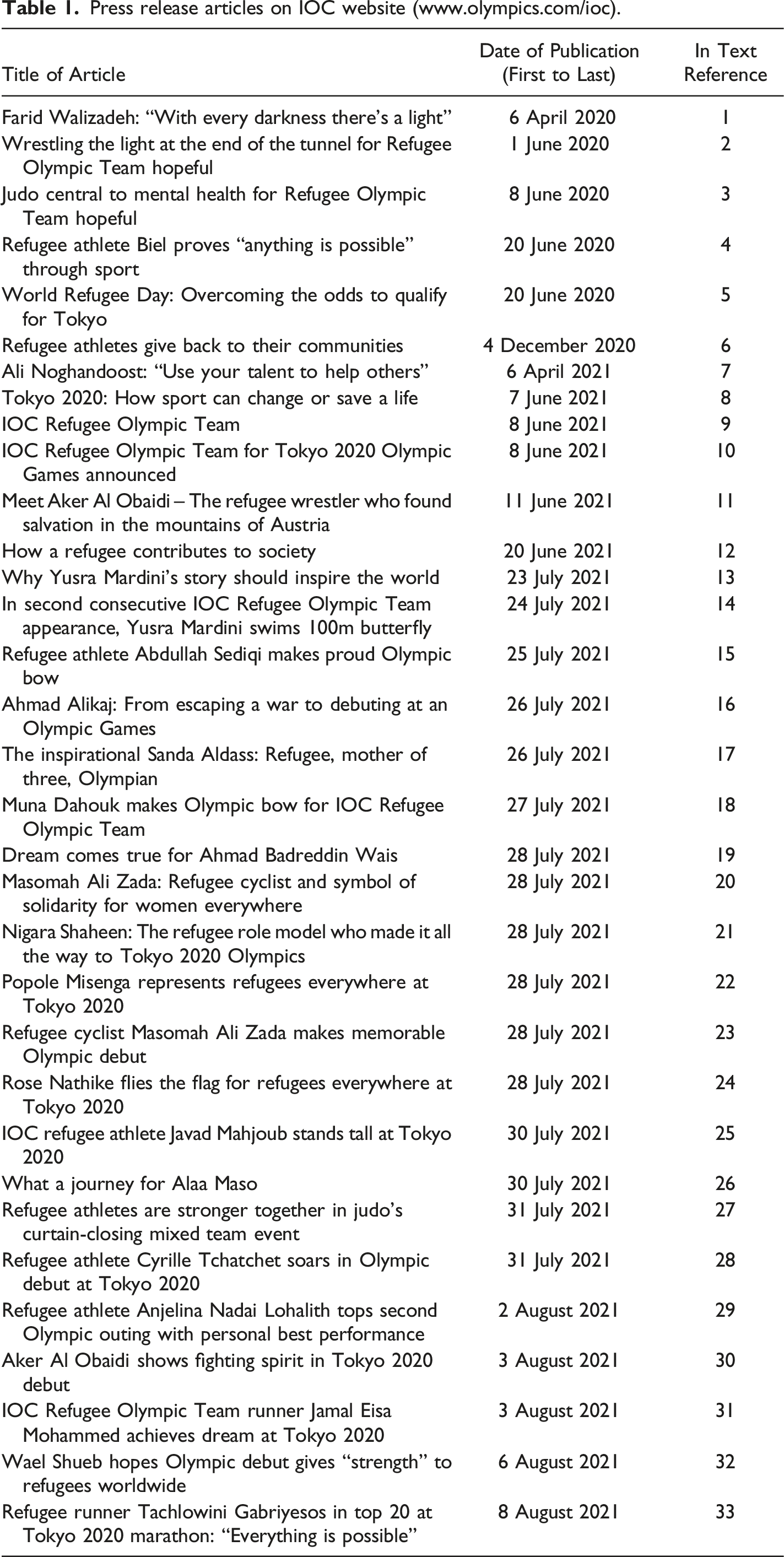
Critical discourse analysis was used to analyze and interpret this catalogue of press releases (Arribas-Ayllon & Walkerdine, 2017; Tannen et al., 2015). Primarily, this method is concerned with “the way social-power abuse and inequality are enacted, reproduced, legitimated, and resisted by text and talk in the social and political context” (Van Dijk, 2015, p. 466). From this perspective, the conformity to, and resistance against, mainstream discourses mirror ongoing processes of challenge and reproduction of cultural hegemony. Inspired by the analytic tradition of media discourse (Cotter, 2015), this article therefore addresses matters related to the catalogue beyond the word and sentence levels, and focuses on the underlying ideologies of the press releases.
Results
Four distinct themes emerged through our discourse analysis of the IOC press releases about the ROT around the 2020 Olympics. These are addressed in turn. Further, we also establish the overarching observation that the IOC appears to have moved, temporally and conceptually, beyond discursive recognition of the “refugee crisis”. While it may be politically expedient to leave the concept of the “refugee crisis” behind, the assertion that sport has helped refugees surmount the challenging conditions they face “on the move” and in their resettlement – let alone impact the lives of those thousands of people not themselves involved in sport (in any capacity) – does not align with the findings of current studies, which point towards continuing difficulties, exclusions and inequalities (e.g. De Martini Ugolotti and Caudwell, 2021; Thangaraj et al., 2018).
The Saving, Healing and Transformative Power of Western Sporting Capital and the Olympic Games
The ubiquitous yet steadfastly nebulous “power of sport” provides the essential backdrop to the IOC’s public communications. Counter to the evidently colossal inequalities in global sport, the Tokyo Games are depicted as creating a unified, communal “level playing field … proving that a lot of things are possible in sport” [27]. Participation in the Olympics is perceived to eliminate the social distance – across widely differing social, political and economic circumstances and histories – within the ROT team itself, but more importantly between the team and “regular” Olympic competitors. Thus, the ROT and its athletes are presented simultaneously as extraordinary and unexceptional; different and like “us”; worthy of their own distinct sporting pathways and narratives but also ready to be rescued, “normalized”, incorporated and ultimately controlled through the hegemonic codes and narratives of Western sport.
There is a further degree of complexity and nuance to what is enunciated here, which expands the conventional “power of sport” narrative. Aptitude in sport was, naturally, already exceptionally high for the majority of refugee athletes before their migration and selection for the ROT. Therefore, sport in/of the West cannot be attributed as playing the classic “saving” role, as might be professed for recreational participants who experience activities for the first time after migration. Yet it remains the case that competitive Western sporting structures and practices (epitomized by disciplines approved for inclusion in the Olympics) – which serve as a metaphor for progress and “civilization” in comparison to the “backward” organic physical cultures of the developing world – are presented as a catalyst for transformational capacity and competency. Participation in these endorsed pursuits in their origin countries provided the requisite skills and capital that could be later “exchanged” for successful integration and mobility in their places of settlement. Critically, while the athletes themselves are recognized as embodying the potential and reality of sport for salvation and change, the IOC presents itself as the main instigator and facilitator of this opportunity. In short, without the intervention of the Olympic Games and the IOC’s construction of a special team, the ROT athletes are rendered incapable of making the social transformations they have achieved in and through sport. The irony is that the majority of ROT athletes are denied perhaps the ultimate social transformation: to become citizens of their new homes and afforded the opportunity to represent them in sport.
The discourse of individual and social transformation is influential, and the establishment of the ROT is articulated by the IOC, specifically, to possess some form of therapeutic power. For instance, Iraqi wrestler Aker Al Obaida’s journey “will speak of a man who transformed himself from the pain of unimaginable odds for a place on one of the world’s greatest sporting stages” [30], with sport “his ticket to a new life” [11]; karate “helped Wael Shueb build a new life in Germany” after a boat journey from Syria [32]; “making Tokyo 2020 was a victory in itself” for judoka Muna Dahouk after fleeing Syria for the Netherlands [18]; judo “came to the rescue” for Sanda Aldass in facilitating her settlement and integration, following a similar journey to Dahouk [3]; for Syrian cyclist Ahmad Badreddin Wais, the Olympics “has shown that people can achieve their dreams no matter where they come from” [19]; and sport has helped taekwondoin Ali Noghandoost “rebuild his life, supporting him in learning new languages [and] building strong friendships in new cities” as he sought asylum in Croatia from Iran [7]. In the most egregious and speculative example, swimmer Yusra Mardini’s migratory trauma is even insinuated as underpinning her success in her resettlement sporting career: “having needing (sic) to swim to help the boat she was on from sinking when she left Syria, Mardini arrived in Germany and has trained there since” [14]. Put simply, for the IOC, sport “holds the power to change – or even save – a life, in more ways than you can imagine” [8].
Yet, of course, how exactly sport and the Olympic Games might facilitate healing, development and integration – in more ways, apparently, than we can imagine – is uncertain in the press releases. Instead, we are left with vague, utopian statements which function to elide and underplay the structural inequalities and challenges that these athletes (and the communities they are deemed to inspire and represent) face beyond their fleeting experiences on the international sporting stage. Moreover, the dominant belief in the healing and transformative power of sport both completely underplays the experiences the refugee athletes have gone through and overstates the impact that sport can have in overcoming them. It is almost as if the trauma of forced migration has evanesced as soon as sport rears it familiar, comforting and saving face. We are informed, plainly and unequivocally, that “sport serves as an escape and a constant where the hardships and trauma can be put to one side” [18]. Competing in the Tokyo Games was, then, for Syrian swimmer Alaa Maso “the end of an epic journey”, having fled Aleppo and travelled through a number of subsequent countries [26]; and, for judoka Javad Mahjoub, “an opportunity for a fresh start” [25]. Not only is the transformative sporting potential for this selective group of human beings – exceptional as a result of their athletic endeavors – underscored; but the assumption that their exploits will be transformative for others who are (sufficiently) like them is also evident (see theme on hope and inspiration below).
The ROT as Epitome of the Global North’s Inclusivity and Benevolence
This discursive theme positions ROT athletes as having wide-ranging and powerful social foundations and effects. It highlights the populations that claim to have played a part in their achievements and mobilities, and those that subsequently benefit from them. While acclaim for their achievements is attributed partially to the athletes themselves, credit is largely given to the wider inclusive and diverse (sporting) communities which have permitted and enabled them. For example, South Sudanese middle distance runner and UNHCR Goodwill Ambassador, Yiech Pur Biel, “reminds us that everyone can help refugees end up in a better place” [4]. Moreover, when the mental toughness and resilience to cope with pressures of competition is questioned, as with Cameroon-born weightlifter Cyrille Tchatchet, “the emotional support [from other lifters, teams and volunteers] kept the refugee athlete’s spirits high and his scores even higher” [28].
This process is mutually reinforcing. IOC President Thomas Bach claims that “refugee athletes are an enrichment for all of us in the entire Olympic community” (emphasis added) [10] and “watching them compete is a great moment for all of us” (emphasis added) [9]. Alongside the voyeurism of coloniality evidenced here, the use of “us” is telling. Intended to speak to the (putatively sizeable, representative and important) Olympic community as a whole, it performs in practice as a discursive enactment of differential power: “us” who (can) read IOC press releases; “us” who are different and detached from refugees, “us” who are privileged to observe human suffering from a distance rather than experience it personally. Specifically, “one of the most uplifting stories at Tokyo 2020 so far has been the participation of the IOC Refugee Athlete Team” [27]. With characteristic hyperbole, the second iteration of the ROT thus becomes a “defining moment – not just for the athletes in particular, but for the Olympic movement entirely” [5]. Ignoring, briefly, the disingenuous nature of this statement (within wider Olympic histories), its possibility and legibility are nonetheless important to recognize as an organization’s performative display of global (sporting) soft power.
Refugee athletes symbolically reward their host governments and publics for providing the bedrock for their selection for the ROT. Athletic successes allow receiving nations to congratulate themselves on their inclusive and tolerant values, validate their immigration policies and make their citizens them feel good about themselves (see Howe, 2011 on a similar narrative in relation to Paralympic athletes). The IOC gains credit and validation by association, through its claims of instigating these opportunities.
These exceptional refugees are contrasted positively with other “flawed” migrants who have chosen not, or been unable, to engage in a socially and economically valuable, and politically integrative, activity such as (Western) sport. Yet athletes’ perceived “value” is selective and contingent, and it can be reduced at a whim; a lack of success or the exhibition of traits that are deemed to be antithetical or oppositional to the white nation state mean that sporting citizenship can be, symbolically, withdrawn instantaneously (Burdsey, 2021). The “value” of refugees is, then, never absolute. Society demands constant and recurring demonstration and articulation of what these communities contribute – and this responsibility is usually placed on refugees themselves. The ascribed “mission” of Mardini, for instance, alongside exciting crowds, is then “to remind everyone of the value of refugees” [13]. Elite sporting activity transcends its intrinsic purpose to take on the integrative function of the neoliberal racial state as it ultimately becomes “another way in which refugees can contribute to greater society” [12].
Representation, Hope and Inspiration for Other Refugees
The ROT is portrayed and expected to represent all refugees globally, eliding the heterogeneity of inter alia identity, status, journey, mobility and outcome. These exceptional athletes are attributed responsibility to speak for the wider community, and the power to create and showcase possibilities to all its members. For instance, middle-distance runner, Rose Nathike Lokoyen, who was born in South Sudan but grew up in Kakuma refugee camp in northern Kenya, “flies the flag for refugees everywhere at Tokyo 2020” [24]; Afghan boxer Farid Walizadeh demonstrates how to “find hope when everything seems lost” [1]; Muna Dahouk “has represented the millions of refugees everywhere by showing how far dreams and dedication can take you” [18]; fellow Syrian judoka, Ahmad Alikaj’s “incredible journey to the Olympics is over in Tokyo 2020, but even just getting here has been a great victory for him and for refugee representation” [16]; and after losing the final of the mixed team judo event, the refugee athletes “had a moment of solidarity together, a circle of hope, a beacon of light for refugees all over the world who have the audacity to dream” [27]. This serves to publicize the athletes’ predicament and advocated mission to the public: to “generate further awareness to the plight of over 80 million displaced people worldwide” [29].
The IOC discourse of refugee representation is replete with essentialist features. Refugees are a highly heterogeneous population group and assuming that the story of refugee athletes might work as an inspiring symbol, or a “dream”, for all of them is misleading. Moreover, being a “refugee” is a legal status that should not be taken as a characteristic that defines and dictates who people with such a background are and what they do. Indeed, essentialist thinking lies at the core of many discriminatory and extremist ideologies which target these very communities. Nonetheless, there is a putative shared experience and solidarity, within the ROT and in the wider global refugee community: “As the refugee team lined up for the morning judo session there was a joy in being together with other people who shared a similar story to yours” [27]; “the symbolic importance of her appearance at an Olympic Games representing the millions of refugees all over the planet cannot be overstated” for Afghan judoka Nigara Shaheen [21]; and, for Afghan cyclist Masomah Ali Zada, taking to the road in Tokyo was “a symbol of hope and solidarity … [and a] call to women everywhere not to be afraid and to be what they want to be” [20]. For ROT Chef de Mission Tegla Chepkite Loroupe, “The athletes represent not only themselves, not only the IOC, but also all refugees in the world” [10].
However, the stated role of the ROT athletes is not just to represent and be visible; they have the capacity and responsibility of offering both hope and inspiration to refugees worldwide too, including those who have not yet experienced – or will never encounter – the “power of sport”. Hope is a frequently recurring concept in the rhetoric of the IOC. The ROT is “a symbol of hope” [9] and “send[s] a message of hope” [29] for all refugees in the world. In particular, Yusra Mardini “was a symbol of hope for millions at the Olympic Games Rio 2016 when she was part of the first Refugee Olympic Team” [6]. This discourse has supercilious elements of the afore mentioned savior position, since it assumes that non-athletes in difficult and/or traumatic life scenarios will gain courage and faith from the ROT – with whom they are likely to have very little in common, beyond their legal status and social marginalization. Indeed, by being afforded the possibility to move to a place and positionality of hope, they are ipso facto before that placed in one of hopelessness before Global North (sporting and Olympic) structures come to the rescue.
Connected to their ascribed role of bringing hope, the ROT athletes are likewise seen to offer inspiration – a source and means for others to follow and be like them and, of course, to change their lives from other (assumed pejorative) practices. The ROT’s aim, we are told, is to “inspire people from all walks of life with the strength of their spirit” [10]. Sport provided Ali Noghandoost “a space for him to draw on his experience to help and inspire vulnerable young children facing a situation similar to his own” [7]; Syrian wrestler Amir Al-Awad was “inspired by the chance to show his fellow refugees that anything is possible” [2]; Eritrean-born long distance runner Tachlowini Gabriyesos “proved that he can keep pace with the best in the world, representing and inspiring the millions of displaced people across the world” [33]; Sanda Aldass reaching the Games “is an inspiration for millions of others to follow their [dreams] too” [17]; Ahmad Badreddin Wais “was first out of the blocks at the Fuji International Speedway [track], inspiring millions with his achievement” [19]; Sudanese middle-distance runner Jamal Abdelmaji Eisa Mohammed’s “goal on the athletics track was to inspire millions of displaced people around the world, and he has achieved exactly that” [31]; and, originating from DR Congo, judoka Popole Misenga’s “mere presence at Tokyo 2020 tells a story of inspiration, survival and of hope” [22]. The assumption that athletes would inspire and affect the wider population is a common theme in the selective heroification of migrant and/or minority ethnic athletes, who are assumed to possess a “lift as you climb” aptitude. However, it actually ends up celebrating a few exceptional individuals while demonizing and marginalizing others who are unable to follow, or are restricted from tracing, a similar path (Burdsey, 2016).
This framing also arguably overstates – and initiates a gendered, ageist and ableist model of – the extent to which sporting participation is prioritized and valued by the millions of “everyday” refugees far removed from Olympic and elite sporting worlds. Moreover, returning again to comparisons with dominant discourses about Paralympic athletes, the representation of ROT members similarly demonstrates evidence of what has been labelled ‘inspiration porn’. Writing about disability, Grue (2016, p. 839) defines this as:
“(a) an image of a person with visible signs of impairment who is (b) performing a physical activity, preferably displaying signs of physical prowess, and is (c) accompanied by a caption that directs the viewer to be inspired by the image in question.”
In the present context, we might replace the first criterion with a description of a person having undergone significant migratory trauma. In both contexts, the purpose of the representation is ultimately for the gratification of those outside the communities in focus.
The Neoliberal Journey: The Value of the Responsible and Hardworking Refugee Athlete
The neoliberal (and racialised) discourse of hard work proclaims that anything is possible with the necessary perseverance, personal responsibility and resilience. ROT athletes are therefore positioned as exceptional individuals who, by espousing these desired values and placing minimal burden on the racial state, have not only been successful in sport but have also demonstrated themselves to be “model migrants”. This, in turn, reflects poorly on the other refugees (the numerical majority) who are ipso facto seen to not work as hard and consequently represent a drain on society.
ROT athletes are described by the IOC as having made it “to the pinnacle of sport against all odds” [27]. The flipside to this is that those individuals who are unwilling or unable to attain this status are dismissed as inferior, inadequate and less valuable. This reflects the long-standing, broader notion of sport as a meritocracy – specifically the misguided idea that hard work, resilience and sheer “bloody-mindedness” will result in success. The plight of Afghan taekwondoin Abdullah Sediqi is a matter of “escape and survival, resilience and refusing to give up” [15]; Tachlowini Gabriyesos’s “unstoppably positive attitude takes him through the hardest of times, always looking forward, always dreaming big” [22]; Yusra Mardini has “tremendous courage and tenacity for life” [13]; “given the hardships and trauma Masomah [Ali Zada] has lived through, the fact that she is competing at the Olympic Games is a triumph against significant odds” [23]; and Jamal Eisa Mohammed shows “that the most important thing for [refugees] to remember is to ‘Not give up and everything will be possible’” [31].
Discussion
In the context of the themes discussed in this article, the IOC regards its establishment of the ROT as a successful, relevant and timely response to the prevailing situation; and an intervention that has important social consequences. Our critical analysis of the IOC’s press releases identified four discourse themes: Western sport and the Olympic Games as possessing transformative power; the ROT as epitome of the Global North’s inclusivity and benevolence; refugee athletes as people that inspire other refugees; and the neoliberal ideology that hard work pays off and can overcome refugees’ wider plights. In all these strands, the IOC reinforces and legitimizes its dominant position through operating in ways that are presented as being ethically irreprehensible. Thereby, the structural conditions of the refugee population and their wider social marginalization are underplayed, ignored or elided. Considering the radical asymmetry of power between the IOC and the ROT’s athletes, it is not surprising that the team’s members and staff wholeheartedly reinforce this rhetoric in these articles (Michelini, 2021).
Previous studies have pointed to the ways in which individual refugee athletes (or those believed to be part of this category) are portrayed in the media and the shifting socio-political attitudes towards them (Agergaard, 2019; Black, 2016; Burdsey, 2016; Michelini, 2021; Winter, 2013). This article furthers this analysis through its focus on institutionalized portrayals and rhetorics of refugee athletes. Focusing on the IOC, this article has addressed and critiqued an institution that holds the power to regulate the world’s biggest sport event to an extent that the ROT is included as a team in the Olympics without national affiliation; something that is a remarkable move considering de Coubertin’s original ideas (Weiler, 2004). Consequently, such power enables the IOC to create and publicize a particular, influential discourse around refugee athletes and the ROT – one that currently appears to assume that the “refugee crisis” has disappeared, with sport and the Olympic Games playing a fundamental role in this process. Furthermore, acknowledging what is not displayed in the IOC’s communication about the ROT, this article points to the lack of concern and understanding about continuing conditions experienced by refugee athletes and the larger group of refugees from which they are drawn.
Our analysis points to international sports organizations’ capacity to adapt to changes in media logic to improve the prospects for their aims, independently of their sportive, humanitarian or economic nature (Birkner & Noelleke, 2016). As other corporations do, the IOC seems eager to create a spotlight on their “socially responsible” operations, which might distract the attention from otherwise problematic practices and decisions of the organization, like delivering the Games in Japan in the middle of a pandemic. With regard to that Olympic Games, their existence without spectators, dangers for the local population, tough restrictions for the athletes and monumental financial costs for the host country can be seen as a merciless “show must go on” policy.
Concluding Remarks
This article has assessed the IOC’s portrayal of the ROT around the 2020 Olympics. Adopting a critical discourse analysis approach, the focus has been on critiquing the institutionalized communication about the ROT by the organization in control of the Olympics. According to the IOC’s communication, underpinned by the contribution of its own intervention, the challenges of refugees who arrived in Europe in 2015 appear to have been overcome.
Focusing on the IOC’s media portrayal of the ROT, we have outlined some initial insight into an institutionalized and instrumental depiction of refugee athletes, and the larger group of refugees that they are claimed to represent and inspire. Utilizing press releases, which are comparable neither to “classic” press reporting nor to modern social media activity, we avoid speculations on their impact. Rather we consider them as critical and informative materials to analyze the self-representation of the IOC and its strategic adaptation to a specific social context. To further and complement this line of investigation, more participatory methods are needed, along with studies that investigate the conditions of refugees in specific countries and localities. Nevertheless, we already know from other studies the challenges for refugees living within asylum systems (De Martini Ugolotti and Caudwell, 2021), including: insecurity and anxiety about events in their home countries, discrimination, temporary – and precarious – residence permits, and requirements to become self-supporting and not a burden on the state (Agergaard et al., 2022).
After considering a very specific facet of media communication, we close this article with a wider consideration of the implications of this research. If mass (forced) migration is a quickly recurring phenomenon, and is always perceived as a “new” crisis, its management will be always perceived as an emergency. Until a systemic solution to the profound contradictions and injustice of our political system (Agamben, 1998) are found, “good” journalism, social activism, civic education and critical sociological research are necessary to highlight the situation of refugees around the world. While the world sport system reacted energetically to the “refugee crisis”, part of this response was simplistic, superficial and strategic; and also selective – and, undeniably, racialised – in the manner in which some global conflicts received greater (sporting) media attention than others, and some refugee populations were regarded as more valuable and worthy of “saving” than others by the Global North. For these reasons, and with the hope that scholarly work may resonate on policy-making and opinion-formation processes, we encourage the sociological community to carry on work on forced migration and sport across diverse settings and contexts.
Footnotes
Declaration of Conflicting Interests
The author(s) declared no potential conflicts of interest with respect to the research, authorship, and/or publication of this article.
Funding
The author(s) received no financial support for the research, authorship, and/or publication of this article.
