




Abstract
The extractives industry (mining, quarrying, oil, and gas) engages in corporate social responsibility (CSR) activities to reinforce its organizational legitimacy and enhance its public image. One such approach to CSR that is popular in the industry is through funding sport initiatives aimed at improving the lives of Indigenous peoples, known as sport for development (SFD). Through the adoption of a settler colonial studies lens, and using netnographic methods and discourse analysis, we examined how three extractives companies portray their funding of SFD in Indigenous communities in Canada and Australia on social media, and the ways in which it contributes to settler colonialism. We determined that there are two main discourses that extractive companies use: i) Extractives companies “help” and “partner” with Indigenous communities to enable Indigenous youth’s access to the transformative power of sport; ii) longevity is strategically associated with such “help” and “partnership.” The production of these discourses enables extractives companies to downplay their contributions to settler colonialism through land denigration and colonial authority.
The extractives industry (mining, quarrying, oil, and gas) engages in corporate social responsibility (CSR) activities to reinforce its organizational legitimacy and enhance its public image (Du et al., 2011). One of the ways it has done and continues to do this is through funding sport for development (SFD) initiatives that focus on Indigenous peoples in Canada and Australia (Millington et al., 2019). SFD programs use sport, recreation, and play to contribute to the achievement of community and international development objectives (Kidd, 2008). Though support for such initiatives may appear to be innocuous, we contend that it is paramount to better understand how SFD funding from extractives companies and the ways in which these companies publicize it on social media may obfuscate the harmful impacts the extractives industry has on Indigenous peoples and their traditional territories. To address these concerns, we used a settler colonial studies lens, netnographic methods, and discourse analysis to answer two questions: How do extractives companies portray their funding of SFD in Indigenous communities in Canada and Australia on social media; and how does it contribute to settler colonialism?
Literature Review
In the sections below, we provide a brief review of literature on three foundational aspects of our research: Indigenous communities, the extractives industry, and sport.
Indigenous Peoples in Canada
In Canada, Indigenous peoples are constitutionally defined as First Nations, Métis, and Inuit; they have inhabited what is now called Canada since time immemorial. Despite Indigenous peoples’ tremendous resistance and resilience, relations between Indigenous peoples and colonial and imperialist expansion activities from settlers have led to the displacement of Indigenous peoples from their ancestral lands, erosion of their languages, and weakening of their social structures (First Peoples’ Heritage Language and Culture Council, 2010). Indeed, the historical trauma experienced by many Indigenous peoples is deeply rooted in land dispossession (Waldram et al., 2006).
In the contemporary context, Indigenous peoples comprise 4.9% of the total population of Canada, numbering more than 1.6 million as of 2016 (Statistics Canada, 2019). An effect of colonialism, Greenwood and de Leeuw (2012) asserted that Indigenous children, youth, their families, and their communities are afflicted by unacceptably disproportionate burdens of illness, including higher rates of infant mortality, child and youth injuries and death, obesity, youth suicide, and exposure to environmental contaminants.
Though sport is often seen as a health-improving intervention, throughout the history of Canada, sport has been inextricably tied to colonialism (Kidd, 2008). A salient example of sport as form of colonialism in Canada can be seen in Indian Residential Schools, which operated from 1876 to 1996 (Miller, 1997). The residential school system used sport as a disciplinary tool to facilitate Indigenous youth’s assimilation into mainstream society while attempting to strip them of their customs and physical cultural practices, which were deemed uncivilized by the state (Forsyth, 2013).
In light of the cultural genocide and atrocities suffered by Indigenous peoples in Canada at residential schools, the Truth and Reconciliation Commission (TRC) was formed to promote reconciliation between settlers and Indigenous peoples. The TRC was established in 2008 with the purpose of documenting the history and lasting impacts of the residential school system while providing those directly or indirectly affected by the legacy of the system with an opportunity to share their experiences. The TRC’s work concluded in 2015 with the formation of its multi-volume final report, which included 94 “Calls to Action” (Truth and Reconciliation Commission of Canada (TRC), 2015). Notably, two of the TRC’s Calls to Action were strongly related to SFD: The 89th Call to Action was aimed at supporting reconciliation through the enactment of policies to promote participation in sport and physical activity, and the 90th Call to Action called for stable funding for community sports programs that reflect traditional Indigenous sporting activities (Giles et al., 2019; Truth and Reconciliation Commission of Canada (TRC), 2015).
Aboriginal and Torres Strait Islanders in Australia
Aboriginal and Torres Strait Islander peoples, the original inhabitants of what is now called Australia, currently comprise 3.3% of the total Australian population (Australian Bureau of Statistics, 2018). Prior to the arrival of colonizers in 1788, Aboriginal and Torres Strait Islander peoples engaged freely in their traditional practices and beliefs, which included holding deep spiritual connections to the land and water (Dudgeon et al., 2014).
The introduction of foreign diseases by colonizers, the settlement and exploitation of Indigenous land, the forcible removal of Indigenous peoples from their ancestral lands onto settlements, and the destruction of their traditional ways of life and resources led to significant and ongoing emotional and intergenerational trauma (Das et al., 2018). Indeed, when compared to non-Indigenous Australians at the population level, Aboriginal and Torres Strait Islander peoples have poorer life expectancy and health-related outcomes (Australian Institute of Health and Welfare, 2011), while also having higher rates of mental illness (Steering Committee for the Review of Government Service Provision, 2014), suicide (Pink & Allbon, 2008), alcohol and substance abuse (Trewin & Madden, 2005), and incarceration (Das et al., 2018).
As with Canada, historically, sport in Australia has been integrated into strategies that target the health and well-being of Indigenous populations (Rossi & Rynne, 2014). A notable example highlighted by Rossi and Rynne (2014) is that of the Royal Commission into Aboriginal Deaths in Custody (1987–1991), which emphasized access to sport and recreation as a tool to discourage Indigenous peoples’ apparent criminal and anti-social behaviors, as well as to foster community cohesion. In response to the Royal Commission, the Australian Government supported the establishment of the Indigenous Sport Program through the Australian Sports Commission in 1993. Its primary aim was to encourage Indigenous peoples in Australia to be more physically active and to participate in sports at all levels (Rossi & Rynne, 2014).
Extractives-Funded SFD
In addition to the ongoing impacts of colonial legacies in Canada and Australia, Indigenous peoples’ connections to land continue to be troubled by the activities of extractives industries in both countries (Frynas, 2005). Of particular note is the fact that resource extraction occurs on Indigenous peoples’ traditional territories—land that has been the context for familial histories, sustenance, and cultural practices since time immemorial (Baker & Westman, 2018). Moreover, the processes of negotiation between extractives companies and Indigenous peoples have historically relied on the exploitation of Indigenous peoples, while seldom including them in decision-making processes. While Indigenous peoples’ participation in decision-making processes in resource extraction has increased across both countries in recent years, power imbalances between multi-billion-dollar corporations and Indigenous communities remain (Baker & Westman, 2018). Irrespective of these shifts and imbalances, one area that is often supported by such arrangements is sport.
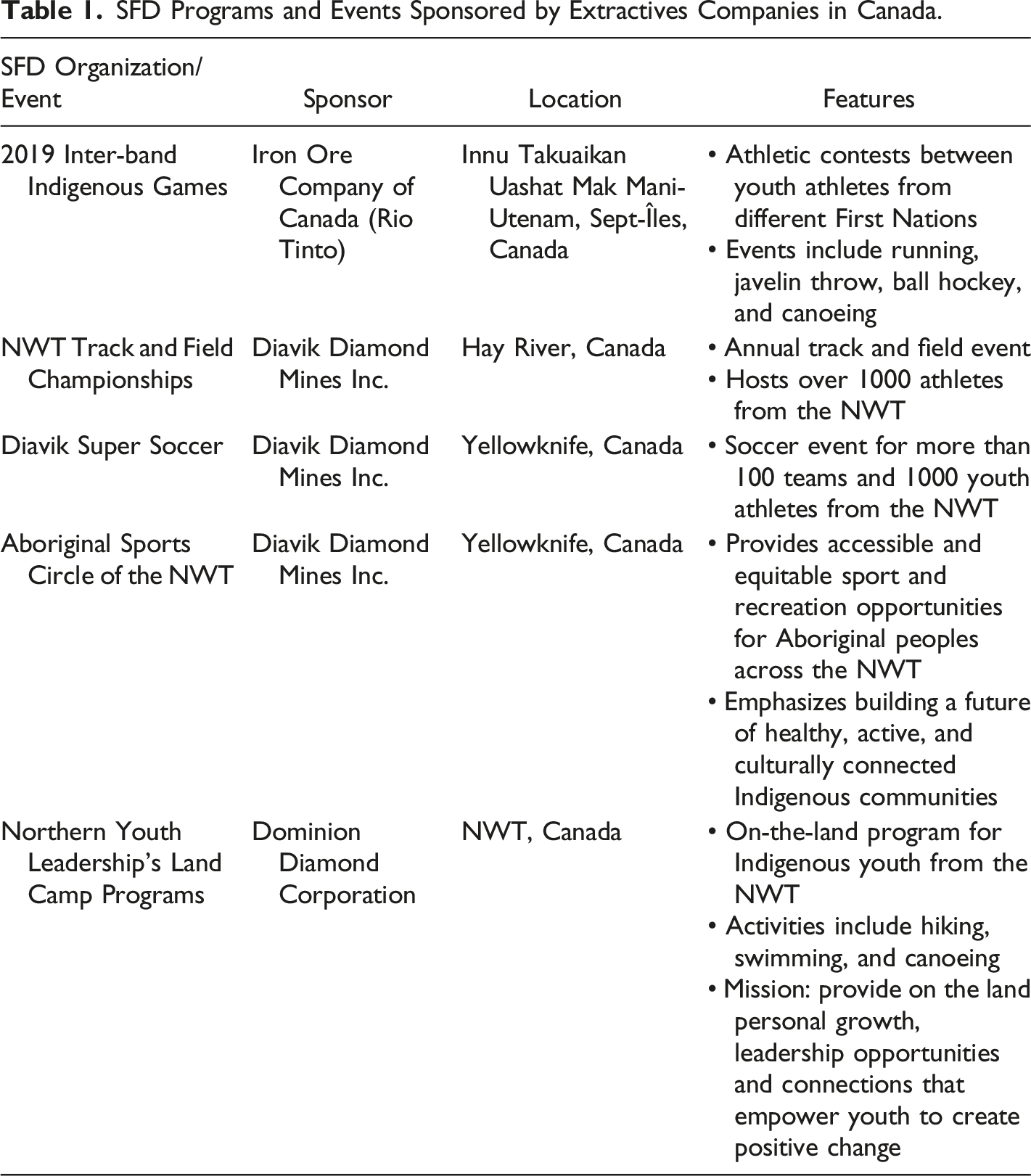
Traditionally, the majority of SFD initiatives have been based in the Global South; however, in recent years, SFD interventions and programs have been increasingly implemented with Indigenous peoples in Canada (Millington et al., 2019) and Australia (Rossi & Rynne, 2014) and funded by the extractives industry. Notable examples of SFD programs in Indigenous communities in Canada that are funded by the extractives industry include Diavik Mine’s (Rio Tinto) sponsorship of the Northwest Territories’ (NWT) Super Soccer program and the NWT Track and Field Championships (NWT School Athletic Federation, n.d.; Rio Tinto, 2014). Examples of the extractives industry’s funding of SFD programs and initiatives in Australia include Rio Tinto’s and BHP’s funding of the Wirrpanda Foundation as well as Rio Tinto’s funding of the Clontarf Foundation (Rio Tinto, 2017; Wirrpanda Foundation, n.d.).
Millington et al. (2019) noted that there is a significant need for critical attention to be paid to the increasing incidence of extractives-funded CSR programming in Indigenous communities in Canada. While the particular gaps they identified pertain to the Canadian context, they can also be extended to the Australian context (Thomson et al., 2010). As Millington et al. (2019) asserted, academic attention to better understand how extractives companies frame themselves as being responsible corporate citizens through funding SFD in Indigenous communities. To this assertion we add that this critical attention must also be extended to the ways in which the funding of these programs further entrenches settler colonialism in both countries. These are the issues we addressed in this research through an examination of three extractives companies’ social media use.
Theoretical Framework
It is important to point out that the authors of this manuscript are non-Indigenous researchers. We do not purport to speak on behalf of Indigenous peoples. We do, however, argue that our scrutinization of the prominent role that the extractives industry has had and continues to have in maintaining dominant power relations in both Canada and Australia can play a role in supporting Indigenous peoples’ decision making in how—or, even if they desire—to decolonize SFD in Indigenous communities in Canada and Australia. It must be noted that while non-Indigenous peoples can act as partners in decolonization efforts, Indigenous peoples are the only ones who can lead decolonizing initiatives, as decolonization must be centered on Indigenous peoples’ perspectives and worldviews (Corntassel, 2012). As a result, we engaged with a settler colonial studies lens rather than a decolonization lens for this research.
Settler colonialism is defined as “a persistent social and political formation in which newcomers/colonizers/settlers come to a place, claim it as their own, and do whatever it takes to disappear the Indigenous peoples that are there” (Arvin et al., 2013, p. 12). A settler colonial-driven approach to SFD tends to reinforce “colonial authority” and western/Eurocentric physical activity, sport, and recreation over—for example, more land-based, Indigenous values and traditional ways centering on all aspects of health—physical, emotional, mental, and spiritual (Bruner et al., 2016). As previous scholarship has demonstrated, settler-driven SFD curriculum that is administered by, for example, Western/global North-based international NGOs such as Right To Play may (re)produce uneven power relations between Indigenous Knowledge and Western knowledge within the context of sport, physical activity, and play (Arellano & Downey, 2019). In a similar vein to the education sector, Indigenous peoples are often used to legitimize settler colonial authority within SFD instead of “valuing and recognizing [Indigenous] individual and collective intelligence on its own merits and on [Indigenous] terms” (Simpson, 2014, p. 22).
What is important to highlight here is that in relation to land and settler colonialism, the structural inequalities and issues facing many Indigenous peoples participating in extractives-focused SFD programming may be further exacerbated by such initiatives—because “within settler colonialism, it is the exploitation of the land that yields supreme value” (Arvin et al., 2013, p. 12). Given the complex ways in which SFD in Indigenous communities in Canada and Australia is often tied to extractives industries’ operations on Indigenous land, we were interested in understanding the ways in which extractives companies represent the SFD activities they fund on two social media platforms: Facebook and Twitter.
Social media as a platform for communications has not just become a fixture of everyday life for billions of people worldwide, but it has also become widely adopted by corporations as a way to disseminate communications (particularly those related to CSR) to their stakeholders and followers (Dwivedi et al., 2021; Kaplan & Haenlein, 2010). Cho et al. (2017) asserted that the use of social media can be beneficial to corporations as it enables them “to set and present a CSR agenda without being modified by traditional media or gatekeepers” (p. 55). Moreover, social media has become an indispensable component of most corporations’ communications strategies as it provides myriad opportunities for corporations to interact with the public and vice-versa. In turn, strategies adopting these two-way communications and interactions allow corporations to reflect public feedback in creating and executing CSR initiatives with the ultimate aim of enhancing organizational legitimacy and public image (Cho et al., 2017).
Methodology
Netnography provides a means for understanding the marketplace of digital consumption and social media through a combination of the participant-observational stance of traditional anthropological ethnography with specially designed procedures suited to the unique contingencies of computer-mediated communications (Kozinets, 2010). With its free, widespread, and significant usage amongst not just individuals but also organizations and corporations alike, social media enable researchers to attain access to substantial and diverse ranges of data that have been disseminated through myriad platforms (e.g., Facebook, Twitter, and Instagram) (Andreotta et al., 2019). Notably, Morais et al. (2020) contended that netnography is necessary in this day and age as many social, political, and commercial relations and discourses are present in the online world, and netnography enables researchers to better understand these online communications and interactions. Given the emergence of social media and the availability of large digital data sets, as well as the ubiquity of internet-connected mobile devices, netnography is relevant and applicable for use as a methodology in this particular research context (Kozinets, 2018).
Common approaches to netnography involve planning, entrée, data collection, data analysis, presentation, and adherence to ethical standards (Kozinets, 2015). This study required immersion in the digital world to make use of the computer-mediated communications of extractives companies as data. In response to the ethical critiques of netnography, particularly related to privacy (Grbich, 2013), data accessed in this study were from Facebook and Twitter pages that were publicly accessible through popular search engines (e.g., Google). Moreover, we omitted discussion comments (i.e., the comments that appear in a thread under each Facebook post and Twitter tweet) from data collection.
Methods
We selected Facebook and Twitter as the sites of analysis due to their widespread use and prominence. As of October 2019, Facebook had almost 2.41 billion monthly active users, while Twitter had approximately 330 million monthly active users (Clement, 2019). For our research, we had three inclusion criteria for extractives companies: i) the company must have had operations in Canada and Australia, ii) the company must have engaged in acts of CSR that included the funding of SFD initiatives with Indigenous communities in both countries, and iii) the company must have had active accounts on Facebook and Twitter. Based on the inclusion criteria, three companies were selected for this study: BHP, Newmont Corporation, 1 and Rio Tinto. BHP, which is headquartered in Australia, is a mining company that specializes in metals and petroleum with operations in countries such as Australia, Canada, and the United States. BHP’s social media presence included Facebook (BHP) and Twitter (@bhp). Newmont Corporation is a prominent gold mining company headquartered in Colorado, with operations in Canada, Australia, and the United States—among other countries (Newmont Goldcorp, 2019). Newmont Corporation is active on Facebook (NewmontGoldcorp) and Twitter (@NewmontGoldcorp). Rio Tinto is a mining corporation headquartered in England and Australia with operations on six continents, but with a notable and concentrated presence in Australia and Canada (Rio Tinto, 2018). Rio Tinto is active on Facebook (Rio Tinto Group) and Twitter (@RioTinto).
We also included subsidiaries of Rio Tinto and Newmont Goldcorp in this study as a means of ensuring that we had ample and variable data. Subsidiaries of Rio Tinto included the following companies: Rio Tinto Canada (@RioTintoCanada on Twitter), Rio Tinto BC Works (RioTintoBCWorks on Facebook), Dominion Diamond Mines (DominionDiamondMines on Facebook), Diavik Diamond Mine (@Diavik_NT on Twitter; Diavik.ca on Facebook), and Rio Tinto Western Australia (RioTintoWA on Facebook). Newmont Goldcorp’s sole subsidiary included in this study was Newmont Goldcorp Australia (@NewmontAu on Twitter), as it was the company’s only subsidiary that met the inclusion criteria.
Using Kozinets’ (2010) procedures for netnographic data collection, entrée was achieved by assuming the role of an internet “lurker” (Williams et al., 2012) on each social media site. In keeping with the “lurker” role of visiting but not contributing to online communities (Harridge-March & Quinton, 2009), we created pseudonym lurker accounts on Facebook and Twitter to enter, observe, and gather data from these sites, and were immersed in this role over a 4-month period (April 1, 2019–August 1, 2019). The posts and tweets that we included in this study had to be pertinent to the research question. As such, we searched for key terms and hashtags including mining, Indigenous peoples, Indigenous relations, Aboriginal Torres Strait Islanders, reconciliation, corporate social responsibility, and sport for development. We also created post notifications for each extractives company’s social media accounts to facilitate data generation. We completed these actions for posts that had been disseminated within a 10-year period (August 1, 2009 –August 1, 2019) to ensure that there were sufficient data to collect and analyze.
Ultimately, we collected 191 posts and tweets, with 88 and 103 of them sourced from Canadian and Australian extractives companies, respectively. Of those 88 collected from Canadian extractives companies 26 were from Twitter and 62 were from Facebook. Of the 103 posts and tweets collected from Australian extractives companies’ social media accounts, 70 were from Twitter and 33 were from Facebook.
Plain tweet text, though concise with a maximum of 280 characters, can provide researchers with rich information such as the distribution of topics and sentiments (Cody et al., 2015) and information-sharing behaviors (Singh et al., 2020). Moreover, URLs (uniform resource locators) and retweets/mentions embedded in tweets can also inform researchers on users’ sharing habits and preferences and on how users connect with others virtually (Ke et al., 2017). In contrast, Facebook posts are user-generated textual data that appear on another Facebook user’s timeline, are not restricted to a set number of characters, and may also be accompanied by a series of images and/or videos (Franz et al., 2019). Notably, Franz et al. (2019) asserted that data obtained from Facebook can afford substantial opportunities for researchers, with user-generated textual data in particular being a rich source of qualitative data.
Analysis
We filed and labeled content of all relevant posts and tweets with the source, date, and URL link, then uploaded them into NVivo 11 to support the analysis process. We then employed critical discourse analysis (CDA) to explore how extractives companies portray their funding of SFD in Indigenous communities in Canada and Australia on social media. Given its emphasis on criticality and elucidating power asymmetries, we felt CDA was particularly suitable in this study adopting a settler colonial perspective. Following (Phillips & Hardy, 2002) approach to CDA, we read and re-read the data to identify overall patterns which were subsequently coded. We then used the generated codes to identify the broader discourses in each national context. The broader discourses then formed the basis for comparison between the Canadian and Australian contexts. Importantly, through a settler colonial studies lens, we were sensitized to not only the principal aspects of the data that we compiled, but also to certain concepts such as relations of power, land dispossession, and Indigenous erasure.
Results
The analysis of posts and tweets from the Canadian and Australian extractives companies resulted in the production of two main, interrelated discourses: i) Extractives companies “help” and “partner” with Indigenous communities to enable Indigenous youth’s access to the transformative power of sport; ii) longevity is strategically associated with such “help” and “partnership.” The production of these discourses enables extractives companies to downplay their contributions to settler colonialism through land denigration and colonial authority.
Extractives Companies “Help” and “Partner” with Indigenous Communities
In both the Canadian and Australian contexts, posts and tweets from extractives companies alluded to the idea that extractives companies help Indigenous communities and peoples in Canada and Australia in ways that change their communities for the better. Examples of help often related to financial contributions. For example, in the Canadian context, Dominion Diamond’s (2019, May 3) post stated that: “Modern diamond mining creates billions in positive socioeconomic and environmental benefits in countries and communities where we operate!” Benefits related to offering sport opportunities featured prominently. For example, Dominion Diamond (2016, November 23) posted the following on its Facebook page: Dominion Diamond would like to congratulate the Tłı̨chǫ̀ Government and the Community Government of Behchokǫ̀ on the grand opening of the recreation complex in Behchokǫ̀ this Saturday. Along with other partners, Dominion was pleased to provide funding for the building, which will have a positive impact on the community. Recreational facilities provide opportunities for children, youth and other community members to stay active and interact with one another.
Diavik Diamond Mines (2017, February 20) expressed its support for the Aboriginal Sport Circle NWT on its Facebook page: “The 2017 Traditional Games Championship is being held this weekend in Yellowknife. We’re proud to support the Aboriginal Sport Circle of the NWT, so they can host important events like this!” Dominion Diamond’s Twitter account also retweeted a tweet from Northern Youth Leadership (Northern Youth 2018, December 11), which stated that: #NYL12DaysOfGratitude wants to send a huge thanks to one of our longest supporters! Dominion Diamond has supported our programming since the beginning and without them it would be much harder for us to run transformational programming for youth from across the NWT!
In these posts and tweets, it is made clear that the extractives company’s financial help is a key factor in Indigenous communities’ and organizations’ ability to offer sport opportunities.
In the Australian context, extractives companies produced this same discourse, though their emphasis on sport’s transformative power was even stronger than the Canadian companies’. Examples of the extractives industry’s general help to Indigenous communities included Rio Tinto’s (2019, April 29) expression of its “commitment to making a positive contribution to the communities where we have a presence.” Many tweets related to the Clontarf Foundation—a Rio Tinto-supported organization that aims to improve the education, discipline, life skills, and employment prospects of Aboriginal and Torres Strait Islander youth, in turn equipping them to seemingly participate more meaningfully in society. Importantly, the Clontarf Foundation uses sport, and particularly Australian rules (“Aussie rules”) football, as a key part of its efforts to help Indigenous communities: One notable retweet of a Rio Tinto tweet came from the South Australian Premier @marshall_steven (2019, July 2): Footy inspires. Footy motivates. The Clontarf Foundation utilises the passion of footy to improve everything from education to life skills in Aboriginal students. Four Clontarf Foundation football academies are now being piloted within six SA schools. We couldn’t be prouder!
Using similar language, RioTintoGroup (2018, June 1) posted the following on its Facebook page: The Clontarf Foundation are making a real impact on young Indigenous boys' lives by getting them back to school and focused on their studies. You can see the difference the foundation is making which is why we’ll proudly continue to support them. It also doesn’t hurt that they let us come around to kick the footy from time to time.
SFD Programs and Events Sponsored by Extractives Companies in Canada.
SFD Programs and Events Sponsored by Extractives Companies in Australia.
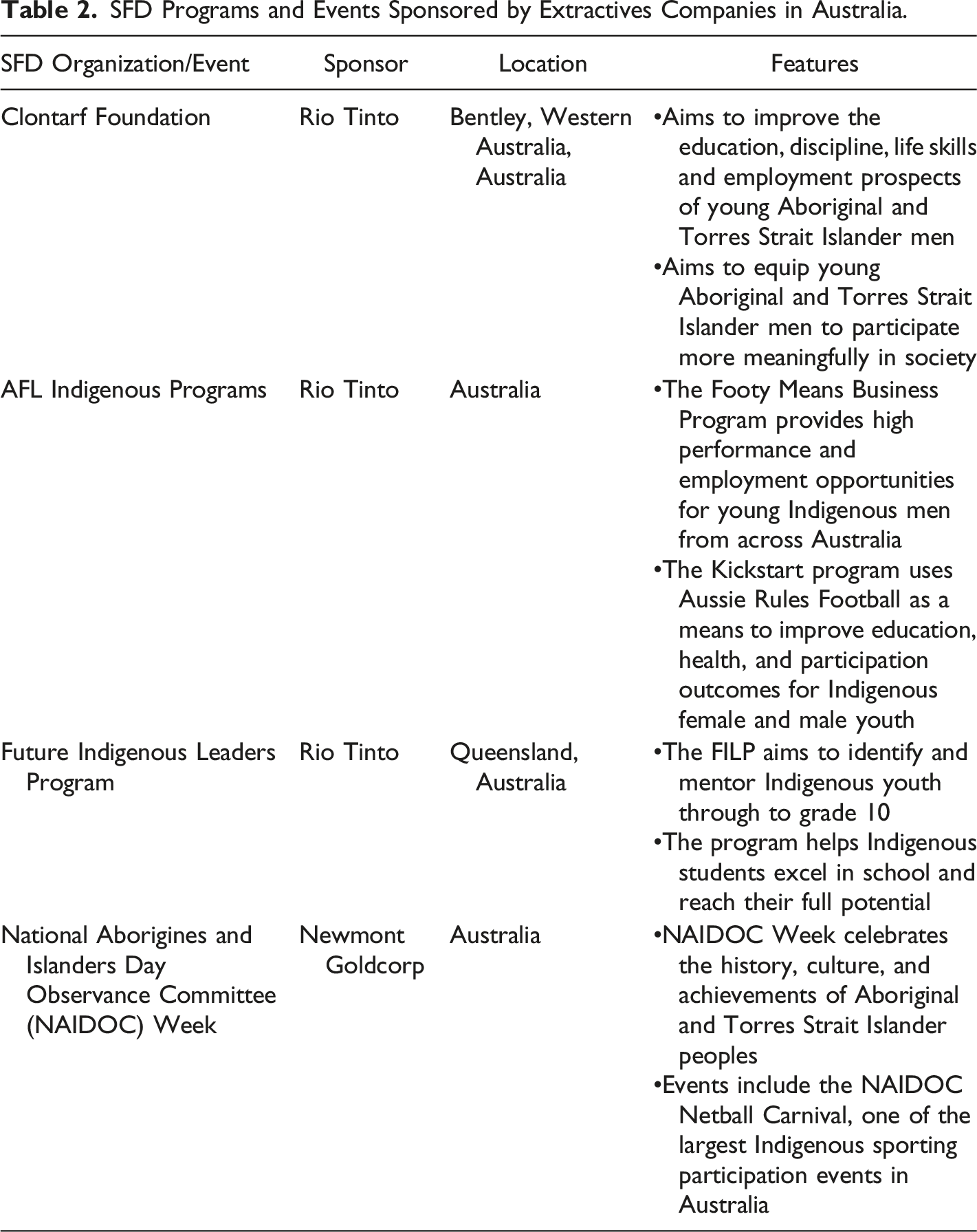
While language around “helping” Indigenous peoples suggests a uni-directional arrangement, the extractives industry funders also used discourses of “partnership” in describing their funding of SFD initiatives in Canada and Australia. For example, Diavik_NT (2016, May 25) tweeted, “Proud to support NWT Track & Field Championships w/3-yr funding partnership!” Within the Australian context, on its Twitter account, RioTintoWA (2018, July 20) tweeted the following about the Clontarf Foundation: Rio Tinto is proud to be the largest corporate partner of the Clontarf Foundation and one of the leading employers of graduates from the Foundation. We’ve contributed over $8 million in funding since 2012 to help the Foundation expand across Australia.
Importantly, on BHP’s Facebook page, partnerships were often tied to discourses of reconciliation—which we discuss below, through, for example, the hashtag “#Indigenous peoples” and an attached link to the company’s Reconciliation Action Plan and Indigenous Peoples Strategy being used in Facebook posts.
Longevity of “Help” and “Partnership”
In the Canadian context, extractives companies’ social media accounts emphasized the importance of future development through their ongoing actions. Fifteen posts and tweets made by Canadian extractives companies stressed the importance of their continued development or of their continued sponsorship of an event or community. An example can be seen in a tweet from Rio Tinto Canada (2017, August 15), which noted, “We are committed to fostering long-term development in the #communities where we operate.” The few posts that were relevant to SFD and the future were retweets or quotes. Otherwise, content that related to sport typically consisted of the funding to be donated to whichever program or event that the company chose to sponsor.
Like their Canadian counterparts, Australian extractives companies also emphasized the longevity of the relationships that they had established. In the Australian context, extractives companies also consistently asserted a future focus whereby they had a responsibility, as corporate entities, to support reconciliation. For example, Rio Tinto Australia posted the following on its Facebook page (2018, Dec. 12): “We have a long history of working in partnership with Aboriginal and Torres Strait Islander communities - around our operations and across Australia more broadly. Which is why we’re committed to building deeper #engagement between Indigenous communities and our Australian operations.” Another example tweeted by NewmontAu (2018, May 28) stated, “We’re working through the @RecAustralia Reconciliation Action Plan (RAP) Program to launch our first Innovate RAP.” Also related to acts of reconciliation, BHP and Rio Tinto’s support for the Uluru Statement from the Heart (an Indigenous consensus position on constitutional recognition) was conveyed through tweets such as this one by NACCHOAustralia (2019, January 30): “Mining giants @BHP and @RioTinto will today become the first major companies to publicly support the #UluruStatement from the Heart, with BHP chief executive Andrew Mackenzie to announce roughly $1 million into a referendum campaign.”
Interestingly, RioTintoWA (2018, March 9) posted the following on its Facebook page, which draws on the aforementioned discourse of partnership while also centering reconciliation through the use of sport: Rio Tinto is the principal partner of the AFL [Australian Football League] Indigenous Programs, supporting male and female Indigenous youth as well as current AFL and AFL Women’s stars. We are extremely proud of our long-standing partnership with the AFL as we work together to promote Indigenous advancement and reconciliation in Australia.
Further, RioTinto Western Australia (2018, March 9) posted, “We are extremely proud of our long-standing partnership with the AFL as we work together to promote Indigenous advancement and reconciliation in Australia” on its Facebook page. These posts ably demonstrate the ways in which extraction, sport, and reconciliation are being discursively produced as relating to each other.
Discussion
Our results indicate that extractives companies portray themselves on social media as both altruistic and committed partners that are responsible for helping the Indigenous communities in Canada and Australia in which they fund SFD initiatives. There were no notable differences in their uses of Facebook versus Twitter other than the length of text allowed. In short, we found that extractives companies utilize Twitter and Facebook as tools to disseminate information pertaining to the funding of SFD initiatives that ostensibly enhances their legitimacy, thereby contributing to the obfuscation of the ways in which the SFD initiatives they fund are directly related to settler colonialism through land dispossession and harmful impacts on the land, communities, and peoples situated near their extraction sites. As such, given the ongoing histories of settler colonialism in Canada and Australia, we contend that the digital spaces in which these portrayals are shaped and shared provide important sites of analysis of the extractives industry’s role in funding SFD programming in Indigenous communities in Canada and Australia.
The Politics of “Help” and “Partnership”
A prominent discourse in the data was that extractives companies in both countries help Indigenous communities and partner with them. Indeed, by disseminating content related to their help of and partnerships with Indigenous communities, extractives companies portrayed themselves as both altruistic and equitable partners to the thousands of people who follow their accounts. Discourses of partnership are intended to (re)construct the developer–developee relationship as one based on equitability and mutual respect, rather than one based on benevolence and gratefulness (Abrahamsen, 2004). Interestingly, the extractives companies in our study appeared to use both strategies.
Given the controversial nature of the extractives industry and its colonial histories, it can be argued that equitable corporate partnerships with Indigenous communities are essential for extractives companies (Millington et al., 2019). Nicholls et al. (2011) argued that a common trope in the SFD realm is the use of discourses of partnership as a tool to enhance legitimacy in the wake of criticism. Indeed, partnerships can have strong foundations built on admirable qualities; however, Nicholls et al. (2011) asserted that unequal power relations are often inextricably woven into the fabric of partnerships that separate those who have the funding from those who need it. Instead of fostering an equitable partnership based on mutual respect and open communication, these discourses work to perpetuate the cycle of domination imposed by the donor onto the recipient (Nicholls et al., 2011). As such, unequal power dynamics between the donors (i.e., extractives industry) and recipients (i.e., Indigenous communities) are underpinned by colonial histories, including land dispossession, which are in turn foundational to much of the SFD sector (Millington et al., 2019).
We posit that the extractives companies we analyzed used specific language that boasts of their help and partnerships with Indigenous communities to produce themselves as essential contributors to these communities. Of course, the Indigenous communities’ land is also indispensable to extractives corporations—and continues to stabilize corporate settler colonial positionalities—though this was not referenced in these companies’ social media posts. If extractives corporations were true “partners” or even—to take this term a step further—Indigenous “allies,” they would “be able to accept, anticipate and, in some cases, insist on their own withdrawal from Indigenous spaces” (Irlbacher-Fox, 2014, p. 156). However, withdrawing from Indigenous spaces and land for such corporations would negate the need for them to fund Indigenous-focused SFD programs in the first place.
The disseminated posts and tweets that pertained to Canadian and Australian extractives companies’ funding of CSR and SFD efforts reproduced discourses of apparent Indigenous deficit while discursively producing extractives companies as satisfying these communities’ needs. This deficit discourse is a line of thinking that frames Indigenous peoples’ identity with a narrative earmarked by deficiency and failure (Fforde et al., 2013; Hyett et al., 2019), which justifies the need for settler colonial intervention. Bond (2005) noted that the deficit discourse is characterized by the efforts of non-Indigenous peoples to impose change, particularly Indigenous peoples’ ways of life, which are deemed to be “correct,” while ignoring the knowledge, skills, talent, and passion that Indigenous peoples possess (Gorringe, 2015). SFD is one of the domains in which this deficit discourse is reproduced. Indeed, in the modern development context, sport has been positioned as a prominent way of moulding Indigenous youth and ultimately building a certain kind of employable, competitive, and economically driven citizen, which in turn perpetuates broad settler colonial discourses related to notions of Indigenous inferiority (Hayhurst & McSweeney, 2020; Millington et al., 2019).
In the Australian context, in particular, several posts and tweets made by extractives companies alluded to the “problems” faced by Aboriginal and Torres Strait Islander youth in areas such as education, employment, and health. Such posts and tweets were accompanied by mention of extractives companies’ efforts to combat these issues—while also expressing pride and excitement to be offering such “help” in the form of sport—reinforcing and perpetuating settler colonial privilege and logic. Unsurprisingly, there was no mention of the costs of this form of help or that some of these problems were caused by the actions of extractives industries in the first place. Notably, in Australia there exists the consensus that sport is a panacea for social ills (Nelson et al., 2010). Recognizing this, Australian extractives companies’ social media accounts—more so than the Canadian accounts—frequently extolled the benefits of participation in sport, especially Aussie rules football, for Aboriginal and Torres Strait Islander youth with such statements as “Footy inspires” and “The Clontarf Foundation utilises the passion of footy to improve everything from education to life skills in Aboriginal students.” Accompanying such posts or tweets were the ideas that sport could be used to “close the gap” and spur positive “development” (read: employment, education, etc.) so that Australia may continue to produce wealth and sustain its position as a settler colonial nation-state.
While Indigenous communities’ partnerships with extractives companies may increase access to cultural and recreational programs (Hayhurst & Giles, 2013), these partnerships nevertheless arise due to a lack of funding and resources from elsewhere. Indigenous peoples are not passive recipients of the help and partnerships offered by extractives companies; nevertheless, CSR practices of using SFD exist in a system that is heavily rooted in settler colonial logic and asymmetries, which can lead Indigenous communities to engage in partnerships with the extractives industry because they are left “with few choices” (van Lujik et al., 2020, p. 514).
Long, Selective Histories, the Future, and Reconciliation
Throughout our analysis, a subtle yet prominent discourse that emerged was extractives companies’ strategic and very selective reminders of the longevity of their “help” and “partnerships” with Indigenous communities. Canadian extractives companies generally emphasized the length of future development, while they concomitantly disregarded the past. This stood in contrast to the Australian companies’ focus on reconciliation. Of particular concern associated with the future development of Indigenous lands is the perpetuation of the negative consequences that arise from extractives practices, such as the loss of control over and desecration of traditional lands and resources, and the subsequent overall detriment to the environment and public health of Indigenous peoples (Baker & Westman, 2018). Importantly, the funding of SFD programs, which can facilitate extractives companies’ attainment of social licenses to operate on Indigenous lands, plays a prominent role in the continuation of the industry’s extractives operations and its disregard for the past.
According to Darnell (2007), the veritable silence regarding the past is intrinsic to SFD, with the sector relying on the ahistorical narratives concerning sport and its power to transform lives for the better. These ahistorical narratives and depictions of sport are particularly important for extractives companies with their need to foster corporate partnerships with Indigenous communities, given the impact that their operations have on the natural landscape and resources, and the colonial histories of resource development. Thus, Canadian extractives companies’ silence regarding the past sustains the narratives surrounding sport and its popularity as an empowering tool, which in turn maintains and obfuscates asymmetrical power relations that mark settler colonial relations between extractives companies and Indigenous peoples.
While extractives companies in Australia also highlighted future development, albeit to a lesser extent than their Canadian counterparts, their social media accounts depicted them as strong advocates for reconciliation, suggesting that they recognize the historical and contemporary factors that have afflicted Aboriginal and Torres Strait Islanders and their resultant desire for constitutional recognition and reconciliation. The intent to shift unequal power relations between Aboriginal and Torres Strait Islander and non-Indigenous peoples has been at the forefront of the reconciliation objective in Australia since the inception of the Council for Aboriginal Reconciliation in 1991 (Brennan, 2004). Notably, through their posts and tweets, the Australian extractives companies we examined proudly endorsed their support for reconciliation and for the Uluru Statement. Despite this explicit support, we contend that the language used by extractives companies on social media perpetuates the unequal power relations that exist between Aboriginal and Torres Strait Islander and non-Indigenous peoples, which contradicts these companies’ self-described reconciliatory efforts.
The Canadian extractives companies’ social media accounts that we examined made no explicit mention of the TRC or of reconciliation in general, seemingly suggesting that the fostering of reconciliation is highly prioritized by Australian extractives companies but not Canadian ones. We posit that these differences may be ascribed to the distinct ways in which the processes of reconciliation have unfolded in Canada and in Australia. For instance, Lamensch (2019) asserted that despite the considerable advancements made by the Australian government towards the treatment of Aboriginal and Torres Strait Islander peoples, little progress has been made since 2000 in truly advancing reconciliation. Importantly, to this day Aboriginal and Torres Strait Islander peoples are still not formally recognized in the Australian constitution, which is in stark contrast to Canada (Lamensch, 2019). As such, Australia’s federal government has no obligation to consult with Aboriginal and Torres Strait Islander peoples when passing laws that could affect them (Chrysanthos, 2019). Perhaps this lack of constitutional recognition is perceived as an opportunity by Australian extractives companies to step in and enhance their public image by fostering their relationships with Aboriginal and Torres Strait Islander peoples through such things as funding CSR and SFD initiatives, especially if those initiatives involve the immensely popular sport of Aussie rules football.
Conclusion
To date, despite the recent proliferation of extractives-funded SFD programs in Indigenous communities in Canada and Australia, there exists a paucity of studies that scrutinize the way that extractives companies present themselves as socially responsible corporate entities through funding SFD in Indigenous communities. As such, the research presented in this paper addresses the need for critical attention placed on the increasing incidence of extractives funded SFD programming in Indigenous communities in Canada and Australia. The results of this research revealed that extractives companies in Canada and Australia use Facebook and Twitter to portray themselves as responsible and committed “helpers” and “partners” of Indigenous communities, while obscuring the ongoing histories of settler colonialism through the strategic use of CSR funding for SFD in these communities. Indeed, the companies used Facebook and Twitter to disseminate content that framed their SFD initiatives as panaceas, which served to reproduce implicit notions of apparent Indigenous deficit. This in turn discursively produced the extractives companies as fulfilling the needs of Indigenous communities. Ultimately, these findings help to elucidate the ways in which the extractives industry utilizes social media as a tool to disseminate and solidify information to enhance their legitimacy while concealing their harmful actions.
In the examples of extractives industry-funded SFD that we identified in our research, extractives companies extracted value from the land to finance Indigenous-focused SFD programing through land destruction. Given the centrality of land to decolonization (Tuck & Yang, 2012), and given the importance of decolonization to Indigenous peoples’ efforts to further self-determination, it seems unlikely that these forms of “help” and “partnership” will make meaningful contributions to Indigenous communities. This is because the return of the land to Indigenous peoples, instead of exploiting it and then using funds accrued from that extraction to fund Indigenous-focused SFD programs, would actually begin to dismantle settler colonialism, which is a necessity for decolonization. Indeed, the erasure of Indigenous peoples from their traditional lands is paramount for settler governments and societies to thrive, as the theft of Indigenous territories is an indispensable aspect of settler colonialism (Arvin et al., 2013).
Future research should continue to question the ways in which the extractives industry perpetuates settler colonialism, with particular attention paid to CSR through SFD. Importantly, in the future researchers could examine how extractives companies are perceived by both Indigenous and non-Indigenous peoples in Canada and Australia and contrast these findings with extractives companies’ self-portrayals on social media. Moreover, given the dearth of critical studies that examine Indigenous peoples’ experiences as “targets” of SFD in Canada and Australia, SFD scholars, and particularly Indigenous scholars, would make crucial contributions by addressing these gaps.
Footnotes
Declaration of Conflicting Interests
The author(s) declared no potential conflicts of interest with respect to the research, authorship, and/or publication of this article.
Funding
The author(s) disclosed receipt of the following financial support for the research, authorship, and/or publication of this article: This work was supported by Social Science and Humanities Research Council of Canada (153489).
