




Abstract
Good communication skills are important for soccer referees, but it remains unclear what exactly constitutes good referee communication. In this article, we focus on the role of verbal framing by soccer referees by contrasting the effects of procedural frames (focusing on rules and regulations) and relational frames (focusing on relational aspects) on perceptions of referee competence. We conducted an experiment (N = 97) in which soccer referees used either procedural or relational frames to communicate about different types of in-game situations (yellow card and offside) to players. Results demonstrate that spectator perceptions of impartiality and confidence did not differ depending on the type of frame used. However, relational (vs. procedural) frames did increase spectator perceptions of respectfulness and communication skills. Soccer referees are recommended to use relational over procedural frames when communicating to players during a match.
Referees are crucial for the success of most sporting events. Across various sports, referees indicate that having good communication skills is an important competence in on-field officiating (Kittel et al., 2019; Morris & O’Connor, 2017; Slack et al., 2013). After all, referees communicate their decisions to players, coaches, and other stakeholders on a regular basis. For instance, in a typical game of elite soccer, a referee has to make and communicate on average 137 observable decisions (e.g., fouls or balls out-of-play; Helsen & Bultynck, 2004), which constitutes more than one decision per minute of regular playing time. However, the on-field communication of a referee is not limited to observable decision-making moments. Rather, additional communication opportunities emerge when referees communicate with players to maintain the flow of the game. Communication varies from observable decisions, such as blowing the whistle for foul play, to less observable moments where, for instance, referees instructs players to “move it on” or that no foul was given (Simmons & Cunningham, 2013). Good referees use communication to control the pace and flow of the game. Therefore, communication skills constitute an important dimension of the competence of referees.
While it has been widely acknowledged that good communication skills are important for high-quality refereeing (Kittel et al., 2019; Morris & O’Connor, 2017; Slack et al., 2013), relatively few studies have indicated how referees should communicate in order to be optimally effective. For instance, the Dutch soccer referee handbook argues that communication is an important referee competence, and that referees are evaluated on different aspects of communication like verbal and non-verbal communication, but does not specify what type of communication referees should use to be optimally effective (Koninklijke Nederlandse Voetbalbond, 2020, p. 42). Furthermore, most studies on referee communication have focused on non-verbal elements such as the use of posture and use of the whistle (for an overview of this research, see Furley, 2021). Next to non-verbal communication skills, verbal communication skills are crucial for referees (Mascarenhas et al., 2006; Slack et al., 2013). In the literature, two distinct perspectives have been developed on what type of strategy would constitute effective verbal communication by referees.
The first referee communication strategy that is often emphasized focuses on the one-way communication of decisions (e.g., Simmons, 2010), in which the referee explains their decisions to players by referencing the rules of the game. This perspective approaches communication from a transmission perspective (Cunningham et al., 2014), in which communication is perceived as successful when the addressee (e.g., a player) receives and decodes the message from the sender (in this case: the referee, see Hallahan et al., 2007). Previous research has demonstrated that effective referees are typically perceived as fair by players and coaches (Cunningham et al., 2018; Simmons, 2010, 2011). Thus, in the transmission perspective, fairness would mostly entail the referee explaining to players and coaches how and why they evaluated the on-field situation according to the rules of the game. Under this perspective, the referee’s verbal communication would thus emphasize the game’s rules and procedures.
A second perspective on referee communication assumes that a referee should display a “feel for the game” (Simmons & Cunningham, 2013). In an interview study, players praised referees who take the time to communicate and empathize with them (Deal et al., 2018). This perspective aligns more with the ritual model of communication (Hallahan et al., 2007), in which communication is defined as a process in which everyone involved in the communication activity contributes to the success of the communicative exchange. Under this perspective, referee communication would emphasize relational aspects, and fairness can be seen as a referee doing right by the players involved.
In the current article, we contrast the effectiveness of procedural and relational communication strategies on the perception of referees. We conducted an experiment in which we varied the communication style used by soccer referees (procedural vs. relational) to communicate about different types of situations that regularly occur on-field. This allowed us to investigate whether and how these two communication styles impacted different dimensions of referee competence.
Procedural and Relational Frames in Referee Communication
The choice to emphasize procedural or relational aspects in referee communication is an example of framing. According to Entman, 1993, p. 52, framing entails “select[ing] some aspects of a perceived reality and mak[ing] them more salient in a communicating text, in such a way as to promote a particular problem definition, causal interpretation, moral evaluation, and/or treatment recommendation for the item described.” Framing has been widely studied in various academic disciplines, including communication science, psychology, organizational science, and political science (Brugman & Burgers, 2018; Kühberger, 1998). In these fields, many studies have demonstrated that frames can be effective in steering recipient attitudes and emotions (for meta-analytic overviews, see Brugman et al., 2019; Kühberger, 1998; Nabi et al., 2020).
In the field of sport communication, framing has been mostly studied in sports news media. Studies have focused on how media outlets frame athletes and coaches, sporting competitions, and/or other sports-related events (e.g., Lewis & Weaver, 2015; Sadri et al., 2021; White et al., 2020). By contrast, few studies have focused on the role of framing during games by one or more of the game’s participants. Current framing studies in the sport communication field (Lewis & Weaver, 2015; Sadri et al., 2021; White et al., 2020) often focus on emphasis frames (Brugman & Burgers, 2018), which present different considerations for discussing the same subject. Our study follows this tradition because we contrast two types of emphasis frames that can be used during games: procedural and relational frames.
Procedural frames highlight the importance of rules and regulations when making a particular decision. A procedural frame is typically a form of one-way communication in which a referee refers to the rules when informing a player of their reasons for making a particular decision. Thus, a procedural frame can be connected to the transmission model of communication (Cunningham et al., 2014; Hallahan et al., 2007). The best-known transmission model of communication was proposed by Shannon and Weaver (1949). In that model, the success of a communicative effort is determined by the degree to which a sender manages to convey a particular message to a recipient. In sports, many referees engage in this type of one-way communication because time for interaction during the game is often limited (Cunningham et al., 2014).
A procedural frame can be used to emphasize fairness in decision-making, by referring to the accuracy and unbiased nature with which rules are applied. When a referee consistently emphasizes how they applied the rules to come to a particular decision, this may boost their perceived impartiality and transparency (Deal et al., 2018). In such a case, the referee does not adapt their judgment based on their relation to individual players, but uses the rulebook as the only touchstone upon which to base their decisions. Studies from the field of psychology have demonstrated that emphasizing fairness can increase trust in the leader (Kalshoven & Den Hartog, 2009; van Knippenberg et al., 2007). Particularly in the area of sport refereeing, a procedural approach may increase the clarity and decrease the ambiguity of the referee’s decisions. Given that referees who communicate about unambiguous (vs. ambiguous) decisions are typically seen as more confident (Furley & Schweizer, 2016), and that one-way communication can be used as a display of confidence (Cunnigham et al., 2014), using a procedural frame may increase the referee’s perceived confidence. Thus, we expect that:
H1. Referees who use procedural (vs. relational) frames are perceived as (a) more impartial and (b) more confident.
A relational frame is an alternative to the procedural frame. With a relational frame, referees prioritize their relationships with players and other stakeholders. Using a relational frame is in line with a ritual model of communication, in which communication is seen as a collaboration between all parties involved in the communicative exchange (Hallahan et al., 2007). A relational frame acknowledges the other person(s) involved in the exchange, and sets up an interaction between the referee and the involved player(s) (Cunningham et al., 2014). Thereby, relational frames can serve to highlight interactional fairness, which refers to the level of dignity and respect that a leader shows to others (van Knippenberg et al., 2007). Research from organizational science demonstrates that people generally feel more respected when a leader displays interactional fairness (Lipponen et al., 2005). Similarly, a previous qualitative interview study revealed that players praised referees who took the time to communicate with players and showed a human side, and that players found these referees to be more respectful (Deal et al., 2018).
Studies on leadership in sport have also demonstrated that, for many successful teams, their social identity as members of their team is very important (Fransen et al., 2015; Krug et al., 2021; Rees et al., 2015). Such studies build on social identity theory (Tajfel & Turner, 1986), which posits that group members generally show favoritism toward their own group and are more critical toward others whom they perceive as belonging to an out-group. In the case of sports, such out-groups can be the opposing team and/or the referees who officiate the game. Many soccer referees have argued that they felt marginalized during play as an out-group for other involved stakeholders in the game (e.g., players, coaches, and fans; Webb et al., 2020). A relational frame may mitigate this in-group salience by inviting players to also consider the perspective of the referee (Manohar & Appiah, 2016). A relational style can thus increase perceptions of referee respectfulness and perceptions of communication skills, leading to:
H2. Referees who use a relational (vs. procedural) frame are perceived as (a) more respectful and (b) having better communication skills.
In order to test our hypotheses, we conducted an online experiment, in which we varied the type of frame (procedural vs. relational) used by Dutch soccer referees when communicating to players about different types of decisions.
Method
Participants, Materials, and Design
Demographic Characteristics of Participants (N = 97).
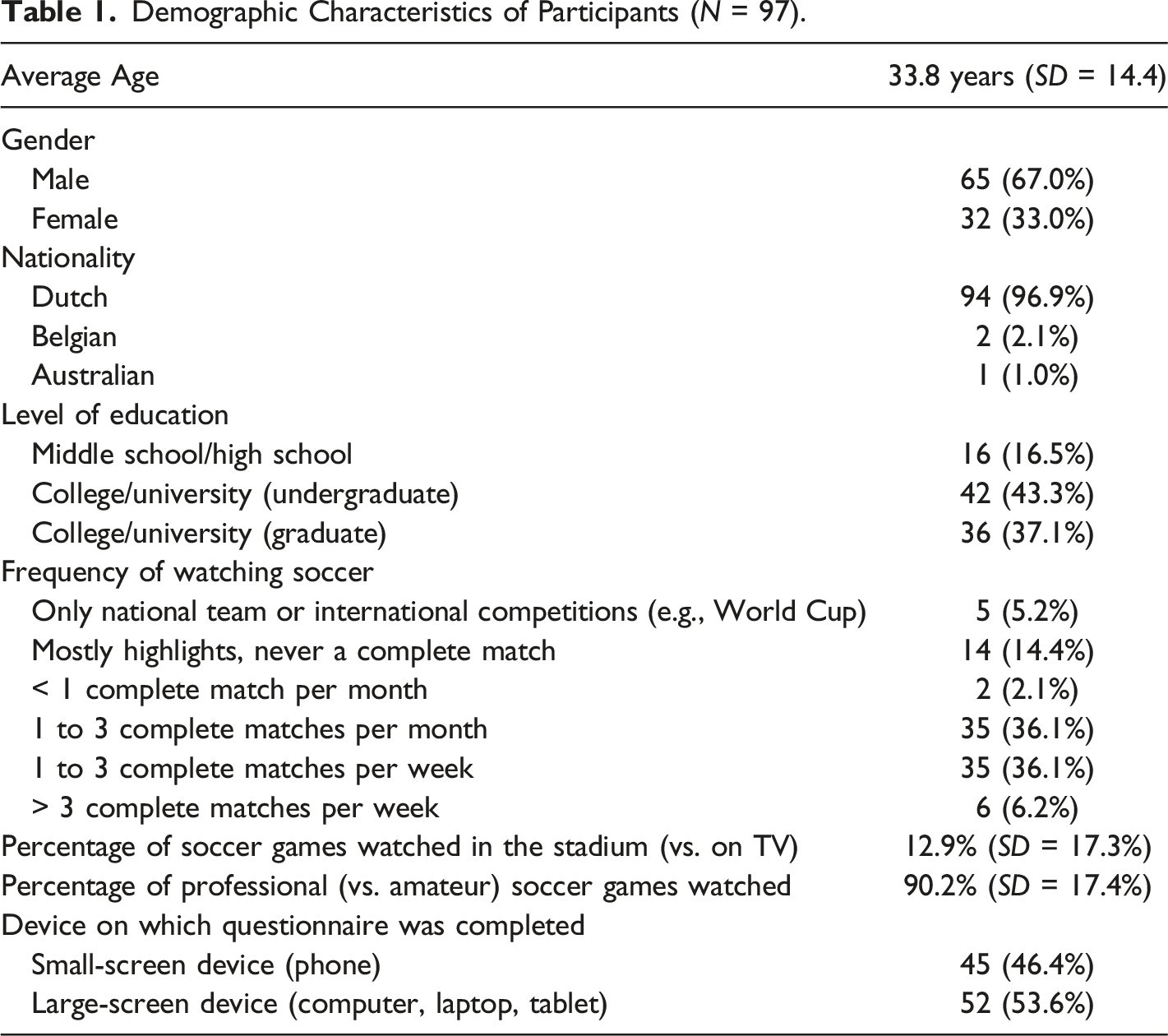
We conducted an online experiment, focusing on referee communication during soccer games. We focused on soccer because it is the most popular sport in the Netherlands (with the highest membership rate in the country; NOC NSF, 2019). Because perceptions of referee communication may depend on the type of in-game situation (Furley & Schweizer, 2016), we focused on two situations in which soccer players often approach a referee for explanations: (1) a situation in which a player receives a yellow card after committing a foul, 1 and (2) a situation in which a goal is disallowed because of a player on the attacking team being offside. 2 To increase the generalizability of our experiment, we included multiple messages of each experimental condition (Jacobs & Jackson, 1983). We used eight video clips, in which one of these two situations occurred (four clips with a yellow card and four clips with an offside). All clips were sourced from highlights of matches played in Dutch men’s amateur soccer (e.g., Tweede Divisie, Derde Divisie, Hoofdklasse) and featured male referees. We chose games from amateur soccer because these received relatively little attention in Dutch national media compared to games from professional soccer (Eredivisie and Eerste Divisie), making it likely the participants had not seen the situations prior to the experiment and would not have formed any prior attitudes toward these amateur referees compared to those for professional referees. Each video clip was edited in iMovie to only focus on the relevant incident and referee response. Clips varied in length from 17 to 33 seconds. To prevent carry-over effects, each clip contained a different referee.
We adapted the audio track of each clip using WavePad. The content of the audio track did not replicate the original communication expressed by the referee on-field, but was scripted and dubbed by the researchers. Specific formulations in the different conditions were inspired by a small-scale content analysis of verbal referee communication during games (Bakker, 2020). For each clip, we recorded two different Dutch audio tracks: one in which the referee used a procedural frame and one in which the referee used a relational frame. In the condition with procedural frames, the referee argued for his decisions by referring to rules and procedures with language expressing certainty. For instance, for one situation with an offside situation, the referee told the players: “Number 11 was offside, my assistant waves his flag, so goal kick. No argument, no argument, no, it is just a goal kick, so stop talking now.” By contrast, in the condition with relational frames, the referee emphasized relations with players and empathy. One example was: “No, I understand you, I understand your frustration, but understand me as well. My assistant waves his flag, I have to disallow it. It is a goal kick.” We also added sound effects (e.g., a whistle, sounds of protesting players) to ensure they were similar across clips and conditions but making sure that the audio matched the events seen in the video clips (e.g., a whistle was heard when the video showed the referee blowing their whistle).
Every participant saw each of the eight video clips once, with the audio for each clip using either a procedural or a relational frame. Therefore, we created two sets of eight stimuli. Participants in set 1 saw the odd-numbered stimuli with a procedural frame and the even-numbered stimuli with a relational frame. For participants in set 2, this was reversed (see Digital Supplementary Appendix A for an overview of all materials, (https://osf.io/zpwvy/).
We did not find differences between the two sets of stimuli for participant age (t (95) = .56, p = .58, Cohen’s d = .11), gender (χ2 (1) = .25, p = .61, Cramer’s V = .03), level of education (χ2 (2) = .27, p = .88, Cramer’s V = .05), average number of games watched in the stadium (t (95) = .78, p = .44, Cohen’s d = .16), average number of games watched from professional soccer (t (95) = .02, p = .99, Cohen’s d = .003), or the type of device used to fill out the questionnaire (χ2 (1) = .50, p = .48, Cramer’s V = .05), indicating no differences in the distribution of participants across the two sets.
Procedure and Instrumentation
The study was distributed online using Qualtrics (www.qualtrics.com). Participants were told that the study focused on evaluations of referees in Dutch men’s amateur soccer. After providing their consent to participate in the study, participants first answered questions about how often they watched soccer (either on television or live). 3 Participants who indicated that they never watched soccer were excluded from further participating in the study. In order to proceed with the questionnaire, participants then performed a sound check to guarantee audio access on their device. Participants also indicated the device on which they filled out the questionnaire.
Next, participants were told that they would see eight videos in which a referee made a decision, and that they had to evaluate each referee. Participants were randomly assigned to one of the two sets of stimuli. Within each set, stimuli were presented in a random order. After watching each video, participants were asked to answer a short attention-check question to see if they indeed watched the video. In case a participant answered this question incorrectly or spent less than 17 seconds (the runtime of the shortest video) on the page with the stimulus video, their answers to that particular stimulus were excluded. Our experiment contained 97 participants, who saw eight clips per participant. Out of these 776 cases, 20 did not pass the attention check, resulting in a total of 756 observations for analysis. 4
For each video, participants had to assess referee competence through an adapted form of the assessment of referee competence scale (ARCS) developed by Oldfield et al. (2020). The ARCS evaluates referee competence based on six dimensions derived from the “Match Officials” section in the Respect Code of Conduct from the English Football Association (FA): (1) fitness, (2) consistency, (3) impartiality, (4) confidence, (5) respectfulness, and (6) communication skills (Oldfield et al., 2020). The first two constructs (fitness and consistency) measure referee performance over the scope of an entire match, and were not measured in the current study because we presented participants with isolated situations. Each remaining construct was evaluated using three items on 7-point Likert scales, with higher scores indicating a higher evaluation of impartiality, confidence, respectfulness, and communication skills (see Supplementary Appendix B for the original Dutch items, https://osf.io/zpwvy/).
Impartiality was measured with three items in which participants assessed whether the referee in each clip (a) seemed biased (reverse coded), (b) seemed to prefer one team over the other (reverse coded), and (c) treated both teams fairly (Cronbach’s α = .86, M = 5.40, SD = 1.24). To assess confidence perceptions, participants were asked whether the referee in each clip (a) stuck by his decisions, (b) had enough confidence to take big decisions, and (c) was a confident manager of the game (Cronbach’s α = .84, M = 5.62, SD = 1.08). Respectfulness was tapped through asking whether the referee (a) respected all players equally, (b) respected that team that received a yellow card (yellow card condition)/whose goal was disallowed because of offside (offside condition), and (c) respected the team that was awarded a free kick (yellow card condition)/the opponents of the team whose goal was disallowed because of offside (offside condition; Cronbach’s α = .81, M = 5.25, SD = 1.13). We also measured participants’ evaluations of referee communication skills by asking whether the referee (a) explained his decisions, (b) listened to the players, and (c) communicated well with the players (Cronbach’s α = .78, M = 4.59, SD = 1.43). After evaluating the eight videos, participants answered demographic questions about their gender, age, nationality, and native language,
5
and were debriefed and thanked for their participation. Figure 1 contains a flowchart of the experimental procedure. Flowchart of experimental procedure.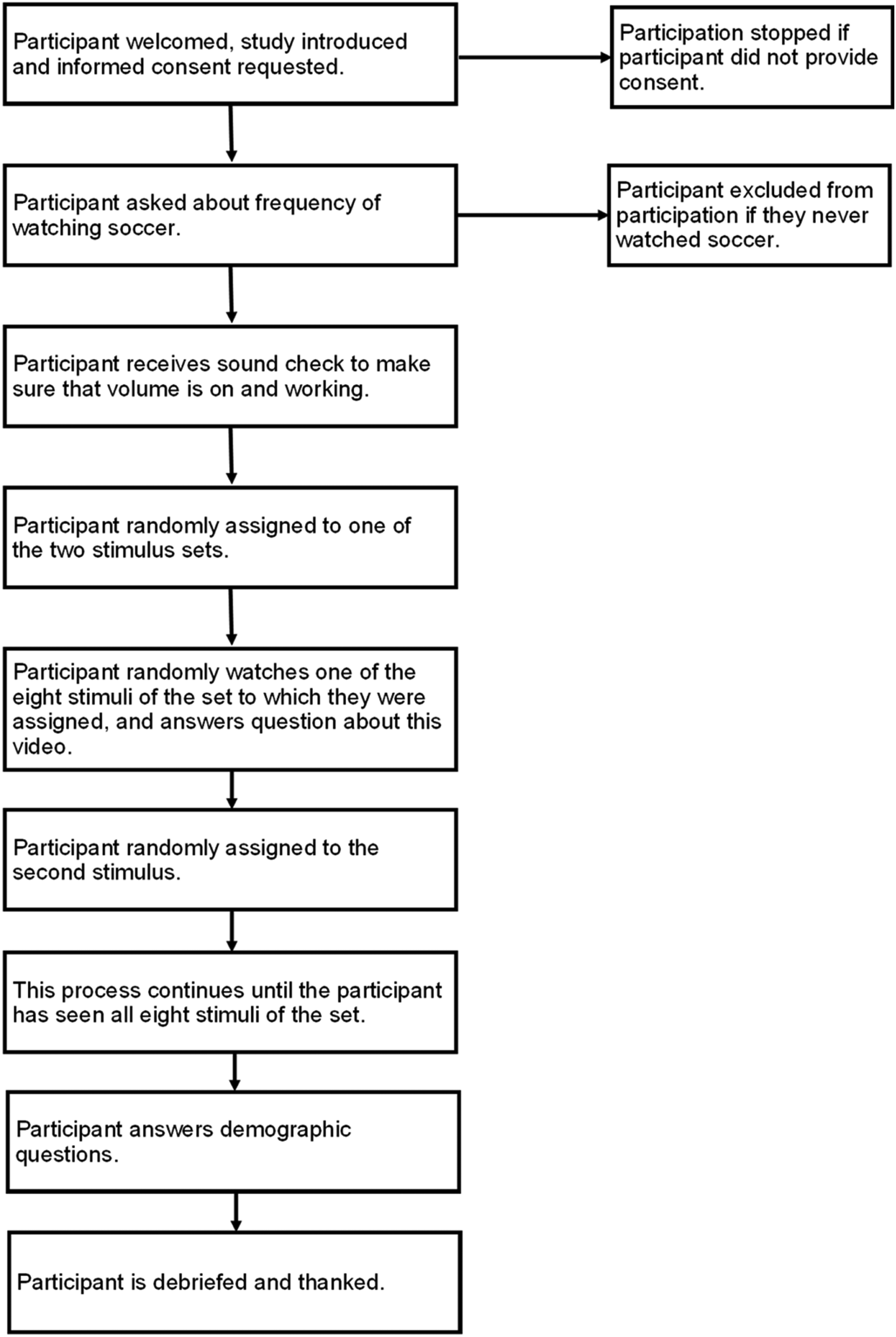
Results
Number of Observations, and Means (and SD) of Dimensions of Referee Competence (Perceived Impartiality, Confidence, Respectfulness, and Communication Skills), by Type of Frame (Procedural vs. Relational) and Type of Situation (Yellow Card vs. Offside).
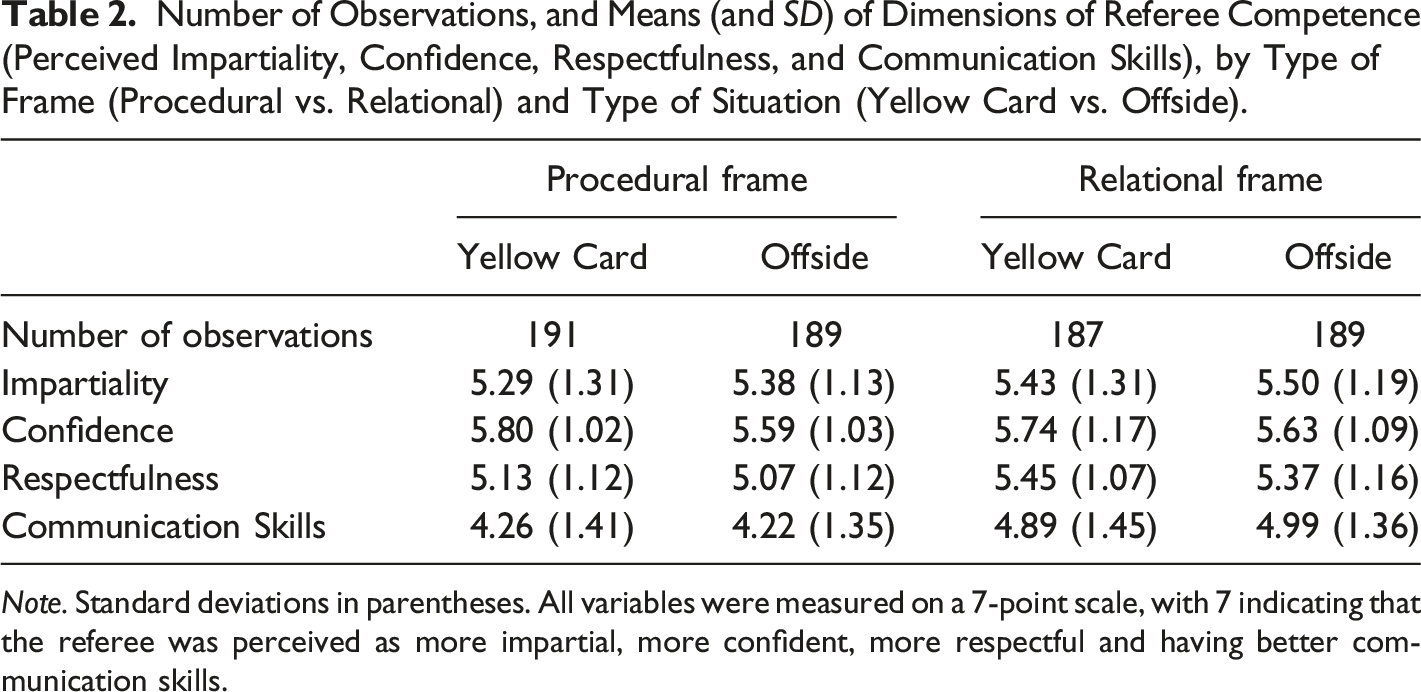
Note. Standard deviations in parentheses. All variables were measured on a 7-point scale, with 7 indicating that the referee was perceived as more impartial, more confident, more respectful and having better communication skills.
Fixed-effects Estimates and Variance–Covariance Estimates for Models Predicting Dimensions of Referee Competence (Perceived Impartiality, Confidence, Respectfulness, and Communication Skills).
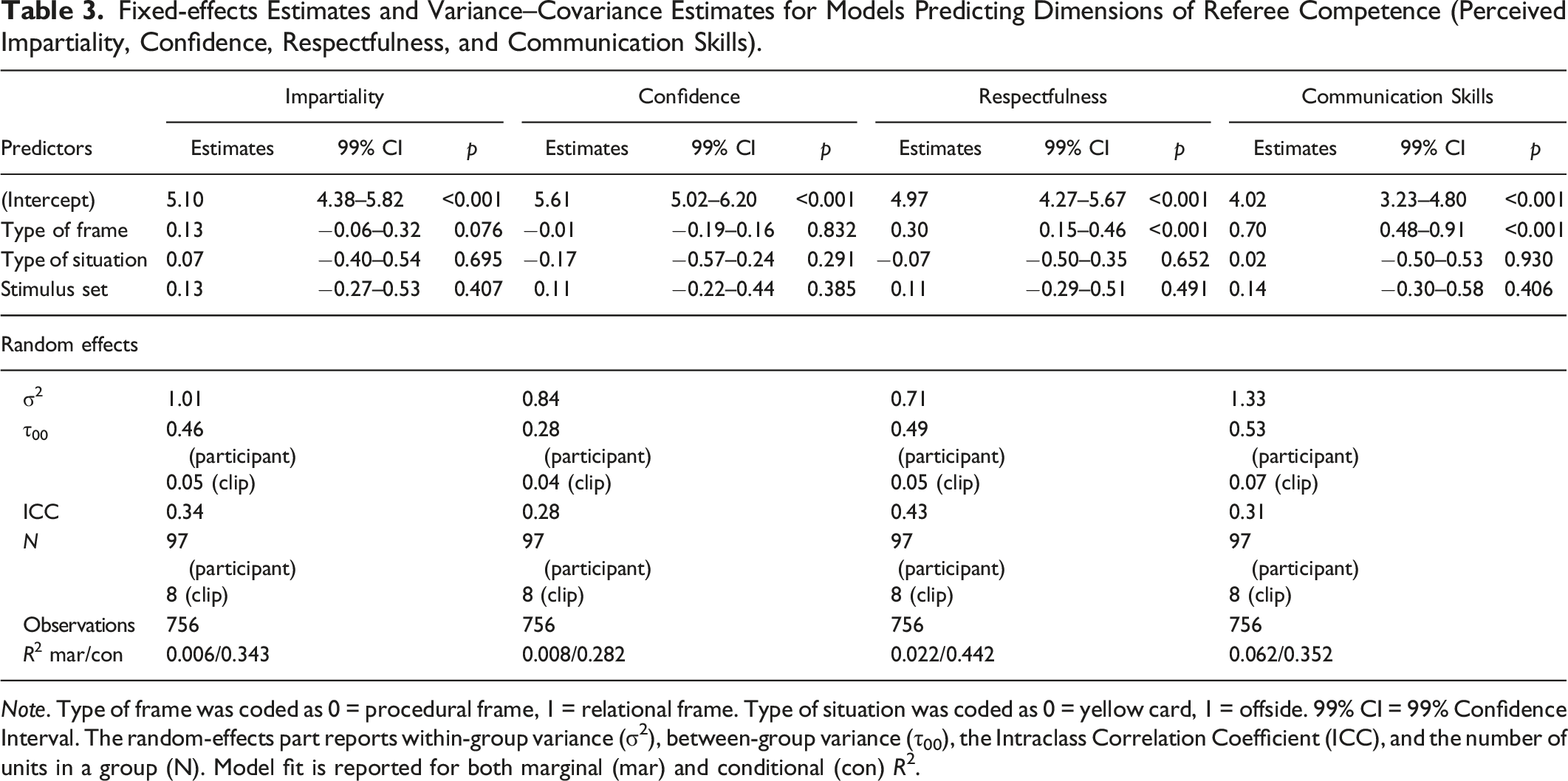
Note. Type of frame was coded as 0 = procedural frame, 1 = relational frame. Type of situation was coded as 0 = yellow card, 1 = offside. 99% CI = 99% Confidence Interval. The random-effects part reports within-group variance (σ 2 ), between-group variance (τ00), the Intraclass Correlation Coefficient (ICC), and the number of units in a group (N). Model fit is reported for both marginal (mar) and conditional (con) R2.
Discussion and Conclusion
Theoretical Implications
Good verbal communication skills are important for any referee. The goal of the current paper was to contrast the impact of two distinct verbal frames (procedural and relational) on spectator perceptions of referee competence. In contrast to our expectations (H1), we found no statistically significant differences between procedural and relational frames on perceived impartiality and confidence. However, referees who used a relational (vs. procedural) frame were perceived as more respectful and as having better communication skills, in line with H2.
Our findings have important implications for referee communication. Our results suggest that relational frames are more effective than procedural frames because relational frames outperform procedural frames on two (out of four) dimensions of referee competence. By contrast, on none of the dimensions of referee competence did we find that procedural frames outperformed relational frames. These effects were observed across different in-game situations in soccer (yellow card and offside).
Social identity theory (Tajfel & Turner, 1986) provides an explanation of these findings. Soccer referees are often treated as an out-group member by other stakeholders in the game, like players, coaches, and/or fans (Webb et al., 2020). Social identity theory argues that in-group members are often more critical towards out-group members (Tajfel & Turner, 1986). In extreme situations, referees may even be the target of out-group abuse, with one study demonstrating that 68% of French soccer referees and 51% of Dutch soccer referees experienced verbal abuse at least once in their referee careers (Webb et al., 2020). Previous research on intergroup communication revealed that inviting in-group members to take the perspective of an out-group member can improve out-group evaluations (Galinsky & Ku, 2004; Manohar & Appiah, 2016). In contrast to a procedural frame, a relational frame prioritizes the relationship between referees and players, and demonstrates that the referee is willing to also consider a situation from a player’s perspective. In that way, a relational frame can improve evaluations of respectfulness and communication skills.
An important additional question relates to the size of these effects of relational (vs. procedural) frames. We find that the effect on perceived respectfulness represents an effect size r of 0.19 (99% CI = 0.09–0.28), while the effect on perceived communication skills has an effect size r of 0.31 (99% CI = 0.21–0.39). Weber and Popova (2012, p. 199) provide empirical guidelines to interpret the magnitude of effect sizes in communication science. Based on their guidelines, we found a statistically medium-sized effect of relational (vs. procedural) frames on respectfulness, and a statistically large effect of relational (vs. procedural) frames on communication skills. This implies that a communication style in which a referee uses relational (vs. procedural) frames should be generally preferred.
These findings are in line with current trends in referee communication. Until recently, procedural communication styles were generally recommended for referees (e.g., Simmons, 2010, 2011), with an emphasis on the referee getting the message across to the players as clearly and unambiguously as possible. One of the reasons for a focus on one-way communication during games is that, in many cases, referees do not have the time to engage in dialogue with players about every decision (Cunningham et al., 2014). Nevertheless, our study demonstrates that, even when time for communication with players is limited, referees can engage in some degree of relational communication, which, in turn, can make others perceive them as more respectful and as having better communication skills.
In all, our study provides empirical evidence that further supports the use of a ritual model of communication over a transmission model (see Hallahan et al., 2007). Reinforcing relationships with players can particularly boost the perception that the referee wants to do right by the players involved. This means that referees should not only think of applying the rules consistently and fairly across situations. In addition, referees should also take aspects of interactional fairness into account during officiating, and should consider showing their human side in the game whenever appropriate.
Practical Implications
Our study also has important implications for referee education programs. Having good verbal communication skills is an important attribute of competent referees (Kittel et al., 2019; Morris & O’Connor, 2017; Slack et al., 2013). However, soccer referees have indicated that communication training is one of the aspects they missed most in their training programs (Apple-Chiarella et al., 2020). In particular, referees have asked for more knowledge about how to improve their communication skills and the subsequent perception of their fairness (Apple-Chiarella et al., 2020). Our study demonstrates that communication strategies and referee perceptions are closely linked, and that the choice for specific communication styles can have a strong impact on how the referee is perceived. Thus, we recommend that referee education programs should pay specific attention to the topic of communication and the impact of different communication styles. Specifically, our research demonstrates that a relational communication style should be taught in such education programs as an important and effective strategy that referees can employ.
Limitations and Recommendations for Future Research
Our study also has a number of caveats. Research on refereeing typically focuses on referees within one particular sport (Kittel et al., 2019; Morris & O’Connor, 2017; Simmons, 2011). The wider replication of our findings in other sports is necessary to generalize our results beyond soccer. It could be particularly relevant to contrast the use of communication strategies by referees during play in team sports (e.g., soccer, basketball) with individual sports (e.g., tennis, judo). Furthermore, participants in our sample were relatively highly educated, with most of them having received at least an undergraduate degree. Future research could investigate whether our results also hold in a sample with a more diverse range of education levels.
In addition, our study was an experiment in which participants imagined themselves as spectators in a soccer game. When spectators or players are involved in games in which they respectively cheer for or belong to one of the teams involved, they are likely to display more in-group favoritism toward that team (Fransen et al., 2015; Rees et al., 2015). Thus, we recommend that our study should be replicated using communication scenarios involving fans and/or players of the actual teams seen in the stimuli (see Burgers et al., 2015, Experiment 1). While our experimental materials were inspired by formulations from a small-scale content analysis of referee communication during actual Dutch soccer games (Bakker, 2020), it would be worthwhile for future research to conduct a large content-analytic study investigating how players respond to different verbal communication strategies by referees.
The use of technology such as the Video Assistant Referee (VAR) has changed refereeing in soccer and other sports. While the VAR was not in use in Dutch amateur soccer at the time of writing, it has been adopted in elite soccer in the Netherlands and beyond. Research has demonstrated that the VAR has a positive effect on the number of correct calls made by the referee (Lago-Peñas et al., 2021; Spitz et al., 2021). However, this can come at a cost, as particularly on-field reviews, in which the VAR asks a referee to review a certain decision on a monitor, can be time-consuming (Lago-Peñas et al., 2021; Spitz et al., 2021). Future research could focus on communication patterns during VAR interventions to determine the effectiveness of framing and other communication strategies in this setting.
Conclusion
Overall, our study demonstrates that referees should use relational frames over procedural frames. Relational frames emphasize interaction with and empathy for players. Even when time for communication is relatively limited during the game, referees can still include specific relational cues in their verbal communication that bring their human side to the communicative exchange. Such relational frames can make spectators perceive the referee as being more respectful and as having better communication skills.
Footnotes
Author’s Note

Declaration of Conflicting Interests
The authors declared no potential conflicts of interest with respect to the research, authorship, and/or publication of this article.
Funding
The authors received no financial support for the research, authorship, and/or publication of this article.