




Abstract
Concussion is a growing issue within sport, including within soccer. Despite the developing medical understanding of concussion, there is still an array of sociocultural discourses and misconceptions around it. In the 2018 UEFA Champions League Final, Liverpool Football Club goalkeeper Loris Karius suffered a head collision in the 48th minute. Postmatch, he was subsequently diagnosed as being concussed. As a result of his concussion, Karius’ performance was arguably impeded, with suggestions that this may have resulted in him making some key errors in the game. Through an analysis of media framing in 52 news articles in the days following the incident, four dominant frames were identified: deflection away from concussion, misunderstanding concussion, education on concussion, and recommendations. Frames that focussed on the lack of awareness and preventative measures that are present in soccer served to highlight the lack of significance afforded to concussion at this particular point in time. In particular, we highlight differences in concussion discourses between those working inside and outside the soccer industry. Overall, these findings contribute to the growing body of sociological work examining concussion in sport.
Introduction
On the 26th May 2018, millions of people throughout Europe and around the world watched Real Madrid Club de Fútbol (Real Madrid) beat Liverpool Football Club (Liverpool) 3-1 in the Union European Football Association (UEFA) Champions League final. Arguably the most prestigious club competition in the European soccer calendar, the final brings to a close a 125-match tournament between 79 teams (from 54 national associate members). On this occasion, however, the game holds significance for not only the inherent prestige, but also for drawing attention towards concussion in soccer.
The final was eventful; the bookmaker’s favourite won, and player errors sealed defeat for Liverpool. In particular, two of the three goals conceded by Liverpool goalkeeper Loris Karius captured media headlines. For the first, on minute 51, under little opposition pressure he threw the ball onto the foot of an opposing player in front of goal, resulting in Real Madrid taking the lead. It has since been referred to as “one of most bizarre goals in Champions League history” (Davis, 2018). The second incident was equally unexpected—and resulted in the third goal—where on the 83rd minute, a speculative long-range effort from Read Madrid player Gareth Bale slipped through Karius’ gloves.
Nine days following the game (4th June 2018), potentially mitigating contextual information was presented. A report released by the Massachusetts General Hospital claimed that Karius had sustained a concussion during the game, most likely the result of a collision with opposition player Sergio Ramos (head to elbow) during the 48th minute of play; three minutes prior to the first goal. The report stated: After carefully reviewing game film and integrating a detailed history—including his reported present and immediate post-contact subjective symptoms—physical examination and objective metrics, we have concluded that Mr. Karius sustained a concussion during the match May 26, 2018. At the time of our evaluation, Mr. Karius’s principal residual symptoms and objective signs suggested that visual spatial dysfunction existed and likely occurred immediately following the event. Additional symptomatic and objectively noted areas of dysfunction also persisted. It could be possible that such deficits would affect performance. (Massachusetts General Hospital, 2018)
Although the Karius incident addresses a unique case, thus making analytic generalisation difficult (Yin, 2009), it is here that this paper presents a valuable contribution to existing knowledge. Specifically, this study examined the media framing of the incident in light of growing academic—and cultural—conversation that has sought to reframe “concussion” as a traumatic brain injury and potential risk factor of Chronic Traumatic Encephalopathy (CTE). This was accomplished through consideration of textual online media outputs as contributors to the socialisation of cultural values (Fromme, 2006) and recognition of such outputs as “agents of socialisation” (Neeley, 2005), a key concept in understanding societal attitudes, behaviours and beliefs in consumer literature. In doing so, broader socio-cultural understandings of concussion were examined in respect to athlete welfare and contemporary sporting norms, many of which are both worrying, as well as damaging, in respect to athlete health. Karius’ injury afforded us an opportunity to examine how media outlets covered the story, and perhaps more particularly, to investigate how the media framed the story in the context of the wider discussions of concussion as a public health issue (Ventresca, 2019).
Sociology, Injury, and Concussion in Sport
A body of work has examined sociological understandings of injury, including concussions, in sport (e.g., Sabo, 2004; Young, 1993). Results suggest that athletes are culturally expected to sacrifice their bodies in the pursuit of success, an act that may be seen as deviant in broader society but normative in sport (Anderson & White, 2018; Hughes & Coakley, 1991). As such, many athletes continue to compete despite suffering from serious chronic pain and injury (Nixon, 2004)—sometimes aided by medical interventions, including the use of analgesic drugs (Holstein et al., 2014). In soccer, Roderick (2006, pp. 18–19) comments how: “athletes learn to disregard the risk of physical harm to normalize pain and injury as part of their sporting experience.” Like all injuries, athletes also learn to play through concussion. For instance, Liston et al. (2018) found that amateur rugby union players underplayed and ignored the importance of concussion in an effort to be “headstrong” and assimilate with the sporting culture.
Others have suggested that many engage in injurious and risky activity because it enhances their masculine and athletic identities, for which elite athletes receive adulation from the media and spectators (Anderson & White, 2018; Sanderson et al., 2016). Here, high levels of masculinity are often associated with team and contact sports as a result of the structural harm involved (Grundlingh, 1994; Nauright & Chandler, 1996; Schacht, 1996). These sports include “warrior narratives” (Adams et al., 2010; Anderson & Kian, 2012), whereby sport is a symbolic enactment and representation of warfare. Adams et al., (2010, p. 281) assert that: “…players who do not live up to the expected orthodox scripts of masculinity are often subordinated through physical dominance and ridicule.” Therefore, players who do not play through injury are stigmatized and vilified through de-masculinizing epithets. As such, Malcolm (2017, p. 135) adds how athletes under-report concussion symptoms due to: “(a) perceptions that their condition is not serious enough; (b) reluctance to leave the game and/or let down teammates; or (c) disbelief that a concussion has occurred.”
The issue with concussion, beyond that of injury, is that symptoms are “vague and heterogeneous” (McNamee et al., 2015, p. 193), making it difficult to recognise the micro-injuries that characterise mild traumatic brain injuries (Cantu & Hyman, 2012). Therefore, concussion diagnoses and prognoses are complicated and contested (Malcolm, 2017). In a study of pitch-side doctors, Malcolm (2017) also found that medical practitioners were complicit in the lack of concussion management within elite sport, primarily as a product of their precarious roles. Consequently, they did not manage injuries correctly, including concussion, through fear they may be dismissed from their often voluntary but prestigious roles. Often, the responsibility for concussions is given to the athletes themselves, absolving the sporting teams and organisations of responsibility (Brayton et al., 2019; Ruston et al., 2019). Nixon (2004) notes how athletes receive biased social support from “conspiratorial allies” that encourages them to play through pain and injury. Here, athletes are trapped in a “sportsnet” whereby they are pressured through a culture of risk to continue, regardless of their ailments and physical condition (Sanderson et al., 2017).
Sport Related Concussion
Meehan (2017, p. 4) defines a concussion as: “trauma-induced brain dysfunction,” while Nowinski (2012, p. 25) states that: “a concussion is…a loss of brain function that is induced by trauma…a brain malfunction or as an alteration in mental status.” Thus, concussions are a subset of traumatic brain injuries, often classified as mild, but which can nevertheless be extremely devastating in terms of their impacts on the lives of the sufferers and their families. An understanding of the signs and symptoms of concussion is therefore critical. These can include: (1) somatic symptoms, (2) physical signs, (3) balance impairment, (4) behavioural change, (5) cognitive impairment, and (6) sleep/wake disturbance (McCrory et al., 2017). Traditionally, loss of consciousness was a requirement for concussion diagnosis, but it is now accepted that this is only present in around 5%–10% of cases (Ellemberg et al., 2009).
There are a number of long-term concerns that are linked to concussion and sub-concussive injuries (Anderson & White, 2018; White et al., 2018). Second impact syndrome, or malignant cerebral edema (Bruce et al., 1981), occurs where a concussed person endures a second trauma to the brain, usually resulting in diffuse cerebral swelling and grave deterioration (McKee et al., 2014), even death. However, the most socially discussed issue associated with concussion at present is CTE (Omalu et al., 2005). While CTE is not a new condition—having been discussed within scientific literature since the 1920s (Martland, 1928)—it has entered cultural imagination following the media interesting in the pathology being found in the brain of deceased American football player, Mike Webster (White & Franks, 2017). CTE is a progressive neurological disorder found in people who have suffered brain trauma(s) (Maroon et al., 2015). The pathology “is associated with gradual onset of neuropsychological, psychiatric and behavioural disturbance followed by progressive cognitive decline” (Stewart et al., 2015, p. 11).
CTE is not the only issue of concern with sport-related concussion. The association of mild traumatic brain injury and sub-concussive injury with dementia, Alzheimer’s Disease (Li et al., 2017) and other indices of social deprivation have been increasingly evidenced (Sariaslan et al., 2016). Here, of the 104,290 people studied, it was found that previous mild traumatic brain injury (concussion) had a significant negative effect on a person’s life chances, when compared with their unaffected siblings. This was true for all measures: receipt of disability pension; psychiatric inpatient admissions or outpatient visits; premature mortality; low educational achievement; and receipt of state welfare payments (Sariaslan et al., 2016). This is true of the soccer context too, with a recent retrospective study articulating that ex-professional players are at an increased risk of neurodegenerative disease compared to the population (Mackay et al., 2019).
The standardised protocol for the initial and immediate medical management of sport-related concussion is easily understood within the recognise and remove strapline (McCrory et al., 2017). This involves the identification of concussion symptoms (see the fifth edition of the Sport Concussion Assessment Tool; Echemendia et al., 2017) before the immediate removal of an athlete from the field of play. Although the symptoms of concussion often involve short-term impairments (Hall et al., 2005), symptoms can persist to be sub-acute and even chronic in nature. For instance, post-concussion syndrome affects between 38 and 80% of those who suffer concussion, meaning they will be symptomatic for extended periods of time (Hall et al., 2005). The impact of post-concussion syndrome on sport may be significant, especially through extended exclusions from play and physical activity.
Soccer and Concussion
Concussion in soccer is often a product of unintentional head impacts (e.g., head to head collisions), while detrimental sub-concussive impacts may result from heading the ball (Di Virgilio et al., 2016; Levitch et al., 2018; Maher et al., 2014). In response to an increased awareness of concussion in soccer, and of particular relevance to this study, UEFA introduced a concussion procedure for all of its competitions in 2014, including the Champions League. According to the protocol: In the event of a suspected concussion, the referee stops the game for up to three minutes, to allow the injured player to be assessed by the team doctor. A player will only be allowed to continue playing on specific confirmation by the team doctor to the referee of the player’s fitness to carry on. (UEFA, 2014)
Media Framing of Concussion
Debates around concussion are typically presented by the media, with concussion in sport (American football in particular but also soccer recently as noted above) featuring in mainstream press reporting in addition to the sport media (Cassilo & Sanderson, 2018). Ahmed and Hall (2017) explored the description of sports concussion in online sports news articles on hockey, American football, soccer and rugby. They claim that media articles have the potential to influence widely public perceptions of concussion, to mediate misconceptions and to increase knowledge. However, Kennard et al. (2017) found that coverage of concussion often trivialised it, which they argue would reduce viewers’ knowledge and response to it.
It would be naïve to think that this reporting was without prejudice as it is typically influenced by the values of the media organisation and/or the writers. One way to understand these values and practices is framing theory, which “addresses the way in which elements in a certain news story are presented, and, in some studies, the influence such frames have on audience perceptions of content” (Lewis & Weaver, 2015, p. 220). Framing involves the selection of certain aspects of reality to focus on, making them more salient, more noticeable and meaningful in any communication (Entman, 1993). Those frames that gain current resonance will “call to mind congruent elements of schemas that were stored in the past,” building on people’s existing knowledge to allow them to make sense of new information and to decide whether it fits with their worldview (Entman, 2010, p. 391). Entman (1993) states that there are four elements to framing; (1) defining the problem by determining what a causal agent is doing and with what costs/benefits, usually measured in terms of common cultural values; (2) diagnosing causes by identifying the forces that create the problem; (3) making moral judgements through evaluating causal agents and their effects; and (4) suggesting remedies by offering and justifying treatments for the problem while predicting their likely effects.
In this way, top-down media framing is a powerful tool that defines the problem and shapes public perceptions (Sanderson & Cassilo, 2019). Framing has been shown to be particularly persuasive with public health issues, with the media shown to influence perceptions of responsibility for solving policy problems (Jarlenski & Barry, 2013). The media framing of these issues often utilises medical doctors as sources for stories, as was found by Barnett and Lee (2019) in their examination of post-traumatic stress disorder, who considered these to be “official” sources. The “medicalization” of such social issues has been critiqued (Malcolm, 2018) as it can control the flow of debate around a topic and may lessen audience sensitivity towards it. However, Van den Bulck (2017) examined celebrity health narratives and, amongst other themes, identified that media stories often provided limited and even sceptical medical elaboration. In a sport-setting, it is more likely that current players and coaches were used as sources as opposed to medical professionals (Karimipour & Hull, 2017). In the case of breaking news stories, the selection of, and interaction with these sources sets the framing process in motion (Entman, 1991).
Framing also occurs in a sport-setting (Cassilo & Sanderson, 2018). For example, in an analysis of media coverage of an Australian football league game in support of the lesbian, gay, bisexual, transgender, intersex, and queer communities, sport was framed as being supportive of sexual minorities but reports often linked these issues to a wider frame of inclusion (Sherwood et al., 2020). Nevertheless, it was also found that while supporting a more inclusive masculinity, change was identified as a complex process that would not happen immediately. Sherwood et al. (2020) also identified that media reports aimed to distance sport from what was considered to be a “political message.” Media coverage of mixed martial arts, an inherently violent sport, presented it as a moral threat that was in need of regulating (Santos et al., 2013). Two dominant frames were identified, leveraging of socio-political capital to regulate the sport and protect society from itself and the framing of public officials as protectors of social citizenry. Finally, recent media framing of mental health issues in sport has been shown to be supportive of athletes, challenging inaccurate assumptions concerning mental illness and calling for greater support for athletes who experience mental illness (Parrott et al., 2019).
Given that media attention on health and safety issues in sport is growing (Cassilo & Sanderson, 2018), and as Benson (2017) argues that concussion in sport should be viewed as a public health issue, on a par with smoking, it is unsurprising that framing should take place in this setting. While there have been a number of examinations of media framing of concussion, these have typically been focussed on the NFL (see Anderson & Kian, 2012; Cassilo & Sanderson, 2018; Furness, 2016; Karimipour & Hull, 2017; Mirer & Mederson, 2017; Sanderson et al., 2016). These studies reveal a somewhat mixed picture, with some coverage ignoring the concussion crisis, protecting the NFL’s reputation (Mirer & Mederson, 2017) and minimising the issue (Karimipour & Hell, 2017), while others have argued that there may be a “fracturing of the hegemonic masculinity narratives surrounding football and injuries” (Cassilo & Sanderson, 2018, p. 91).
This study, therefore, contributes towards our growing understanding of framing of concussion reporting by examining a case from European soccer. Until recently, concussion and traumatic brain injury in soccer had received much lower levels of media attention. However, with the 2020 introduction of bans on heading of the ball at youth levels, the topic has become the focus of mainstream attention (see above). Here, we examine a specific case of media framing in soccer that occurred prior to this increased media coverage.
Methodology
Data was captured via a textual analysis of online media articles that referred to the Karius concussion incident using the following search terms: “Karius concussion”; “Liverpool keeper concussion”; “Champions League Final concussion”; and “Sergio Ramos causing concussion.” The articles were sourced using the advanced search features via a popular search engine, where 56 online media reports were retrieved from 34 different British (N = 29), European (N = 10) and international (N = 5) media organizations and broadcasters, including a mixture of sport-specific (N = 16) websites and general news outlets (N = 18). In all instances, the online versions of reports were used rather than hardcopies of newspapers and only those that were free to access were accessed. Moreover, web-based sources have overtaken the use of newspaper and radio-based news platforms for adults and the internet is the most popular platform for 16–24-year olds (Ofcom, 2018). Importantly, sources that simply reiterated data from another article were disregarded to allow researchers to discern the “original” or “true” meanings of the cultural discourse portrayed (Hodder, 1994). Indeed, in studies of this nature, textual analysis is recognised as a valuable methodology by which to capture explicit and subtle cultural interpretations of events, as individuals and groups construct textual narratives in order to make sense of society (McKee, 2001). That said, it is important to remember that narrative analyses are subjective in their undertaking (Anderson & Kian, 2012). Therefore, appropriate considerations and a transparent audit trail are provided below.
Three researchers (authors one, two and four) thematically analysed the data and inductively co-created the initial codes. These initial codes were discussed and subsequently developed into themes (Braun & Clarke, 2006). Throughout the process, discussion between the three coding authors was maintained in order to ensure consistency, in which there were no disagreements. The process of coding was checked and agreed by author two.
Validity/Trustworthiness
Traditionally, interpretivist studies have been subject to the criteriological measures of trustworthiness and validity (Lincoln & Guba, 1985). However, this investigation recognised contemporary arguments that such perspectives should stand alone from (post)positivistic work given their ontological and epistemological distinctions (Smith et al., 2014). To this end, the work in this paper forgoes notions of “validity” to instil the characterising traits of rich rigour, sincerity, credibility and transparency to inform the investigation (Smith et al., 2014). In practical terms, this saw three researchers perform the initial data coding, resulting in a concurrent peer debriefing process that served to not only compare interpretations, but also to challenge any sense making and inherent biases. Subsequently, the authors argue that the research presented here is credible in that significant time has been spent not to “test” trustworthiness, but to provide a transparent audit trail that demonstrates appropriate reflection and reflexivity regarding the interpretations offered.
Results and Interpretation
Data analysis revealed four key themes (deflection away from concussion, misunderstanding concussion, education on concussion, and recommendations) in characterising the presentation and understanding of concussion in professional soccer in the media. While it must be acknowledged that what is presented is an interpretation of this framing, it is likely also reflective of the broader social rhetoric on concussion in grassroots and professional sport (Anderson & White, 2018; Ventresca, 2019).
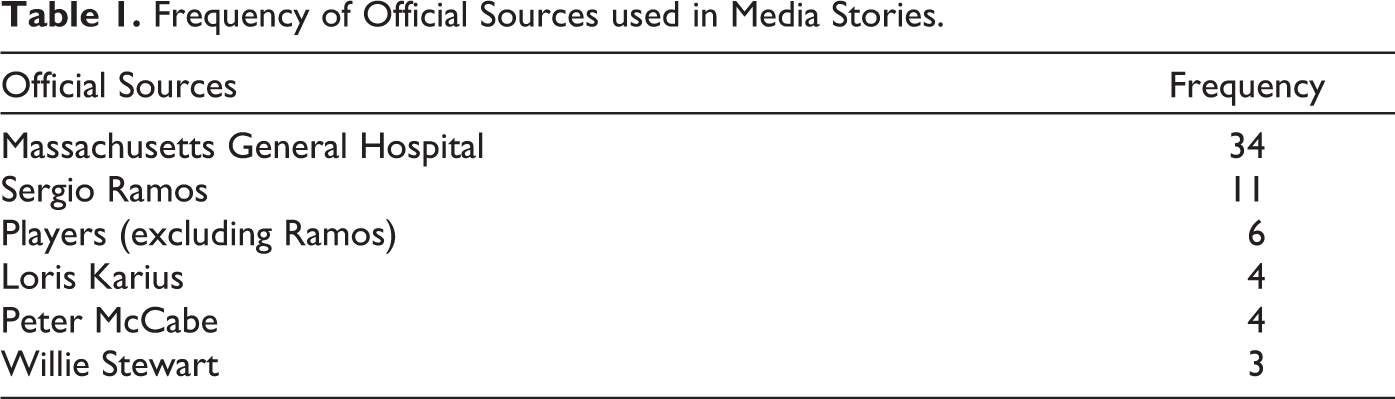
All bar two of our sources provided some context for the incident with reference to the match and 40 made reference to the statement from Massachusetts General Hospital. Interestingly, only United Kingdom (UK)-based sources employed an education frame and when doing so they drew on “official sources” such as Headway Chief Executive Peter McCabe and aforementioned UK neurologist Dr Willie Stewart, who was first person to identify CTE in a British soccer player. The most common sources were those from Massachusetts General Hospital (in 34 articles, 61%), while players (particularly Sergio Ramos) were frequently quoted (30% of articles); Karius himself was only quoted in four articles. Quotes from players were typically used in the deflection away from concussion and, in particular, the misunderstanding concussion frames.
Frequency of Official Sources used in Media Stories.
Deflection Away From Concussion (present in 34% of articles)
Given the spectacle that is elite sport, mistakes made by athletes—regardless of whether they are injured or not—are public in nature. This is typified in one article whereby the authors express that mistakes by a goalkeeper are under particularly high, possibly unfair, levels of scrutiny. Here, Das (2018) wrote: He wears the number 1 on his back. The first to be paid? No, the first one to pay. It’s always the keeper’s fault. And when it isn’t he still gets blamed. And when the team has a bad afternoon, he’s the one who pays the bill…The rest of the players can blow it once or twice in a while and then redeem themselves with a spectacular dribble or a masterful pass, a well-placed volley. Not him. With a single slip up the goalie can ruin a match or lose a championship, and the fans suddenly forget all his feats and condemn him to eternal disgrace. No matter how much Klopp [the manager of Liverpool] attempts to pad out his squad to ensure he has the strength in depth next term…it [is] that first name on the team sheet [the goalkeeper, Karius] that urgently needs to be addressed. (Beesley, 2018)
Other articles claimed that the concussion diagnosis may be a strategy to ensure that the player’s resale value did not diminish and, indeed, as we discuss below, it is plausible that the public revealing of his injury diagnosis may have been an attempt to salvage Karius’ reputation and justifying his poor performance. This view was supported by comments from former players, such as this example in The Daily Express who cited former professional soccer player, Danny Mills, saying: Is it Liverpool trying to get a bigger fee for him? Trying to save Karius’ career and give him a second chance? (Amako, 2018)
Misunderstanding Concussion (Present in 38% of Articles)
This frame was reflected in comments that displayed a lack of understanding of concussion causes and symptoms. The Daily Express also quoted Danny Mills to question whether Karius had even sustained a concussion. Mills said: So many players have bumped heads. Could you go back retrospectively and go he was bit dazed? There were two glaring errors but there were no other mistakes. (Amako, 2018) I feel sorry for what happened with him, but to blame it on concussion that he made those mistakes—he also made two amazing saves. So that was luck then? I don’t know because he couldn’t see the ball. (quoted in Doyle, 2018)
Nevertheless, other publications questioned the concussion diagnosis by utilising quotes from other members of the soccer industry, including medical personnel at other clubs. Concerningly—and in contravention to contemporary accepted medical understandings of concussion (McCrory et al., 2017)—a quote from Italian soccer team Juventus’ neurologist, Franco Benech, was used by Italian publication Calciomercato to claim that it was “not possible for the player to have suffered a concussion” (calciomercato.com, 2018). He was quoted as saying: To certify a concussion there must have been also a small loss of consciousness [which Karius is not reported to have]. And then, the doctors must not allow the player to play in those conditions. It is not conceivable and it is impossible for an athlete to suffer a traumatic event of such a commotional type without leaving the field. (Benech, quoted in calciomercato.com, 2018) It was more than surprising when the doctors at the Massachusetts Hospital issued their conclusions related to the Liverpool goalkeeper Loris Karius in the Champions League final…professional sports doctors themselves felt somewhat embarrassed reading the statement…For me, as a sports doctor with many years of experience in this type of incident, all of the symptoms being shown by Karius were psychosomatic, due to a huge mistake in a top-level sporting event. (González, 2018) The first is the disgraceful suggestion the concussion is being used as an excuse. We can, and should, disregard this nonsensical accusation…It isn’t being offered as an excuse, they are just facts. Karius suffered a concussion and the errors subsequently occurred. (Preece, 2018)
There is also an expectation that athletes are able to withstand and play sport despite their pain and injuries (Hughes & Coakley, 1991). For example, in a Forbes article, Dines (2018) commented that: Professional athletes in all sports are conditioned to be tough and play through pain. A concussion with mild symptoms can be enough to affect performance [as was arguably seen in this Champions League soccer final] while not seeming bad enough to the player to warrant seeking medical attention. What concerns me more is the opinion Liverpool should have kept the injury hush-hush, so as to save the keeper and his club from further mockery from those who do see it as an excuse.
Education on Concussion (Present in 17% of Articles)
Although some looked to dismiss Karius’ concussion, other media sources used this as an opportunity to educate the media and the public on the issue of concussion. Recognising this, Dines (2018) in Forbes wrote: “Karius’ concussion highlights the difficulty associated with diagnosing and treating these complicated and often devastating injuries.” While some may suggest that it is worrying that lessons have not been learnt since the 2014 FIFA World Cup—which was marred by numerous ill-managed concussions (Cusimano et al., 2017)—this incident provided a renewed opportunity to educate the sporting fraternity on concussion diagnosis and management.
Immediately after the concussion, Dr. Ross Zafonte and Lenore Herget at Massachusetts General Hospital released the statement noted at the start of this paper in what they describe as: “an effort to prevent, where possible, the dissemination of incomplete or erroneous information” (Massachusetts General Hospital, 2018). In a widely quoted statement, they specify that Karius was suffering from issues with his vision and spatial awareness, noting that: At the time of our [their] evaluation, Mr. Karius’s principal residual symptoms and objective signs suggested that visual spatial dysfunction existed and likely occurred immediately following the event. Additional symptomatic and objectively noted areas of dysfunction also persisted. (Massachusetts General Hospital, 2018)
Preece (2018) also recognised: “the general ignorance to the potential dangers caused by trauma to the head.” In addition, he noted how: the lack of understanding of the causes, the symptoms and the long-term consequences makes it blindingly obvious of the need for this to lead to wider education on concussion. (Preece, 2018) In the biggest game in club football [soccer], with hundreds of millions of fans watching around the world, it is alarming to hear that a player has played nearly half a match with a potential concussion. (quoted in TalkSport, 2018) The best time to diagnose a discussion is when it happens…he should have been assessed on the pitch. If that didn’t happen, when he came off. If that didn’t happen, when he got back to Liverpool.
Recommendations (Present in 10% of Articles)
In addition, there were an array of recommendations in the articles about how to improve the situation. For instance, it was noted in the BBC (2018) that while: “officials and medics did not see a collision between Loris Karius and Real Madrid’s Sergio Ramos in the Champions League final,” the use of: “…medical staff on the sidelines or in the stands [who could] review incidents on a laptop computer or mobile device would support concussion diagnosis”. This became possible in the English Premier League in 2016 and may be worthy of expansion into other soccer leagues and competitions.
While UEFA rules were updated in 2014 to allow up-to three minutes to assess a player for concussion, further developments around in-game assessments have been suggested. Specifically, the BBC utilised expert commentary to substantiate the need for further measures to allow players to be fully assessed for concussion. They quoted notable neurologist Willie Stewart saying: football [soccer] doesn’t allow an interchange for a player to be assessed to see if he has a brain injury; doesn’t allow significant time for the medics to assess the player. (quoted in BBC, 2018)
Reference was also made to comments from the United Kingdom Parliament on the incident, suggesting some independent oversight is required in the decision-making processes around concussive injuries. Here, the Chairman of the All-Party Parliamentary Group for Acquired Brain Injury, Chris Bryant MP, commented that: The concussion suffered by the Liverpool goalkeeper in the recent Champions League match shows absolutely that association football [soccer] has not yet got this right…It shouldn’t be the club doctor that is making a decision about whether somebody continues to play—it should be an independent medical assessment.
The Framing of Karius’ Concussion
Media coverage of Karius’ concussion diagnosis is consistent with Entman’s (1993) four elements of framing. The problem is defined, largely through a lack of understanding of concussion; causal factors include the attitudes of players and those involved in the sport, with moral judgements on the lack of education on concussion and some, admittedly brief remedies provided. As we have noted, there were a number of competing frames in the coverage of this discussion of concussion. As such, these frames are reflective of a strongly polarised debate that surrounds sport and concussion (Johnson et al., 2015). On one hand, there were those who either deflected attention away from concussion or who questioned whether such a collision was possible to cause a concussion. The use of current and former players, along with medical staff involved with soccer clubs attempted to add credence to these stories and created a powerful argument that concussion was either not to blame for the player’s errors or that he had not been concussed. As identified by Barnett and Lee (2019) such “official” sources add weight to media discourses. Nevertheless, these sources can be used in a negative manner (Van den Bulck, 2017), questioning the health concerns of celebrity figures—such as Karius. Entman (1991) notes that the use of a medical professional strengthens a frame, making it more difficult for a typical, non-medical expert reader to disagree with and so these stories have the potential to influence the views of the public and generate scepticism on the significance of concussion in soccer—focussing on previous poor performance lessens the impact of concussion in this instance. However, another novel finding of our research is that it was often the voice of players that were also used in such a negative manner (via the deflection away from concussion and misunderstanding concussion frames), making players implicit in this scepticism. Malcolm (2017, p.135) suggests that under-reporting of concussion is due to: “(a) perceptions that their condition is not serious enough; (b) reluctance to leave the game and/or let down teammates; or (c) disbelief that a concussion has occurred.” This is similar to the narrative in this research whereby some media outlets implied that the Karius’ concussion was feigned as an excuse for poor performance. Such framing is in contrast to that found in reporting of other public health issues such as PTS and mental health awareness where the media has been shown to present these sufferers as victims and in need of support (Barnett & Lee, 2019; Parrott et al., 2019).
Alternatively, two related frames, Education on Concussion and Recommendations, identified the seriousness of concussion in soccer. Both of these focussed on recognising and then removing concussed players from the game, a strategy that is now used in many sports (McCrory et al., 2017). However, this framing serves to make playing sport seem less harmful and fails to include prohibitionist impulses that address the potential for trauma that is inherent in any contact sport. Nevertheless, we acknowledge that these discussions took place prior to the banning of heading in some youth soccer training and may be treated differently now. These frames also served to highlight the lack of significance afforded to concussion at this particular point in time. Overall, they reveal that more needs to be done in order to challenge the cultural narratives in soccer, to make players aware of the potential severity of concussive injuries and the need for immediate removal from the game (Liston et al., 2018).
It should be noted that the “official” voices that were used to support these frames were typically drawn from outside of soccer and are, thus, less complicit in poor concussion management than those working for soccer teams, who are in precarious positions at their clubs (Malcolm, 2017). They may also be immune from traditional sporting rhetoric that requires athletes to sacrifice their bodies (Hughes & Coakley, 1991). Interestingly, while not as explicit as the leveraging of socio-political capital that was used to call for regulation in MMA (Santos et al., 2013), the attempts to educate readers, combined with the use of political sources are indicative of a desire to protect society. Perhaps most importantly, by quoting members of the British Parliament, concussion was framed as a public health issue and not only a sporting issue (Benson, 2017).
This case is also a good indication of the precariousness of an elite athlete’s career (Roderick, 2006). Athletes in this terrain are commercial assets that may be discarded when their performance is not conducive to the success of the team or business. Here, the athlete’s performance on the field is paramount to their job security and stability (Roderick, 2006). Despite Karius suffering an injury in the pursuit of success for his team, the mistakes made have been very costly for both him and Liverpool. Therefore, regardless of whether or not Karius suffered a concussion, it is significant that he both sought out and then made public a concussion diagnosis. It would be interesting to discover who made the decision to make this diagnosis public as it has clearly influenced and framed the discourses surrounding Karius’ injury. Notwithstanding that he suffered an occupational injury, his footballing ambitions and progression are now thwarted; with him being transferred on loan to a team who play in a much less prestigious league.
Conclusion
Sport-related concussion is a growing concern (McCrory et al., 2017), with increasing academic and media attention exploring the issue (Anderson & White, 2018). Unfortunately, in the 2018 Champions League soccer final, Liverpool Football Club goalkeeper Loris Karius made two costly mistakes after being concussed in the game. As a result, this research examined the media framing of this incident and the various responses from sporting professionals and pundits in 56 press articles. We have identified that in this instance, there was no dominant frame in the way that the media communicated concussion, nevertheless negative frames were more common. Pertinent discourses emerged from the data; notably that attention was deflected away from concussion, that concussion was used as an excuse for poor performance, as well as the media using this incident as an opportunity to educate the general public on concussion, and to make recommendations for concussion management. Our findings also point towards cross-cultural differences in attitudes towards concussion, with a greater scepticism towards concussion in Europe. As noted above, it was only UK-based sources who attempted to provide education on the potential severity and consequences of concussion while their European peers relied on the views of players.
As in other injury research (Liston et al., 2018), Karius suffering a concussion highlights the precarious nature of a career in elite soccer, whereby players can and will be dropped from a team due to poor performance, including when it is arguably a product of a neurological injury sustained in play. There was even cynicism in the media that Liverpool may be using concussion as an excuse for Karius’ poor performance in order to recuperate the best price for the player. Such a position reflects the contemporary landscape of elite sport, whereby athletes are commercial assets with a value that needs to be protected and maintained (Roderick, 2006).
While this paper has only looked at the media framing of this particular concussion, it contributes to a broader social understanding of concussion in sport (Anderson & White, 2018; Ventresca, 2019), specifically the media intersection with sport-related concussion. Indeed, through the examination of common media narratives, broader social perspectives towards sport-related concussion within popular team sports (i.e., soccer) can be examined. Therefore, future research should continue to examine the framing of similar events, across an extensive sample of articles, as well as comparing responses across cultures and publication types. Further work is also required in the education, prevention and management of concussive injuries within soccer (Maher et al., 2014). In particular, one area that requires attention is in-game concussion assessment and the use of temporary substitutions, akin to the protocols followed in elite rugby union.
Footnotes
Author’s Note
Keith D. Parry is now affiliated with Bournemouth University, United Kingdom.
Declaration of Conflicting Interests
The author(s) declared no potential conflicts of interest with respect to the research, authorship, and/or publication of this article.
Funding
The author(s) received no financial support for the research, authorship, and/or publication of this article.
