




Abstract
The covers of running magazines are powerful ideological tools, and the individuals featured on covers shape broader public perception of who belongs in running. To examine representation, this study analyzed 285 images of athletes on the covers of three popular North American running magazines over an 11-year period (2009–2019). Through a visual content analysis of cover photos and the use of intersectional feminist theory as a framework, we found disparity in the representation of racialized athletes in comparison to non-racialized athletes, as well as an overrepresentation of female athletes in comparison to their male counterparts. We argue that in order to challenge dominant understandings of who can rightfully and safely participate in running, it is essential to increase the images of racialized people on magazine covers.
Keywords
Female and racialized athletes are under-represented in sports media coverage when compared with men (Lawrence, 2016; Primm et al., 2007; Weber & Carini, 2013) This is particularly troubling as women and racialized people participate in sport in increasing numbers (Gilreath et al., 2017; Musto et al., 2017; Pauline, 2014; Ponterotto, 2014; Schmidt, 2016; Wiggins, 2014), but this increase has not been reflected in sports media coverage (Cooky et al, 2015; Sherwood et al., 2017). This is not only discouraging for marginalized athletes, it also reinforces and perpetuates firm but false stereotypes and assumptions surrounding who participates in sport, and who can make a claim to being an athlete (Avraham & First, 2010; Zenquis & Mwaniki, 2019). Without changes in representation, stereotypes and assumptions are portrayed in a fixed manner (Mastro et al., 2011). This disparity in representation merits critical investigation because it contributes to the symbolic annihilation of vulnerable athletes from sports media, removing their stories from sports narratives, and maintaining pre-existing social inequalities around race and gender.
The covers of sports magazines are powerful ideological tools, and the individuals featured therein serve as role models, teaching the broader public that different sexes and races belong within both elite and recreational sport. Whether a magazine features an athlete or a professional model on the cover, they enforce values of normative participation as those featured on magazine covers are almost exclusively young, conventionally attractive, and white (Ponterotto, 2014). Not only does this practice limit our dominant understanding of who can rightfully participate in sports (and who is erased entirely), this also shapes future participation in sports (Carter-Francique & Richardson, 2016).
To date, scholars have analyzed the representation of racialized and female athletes in sports magazines within the Western context (Denham, 2020; Frisby, 2017; Lawrence, 2016; Smallwood, Brown, & Billings., 2014; Weber & Carini, 2013); however, there is limited research specifically examining the representation in speciality running magazines. Past research in sports media has shown the differential treatment of sports athletes on the basis of gender (Buysse & Embser-Herbert, 2004). Gender inequality has been maintained by sport and media, through the continued perpetuation of gender stereotypes (Buysse & Embser-Herbert, 2004). Representations in running magazines are important within our current social context for a number of reasons: while runners of East-African origin dominate elite running competitions such as the Olympics and major marathons (World Athletics, 2019), racialized bodies from any geographic location rarely appear on the cover of major North American running magazines (Bridel, Denison, & Markula, 2015; Foster & Chaplin, 2017). Further, the murder of Ahmaud Arbery, a Black runner in the United States of America, who was shot by two white men while he was jogging, and the ongoing Black Lives Matter movement, reveal that occupying public space for recreational purposes such as running is not only fraught, but dangerous, for racialized people (Frankowski, 2019; Gillborn, 2018; Holmes, 2020). While there are multiple and intersecting social, political, and historical factors that inform Arbery’s murder, the near-absence of Black bodies on the cover of running magazines reinforces the racist stereotype that a Black person only runs in public when they are escaping the scene of a crime (Colburn & Melander, 2018). As a result, exploring the representation of racialized runners in major magazines is inextricably linked with anti-racist projects, as it disrupts the racial logic that informs who can run freely, and who remains a suspect while exercising in public.
With these factors in mind, this study examined the representation of runners with a focus on gender and race, on the covers of three major North American running magazines: Runner’s World, Women’s Running, and Canadian Running from 2009 to 2019, as well as quantifying the changes in representation over time. Our goal was to determine not only how often female and racialized people were featured on the cover of these magazines, but also to make sense of the types of representations, such as active and passive stances and style of dress, to lay the foundation for further studies of running magazines and the broader running community from a feminist and anti-racist perspective.
Choice of Language
As a point of clarity, in this paper, we use the term racialized individual to describe anyone whose representation in the running magazines we sampled, was non-white. The term “racialized” acknowledges that these individuals are not experiencing barriers as a result of their own personal identities, but rather by the racial prejudices that exist in society, and that are social processes that come to be inscribed, through race, into their bodies (Equity & Inclusion Lens Snapshot, 2016). In other words, by using the term racialized individual, we are acknowledging that race is a social construct (Inwood & Yarbrough, 2010). The term racialized individual implies a shared experience; many racialized individuals experience similar experiences of harassment, racial profiling, discrimination, and representation ( Equity & Inclusion Lens Snapshot, 2016). Our use of the term is not without drawbacks, and the shortfalls of our methodology of visually identifying cover athletes merits serious discussion. The term racialized collapses all racial differences into one category, and while our intention is to underscore racialization as a social process, the experience of racism is heterogeneous, and eclipsed by this term (Carter-Francique & Richardson, 2016). We also acknowledge that “racialized” is an overarching term that does not highlight the extent of the ancestral and cultural differences between individuals.
Literature Review
Media Representations
Media representations are an important part of broader ideologies surrounding sport and embodiment. These images operate as social constructs that covey important social meanings and ideals to viewers and consumers (Fürsich, 2010). While representations do at times mirror reality, they can also distort it by normalizing some ideas at the expense of others (Fürsich, 2010; Mastro et al., 2011). Representations thus play an integral role in establishing and affirming societal norms (Mastro et al., 2011), at the individual and collective level. Media outlets mobilize the power of representation to shape how the consumers and readers interpret the world around them (Colburn & Melander, 2018; Mastro et al, 2011), and ultimately appeal to their audience to sell magazines and products.
The media plays a major role in the maintenance of problematic stereotypes of marginalized groups, particularly of racialized individuals and of women (Carter-Francique & Richardson, 2016; Colburn & Melander, 2018; Sherwood et al., 2017). This has largely relied on two interconnected factors: the desire for media to appeal to the mainstream audience and the repetitive nature of mass media representations (Fürsich, 2010; Sherwood et al., 2017). Historically, a mainstream audience or dominant group is comprised of non-racialized individuals, reflecting longstanding cultural norms entrenched within white supremacy in the Western context. As a result, media outlets tailor their images and content to appeal to this audience (Fürsich, 2010). Since racialized individuals are relegated to the margins of mainstream society, representations of these groups tend to affirm white supremacy, that is, the notion that whiteness is universal, desirable, and superior. As a result, representations of racialized groups are limited because they are socially produced as unrelatable to mainstream audiences, and thus unappealing (or even threatening) to the mainstream (Elling & Knoppers, 2005; Lawrence, 2016; Mastro et al., 2011; Primm et al., 2007; Schmidt, 2016; Wiggins, 2014;). Readers and consumers are then bombarded with these fraught images through the repetitive nature of media (Fürsich, 2010; Sherwood et al., 2017), which delivers an onslaught of images repeating the same messages, enforcing concepts and stereotypes to anyone who encounters these images
Sports media also exhibits influence over societal norms, and is especially powerful in establishing and upholding norms around sports and athleticism (Cooky et al., 2015; Sherwood et al., 2017; Weber & Carini, 2013; Zenquis & Mwaniki, 2019). Representations in sports media shape our collective understanding not only of the ideal athlete, but of which groups are entitled to participate in sport (Lawrence, 2016). The manner in which athletes and sports are depicted largely determines how the general public characterizes them, and subsequently who is encouraged to pursue these sports (Carter-Francique & Richardson, 2016; Schmidt, 2016).
Media Representations of Racialized Individuals
The ubiquitous representations discussed above shape the development and evolution of each of our unique identities. Simply put, we are all influenced by the ideological underpinnings of media and cultural images. By overrepresenting some bodies and erasing others, the media portrays whiteness as the norm, further Othering racialized groups, and contributing to their symbolic annihilation (Carter-Francique & Richardson, 2016; Fürsich, 2010; Zenquis & Mwaniki, 2019). Racialized individuals thus contend with poor representation or a complete lack thereof (Bridel et al., 2015; Colburn & Melander, 2018; Mastro et al., 2011). This underrepresentation harms how racialized individuals identify with their cultural and racial backgrounds, and circumscribes their understanding of their potential (Colburn & Melander, 2018; Mastro et al., 2011). In contrast, the wide ranging and complex representations granted to non-racialized individuals allows them to see themselves as unique, important, and integral to an orderly society, reinforcing a positive sense of self (Mastro et al., 2011). For racialized individuals, however, their limited representation inhibits them from developing complex and positive understandings of their cultural and racial groups, which in turn can inhibit the development of multifaceted identities (Colburn & Melander, 2018; Denham, 2020; Mastro et al., 2011).
These factors are at play in sports media. Recent studies have revealed that racialized individuals are rarely represented on the covers of sports magazines (Denham, 2020; Eagleman, 2011; Lawrence, 2016; Primm et al., 2007). Lawrence (2016) found that South Asian and Black men were the least represented in the UK edition of Men’s Health magazine from January/February 2010 to January/February 2011. While Black athletes were more present in the magazine than South Asian men, their inclusion was deemed peripheral to the central representation of white athletes (Denham, 2020; Lawrence, 2016). Lawrence describes the pages of the magazine as being an ode to “ideally beautiful white women” and “chiselled white male bodies” (Lawrence, 2016, p. 782). This study foregrounds a broader trend where publications consistently choose not to feature racialized athletes, despite their level of skill and participation in major sports leagues (Eagleman, 2011; Lawrence, 2016; Primm et al., 2007). Ultimately, the representation of racialized athletes does not accurately reflect their participation in sport, providing readers with a distorted view of elite and recreational sports bodies. This is especially clear as there is virtually no correlation between athletic accomplishment or participation and the likelihood of being a cover athlete of Sports Illustrated (Primm et al., 2007). Even in sports where racialized individuals are the majority, they are disproportionately under-represented in the media (Denham, 2020; Zenquis & Mwaniki, 2019). This is especially pronounced for racialized female athletes, who bear the double burden of sexism and racism within sport. The number of Black women competing at the collegiate and professional levels is steadily increasing, but there has not been a notable increase in their media representation (Martin, 2018; Zenquis & Mwaniki, 2019). Thanks to the double burden of race and sex, racialized women are rarely represented in sports media (Carter-Francique & Richardson, 2016; Denham, 2020; Martin, 2018; Zenquis & Mwaniki, 2019), because the intersections of race and sex locate them furthest from the idealized “chiseled white man” ubiquitous within sports media.
Media Representation of Women
Mainstream Western media outlets tend to represent women in two ways: as sexual objects (Halliwell et al., 2011; Smallwood et al., 2014) or as caregivers (Cooky et al., 2015; Musto et al., 2017). In both cases, these representations of women are largely exploitative and reductive, framing them both in relation to male desire, and as subordinate to men’s roles (Berberick, 2010; Cooky et al., 2015; Kim & Sagas, 2014; Smallwood et al., 2014). On one hand, female sexuality is often used as an advertising strategy to sell products to men, and on the other, women often feature as caring for the family, with a man as the symbolic head of the household (Berberick, 2010; Cooky et al., 2015). Both representations rely on the notion of masculine superiority and prowess, rendering the female athlete incompatible within this binary. Furthermore, the media establishes and affirms female beauty standards through the repetitive and sustained depiction of the “ideal woman” according to social trends (Berberick, 2010; Kim & Sagas, 2014; Smallwood et al., 2014). While this standard of beauty is ever-evolving, it is invariably restrictive and often unattainable (Berberick, 2010). When women are exposed to a stream of images of the “ideal woman,” as well as the sentiment that they should aspire to look like the “ideal woman,” they often experience negative thoughts and self-image (Berberick, 2010; Halliwell et al., 2011). Ultimately, the media strongly impacts the psychological, and arguably physical, well-being of women.
Media depictions of women’s sports affirms the centrality of white men, much like the patterns that characterize race described above. As a result, media depictions of female athletes tend to marginalize them while building an audience for their male counterparts (Cooky et al., 2015; Cooky et al., 2013; Denham, 2020; Sherwood et al., 2017). Because the female athlete does not meet the demands of the dominant representations discussed above, female athletes are often “feminized,” that is, represented in a way that emphasized their physical beauty rather than their athletic ability (Kim & Sagas, 2014; Smallwood et al., 2014; Weber & Carini, 2013). There is a great deal of attention paid to the physical appearance of female athletes in comparison to their male counterparts, and their physical appearance plays a role in their likelihood to be selected as cover athletes (Denham, 2020; Kim & Sagas, 2014; Ponterotto, 2014). One has to look no further than magazine spreads featuring the ‘hottest’ female Olympians to be reminded that, not only are elite female athletes objectified, they must sometimes participate in that objectification to feature in magazines from the outset (Kim & Sagas, 2014; Ponterotto, 2014; Smallwood et al., 2014). Taken together, these factors show that sports are still a male-centered industry, with female athletes having to contend with significantly less media coverage, lower salaries, and overall marginalization despite high levels of participation and accomplishment (Cooky et al., 2013; Cooky et al., 2015; Sherwood et al., 2017).
An important and wide-reaching facet of visual representation in sports media are magazine cover photos. Recent studies have found that female athletes have also been poorly represented on the covers of North American sports magazines. In a study conducted by Frisby (2017), it was found that, within the American context, women appeared on 10% of all covers from 2012 to 2016 on the covers of Sports Illustrated and ESPN the Magazine. However, only 6.1% of the female cover models were elite athletes (Frisby, 2017). Additionally, Weber and Carini (2013) conducted a content analysis of Sports Illustrated, they found that only 4.9% of covers featured women, and only 2.5% featured women as the primary cover athlete; there was also no significant change in representation of women over the four years. The participation of women in sports was often minimized as they shared covers with male athletes, generally featuring “anonymous” women who were not related to sports participation (Weber & Carini, 2013). The message here is clear: women belong in the sports realm as sexual accessories to male athletes, emphasizing men’s skill, physique, and heterosexual prowess (Denham, 2020; Kim & Sagas, 2014; Smallwood et al., 2014). There have been some observed changes in the representation of female athletes in print media within specific contexts, for example, the representation of the 2015 women’s FIFA tournament in the UK; however, these improvements have yet to be observed within media overall (Petty & Pope, 2019). The overall minimization of female athlete participation was amplified in the experience of racialized female athletes, who exist at the intersection of two marginalized identities (Carter-Francique & Richardson, 2016; Martin, 2018; Zenquis & Mwaniki, 2019). Given these trends, we decided to turn our attention to the covers of running magazines as they remain largely undiscussed.
Theoretical Framework: Intersectional Feminist Theory
Individuals who experience multiple forms of oppression, such as racism and sexism, are often further marginalized when these aspects of their identity are seen as mutually exclusive categories (Christoffersen, 2017). Intersectionality, a term coined by Kimberlé Crenshaw, sees all aspects of identity as linked and mutually reinforcing (Christoffersen, 2017; Crenshaw, 1990). Vectors of privilege and oppression, including gender, ethnicity, disability, socioeconomic background, and age, are not homogenous, but rather, exist in different combinations for each individual, forming unique lived experiences (Christoffersen, 2017). Furthermore, the intersection of identities, or where the socially constructed conceptions of identity converge, often results in the Othering of individuals from within the parameters of groups when they are understood as homogenous entities (Carter-Francique & Richardson, 2016). Intersectionality thus captures the complexities of the lived experiences of people existing at the intersections of multiple categories, particularly when looking at discrimination and inequality (Carter-Francique & Richardson, 2016; Christoffersen, 2017). Hancock (2007) urges us to consider these categories as shared, but also as permeable. For Hancock, categories such as race and sex signal a set of experiences based on a shared experience of similar social forces, such as structural racism and sexism. If we understand these categories as permeable, we can reveal the ways that individuals and groups experience racism and sexism differently, based on their experiences of other social forces, such as dis/ability. In order for researchers to capture this complexity, Hancock (2007) situates intersectionality as a research paradigm. Within this framework, categories are continually in flux, and a project constitutes a snapshot of phenomenon or a lived reality, rather than fixed or defining portrait of how people experience the world around them (Hillsburg, 2013).
This paper is guided by Hancock’s (2007) discussion of intersectionality as a paradigm, and departs from the perspective that intersectionality is first a theory, but also an overarching framework for feminist research. If we study media representations through an intersectional lens, we attend to the relationship between race and sex in these images (Carter-Francique & Richardson, 2016). For example, not only are Black female athletes rarely represented, when they are, they are often in ways that reify racist and sexist tropes that posit Black women as animalistic, out of control, or as failing to adhere to dominant beauty standards which situate white women as the apex of beauty (Carter-Francique & Richardson, 2016; Martin, 2020). Here, these work in symphony with social structures, group identity, and individual experience. In past studies, scholars have used an intersectional framework to identify how the relationship between race and gender negatively impacts the sporting experiences of Black women (Carter-Francique & Richardson, 2016; Martin, 2018; Zenquis & Mwaniki, 2019). The aim of this study is to determine the extent to which the representation of female and racialized athletes is skewed in running magazines, and subsequently how their participation is trivialized. Intersectional theory will allow us to identify how race and gender intersect, impacting the representation of racialized individuals in the running world. If both racialized people and women are underrepresented in this realm, we suspect that racialized women will be almost entirely absent from these magazine covers, despite the reality that Black women dominate Olympic and elite running across the globe (World Athletics, 2019).
Method
We conducted a visual content analysis based on images of athletes on the covers of Runner’s World, Women’s Running, and Canadian Running issues between the years of 2009 and 2019. These magazines were selected due to their prominence within the running community across North America. Runner’s World is based in the United States and engages approximately 10.44 million runners monthly across all platforms, including print, digital, and social media audiences (Runner’s World, n.d.). Women’s Running is the largest women-specific running media brand, with a readership of approximately 83,000 (Pocket Outdoor Media, 2020). Canadian Running is the largest nationally distributed running magazine in Canada. This research issue was identified by co-authors six through eight, who are Olympians and prominent members of the running community who identified disparities in the representation of athletes on the basis of race.
Visual content analysis was utilized to gain insight into media portrayals and representations (Van Leeuwen & Jewitt, 2001). This approach was strategically selected to examine the social process of racialization, whose foundation is often the product of visual identification. Through visual content analysis, we could quantify representations by grouping them into clearly defined categories. After this, evaluative comparisons can be drawn to determine differences in representation (Van Leeuwen & Jewitt, 2001). This method allows us to explore the vast inequalities that become apparent when we attend and interrogate visual identification, and amidst these complexities, we have used this approach because it brings the inequalities of representation into sharp relief.
The unit of analysis of this study was the cover of the magazine. The issues that could be located in the relevant time period were analyzed, including covers that featured groups of athletes, teams, sporting events, and political messaging. Covers that did not feature athletes, such as those that featured athletic gear and medals, were excluded from analysis. The categories and our corresponding process for systematic review is based on previous academic research in media studies (Hardin et al., 2005; Malik, 2016). The aim of this study was to examine discrepancies in the representations of racialized and non-racialized individuals, as well as between male and female athletes. We also sought to determine if changes in representation were implemented by each magazine over the 11-year time period. As such, tests of proportions and chi square tests were used as appropriate to determine if statistically significant differences were present in the proportion of covers including/excluding racialized individuals by magazine overall, and further assessed by gender.
Procedure
Runner’s World, Women’s Running, and Canadian Running were selected because they are prominent North American running magazines. Magazine covers were located through an online search and if we were unable to locate an issue, we emailed editors to obtain a copy. In total, 285 covers were located (88 Women’s Running, 122 Runner’s World, and 75 Canadian Running). From 2009 to 2018, Runner’s World released between 11 and 12 issues each year, however in 2019 only six issues were published. Women’s Running released six issues per year from 2009 to 2012 and again in 2019, and 10 issues per year from 2013 to 2018. Canadian Running published seven issues a year including their trail special.
There were a total of four covers that could not be located, including: March/April 2009 and May/June 2009 of Women’s Running; May 2009 and the 2009 Trail Special of Canadian Running. Further, we excluded five Runner’s World magazine covers that did not feature human subjects including: a July 2013 tribute to the Boston Marathon tragedy as well as the August 2017, September/October 2018, March/April 2019, and September/October 2019 covers which featured running shoes. The covers were analyzed using a coding document which helped gather data according to the following categories: most prominent cover title, gender, race (racialized individual or non-racialized individual), age, motion in photo, type of image, and type of clothing (see Appendix). The first two authors worked to code all of the magazine covers with oversight from author three. Inter-rater reliability was assessed through pilot coding and testing between all authors. Any disagreements in coding were discussed, researched, and decided upon by all authors. The coding results were then entered into a database which had been formulated to allow the researchers to analyze trends in the data. After this, tables were generated which outlined the representation of racialized individuals, representation by magazine by gender, and gender by magazine.
Coding Categories and Operationalization
Gender was coded as: 1) Female; 2) Male; 3) Transgender; 4) Group; 5) Not Applicable. The athletes’ gender was determined through visually assessing the athlete’s gender expression as well as examining the pronouns used to describe them on the cover. Clothing was coded as: 1) Shirtless (males only); 2) Sports bra (females only); 3) Shirt; 4) Not-applicable.
Race/ethnicity was coded as: 1) Racialized; 2) Non-racialized; 3) Group; 4) Not Applicable. These categories were chosen for the sake of simplicity as well as to limit the assumptions made about the identity of athletes. The athletes’ race/ethnicity was initially visually assessed by looking at their names, skin tone, and facial features. If there were uncertainties, other resources were examined regarding the athletes including articles, social media platforms, and interviews.
The motion in the photo was coded as: 1) Active; 2) Passive; 3) Not applicable. “Active” poses were defined as portraying the athlete in motion. Athletes that were posed in a stationary manner were coded as “passive” poses.
Results
There were a total of 289 magazines published from 2009 through 2019; this analysis included a total of 280 magazine covers (unable to locate [n = 4], covers featuring inanimate objects (medal [n = 1] and shoes [n = 4]) were excluded.
The Representation of Racialized Individuals
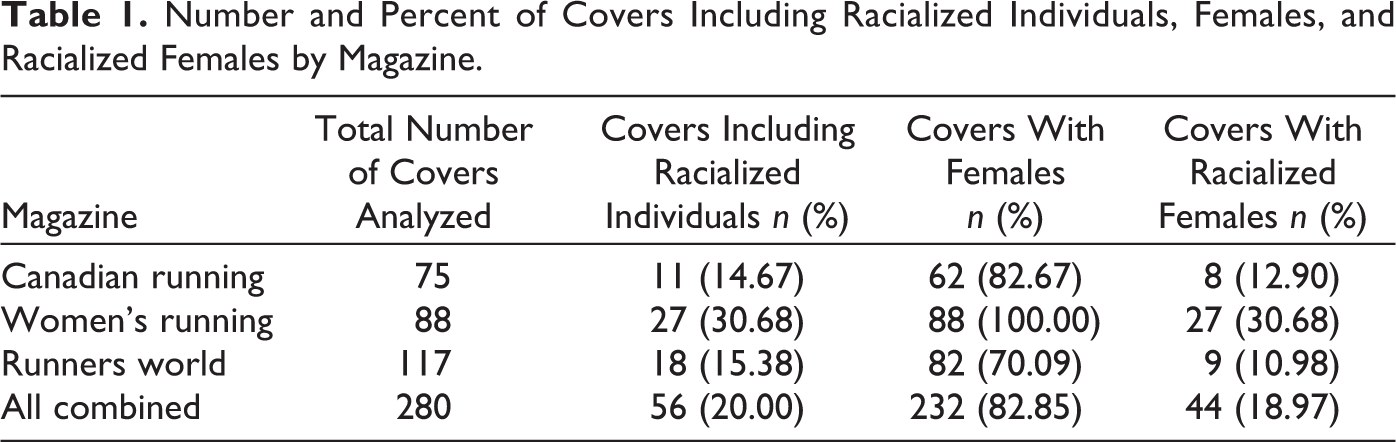
Results revealed that racialized individuals were featured on approximately twenty percent of all covers (n = 56, p < .001), 15.38% of Runner’s World covers (n = 18, p < .001), 30.68% of Women’s Running (n = 27, p < .001), and 14.67% of Canadian Running magazine (n = 11, p < .001; see Table 1).
Number and Percent of Covers Including Racialized Individuals, Females, and Racialized Females by Magazine.
The Representation of Gender
Female athletes were featured on 82.85% (n = 232, p < .001) of all covers. As expected, 100% of the Women’s Running covers featured female athletes including one transgender athlete (n = 88), of these 30.68% (n = 27) were racialized athletes. Out of the 117 Runner’s World covers, 70.09% (n = 82) featured female athletes and 10.98% (n = 9) of these represented a racialized female athlete. Male athletes were featured on 35.04% (n = 41) of Runner’s World covers, of which 26.83% (n = 11) featured a racialized male athlete. Of the 75 Canadian Running covers analyzed, 82.67% (n = 62) featured a female athlete, with 12.90% (n = 8) featuring a racialized female athlete. The remaining 18.67% (n = 14) of the Canadian Running covers featured a male athlete, of which 28.57% (n = 4) represented a male racialized athlete.
Overall, 65% of females were shown partially clothed in sports bras (n = 124) and 27% of male athletes were shirtless (n = 15; p = .003). There were 44 covers that featured racialized females, 39 of which displayed their entire torso; 188 covers that featured non-racialized females, 183 of which displayed their entire torso. There was a meaningful and statistically significant difference in the percent of covers with women in sports bras vs shirts for racialized and non-racialized women. Fourteen (35.9%) of the 39 covers of racialized women and 112 (59.57%) covers of non-racialized women had the women in sports bras (χ2, p = .006), the remainder had the women in shirts covering their torsos.
Active Versus Passive Roles
When the images were analyzed by the role/motion of the individual (active vs. passive) it was found that overall 196 covers included active roles and 83 were passive and one cover included a group of individuals with five in passive roles and one in an active role. There were no significant differences between racialized and non-racialized females in terms of motion. Of the 232 covers with females on them 167 (72.0%) were in active roles. This was similar for covers featuring racialized females with active roles for 72.7% (n = 32). Sixty percent (n = 33) of the 55 covers with males on them featured men in active roles.
Changes in Representation over Time
When we examined representation of racialized athletes by year, we found that Runner’s World featured no racialized athletes in 2009 or 2014. Prior to 2015, an average of 8.62% of covers per year featured a racialized athlete, whereas in 2015 and after, an average of 26.41% of covers per year featured racialized athletes, a meaningful and statistically significant difference (p < .02). Canadian Running featured no racialized athletes in 2011 and 2013, with no identifiable changes over the decade (p = .91). Women’s Running demonstrated improvement over time in the representation of racialized athletes. There were no racialized athletes featured from 2009 to 2012, however, in 2013, there was a meaningful and sustained increase. On average, Women’s Running released approximately 4 issues annually featuring racialized athletes from 2013 to 2019, representing 40% (n = 27) of the 66 issues they released during that time (Table 2, Figure 1). There were no significant changes over time in gender representation.
Number of Covers Including Individuals From Racialized Minorities by Year.
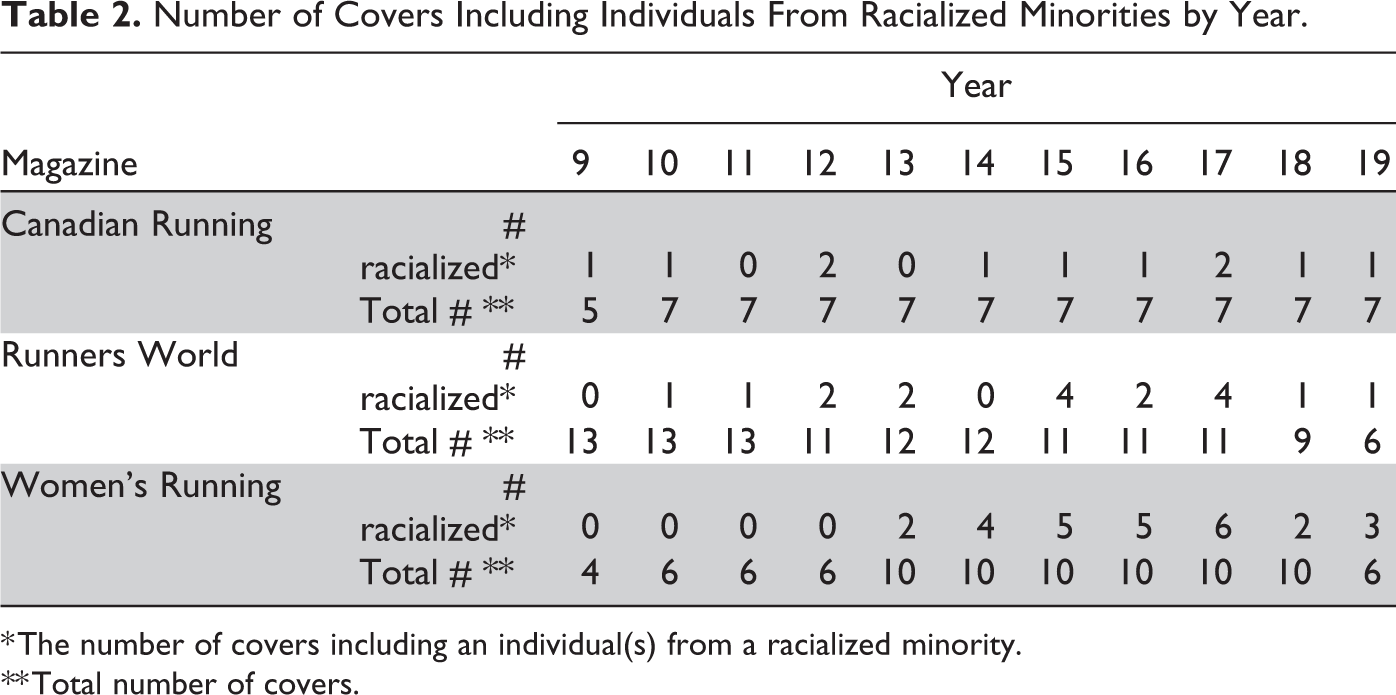
* The number of covers including an individual(s) from a racialized minority.
** Total number of covers.
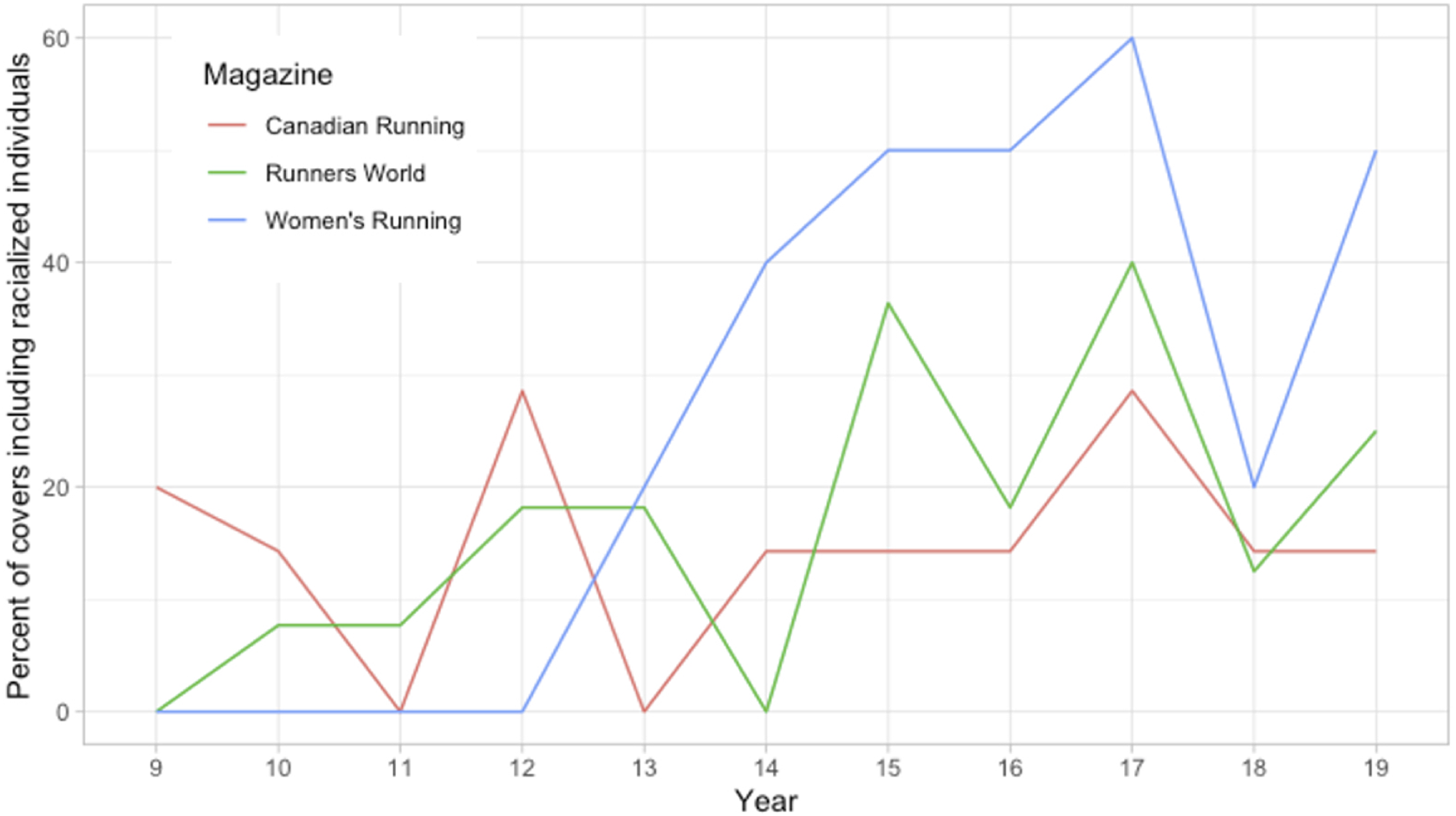
Percent of covers including racialized individuals by year.
Discussion
To our knowledge, this is the first visual content analysis of North American running magazine covers. This work contributes to, and builds upon, research in sport and media by using an intersectional approach to understand the ways that the representation of cover athletes/models functions as an exercise of power. A number of researchers have pointed to the disparities in representation of race and gender (Carter-Francique & Richardson, 2016; Frisby, 2017; Fürsich, 2010; Weber & Carini, 2013; Zenquis & Mwaniki, 2019). These are not surprising given the dominance of white males in high level sporting positions (Lapchick et al., 2018)—which perpetuates organizational decisions (such as who should be on magazine, and why) and reinforces interests of dominant groups (Fürsich, 2010; Lapchick et al., 2018; Zenquis & Mwaniki, 2019). Below, we will further discuss the complexity of representation—by looking specifically at intersections of race and gender, contextualizing power within the larger sporting and media context.
Race
The results presented in this paper align with previous studies on the underrepresentation of racialized athletes on the covers sporting magazines (Denham, 2020; King et al., 2002; Lawrence, 2016; Leath & Lumpkin, 1992; Primm et al., 2007). These studies found that Black, Native American, and South Asian athletes have been found to have particularly low levels of representation in comparison to other racialized individuals (King et al., 2002; Lawrence, 2016). Despite improvements in representation of racialized minorities in the latter half of the decade for both Runner’s World and Women’s Running, Women’s Running was the only magazine with any period of time with substantial representation (40%). The lack of improvement in representation of racialized minorities by Canadian Running is in line with other findings that show a lack of improvement in representation over time (Denham, 2020; Leath & Lumpkin, 1992). This reflects the ongoing stereotype that racialized individuals are either unworthy of representation or are unmarketable to the general public. Not only does this trivialize the accomplishments and participation of racialized athletes, but it also Others and alienates racialized athletes from sports narratives, positioning non-racialized runners as the “default” athlete.
The lack of representation of racialized individuals is harmful, but not surprising considering the identities of the individuals who control and shape sports media (Zenquis & Mwaniki, 2019). According to the 2018 Associated Press Sports Editors Racial and Gender Report Card, 85% of all sports editors, 77.7% of the copy editors/designers, and 82.1% of reporters were white (Lapchick et al., 2018). If those responsible for determining who is represented in a magazine are all from dominant groups, it is less likely that they will notice the lack of representation of people who are not white, male, and/or hegemonically attractive. Ultimately, the lack of representation indicates that racialized individuals do not have the opportunity to represent themselves (or to demand representation), but rather, must rely on members of the dominant group to decide to include them in media publications (Zenquis & Mwaniki, 2019). While there has been an overall improvement in the number of racialized individuals in sports media positions over time, they still only hold 15% of all jobs (Lapchick et al., 2018). Clearly, the problem of representation is but one aspect of the sports media empire that merits critical intersectional analysis. As a result, discussions about representation must consider the ways power flows through the relationship between magazine editors, publishers, and representations. We must interrogate who is making key decisions, and why these decisions are made.
Furthermore, these results are not representative of population demographics of Canada and the United States. According to the 2016 census, approximately 21.8% of the Canadian population was considered a “visible minority,” or a racialized individual (Statistics Canada, 2016). Thus, the number of racialized individuals featured on Canadian Running covers is not representative of the Canadian population. While it was more challenging to calculate racialized individuals using US census data, it is reported that 60.1% of individuals identify as “White alone, not Hispanic or Latino. (U.S. Census Bureau, 2019). During the 11-year time period examined, both Women’s Running and, to a greater extent, Runner’s World covers were not representative of the U.S. population. This must be rectified to ensure representation of racialized individuals, which is one of many important steps to changing the culture of running.
Racialized male runners were represented more often than racialized female runners (with the exclusion of Women’s Running). Racialized female athletes have historically been marginalized in sports, as they occupy an intersection between two highly marginalized identities in a white, male dominated industry (Carter-Francique & Richardson, 2016; Christoffersen, 2017; Zenquis & Mwaniki, 2019). While racialized male runners experience marginalization through one aspect of their identity, racialized female runners experience it along the axes of two intermingling vectors: race and sex. Despite their marginal status in the sports world, racialized male runners have a form of privilege not afforded to racialized female runners. This study shows that decision-makers at major running magazines must strive for greater representation of racialized athletes, with a specific focus on racialized females as they exist at a particularly vulnerable intersection.
Gender
The differential treatment of athletes on the basis of their gender in sports media has been well documented in past research (Bernstein, 2002; Bishop, 2003; Buysse & Embser-Herbert, 2004; Cooky et al., 2013; Fink & Kensicki, 2002; Hardin et al., 2002). Buysse and Embser-Herbert (2004) recognized that gender stereotypes are maintained by sport and media through gender inequality. Given the ways sports media tends to perpetuate gender stereotypes and inequalities, it is important to consider the way in which media represents female athletes in comparison to their male counterparts. Interestingly, the results from this study indicate that women are overrepresented, and that men are underrepresented in all three of the running magazines analyzed. These findings are largely in contrast with other research which has revealed that male athletes are far more common on sport magazine covers than females (Frisby, 2017; Weber & Carini, 2013). This may suggest a shift towards greater inclusion of women in current media culture. Since the passage of Title IX, there has been an increase in women’s professional sport leagues and female sport participation (Frisby, 2017). Thanks to the running boom, participating in recreational jogging and road races has risen dramatically. It is possible that the increase in female representation is as a result of these factors, as women are now a viable target audience for magazines and advertisers therein. This might also be the product of changes happening at the organizational level to incorporate more females after years of underrepresentation.
Alternatively, the findings from this research align with reports that reveal women are hypersexualized in media (Fink & Kensicki, 2002; Frisby, 2017). When considering the number of portrayals on magazine covers, it is clear that women’s sports were not minimized, however, the manner in which they were depicted may trivialize their participation. The majority of female athletes (65%) were shown partially clothed, wearing sports bras revealing their torso. In contrast, the vast majority of male counterparts were depicted with t-shirts and were only shirtless on 27% of the covers. This result suggests that there is a relationship between gender and clothing worn by athletes on magazine covers, which aligns with previous research that found female athletes objectified and sexualized by the clothing they wore in comparison to their male counterparts (Frisby, 2017). It should be noted, however, that in this study there was no statistically significant difference between active and passive poses seen in males versus females, which has been previously documented in other studies (Fink & Kensicki, 2002). By highlighting adherence to hegemonic beauty rather than emphasizing athletic qualities, these magazines reify socially constructed gender roles and undermine the inroads they have made to diverse representation of female athletes (Fink & Kensicki, 2002). Frisby (2017) recognized the impact that these images may have on young girls, who may interpret the images of partially dressed athletes as the ideal to gain media attention. These findings can have further implications as pointed out by Weber and Carini (2013), who noted that women portrayed in this type of manner can send the message that athleticism and skill are not enough, and that female athletes must emphasize their beauty or sexiness. As a result, simply representing women is not enough, and the magazines we discuss in this study must consider whether their inclusion of female athletes situates these individuals as runners, or simply as objects for consumption.
In a male-dominated and controlled industry, it is easy for the accomplishments of female athletes to be marginalized and their importance to be reduced (Lapchick et al., 2018). According to the 2018 Associated Press Sports Editors Racial and Gender Report Card, 90% of sports editors, 79.6% of the copy editors/designers, and 88.5% of the reporters were men (Lapchick et al., 2018). Thus, the representation of female athletes is lacking, in part, due to limited women in positions of power to advocate for representation. The trivialization and underrepresentation of racialized female athletes, in comparison to non-racialized female athletes can also be linked to the small fraction of sports media positions occupied by racialized women (Lapchick et al., 2018). With an inadequate number of racialized women in positions of power and limited improvement over time, racialized women continue to be missing from decision-making positions. Racism and sexism make them less likely to be featured as cover athletes, but also less likely to be in a position of advocacy for change. As Ray (2014) has argued, “gender and race are not separate and additive but interactive and multiplicative in their effects” (p. 782), thus through an intersectional approach we see how race and gender are intertwined in influencing leisure sport participation. This contributes to limited improvements in representation, which must be addressed in order to provide adequate representation of racialized women in particular.
Study Limitations
As is the case with all research, this study has several limitations. Our methodology of visually identifying and categorizing individuals on the covers of the magazines we analyze is fraught: our identification might not match how individual athletes/models see themselves, and risks erasing the specificity of their experiences. In an effort to examine how race operates in sporting media, the process of identifying racialized individuals (anyone who was visibly ‘non-white’) repeated the same problematic process that has historically been used to exclude racialized groups from all aspects of society, that is, assigning racial categories to people who visually are not white. While visual identification provides theoretical maneuvers to understand race and power (Gonzalez-Sobrino & Goss, 2019) we must be mindful of the ways in which this process of categorization may perpetuate the very marginalization we contest. Moreover, the scope of this study was limited to only three popular North American running magazines. It is likely that different trends would be observed with the inclusion of running magazines from other regions of the world. Furthermore, only magazine covers were analyzed, and it is possible that there were greater levels of representation within the magazine issue itself.
Recommendations and Future Research Directions
Lack of representation of magazine covers is but one cog in the ideological machinery that allows racism and sexism to exist. Representation in running magazines and subsequently, participation in running, reflects and reinforces wider social inequities and discourses around who is entitled to occupy public space by running, and how they should look while in motion. In order to create effective change, we need greater diversity of representation on running magazines covers, and to problematize issues that impact non-white runners within the pages of these publications. While our study found that women are over-represented on magazine covers, we must critically examine other facets of this representation, such as their sexualization and homogeny, which reveals “many forms of looking relationships occur in contemporary society, but the normative white heterosexual male gaze is a key process of heterosexuality and racial exclusion” (White, 2017, p.76). The meaningful interrogation of media companies includes critiquing the power wielded by those who decide which bodies grace the covers of magazines. Meaningful change requires a cultural shift within sport media systems, and women and racialized individuals must work in positions of leadership and power.
Conclusion
The study aimed to visually assess representational patterns on three popular running magazine covers. Racialized individuals, particularly racialized women, are underrepresented across the three popular running magazines. Taking proportional representation into account (at a minimum), Runner’s World and Canadian Running are still below the threshold of reported National population percentages of racialized peoples. This critical examination demonstrates the ways in which lack of representation may hinder access, opportunities, and participation in running and puts specific populations at risk while engaging in a recreational activity. The implications of greater inclusivity of racialized individuals on magazine covers go beyond creating a “welcoming” space—it can be a matter of life and death. As the murder of Ahmaud Arbery demonstrates, it is a crucial time for representation of racialized runners as an anti-racist approach to disrupt the deeply embedded discourse of who can safely run. Improved representation of racialized individuals on magazine covers may be one strategy to progress inclusivity and accessibility of running, as representation constructs meaning. We urge popular sport magazines to improve the transparency of their publishing policies and practices, publicly commit to improving diversity on magazine covers, and implement measurable and transparent metrics. There is an urgent need for media to consider who is being portrayed and the ways in which athletes are portrayed. This can be achieved by demanding diversity on popular running media and making a commitment to content that is appealing to a broader audience of runners. It is imperative that images of racialized and minority athletes are normalized in order to enhance access, inclusivity, and safety of all runners.
Footnotes
Declaration of Conflicting Interests
The author(s) declared no potential conflicts of interest with respect to the research, authorship, and/or publication of this article.
Funding
The author(s) disclosed receipt of the following financial support for the research, authorship, and/or publication of this article: This work was supported through a Social Science and Humanities Research Council (Grant ID# 430-2020-01085).
