




Abstract
This study examined the relationship between role-taking ability and school liking or school avoidance in late childhood. Participants were Grades 5 and 6 Japanese children (N = 187; 107 boys and 80 girls). To assess the role-taking ability of elementary school children, the study used a hypothetical dilemma task, in which the main character encounters a dilemma in a rule or moral situation within a school context. The School Liking and Avoidance Questionnaire was used to measure children’s emotional adjustment to school. The relationship between school liking and developmental stages of role-taking ability in rule and moral situations was evaluated. Significant stage-based differences in school-liking scores were found in both rule and moral situations. In examining the relationship between school avoidance and role taking, significant developmental effects were found only with respect to role taking in rule situations.
Introduction
As children mature and develop, their cognitive growth allows them to gain a new understanding of themselves and others. A critical aspect of this development is the child’s growing capacity for “role taking” (Altshuler & Shipman, 2009). Role-taking ability means considering the viewpoints of other persons and is at the core of cognitive development theories of social and moral development (Crawford & Power, 2008). Role taking is described as the ability to understand someone else’s “thoughts,” “feelings,” and “points of view.” As children become less egocentric and increasingly able to understand and coordinate multiple dimensions of interpersonal experiences, their role-taking ability improves (Astington, 1993; Shantz, 1983). Psychologists studying development and cognition tend to agree that the capacity to consider another person’s point of view contributes substantially to an individual’s social capability and comprises a complex set of skills (Barnes-Holmes, McHugh, & Barnes-Holmes, 2004). Robert Selman is credited with elaborating upon the concept of role-taking ability (Altshuler & Shipman, 2009). Selman (1980) emphasized the relationship between the development of role-taking ability and the growth of interpersonal understanding. As children’s role taking improves, their abilities to understand psychological processes (their own and those of others) lead to enhanced empathy and communication as well as problem-solving skills (Chandler, 1973; Selman & Schultz, 1990). Coordinating the perspectives of self and others makes it possible to have a sense of morality and allows us to develop enduring interpersonal and social relationships (Crawford & Power, 2008) and children with deficits in role-taking ability may have problems relating to others (Hildyard & Wolfe, 2002; Lyman & Selman, 1985).
Using Kohlberg’s interview methodology (Kohlberg, 1969), Selman has studied the development of role-taking ability by asking children to comment on a number of interpersonal dilemmas (Selman, 1976). Procedures for measuring role-taking ability were developed by Selman and Byrne (1974). In Selman’s procedure, a story that poses a hypothetical interpersonal dilemma for the main character is read to the child. The child is then asked several questions about how to solve the problem. An example is provided below (Selman & Byrne, 1974): Holly is an 8-year-old girl who likes to climb trees. She is the best tree climber in the neighborhood. One day while climbing down from a tall tree, she falls but does not hurt herself. Her father sees her fall. He is upset and asks her to promise not to climb trees any more. Holly promises. Later that day, Holly and her friend meet Shawn. Shawn’s kitten is caught in a tree and can’t get down. Something has to be done right away or the kitten may fall. Holly is the only one who climbs trees well enough to reach the kitten and get it down, but she remembers her promise to her father.
After reading the story, the interviewer asks the following questions to assess how well the child understands the perspectives of Holly, her father, and Shawn:
Does Holly know how Shawn feels about the kitten? How will Holly’s father feel if he finds out she climbed the tree? What does Holly think her father will do if he finds out she climbed the tree? What would you do in this situation?
Selman’s Stages of Role-Taking Ability.

Role-taking ability appears to be a prerequisite for the emergence of prosocial behavior involving cooperation and altruism (Chandler, Sokol, & Winery, 2000). Previous studies have shown that children’s role-taking ability is positively correlated with their cooperation at r = .21 (Denham et al., 2003; Mostow, Izars, Fine, & Trentacosta, 2002). Furthermore, Kagan and Knudson (1983) indicated that the role-taking ability is positively correlated with the classroom behavior such as altruism (r = .30). Also, Ensor, Spencer, and Hughes (2011) found that the role-taking ability is positively correlated with the classroom behavior such as helping and sharing (r = .52).
Children who are prosocial adjust themselves relatively well at school and have better peer relationships than children who are less prosocial (Clark & Ladd 2000). Prosocial characteristics, such as cooperativeness and kindness, have been associated with being popular among classmates (Cillessen & Rose, 2005). Conversely, aggressive behaviors, such as fighting, have been associated with rejection by classmates (Rodkin, Farmer, Pearl, & Van Acker, 2000). In addition, Dijkstra and Gest (2015) found that prosocial behavior is positively correlated with academic achievement. There is also evidence for a positive correlation between children’s early prosocial behavior and later academic achievement (β = .57, Caprara, Barbaranelli, Pastorelli, Bandura, & Zimbardo, 2000).
Prosocial behavior plays an important role in school adjustment. However, prosocial behavior is only one aspect of school adjustment. In recent years, school adjustment is often measured through children’s classroom behavior and school emotion (Way, Reddy & Rhodes, 2007). School emotions, defined as children’s sentiments toward school such as school liking and avoidance (Ladd & Dinella, 2009), have been the focus of quantitative measures of children’s emotional adjustment to school (Buhs & Ladd, 2001). School liking has been defined as the extent to which children profess to like or dislike school, and school avoidance has been defined as the extent to which children express a desire to avoid school (Ladd, Kochenderfer, & Coleman, 1996). Certain behavioral characteristics have been identified as important precursors to school emotions among elementary school aged children (Kwon, Kim, & Sheridan, 2014). School liking is related to children’s progress and success in school (Valiente, Swanson, Lemery-Chalfant, 2012). Children who like school and become involved in classroom activities are more likely to profit from their educational experiences (Ladd, 1990). In contrast, negative sentiments toward school lead to avoidance or withdrawal from the school (Ladd, 1990).
Children’s affective reactions to school have an influence on their subsequent school adaptation (Bogat, Jones, & Jason, 1980; Ladd, 1989, 1996). Honma and Uchiyama (2014) showed that the degree to which children liked school was positively correlated with their schoolwork, their sense of belonging at school, and their making friends. School avoidance was negatively associated with schoolwork, a sense of belonging, and teacher–child relationships. Adjustment to school is one of the most significant predictors of psychosocial outcomes during the schooling years and into adulthood (Pears, Kim, Capaldi, David, & Fisher, 2012). Alexander and Entwisle (1988) have argued that children’s school liking is a powerful determinant of subsequent psychosocial development. Similarly, children’s negative attitudes predict later lack of participation and achievement (Ladd, Bush, & Seid, 2000). However, in assessments of school liking from kindergarten to sixth grade, school liking gradually decreases as children progress through the higher grades (Smith, 2011). Hence, it is important to identify the factors that promote school liking and decrease school avoidance.
In the classroom behaviors, prosocial behavior is a precursor to school liking (β = 0.17; Kwon et al., 2014). As described earlier, role-taking ability was positively correlated with prosocial behavior (e.g., Denham et al., 2003; Ensor et al., 2011; Kagan & Knudson, 1983; Mostow, Izard, Fine, et al., 2002). Therefore, role-taking ability is potentially associated with school liking and school avoidance, although the relationship has not yet been investigated.
Role-taking ability is essential for social and moral education (Crawford & Power, 2008), with exposure to different viewpoints playing a critical role in moral development (Eisenberg, 1986). Honma and Uchiyama (2005) shown that role-taking ability is positively correlated with the family atmosphere (r = .54). However, as children frequently cooperate with each other in school activities, school offers important opportunities for gaining access to different viewpoints, leading to enhanced role-taking ability (Carlo, Fabes, Laible, & Kupanoff, 1999). Not only children’s families but also the school context where thoughts and perspectives are learned from people other than family members (e.g., teachers and friends) would play an important part in role-taking ability. Therefore, this study focused on analyzing the development of the role-taking ability with particular focus on the school context.
In school, children’s social interactions occur within two distinct contexts: social conventions and morals (Nucci & Turiel, 1978; Smetana, 1981; Turiel, 1977, 1978). Drawing from philosophical perspectives, social conventions are defined as consensually determined uniformities, expectations, or rules that coordinate individual’s interactions within different social systems (Turiel, 1983). In the school context, social conventions underlie classroom rules and their main function is to regulate children’s behavior in the classroom (Thornberg, 2006). For example, social conventions include rules such as not eating with the hands, not chewing gum in class, not calling teachers by their first names, and not talking without raising one’s hand. On the other hand, morality concerns justice, welfare, and rights that are seen as developmentally and conceptually distinct from social conventions (Turiel, 1977, 1978). Morals are considered prohibited actions even though they are unrelated to rules (Turiel, 1977, 1978). For example, morals prohibit actions such as lying, stealing, bullying, and killing (Turiel, 1983).
Previous studies on children’s conceptual understanding of social conventional rules and morals suggest that children are able to distinguish social conventional rules from morals (Much & Shweder, 1978; Nucci & Nucci, 1982; Nucci & Turiel, 1978). Note that social conventional rules and morals are distinguished concepts. Smetana (1981) found that 3- and 5-year-old children differentiate actions based on social conventions from those based on morals. Recent research has focused on how children balance and apply different moral and social concepts (Smetana, Jambon, & Ball, 2014). Turiel (1983, 2002, 2006) stated that children’s daily social experiences contributed to the development of moral judgments. Both the rules and morals are essential for children’s adaptation to school. Therefore, this study makes an attempt to analyze school context at both aspects of rule and moral situations.
Selman and Byrne’s (1974) study on role-taking ability focused on hypothetical scenarios involving interpersonal dilemmas similar to those developed by Kohlberg (1969), with appropriate modifications implemented for use with young children. For that reason, Selman and Byrne’s scenarios did not involve dilemmas within a school context.
The present study, on the other hand, assessed role-taking ability in elementary school. The aim of the present study was to examine the relationships between stages of role-taking ability in rule and moral situations and school liking or school avoidance within a school context. Since Selman and Byrne (1974) did not include the school context in their study, stories in this study were used particularly within a school context, involving either rule (i.e., social conventional) or moral situations in which the main character encountered a hypothetical dilemma that developed by Honma and Uchiyama (2002). Two important hypotheses were taken into consideration in this study: Hypothesis 1. In rule and moral situations within a school context, children at a higher developmental stage of role-taking ability show higher school liking than children who are at a lower developmental stage of role-taking ability. Hypothesis 2. In rule and moral situations within a school context, children at a lower developmental stage of role-taking ability show higher school avoidance than children at a higher stage of role-taking ability.
Based on the two hypotheses, the goal of this study was to quantitatively examine the relationship between the stage of role-taking ability in rule and moral situations within a school context and the degree of school liking and school avoidance. To our knowledge, none of the previous studies have examined the relationship among them. It is expected that the results of the present study would contribute to improving the school adjustment for children.
Method
The purpose and methods of this research as well as the ethical considerations pertinent to the study were explained to the school principal. The survey was conducted after written consent was obtained from the principal. This study received approval from the Niigata University Ethical Advisory Committee.
Participants
Participants were fifth- and sixth-grade children (N = 187) attending a public elementary school in Japan. Of the 187 participants, 107 were boys, and 80 were girls. One school participated in this study. The school was located in an urban area and was attended primarily by middle-class students.
Measures
Role-taking ability
We used a hypothetical dilemma task developed by Honma and Uchiyama (2002), in which the main character encounters a dilemma in a rule or moral situation within a school context. Their task is similar to Holly’s dilemma story task in Selman and Byrne (1974), with an exception that Honma and Uchiyama’s task presents a dilemma in a rule or moral situation within a school context. In the process of validating their task, Honma and Uchiyama compared role-taking ability assessed by the Holly’s dilemma story task with that assessed by their task. They found a moderate positive correlation between the two in moral situations (r = .42). They also found a positive correlation in rule situations (r = .18). Five elementary school teachers (years of teaching experience: M = 22.60, SD = 9.89) reviewed the contents of the stories in the task, and all of them reported that the stories properly reflect rule and moral situations in the school context. The sex of the main character was matched to that of each participant. The stories and items (Q1-Q5) on the answer sheet are shown in the Appendix.
Four developmental stages of role-taking ability in the present study were assessed, based on the developmental stage of Selman and Byrne (1974), 1 point (Stage 0: egocentric undifferentiated perspective); 2 points (Stage 1: differentiated and subjective perspective-taking); 3 points (Stage 2: self-reflective/second-person and reciprocal perspective); and 4 points (Stage 3: third-person and mutual perspective-taking).
School liking and avoidance
The participants completed the School Liking and Avoidance Questionnaire developed by Ladd and Price (1987) to measure their emotional adjustment to school. This measure is available in a self-report version (Ladd & Price, 1987), a teacher-report version (Ladd et al., 2000), and a parent-report version (Ladd et al., 2000). The self-report version, which has been translated into Japanese (Ohtsui, Hotta, Takeshima, Mastumi, & Ladd, 2006), was used in this study. This version consists of nine items regarding school liking (e.g., “Is school fun?” “Are you happy when you’re at school?”) and five items regarding school avoidance (e.g., “Do you wish you didn’t have to go to school?” “Would you like it if your Mom or Dad let you stay home from school?”), yielding a total of 14 items. Items were scored on a 5-point scale with the following response choices: “strongly disagree” (1 point), “disagree” (2 points), “neither agree nor disagree” (3 points), “agree” (4 points), and “strongly disagree” (5 points).
Procedure
First, the homeroom teacher distributed a packet for assessing the role-taking ability that included stories in rule and moral situations, questions for each story, and the answer sheet (Appendix). To make the stories easily understandable to the children, three drawings were used as supplemental material.
After the children received the packet, the homeroom teacher read a story and the questions to the children. Afterward, the children answered the questions individually on their answer sheet. For a half of children, this was done for the rule story first and then for the moral story. For the other half of children, the order was reversed. Because it is difficult to implement this kind of a semi-structured interview with young children, the homeroom teacher properly prompted the children to complete the answer sheet in the classroom.
After the children completed the answer sheets for role-taking ability, the homeroom teacher distributed a packet for the School Liking and Avoidance Questionnaire. The children completed the questionnaire in groups in their classroom.
As for developmental stages of role-taking ability, all answers were independently rated by two persons. The correspondence ratio of the rating for rule situations and moral situations are 93.0% and 94.1%, respectively. When the raters’ scores did not match, they resolved the discrepancy by discussing the participants’ responses and decided the final score together. In addition, the third rater, who was also blind to the details of the study, independently rated the question on which the previous two raters disagreed. The score of the third rater was always consistent with the score from the previous two raters.
Analyses
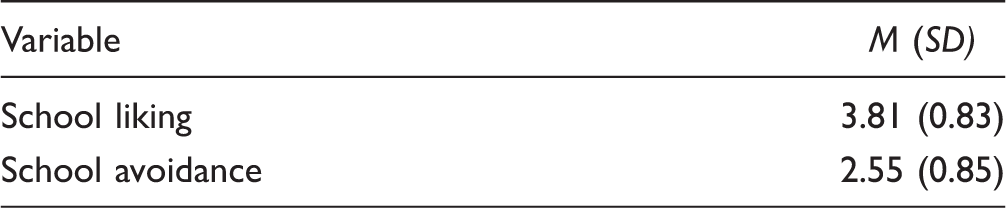
Two sets of analyses were performed to examine any associations between role-taking ability and school liking or avoidance. In the section below, descriptive statistics will be presented first including the means and standard deviations from the School Liking and Avoidance Questionnaire and the percentage of students at each stage of role-taking ability in rule and moral situations. Second, the relationship between median scores of School Liking and School Avoidance and the various stages of role-taking ability in rule and moral situations was determined by applying the Kruskal-Wallis test and conducting multiple comparisons. All statistical analyses were performed with SPSS version 22.
Results
Descriptive Statistics
Means and Standard Deviations for School Liking and School Avoidance Scores.
Percentage of Participants at Each Stage of Role-Taking Ability in Rule and Moral Situations.

Kruskal-Wallis Analyses
Median Scores of School Liking Across Stages of Role-Taking Ability.
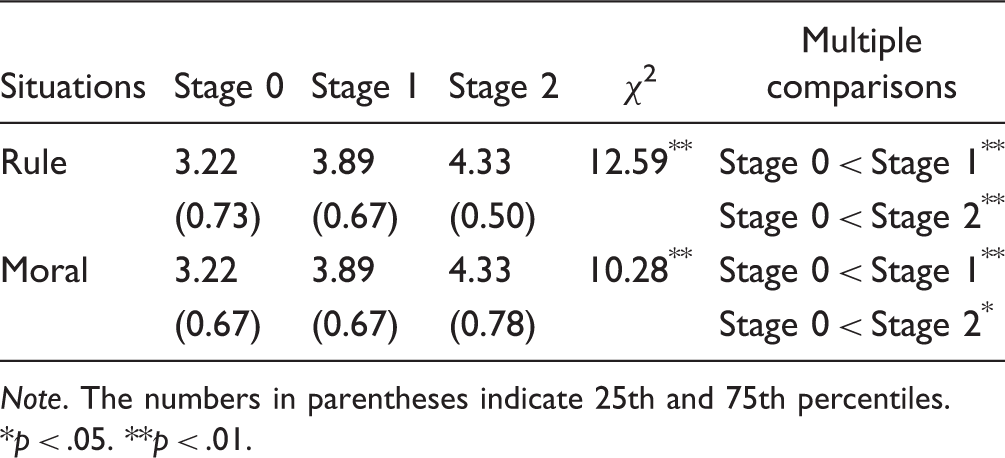
Note. The numbers in parentheses indicate 25th and 75th percentiles.
p < .05. **p < .01.
Only one participant, a fifth-grade girl, exhibited Stage 3 role-taking ability in the moral situation; therefore, this participant was removed from the analysis. A significant difference was found in school liking scores based on role-taking ability in both rule and moral situations. To examine the difference in scores between stages, multiple comparisons were conducted using the Mann-Whitney U test. For rule situations, school liking scores at both Stages 1 and 2 were higher than that at Stage 0. The results for Stages 1 and 2 are as the following: (a) Stage 1: Mann-Whitney U = 1695.50, z = −2.99, p < .01, r = .23; (b) Stage 2: Mann-Whitney U = 134.00, z = −2.90, p < .01, r = .40. Similarly, for moral situations, school liking scores at Stages 1 and 2 were higher than that at Stage 0. The results for Stages 1 and 2 are as the following: (a) Stage 1: Mann-Whitney U = 1408.00, z = –2.89, p < .01, r = .22; (b) Stage 2: Mann-Whitney U = 184.50, z = −2.20, p < .05, r = .31.
Median Scores of School Avoidance Across Stages of Role-Taking Ability.

Note. The numbers in parentheses indicate 25th and 75th percentiles.
p < .10. *p < .05. **p < .01.
Discussion
This study was aimed at examining the relationships between stages of role-taking ability in rule and moral situations and school liking or school avoidance within a school context. This study tested the two hypotheses in rule and moral situations within a school context: (a) children at a higher developmental stage of role-taking ability show higher school liking than children who are at a lower developmental stage of role-taking ability, and (b) children at a lower developmental stage of role-taking ability show higher school avoidance than children at a higher stage of role-taking ability. The results provide support for both hypotheses. For both rule and moral situations, school liking was significantly different among the groups that differed in role-taking ability. Multiple comparisons revealed that in both situations, school liking scores were higher at both Stages 1 and 2 than at Stage 0. With respect to the relationship between stages of role-taking ability and school avoidance, a significant difference and trend were found for the rule and moral situations, respectively. Multiple comparisons revealed school avoidance scores of both Stages 1 and 2 were lower than those of Stage 0.
Generally speaking, role-taking ability is a cognitive capacity to consider the world from another individual’s viewpoint that allows a person to anticipate the behavior and reactions of others (Davis, 1983). Role-taking ability is positively related to children’s friendship quality (Smith & Rose, 2011), peer acceptance (Bosacki & Astington, 1999), and the development of conflict negotiation strategies in childhood and adolescence (Yeates & Selman, 1989). However, children at a lower stage of role-taking ability (i.e., Stage 0) possess the egocentric undifferentiated perspective in which they are unaware of any perspective other than their own (Selman & Byrne, 1974). This study showed that children in Grades 5 or 6 are still in a very lower developmental stage despite their actual age (see Table 1). On the other hand, children whose stage of role-taking ability was higher than Stage 0 (i.e., Stages 1 and 2) realize that other people can have a perspective that is different from their own.
The development of relative age-appropriate role-taking ability is essential because it involves a basic restructuring of children’s conceptual understanding of friendship, authorities, peer groups, and self (Selman, 1980). When children with age-appropriate role-taking ability encounter a friend who is in trouble or upset, the tendency to take the friend’s point of view should increase the likelihood of such children’s sharing in their friend’s affective state (Smith & Rose, 2011). However, poor role-taking ability relative to their actual ages is related to egocentrism, a state of undifferentiation between the self and non-self (i.e., Stages 0). Chandler (1973) also indicated that poor role-taking ability is related to aggressive behaviors. In addition, Cutting and Dunn (2002) found that children’s role-taking ability was positively related to their sensitivity to teachers’ demand. In the school context, children often encounter situations in which they have to behave with consideration for the viewpoints of the people around them (e.g., classmates and teachers). These results suggested that growing beyond the egocentric perspective is an important factor in school liking.
School avoidance refers to the extent to which children harbor negative emotions toward school and actively seek to avoid the classroom (e.g., asking to stay home; Ladd et al., 2000). Previous research has shown that cooperative participation in the classroom is related to school liking (Ladd & Dinella, 2009), whereas aggression in the classroom is one of the factors related to school avoidance (Kearney & Albano, 2000). Role-taking ability is associated with the ability to inhibit aggressive responses (Richardson, Hammock, Smith, Gardner, & Sigono, 1994). Higher role-taking ability is associated with lower aggression, including a greater number of positive and a lesser number of negative responses (Richardson, Green, & Lago, 1998). However, Sierkama, Thijs, Verkuyten, and Komer (2014) found that children with a lower stage of role-taking ability would express more refusals to receive assistance, compared with children with a higher stage role-taking ability. In addition, a lower stage of role-taking ability underlies the deficits in children and adolescents’ ability to differentiate and coordinate perspectives of self and other, which impairs their ability to establish positive and effective relationships with others (Lynch & Cicchetti, 1991; Toth, Cicchetti, Macfie, & Emde, 1997). School is a place in which children interact with others. Therefore, it is not surprising that children with poor role-taking ability had higher school avoidance.
Two limitations of the present study are noteworthy. First, improvement of role-taking ability is not always necessary for improvement of school liking and school avoidance. If the class atmosphere is friendly and accepting to children, children feel highly acknowledged. Such a class atmosphere would bring about positive effects on children’s school liking (Brand, Felner, Shim, Seitsinger, & Dumas, 2003; Ravens-Sieberer, Freeman, Kokonyei, Thomas, & Erhart, 2009; Waters, Cross, & Runions, 2009; Way, Reddy, & Rhodes, 2007). Therefore, it can be considered that children’s role-taking ability is not the only factor that is associated with their school liking. Second, all participants in the present study were recruited from one school. The external validity of the present study, therefore, may be questioned due to this limited sample. Additional research that recruits participants from several schools is needed to test the generality of the findings.
Future studies should address the following issues. First, although behavioral characteristics have been identified as important precursors to school emotions among elementary aged children (Kwon et al., 2014), classroom behavior was not measured in this study. Future research should examine the relationships between role-taking ability, classroom behaviors, school liking, and school avoidance. Second, in order to prevent the influence of gender difference in measuring the role-taking ability, the sex of the main character in the story task was matched to that of the participants in this study. Therefore, the effect of gender on the role-taking ability was not examined in this study. However, it is possible that the sex interaction is an important factor. Future research should analyze gender differences by revising the story task.
Although exploratory, the current study demonstrated the relationship between role-taking ability and school liking or school avoidance in late childhood. In particular, it is worth noting that, unlike the previous studies (e.g., Selman & Byrne, 1974), the relationship was obtained through the novel task that measured role-taking ability in rule and moral situations in the school context.
Children with conduct disorder and delinquent adolescents show deficits in role-taking ability (Lee & Prentice, 1988; Macquiddy, Maise, & Hamilton, 1987; Mullis & Hanson, 1983). However, if children and adolescents are trained on their role-taking skill, they can improve their role-taking ability, thereby improve prosocial behavior along with it (e.g., Burack et al., 2006; Chandler, Greenspan, & Barenboim, 1974; Iannotti, 1978; Marsh, Serafica, & Barenboim, 1980). Moreover, socially maladjusted (i.e., aggressive, disruptive, or antisocial behavior) children who received training programs designed to enhance role-taking ability, demonstrated increases in positive behavior (i.e., cooperation, being constructive) and decreases in negative behaviors (i.e., antisocial, disruptive) in the classroom (Chalmers & Townsend, 1990). Prosocial behavior represents one aspect of school adjustment, which has significant positive relationships with school liking (β = .17, Kwon et al., 2014). These results suggest that children who are at an early developmental stage of role-taking may benefit from these trainings. Taken together, the findings of this study suggest that children increase their school liking and decrease their school avoidance by improving their role-taking ability. The findings of this study also suggest that improving role-taking ability increases children’s emotional adjustment to school. Such findings have not been reported in the literature. We believe that these findings have a potential to contribute to the improvement of children’s school adjustment.
Footnotes
Declaration of Conflicting Interests
The author(s) declared no potential conflicts of interest with respect to the research, authorship, and/or publication of this article.
Funding
The author(s) disclosed receipt of the following financial support for the research, authorship, and/or publication of this article: This work was supported by JSPS KAKENHI Grant Number 26780505.