




Abstract
The term relative age effect (RAE) refers to age differences between athletes within the same cohort, and is frequently found within a plethora of sports. Less clear than the actual occurrence of the effect has been the strength of the effect across, and within, different sports, and also variations across sex, age, and skill level. In this study, we analyzed birth dates among the fifty top ranked alpine skiers in the World Cup system over the last twenty years. The analysis included both male (n = 238) and female skiers (n = 235) grouped into either a speed group (downhill and Super-G) or a technical group (slalom and giant slalom) based on World Cup points. The results show an RAE among the male skiers in the speed disciplines. No significant RAEs were found in men specializing in technical disciplines, and none at all in women. This finding demonstrates that the RAE can vary across subdisciplines within alpine skiing at the elite level.
Introduction
To avoid developmental discrepancies, sport federations and administrations typically group children based on their annual age. Although the grouping is well intended, it leads to a possible twelve months difference within the same-age cohort. Grondin, Deschaies, and Nault (1984) were among the first to assess the consequences of such annual-age grouping in sport, where their results identified significant and repeated overrepresentations of children born early in the cohort (i.e., the first three months after age-group cutoff dates). This difference in proportion of athletes born in the first quartile is commonly referred to as the “relative age effect” (RAE; Musch & Grondin, 2001).
While the RAE has been consistently demonstrated across sports and across sex and age, thus we know a lot about the actual occurrence of the effect, less is known about the variations in strength of the effect across, and within, different sports, and also variations across sex, age, and skill level. In a recent meta-analytical review, Cobley, Baker, Wattie, and McKenna (2009) demonstrated that the RAE in sport is a relatively consistent feature across the thirty-eight included studies published in the period 1984 to 2007. However, the authors also identified age category (youth vs. adult), skill level, and sport context as moderators of RAE magnitude. Specifically, young athletes (<18 years) in team sports such as basketball, soccer, and ice hockey appear to have the most pronounced RAE. As for skill level, the RAE is observed early in the development of athletes and the effect is stronger among pre-elite athletes than among elite athletes (Cobley et al., 2009; Schorer, Cobley, Büsch, Bräutigam, & Baker, 2009). Some researchers claim that the effect may be reversed at the elite level because relatively younger athletes develop superior skills to remain in the sport (Schorer et al., 2009) and that relatively older elite athletes drop out of sport earlier (Bäumler, 1998; Schorer et al., 2009). The RAE has been shown to be less prominent in women compared with men, and sometimes altogether absent (Cobley et al., 2009; Goldschmied, 2011). In general, there seems to be a paucity of studies examining the RAE in individual sports compared with team sports and the reported datasets were also conflicting (Cobley et al., 2009; Raschner, Müller, & Hildebrandt, 2012).
The proposed theoretical explanations for the RAE have commonly suggested greater likelihood of more advanced physical characteristics (e.g., body mass index, aerobic and anaerobic power, muscular strength) among relatively older athletes (Baker, Schorer, & Cobley, 2010; Schorer et al., 2009). This maturation hypothesis suggests that the chronological age reflects greater maturation at any given time and therefore contributes to developmental advantages (Baker et al., 2010). Being relatively older than the other participants might contribute to higher individual performance in many sports, especially sports requiring power, speed, and endurance (Schorer et al., 2009). A complementary explanation involves the process where the oldest athletes in their cohort are more likely to be selected by coaches partly due to their physical advantages, which in turn influences the volume of training and competition compared with the relatively younger athletes (and perhaps nonselected) peers (Musch & Grondin, 2001).
Although the maturation hypothesis can be applied to team and individual sports, physical differences can be counterweighed when there is a substantial degree of technical skills involved. RAEs have not been found in studies on technical sports such as figure skating, gymnastics, and golf (Baker, Janning, Wong, Cobley, & Schorer, 2014; Cobley et al., 2009). Indeed, a reverse RAE is found in sports where low weight and short height is an advantage, for example, rhythmic gymnastics and shooting (Baker et al., 2010; Delorme & Raspaud, 2009). In this regard, it has been suggested that the ski sports provide a particularly appropriate context to examine RAEs, given that both anthropometric characteristics and learned skills contribute to high-level performance (Baker et al., 2014; Turnbull, Kilding, & Keogh, 2009). Ski racing in alpine skiing is split into two speed and two technical disciplines, each with different physiological demands (Turnbull et al., 2009). The anthropometric demands in alpine skiing with large body masses are considered to be a competition advantage, especially in the speed events (Neumayr et al., 2003). Accordingly, alpine skiers born in the first quartile are found to be taller and heavier than the ski racers born in other quartiles (Müller, Müller, Hildebrandt, Kornexl, & Raschner, 2015).
RAEs in alpine skiing have been identified at the youngest level of youth ski racing (Müller, Hildebrandt, & Raschner, 2015; Romann & Fuchslocher, 2014b) and in youth Winter Olympics (Raschner et al., 2012). The effect also exists from a national level to an international level (Baker et al., 2014; Müller, Hildebrandt, et al., 2015), and even among racers earning at least one point in the alpine World Cup (Müller et al., 2012).
When attempting to tease out the more subtle differences within the RAE in alpine skiing, a relevant variable might be the skiers’ skill level. As this level increases, so does the degree of specialization and at the very top level, almost all are specialists. Thus, they specialize in either speed disciplines, within which (a large) body size is advantageous, or technical disciplines, within which the smaller athletes would be equally likely to excel.
The aim of the present study was to conduct the next step and examine whether RAEs could be identified within the very best alpine skiers ranked among the top fifty (men and women) in the alpine skiing World Cup across two decades, competing in all disciplines. These are skiers performing at the top level throughout a whole season, and not just in a single race. The hypotheses were that there would be a general effect of birth month across the sample, albeit more pronounced in the speed disciplines (Super-G and downhill) compared with the technical races (giant slalom and slalom) due to a valuable effect of being relatively heavier and taller (Neumayr et al., 2003). Furthermore, we did not expect an effect of relative age within female skiers in either subdiscipline.
Method
Participants
The top fifty male and female skiers each year in the total World Cup ranking list during the period 1995 to 2014 were selected for the present study. Because of overlap, this comprised a sample of 234 male and 235 female alpine skiers, respectively.
Design and Analysis
Data were collected from the FIS website (fis-ski.com) and included skiers’ birthdates, total World Cup points, and points from each individual discipline (slalom, giant slalom, Super-G, downhill, and combined). Initial screening of the dataset indicated that an unexpected proportion of the birthdates were January 1, and several of these had to be corrected in accordance with birthdates reported on other websites (Facebook, Wikipedia, etc.). Athletes were further categorized as either speed or technique specialists based on their accumulated FIS points in the different subdisciplines: Skiers with ≥90% of their FIS points in slalom/giant slalom were designated as technique specialists, and skiers who had accumulated ≥90 % of their FIS points in downhill/Super-G were considered to be speed specialists. The rationale for this categorization was that it might be expected that these disciplines require a substantial proportion of specialization in order to compete at the highest level (international elite level).
Analysis
In order to examine RAEs, athletes’ birth dates were categorized according to the cutoff date of January 1, which is the international cutoff date for youth skiing (FIS, 2015). Therefore, Quartile 1 included athletes born between January and March, Quartile 2 from April to June, Quartile 3 from July to September, and Quartile 4 from October to December. To assess differences among relative age quartiles, the observed distributions were analyzed against distributions of live births by month in the European Union (Eurostat, 2016) the past decade (twenty-eight countries, fifty-three million births) by Chi-square tests (χ2). Effect sizes for the chi-square tests were calculated with Cramer’s V (ϕ). Chi-square tests were also used to assess gender- and discipline-specific differences in RAEs, and odds ratios (ORs) and 95% confidence intervals (95% CIs) were calculated according to these categorizations. The statistical analyses were performed in SPSS (Version 21.0, IBM, US) and p < .05 was used as statistical significance criterion.
Results
Male Elite Alpine Skiers
Distributions of birth months for male elite alpine skiers are depicted in Figure 1. Chi-square analysis indicated a significant difference in the distribution of birth months for male alpine skiers, χ2 (3) = 8.8, p < .05, ω = 0.19, when compared with the birth month distribution in the EU statistics. When the data were spilt into disciplines, the χ2 analysis indicated that birth month distributions from male alpine skiers specializing in primary speed-related disciplines (downhill and Super-G) were significantly different from the expected distribution, while birth month distributions for male alpine skiers specializing in more technical disciplines (slalom and giant slalom) were not different from the EU distributions. The ORs, effect sizes, and the corresponding χ2 for each quarter according to discipline are presented in Table 1.
Relative age quartile distribution for male and female elite alpine skiers. Descriptive ORs and Corresponding χ2 Values and Effect Sizes (ϕ) Across All Relative Age Quarters for Disciplines and Separated for Gender. CI = confidence interval; OR = odds ratio;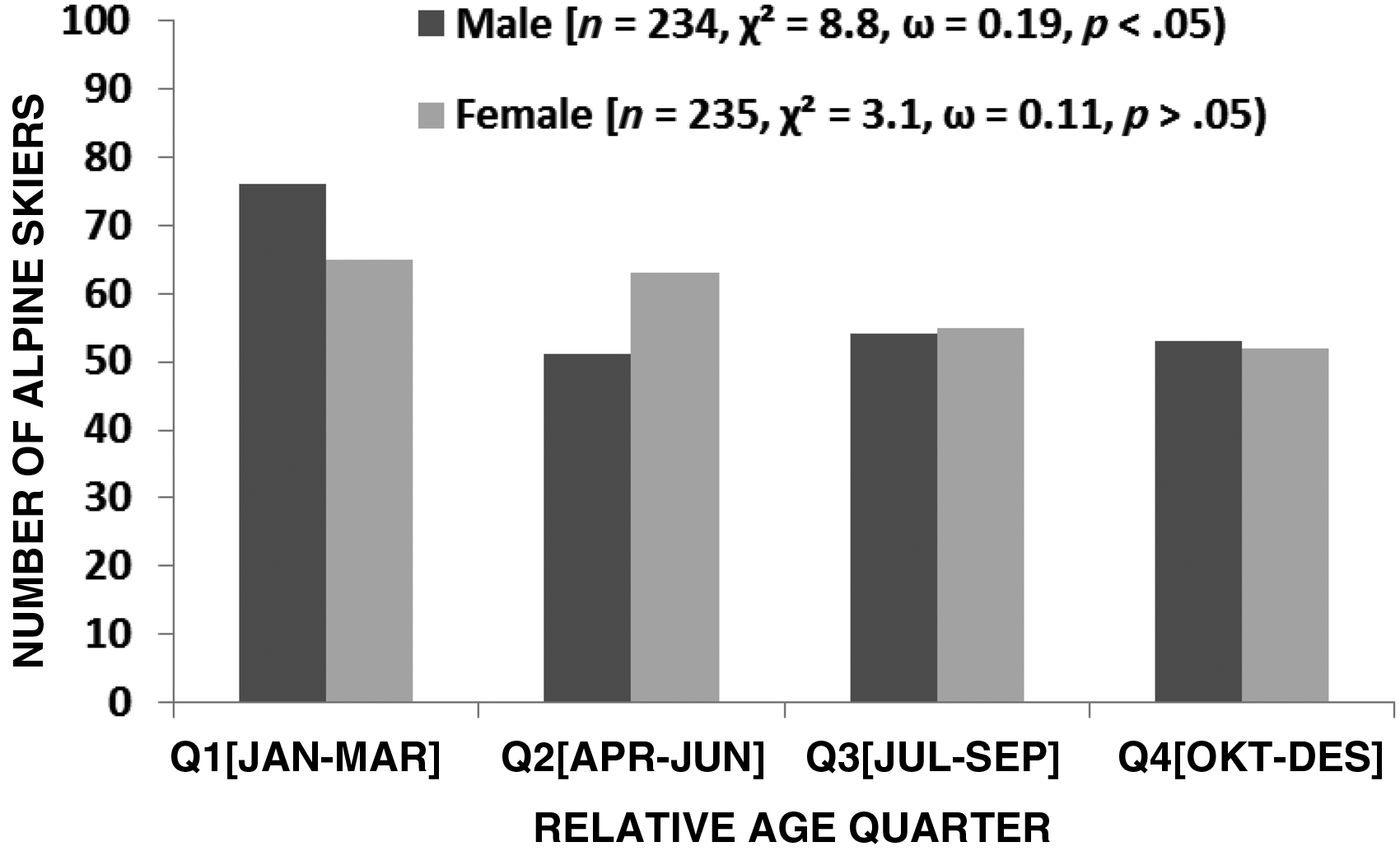

Female Elite Alpine Skiers
Overall, the χ2 analysis indicated no statistically significant difference in observed birth month distribution compared with the EU distribution for the female elite alpine skiers. This was evident in the overall distributions, χ2 (3) = 3.1, p < .05, ω = 0.11 (see Figure 1) and for the ORs, effect sizes, and corresponding χ2 for each quarter according to discipline (Table 1).
Discussion
As hypothesized, the RAE was present in top international alpine skiers. However, the RAE was only found in the speed disciplines for the men. No effect was seen in men specializing in technical disciplines, and none at all for women. Thus, an RAE persists all the way to the top-ranked alpine skiers in the World Cup for men in speed disciplines. This is consistent with previous findings at a national level for youth alpine skiers (Müller, Hildebrandt, et al., 2015; Romann & Fuchslocher, 2014b) and at an international level for elite skiers (Baker et al., 2014; Müller et al., 2012; Raschner et al., 2012).
In the present study, no significant RAE in men within the technical disciplines were found, which differs from previous results indicating RAE in alpine skiing for both men and women (Baker et al., 2014; Romann & Fuchslocher, 2014a). The absence of an RAE in female elite alpine skiers can probably be explained by the fact that women mature earlier than men (see Raschner et al., 2012) and that women’s sports have fewer participants, which reduce the effects of the RAE (see, e.g., Romann & Fuchslocher, 2014a), thus the selection procedures are less strict (Schorer et al., 2009). The present results fall in line with most previous studies in suggesting that the RAE is less prominent in female athletes compared with male athletes (Baker et al., 2010). While some researchers have found a reverse RAE in elite sports (see Baker et al., 2010), the present study confirms that being born early is an advantage in the speed disciplines even at top level in alpine skiing.
The present findings are consistent with Baker et al.’s (2014) and Müller, Müller, Hildebrandt, et al.’s (2015) argument that ski sports require both physical attributes and skills. The findings further suggest that the RAE is largest in those subdisciplines in which physical attributes are especially important (here, the speed disciplines), while being less prominent in those subdisciplines requiring technique (as in the technical disciplines). This argument is in line with those of Neumayr et al. (2003).
From early on in their careers, and still at the top level, alpine skiers profit from being larger and heavier due to gravitational effects resulting in higher velocities (see, e.g., Hébert-Losier, Supej, & Holmberg, 2014; von Duvillard, Rundell, Bilodeau, & Bacharach, 2000), and the effects of being larger and heavier are well documented (Müller, Hildebrandt, et al., 2015; Müller, Müller, Hildebrandt, et al., 2015; Romann & Fuchslocher, 2014b). Such effects would be even more prominent in younger skiers due to their relatively lower average weight, and also the relatively lower velocities making it less of a problem to retain control over the skis. Furthermore, especially throughout adolescence, when the relative differences in body size are the largest, the selection process is fierce (Musch & Grondin, 2001). Earlier developed skiers (including those who are relatively older due to the RAE), thus, gain an advantage over the less developed, and smaller, skiers (Müller, Hildebrandt, et al., 2015). This gives an advantage before, for example, entering ski-boarding schools, which is important in the talent-developing system in many countries (Müller, Müller, Kornexl, & Raschner, 2015). In adults, the relative weight differences are smaller, and the velocities on snow are higher, thus requiring more muscle force in order to stay on the skis and in the course. As there is a trade-off between speed and the ability to control the body on the skis when velocities are high (larger bodies are less agile), and the relative velocities in slalom and giant slalom are lower, skiers would have less of an advantage within the technical disciplines compared with the speed disciplines (see Hébert-Losier et al., 2014). In adulthood, the advantage of a larger body would be restricted to the speed disciplines, while the more agile, smaller skiers would profit from the many rapid direction changes within the technical disciplines (see Supej, Kipp, & Holmberg, 2011).
It was hypothesized that there would be a general effect of birth month across the sample in alpine skiing, and that this effect would be more pronounced in speed disciplines than in technical disciplines. This was confirmed in the present study. The results suggest that variations in the RAE exist not only across sports, but also across subdisciplines and genders within individual sports at the elite level.
There are obvious limitations to the present study, mostly related to the generalizability of the results. Although the RAE may be similar across studies, and across sports, it is not possible to generalize findings across sex, age, sport, and skill level. Thus, more studies are needed to conclude about the variations across such variables. Furthermore, the presence of an RAE says nothing about what may have caused the effect, chronological age, more time for practice due to being born earlier, or a Cinderella effect in which skiers are given extra opportunities due to their initial advantage. Further studies may shed more light on explanatory variables as well.
Footnotes
Declaration of Conflicting Interests
The author(s) declared no potential conflicts of interest with respect to the research, authorship, and/or publication of this article.
Funding
The author(s) received no financial support for the research, authorship, and/or publication of this article.