




Abstract
Strengthening parent support is critical to improving the transition to adulthood outcomes of racially minoritized youth. However, in literature, the transition experiences of racially minoritized parents are often characterized using deficit-based language. Strengths-based counternarratives of racially minoritized parents could offer a broader account of parent experiences. We conducted a pilot sequential explanatory transformative mixed methods design with equal priority to capture the adversities experienced and the strengths leveraged by South Asian parents in the United States. When navigating the transition planning process. We used the strengths-based frameworks of community cultural wealth and counterstories to reframe and re(present) the transition experiences of South Asian parents. Specifically, we blended quantitative (N = 46) and qualitative findings (N = 8) to develop a preliminary meta-inference of the transition experiences of South Asian parents. We discuss the implications of our findings for research and practice.
Keywords
As the United States becomes increasingly diverse with a minority–majority landscape (U.S. Census Bureau, 2020), it is essential to understand how racially minoritized families are currently engaged in the transition planning process. Conceptualizations of parental involvement have historically been derived from the language used in the Individuals with Disabilities Education Improvement Act (IDEA, 2004) stating, “Each public agency must take steps to ensure that one or both of the parents of a child with a disability are present at each Individualized Education Program (IEP) team meeting or are afforded the opportunity to participate” (Sec. 300.322). However, parents often encounter significant barriers to being involved in IEP team meetings during the transition planning process. These barriers include limited knowledge of transition planning and career preparation opportunities (Blustein et al., 2016; Cavendish & Connor, 2018; Kirby et al., 2020), misaligned employment preferences among parents and service providers (Gilson et al., 2018), and little familiarity with and access to local, community-based transition resources (Schutz et al., 2022).
Prior research has further demonstrated that racially minoritized parents, in particular, experience additional barriers in the transition planning process. For instance, Wilt and Morningstar (2018) reviewed transition literature focusing on the experiences of racially minoritized families of children with disabilities. They found that 115 families across seven studies described the following barriers to transition planning: limited access to transition-related information, deficit-based assumptions about families from professionals, negative past experiences and ongoing mistrust, and limited availability of community support (Wilt & Morningstar, 2018).
Studies focusing on specific subgroups of racially minoritized parents also reveal how families experience challenges unique to their population. Kim and Morningstar (2020) found that 24.4% of Korean parents of children with intellectual and developmental disabilities (IDD) thought transition planning was not useful for them, perhaps due to limited resources offered by schools and limited knowledge of transition planning services. Similarly, Lo and Bui (2020) reported that Korean and Vietnamese parents of children with IDD were seldom offered interpreters during transition planning meetings, often resulting in lower perceived involvement from the parents. In addition, schools carried low expectations of the adulthood outcomes of these children. Prior research with Latino/a/x parents also indicates that families did not trust the school system during IEP meetings because they felt disempowered, ignored, and unwelcome by the school professionals (Montoya et al., 2022). Although IDEA strongly emphasizes partnerships between schools and families, racially minoritized parents frequently face ongoing systemic barriers that further marginalize families as they navigate the transition planning process. Thus, special education demands a paradigm shift to redefine parental involvement using culturally aligned and strengths-based approaches.
South Asian Families in Transition
With more than 60,000 Asian students exiting high school from special education services between 2017 and 2018 (U.S. Department of Education, ED Facts Data Warehouse, 2020), it is essential to conduct research and design transition services focused on the unique experiences of subgroups that often get lost in the monolithic label of “Asian.” Despite emerging literature on the parental involvement of Asians, only a handful of studies have exclusively explored the experiences of South Asian parents of children with disabilities living in the United States. (We define South Asia as Afghanistan, Bangladesh, Bhutan, India, Iran, Maldives, Pakistan, Nepal, or Sri Lanka.) Existing research on South Asian families has primarily focused on younger children and broader notions of disability diagnoses and services (Jegatheesan et al., 2010; Ravindran & Myers, 2013). For instance, Jegatheesan and colleagues (2010) interviewed three South Asian families about their views on autism from an Islamic perspective. Similarly, Ravindran and Myers (2013) surveyed 24 South Asian parents to explore their beliefs regarding the causes of autism and available services. However, in the United Kingdom, Raghavan et al. (2013) conducted a more targeted exploration of the transition planning experiences of South Asian parents. Specifically, the researchers interviewed 26 South Asian parents of youth with intellectual disability. They noted that parents were unfamiliar with transition planning services, expressed dissatisfaction with adult service providers, and shared that transition professionals carried lower expectations regarding their child’s post-school outcomes (Raghavan & Small, 2012).
In the United States, only two studies to date have focused explicitly on future planning or post-school outcomes of South Asian youth with disabilities. Zechella and Raval (2016) interviewed 15 South Asian parents of children with IDD about their transition experiences. They reported that most families faced multiple challenges when accessing services and had limited knowledge of the future outcomes of their children. In addition, John and colleagues (2016) used the Family Stress and Coping Questionnaire to identify stressors among 33 Indian immigrant parents of children with developmental disabilities. The authors found that parents’ most significant sources of stress were regarding long-term/future planning goals and finding social opportunities for their children (John et al., 2016). Indeed, parents’ perspectives emphasize the need to expand transition services to this population. As such, disaggregated transition knowledge about South Asians could lead to more precise support services for South Asian parents and youth, strengthen educator knowledge about the specific needs of this population, and offer greater accountability in creating policies directed toward South Asian families and their youth with disabilities.
Theoretical Frameworks
The framework of family resilience argues that families strengthen their knowledge and resources when faced with adversities (Walsh, 2015). Walsh (2015) proposed three dynamic processes for understanding and building family resilience: (a) belief systems (e.g., meaning-making, positive outlook, and transcendence/spirituality), (b) organizational processes (e.g., flexibility to adapt, connectedness, and family, social, and economic resources, and (c) communication processes (e.g., clarity of information, emotional sharing, and collaborative problem solving). Family resilience exists within broader macro and mesosystems that further challenge and refine families’ inherent and developed strengths. This lens informed our use of the following two frameworks: community cultural wealth (CCW) and counterstories.
Historically, the transition planning process has been primarily informed and shaped by the perspectives of White, middle-class families. For instance, a recent review of future planning perspectives of families noted that across 43 international studies with 3,221 participants, 87.2% of the studies included respondents who identified as White (Lee & Burke, 2020). Furthermore, when the voices of racially minoritized families are represented in transition literature, their experiences and perspectives are often overshadowed by deficit-based narratives (Wilt & Morningstar, 2018). For instance, racially minoritized parents’ transition knowledge and adulthood goals are often compared to a White, dominant group to explore discrepancies in transition outcomes without historical and systemic context, thereby perpetuating narratives that reflect a deficit-based representation of these experiences (Kim & Morningstar, 2020).
We used the framework of CCW (Yosso, 2005) to advance the perspectives of racially minoritized parents using strengths-based approaches that historically situate and systemically contextualize the transition planning process. The framework of CCW draws from critical race theory to challenge the perception that only White, middle-class populations carry valuable capital (Yosso, 2005). Community cultural wealth centers on the voices of racially minoritized individuals and offers a strength-based perspective based on six forms of capital or strengths they carry: (a) aspirational capital, or the ability to maintain hope in face of adversity (e.g., expectations of a child to graduate from a 4-year college); (b) navigational capital, or the process of navigating educational structures that are not designed for marginalized communities (e.g., navigating complex financial waivers such as a Medicaid program); (c) social capital, or fostering social networks that are culturally reflective of the communities (e.g., religious communities or online parent groups); (d) familial capital, or knowledge that is shared and nurtured in the family (e.g., extended family support in decision-making); (e) resistant capital, or behavior that challenges inequity (e.g., asking for due process or hiring an advocate); and (f) linguistic capital, or the ability to communicate in multiple languages as communities navigate educational structures (e.g., using multiple languages to seek support or access services). For example, in transition, aspirational capital could be evident in parents when they expect their child to graduate from college while having limited knowledge of college options, limited financial resources, and resistance from transition planning personnel. Notably, CCW challenges racialized and deficit-oriented perspectives often associated with marginalized communities by offering a strengths-based framework to reframe their experiences.
The only available example of CCW in a transition context comes from a scoping review of culturally sustaining practices within transition planning to understand barriers families face and how schools use culturally sustaining practices to support them (Wilt et al., 2021). The researchers found that racially minoritized families relied on resistant, aspirational, familial, and social capital when navigating the transition planning process. For example, the authors found that families drew upon their social capital by working with informal networks to prepare their children for employment opportunities (Wilt et al., 2021).
We also used the critical race methodology of counterstories to amplify the often-silenced voices of racially minoritized parents. Solórzano and Yosso (2002, p. 32) define counterstories as a method of re(presenting) stories of marginalized populations and as a vehicle for “exposing, analyzing, and challenging the majoritarian stories of racial privilege.” In our study, the qualitative findings were re(presented) as counterstories to challenge deficit-oriented narratives and illustrate the experiences of strengths and resilience among South Asian parents navigating the transition planning process.
Purpose of This Study
The purpose of this study was to center the voices of South Asian parents to better understand their experiences with transition planning. We used the frameworks of CCW and counterstories to offer a strengths-focused counternarrative to the deficit-based perspective often associated with racially minoritized families. We conducted a pilot study using a sequential explanatory transformative mixed methods design with equal priority to answer the following questions:
Method
A mixed methods design is used to collect and analyze quantitative and qualitative data by mixing or integrating both methods to understand a larger “mixed” research question (Creamer, 2018). We conducted a sequential explanatory mixed methods design in two phases (Tashakkori & Teddlie, 1998). First, we collected and analyzed quantitative data. Second, we collected and analyzed qualitative data to expand on and explain the quantitative findings using participant voices to strengthen the research inquiry. We chose a sequential explanatory design to explore the adversities South Asian parents faced using survey data and then re(presented) their voices using interviews. We sought to understand how parents use their CCW as strengths to navigate the transition planning process despite the racialized adversities they encounter.
We first collected quantitative data (survey) and used the findings to inform the qualitative method (interviews). Mixing was fully integrated using four distinct steps: linked research questions, conducting nested sampling with sequential data collection and analysis, combining quantitative and qualitative results using blended analysis, and merging the blended variables to inform meta-inferences (see Table 1). First, we linked and labeled the research questions to ensure that both methods were reflected in the research questions before beginning the study. Second, we intentionally integrated quantitative and qualitative methods using nested sampling (e.g., the survey participants were all invited for interviews). Third, we mixed the two methodological approaches using blended variables during data analysis. Specifically, blending occurs when quantitative and qualitative findings are combined or integrated to generate a new variable or theme, namely a blended variable (Creamer, 2018).
Sequential Explanatory Design Mixing Procedures.
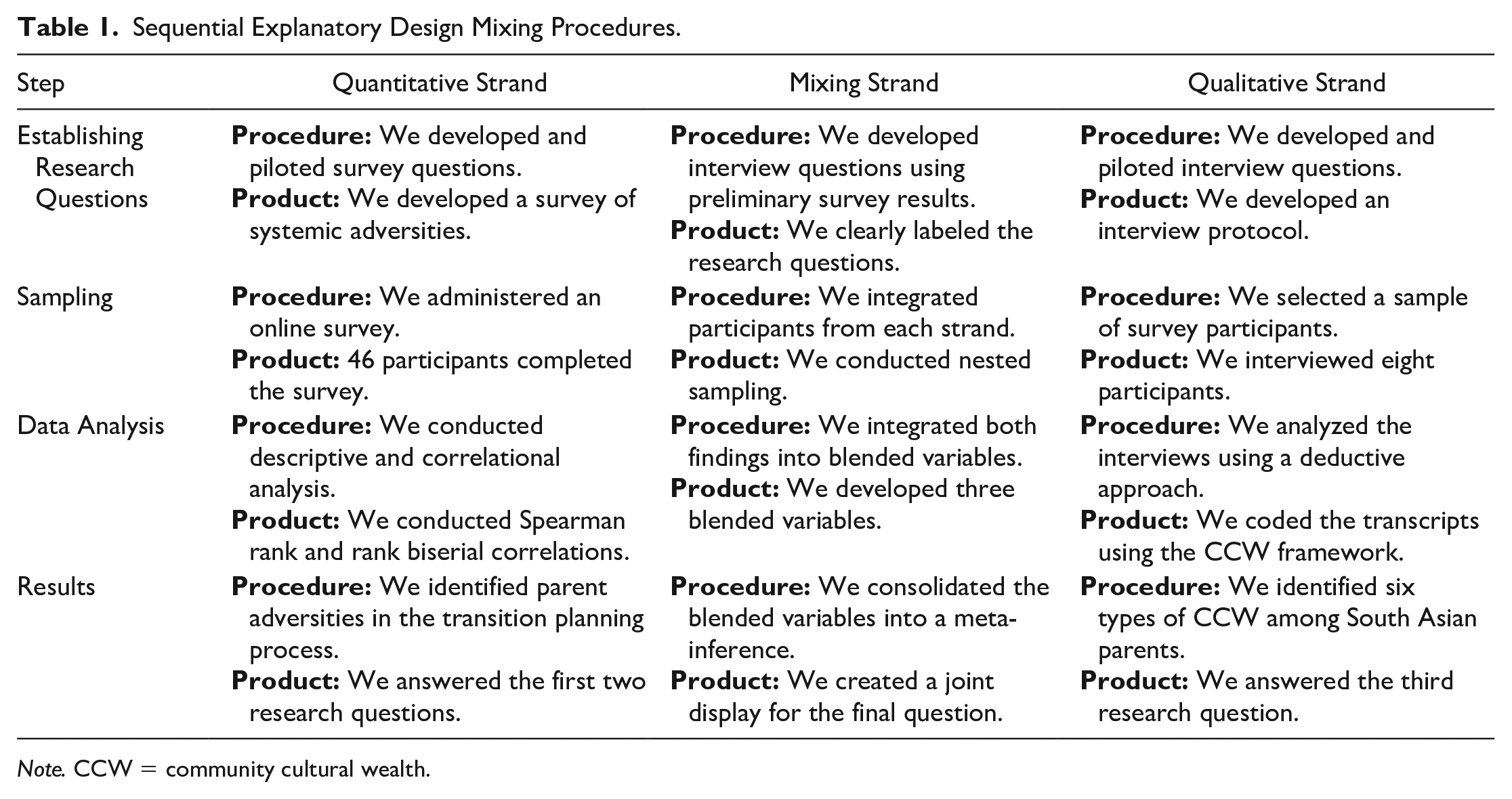
Note. CCW = community cultural wealth.
Last, we used the blended variables generated from blended analysis to develop a preliminary meta-inference about how South Asian parents overcome their racialized adversities using their CCW to navigate the transition planning process. A meta-inference is a final point of examination that integrates the conclusions formed during blended analysis to answer the final research question (Creamer, 2018). While a blended analysis combines the findings from both methodological approaches, a meta-inference is the sum that reveals an understanding of the broader phenomenon being explored in the study. We also used philosophical transparency to indicate the philosophical underpinnings of the research process (Creamer, 2018). We viewed the entire research process from a transformative paradigm, which includes active recognition, acknowledgment, and reflection toward systems of power and oppression that are reflected within research practices (Mertens, 2007).
Researchers’ Positionality
The first author is an assistant professor of special education who identifies as a South Asian woman. Thus, her identity as a researcher, a member of the South Asian community, and a family member is a salient part of her research and significantly informs her work. The second author is an associate professor of special education and identifies as a White woman. As a family member and a former secondary special education teacher, she is committed to conducting research to ameliorate systemic and cultural barriers experienced by racially minoritized students and their families. We are aware that as scholars invested in intersectional and equity-driven work our biases and experiences could have influenced our interpretation of the findings. Although we attempted to maintain rigor and objectivity, we acknowledge that our positionalities continue to shape and transform our research. As such, we conducted a mixed methods study for deeper analysis and used a transformative paradigm to explore the role of inequity and power in the pursuit of social justice.
Survey Recruitment
The quantitative section of the present study is a South Asian subset of a larger multi-state survey project to understand the transition experiences of racially minoritized families of children with disabilities. Upon receiving approval from the university’s institutional review board, we distributed survey flyers, a survey link, and a brief description of the study to 295 family-based organizations, clinics and therapy services, autism-specific organizations, inclusive higher education programs, faith-based organizations, radio stations, community centers, and parent groups, including 56 South Asian organizations (e.g., Muhsen, Olive Branch, Daya, NAMI, South Asian Council for Social Services, and Enabled Muslims). Organizations recruited participants by sharing the survey link and the appropriate flyer (either in English or Hindi) using a listserv or personal emails. We also advertised the study on South Asian radio shows, posted flyers in local South Asian community centers, and used word-of-mouth communication among South Asian stakeholders to increase awareness about the study. In addition, we employed snowball sampling by asking parents to indicate if there were additional organizations we could partner with to distribute the survey (Onwuegbuzie & Collins, 2007). Recruitment occurred virtually from May 2020 to June 2021.
Participants
Participants were included in the present study if they (a) were parents or caregivers of a child with a disability, (b) identified as South Asian based on country of origin, (c) could communicate and read in English or Hindi, and (d) resided in the United States. We defined South Asians as individuals who trace their ancestry or origins to Afghanistan, Bangladesh, Bhutan, India, Iran, Maldives, Pakistan, Nepal, and Sri Lanka (United Nations Statistics Division, 1999). Upon opening the online survey link, participants were asked to read the consent document and indicate their agreement to participate in the study. If they did not give consent, they were taken to an exit screen and asked to exit the survey. Participants could complete the survey in English or Hindi, online or on the phone, with the research team.
We received survey responses from 46 South Asian parents (see Table 2). Most participants (80.4%) identified as mothers, 15.2% identified as fathers, and 4.2% identified as a sibling or an uncle. All respondents will be referred to as “parents” because over 95% identified as a parent. One parent completed the survey in Hindi on the phone with the first author. Otherwise, all other parents completed the survey online in English. More than half of the parents (n = 24) had a child between the ages of 12 and 22 years, approaching or recently completing the transition process. Overall, child ages ranged from 4 to 42 years (M = 17 years). We included parents who did not have a child within the traditional transition planning age (e.g., 14–22) to explore their experiences related to school-based support and adulthood experiences. In addition, 59.2% of children were males, and primary diagnoses included autism (39.7%), intellectual disability (20.6%), and other disabilities (39.7%). Eight parents indicated interest in participating in an interview approximately 1 year later. Six mothers and two fathers participated in the interviews (see Table 2). Children’s diagnoses included autism (n = 4), intellectual disability (n = 3), and speech or language delay (n = 1). Six parents had transition-age children between 14 and 22, while two parents had children in elementary school.
Demographics of the South Asian Parents in the Study.
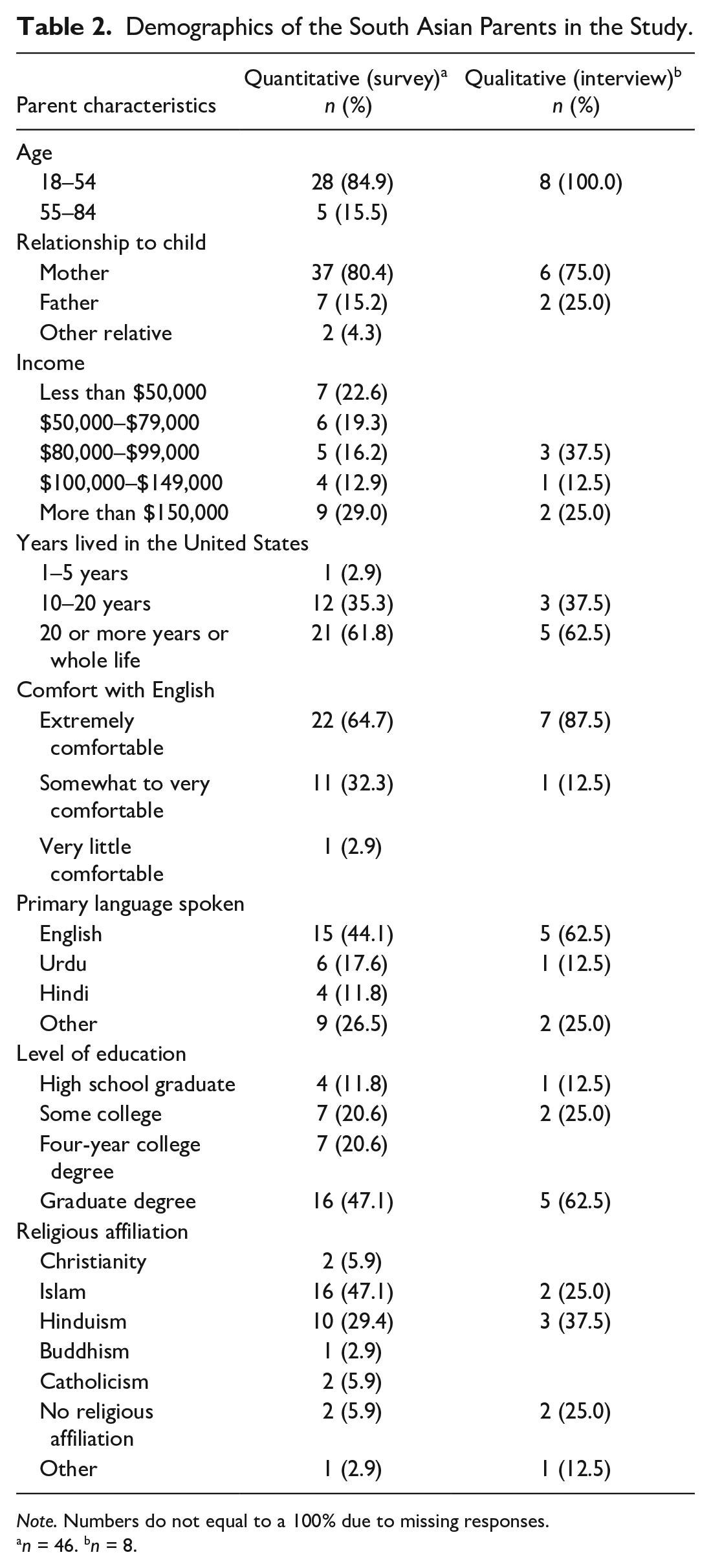
Note. Numbers do not equal to a 100% due to missing responses.
n = 46.
n = 8.
Data Collection
Quantitative
We conducted a culturally adapted replication of the transition survey measure created by Blustein and colleagues (2016) to explore the experiences of minoritized parents navigating transition planning. The complete adapted online survey was administered to participants and included seven sections with 35 questions related to (a) knowledge of school-based transition topics, (b) parent involvement in transition planning, (c) knowledge of community-based transition resources, (d) knowledge of adult service systems, (e) parent needs, (f) parent expectations, and (g) parent challenges or adversities. We also asked survey questions related to parent and child demographics. This study only explored the survey section related to parent adversities. The complete survey can be obtained by contacting the first author.
We culturally adapted the transition survey in three phases. First, we reviewed the original survey questions for the section related to parent adversities and reexamined its relevance for minoritized families. Informed by prior research with racially minoritized families, we added questions about parent voice and advocacy (e.g., my voice not being heard by individuals involved in planning for my child’s future; Rueda et al., 2005), family and community support (e.g., other individuals help me access services for my child; Achola & Greene, 2016), and faith-based community support and adversities related to stigma/taboo (e.g., stigma or taboo surrounding disabilities in my family; Shikarpurya & Singh, 2021) to offer more culturally affirming options.
Second, we simplified the language used from the original survey instrument to increase accessibility and reduce linguistic barriers by replacing “transition planning” with “future planning/planning for the future” (Lo & Bui, 2020). Third, the first author, who is fluent in Hindi, translated the survey from English to Hindi. We also asked three South Asian parent advocates who were fluent in Hindi to review the survey for consistency and clarity. The parent advocates identified as a parent of a child with a disability and knew the researchers through personal and professional connections. They suggested linguistic changes to add further clarity for families. Upon revisions, we piloted both versions of the survey (i.e., English and Hindi) with three additional South Asian parents who expressed satisfaction with completing the survey. The complete online survey was available on Qualtrics in English and Hindi. We also offered an incentive of a $10 Amazon gift card to four parents in a randomly selected drawing upon completing the survey. The parents could indicate at the end of the survey if they wished to participate in the drawing by providing an email address.
Parent Demographics
We asked parents to indicate their age, sex, household income, marital status, occupation, education level, and race/ethnicity. We also asked culturally responsive demographic questions such as their country of birth, the amount of time they have lived in the United States (ranging from under one year to their entire lives), their level of comfort with speaking English (ranging from very little comfort to extremely comfortable), the language they speak most often at home, and their religious affiliation. We asked parents to provide their zip codes to understand the geographic diversity of participants.
Parent Adversities
Although the survey had multiple sections, the analysis for this article focuses specifically on the section related to parent adversities. Parents rated 14 items on a five-point Likert-type scale (1 = 0% never, 2 = rarely, less than 10% of the time, 3 = sometimes, around 50% of the time, 4 = usually, over 70% of the time, 5 = every time, 100%) to indicate how often they experienced adversities or challenges when accessing services for their children. Survey items ranged widely, including knowledge-based adversities (e.g., little knowledge of employment opportunities), personal or societal adversities (e.g., financial, little support from family members), and cultural competency-related adversities (e.g., the difference between home and school values). Cronbach’s alpha was α = 0.88, which indicated strong internal consistency among the items in this section.
Qualitative
We conducted semi-structured interviews on Zoom for an hour and transcribed the interviews using the Trint software. All the interviews were conducted in English, except one, which was conducted in both English and Hindi. One South Asian parent and one graduate researcher piloted the interview protocol to ensure there were no leading questions. Our interview protocol included two sections. The first section asked questions about the child (e.g., What are some services your child receives in school related to planning for their future after high school?), and the second asked about parents’ experiences (e.g., What has your experience been like with navigating future planning services for your child?). The protocol included 10 questions (see online supplementary materials). We also translated the responses from Hindi to English for transcription. All interview participants received a $15 Amazon gift card in appreciation of their time.
Data Analysis
Quantitative Data Analysis
We used the SPSS software to calculate descriptive statistics and correlation analyses. We used the Spearman rank correlation coefficient to measure the strength and direction of the relationship between the frequency of adversities experienced by parents and the following demographic items: parents’ education, years they have lived in the United States, their comfort with speaking English, and their income. We also used a rank biserial correlation coefficient to calculate the strength of the relationship between the frequency of adversities experienced by parents and the following dichotomous demographic items: parents’ sex, marital status, religious affiliation, and the primary language spoken at home. We measured the magnitude of the strength of the relationship using guidelines provided by Cohen (1988), wherein in psychology and educational research, 0.1 is considered a weak relationship, 0.3 is considered a moderately strong relationship, and 0.5 is considered a strong relationship. Missing responses were addressed using pairwise deletion. We hypothesized a negative relationship between (a) parents’ level of education and the frequency of challenges across four transition-knowledge items, (b) their comfort with English and the frequency of linguistic challenges experienced, and (c) parents who speak a language other than English at home and the frequency of experiencing differences between home and school values.
Qualitative Data Analysis
We used a deductive approach to analyze the interview responses using the six pre-existing themes from the CCW framework (Gale et al., 2013). We used the Dedoose software to code and analyze our transcripts. First, we coded a transcript together to categorize the interview responses and pair the codes to the CCW framework. We also established a category for emerging or new codes found in the interviews that did not exist within the theoretical framework using inductive analysis. Next, we coded all transcripts independently and discussed discrepancies until we reached a consensus. We established trustworthiness through data triangulation among multiple coding team members, writing memos and field notes throughout the process, and conducting member checks with participants (Corbin & Strauss, 2015). Specifically, we developed a table of parent strengths derived from the interviews and emailed it to all the participants for the member checks. We asked the participants to share their thoughts on the extent to which the findings reflected their own experiences based on the findings’ consistency, clarity, cohesion, and comprehensiveness. Half of the parents (n = 4) responded with their feedback. They shared their satisfaction with the findings and did not provide any additional feedback.
Blended Analysis
We integrated quantitative and qualitative data using blended analysis (Creamer, 2018). This process occurred in four stages. First, we developed a table to identify themes and compare trends across the two phases. The third research question guided the grouping of the findings horizontally, with adversities categorized in one column and strengths in another. Second, we consolidated the adversities into three overarching themes based on their shared characteristics. For instance, survey items pertaining to information or knowledge were grouped together. The groups resulted in three broad categories of adversities. Subsequently, we identified the strengths parents leveraged to overcome the broader adversity. Thus, we aligned each adversity category with the corresponding strengths used to navigate the specific challenges. Third, we horizontally mixed the broader findings from the prior stage to form three blended variables for each category. The three blended variables represented independent findings that offered a meaningful point of analysis. Finally, we integrated the three blended variables into a preliminary meta-inference to inform how South Asian parents leverage their CCW to overcome adversities within the transition planning process (Tashakkori & Teddlie, 1998).
Results
RQ1. What Adversities Do South Asian Parents Experience When Accessing Transition Planning Services, and How Often Do They Encounter Them?
Parents most often experienced adversities related to knowledge and advocacy (see Table 3). Parents faced the following knowledge-based challenges most often: little knowledge of future planning (M = 3.03), little knowledge of college or higher education opportunities (M = 3.00), little knowledge of employment opportunities (M = 2.97), and little knowledge of the special education system (M = 2.82). In addition, 69.7% of the parents reported not being heard by individuals involved in planning for their child’s future 50% or more of the time (M = 3.00). Furthermore, 53.4% of parents indicated that other individuals help them access services 50% or more of the time, which includes support from their other children (e.g., older siblings), local parent networks, and close friends. Parents also shared additional challenges they experienced using an open-ended response. These challenges included accessing respite care services, archaic stereotypes from service professionals, and locating employment for their children. Parents reported that they experienced linguistic challenges the least often among all the survey items (M = 2.09).
Frequency of Adversities Experienced by Parents and Relationships with Demographic Factors.
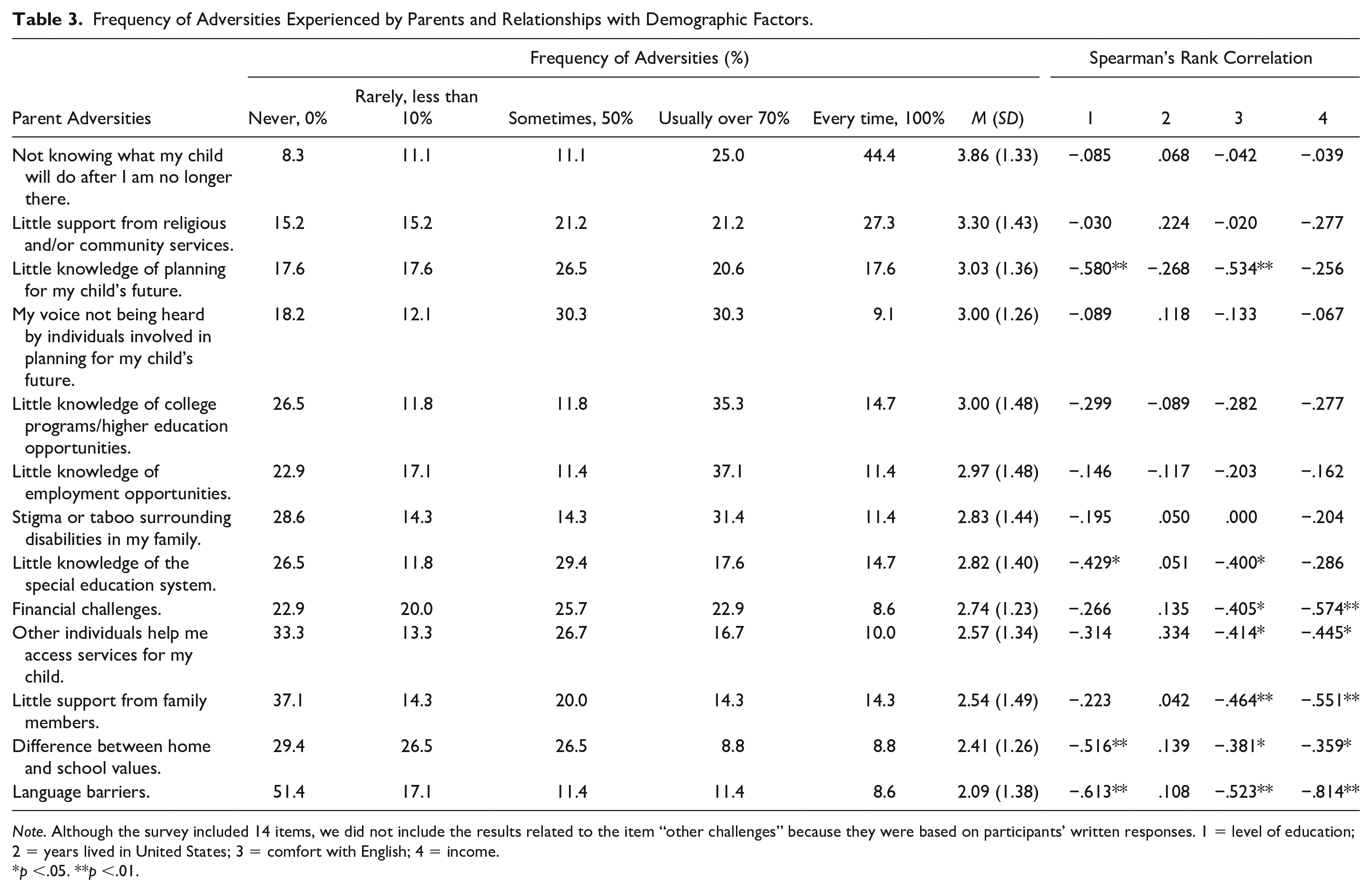
Note. Although the survey included 14 items, we did not include the results related to the item “other challenges” because they were based on participants’ written responses. 1 = level of education; 2 = years lived in United States; 3 = comfort with English; 4 = income.
p <.05. **p <.01.
RQ2. What Is the Relationship Between Parent Demographics and How Often Parents Encounter Adversities When Accessing Transition Planning Services?
According to Spearman’s rank correlation, as parents’ level of education increased, the frequency of the following parent challenges decreased: knowledge of future planning, r(32) = −.580, p < .01; knowledge of special education systems, r(33) = −.429, p < .05; and language barriers, r(33) = −.613, p < .01. The findings indicated negative, moderate to strong, and significant relationships (see Table 3). In addition, we also found strong negative relationships between parents’ income and how frequently they encountered financial adversities, r(31) = −.574, p < .01, and recieved support from family members, r(31) = −.551, p < .01. As parents’ income increased, the frequency of their financial challenges and the support from family members decreased. Finally, we identified negative, moderate to strong, and significant relationships between parents’ comfort with English, their income, their level of education, and how frequently they experienced differences between home and school values (see Table 3). We did not find a relationship between parents’ level of education and the frequency of adversities related to knowledge of employment opportunities and knowledge of college or higher education opportunities.
Using Spearman’s rank correlation, we also found that as parents’ comfort with English decreased, the frequency of the following parent challenges increased: language barriers, r(33) = −.523, p < .01; parents’ reliance on the support of others to navigate services, r(29) = −.414, p < .05; knowledge about future planning, r(32) = −.534, p < .01; knowledge about the special education system, r(33) = −.400, p < .05; financial barriers, r(33) = −.405, p < .05; and family support, r(33) = −.464, p < .01. The relationships were negative, moderate to strong, and significant (see Table 3). We did not find any significant relationships between the number of years parents have lived in the United States and the frequency of adversities they experienced.
Finally, according to the rank biserial correlation, there was a strong negative relationship between parents who speak a language other than English at home and the frequency of challenges they encountered with having little knowledge of future planning, r(32) = −0.549, p < .01. We did not find a relationship between parents who speak a language other than English at home and the frequency of challenges they experienced related to the difference between home and school values. Rank biserial correlation also identified a moderately strong, negative relationship between parents’ marital status and how frequently parents experienced financial barriers, r(33) = −0.415, p < .05.
RQ3. What Forms of Community Cultural Wealth Do South Asian Families Draw Upon When Navigating the Transition Planning Process?
Navigational Capital
Navigational capital was defined as the strength of parents to navigate or maneuver through special education organizations, agencies, laws, and systems. Parents reported various strengths within this domain, such as (a) familiarity with language (e.g., knowing or accessing the language or jargon related to special education), (b) navigating formal structures (e.g., IEP meetings, service systems, and therapy clinics), (c) navigating informal structures (e.g., online parent groups, informal organizations, and parent training), and (d) research avenues (e.g., navigating the realm of research to understand and access services). Parents also shared how they navigated online research to identify resources. For instance, a parent stated, “Since we were not citizens when she [the daughter] was younger, ABA [applied behavior analysis] was not covered by insurance. So, I became active in researching and finding services for her online. I had to find a way.”
Aspirational Capital
We defined aspirational capital as the parents’ ability to articulate their hopes, dreams, and visions for the future while facing systemic adversities. Parents discussed aspirational capital in two ways: aspirations for themselves (e.g., financial stability, learning current research, and advocating for their child) and aspirations for their children (e.g., hopes and dreams for the child). For instance, sharing aspirations for themselves, a parent stated, I do not know a lot of details about the Americans with Disabilities Act (ADA). I took the basic trainings, but I need to go get specific information. That way, he [the son] will know what to advocate for, and, if he is working, what kind of accommodations he can have.
In addition, parents also described maintaining aspirations to educate their community, sharing their knowledge with others, and expanding their resources to support other families. We also found multiple sub-themes in parents’ visions for their children, including (a) the desire for their child to actively participate in meaningful activities; (b) securing a place for their adult child to live and thrive; (c) hopes for the child to have a sense of belonging in the community, in the family, or through relationships (e.g., marriage or children); and (d) high aspirations for their child’s overall well-being, including their happiness, being loved by others outside the family, and making meaningful contributions to society.
Resistant Capital
We defined resistant capital as forms of advocacy that challenge the status quo, including behaviors that show resistance to structures or organizations to fight for more equitable and just outcomes for their children. Parents specifically discussed two types of resistant capital: resistance toward personal factors (e.g., cultural values, upbringing, and families) and organizational structures (e.g., schools, organizations, and communities). For instance, a parent shared resisting their upbringing by stating, “When you grow up in a South Asian community, most of the special needs kids are hidden away. They don’t ever go to school. When we were in school, we literally had no special needs kids.” Parents also displayed resistance when interacting with organizations, such as schools, clinics, university centers, and the adult service system. Most parents learned to resist along the way based on how the special education structures treated them.
Social Capital
Social capital was defined as a network of individuals, including friends, community members, and other peers, who served as sources of support for parents. We found that all parents identified at least one social support, with one parent describing over eight different sources of social capital. Parents found strength and support from various organizations (e.g., community-based or faith-based). In addition, they formed social connections with other parents during parent training, social activities their children engaged in, and by joining online parent groups on social media. For instance, a parent shared the importance of staying connected with a social community, stating, “Even if there is just one person who can give you a little bit of advice or a little bit of understanding, it matters a lot.”
Familial and Linguistic Capital
The last two areas of strength, familial and linguistic capital, were the least discussed by parents. Familial capital was defined as being connected with immediate or extended family, having shared knowledge passed down by family, recieving support from family members, or describing the role of families in their lives. For instance, one parent shared, “Family was never in my way. They were always supportive. However, there were moments where I had to convince everyone to get on board and make them understand that fighting for ABA services was worth it.” However, the parents did not mention any immediate or direct support provided by family members. Linguistic capital was defined as skills attained by family members by communicating in a language other than English. These skills included seeking translators, developing strong relationships with others who are multilingual, and seeking services in multiple languages. This form of strength was discussed the least by parents. One parent mentioned the gift of teaching their child in two languages (English and Urdu) while acknowledging the challenges associated with receiving speech therapy in both languages. Another parent spoke three languages, which we noted as a sign of strength.
RQ4. How Do South Asian Parents Leverage Their Community Cultural Wealth to Overcome Adversities When Navigating the Transition Planning Process?
We combined the quantitative findings (survey) with the qualitative findings (interviews) using blended analysis to form a meta-inference (see Supplementary Materials). The mixed findings resulted in three blended variables (see Figure 1). First, although parents indicated they frequently experienced multiple challenges with key aspects of transition planning (e.g., knowledge of employment, higher education, or special education system), they used their aspirational, social, and navigational capital to seek information from resources outside of the school and maintained high aspirations for themselves. Second, parents expressed that they frequently did not have a voice when speaking with stakeholders or making decisions for their children. Nevertheless, they leveraged their resistant and navigational capital to continue to resist and fight the system to provide equitable opportunities to their child. We also noted that regardless of being immigrants or being born in the United States, the special education system was a novel system for them. While parents advocated by resisting and navigating the system using special education terminology, they did not know what to advocate for or the path toward getting their voices heard. Third, while parents indicated limited capacities of internal and external support, they leveraged multiple areas of strengths, including social capital and resistant capital, to create and nurture support systems around them. Specifically, parents reported that they received little support from their families, support from religious organizations, and other community members. They also faced adversities related to finances, and stigma when navigating services. As a result, we posit that parents created chosen families using their social capital and widened their support systems (Gates, 2017). Parents also used their resistant and social capital to offer resources to other families, thereby expanding their networks and ensuring others within their communities were well supported.
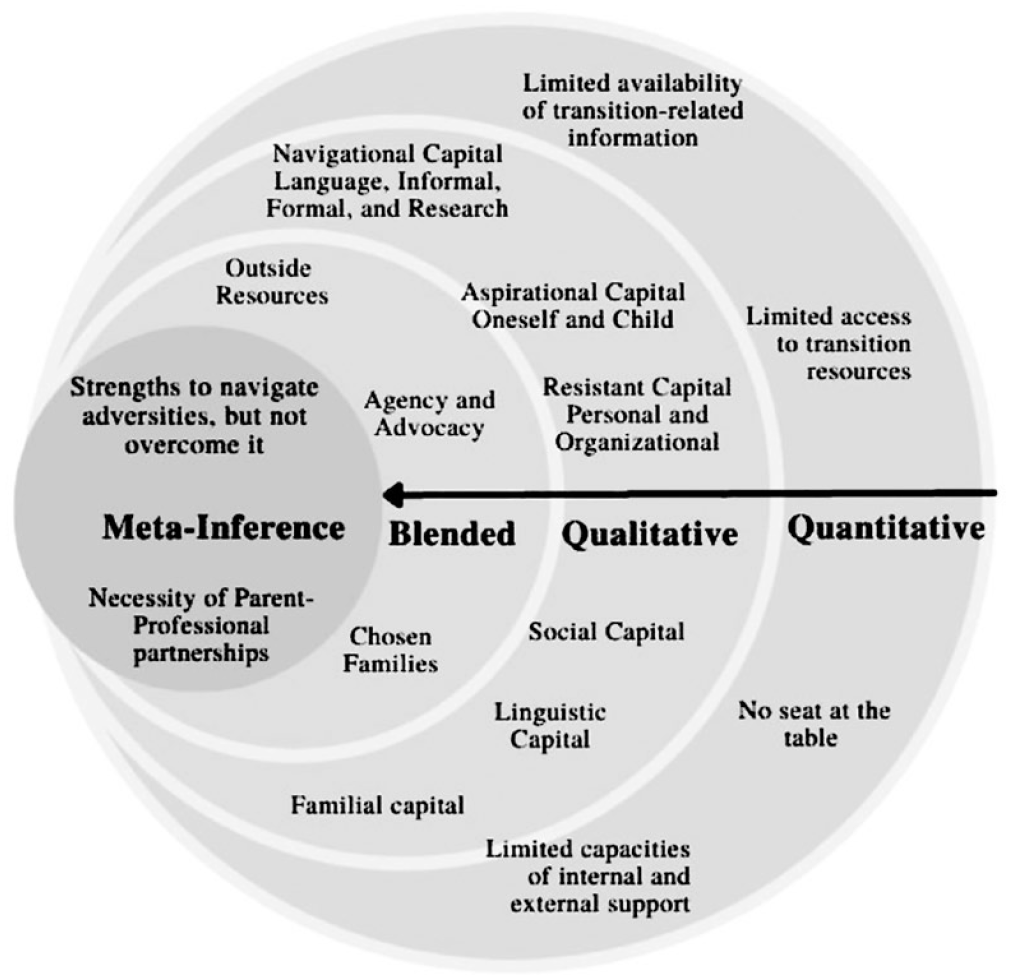
Blended findings and meta-inference: How do South Asian parents leverage their community cultural wealth to overcome adversities when navigating the transition planning process?.
We combined the three blended variables to create a preliminary meta-inference (see Figure 1). First, parents use outside resources to gain knowledge and maintain high hopes despite facing adversities. Second, parents are empowered, and they know how to advocate. However, they may not know what to advocate for. The system is an unfamiliar territory. Third, parents developed chosen families and looked out for one another. As a result, the meta-inference concludes that parents have inherent and developed strengths to maneuver systemic adversities but need more targeted, structured support to overcome them. A parent–professional partnership built on equity, parent strengths, and culturally affirming practices is necessary to support parents in truly overcoming systemic adversities.
Discussion
Overall, this study presents a novel application of mixed methods to reframe and redefine the prevailing narrative that portrays racially minoritized families only in the context of the challenges they experience using deficit-based narratives. As such, our strengths-based findings offer several significant insights to bolster the transition planning process for South Asian parents and other racially minoritized families of children with disabilities.
Reframing Parent Narratives
First, our findings add the contextualized experiences of South Asian families to the growing transition literature on systemic adversities racially minoritized parents face when navigating the transition planning process (Lo & Bui, 2020; Wilt & Morningstar, 2018). In addition, our blended findings extend the literature toward identifying strengths, particularly resistant, social, navigational, and aspirational strengths South Asian parents leverage to navigate the complexities of transition planning. For instance, we found that while parents experienced adversities related to knowledge and access to information, they used their social capital to learn about post-school opportunities for their children. As such, we posit that parent challenges should be reframed within the context of parent strengths to thoroughly examine the complexities of navigating the transition planning process. In addition, intentional reframing of parent narratives using strengths-based frameworks advances the language used to explore paradigms related to parent involvement, parent advocacy, and parent partnerships. Specifically, research that continues to reframe the experiences of racially minoritized families of youth with disabilities through counterstories of strength and resilience could ultimately expand the narrow scope of parent engagement that currently prevails within special education.
Redefining Parent Agency
Second, our findings offer important insights regarding the power and potential of parent voices in the transition process. The quantitative findings emphasized systemic and racialized barriers to advocacy for South Asian parents (e.g., not being heard by schools and professionals, M = 3.00), which aligns with the experiences of Black (Scott et al., 2021), Latino/a/x (Aleman-Tovar et al., 2022), and Chinese and Vietnamese parents examined in prior transition literature (Lo & Bui, 2020). However, our blended findings differed from prior literature on advocacy (Burke & Goldman, 2018) by shifting the burden of advocacy from parents to the system. Shifting the dialogue from advocacy to agency emphasizes systemic adversities that govern the extent to which parents are able to voice their concerns. We found that South Asian parents do advocate using their resistant and navigational capital; however, they have less agency due to structural racism and limited knowledge of the culture of advocacy in special education, which is particularly derived from a cultural that is White, middle-class, and individualistic-oriented. Our findings demonstrate that South Asian parents continue to advocate within the context of their cultural norms and values. However, their advocacy often goes unseen. For instance, we found that parents advocated within their families, social environments, and school systems to gain knowledge and resources about post-school opportunities. These experiences emphasize a need to shift away from traditional, White, Western-oriented standards of advocacy toward redefining agency and advocacy for South Asian parents and their youth to promote transition planning that aligns with their family’s desires, goals, and cultural values.
Reshaping Parent Support
Third, our findings revealed limited capacities of internal and external support systems for South Asian parents of children with disabilities in transition, thereby affirming prior literature on limited faith-based supports (Shikarpurya & Singh, 2021) and ongoing stigma from families among South Asian parents (John et al., 2016). For example, we found that prevailing stigma around disability (M = 2.83), limited familial support (M = 2.54), and lack of faith-based support (M = 3.30) were adversities parents faced often. However, our blended findings illustrated that South Asian parents developed chosen families to navigate the complex and uncharted territory of transition to adulthood. Notably, immigrant families build strong social communities outside of their immediate families as pillars of “familial” chosen support systems (Gates, 2017). In addition, our findings affirmed parents’ resilience in expanding their organizational processes toward strengthening their familial support using chosen families (Walsh, 2015). Thus, we interpret chosen families as a strength and posit that parent support could also reflect chosen families as part of their support networks.
Limitations and Implications for Future Research
Although the blended findings offer promising insight into reshaping the transition planning experiences of South Asian parents using a strengths-based lens, there are several limitations that present opportunities for future research. First, the findings from this study may not be representative of the experiences of a broader sample of South Asian parents of youth with disabilities. Specifically, our sample size was modest for the quantitative (n = 46) and qualitative (n = 8) strands. Despite our intentions to recruit a nationally representative sample, most survey participants (n = 40) and all interview participants resided in Texas. Thus, our findings should not be generalized to populations in other states or regions. Although missing data were addressed using pairwise deletion, it could have resulted in an underestimated standard error. Thus, future researchers should aim to recruit a larger sample for generalizability. In addition, while we aimed to recruit parents across a diverse range of demographic characteristics, most of the parents in this study were homogenous. For instance, they largely held college degrees, had higher incomes than the national average, mainly resided in Texas, and primarily communicated in English. Future researchers could aim to conduct broader recruitment across the country to capture a more varied demographic sample. Furthermore, in our effort to create a singular survey measure that would characterize the transition experiences of a diverse sample across a wide range of time points, the context and chronology varied widely across participants, with children ranging from 4 to 42 years. As such, we could not extrapolate the differences between parents’ current or prior experiences with transition services, but we encourage future researchers to include specific timeframes in their survey items.
Second, future researchers could benefit from further disaggregating racial/ethnic collective labels (i.e., South Asian). For instance, the specific transition planning experiences of parents from various ethnicities (e.g., Afghan, Indian, or Pakistani) or immigration status (e.g., refugee or mixed-status families) could offer further insight into their unique challenges and strengths. Although this study centered on parents’ experiences, youth perspectives are crucial to improving adulthood outcomes. Future researchers could integrate multiple perspectives, including those of the parents, young adults with disabilities, their chosen families, and community members, to capture the systemic adversities they face and the capital they use to navigate those barriers. Third, since the survey questions related to systemic challenges were already pre-defined, parents could have experienced additional challenges that were beyond the scope of this study. Similarly, parent strengths were also defined within the context of the CCW framework, limiting parents’ expression of their strengths. Future researchers could conduct additional qualitative studies that offer parents the agency to define their challenges and strengths without a prior framework or guidelines. Their defined strengths could also lead to the development of an additional strengths-based framework for various disaggregated populations or expanding the current CCW framework. Finally, alongside parent and youth perspectives, future researchers could also explore the extent to which transition professionals in schools and adult service systems offer culturally responsive and affirming transition services to meet the needs of South Asian youth and their families.
Implications for Practice
This study also offers significant insights for transition practitioners and other key stakeholders to advance the adulthood outcomes of South Asian youth with disabilities and their families. First, teachers and transition specialists could recognize the strengths identified in this study (e.g., navigational capital, resistant capital, and social capital) within their transition assessments, transition plans, and the language they use when communicating with parents. For example, parents’ navigational capital could be affirmed by educators when beginning the transition planning meeting (e.g., “I applaud how you have navigated the complex transition planning process so far.”). In addition, practitioners could offer a questionnaire informed by the six forms of capital identified in this study at the beginning of the transition planning process to support families and youth in recognizing and affirming their strengths. For instance, the questionnaire could include a section asking parents how often they engage in transition planning opportunities (e.g., In the past 6 months, how often have you considered or connected with an agency to identify employment for your child?) and a table of guiding questions or recommendations on how families could extend these opportunities within their context.
A similar questionnaire could also be administered to the youth by adopting strengths-based language (e.g., An example of navigational strength is when we can go through difficult situations at school or work even if we may not know the systems well. Do you think this could be a strength of yours at home, school/college, or work?) to inform their person-centered planning goals. A strengths-centered transition questionnaire could realign youth and family expectations, ground practitioners using a strengths-oriented mindset, and guide educators toward culturally affirming resources that could advance meaningful post-school outcomes for racially minoritized youth. Furthermore, practitioners could extend invitations to additional individuals (e.g., faith leaders, community members, or chosen families) to attend and engage in transition meetings. As parents rely on the strength of their chosen families and informal networks, these strategies could further advance parents’ and their youths’ existing CCW.
Second, this study highlighted a need to increase parental knowledge and equip parents with the tools to navigate the adult service system. Therefore, parent training centers, national organizations, and other community stakeholders who inform and train parents could provide parents with a list of questions to ask when speaking to a coordinator at vocational rehabilitation or conduct a mock meeting where parents could practice their advocacy skills. Third, as parents rely on vast social connections to navigate the transition process, adult service agencies could offer parents more opportunities to connect with affinity groups (e.g., parents from the same culture or shared experiences) and strengthen parent mentoring relationships. Finally, racially minoritized youth and their families could apply the findings of this study toward reframing their involvement and outcomes using language that recognizes their strengths and resilience.
Supplemental Material
sj-docx-1-cde-10.1177_21651434231200817 – Supplemental material for Resisting Legacies of Racialized Adversities: Counterstories of South Asians Navigating Transition Planning
Supplemental material, sj-docx-1-cde-10.1177_21651434231200817 for Resisting Legacies of Racialized Adversities: Counterstories of South Asians Navigating Transition Planning by Sehrish Shikarpurya and Carly B. Gilson in Career Development and Transition for Exceptional Individuals
Supplemental Material
sj-docx-2-cde-10.1177_21651434231200817 – Supplemental material for Resisting Legacies of Racialized Adversities: Counterstories of South Asians Navigating Transition Planning
Supplemental material, sj-docx-2-cde-10.1177_21651434231200817 for Resisting Legacies of Racialized Adversities: Counterstories of South Asians Navigating Transition Planning by Sehrish Shikarpurya and Carly B. Gilson in Career Development and Transition for Exceptional Individuals
Footnotes
Acknowledgements
We would like to acknowledge the contributions of Luis Morissette and Marianne Rice, doctoral students at Texas A&M University.
Declaration of Conflicting Interests
The author(s) declared no potential conflicts of interest with respect to the research, authorship, and/or publication of this article.
Funding
The author(s) received no financial support for the research, authorship, and/or publication of this article.

Supplemental Material
Supplemental material for this article is available on the Career Development and Transition for Exceptional Individuals website with the online version of this article.
References
Supplementary Material
Please find the following supplemental material available below.
For Open Access articles published under a Creative Commons License, all supplemental material carries the same license as the article it is associated with.
For non-Open Access articles published, all supplemental material carries a non-exclusive license, and permission requests for re-use of supplemental material or any part of supplemental material shall be sent directly to the copyright owner as specified in the copyright notice associated with the article.
