




Abstract
Promoting the Readiness of Minors in Supplemental Security Income (PROMISE), a study of 13,444 randomly assigned youth and their families, includes six model demonstration projects and a technical assistance center funded through the U.S. Department of Education and a national evaluation of the model demonstration projects funded through the Social Security Administration. The Departments of Labor and Health and Human Services and the Executive Office of the President partnered with the Department of Education and Social Security Administration to develop and monitor the PROMISE initiative. This article provides an overview of PROMISE as the introduction to this special issue of Career Development and Transition for Exceptional Individuals.
Keywords
This article serves as an introduction to this special issue and provides a context for the following articles which report findings from the Promoting the Readiness of Minors in Supplemental Security Income (PROMISE) initiative. The U.S. Department of Education (ED) funded a large study of randomly assigned youth receiving Supplemental Security Income (SSI) benefits and their families to test interventions to predict positive outcomes for youth SSI recipients and their families. The following articles describe the PROMISE implementation and present analyses of data, the findings of which do not necessarily represent the positions or policies of the ED.
Inception of PROMISE
During the recession of 2008 to 2009, some States were unable to match Vocational Rehabilitation (VR) dollars at the same levels as established prior to the recession. The Consolidated Appropriations Act of 2012 (P.L. 112-74) provided the authority to use these returned unmatched dollars for the PROMISE initiative. Approximately US$229 million were directed to create PROMISE. The appropriation provided ED the opportunity to fund “competitive grants to States to improve the provision and coordination of services for SSI child recipients” (P.L. 112-74, p. 311). The Social Security Administration (SSA) was directed to fund a national evaluation of the program. The appropriation required interdepartmental collaboration with the U.S. Departments of Labor (DOL) and Health and Human Services (HHS). The Executive Office of the President’s Office of Management and Budget (OMB) continued its oversight of the initiative by participating in and facilitating the collaboration among the federal partner agencies.
Need for PROMISE
The purpose of PROMISE was to investigate ways to improve secondary, postsecondary, and employment outcomes of youth receiving SSI and their families. Youth SSI recipients “qualify if they have a medical condition or combination of conditions that meets Social Security’s definition of disability for children, and if his or her income and resources fall within the eligibility limits” (SSA, 2019, p. 1). Secondary students with disabilities living in poverty, as compared with their peers with higher household income, experienced lower attendance rates and academic performance, such as grades, but higher rates of disciplinary actions, including suspensions (Wagner et al., 2004).
The PROMISE model demonstration projects (MDPs) were designed to test the impact of evidence-based practices (EBPs) on youth with disabilities living in poverty and improved provision and coordination of services that individually showed evidence of positive impact among these youth. For the EBPs to have the intended impact, core features had to be implemented with fidelity and include the student populations studied in the research (Cook & Odom, 2013). The overall PROMISE research question can be stated as follows:
To begin to answer this research question, the set of EBPs had to be identified. Through several series of listening sessions, ED gathered input from stakeholders on the better approaches to project design (e.g., ED, 2012a, 2012b). Specifically, secondary transition stakeholders were engaged to identify EBPs to be included in the projects. From a long list of possible practices, four categories of EBPs were required of the applicants. The four categories were (a) case management, (b) benefits counseling and financial capability services, (c) career and work-based learning experiences, and (d) parent training and information. Along with these required practices, applicants were required to provide “other services and supports designed, in combination with the required services, to improve education and employment outcomes for participating children and their parents” (78 Fed. Reg. 29737, 2013). Stakeholder input also identified the importance of providing these services to younger youth with disabilities as well as to their families.
Stakeholders cited the research literature as well as qualitative, anecdotal, and lived experiences as evidence of the many challenges facing youth SSI recipients and their families. The PROMISE conceptual framework posits that simultaneous implementation of EBPs to youth SSI recipients and their families is sufficient to overcome the individual and environmental barriers to intermediary outcomes of education and employment attainment and the long-term outcome of reduced reliance on public benefits (Fraker et al., 2014). Figure 1 provides the PROMISE conceptual framework.
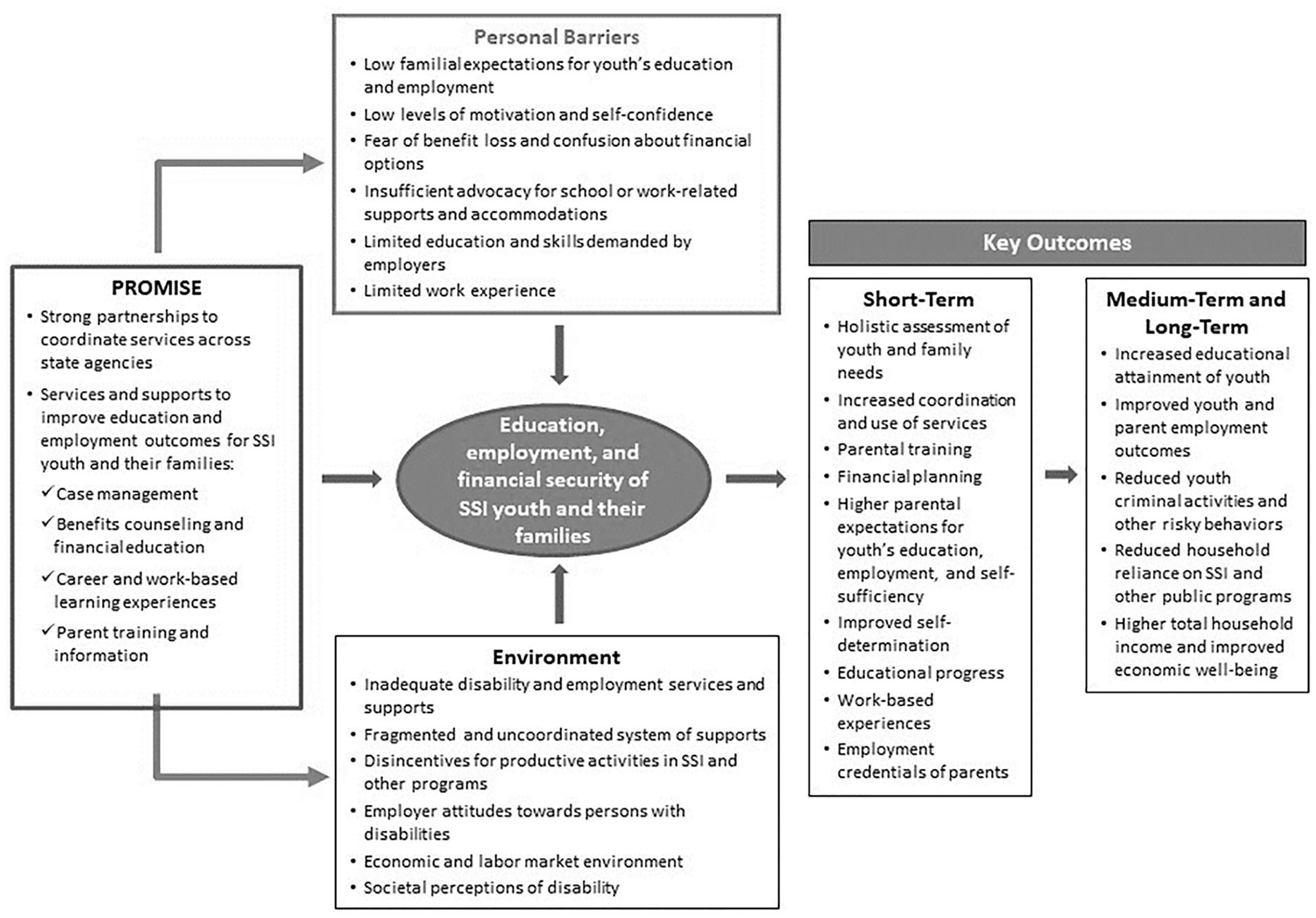
PROMISE conceptual framework.
Development of PROMISE
In federal fiscal year (FFY) 2013, ED published the Notice Inviting Applications (NIA) which outlined the requirements for application and project implementation. Each applicant was required to have partnerships among state agencies responsible for administering certain programs, enroll a minimum number of eligible youth and families, and describe their model for improving the provision and coordination of enhanced services to participants. To meet the purpose of coordinating service, the applicants were required to bring together the agencies within their State responsible for crucial program administration. In the NIA, the applicants, at a minimum, had to partner with the State agencies or equivalents responsible for administering programs that provide the following services:
State VR services under Title I of the Rehabilitation Act
Special education and related services under Part B of the Individuals with Disabilities Education Act (IDEA)
Workforce Development services under Title I of the Workforce Investment Act (WIA), including Youth Services described in the WIA (Section 129(c)(2))
Medicaid services under Title XIX of the Social Security Act
Temporary Assistance for Needy Families under the Personal Responsibility and Work Opportunity Reconciliation Act
Developmental/intellectual disabilities services
Mental health services (78 Fed. Reg. 29735-29736, 2013)
The structure of these partnerships was determined by the applicant. The applicant could also propose to collaborate with other agencies.
PROMISE limited enrollment to youth SSI recipients aged 14 to 16 years, as recommended through the stakeholder input sessions (ED, 2012b). Stakeholders raised the importance of family context of youth SSI recipients (U.D. ED, 2012b). To attempt to meet the long-term outcome of reduced reliance on public benefits, families would need to receive services, such as financial and benefits information, provided by the PROMISE projects. As a result of this recommendation, PROMISE enrolled both youth and their families. The term “family” was defined as everyone in the household. This definition allowed PROMISE to serve parents and siblings as well as others who resided, even temporarily, in the home. PROMISE was a research study. The enrolled youth and their families were randomly assigned to either usual service or PROMISE service groups by the national evaluator. For the study to have statistical power after attrition, each project was required to recruit a minimum of 2,000 eligible youth and their families.
Consortium applicants were allowed so that smaller States could participate in PROMISE. The consortium States did not have to be contiguous. There was no limit to the number of States coming together as a consortium. Like the single-State applicants, the consortium was required to recruit and serve at least 2,000 youth and their families. The Consortium did not need to recruit equal number of youth and their families from each State. The funding level for any applicant was based on the number of youth SSI recipients being recruited. It was set at US$6,500 per enrolled youth per year. With the minimum enrollment of 1,000 youth SSI recipients in the treatment group, the applicant could request no more than US$32,500,000. The maximum award was limited to US$50,000,000. To request the maximum allowable budget, the applicant was required to enroll 1,539 youth SSI recipients and their families in the treatment group.
Outcomes-based payments (OBPs) allowed incentives to “providers that achieve, improve, or exceed their performance on specified quality, cost, and other benchmarks” (78 Fed. Reg. 29741, 2013). Applicants were invited to include OBPs in their proposed projects. The invitational priority for OBPs, which increased neither the applicant’s allowable budget nor the applicant’s likelihood of receiving the grant award, was required for detailed descriptions of the methodology, quantifiable data, measures, and comparison metrics to determine provider performance. Wisconsin PROMISE included OBPs to incentivize the timely meeting of enrollment targets. The New York State project included OBPs for meeting established service delivery targets.
PROMISE Initiative
The PROMISE applications were competed in FFY 2013. A panel of peer reviewers, each representing at least one stakeholder group (e.g., secondary transition, VR), scored the applications using the published selection criteria. The applications were ranked by raw score, which allowed ED to award grants to the top applications as funds allowed. Six cooperative agreements were funded. Grants were awarded to one consortium application from Utah, South Dakota, North Dakota, Montana, Colorado, and Arizona and five single-state applications from Arkansas, California, Maryland, New York, and Wisconsin. The consortium named itself Achieving Success by Promoting Readiness for Education and Employment (ASPIRE).
As required, the awards were granted to governors, who assigned the project to various lead agencies within their states. Maryland was led by a State cabinet-level Department of Disabilities. The mental health agency led the New York project. The Arkansas Department of Education contracted with the University of Arkansas to lead the Arkansas PROMISE project. Wisconsin, ASPIRE, and California were led by the VR agency. Within the consortium, each consortium State similarly identified a lead agency among the required partnering agencies: Utah, Montana, and Colorado by their respective VR agencies; Arizona by its Governor’s Office of Youth, Faith and Family; North Dakota by Minot State University; and South Dakota by a nonprofit services agency. Each of the 11 State lead agencies structured their service delivery around a constellation of required partnering agencies and organizations. Although SSA contracted for a national evaluation of the PROMISE initiative, each project was required to evaluate their project implementation for continuous improvement. The formative evaluations for all six projects were headed by external experts many of whom were associated with universities.
In 2014, ED awarded a competitive grant to the Association of University Centers on Disabilities to provide technical assistance (TA) to the six PROMISE projects. The PROMISE TA Center supported communication, developed resources, and maintained a repository of PROMISE materials. The implementation of the individual projects was strengthened through the communication, collaboration, and relationships developed through the TA Center. Their website will remain a source for PROMISE information (see www.promisetacenter.org).
Recruitment and Enrollment
The six projects began on October 1, 2013, which coincided with the funding lapse and 17-day federal government shutdown. According to the NIA, projects were allowed 4 months for planning and finalizing all aspects of the MDP. The lead agencies, in many cases, had to formalize partnerships with other agencies through memoranda of agreement and to procure delivery of services through contracts. Each project had to enter into a data-sharing agreement with SSA, part of which was ensuring security clearance for all PROMISE personnel who would access participant information.
Enrollment was the first activity of the projects. SSA provided lists of eligible youth to each MDP. Some projects sorted the eligible youth by age, oldest to youngest, to reduce the number of youth who would age out of eligibility prior to outreach for enrollment. The lists of eligible participants may also have been sorted by zip codes to allow the projects to target enrollment efforts to those areas in their states. The first youth were enrolled by Wisconsin and Maryland in April 2014, California in August 2014, Arkansas in September 2014, and ASPIRE and New York in October 2014. The enrollment period ended in April 2016, with all projects meeting or exceeding their target. Arkansas enrolled 2,000 youth, ASPIRE 2,051 youth, California 3,273 youth, Maryland 2,006 youth, New York 2,090 youth, and Wisconsin 2,024 youth.
Implementation
The enrolled youth and their families were assigned to either the control or the treatment group. Table 1 provides target and actual enrollment by each MDP in treatment and control groups. Approximately half of the enrolled participants were randomly assigned to receive PROMISE enhanced services, while the other half received usual services. When two or more eligible youth lived in the same household, one youth was enrolled and randomly assigned to PROMISE or usual services. The other youth were counted as “non-research” and received the same services, either PROMISE or usual, as the enrolled youth.
Total Study-Wide Enrollment.
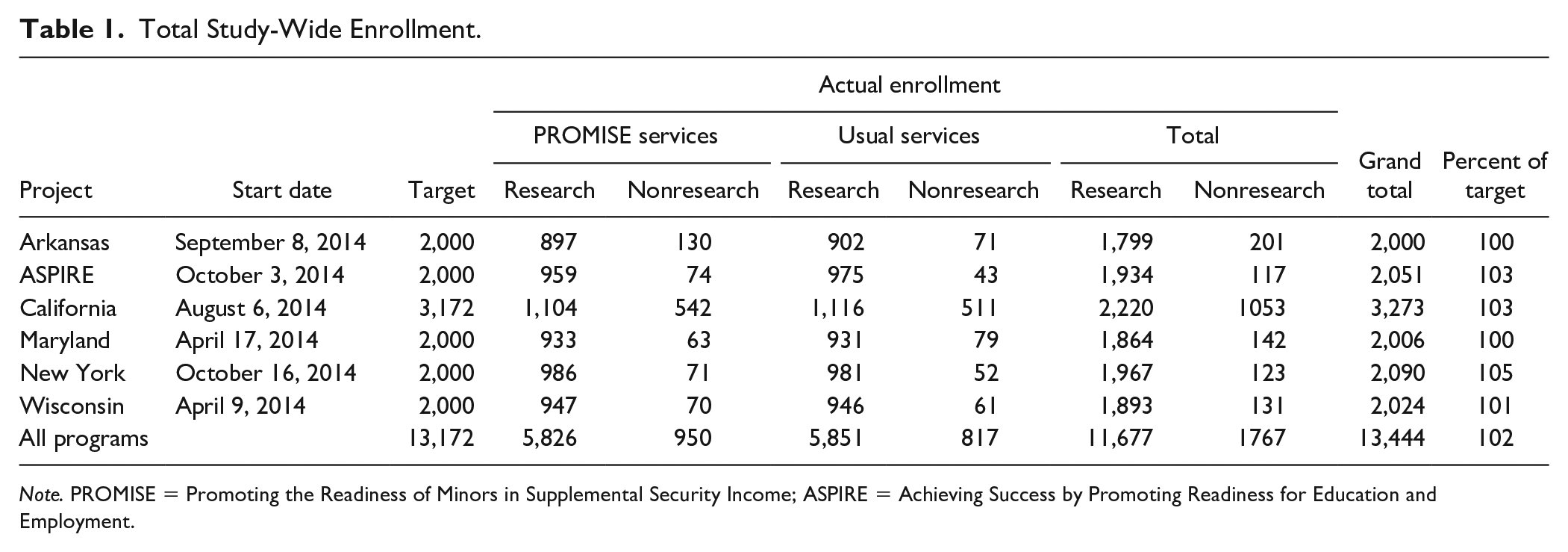
Note. PROMISE = Promoting the Readiness of Minors in Supplemental Security Income; ASPIRE = Achieving Success by Promoting Readiness for Education and Employment.
The enhanced PROMISE services consisted of four required services and supports: (a) case management; (b) benefits counseling and financial capability services; (c) career and work-based learning experiences, including paid employment in integrated settings; and (d) parent training and information. The projects chose to include additional services and supports as well as determined the way the services and supports were provided to the participating youth and their families. The enhanced services included the coordinated set of services and supports designed to improve the education and employment outcomes for the treatment group of youth and their families.
The enhanced services became the intervention being studied for the PROMISE research study. A key factor in the intervention became the fidelity of implementation of each PROMISE project’s service coordination and delivery. Projects were required to provide the same services to all similarly situated youth and their families, regardless of which region of the state in which they lived and, in the case of the consortium, regardless of which region within which state they lived. The PROMISE projects uncovered that services were unevenly provided across regions of states. Each project faced a lack of capacity in the delivery of at least one required service. As a result, each project addressed the service gaps by building capacity. A common example was that PROMISE projects supported organizations that had a presence in all regions to provide PROMISE services. In one state, the state university’s extension program leveraged their resources to provide training spaces in several areas of the state. In another state, PROMISE funds supported training for community living center staff to obtain benefits counselor certification. All PROMISE projects had sufficient staffing and resources to be able to meet and serve youth and families in rural or geographically isolated areas.
Systems change was a common result of PROMISE projects within these 11 States. One noticeable systems change was increased direct service capacity of the PROMISE partner agencies and service providers. Personnel, many of whom remained employed by PROMISE agencies and service providers, were trained in the enhanced services, required to collaborate across agencies, and responsible for coordinated service plans. Other systems change resulted from the required partnerships among state agencies, which increased, and at times created, opportunities for communication and collaboration that influenced service coordination and provision outside the PROMISE projects. Any systems change, although positive for youth and families in these states, could potentially contaminate the findings of research significance of impact among the enrolled participants. The original 5-year grant period was extended with no additional funds for all six projects. Although end dates vary, all projects will close before the end of FFY 2020. The articles in this special issue result in large part from analyses performed under the no-cost extension of the grant awards.
Conclusion
The purpose of this article was to provide an overview of the requirements of the PROMISE initiative, rather than describe or even list all interventions, improvements, and sustainability developed as a result of the PROMISE projects. The PROMISE materials developed to date, including links to products developed by the national evaluator, are available through ED’s PROMISE webpage and PROMISE TA Center website.
The results of the PROMISE model demonstrations remain at the time of this publication formative and preliminary. However, these preliminary results are encouraging. The stakeholders during the preaward listening sessions, held by ED, indicated that outcomes for youth with disabilities living in poverty had remained unchanged despite decades of intervention. The fact that all six PROMISE projects indicate positive impact on education and employment outcomes of these youth and their families testifies to the value of these projects. The long-term impact and outcomes will not be known until the national evaluator and PROMISE projects complete final analyses of post-intervention data and outcomes. The lessons learned from the projects can inform effective practices for youth SSI recipients and their families.
Footnotes
Authors’ Note
The authors appreciate the guest editors for requesting this article. It is not intended to provide an exhaustive description of the history and process of the development and implementation of the Promoting the Readiness of Minors in Supplemental Security Income (PROMISE) initiative; rather, the authors intend to provide a general context for the articles that follow. The information in this article is culled from resources available to the public. Readers are encouraged to review those documents for more information.
Declaration of Conflicting Interests
The author(s) declared no potential conflicts of interest with respect to the research, authorship, and/or publication of this article.
Funding
The author(s) disclosed receipt of the following financial support for the research, authorship, and/or publication of this article: The authors are federal employees who serve in the PROMISE program office. This article presents information from several grant awards under CFDA# 84.418P and 84.418T.