



Abstract
Background:
With the increasing use of social media, social media addiction (SMA) has become a pressing issue and is associated with multiple negative outcomes. Lack of mindfulness has been shown to be associated with an increased risk of SMA, yet such an association has never been explored among nurses in China.
Methods
From December 4, 2022 to March 14, 2023, a cross-sectional study was conducted in 29 hospitals in Hunan Province, China. A total of 1,141 nurses were recruited and completed the online questionnaires. Mindfulness and SMA were assessed by the Mindful Awareness Attention Scale (MAAS) and Social Networking Service Addiction Scale (SNSAS), respectively. Multivariate linear regression analysis was used to explore the association between mindfulness and SMA, and other influencing factors of SMA.
Results
The nurses had an average score of 68.02 ± 11.86 for mindfulness and 46.15 ± 15.09 for SMA. The results of linear regression analysis showed that lower levels of mindfulness (β = –0.06, p < .001), shorter working years (β = –0.21, p = .014), and experiencing more frequent workplace violence (β = 0.21, p =.007) were associated with an increased risk of SMA.
Conclusions/Application to Practice
Our study shows a generally moderate level of SMA among nurses in Hunan Province, which was influenced by mindfulness, working years, and workplace violence. Mindfulness-based interventions may be effective interventions to alleviate nurses’ SMA. Special attention should also be paid to nurses with shorter working years and those who experienced workplace violence.
Background
In the context of worldwide technology-mediated communication, social media use has grown extensively and infiltrated people’s daily lives (Stănculescu & Griffiths, 2022). In the United States, 68% and 73% of adults are active users of Facebook and YouTube, respectively (Smith, 2018). As of December 2023, the number of mobile internet users in China has reached 1.091 billion, the proportion of internet users accessing the internet via mobile phones is 99.9%, and the average weekly online duration per person is 26.1 hours (“CNNIC: The 53rd Statistical Report on the Development Status of the Internet in China,” 2024). As dependence on social media increases, a large number of users have been observed to be at risk of maladaptive social media use with symptoms specific to behavioral addictions, referred to as social media addiction (SMA; Zhao et al., 2022). Social media addiction is described as an uncontrollable urge to use the internet and social media to the extent that behavioral addiction symptoms occur (Cao et al., 2020; Chen, 2019; Y. Sun & Zhang, 2021). Social media addiction is characterized by the following four symptoms of addiction: loss of control, anxiety and feeling lost, withdrawal and escape, and productivity loss (Gong et al., 2020; Kwon et al., 2016; Liu et al., 2022).
Social media addiction may result in a person being in a state of over-attention even when they are not using social media. People with SMA often devote a lot of energy and time to social media cravings; this dependency damages other important areas of their lives (Brailovskaia, Schillack, et al., 2020). Studies have shown that excessive use of social media can lead to decreased work performance (Xanidis & Brignell, 2016), poor social relationships (Müller et al., 2016), insomnia (Hjetland et al., 2021), low life satisfaction (Hawi & Samaha, 2017), and psychological distress, such as stress, depression, anxiety (Huang, 2010; Thomson et al., 2021), and even suicide (Brailovskaia, Teismann, et al., 2020). With the increasing number of internet and SMAs, more than 210 million people in the world will be affected (“Social Media Addiction Statistics, 2023—Who Is Most At Risk?” 2024), making it urgent to reduce social media addictive behaviors (Longstreet & Brooks, 2017). It is thus important to understand the influencing factors of SMA to guide targeted and effective intervention programs.
Mindfulness refers to the state of ‘bringing one’s complete attention to the experiences occurring in the present moment, in a non-judgmental or accepting way’ (Baer et al., 2006). Mindfulness has been found to enhance mental clarity, strengthen focus, and lead to improved well-being (Jones et al., 2022; Sriwilai & Charoensukmongkol, 2016). Mindfulness has shown beneficial effects in improving many health conditions, including depression, anxiety, stress, insomnia, addiction, mental illness, pain, hypertension, weight control, cancer-related symptoms, and prosocial behavior (Bishop et al., 2004). Mindfulness has also been shown to improve addictive behaviors as it promotes functional coping strategies and reduces the risk of maladaptation and self-destructive behavior in stressful situations. For instance, Kiraly et al. (2020) proposed a consensus guide that helps reduce problematic and addictive online activities during the pandemic, with mindfulness as a key protective factor.
Although the association between mindfulness and SMA has been well established, most studies have been focused on adolescents and college students and looked at the connection between social media use and many different psychosomatic disorders (Brailovskaia, Schillack, et al., 2020). Few studies have been conducted on specific populations, especially on groups of nurses (Luo et al., 2022). Moreover, extant social media research is scant on the impact of social media in the work context, especially in the health care field (Sriwilai & Charoensukmongkol, 2016). To fill in the research gaps, we conducted this study to investigate the current status of nurses’ SMA, to examine the relationship between nurses’ level of mindfulness and SMA, and to explore other potential risk factors of SMA. The results of the study are beneficial to enrich the theoretical and empirical research on SMA and may also guide the development of future prevention and intervention programs to improve SMA among nurses.
Methods
Participants and Procedure
The cross-sectional study was conducted in four primary, eight secondary, and 13 tertiary general hospitals as well as four specialized hospitals in Hunan Province, China from December 4 2022 to March 14, 2023. The study included all nurses working in the selected hospitals for more than 1 year and who consented to participate in the study. Nurses who were on leave (study leave, sick leave, and maternity leave) or who had a history of psychiatric illness and disorders of consciousness were excluded from the study.
Data were collected through an online questionnaire by Sojump software (https://www.wjx.cn/), which is one of the most widely used authoritative questionnaire survey platforms in China with high efficiency and reliability. A link to the online questionnaire survey was sent to nurses through social media, such as WeChat and QQ. The survey was completely anonymous and the screening criteria for invalid questionnaires were as follows: (a) answering time of less than 300 seconds (less than normal answering time) and (b) questionnaires with the same answers to all questions or with a large number of repeated responses. The study was approved by the Institutional Review Board of the Third Xiangya Hospital of Central South University (Fast 23723). All participants provided electronic informed consent before participating in the study. A total of 1,194 questionnaires were collected, among which 1,141 were valid and included in the final analysis.
Measures
Mindfulness
Mindfulness was measured using the Mindful Attention Awareness Scale (MAAS) developed by Brown and Ryan (2003). This is a unidimensional scale including a total of 15 items. Each item is positively scored on a 6-point Likert-type scale from 1 (almost always) to 6 (almost never). The total score ranges from 15 to 90, with a higher score indicating a higher level of mindfulness. A total score of ≤ 40, 41 to 65, and 66 to 90 represents poor, moderate, and good mindfulness, respectively. In the present study, the MAAS demonstrated good internal consistency with a Cronbach’s α coefficient of 0.94.
Social Media Addiction
Social media addiction was measured using the Social Networking Services Addiction Scale (SNSAS) (Wang, 2019). This is a unidimensional scale including a total of 18 items to assess the user’s addiction level. Each item is positively scored on a 5-point Likert-type scale ranging from 1 (strongly disagree) to 5 (strongly agree). The total score ranges from 18 to 90, with a higher score indicating a higher level of addiction. In the present study, the SMA demonstrated good internal consistency with a Cronbach’s α coefficient of 0.96.
Demographics
Through literature analysis and expert consultation, the following 15 demographic variables were identified that could have an impact on SMA. These include gender, age, marital status, education, grade of hospital, type of hospital, working department, working years, professional qualification, monthly income, working hours per week, night shifts per month, government authorization (public or private hospital), workplace violence, and current physical health.
Statistical Analysis
SPSS 27.0 was used for data analysis. Comparisons of SMA scores by different sample characteristics were conducted using two-sample independent t tests for two-group comparisons, and one-way analysis of variance (One-Way ANOVA) for multiple-group comparisons. Pearson’s correlation coefficients were used to measure the correlation between mindfulness and SMA. Multiple linear regression analysis was conducted to analyze the association between mindfulness and SMA, and other factors associated with SMA, with SMA as the dependent variable. p < .05 was considered statistically significant.
Results
Sample Characteristics
Table 1 shows the socio-demographic characteristics of the 1,141 nurses. Most were female (97.5%), married (71.2%), had an undergraduate education (73.4%), worked in general (91.8%) and third-class (66.7%) hospitals, and worked 40 to 60 hours per week (65.2%). Over half of the nurses held professional qualifications of supervisor (52%), worked in private hospitals (57.1%), and were in good health (54.7%). Among all participants 55.4% indicated that they had never experienced workplace violence, while 37.4% and 7.2% had experienced it one to three times, and more than three times, respectively.
Participants’ Socio-Demographic Characteristics

Scores of SMA and Mindfulness
As shown in Table 2, the total score of SMA was 46.15 ± 15.09, and the scores of the six subscales ranged from 6.91 ± 2.75 for the relapse dimension to 8.45 ± 3.07 for the emotional adjustment dimension. The nurse’s mindfulness score was 68.02 ± 11.86. As there is currently no clear classification of mindfulness scores, the total score on the MAAS is 90. We believe that the overall level of mindfulness among Chinese nurses is relatively high.
Score of Social Media Addiction and Mindfulness Scale
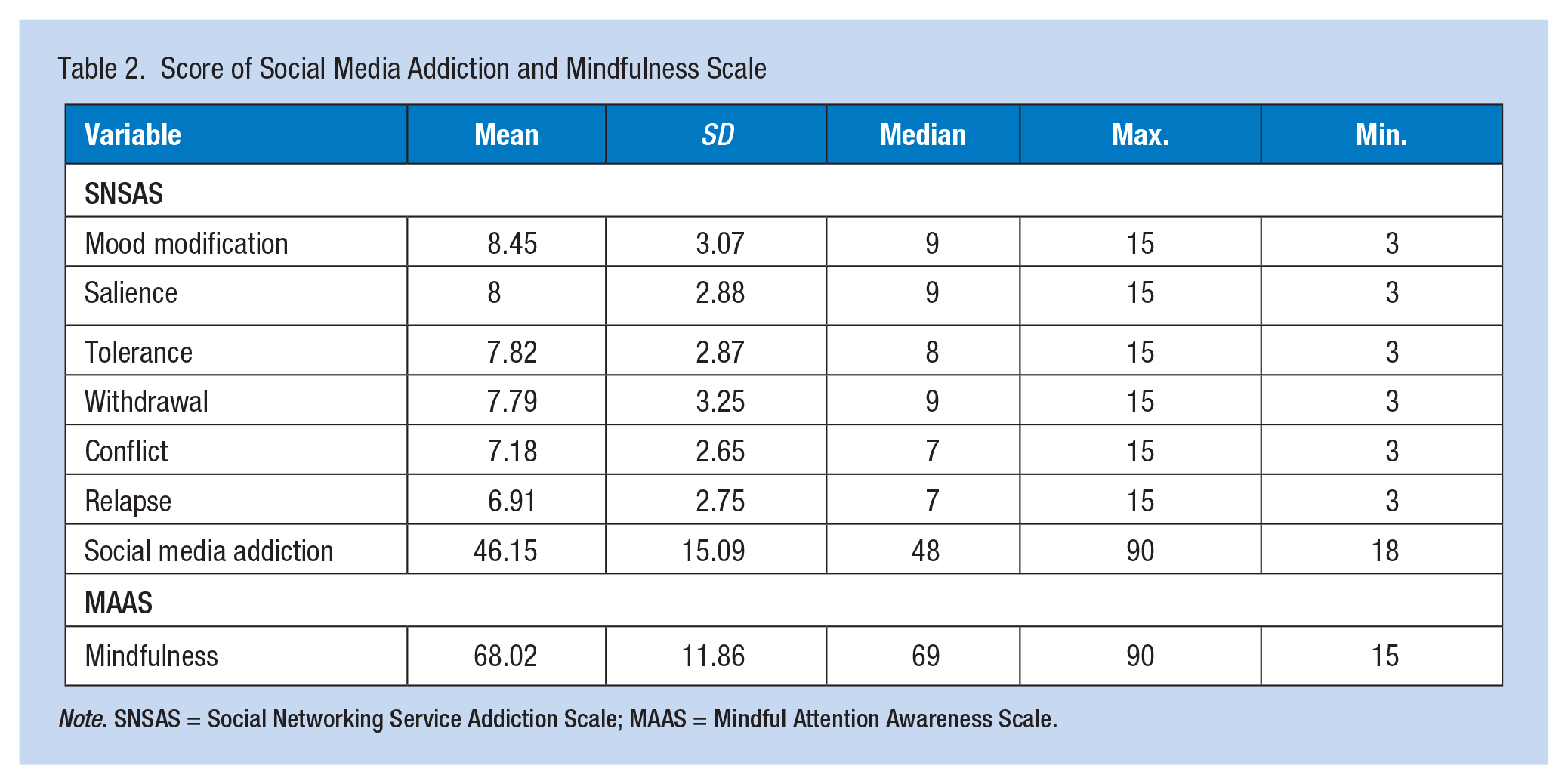
Note. SNSAS = Social Networking Service Addiction Scale; MAAS = Mindful Attention Awareness Scale.
Comparison of SMA Score by Demographic Characteristics
Further comparison of the SMA score by various socio-demographic characteristics showed significant differences in the following variables: age, marital status, working years, professional qualification, government authorization, night shifts per month, work violence, and physical health. As shown in Table 1, nurses aged between 18 and 30 years, who are unmarried, have less than 5 years of work experience, lack professional nursing qualifications, work five to 10 night shifts per month, are employed in private hospitals, and have experienced workplace violence more than three times since employment, achieve the highest SMA scores.
Association Between Mindfulness and SMA
The Pearson correlation coefficients between mindfulness and SMA and its subscales are shown in Table 3. Mindfulness was significantly and negatively correlated with SMA (r = –0.467, p < .001) as well as its six subscales, with r ranging from –0.314(p < .001) for the salience subscale to –0.448 (p < .001) for the recurrence subscale.
Pearson’s Correlation Analysis Between Mindfulness and SMA
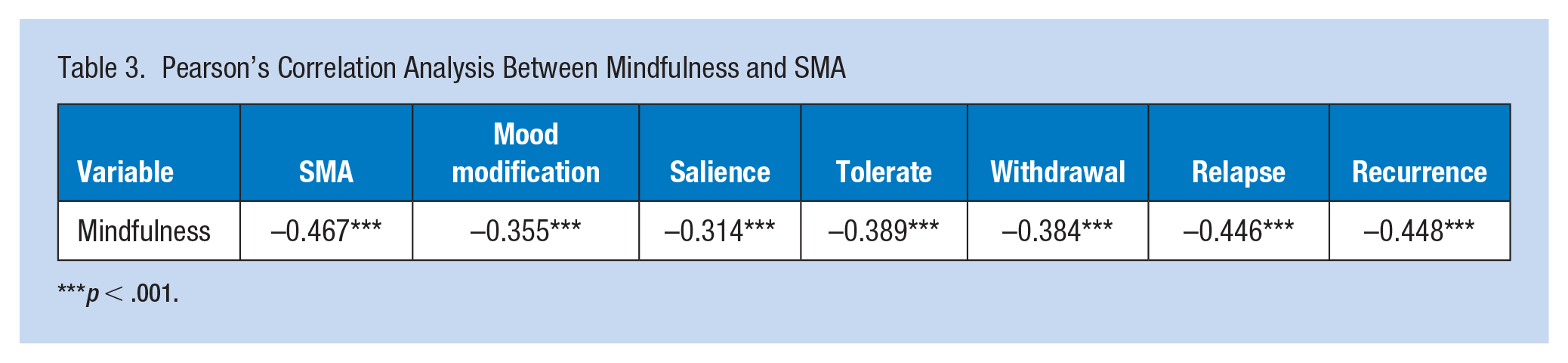
p < .001.
The Influencing Factors of SMA
A multiple linear regression analysis was conducted with the SMA score as the dependent variable and all significant variables in the univariate analysis as independent variables. As shown in Table 4, among eight variables that were included in the regression model, three remained significant after controlling for: mindfulness, working years, and frequency of workplace violence. Specifically, lower levels of mindfulness (β = –0.06, p < .001), shorter working years (β = –0.21, p = .014), and more frequent workplace violence (β = 0.21, p = .007) were associated with a higher level of SMA.
Linear Regression Analysis Results
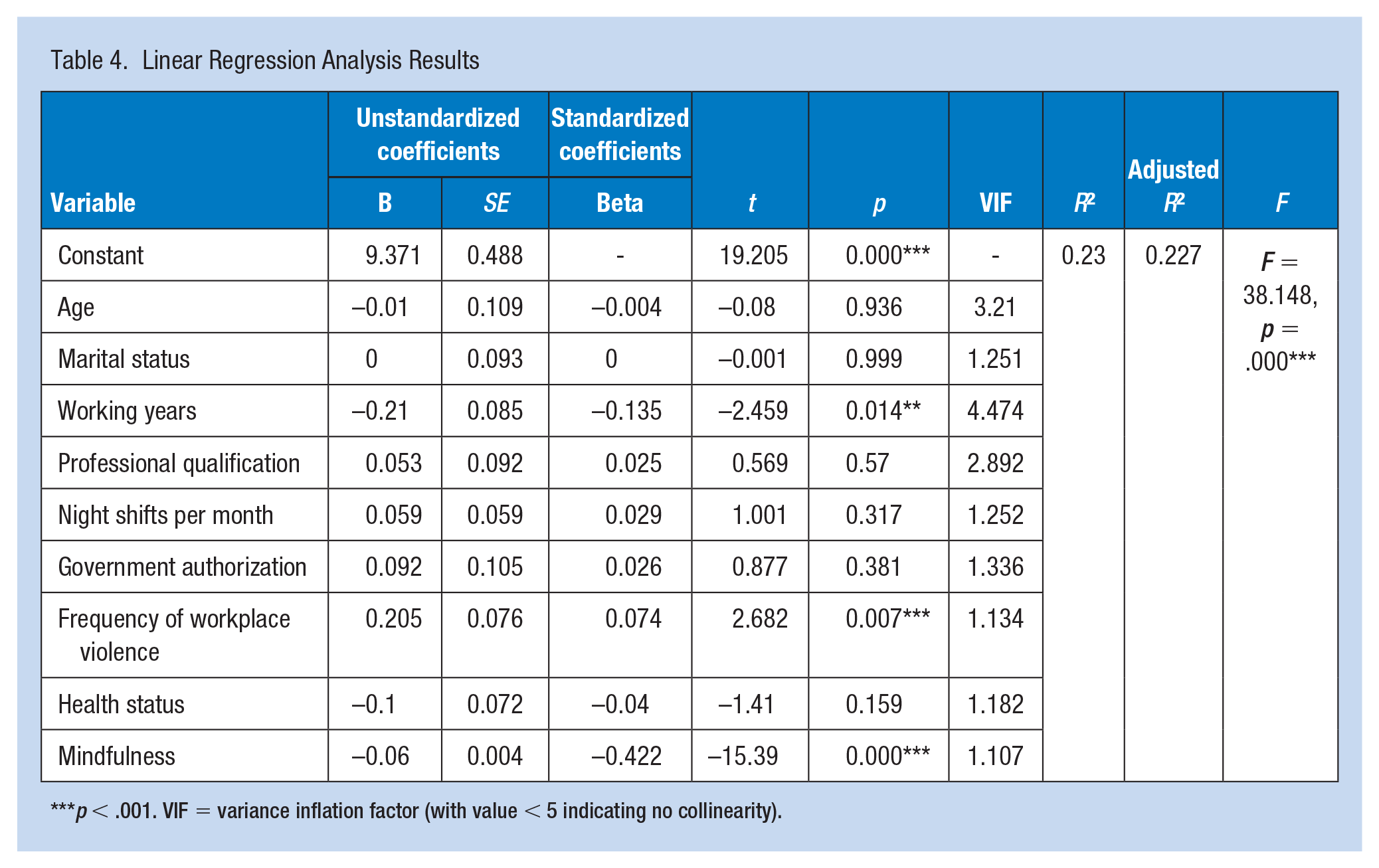
p < .001. VIF = variance inflation factor (with value < 5 indicating no collinearity).
Discussion
Summary of the Findings
To our knowledge, this is the first study to systematically investigate the status of SMA and to examine the association between mindfulness and other influencing factors of SMA among nurses in China. Our results showed that the nurses had a moderate level of SMA, with a mean score of 46.15 ± 15.09 for the SNSAS. Further multivariate linear regression analysis showed that lower levels of mindfulness, shorter working years, and more frequent workplace violence were associated with an increased risk of SMA. This study strengthens our understanding of SMA among nurses as well as contributes key practical and theoretical insights to guide future research and interventions.
Mindfulness and SMA
Our study identified a strong negative correlation between mindfulness and various dimensions of SMA, indicating that nurses with lower mindfulness levels were more likely to develop SMA. This finding was consistent with a large body of previous studies showing that mindfulness was negatively correlated with SMA (Eşkisu et al., 2020; Hassan & Pandey, 2021; Mazzoni et al., 2017; Sriwilai & Charoensukmongkol, 2016). A possible explanation may be that individuals with lower levels of mindfulness may also have lower self-control, which in turn increases social anxiety and leads to compulsive use of social media (Apaolaza et al., 2019). The association between mindfulness and SMA may be bidirectional. On one hand, lower levels of mindfulness may lead to higher levels of SMA. On the other hand, people who are highly addicted to social media may have lower mindfulness abilities. Mounting evidence has shown the negative impact of SMA on mindfulness, wherein people who are unable to control their urges and behaviors toward using social media are found to have more difficulty focusing on or paying close attention to their jobs or other activities (Sriwilai & Charoensukmongkol, 2016). One important implication of the findings was that mindfulness-based interventions may be utilized as an effective way to improve SMA, as it can use self-awareness that controls behavior to reduce the tendency for destructive behavior and promote positive achievement (X. Sun, 2022). Previous studies have confirmed the effectiveness of mindfulness intervention on improving craving, material use disorders, and post-traumatic stress disorder (Korecki et al., 2020; Luteijn et al., 2020). It is thus expected that mindfulness-based intervention may also help reduce nurses’ dependence on social media, thereby reducing the adverse effects of SMA on their physical, mental, and social well-being.
Demographic Influences on SMA
In addition, our study also identified two socio-demographic factors that were associated with SMA: nurses’ working years and experiences of workplace violence. Specifically, nurses with shorter working years and who experienced more frequent workplace violence had a higher level of SMA, which was also in line with previous studies (Hosgor et al., 2021). Nurses with shorter working years may have less sense of belonging and identification with the organization. They may feel pressure and uneasiness when adapting to a new environment. They may feel nervous and anxious as they struggle to learn new work methods and work with different people. To alleviate such psychological distress, they may turn to social media as a way to escape reality and gradually develop into SMA. Numerous studies have shown that experiences of workplace violence have a serious impact on the victims’ physical and mental health, interfering with their work status, and may even lead to long-term psychological trauma and emotional stress (Magnavita et al., 2022). In this situation, social media may become an alternative to escape reality and release stress. Nurses who have experienced violence at work may feel safer and more comfortable in the virtual world provided by social media, and therefore be more inclined to spend more time on social media and develop SMA. Hospital violence against nurses is a global concern, but there has been no research on the relationship between nurses’ experiences of workplace violence and SMA, which warrants further research.
Although this study provides important insights, it has some limitations. First, the participants were recruited from the Hunan Province of China and may not represent nurses in other parts of China. Future multi-center studies across the country are needed to get a more representative sample. Second, the cross-sectional study design may preclude any causal relationships between key variables, such as mindfulness and SMA, which relies on future longitudinal studies for further exploration.
Implications for Occupational Health Practice
This is the first study in China to investigate nurses’ SMA and associated factors, with a focus on the relationship between mindfulness and SMA. The results suggest that nurses with lower levels of mindfulness, shorter working years, and more frequent experiences of workplace violence are more likely to have SMA. The findings provide important implications for future research and interventions. First, it is particularly important to cultivate nurses’ mindfulness awareness and skills, as mindfulness training can reduce their dependence on social media. It is thus suggested that mindfulness-based interventions should be developed and implemented among nurses to prevent SMA and improve their general well-being. Second, this study found that nurses with shorter working years have the highest SMA level. Therefore, the study results indicate that newly hired nurses (with shorter working years) and nurses with lower levels of mindfulness are more prone to SMA. Consequently, it is recommended to pay special attention to the psychological needs of newly hired nurses. Providing psychological counseling and career planning can help them better integrate into the work environment and reduce excessive reliance on social media. Third, more effective prevention and management of workplace violence should be implemented in hospitals to prevent and reduce workplace violence. Psychological counseling and support should also be in place for nurses who have experienced workplace violence to help them better cope with setbacks, regain enthusiasm for work, and reduce the possibility of SMA.
Applying Research to Occupational Health Practice
Social media addiction is a growing concern that may have negative impacts on individuals and society. Mindfulness, the awareness and acceptance of present-moment experiences, is considered as a protective factor against SMA. We surveyed 1,141 nurses from 29 hospitals in Hunan Province, China, and measured their levels of mindfulness and SMA, as well as the relationship between them. We also examined the effects of other factors on SMA. Our research results suggest that mindfulness-based interventions may help reduce SMA among nurses, and that special attention should be paid to nurses who are new to the profession or who have experienced workplace violence. Effective measures should be taken to prevent and manage workplace violence, thereby reducing the likelihood of SMA
Footnotes
Contributors
Study conceptualization and design: CLK, HW. data collection: JFL, QXZ, and WZX. Data analysis: CLK. drafting and revision of the manuscript: CLK, HW. concurrence with the findings and conclusions of the manuscript: CLK, HW, JFL, QXZ, and WZX. All authors approved the final manuscript and acted as guarantors for the study.
Conflict of Interest
The author(s) declared no potential conflicts of interest with respect to the research, authorship, and/or publication of this article.
Data Availability Statement
The data that support the findings of this study are available from the corresponding author upon reasonable request.
Funding
The author(s) disclosed receipt of the following financial support for the research, authorship, and/or publication of this article: The authors gratefully acknowledge support for this study from the National Natural Science Foundation of China (Grant No.72204272).
Ethical Approval
The Ethics Committee of Xiangya Third Hospital of Central South University (Kuai 23723) approved this study on Thursday, October 19, 2023.
