




Abstract
Background:
Persistent job-related stress can be harmful to physical and mental health and has a sizable financial burden on society. Face-to-face interventions are effective in reducing stress but have the disadvantage of high costs and time requirements. mHealth solutions may be an effective alternative to provide stress management interventions at work. Occupational health professionals need information on which mHealth apps are effective for employees to manage job-related stress. The aim of this review is to provide an overview of effective web- and app-based interventions for reduction of job-related stress and stress-related symptoms.
Method:
A literature review was conducted in the databases PubMed, PsycINFO, CINAHL Complete, and IEEEXplore.
Findings:
A total of 24 articles describing 19 products were found. All products showed effectiveness in trials in improving mental and/or physical health and reducing stress. Most products have a course-like structure with a duration from 1 to 8 weeks. The products use various methods such as psychoeducation and education on stress, cognitive restructuring, emotional regulation, problem-solving, goal setting, gratitude, breathing, or mindfulness techniques. Most products use more than one method and most mixed material such as text on web pages, text messages, videos, reading and audio material, and games.
Conclusion/Application to Practice:
Overall, effective mHealth products were identified for the intervention of acute and chronic stress. Occupational health practitioners can use these 19 evidence-based mHealth products when advising organizations on health promotion of employees to reduce stress symptoms and promote health and well-being.
Background
On a world ranking of employees experiencing work stress on a daily basis in 2021, North America is the second most affected region in the world with 50% of the employees experiencing stress at work. Only East Asia has a higher ranking with 55% of employees facing work stress on a daily basis (Clifton, 2022). Work-related stress increased in many countries through the COVID-19 pandemic (Jewell et al., 2020; Leclerc et al., 2022; McGinty et al., 2020). Some employees were forced to work remotely, and the related social isolation and family–work conflicts were factors that increased stress for numerous employees (Galanti et al., 2021; Xiong et al., 2020). The World Health Organization (2020) defines work stress as the “response people may have when presented with work demands and pressures that are not matched to their knowledge and abilities and which challenge their ability to cope.” Stress becomes dangerous if one does not respond or cope with it adequately (O’Connor et al., 2021), resulting in physical, emotional, and behavioral consequences such as reactions of the nervous, cardiovascular, or respiratory systems, headaches, sleeping disorders, anxiety, fear, sadness, or depression (American Psychological Association [APA], 2021; Yaribeygi et al., 2017). Rehabilitation of diseases caused by stress can be challenging and lengthy for the individual (Korhonen et al., 2020), and stress is a common reason for sick leave (Duchemin et al., 2019). Furthermore, stressed people at work are more likely to leave their job (Omar et al., 2020). Therefore, stress management is a concern for companies, insurers and society, and evidence-based interventions to reduce stress are needed. Stress treatment should be provided promptly to prevent long-lasting or chronic stress and it consequences (APA, 2021; Dai et al., 2020).
mHealth (mobile health) is defined as a mobile wireless technology for the cost-effective and secure use of information and communication technologies in support of health and health-related fields (World Health Organization, 2018). The use of mHealth products has several benefits compared with traditional therapy forms: for example, economically beneficial, the inclusion of undersupplied population groups, possibility to overcome distances, fast access, low usage threshold, anonymity, flexibility in application (Iribarren et al., 2017). Web- and app-based interventions promote and support health and augment conventional health services. In 2021, 350 000 mHealth apps were available in app stores (Byambasuren, 2020). This very large number of apps makes it difficult for users to find and choose an effective and evidence-based product. Byambasuren (2020) states a lack of knowledge of effective mHealth apps and suggests: “a curated compilation of effective [mHealth] apps” (p. 4). To our knowledge, no scientific work provides an overview of mHealth products that have shown to effectively reduce stress and stress related symptoms.
The aim of this literature review, therefore, is to explore which web- and app-based mHealth interventions are effective in stress management at work.
Methods
A literature review was performed according to the PRISMA flow diagram (Figure 1). The search was carried out in four scientific databases: PubMed, PsycINFO and CINAHL Complete, and IEEEXplore. The search terms were web-based, stress reduction, intervention, evidence and a broad set of synonyms were used to maximize sensitivity. Boolean operators were used, “OR” within topics and “AND” to combine topics. The search was limited to publication years 2015 to 2022, including working adults (18 years or above) who had no specific diagnosis and to articles written in English or German. Studies were included if they were randomized controlled trials, systematic reviews, or meta-analyses.
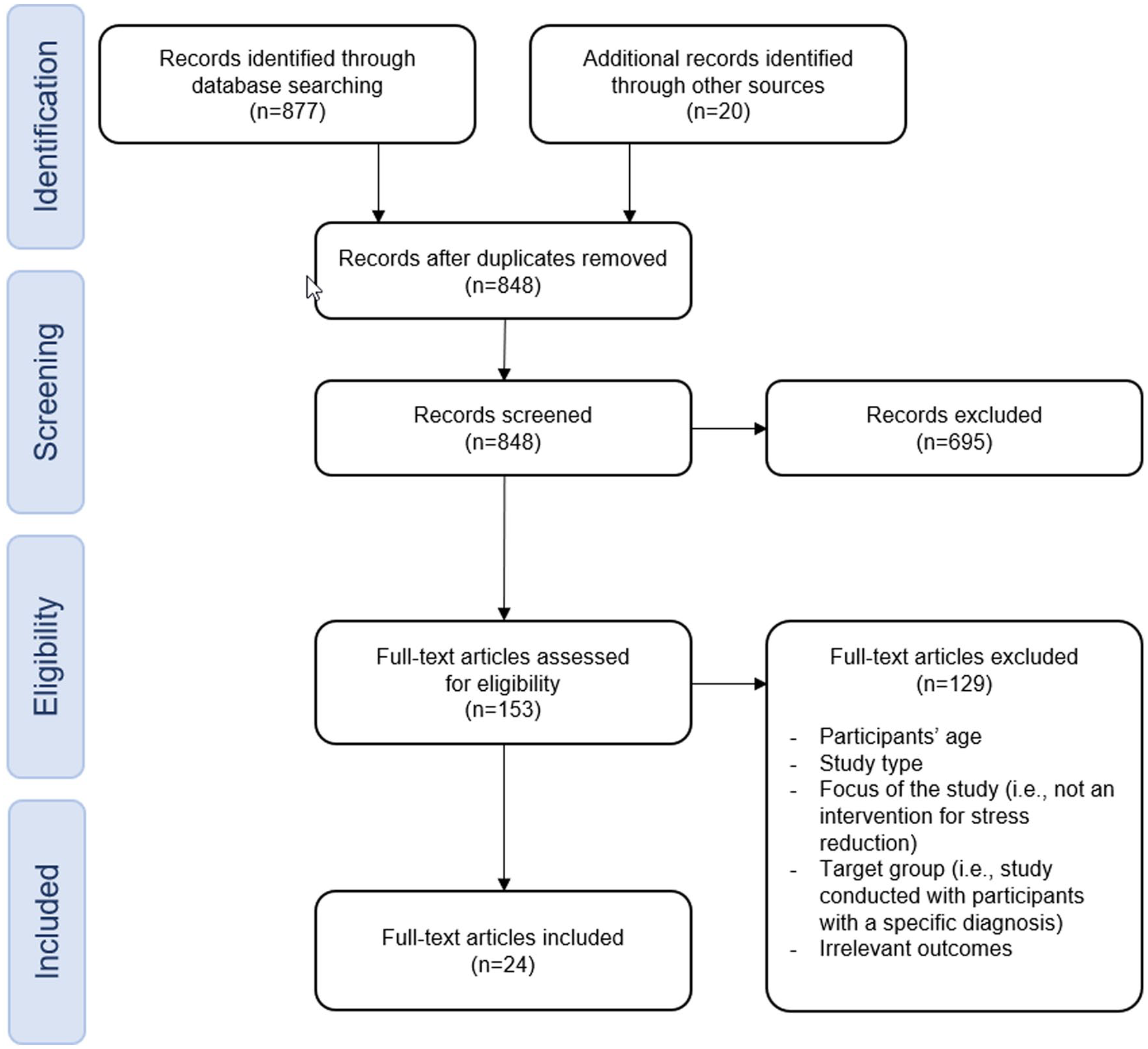
PRISMA Flowchart.
The search resulted in a total of 877 articles (see Figure 1). Using Wohlin et al. (2022) snowball method, we identified a further 20 studies by checking the reference list of the articles already found for additional matching articles. After the removal of duplicates, we screened 848 abstracts, whereby 695 articles were excluded because they did not fit the topic or had another focus. In a second step, the full text of the remaining 153 studies was assessed. We excluded 129 records because they did not match our inclusion criteria with regard to study type or target population or because the focus of the study was not an intervention for stress reduction. We ultimately included 24 eligible articles (RCT) in our review.
Results
We found 24 studies describing 19 products, originating from 7 different countries: Germany (6), Denmark (1), United Kingdom (5), United States (7), Sweden (3), Brazil (1) and Korea (1). Participants in the studies were from a variety of professional backgrounds including pharmaceutical, high-tech, information technology, management (9), hospital (4), university or school (3), or psychologist (1). Seven of the studies included participants from the general working population without being specified.
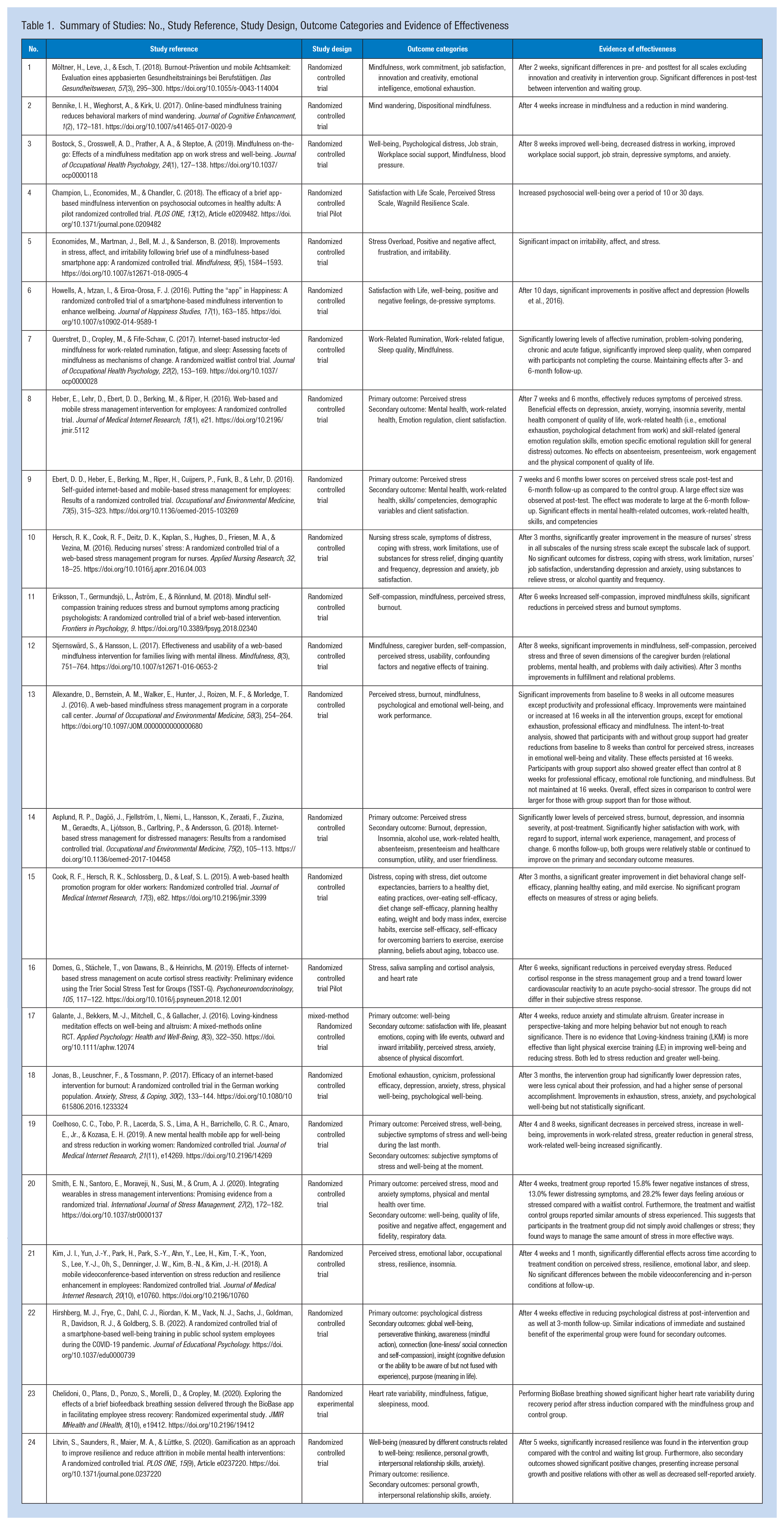
Of the 19 products, 11 are web-based and eight are apps (see Tables 1 and 2 for summaries of products). All products showed effectiveness. They all improved mental health by decreasing stress-related symptoms such as perceived stress, perceived burnout symptoms, depressive symptoms, emotional exhaustion, and anxiety. Furthermore, improved mental health outcomes were improved resilience (Champion et al., 2018; Kim et al., 2018; Litvin et al., 2020), work commitment (Möltner et al., 2018), job satisfaction (Hersch et al., 2016; Möltner et al., 2018), emotional intelligence (Möltner et al., 2018), and self-efficacy (Cook et al., 2015). Studies of 11 products used stress as primary or secondary outcome measure, quantified by the Perceived Stress Scale of Cohen et al. (1983). Other studies used, for example, stress scales of Orioli (Orioli et al., 1987, as cited in Cook et al., 2015), the Stress Overload Scale (Amirkhan et al., 2015; as cited in Economides et al., 2018), or the Nursing Stress Scale (Gray-Toft & Anderson, 1981 as cited in Hersch et al., 2016). The pre- and post-tests of most studies varied between 2 weeks and 6 months.
Summary of Studies: No., Study Reference, Study Design, Outcome Categories and Evidence of Effectiveness
Summary of Products: Product name, Nr., Product Type, Product Validation, Technique and Conceptual Framework, and Short Description of Product
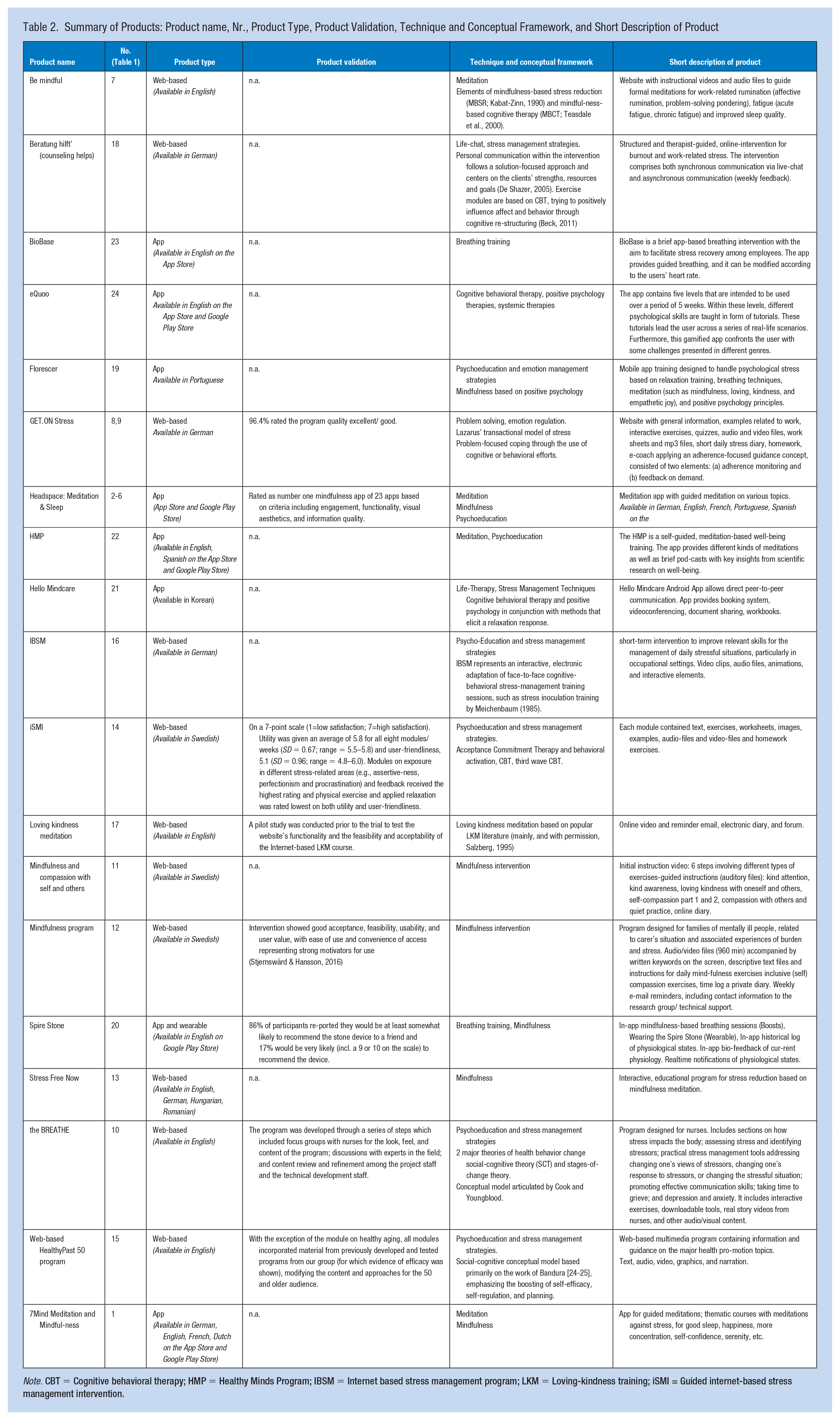
Note. CBT = Cognitive behavioral therapy; HMP = Healthy Minds Program; IBSM = Internet based stress management program; LKM = Loving-kindness training; iSMI = Guided internet-based stress management intervention.
Content of Products
Most of the programs include introductions, theoretical, or educational inputs (e.g., concept of meditation and mindfulness, how stress affects the body and daily life, problem-solving methods; for details see Table 2). There are products that cover a variety of health-related topics such as the web-based “HealthyPast 50” program (Cook et al., 2015) or the “GET.ON Stress” program (Ebert et al., 2016). In “HealthyPast 50,” based on an initial assessment, participants receive information on a selection of several health topics such as healthy eating, active lifestyle, tobacco use, weight management, and stress management.
Meditation interventions such as the “Healthy Minds Program” (Hirshberg et al., 2022), the “Be mindful” (Querstret et al., 2017), the “Mindfulness program” (Stjernswärd & Hansson, 2017), or the “7Mind Meditation and mindfulness” (Möltner et al., 2018) contain various methods of meditation rather than focusing solely on stress reduction. Their aim is to improve awareness, well-being, sleep quality, happiness, concentration, and self-confidence. The app “Headspace” covers meditation exercises on topics such as overcoming fear, stress reduction breathing, joy, calmness, and concentration (Bostock et al., 2019; Economides et al., 2018). The focus of the web-based program “mindfulness and compassion with self and others” offers mindfulness exercises as well as compassion-focused exercises regarding loving-kindness and exercises to practice compassion with self and others (Eriksson et al., 2018). The apps “Stress free now” and “BioBase” only comprise breathing training modules based on mindfulness stress reduction (Chelidoni et al., 2020; Smith et al., 2020). “Stress free now” can additionally be combined with a wearable device that provides real-time notifications on significant and sustained changes of respiratory patterns (Smith et al., 2020).
The apps “Florescer” and “Hello Mincare” focus on psychoeducation and education on stress, cognitive restructuring, emotional regulation, problem-solving, goal setting, and gratitude. The web-based program “Get.ON stress” is an intervention based on psychoeducation, including modules regarding problem-solving, emotion regulation, and planning for the future. The optional modules provide information on time management, rumination and worrying, psychological detachment from work, sleep restriction, stimulus control, nutrition, exercise, planning of breaks during work, and social support. The self-guided program includes different interactive elements (e.g., online diary; Ebert et al., 2016). The web-based programs “iSMI” and “the BREATHE” show a similar structure. Both start with an introduction and information about stress followed by coping with work environmental stressors, symptoms of stress, and how to manage those symptoms. The iSMI covers relaxation and cognitive–behavioral therapy principles, exercises to practice work–home interface and value-based action skills (Acceptance Commitment Therapy) as well as practice balance and exposure or modules on positive management using various materials (Asplund et al., 2018). “The BREATHE” provides different stress management strategies and tools and addresses additional topics such as avoiding negative coping (use of alcohol and drugs) and improve mental health (focus on depression and anxiety). These topics are provided through interactive exercises, downloadable tools, and real story videos from nurses or other audio/visual contents. The program includes a tool to track stress (Hersch et al., 2016).
Different Materials Used to Convey Content
All 19 products use mixed materials. Texts provide instructions or background information on a regular basis. For example, the “stress free now” program (Allexandre et al., 2016) provides daily articles about evidence of each weeks theme or discusses cognitive and behavioral strategies, activities, and concepts supporting or related to mindfulness. Videos allow practicing exercises when needed (Galante et al., 2016). Video introductions give basic information about stress and coping methods (Ebert et al., 2016). Audio material provides guided meditations, body scans, mindful movements instructions, or background information to a specific topic (Asplund et al., 2018; Cook et al., 2015; Domes et al., 2019; Ebert et al., 2016; Heber et al., 2016; Querstret et al., 2017; Stjernswärd & Hansson, 2017). Diaries (e.g., in form of a blog) are used to write down expectations or course experiences or for self-reflection about stress behavior (Galante et al., 2016). To build empathy with the product, the “web-based HealthyPast 50 program” shows photos of elderly people, photos of people at same age as target users. Some programs provide text messages, for example, to remind users to breathe consciously and relax, or to remind them to start the mediation session. Worksheets contain strategies or concepts relating to the interventions. One product also makes use of gamified stress reduction interventions (Litvin et al., 2020).
Interventions
Most products contain interventions with a modular structure. For example, the intervention in the product “Be mindful” requires the completion of a session before starting a new one (Querstret et al., 2017). The amount of time required to complete the interventions varies between products. There are products such as the “Be mindful” or “Florescer” that are to be performed during a fixed period of 4 to 8 weeks (Coelhoso et al., 2019; Querstret et al., 2017). Others have an unlimited and continuous number of sessions as, for example, “Headspace” with one session per day (Bostock et al., 2019). The duration of the single sessions varies from 3 to 60 min between the products.
Discussion
To reduce work-related stress and improve stress management, mHealth solutions are an effective and useful alternative to common face-to-face interventions.
Our review provides an overview of mHealth products that reduce perceived stress and stress-related symptoms and increase well-being. There is a great variety in form and content between the 8 apps and 11 web-based interventions we found. Besides stress reduction, various health outcomes are targeted by the interventions and provide manifold options for preventing and addressing stress at work. Especially meditation, mindfulness, or breathing exercises are popular content. Martín et al. (2018), who analyzed mobile apps for stress management, show similar results: Most apps included in their review use relaxing sounds or music and breathing and relaxation exercises.
Some of the mHealth products described in our study are intended to be used in acute stress situations, such as apps with guided meditations or apps combined with a wearable that alerts users when stress occurs and then suggests an appropriate intervention. Other products address more general stress reduction and prevention, for example, to better cope with upcoming stressful situations.
Findings from our review show that mHealth products can be used to effectively address work related stress. However, there are limitations. The rapid development in the market of mHealth products requires a continuous update of an overview of evidence-based products available. A further limitation is that most studies measure outcomes over a period 2 weeks to 6 months. The long-term effect of the products remain unclear. Furthermore, not all products showed effectiveness in every outcome measure. For example, the study by Cook et al. (2015) showed significant improvement in components such as healthy eating and exercises but not in measures regarding stress. Since there is often a correlation between the different outcome measures (e.g., the interaction of nutritional behavior and stress), it can be assumed that this intervention may have a positive impact on stress perception in the long run (El Ansari et al., 2014).
As most products use several methods to address stress reduction, specific success factors of single mHealth intervention cannot be fully determined. Further research is needed to identify key elements for effective mHealth interventions. Furthermore, if study protocols used the same measurement tools such as the Perceived Stress Scale (Cohen et al., 1983), it would facilitate the comparison of the various interventions and products.
Nevertheless, the present literature review provides an overview of effective mHealth interventions for health professionals and for employees. Thereby, mHealth products are an attractive alternative to conventional face-to-face interventions to address stress-related health issues. Especially after the Covid-19 pandemic, working remotely remains popular and remote access to stress interventions is needed. With the expected long-term increase in people working from home, this growth in stress will also be increasingly encountered by Occupational health practitioners (OHP) in their day-to-day work. Online tools will allow for real-time interventions independent of geographic workplace.
Implications for Occupational Health Nursing Practice or Implications for Occupational Health Practice
Due to the confusing amount of available mHealth products, it can be difficult for OHP’s to find guidance for recommending and prescribing evidence-based products. This review shows effective mHealth products to prevent and treat stress-related symptoms that have the potential for the use in occupational health practice. To promote the use of the products, it can be recommended that different products (e.g. with different materials, interventions and thematic contents) are offered. Thus, employees can choose products that correspond to their preferences.
Applying Research to Occupational Health Practice
mHealth products are an attractive alternative to face-to-face interventions for stress reduction and stress-related health issues at work. We identified 19 products that are effective, inexpensive, and flexible with regard to time and location of use. OHP’s can use these 19 evidence-based mHealth products when advising organizations on the health promotion of employees to reduce stress symptoms and promote health and well-being.
Footnotes
Acknowledgements
We thank Martina Spiess for proofreading the manuscript and language corrections.
Authors’ Note
This manuscript is not under review elsewhere and the primary data have not been published previously nor accepted for publication. Time of research June 2020 to September 2022. This research is a part of the mHealthINX project (The mental Health eXperience; Indication- iNtervention- eXperience).
Author Contributions
All authors contributed to the design, review, analysis, and interpretation of the data. All authors were from the beginning or to the final approval, part of the research and drafting process.
Conflict of Interest
The author(s) declared no potential conflicts of interest with respect to the research, authorship, and/or publication of this article.
Funding
The author(s) disclosed receipt of the following financial support for the research, authorship, and/or publication of this article: The mHealthINX project is funded by the European Active and Assisted Living program (AAL).
