



Abstract
Background:
Presenteeism, the act of showing up to work when one is ill, is a prevailing global phenomenon, at rates varying from 30% to 90%. Presenteeism results in consequences to the worker’s health, like pain, depression, and poor work ability, as well as consequences to the organization like productivity loss, negative feelings and engagement of coworkers, and risk of accidents. Agriculture is an important sector for the global economy, providing employment for 27% of the global workforce. This study aimed to estimate the prevalence of presenteeism and its associated factors among agricultural workers.
Methods:
A systematic review was performed through searches at PubMed, Web of Science, LILACS, SciELO, EMBASE, PsycINFO, and Scopus databases. Observational studies (cross-sectional, cohort or case-control) that reported the prevalence of presenteeism in agricultural workers were eligible.
Findings:
A total of 139 studies were found but only two met the inclusion criteria. The selected studies reported prevalence rates of presenteeism of 5.0% and 58.2%. Poor work safety climate, female workers, workers dissatisfied with management, and sunscreen not available at the workplace were strongly associated with the prevalence of presenteeism.
Conclusions/Applications to Practice:
We concluded that the scientific literature about the prevalence of presenteeism among agricultural workers is scarce. Future studies about presenteeism among agricultural workers should measure the prevalence and/or incidence of presenteeism by using the epidemiological approach and, furthermore, should integrate these measures with the work productivity approach.
Background
Agriculture is an important sector for the global economy, providing employment for 874 million people in 2020, or 27% of the global workforce (FAO, 2021). Particularly in developing countries, there are large contingents of women in agriculture, inadequate tools, poor farming practices, exclusion of agricultural workers from national labor laws, low wages, dangerous working conditions, and a high incidence of child and forced labor (International Labour Organization, 2022).
Presenteeism, the act of showing up to work when one is ill (Johns, 2010), is a prevailing global phenomenon (Karanika-Murray & Cooper, 2018), described among workers with different occupations (Kinman, 2019), at rates varying from 30% to 90% (Lohaus & Habermann, 2019). A review pointed out some health consequences associated with presenteeism: poor self-rated health; poor physical health as measured by complaints of pain in upper/back, shoulder, hips, and wrists; poor mental health, as measured by depression, poor mental well-being, emotional exhaustion, and depersonalization; poor work ability; and sickness absence (Skagen & Collins, 2016). Presenteeism can also have organizational consequences like productivity loss, lower engagement and negative feelings toward coworkers, high absenteeism due to spread of illness, risk of accidents, and higher error rate (Lohaus & Habermann, 2019).
Presenteeism has been studied according to two different approaches: the epidemiological approach and the productivity approach (Ishimaru et al., 2020; Pie et al., 2020). The epidemiological approach is concerned about measuring the frequency of presenteeism and the factors associated with this outcome. The studies with this approach generally use a single-item question to measure presenteeism that asks the worker about the frequency he or she went to work despite feeling sick during a certain period of time (Lohaus & Haberman, 2019). The productivity approach is interested in productivity losses resulting from attending to work while ill, using standardized instruments, like the widely used Stanford Presenteeism Scale (Koopman et al., 2002). A literature review has identified 21 instruments for measuring presenteeism as losses of work productivity, addressing quantification of worker self-perception, comparative impairment, and unproductive work time (Ospina et al., 2015).
Studying presenteeism considering only its consequences does not take into account its magnitude. Ideally, the epidemiological and work productivity approaches should be integrated, considering causes, prevalence, and consequences of going to work despite feeling ill or injured (Johns, 2010).
The living conditions and health of agricultural workers and the serious repercussions of presenteeism spark a warning about the magnitude of the problem, which can accentuate the vulnerabilities and demonstrate patterns different from the other working classes already studied. The fragility of mostly temporary employment links and the low opportunity for employment outside of agricultural activity (Siqueira et al., 2017) may make these workers more likely to attend work when sick (Lu et al., 2013; Reuter et al., 2019). This study aimed to estimate the prevalence of presenteeism and its associated factors among agricultural workers.
Methods
A systematic review was carried out, following the recommendations of the Preferred Reporting Items for Systematic Reviews and Meta-Analyses- PRISMA (Moher et al., 2009). The protocol of this review was registered in the International Prospective Register of Systematic Reviews (PROSPERO) identified as CRD42020203653.
Eligibility criteria included observational studies (cross-sectional, cohort, or case-control) that reported the prevalence or incidence of presenteeism (defined as the frequency the agricultural worker went to work despite feeling sick during a certain period of time). No limitation was established regarding the language, country where the study was conducted, or year of publication.
This study included articles among agricultural workers who reported going to work despite feeling sick, pain, hurt, or physical or psychological diseases.
Searches were performed at the databases PubMed/Medline, Web of Science, EMBASE, LILACS, SCOPUS, SciELO, CINAHL, PsycINFO and also by manual search at Google Scholar and in the lists of references of the selected studies. The searches were updated until January 2022. The search strategy was elaborated using the Medical Subject Headings (MeSH) and the Health Sciences Descriptors (DeCS), as well as keywords and synonyms. The strategy included three groups of words related to participants (farmers), event of interest (presenteeism), and type of study (observational) (Supplementary Table 1). The USA National Library of Medicine (https://www.ncbi.nlm.nih.gov/mesh/) defines the MESH “Agriculture” as “The science, art or practice of cultivating soil, producing crops, and raising livestock.” The MESH “Farmers” is defined as “Persons who cultivate land or crops, or raise livestock.” In its turn, the MESH “Livestock” includes “Domesticated farm animals raised for home use or profit but excluding poultry. Typically, livestock includes cattle, sheep, horses, swine, goats, and others. “Agricultural workers,” “farmworkers,” and “ranchers” are all ENTRY TERMS for Farmers.
Two authors worked independently to select the studies. All studies were evaluated by means of title and abstract, the potentially eligible ones, according to the predefined inclusion and exclusion criteria, were selected for full reading to evaluate inclusion in the review. The cases of disagreement among the evaluators were discussed and resolved by consensus. Two authors worked independently in the data extraction from the selected studies.
The Newcastle-Ottawa scale for nonrandomized studies (Wells et al., 2021) was used by two independent reviewers to evaluate studies quality.
Findings
The search strategy retrieved 164 publications, including 25 duplicated titles. After reading the 139 titles and abstracts, 136 articles were excluded because they did not meet the inclusion criteria of measuring presenteeism using an epidemiological approach. Another article was excluded because it measured “sickness presenteeism” but did not include the measurement method (Mekonnen et al., 2019). Ultimately, only two articles remained (Figure 1).
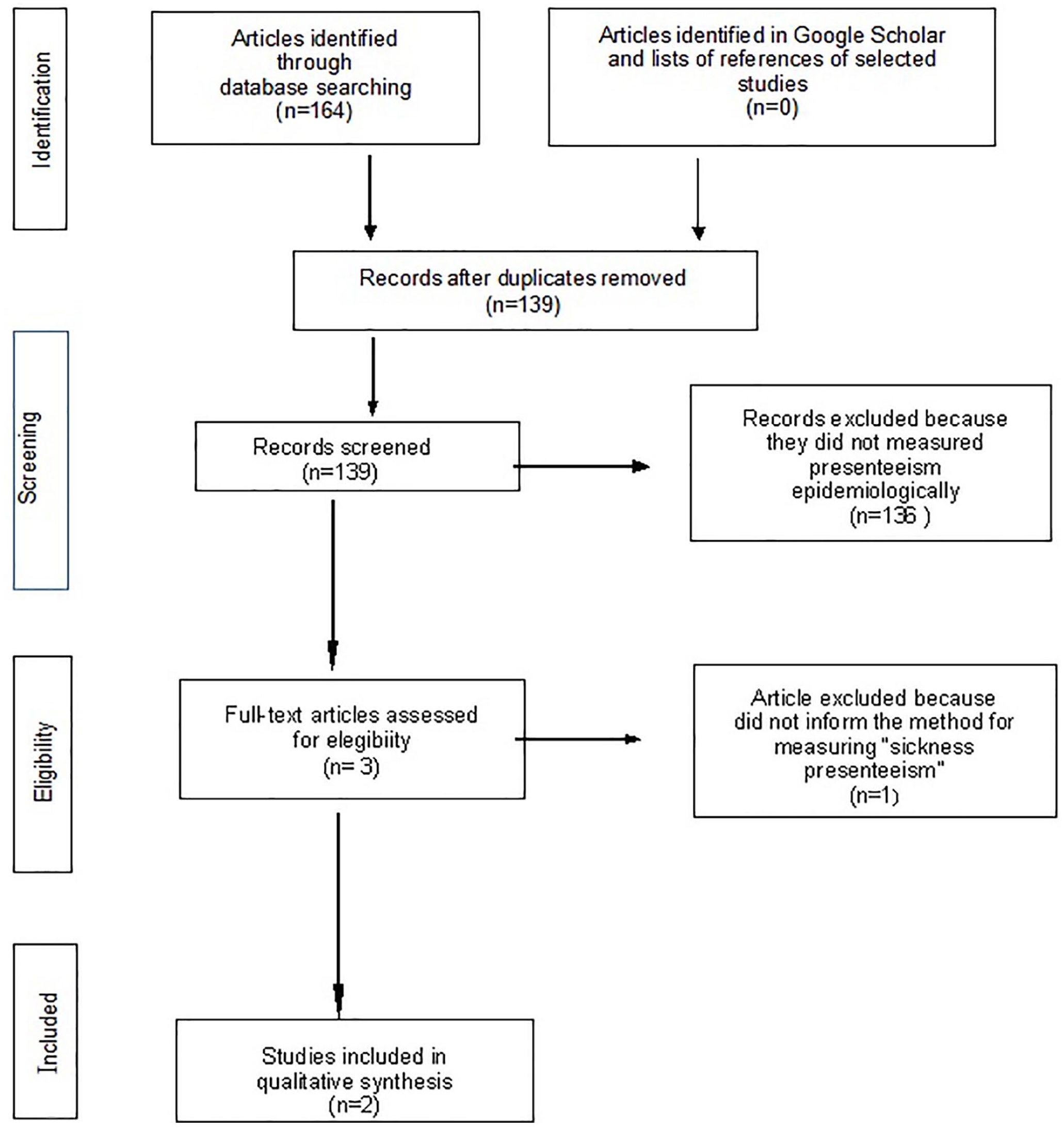
Flowchart of Articles Selection Process
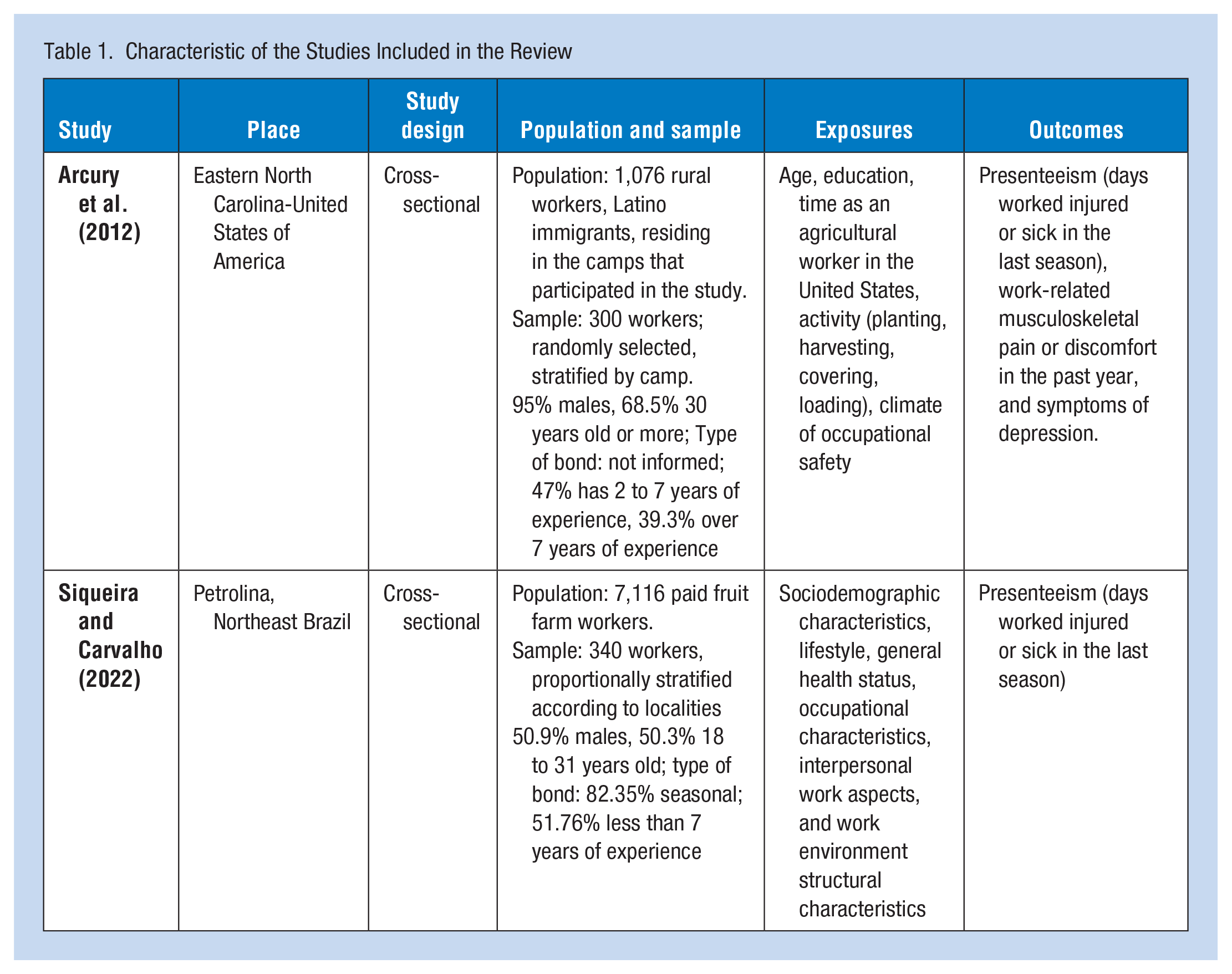
The studies were published in 2012 and 2021, conducted in the United States (Arcury et al., 2012) and in Brazil (Siqueira & Carvalho, 2022), targeting samples of tobacco (n = 300) and fruit extraction (n = 340) agricultural workers, respectively. Both studies had cross-sectional designs, presented sampling size calculation, used stratified sampling, and investigated presenteeism as an outcome; data for both studies were collected through structured questionnaires (Table 1).
Characteristic of the Studies Included in the Review
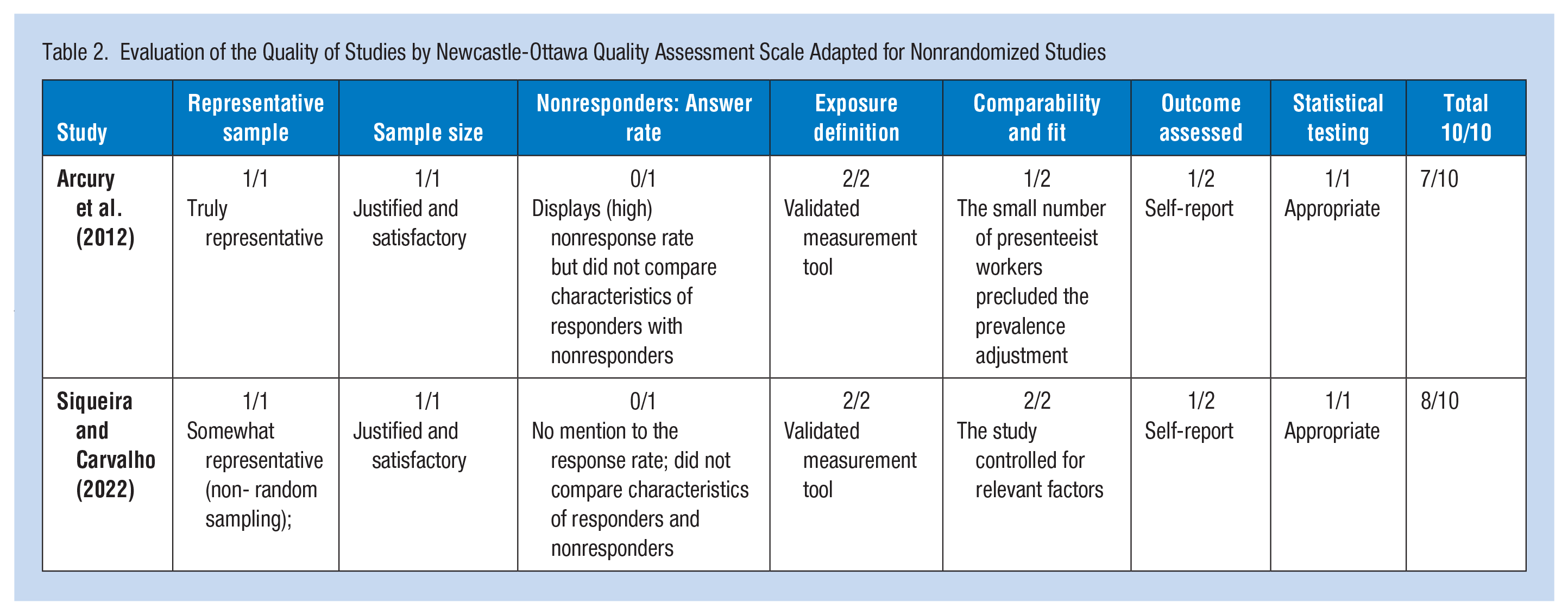
The studies rated 7 (Arcury et al., 2012) and 8 (Siqueira & Carvalho, 2022) points, respectively, in the Newcastle-Ottawa scale that allows a maximum of 10 points. The quality assessment of the two selected studies is summarized in Table 2.
Evaluation of the Quality of Studies by Newcastle-Ottawa Quality Assessment Scale Adapted for Nonrandomized Studies
Among immigrant farm workers in North Carolina (Arcury et al., 2012), the prevalence of presenteeism was 5% and it was associated with a poor work safety climate. Among paid fruit farm workers in Brazil (Siqueira & Carvalho, 2022), the prevalence of 58.2% was associated with feminine sex, dissatisfaction with management, and unavailability of sunscreen at the workplace. In both studies, presenteeism was self-reported, measured according to the same definition (worked for at least one day despite being injured or ill in the last season), and presented as a dichotomous variable (yes or no) (Table 3).
Factors Associated With Presenteeism in the Selected Studies
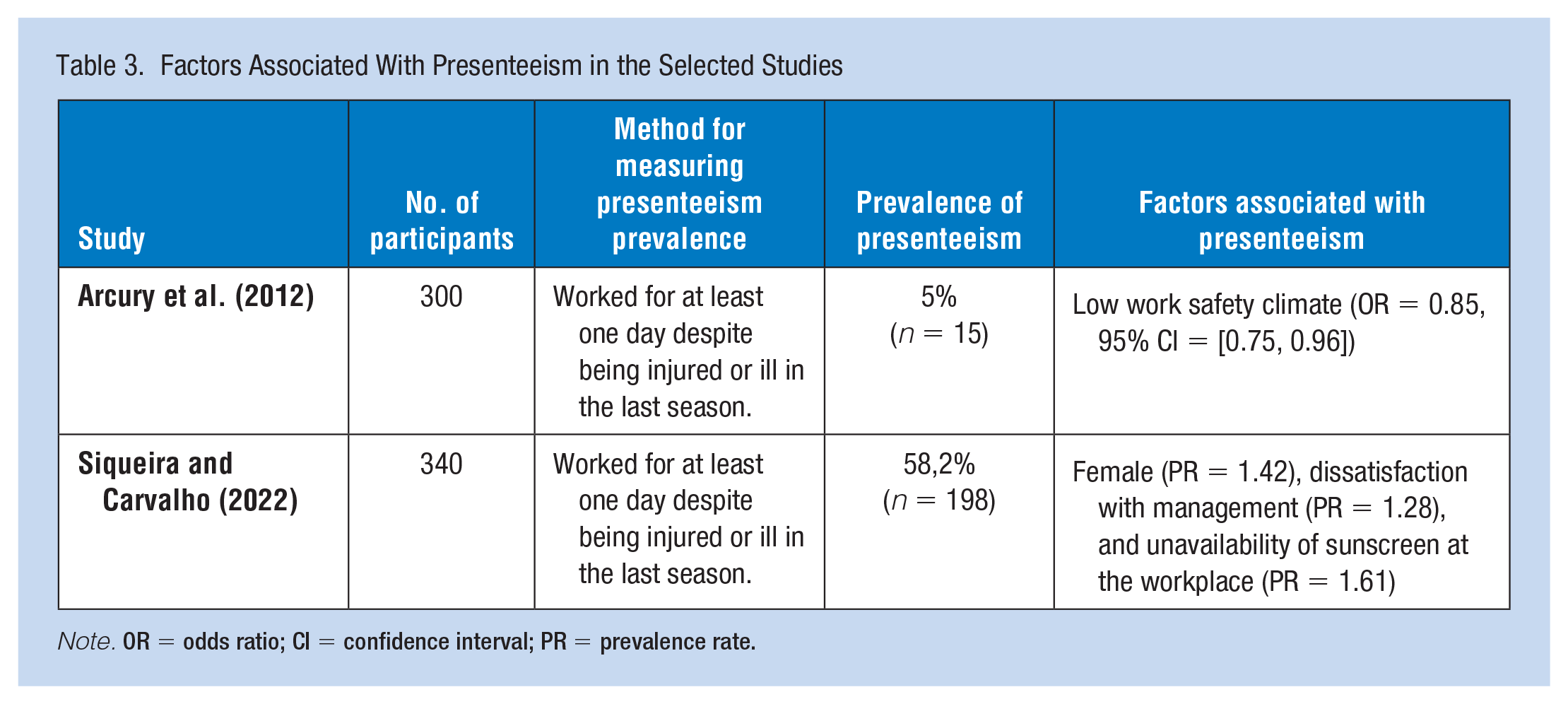
Note. OR = odds ratio; CI = confidence interval; PR = prevalence rate.
Discussion
It is noteworthy that only two (1.5%) of 136 articles included in this review have used the epidemiological approach of presenteeism, by measuring its prevalence, denoting a gap in the knowledge about this subject. Because only two studies were found, a meta-analysis for estimating a summarized prevalence rate of presenteeism was not possible.
The two studies were performed in working populations with marked differences according to countries of origin, cultural backgrounds, modes of production, and social characteristics. However, both populations worked in monocultures, under intensive modes of production that absorbs huge contingents of easily replaced workforce, demanding high physical strain, and exposures to repetitive tasks, uncomfortable postures, physical and chemical agents, and challenging weather conditions. In both cases, most of the workers had low income, low schooling, and seasonal employment contract.
The prevalence of 5% reported by Arcury et al. (2012) is much lower than that of 58.2% reported by Siqueira and Carvalho (2022). Perhaps, this difference could be explained by the characteristics of the participants. The study by Arcury et al. (2012) interviewed immigrant workers living in their workplaces; 39.3% referred elevated musculoskeletal discomfort and data regarding absenteeism were not presented. Therefore, it is plausible to suppose that there was underreporting of presenteeism among these workers. The fear of losing their job is an important factor for the occurrence of presenteeism (Lohaus & Habermann, 2019). In the case of immigrant workers, the fear of losing their place of residence and being deported intensifies the vulnerability of these workers, leading to dangerous behavior, such as working even sick (Arcury et al., 2012) and concealing these acts, which leads to underreporting.
The results presented here need to be interpreted with caution. The two cross-sectional studies are cross-sectional, precluding causal inferences. The self-report characteristic of presenteeism may induce memory bias, but this is the most widely used approach in the literature (Lohaus & Habermann, 2019). As agricultural workers are a very hard-to-reach population, many of the studies that seek to explain workers’ perceptions and behaviors are probably based on long-term ethnographic methods that do not make accurate measures of presenteeism prevalence. Theses and dissertations were not included in this review.
In conclusion, this systematic review revealed an important gap in the literature about the prevalence of presenteeism in agricultural workers. The findings of this review have implications for occupational health practice, particularly for researchers and practitioners who deal with presenteeism and its consequences in agricultural workers all over the world. Therefore, future studies about presenteeism among agricultural workers should measure the prevalence and/or incidence of presenteeism by using the epidemiological approach and, furthermore, should integrate these measures with the work productivity approach.
In Summary
• This study revealed an important gap in the literature about the prevalence of presenteeism among agricultural workers.
• Studies about presenteeism in agricultural workers have predominantly focused on workers’ productivity and not on its magnitude, causes, and effects on workers’ health.
• Future studies about presenteeism among agricultural workers should try to integrate the epidemiological and the work productivity approaches.
Supplemental Material
sj-docx-1-whs-10.1177_21650799231154281 – Supplemental material for Prevalence of Presenteeism in Agricultural Workers: Systematic Review
Supplemental material, sj-docx-1-whs-10.1177_21650799231154281 for Prevalence of Presenteeism in Agricultural Workers: Systematic Review by Vitória de Barros Siqueira, Alaine de Souza Lima Rocha, Paulo Adriano Schwingel and Fernando Martins Carvalho in Workplace Health & Safety
Footnotes
Author Contributions
Vitória de Barros Siqueira: Substantial contributions to the conception of the work, analysis and interpretation of data for the work, final approval of the version to be published, and agreement to be accountable for all aspects of the work in ensuring that questions related to the accuracy or integrity of any part of the work are appropriately investigated and resolved (work accountability).Alaine de Souza Lima Rocha: Substantial contributions to the conception of the work, analysis and interpretation of data for the work, final approval of the version to be published, and work accountability.Paulo Adriano Schwingel: Substantial contributions design of the work, critical review for important intellectual content, final approval of the version to be published, and work accountability.Fernando Martins Carvalho: Substantial contributions to the conception of the work, analysis and interpretation of data for the work, critical review for important intellectual content, final approval of the version to be published, and work accountability.
Declaration of Conflicting Interests
The author(s) declared no potential conflicts of interest with respect to the research, authorship, and/or publication of this article.
Funding
The author(s) disclosed receipt of the following financial support for the research, authorship, and/or publication of this article: This research was supported in part by Coordenação de Aperfeiçoamento de Pessoal de Nível Superior—Brasil (CAPES) under Finance Code 001 and by the Brazilian National Council for Scientific and Technological Development (CNPq), Grant No. 304691/2018-6.

Supplemental Material
Supplemental material for this article is available online.
References
Supplementary Material
Please find the following supplemental material available below.
For Open Access articles published under a Creative Commons License, all supplemental material carries the same license as the article it is associated with.
For non-Open Access articles published, all supplemental material carries a non-exclusive license, and permission requests for re-use of supplemental material or any part of supplemental material shall be sent directly to the copyright owner as specified in the copyright notice associated with the article.
