




Abstract
Background:
Physical inactivity is an important risk factor for chronic mental and physical health conditions in firefighters. It remains unclear why a substantial portion of firefighters do not meet the World Health Organization’s physical activity (PA) recommendations. In this cross-sectional study, we explored associations between motivational reasons for being physically active and time spent exercising, walking, and in incidental PA in firefighters. A secondary aim was to investigate differences in motivational reasons between physically active versus physically inactive firefighters.
Methods:
Eighty-seven participants (43.1 ± 10.3 years; 87.6% male) who were recruited via a nonprofit peer support network of fire rescue personnel in Flanders, Belgium, completed the Behavioral Regulation in Exercise Questionnaire 2 (BREQ-2), Simple Physical Activity Questionnaire (SIMPAQ), and the Physical Activity Vital Sign (PAVS) via an online survey.
Findings:
Firefighters who identified the benefits of exercising and/or those who found pleasure or a personal challenge in it exercised more. Those who did not meet the guideline of 150 min of moderate-to-vigorous physical activity per week had much less intrinsic motivation.
Conclusions/Implications for Practice:
This study demonstrates that autonomous motives for PA (i.e., because it is perceived to be consistent with intrinsic goals or outcomes and emanates from the self) are important for an active lifestyle in firefighters. Occupational health professionals can foster autonomous motivation in firefighters by focusing on the benefits of exercise, making sure there are a wide range of exercise options available, and supporting initiatives of firefighters within the fire station.
Background
Firefighters are at an increased risk for developing chronic physical and mental health conditions (Igboanugo et al., 2021; Obuobi-Donkor et al., 2022) due to job exposures to a complex mixture of hazardous pollutants released from the burning of several materials (Navarro et al., 2019). In addition, exposure to adversity and potentially traumatic events on a regular basis can result in chronic mental and physical conditions (Obuobi-Donkor et al., 2022). Furthermore, an inactive lifestyle has also been reported as an important mental and physical health risk factor in firefighters (Choi et al., 2016; Kling et al., 2020; Ras & Leach, 2022). Firefighters spend most of their working time physically inactive at the fire station as well as during their off-duty leisure time (Barry et al., 2020).
The World Health Organization’s guideline recommends that for a good health, adults should engage in 150 min of moderate-to-vigorous-intensity physical activity every week (Bull et al., 2020). Although the mental, cognitive and physical health benefits of physical activity and consequences of not engaging in physical activity are well documented (Ashdown-Franks et al., 2020; Schuch et al., 2018, 2019), also in firefighters (McKeon et al., 2021), it remains unclear why a substantial portion of firefighters do not meet the World Health Organization’s physical activity recommendations.
Conceptual Framework
To understand why firefighters are physically inactive, one must consider motivational regulations for physical activity participation. A framework that has been studied intensively in the past 25 years is the self-determination theory of Ryan and Deci (2000). The framework differentiates between controlled (i.e., external and introjected) and autonomous (i.e., identified, integrated and intrinsic) forms of motivation. External regulation reflects the influence of external /pressures (e.g., superiors, medical staff, and colleagues) for being physically active, but introjected regulation relates to self-imposed pressures like not wanting to feel ashamed or guilty when not being physically fit. These two behavioral regulations express a form of external control. Identified regulation refers to being physically active due to the personal recognition and acceptance of the health benefits of physical activity, while integrated regulation relates to manifesting the pursuit of physical activity because it is in line with one’s core values and sense of self, for example, being physically fit as a sense of responsibility to the public and co-workers. These two regulations represent a gradual transition to more autonomous forms of motivation (i.e., engaging in a behavior because it is perceived to be consistent with intrinsic goals or outcomes and emanates from the self). Intrinsic regulation is the most autonomous form and relates to being active as it is inherently enjoyable and/or satisfying (Ryan & Deci, 2000).
A study exploring motives for exercising for at least 15 min during leisure-time demonstrated, in line with the framework of the self-determination theory (Ryan & Deci, 2000), that autonomous motivation is associated with exercise participation among firefighters in the US (Long et al., 2014). However, the study of Long et al. (2014) had two important limitations. First, the authors only explored motives for structured leisure-time exercise but not for other leisure activities such as walking or for transport-related physical activity such as active commuting, and also not for incidental physical activity, for example household chores, all of which are, from a health perspective, important health behaviors (Bull et al., 2020; Rosenbaum et al., 2020). Second, Long et al. (2014) only explored correlations between leisure-time exercise and autonomous motivation.
Exploring associations between different physical activity levels (i.e., exercise, walking, and incidental physical activity) and different motivational regulations within the self-determination theory in firefighters is important to be able to better understand motives for physical activity in this particular workforce, and consequently inform appropriate evidence-based lifestyle recommendations. To fill the current gaps in the literature, this study aims to explore associations between time spent exercising, walking, and in incidental physical activity, with amotivation, external, introjected, identified, and intrinsic regulations (Ryan & Deci, 2000) in firefighters. A secondary aim was to investigate differences in motivational regulation levels between physically active versus physically inactive firefighters. We hypothesize that higher levels of amotivation, and external and introjected regulations (i.e., controlled forms of motivation) are associated with lower physical activity levels while higher levels of identified and intrinsic regulations (i.e., autonomous forms of motivation) are associated with higher physical activity levels.
Methods
Participants and Procedure
We recruited firefighters from December 2021 to March 2022 through the Fire Stress Team (FiST) which is a nonprofit peer support network of fire rescue personnel with about 70 members aimed at increasing awareness for support and care for fire rescue personnel in Belgium. Participants were recruited via an e-mail sent to FiST members containing a flyer of the study. In addition, the study was promoted on FiST’s web page, their social media platform, and in a newsletter. FiST members were encouraged to share the recruitment call for this study with their colleagues in the regional fire intervention zones. E-mails and open calls for participants were repeated on three different occasions. Participants were eligible for inclusion if: (a) they were between 18 and 65 years and (b) they were actively engaged during the past month as a firefighter, either professional or voluntary. Retired firefighters were excluded from the study. Interested participants were advised to contact the research team via an e-mail or Skype to express interest. After participants provided their digital informed consent, a link to the on-line survey was sent. Participants’ age (years), gender (male, female, nonbinary), rank including high (lieutenant to colonel), middle (sergeant, adjutant), or low (firefighter, corporal) rank, and volunteering status (yes, no or partially yes and partially professional) were collected. Participants also completed the Behavioral Regulation in Exercise Questionnaire 2 (BREQ-2) (Markland & Tobin, 2004), Simple Physical Activity Questionnaire (SIMPAQ) (Rosenbaum et al., 2020) and the Physical Activity Vital Sign (PAVS) (Greenwood et al., 2010). The study procedures were approved by the Social and Societal Ethics Committee (SMEC) of the University of Leuven (G-2020-2473-R2[MIN]).
Outcome Measures
Behavioral Regulation in Exercise Questionnaire 2 (BREQ-2)
The Dutch version of the BREQ-2 (Markland & Tobin, 2004) was used. The BREQ-2 considers an individual’s motivation toward exercise. In accordance with previous studies (Vancampfort, De Hert, et al., 2015; Vancampfort et al., 2016; 2018; Vancampfort, Madou, et al., 2015; Vancampfort, Stubbs, et al., 2015), we adapted the BREQ-2 by replacing the term “exercise” with the term “physical activity.” The BREQ-2 comprises 19 items relating to five motivational regulations (Ryan & Deci, 2000), i.e., amotivation (e.g., “I think being physically active is a waste of time”), external motivation (e.g., “I feel under pressure from my friends/family to be physically active”), introjected motivation (e.g., “I feel ashamed when I am not physically active”), identified motivation (e.g., “I value the benefits of physical activity”), and intrinsic motivation (e.g., “I enjoy physical activity”). Each item is measured on a 5-point Likert-type-scale, from 0 (‘Not true for me’) to 4 (‘Very true to me’). The mean of the five subscales was calculated.
Simple Physical Activity Questionnaire (SIMPAQ)
The SIMPAQ is a five-item clinical tool to assess physical activity levels among populations at high risk for physical inactivity. It can be freely downloaded from www.simpaq.org. It estimates time spent in bed (min/day), time spent sedentary during waking hours (min/day), time spent napping (min/day), time spent walking (min/day), time spent time spent in exercise, understood as a structured form of physical activity (min/day), and time spent in incidental or nonstructured physical activity, like going to the supermarket or commuting (min/day), during the past week (Rosenbaum et al., 2020). The sum of the hours recorded in the SIMPAQ items should add to approximately 24-hours. In this study, we focus on the time spent walking, time spent in structured exercise, and time spent in incidental or nonstructured physical activity. The SIMPAQ has good a test–retest reliability and validity (ρ = 0.25) for assessing physical activity and sedentary levels of physically inactive participants with stress-related problems (Rosenbaum et al., 2020).
Physical Activity Vital Sign (PAVS)
Meeting the physical activity guidelines was assessed using the PAVS, which comprised of two simple questions (Greenwood et al., 2010). The first question was: “On average how many days per week do you engage in moderate to vigorous physical activity like a brisk walk?” It was explained that moderate-to-vigorous intensity refers to activity that increases breathing or heart rate more than normal. The second question was: “On those days, how many minutes do you engage on average in physical activity at this level?” Next, the two responses were multiplied together to calculate the minutes per week of self-reported moderate-to-vigorous physical activity and verified whether the participants were achieving the recommended target of 150 min per week of moderate-to-vigorous physical activity or not (yes = 1; no = 0). Participants were requested not to consider time spent during work-related firefighting interventions. The PAVS is a valid and reliable tool for distinguishing whether people do or do not meet the international physical activity guidelines (Ball et al., 2016).
Power Analyses
A power analysis using G*Power (3.1.9.7) for Pearson correlation analyses (Faul et al., 2007) demonstrated that a sample size of 84 participants was required to detect a small effect (r = 0.3) (Cohen, 2013) with statistical power of 80% and significance level of 0.05. Since this power was valid for the correlation analyses, group comparisons were carried out on an exploratory basis.
Statistical Analyses
Normality of the data was tested by means of the Shapiro–Wilk test and, except for age, data were found not to be normally distributed. Continuous data are presented as mean and standard deviation for age and median and interquartile ranges for the other variables. Associations between BREQ-2 and SIMPAQ scores were calculated using Spearman’s rho coefficient. To interpret the strength of correlation, we used Cohen cut-off points of 0.10, 0.30, and 0.50: with r < 0.30 considered as a small correlation, 0.30 ≤ r < 0.50 as a moderate correlation, and r ≥ 0.50 as a large correlation (Cohen, 2013). Differences in BREQ-2 scores between those who did and did not meet the minimum physical activity recommendation of at least 150 min of moderate to vigorous physical activity per week were investigated using Mann–Whitney U tests. The significance level was set at p < .05. Since there is no difference in Belgium between the physical and operational requirements or training for professional versus volunteer firefighters and both categories have similar mandatory on-call (fire and ambulance) duties at the fire station (Tonnaer, 2019), no separate analyses were performed for both categories. Quantitative statistical analyses were performed with SPSS v.28.
Results
Participants
A total of 104 firefighters participated in the study. Seventeen records had to be excluded due to missing SIMPAQ data, leaving a total of 87 participants (mean age = 43.1 ± 10.3 years; 87.6 % male). The demographic characteristics of the included participants are presented in Table 1. In total, 27 participants (31%) did not the meet physical activity guidelines.
Descriptive Characteristics of the Firefighters (N = 87)
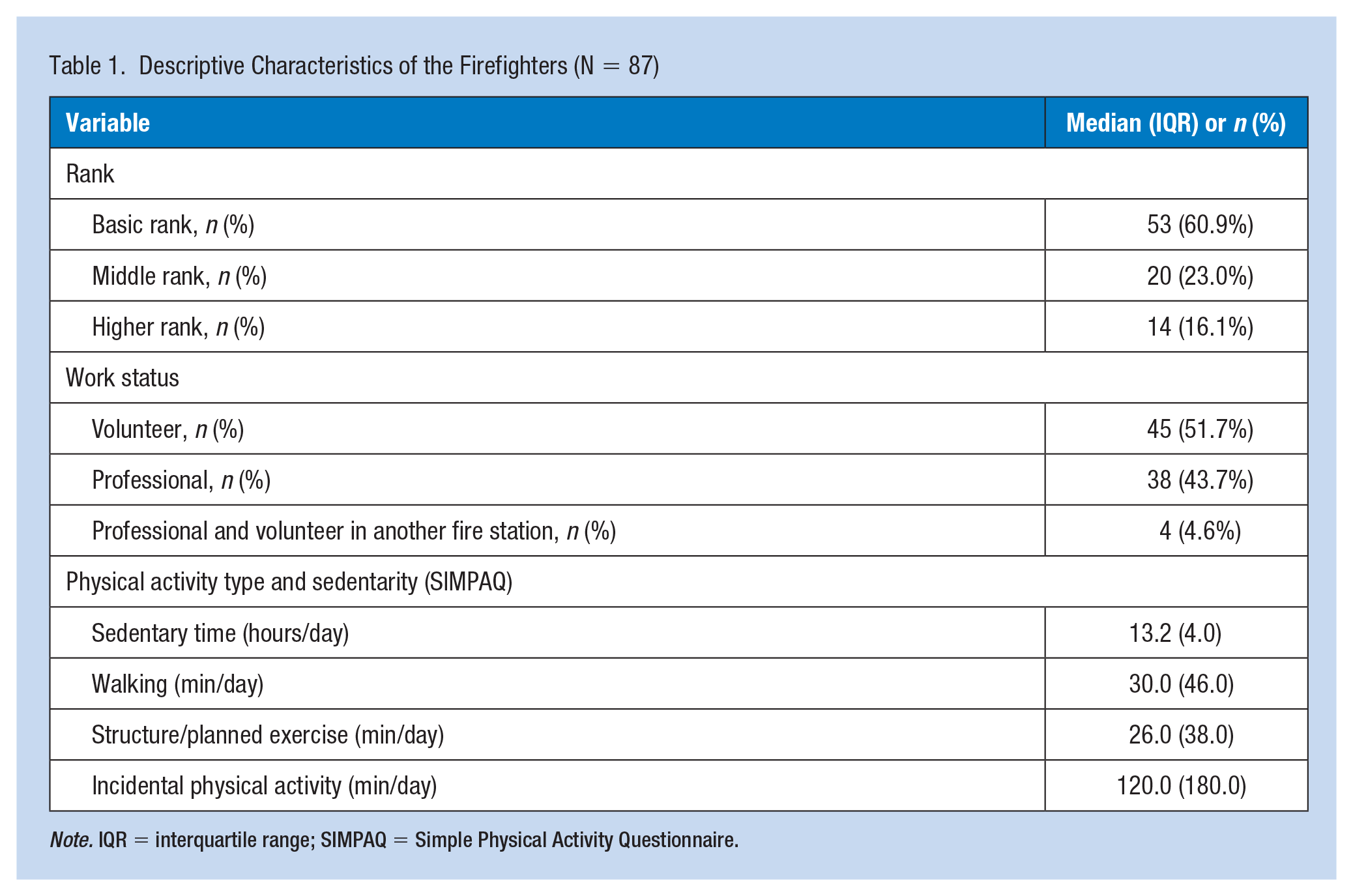
Note. IQR = interquartile range; SIMPAQ = Simple Physical Activity Questionnaire.
We found a significant, moderate, negative correlation between BREQ-2 amotivation and the SIMPAQ exercise level. There was also a significant, moderate, positive correlation between BREQ-2 identified motivation and the SIMPAQ exercise score. Finally, a significant, large, positive correlation was found between the BREQ-2 intrinsic motivation and SIMPAQ exercise score. An overview of the correlations between BREQ-2 and SIMPAQ scores is presented in Table 2.
Spearman-Rho Correlations Between BREQ-2 and SIMPAQ Scores in Firefighters (N = 87)
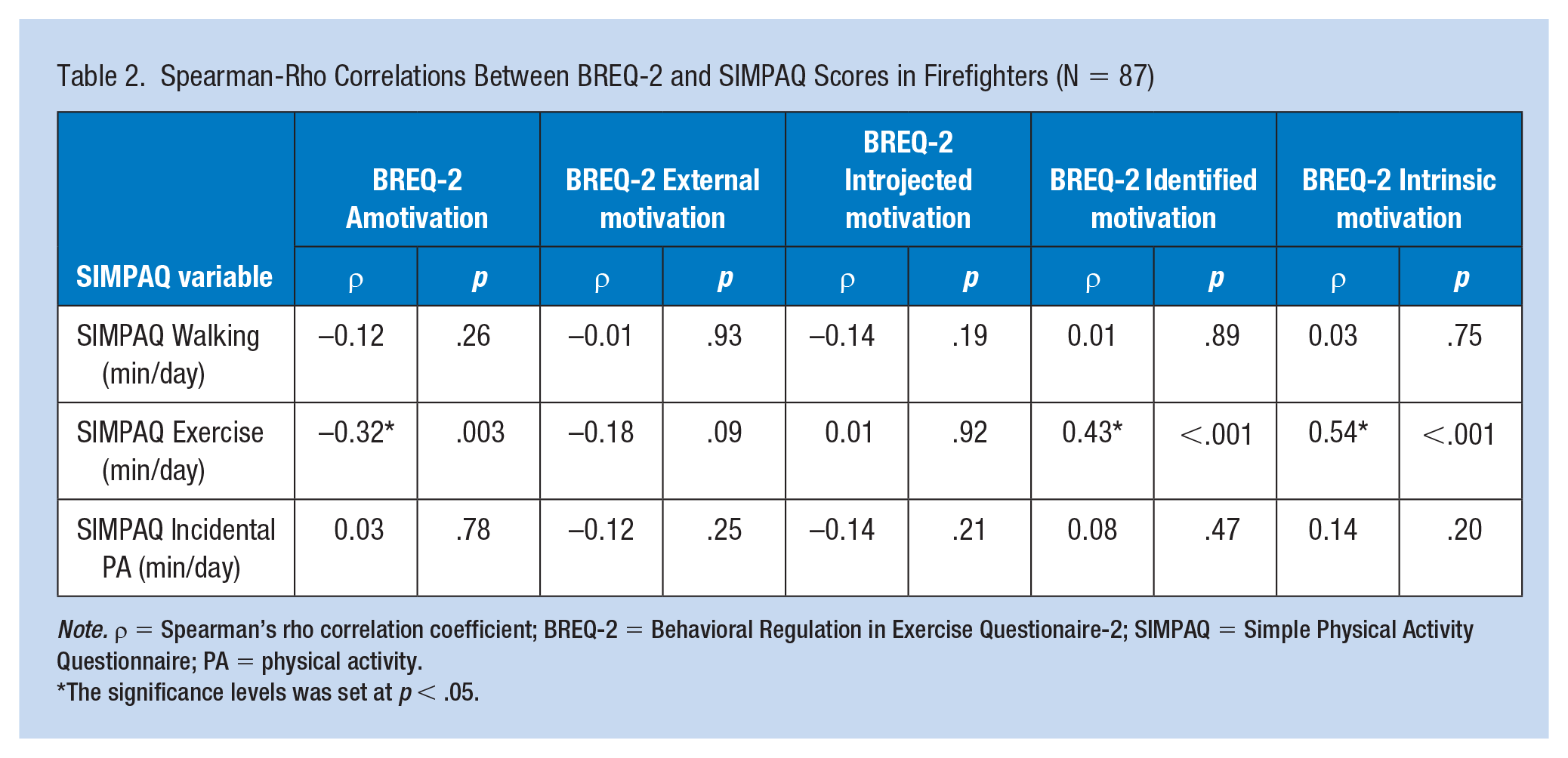
Note. ρ = Spearman’s rho correlation coefficient; BREQ-2 = Behavioral Regulation in Exercise Questionaire-2; SIMPAQ = Simple Physical Activity Questionnaire; PA = physical activity.
The significance levels was set at p < .05.
Differences in BREQ-2 scores between those who did meet versus who did not meet the physical activity guidelines are presented in Table 3. Those who met the physical activity guidelines had significantly lower amotivation scores and significantly higher identified and intrinsic motivation scores.
Differences Between Motivation Levels in Firefighters Meeting Versus Not Meeting Physical Activity Guidelines (N = 87)
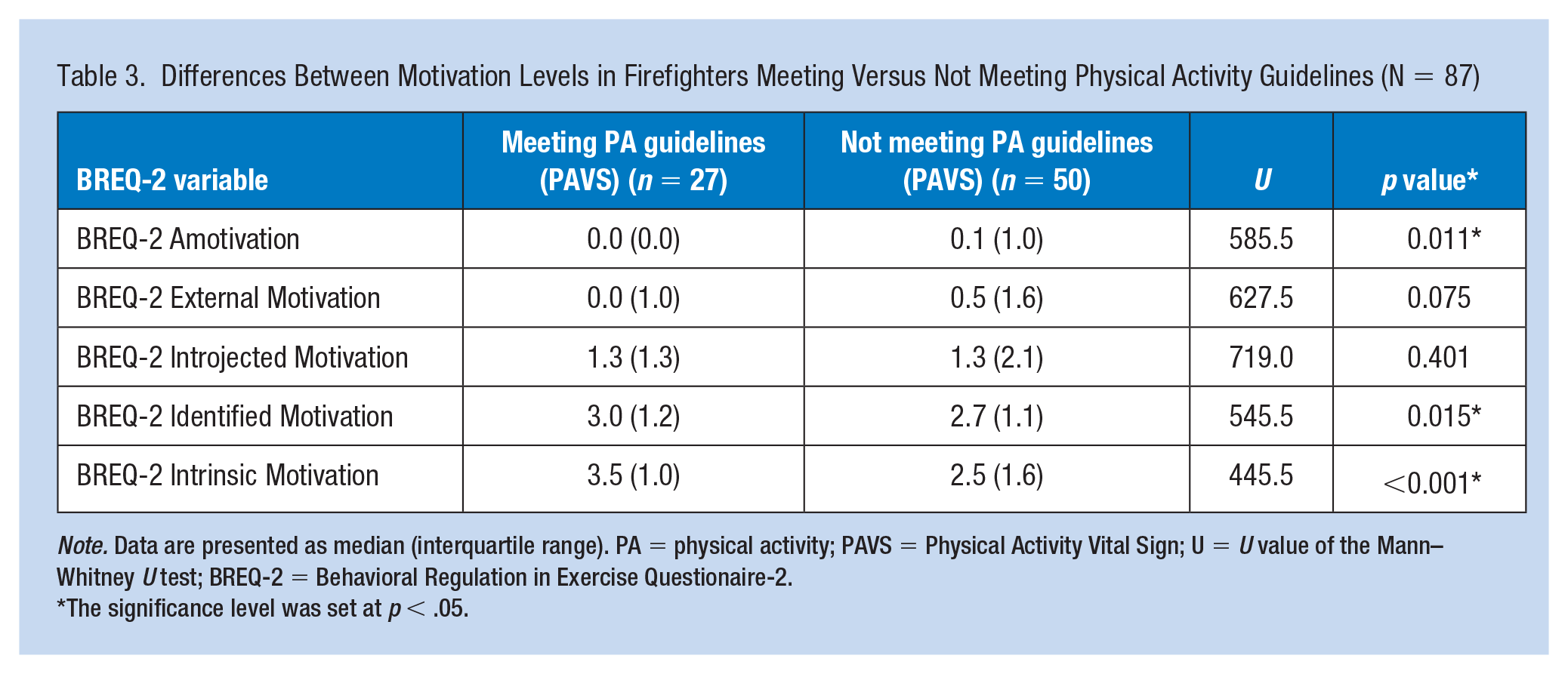
Note. Data are presented as median (interquartile range). PA = physical activity; PAVS = Physical Activity Vital Sign; U = U value of the Mann–Whitney U test; BREQ-2 = Behavioral Regulation in Exercise Questionaire-2.
The significance level was set at p < .05.
Discussion
We found that higher levels of autonomous motivation are associated with more time spent exercising, but not with more time spent walking nor with time spent in incidental physical activity in firefighters. A second finding was that those firefighters who met the World Health Organization recommendation of at least 150 min of moderate-to-vigorous-intensity physical activity every week (Bull et al., 2020) reported higher levels of autonomous motivation for physical activity and lower amotivation than those who did not.
Our findings are in line with a study from the United States (Long et al., 2014) showing that higher levels of autonomous motivation for exercise are associated with more frequently engaging in strenuous, moderate, and mild aerobic exercise. Our study adds to the literature that both identified and intrinsic regulations are associated with more time spent exercising, while external and introjected regulations do not. These findings indicate that motives for exercising among firefighters relate more to the identified benefits of the behavior or to the enjoyable, satisfying nature rather than feeling external or internal pressure to exercise. In Belgium firefighters are not required but are recommended to do physical activity 2 to 3 times per week (Vereniging van Vlaamse Steden en Gemeenten, 2022). Interestingly, levels of walking and incidental physical activity did not relate to any of the motivational regulations. One of the reasons might be that firefighters do not perceive these physical activities as appealing or beneficial for their health or job performance. Additional qualitative research is however needed to gain a deeper understanding of the motives for walking and incidental physical activity in firefighters as these might be potentially important health enhancing lifestyle strategies for this particular workforce (Lovejoy et al., 2015). Further longitudinal and intervention research is also needed to examine the implications for occupational health practice in more detail. Implementation research could investigate whether facilitating autonomous motivation for exercise results in more time spent exercising and consequently being increased physically active. The subsequent impact on physical and mental health outcomes and job performance related parameters should be assessed as well. In the general population, autonomous motivation is facilitated by satisfaction of the psychological needs for autonomy (i.e., experiencing a sense of psychological freedom when engaging in an activity), competence (i.e., feeling effective to attain desired outcomes), and social relatedness (i.e., being socially connected), and with feelings of internal coherence and well-being that are thought to emerge from those experiences (Deci & Ryan, 2000). Cross-sectional research in firefighters (Long et al., 2014) did however, surprisingly, show that in firefighters the need for autonomy, competence, and social relatedness did not predict more frequent aerobic exercise, but did predict more frequent strength training. One of the reasons given was that strength training might simply be more salient to firefighters when they think about exercising, also for their job performance. Besides this, the latter study only investigated the number of sessions in a week and not the time spent physically active, which, from a general health recommendation perspective is equally important. Future intervention research could investigate whether autonomous motivation for exercise in the fire station can be facilitated via, for example, making a wide range of gym equipment options available, exploring the extent to which fitness programs and scheduling can be flexible, and avoiding mandatory workouts (i.e., facilitating the need for autonomy and competence). However, one should consider the potential safety hazard of exercising too intensely while on shift, as there might be a call to respond to an emergency situation (Lovejoy et al., 2015). The effect of facilitating the need for social relatedness on exercise participation can be explored in more detail via, for example, providing opportunities to work out in small groups or by implementing friendly competitions among colleagues (Long et al., 2014), for example, via active video gaming (i.e., exergaming) during on-duty time (Lovejoy et al., 2015). This could foster the challenging nature of the activity, which is an intrinsic regulation for physical activity (Ryan & Deci, 2000).
The results of this study should be interpreted with caution due to limitations. First, the cross-sectional nature of this study precludes causal relationships being established. Second, the construct validity of the SIMPAQ and PAVS are still unknown in firefighters. Previous research demonstrated that, compared with objective assessments, firefighters tend to overestimate their physical activity levels (Kling et al., 2020). Consequently, future research should include objective physical activity assessment tools such as accelerometers or other, for example, wrist-wearable activity tracking devices. Third, the online recruitment pathway may have resulted in a biased sample toward firefighters who are liaised to their FiST colleagues or engage with social media and are technologically literate. Besides this, we only included firefighters who volunteered to participate in the study and it is likely that firefighters who are physically active and/or are less sedentary were more likely to have participated. Fourth, there is an underrepresentation of female firefighters in our sample, and although mainly men are working within firefighter teams, there have been recent calls for research examining the relationships between physical activity participation and gender (Pebole & Hall, 2019).
Despite the abovementioned limitations, it can be concluded that in a sample of Belgian firefighters, higher levels of autonomous motivation for physical activity are associated with more time spent exercising, but not with time spent walking and incidental physical activity. Intervention studies fostering autonomous motivation are needed before any rigorous occupational health practice recommendations for this workforce can be made.
Applying Research to Occupational Health Practice
Firefighters are at risk for chronic health conditions and being physically inactive is also an important risk factor in this population. This study provides evidence for the role of occupational health professionals in fostering motivation in firefighters to exercise. This can be done in fire stations by making sure there are a wide range of exercise options available, by supporting initiatives of firefighters within the fire station, and by avoiding the introduction of mandatory workouts. Occupational health professionals should use autonomy supportive language (e.g., “could” and “choose” rather than “should” and “have to”) when assisting fire station in adopting an active work environment. Based on the current evidence, it can be suggested that the use of flexible workout sessions, either in small groups or individual, might be beneficial. Despite the evidence, caution is needed in formulating recommendations as the findings need to be confirmed in intervention research.
Footnotes
Conflict of Interest
The author(s) declared no potential conflicts of interest with respect to the research, authorship, and/or publication of this article.
Funding
The author(s) disclosed receipt of the following financial support for the research, authorship, and/or publication of this article: This work is funded by Global Minds KU Leuven (Reference nr.: GPSU/20/037).
