



Abstract
Background:
Workplace violence incidents remain pervasive in health care. Home care workers like personal support workers (PSWs) provide services for clients with dementia, which has been identified as a risk factor for workplace violence. The objective of this study was to evaluate whether the implementation of a rapid response algorithm resolved unsafe working conditions associated with responsive behaviors and decreased perception of risk.
Methods:
A nonexperimental pre- and post-evaluation design was utilized to collect data from PSWs and supervisors. PSWs completed an online survey about their experience with workplace violence and perception of risk. Bi-weekly check-ins were conducted with supervisors to track incidents and their level of resolution in the algorithm. Semi-structured interviews were also conducted to gather in-depth feedback about the algorithm in practice.
Findings:
We found no difference in risk perception among PSWs pre- and post-implementation. However, PSWs who had been employed for less than 1 year had a significantly higher risk perception. Overall, the algorithm was found to be helpful in resolving workplace violence incidents.
Conclusion and Application to Practice:
Opportunity exists to further refine the algorithm and ongoing dissemination, and implementation of the algorithm is recommended to continually address incidents of workplace violence. Newly hired PSWs may require additional supports. Ongoing education and training were identified as key mitigation strategies.
Background
Workplace violence is a significant problem in Canada, with approximately 350,000 incidents reported per year (Hango & Moyser, 2018; Léséleuc, 2004). Workplace violence is broadly defined as “any act in which a person is abused, threatened, intimidated, or assaulted in his or her employment” (Canadian Centre for Occupational Health and Safety, 2015, 2018).
Healthcare workers have some of the highest rates of workplace violence (Byon, Lee, et al., 2020; Campbell et al., 2014; Lanctôt & Guay, 2014; Léséleuc, 2004; Nakaishi et al., 2013) with studies showing incident rates for home care workers as high as 65% (Nakaishi et al., 2013; Vladutiu et al., 2016) despite underreporting linked to fear of reprisal or loss of income (Byon, Liu, et al., 2020; Wassell, 2009).
Personal support workers (PSWs) provide services to clients with dementia which has been identified as a risk factor for workplace violence due to the likelihood of clients exhibiting responsive behaviors (Galinsky et al., 2010; Karlsson et al., 2019; Schnelli et al., 2020) that may include verbal and physical aggression, agitation, and resisting care. These types of behaviors may lead to workplace violence incidents, causing physical, psychological, and emotional harm as well as negative impacts on quality of care, financial and human resource capacity strain (Lanctôt & Guay, 2014).
In response to internal data showing an increase in the total number of workplace violence incidents being reported, a pilot study was conducted to evaluate the effectiveness of a rapid response algorithm (Figure 1) which provides a step-by-step approach for resolving incidents at the following three levels: (a) supervisor follow-up with the PSW; (b) joint visit to the client with the supervisor; and (c) consultation with a rehabilitation or nurse specialist. Specifically, we were interested in whether the rapid response algorithm (a) helped resolve workplace violence incidents due to responsive behaviors and (b) decreased perception of risk among PSWs. Perception of risk was included as a measure of feeling safe at work when caring for clients exhibiting responsive behaviors.
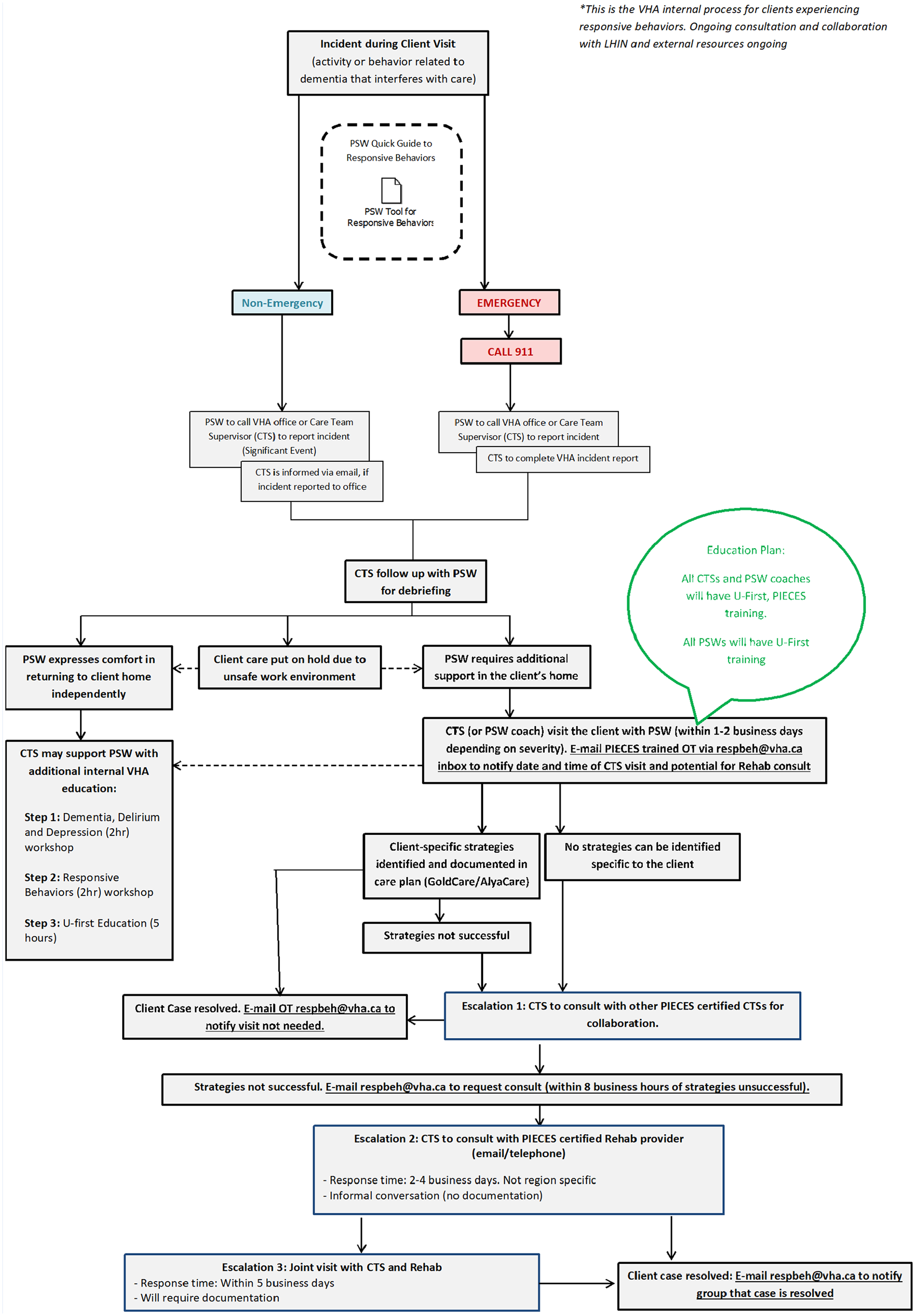
Rapid response algorithm.
Methods
This was a nonexperimental pre–post-intervention pilot study conducted at a medium-sized, not-for-profit home care organization employing more than 2,700 staff members and offering nursing, personal support, and rehabilitation services across Ontario. The workforce consists primarily of PSWs who help clients live safely in their homes as independently as possible. PSW teams are led by supervisors who are Registered Practical Nurses or Registered Nurses. The evaluation of the rapid response algorithm was conducted among two PSW teams within the Greater Toronto Area. Data collection included both quantitative and qualitative data and began in February 2019 and continued until November 2020. The COVID-19 pandemic was officially declared in Ontario in March 2020 and thus was ongoing during the latter half of the data collection period.
Rapid Response Algorithm
The algorithm was developed by an interprofessional team, two family caregiver advisors and a geriatric psychiatrist. The algorithm included a three-step approach for resolving incidents and highlighted existing educational offerings and relevant organizational policies. A “Quick Guide” badge to reference during emergency situations was also created and distributed to PSWs. Implementation of the rapid response algorithm was supported by an organization-wide communication campaign (posters and videos) to clarify the standardized three-step approach to resolution and encourage reporting.
Data Collection
Survey data were collected anonymously from PSWs using a single online survey (Figure 2) administered at three time points: pre-implementation (phase I), at 6 months (phase II), and 1-year post-implementation (phase III).
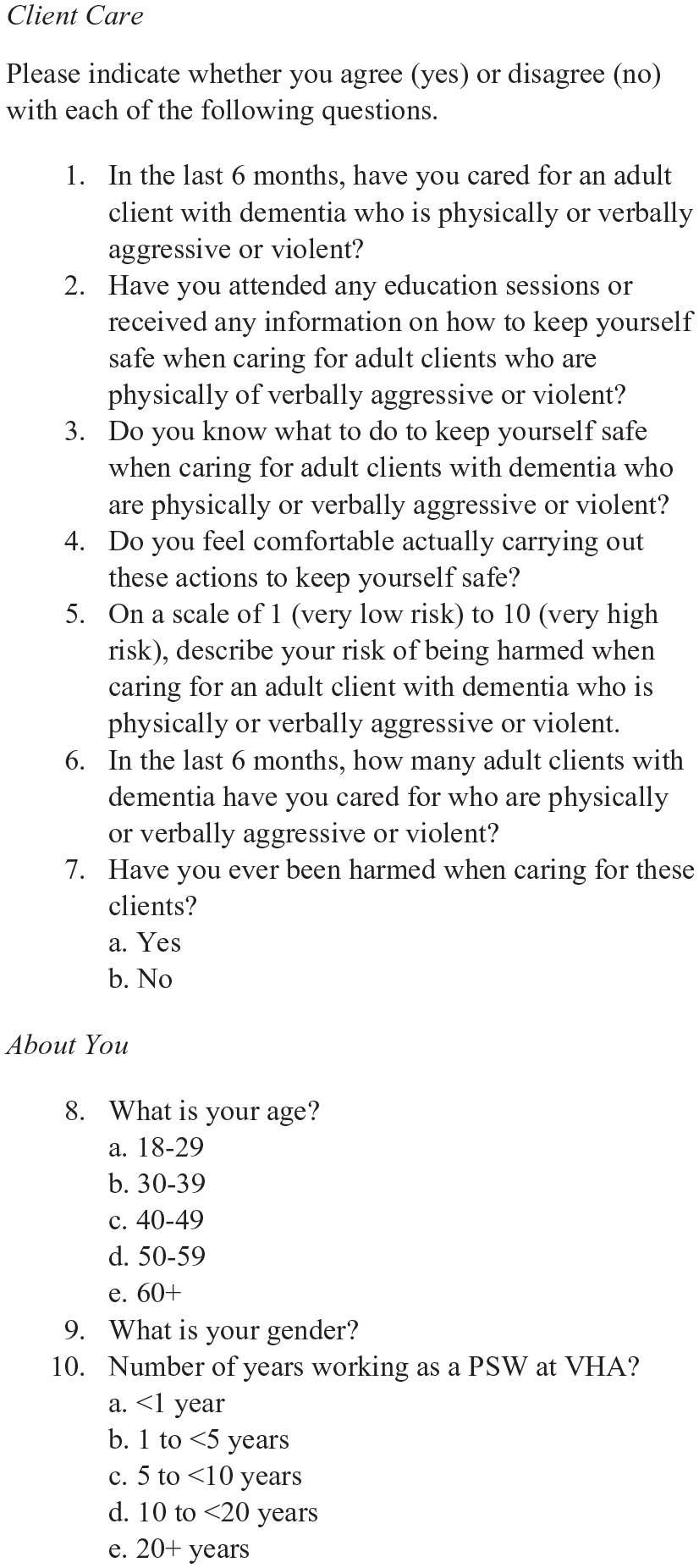
Spot it, Prevent it: Responsive behaviors program evaluation PSW survey.
Data were also collected through bi-weekly check-ins from a convenience sample of 11 supervisors from the same regions to track incidents reported during this time. During these email or phone check-ins, the research associate inquired about incidents since the last check-in, received a summary of the incident, and how the supervisor handled the situation noting at which level the incident was resolved. A resolved incident was one where the responsive behaviors were managed or stopped through the implementation of various strategies identified by the supervisor, worker, or other supports.
In-depth semi-structured interviews with supervisors were conducted virtually (phone or video) 1-year post-implementation to better understand the experience in handling workplace violence incidents and the use of the rapid response algorithm (Online Appendix 1: interview guide).
Data Analysis
Descriptive statistics were used to describe the survey respondents. We conducted multiple comparison t-tests with Bonferroni correction to check for differences between the three phases of data collection for the online PSW survey. All incidents reported by the supervisors during the check-ins were classified based on the type of incident (external violence by an unknown assailant; client to worker; employee to employee; or domestic violence) and the level at which they were resolved as outlined in the algorithm. Frequency counts and proportions were then used to summarize this information. Semi-structured interviews with supervisors were audio-recorded, transcribed, and reviewed for quality assurance prior to analysis. Inductive thematic analysis (Braun & Clarke, 2006) was used to analyze transcripts. Two researchers (A.R. and M.R.) reviewed all transcripts independently and in duplicate and generated initial codes. All initial codes were collated into potential themes and reviewed and discussed. Ongoing analysis to revise the definitions and naming of each theme continued until both coders were in agreement and satisfied that the themes reflected the overall narrative of the data set. A final summary of each theme with appropriate sample quotes from the transcripts was then produced.
This study was approved by the Research Ethics Board at the University of Toronto.
Results
PSW Online Survey
A total of 752 responses were received to the online survey across the three phases of data collection (n = 305 in phase I; n = 202 in phase II; n = 205 in phase III). The majority of responses were from females (n = 724, 96.6%), and two thirds of the responses were from those between the ages of 40 to 59 years old (n = 509, 67.7%). Almost half of the responses were from those who had worked as a PSW for less than 5 years (n = 337, 44.8%). Approximately 78% of survey responses (n = 587) were from those who indicated having attended education or training sessions on how to keep themselves safe and 81% of responses (n = 609) reported feeling comfortable carrying out these actions.
Table 1 summarizes PSW experience and risk perception with workplace violence pre- and post-implementation of the rapid response algorithm. Results showed just over half of respondents had recently cared for a client with dementia who was physically or verbally aggressive or violent and approximately a quarter of respondents reported ever being harmed when caring for these clients. When PSWs were asked to rate their perception of risk on a scale of 1 (very low) to 10 (very high), the average score was 4.93 preimplementation and 4.99 postimplementation. This difference was not statistically significant (p = .83).
PSW Experience and Risk Perception With Workplace Violence Before and 1-Year After the Implementation of the Rapid Response Algorithm
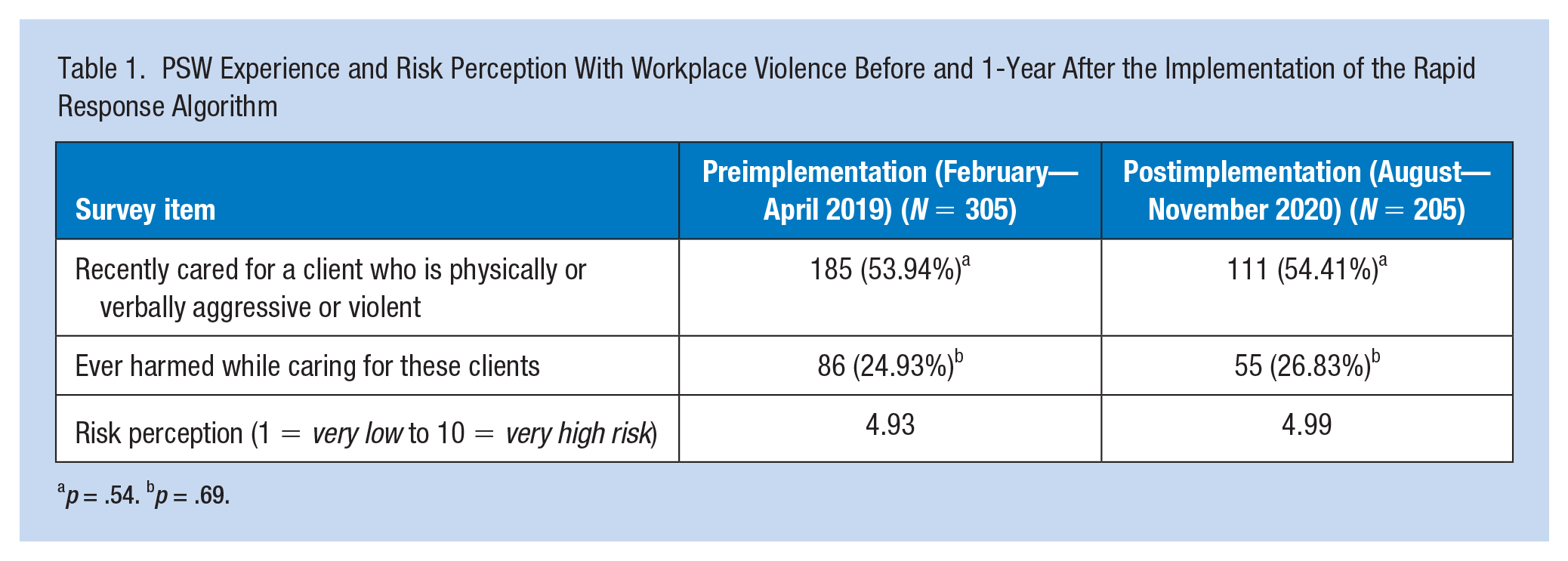
p = .54. bp = .69.
Differences in risk perception were found when considering time spent working as a PSW. Those PSWs working less than 1 year at the organization had a higher overall risk perception (5.67) compared to those who had been working for more than 1 year (4.51). This difference was statistically significant (p = .001) and based on pre (phase one) and post (phase 3) data.
Supervisors
A total of 16 bi-weekly check-ins (June 2019 to February 2020) were completed with a convenience sample of six supervisors (54.5% response rate). A total of 22 incidents were reported with the majority (n = 21, 95.5%) classified as client to worker while one incident (4.5%) was classified as employee to employee. Physical aggression was most common (n = 15) followed by verbal aggression (n = 5) and both (n = 2). Approximately 68% of reported incidents (n = 15) were resolved at the time of data collection. Of those incidents that were resolved, the majority (n = 9, 60%) were resolved at level 1 (supervisor follow-up with the PSW) or level 2 (a joint visit with the supervisor; n = 6, 40%). No incidents were resolved at the third level of resolution (consultation with a rehabilitation or nurse specialist). A total of five semi-structured interviews were conducted with supervisors. Four themes were identified from these data which are outlined below.
Theme 1—The Algorithm Tends to Reflect What is Being Done in Practice
It was noted that a similar process was used by supervisors to handle workplace violence incidents that closely reflected the algorithm. Supervisors agreed that general processes used to handle workplace violence incidents were reflected in the rapid response algorithm and said that “the algorithm works because most times when there is behavioral kind of related problem with dementia patient, the PSW, they always call, like, is indicated [in the algorithm] they call the office” (Supervisor #3). Supervisors shared the importance of prioritizing PSW safety and highlighted the multidisciplinary nature of handling incidents. Several common strategies were used by supervisors to mitigate the possibility of an incident such as: ensuring consistent scheduling of PSWs, building rapport between PSWs and clients, and sensitivity of clients’ cultures. When resolving incidents supervisors also relied on their nursing skills, previous experiences and supervisor-colleagues, particularly when new to the supervisor role.
Theme 2—The Algorithm and Communication Plan Should be Adjusted
Although supervisors agreed that the algorithm was reflective of what occurs in practice, they also noted that the algorithm could be refined to capture additional reporting requirements and guidance when conducting investigations (e.g., reporting requirements to the funder as home care service delivery is contracted out by the provincial government). Supervisors noted that there were external supports available that were not currently reflected in the algorithm (e.g., Behavior Support Outreach Team from the home care funder). Other suggestions included the integration of a contact who can provide support when navigating the algorithm, better dissemination of the email address for accessing the third-level consult, and the inclusion of virtual care to fit the current COVID-19 context.
Improvements to the communication plan could increase accessibility and awareness of the algorithm, particularly for new hires, to better support effective handling of workplace violence incidents: Sometimes people are new. They don’t know the process. They don’t know who to call or who the supervisor may be or what is the proper place and what is the proper process, and this could be something that could be really helpful. (Supervisor #5)
An ongoing communication campaign would likely be beneficial for disseminating the information included in the algorithm.
Theme 3—Risk Perception of Working With Clients Who Display Responsive Behaviors
Another recurring theme from the interviews involved the perception of risk, or feeling of safety, when caring for clients who display responsive behaviors. The majority of supervisors reported risk perception as moderate or low for both themselves and their PSW staff. They also noted that with the appropriate education, tools, and training to recognize responsive behaviors and their triggers, risk perception for these individuals could be reduced even more. One supervisor stated: They should be moderate for both. Again, it could be low, but if PSWs are trained with dealing with behaviors and knowing about, for example, dementia, delirium, depression, to understand the condition of the client. If they’re actually trained, I think the risk could be low. (Supervisor #1)
Supervisors also discussed how risk perception fluctuates over time and will be influenced by factors such as work geography and changing caseload with the admission of new clients. Interestingly, supervisors also commented on the change in risk since the beginning of the COVID-19 pandemic including how the pandemic has affected access to care and resulted in added stress for clients and staff: I feel like, with this pandemic, it has gotten worse—you know, because the clients are a lot more stressed, the staff are stressed. I think they’re not getting the services that they would usually, so there is some aggression. (Supervisor #5)
Theme 4—The Importance of Education and Training
Another recurrent theme across interviews was the importance of education and training for mitigating workplace violence incidents in home care settings. Supervisors discussed how education and training equip staff members who work independently with knowledge on how to recognize triggers and manage responsive behaviors and thus should be required as the first step for all supervisors and PSWs upon hire. While relevant training is available to staff and included in the algorithm, the data from the interviews and PSW survey suggest that ongoing efforts to ensure compliance and access to this training are needed.
Discussion
While no difference in risk perception was found among survey respondents pre and post implementation, we found that those who had been working at the organization for less than 1 year had significantly higher safety concerns at work and may benefit from additional support. The need for structured processes, like the rapid response algorithm, was confirmed when more than half of the respondents surveyed pre-implementation and post-implementation reported recently caring for a client who had been physically or verbally aggressive and a quarter reported being harmed. Overall, the algorithm was found to be helpful and was adopted into practice easily with suggestions to embed additional components to streamline available resources (internal and external to the organization) and clarify documentation requirements. Our results also suggested that increased awareness of the algorithm was needed, especially for newly hired PSWs and supervisors and that a regular, ongoing communication campaign is likely to close this gap.
Our findings regarding the prevalence of workplace violence incidents were in alignment with prior work (Byon, Lee, et al., 2020; Hanson et al., 2015; Léséleuc, 2004; Liu et al., 2019; Nakaishi et al., 2013) where just over half of our PSW respondents were subjected to physical or verbal abuse and a quarter had been harmed. Our results also suggested that the prevalence of workplace violence may fluctuate over time with new admissions or during times of healthcare crises when health and human resources are limited. Additional strategies to protect staff members during these times of greater uncertainty may be required.
The need for ongoing education and training for both PSWs and supervisors in managing and preventing workplace violence incidents was made clear during the study period. While education and training were embedded within the integrated Spot It, Prevent It: Responsive Behaviors program, our results suggested that not everyone attended this training. In particular, those who had been employed as a PSW for less than 1 year should be made aware of and expected to attend training sessions.
Interestingly, our study found that physical aggression was most commonly reported, which was inconsistent with prior work that identified verbal aggression as the most common type of incident (Byon, Lee, et al., 2020; Hanson et al., 2015; Liu et al., 2019). It was possible that PSWs working in the home care sector may not want to spend unpaid time reporting verbal aggression, whereas physical aggression may be considered a more serious incident requiring a formal report and response.
Research by Nakaishi et al. (2013) also focused on the experiences of home care workers and found that while many were experiencing workplace violence, they were generally unaware that their colleagues were also having similar experiences and considered this to be a “part of the job.” These findings are particularly troubling in the context of home care service delivery where individuals work independently and often in isolation from colleagues (Quinn et al., 2021). Creating a culture of consistent reporting is particularly important in home care where providers enter individual homes to provide care in isolation from colleagues who may be helpful in a crisis. It is believed that increased transparency of what will happen following a report of workplace violence is key to improving reporting. Over time, providers may feel more comfortable reporting incidents if a structured and transparent approach, such as a documented three-step response, is adopted and consistently championed by the organization. This broadly visible process places the responsibility for investigating, managing, and mitigating future incidents on all members of the care team and may minimize fear of reprisal. Demonstrating the organizational commitment along with the expectation that supervisors support point-of-care providers to address and resolve these situations was a driver for the communication campaign related to the rapid response algorithm. Organizations should consider additional strategies for motivating staff members to report such incidents with extreme care taken to ensure that staff members do not feel punished or experience a loss of income if they do report.
Strengths and Limitations
This was a pilot study with a pragmatic nonexperimental design utilizing a comprehensive data collection plan (qualitative and quantitative) including PSWs and supervisors at multiple time points and data collection instruments (surveys, bi-weekly check-ins, and semi-structured interviews) which enabled triangulation of study findings. We did not link responses across the different rounds of the PSW survey and as such were not able to explore risk perception through paired t-tests and risk perception in our study was only measured using one item on the survey. However, given the nature of the survey topic, we felt an anonymous survey would maximize response rate and comfort with reporting sensitive information. Given how care is assigned and delivered, it was not possible to only survey PSWs who provide care to clients with responsive behaviors. Accordingly, our study results are reflective of PSW experiences across our organization who care for a range of clients.
Implications for Occupational Health Practice
In conclusion, prevalence of workplace violence incidents in our sample was approximately 54% with physical aggression being most common. Risk perception was significantly higher among PSWs employed for less than 1 year. The rapid response algorithm did not alter risk perception or workplace violence prevalence among staff pre and post implementation. However, the algorithm was identified as a useful resource in helping manage and resolve incidents from the supervisory perspective. In addition, our results suggested that ongoing awareness of the algorithm or other supports available is needed for staff at all organizational levels. Occupational health practitioners should consider how they can provide additional supports for newly hired staff and organizations should continue to invest in education and training to help prevent, manage, and encourage reporting of incidents to ensure staff and client safety.
Application to Occupational Health Practice
Workplace violence incidents are common among home care workers. A rapid response algorithm outlining key steps and resources for resolving such incidents is helpful from the supervisory experience and may also be revised and used by occupational health practitioners in other sectors where prevalence of such incidents is high. Our results also suggested that newly hired PSWs may require additional supports to prevent and manage incidents. As such, occupational health practitioners may need to develop targeted strategies to better support newly hired workers.
Supplemental Material
sj-docx-1-whs-10.1177_21650799221110891 – Supplemental material for Spot It, Prevent It: Evaluation of a Rapid Response Algorithm for Managing Workplace Violence Among Home Care Workers
Supplemental material, sj-docx-1-whs-10.1177_21650799221110891 for Spot It, Prevent It: Evaluation of a Rapid Response Algorithm for Managing Workplace Violence Among Home Care Workers by Arlinda Ruco, Kathryn Nichol, Brydne Edwards, Meghla Roy, Dionne Morgan, D Linn Holness and Sandra McKay in Workplace Health & Safety
Footnotes
Conflicts of Interest
The author(s) declared no potential conflicts of interest with respect to the research, authorship, and/or publication of this article.
Funding
The author(s) disclosed receipt of the following financial support for the research, authorship, and/or publication of this article: This study was funded by a grant from the HIROC Foundation Safety Grants Program.
Ethics Details
This study was approved by the Research Ethics Board at the University of Toronto (REB #00036978) on December 18, 2018.

Supplemental Material
Supplemental material for this article is available online.
References
Supplementary Material
Please find the following supplemental material available below.
For Open Access articles published under a Creative Commons License, all supplemental material carries the same license as the article it is associated with.
For non-Open Access articles published, all supplemental material carries a non-exclusive license, and permission requests for re-use of supplemental material or any part of supplemental material shall be sent directly to the copyright owner as specified in the copyright notice associated with the article.
