




Abstract
Background:
Nonresidential fires and resultant injuries and deaths have been on the rise the last decade in the United States. Although evacuation is a primary prevention method, people in the workplace still fail to evacuate when they hear a fire alarm. The current formative study applied the Reasoned Action Approach (RAA) to identify belief factors associated with university employees’ intention evacuate.
Methods:
Data were collected from employees at a large public university (N = 490) through an online survey. Multiple linear regression quantified the relative contribution of six RAA constructs that represent belief factors underlying employees’ intention to leave the office building immediately the next time they hear a fire alarm.
Findings:
Nearly 60% of the variation in employees’ intention to leave was predicted from the belief factors, adjusted R2 = 0.598, F(17, 472) = 43.80, p < .001. Controlling for demographic characteristics, five of the six RAA global constructs showed statistically significant independent associations with intention: instrumental attitude (B = .272, SE = .026, p < .001), experiential attitude (B = −.073, SE = .026, p = .024), injunctive norm (B = .210, SE = .075, p < .001), descriptive norm (B = .347, SE = .070, p < .001), and capacity (B = .178, SE = .077, p < .001).
Conclusions/Applications to Practice:
These findings show the RAA can be successfully applied to provide employees’ perspective on safety decisions like evacuation. The belief factors’ relative contributions can help safety professionals prioritize interventions to facilitate leaving immediately. Here the high weights for the two normative factors suggest addressing employees’ descriptive beliefs that others like them leave and their injunctive beliefs that significant others, like supervisors and safety personnel, approve of their leaving.
Methods
Fires are a significant public health and safety issue in the United States killing more Americans than all natural disasters combined (American Red Cross, n.d.; National Fire Protection Association [NFPA], 2020). Specifically, nonresidential structural fires have increased over the past 5 years with a 20% increase in prevalence and 16% increase in fire-related deaths. Locations of assembly, educational settings, and healthcare and correctional facilities were the top 3 classes of nonresidential fires, and all are places of employment with potential fire hazards (NFPA, 2020). Given these risks, it is critical that employees adhere to fire safety protocols and promptly evacuate during fire alarms to prevent unnecessary injury and death.
Yet many employees often fail to evacuate when fire alarms are activated, despite its obvious benefits and evacuation being practiced since early childhood (Pillemer et al., 1994). Evacuating during fires not only prevents injuries and fatalities but also enables emergency personnel to focus on fire containment rather than search and rescue operations (Marsh et al., 2018). Individuals may fail to evacuate when they deem the alarm as false, experience alarm fatigue due to perceptions of frequent drills or “false alarms,” or believe others (e.g., firefighter, safety manager) are responsible for initiating evacuation (Caponecchia, 2010; Gwynne et al., 2016; Jelenewicz, 2008; Kobes et al., 2010; Proulx, 1995; Proulx & Reid, 2006). Furthermore, people often underestimate the rate of fire spread and perceive the risk for public fires as minimal (Hahm et al., 2016; Jelenewicz, 2008; Kobes et al., 2010; Ramachandran, 1990). For instance, evacuation compliance of the World Trade Center on September 11, 2001, was low even though 98% of those surveyed had participated in a fire drill within the past year (Gershon et al., 2012). Gershon and colleagues (2012) also found 15% of those surveyed perceived the situation as minor and did not initially evacuate; 74% of those who evacuated were delayed due to prioritizing other activities (e.g., gathering items, seeking). It is estimated that two thirds of injuries and half of fire-related fatalities are preventable if people evacuated immediately (Gershon et al., 2012; Kuligowski, 2013; Proulx & Pineau, 1996; Thompson, 2003).
Knowledge gaps within evacuation literature remain. Little is known about attitudes and other belief factors that might be operating as causes of intention and behavior. Furthermore, prior evacuation research does not always center on workplace settings or focuses solely on modeling and engineering (Fahy & Proulx, 2001; Koo et al., 2014; Kuligowski, 2013; Liu & Lo, 2011; Tong & Canter, 1985). To address this dearth of information, theory and evidence-based research is needed to understand why individuals do or do not evacuate during fire alarms. The Reasoned Action Approach (RAA)—the most recent iteration of the Integrative Model, Theory of Planned Behavior (TPB), and Theory of Reasoned Action (TRA)—has been applied to understand how people make decisions about many health behaviors (Fishbein & Ajzen, 2010). Recent meta-analyses have demonstrated that the RAA/TPB can help identify beliefs that predict and explain intention and behavior in a variety of domains (McEachan et al., 2011, 2016). Furthermore, research demonstrates that interventions based on these theory-based belief factors are effective at changing behavior (Steinmetz et al., 2016). Identifying beliefs underlying employees’ decision to evacuate immediately would be a crucial initial step in the design of evidence-based interventions to facilitate timely evacuations.
According to the RAA, intention is the belief factor that predicts behavior. And in turn, intention is predicted by six belief factors that define the theoretical constructs of attitude toward the act, perceived norm, and perceived behavioral control. Attitude toward the act represents individuals’ appraisal of the act of evacuating during fire alarms. Attitude toward the act is comprised of two components: the instrumental component is related to outcome expectations (e.g., evacuating is beneficial) and the experiential component pertains to affect (e.g., evacuating is boring). Perceived norm determines the social pressure to engage in the target behavior. Perceived norm comprised two components: the injunctive component reflects what individuals perceive those who are important to them expect them to do (i.e., “do what I say”) and the descriptive component reflects what individuals perceive other people like them will do (i.e., “do what I do”). Finally, perceived behavioral control represents the extent to which an individual believes they are capable of performing the behavior. Perceived behavioral control comprised two components: autonomy is the individual’s belief about their ability to control the behavior and capacity is the individual’s belief or perception about their ability to perform the behavior (i.e., self-efficacy, not actual skill; Bandura et al., 1999; Fishbein & Ajzen, 2010).
This study aimed to determine the following: Which of the six RAA belief factors make the larger independent contribution to predicting the intention of employees to evacuate immediately during a fire alarm at work? These relative weights can then suggest which belief factors to target with interventions to increase intention to leave and ultimately to support timely evacuation.
Methods
Participants and Data Collection
Survey data (N = 540) were collected electronically via Qualtrics (Provo, Utah, © 2019) from participants recruited from a large Midwestern university. This occupational setting was selected since its employees spend the majority of their time indoors and because fire evacuation in this context is paramount to personal and public safety (Sekizawa & Notake, 2006). Furthermore, this workplace has several potential fire hazards which include construction, laboratory spaces, electrical units, as well as communal and professional kitchens. Convenience and chain referral sampling was used to recruit employees at the university. All participants were aged 18 or older, worked part- or full-time, and had internet access. Students, student employees, student instructors, retirees, and former employees were excluded from the study. Cognitive interviews were conducted among six employees from the population of interest (four staff, two faculty; mean age: 40.5) to determine survey readability and diction, as well as to estimate time of completion prior to the survey being distributed widely (Groves et al., 2011). Participants were compensated for their participation.
Measures
Demographic characteristics
Participants reported their age, gender, race/ethnicity, highest level of education, and whether they identified as staff or faculty. Selection of the demographic variables was based on a review of the literature and bivariate analyses with the variable of intention. Responses were coded as follows: age (18–29, 30–39, 40–49, 50–59, 60–64, and 65 and above), gender (male, female, or other), race/ethnicity (White/Caucasian, Black/African American, Hispanic or Latinx, Asian or Asian American or Pacific Islander, bi- or multiracial, other), education level (high school graduate, some college, associate degree or vocational/trade school, bachelor’s degree, graduate degree, other), and faculty status (yes/no).
Close-ended RAA measures
We defined the behavior of interest as “leaving the office building immediately the next time I hear a fire alarm at work.” The six RAA belief factors were measured on 7-point scales based on operationalization recommendations outlined by the theory’s creators (Fishbein & Ajzen, 2010).
Intention was assessed with three items: “My leaving my office building immediately the next time I hear a fire alarm at work is [very likely/very unlikely],” “I will leave the office building immediately the next time I hear a fire alarm at work [strongly agree/strongly disagree],” and “I plan to leave the office building immediately the next time I hear a fire alarm at work [strongly agree/strongly disagree].” Instrumental attitude was measured with four items (bad/good, useless/useful, worthless/valuable, dangerous/safe). Experiential attitude was measured with four items (unpleasant/pleasant, boring/exciting, stressful/relaxing, awful/nice). Injunctive perceived norm was measured with two disagree–agree items: “My co-workers think I should leave the office building immediately the next time I hear a fire alarm at work” and “Most people who are important to me think I should leave the office building immediately the next time I hear a fire alarm at work.” Descriptive norm was measured with two disagree/agree items: “My co-workers will leave the office building immediately the next time they hear a fire alarm at work” and “Most people like me will leave the office building immediately the next time they hear a fire alarm at work.” The autonomy belief factor was measured with two items: “My leaving the office building immediately the next time I hear a fire alarm at work is [completely under my control/not at all under my control]” and “My leaving the office building immediately the next time I hear a fire alarm at work is [completely up to me/not at all up to me].” The capacity belief factor was measured by two items: “How confident are you that you can leave the office building immediately the next time you hear a fire alarm at work [very confident/not at all confident]” and “How sure are you that you can leave the office building immediately the next time you hear a fire alarm at work [very sure/not at all sure].”
Data Analysis
Descriptive statistics were reported for categorical variables; means and standard deviations were reported for continuous variables. Bivariate (Pearson) correlation coefficients between intention and the six belief factors were computed. A value of p < .05 was considered statistically significant.
Multiple linear regression was conducted to predict intention from the six belief factors, controlling for the demographics. For the regression analysis, race/ethnicity was collapsed into two categories (White/Caucasian and non-White) and education level was collapsed into three categories (less than bachelor’s, bachelor’s degree, and graduate degree) to reduce the number of levels for variables with small cell counts. The measures of intention and the six belief factors were standardized. The assumptions of regression (e.g., adequate sample size, normality, linearity, homoscedasticity of residuals, absence of outliers, absence of multicollinearity) were evaluated and met (Berry, 1993). All data were analyzed using Stata v17 (Stata Statistical Software: Release 17; StataCorp LLC, College Station, TX, USA).
This study was approved by the researchers’ institutional review board.
Results
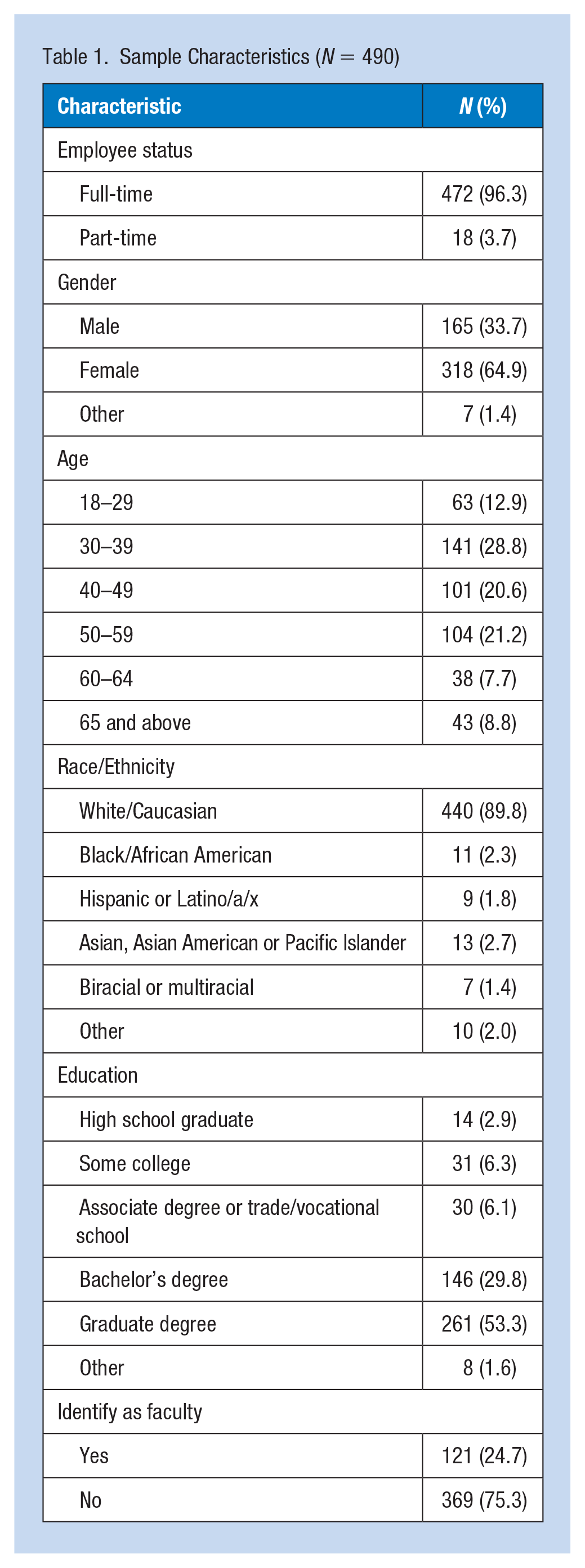
The final sample size was N = 490. Fifty cases were dropped for missing one or more items from intention or the RAA belief factors. As displayed in Table 1, 96.3% of the sample were full-time employees, 64.9% female, and 89.8% non-Hispanic White. The mean age was 43.7 (SD = 12.3; range = 21–72). About three quarters identified as staff (75.3%) and about half had earned a graduate degree (53.3%). Means, standard deviations, reliability, and correlations for the RAA belief factors are detailed in Table 2.
Sample Characteristics (N = 490)
Means, Reliability, and Correlations (N = 490)
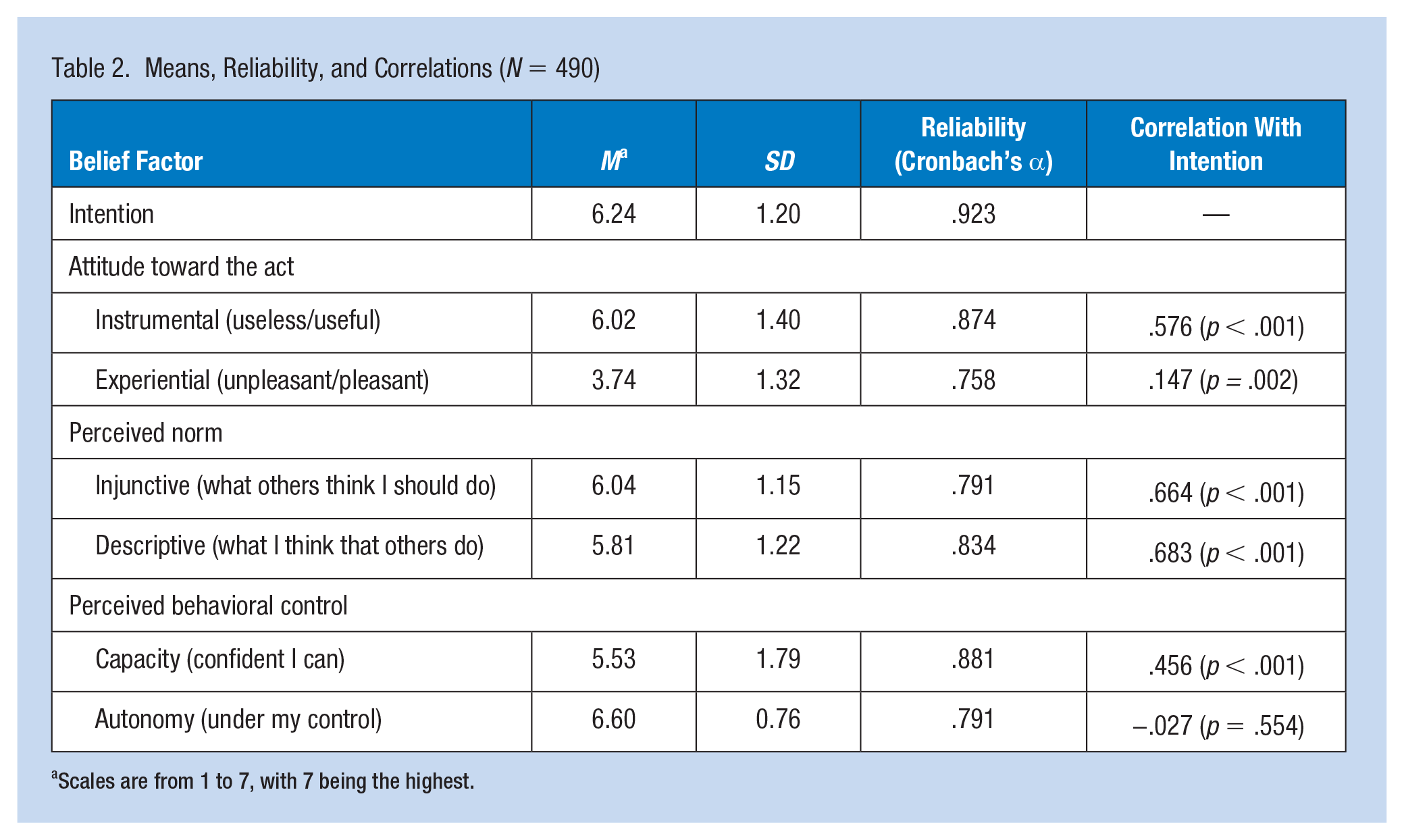
Scales are from 1 to 7, with 7 being the highest.
Regression results testing factors associated with intention for the behavior of “leaving the office building immediately the next time a fire alarm is heard at work” are displayed in Table 3. The regression results suggested that intention was well predicted from the six belief factors, F(17, 472) = 43.80, p < .001, with the model explaining nearly 60% of the variation in employees’ intentions to evacuate (adjusted R2 = .598). Controlling for demographic characteristics, five of the six RAA belief factors showed statistically significant independent associations with intention to leave the office building immediately during a fire alarm: instrumental attitude (B =.272, SE = .026, p < .001), experiential attitude (B = −.073, SE = .026, p = .024), injunctive norm (B = .210, SE = .075, p < .001), descriptive norm (B = .347, SE = .070, p <.001), and capacity (B = .178, SE = .077, p < .001). Autonomy did not make a significant independent contribution to intention, nor did any demographic characteristics (Table 3).
Results From Regression Analysis Testing Factors Associated With Intention to Leave the Building (N = 490)
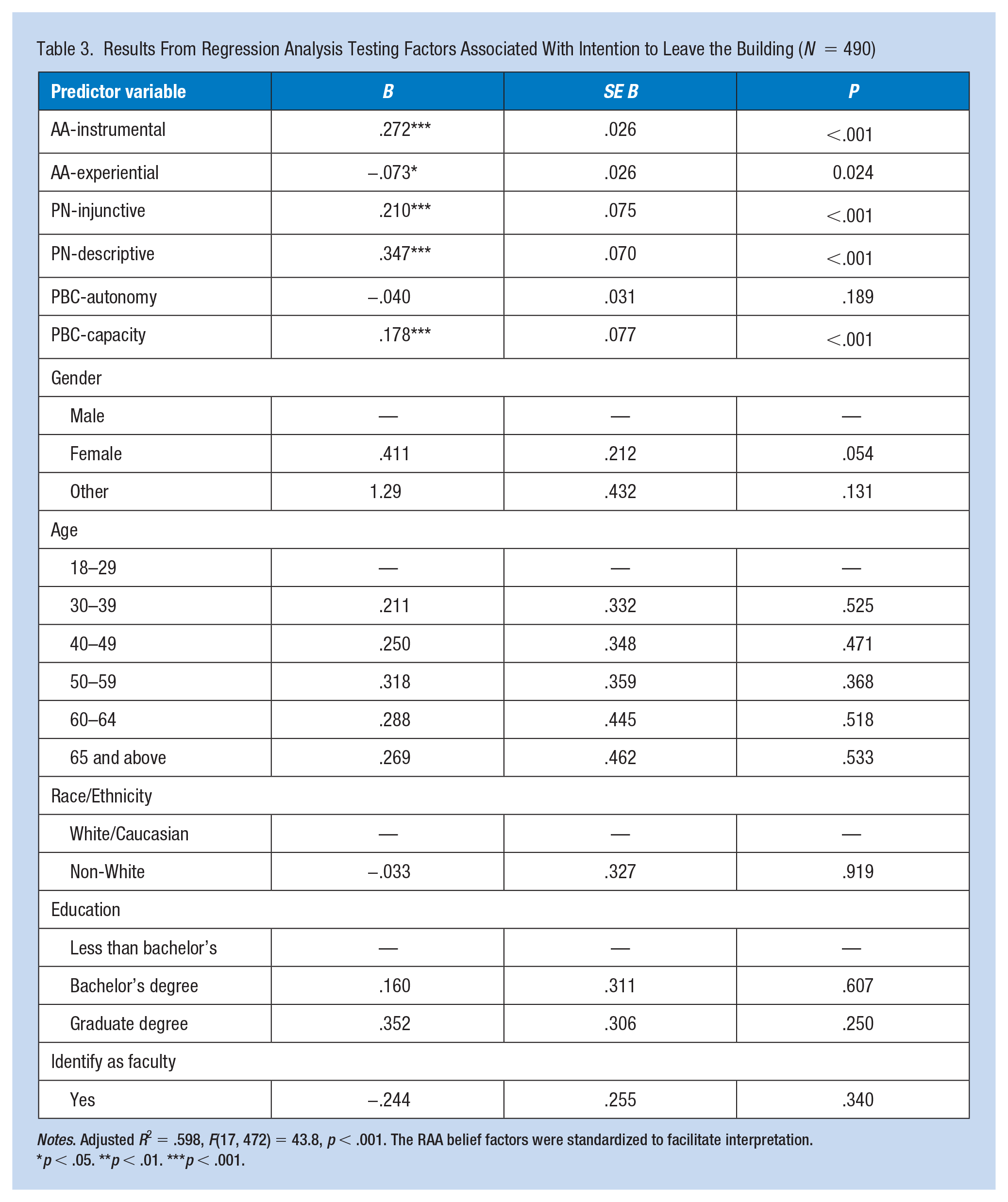
Notes. Adjusted R2 = .598, F(17, 472) = 43.8, p < .001. The RAA belief factors were standardized to facilitate interpretation.
p < .05. **p < .01. ***p < .001.
Discussion
Even though the benefits of evacuation during a fire alarm are widely known (Kuligowski, 2013; Pillemer et al., 1994; Proulx & Pineau, 1996), many people still fail to evacuate during fire alarms especially in the workplace (Gwynne et al., 2016; Jelenewicz, 2008). While existing literature examines different facets of fire alarm evacuation (e.g., demographics, personality traits, knowledge and experience with fires, judgment, herd behavior, stress resistance; Gershon et al., 2012; Haghani et al., 2019; Haghani & Sarvi, 2019; Kinateder et al., 2015; Kobes et al., 2010; Nguyen et al., 2019; Proulx & Reid, 2006; Tsurushima, 2019; USFA, 2019), little research has been done on theory-based belief factors underlying employees’ decision to evacuate. This formative study, using the RAA, provides us the perspective of the worker and identifies the belief factors associated with intention to leave the office building immediately. These beliefs can then be used to suggest communication, educational, and environmental interventions to encourage immediate evacuation and ensure collective workplace safety.
Most of the participants were aged 30 to 59, female, White, had a graduate degree, and identified as staff. The means for intention and for five of the six constructs were positive, about 6 on a 7-point scale. This indicates that university employees intended to leave immediately, believed it was useful and valuable to leave, perceived others wanted them to leave immediately, perceived others like them did leave, and believed they could leave. The mean for experiential attitude was 3.74, just below the midpoint of 4. This means that participants rated the behavior of leaving the building as more on the unpleasant, boring, stressful, and awful side of neutral (Fishbein & Ajzen, 2010).
The adjusted R2 of .598 in our model is slightly higher than the variance in intention (58%) in a recent RAA meta-analysis applied to different behaviors (McEachan et al., 2016). This suggests that RAA is an applicable and useful theory for research in occupational health and safety contexts, such as understanding employee intention to comply with established protocols and public health safety measures (further detailed in Implications for Occupational Health Practice). In the regression model, none of the demographic characteristics were significantly associated with intention. Five of the belief factors showed significant independent associations with intention.
Attitude Toward the Act—Instrumental and Experiential Attitude
Instrumental attitude as the perception that leaving was useful made a significant independent contribution to intention in this study. This is consistent with a recent meta-analysis of RAA studies (McEachan et al., 2011, 2016). It is also consistent with several studies in the safety literature which indicate positive attitudes toward safety behaviors can enhance evacuation (Kang et al., 2007; Lindell & Perry, 2012; Lindell & Prater, 2002; Yang & Zhuang, 2019). Experiential attitude also carried a significant weight in the prediction of intention; the weight in this study was negative and notably small. The small negative weight for experiential attitude departs from the RAA literature. For many health behaviors, experiential attitude shows a very high positive weight (McEachan et al., 2016). In this study, experiential attitude captured how pleasant, relaxing, and nice the behavior was perceived to be. The negative weight may imply that those who see evacuation as unpleasant, stressful, boring, and awful are more likely to intend to leave the building.
Perceived Norm—Injunctive and Descriptive Norms
In this study, both injunctive and descriptive norms made independent contributions to the explanation of intention to leave the building immediately when a fire alarm is heard. This is concordant with a meta-analysis of RAA studies across various behaviors (McEachan et al., 2011, 2016). Furthermore, these findings are consistent with the safety literature on evacuation during emergencies. Using the TPB’s definition of perceived norm (Ajzen, 1985; Fishbein & Ajzen, 1977), Paek and colleagues (2010) found that perceived norm and subjective norm had a significant influence on an individual’s emergency preparedness (e.g., cognitive preparedness and emergency items on hand). Yang and Zhuang adapted a TRA definition of subjective norm; they found descriptive norm increased information sharing and seeking for hurricane evacuation (Gottlieb et al., 1992; Yang & Zhuang, 2019). Two other studies, using the Social Norms and Economic Theory and the Norm of Reciprocity, found that management and workgroup norms improved construction safety and increased employee safety voice, respectively (Choi et al., 2017; Tucker et al., 2008).
Perceived Behavioral Control—Autonomy and Capacity
Autonomy did not have a significant independent contribution to intention. This is consistent with RAA meta-analyses which show autonomy has a marginal or nonexistent weight on predicting intention across behaviors (McEachan et al., 2011, 2016). While a policy cannot physically make someone leave, the presence of the policy may diminish an individual’s perceived control. Furthermore, prior fire evacuation research suggested most people adopt the role of a follower or do not willingly perform a behavior until told by a leader or authoritative figure to do so, thereby relinquishing autonomy (Gershon et al., 2012; Kinateder et al., 2015; Kobes et al., 2010). Capacity, employees’ confidence they could leave, made an independent contribution to the explanation of intention to leave the office building immediately when a fire alarm is heard. This is consistent with the RAA meta-analyses showing the positive, significant relationship for capacity to predict intention across many behaviors (McEachan et al., 2011, 2016). In addition, this aligns with the safety literature. It has been found that improving self-efficacy for disaster response can increase evacuation readiness and self-efficacy in emergency preparedness is enhanced when it aligned with group norms (Newnham et al., 2017; Samaddar et al., 2014).
Limitations
Several limitations should be kept in mind when applying these results. First, this study used a cross-sectional design so causation cannot be inferred. Second, the high mean on intention may be a result of social desirability or may represent a self-selection bias in electing to complete the survey. Third, the outcome analyzed in this study was intention to engage in the behavior, not the behavior itself. Thus, we have not demonstrated how well beliefs or intentions predict behavior nor identified other environmental determinants of behavior. Fourth, the setting was a university workplace with an educated, primarily White population, limiting the generalizability of the findings.
Implications for Research
This study suggested that six belief factors can be used to understand intention. Additional formative research is needed to identify the specific beliefs underlying these factors. Specifically, a research opportunity exists to identify the perceived outcomes underlying attitudinal factors, the significant others underlying the normative factors, and the perceived barriers and facilitators underlying the autonomy and capacity belief factors. In addition, longitudinal research which assesses behaviors is needed to determine how well intention and the belief factors predict behavior. And intervention evaluation research will be necessary to assess the effectiveness of interventions suggested below.
Implications for Occupational Health Practice
The findings detailed in Table 3 demonstrate the success of the RAA in helping us gain a better understanding of the beliefs underlying intention to engage in occupational safety and health behaviors, such as leaving an office building immediately when they hear a fire alarm at work. These findings suggest and prioritize interventions that facilitate the decision or intention to leave and eventually the behavior of leaving. These can be included as part of a multilevel or stacked program that can be implemented by workplace emergency planning and safety personnel to encourage evacuation. Below, we have outlined possible interventions addressing each of the four belief factors which made statistically significant, positive independent contributions to the prediction of intention to leave when one hears a fire alarm (Fishbein & Ajzen, 2010). Then, we illustrate how the RAA can be used to help us address the challenges we currently face with the COVID-19 pandemic.
Instrumental Attitude
The significant weight of instrumental attitude, the belief factor assessing leaving as useful, in explaining intention suggests that safety leadership can develop communication and educational interventions that help employees learn about and really believe that the benefits of leaving immediately apply to them (Eldredge et al., 2016). These interventions can use persuasive communication to help people truly understand the benefits and address any barriers. Safety management personnel and employers can hold brief communication or education sessions by rotating through standing departmental meetings or holding short safety workshops that count toward professional development requirements. These sessions can even be incorporated into larger employee meetings (e.g., town hall) to further convey the benefits of immediate evacuation during fire alarms (Fishbein & Ajzen, 2010). By leveraging instrumental attitude and conveying to employees the advantages of immediate evacuation during fire alarms outweigh the perceived or real disadvantages, more people may engage in the behavior. Through this, risk may be reduced because preparedness for adverse safety events is being mitigated.
Injunctive Norm
Two normative beliefs made statistically significant independent contributions to the prediction of intention. The significant weight for the injunctive norm, the belief that others think I should leave, suggested one would help employees believe that others significant to them in their environment (e.g., colleagues, supervisor) think they should leave. These interventions can provide information about the approval of significant others in the environment, including people in the work environment, such as colleagues, immediate supervisors, and leaders, as well as people outside of work, such as family members. A social media campaign can be developed with communication tailored to the various segments of the employee population, underscoring others’ approving and encouraging the employees to evacuate immediately. This strategy of using a social media campaign targeting injunctive norm has been used by universities to target a different segment of their population—students rather than employees—to curb underage and binge drinking such as, “4 out of 5 students DO NOT drink alcohol. Join the crowd!” (GUIDE Inc., 2021). This intervention can be adapted by employers and safety leadership to bolster immediate evacuation among their employees.
Descriptive Norm
The belief factor with the largest weight was the descriptive norm, the belief that others like me would leave. Addressing descriptive norm means interventions to help employees come to believe that others like them (e.g., colleagues or others in their building) leave the building (Fishbein & Ajzen, 2010). This may need to be different for different segments of the employee population. In the case of the university workplace, safety leadership may need to develop one version for staff and another for faculty. For this approach to work, emergency and safety personnel will need to determine whether most people do in fact leave. If the majority do not leave, one needs to use other interventions to increase the number of those who do leave before leverage the descriptive norm (Fishbein & Ajzen, 2010). A formal communication or use of social media can be used to convey the percentage of people who do leave immediately during workplace fire alarms (Eldredge et al., 2016). Alternatively, safety leadership can use role model stories or provide group sessions in employee meetings in which various types of employees talk about the fact that they leave and indicate why and how. Stories and role model narratives have been found to enhance occupational safety training and participation by stakeholders (Cullen, 2008; Kok et al., 2018). Exercises can be conducted where employees discuss fire safety and detail how immediate evacuation positively contributes to a safe work environment; this can even be integrated into new employee orientation or onboarding. These exercises provide opportunities for social comparison where normative pressure on the individual gets them to believe their colleagues and others like them evacuate immediately during any and all fire alarms (Eldredge et al., 2016).
Capacity
Capacity was the fourth belief factor that made a statistically significant, positive independent contribution to intention. Capacity, defined as the confidence that a person could leave, represents self-efficacy or perceived skill to practice the behavior. There are two types of interventions to improve confidence: individual skill-building activities and environmental changes that make the behavior easier. Both would need to address facilitators and barriers of leaving. Confidence can be improved with individual-level interventions that build skills and the corresponding belief in the skills. These can be delivered in one of the three ways found to be effective at building skills and self-efficacy: reading a verbal communication, watching a model, or actual practice (Eldredge et al., 2016). For example, if a barrier is a concern about leaving personal items behind, an intervention could help employees develop and practice approaches to identify minimum essential items (coat, keys, wallet, phone) and gather them rapidly. If a barrier is a concern about exiting, an intervention could help employees identify and practice using their best route. If drills are used to build skills, it would be more effective to conduct them in a way that optimizes the building of skills and the confidence in capacity: by announcing them, by being clear about what is to be learned, and by debriefing employees on the quality of the drill (e.g., time for total evacuation, failure points, too much time spent gathering items; Eldredge et al., 2016). Confidence can also be addressed at the organizational level by modifying the environment to remove the barriers to make the behavior easier. For example, in the case of the concern about exit, safety professionals can review their buildings to make sure there are sufficient and clearly marked exits. Or, if the barrier is knowing the meaning of the sound, safety professionals can adopt talking alarms that clearly say that employees are expected to leave the building due to a fire hazard.
Employees are a priority population for safety and health. As the COVID-19 pandemic subsides and more people return to work, it is of utmost importance employees adhere to protocols for their own safety and for the safety of coworkers and the public. Recent studies have validated the utility of RAA/TPB to understand intentions to wear a mask in public and to get vaccinated. Pan and Liu (2022) found that attitude and descriptive norm predicted intention to use a mask on an airplane during COVID-19, with attitude being the primary driver for young and middle-aged travelers. Andarge and colleagues (2020) found subjective norm (called injunctive norm in RAA) and perceived behavioral control to be the belief factors that should be targeted for interventions to help adults with chronic conditions practice personal prevention measures. Shmueli (2021) found that subjective norm and self-efficacy could predict intention to receive the COVID-19 vaccine.
In sum, there is value in applying theories of behavior, like RAA/TPB, to safety behaviors. Application of RAA/TPB not only provides insight pertaining to individual intention but also helps practitioners and policymakers decide which belief factors should be the focus to deliver the most effective intervention—especially when time and resources may be limited.
Applying Research to Occupational Health Practice
Many injuries and fatalities from nonresidential fires can be prevented if people evacuate immediately. This cross-sectional study of employees of a Midwestern university applied the Reasoned Action Approach to identify belief factors underlying intention to “leave the office building immediately the next time I hear a fire alarm at work.” Four theory-based belief factors were significantly associated with intention and suggest occupational interventions to facilitate immediate evacuation. The highest weight for descriptive norm (what I think others do) suggests letting people know that others are leaving—if that is the case. The significant weight for injunctive norm (what significant others think I should do) suggests communicating that others, like supervisors and safety personnel, approve of their leaving. The significant weight for instrumental attitude (useful) suggests promoting perceived benefits. The significant weight for capacity (confidence that I can leave) suggests skill building and environmental interventions to facilitate, rapid easy exit.
Footnotes
Acknowledgements
We thank Indiana University’s Public Safety and Institutional Assurance (PSIA) staff for their partnership and assistance disseminating the survey.
Conflict of Interest
The author(s) declared no potential conflicts of interest with respect to the research, authorship, and/or publication of this article.
Funding
The author(s) disclosed receipt of the following financial support for the research, authorship, and/or publication of this article: This study was funded by the first/corresponding author’s discretionary account.
Human Subjects Review Details
The Institutional Review Board at Indiana University approved this exempt research, Protocol #1911129390, on December 3, 2019.

Data Availability Statement
The data that support the findings of this study are available from the corresponding author upon reasonable request.
Author Biographies
Aurora B. Le, PhD, MPH, CSP, CPH, is the John G. Searle Assistant Professor of Environmental Health Sciences at the University of Michigan School of Public Health. She completed her PhD at Indiana University School of Public Health-Bloomington in Health Behavior. Her contribution includes conceptualization, data curation, formal analysis, funding acquisition, investigation, project administration, supervision, validation, writing the original draft, reviewing, and editing.
Susan E. Middlestadt, PhD, is a Professor Emeritus at Indiana University School of Public Health-Bloomington. Her research interests are in applied research to design and evaluate theory-based and empirically grounded behavior programs. Her contribution includes conceptualization, supervision, reviewing, and editing.
Hsien-Chang Lin, PhD, is an associate professor at Indiana University School of Public Health-Bloomington. His research program encompasses health services, health policy, pharmaceutical health outcomes, and health behavior research. His contribution includes assistance with formal analysis, reviewing, and editing.
Carrie L. Docherty, PhD, ATC, FNATA, is executive associate dean and a professor at Indiana University School of Public Health-Bloomington. Her research has focused on proper assessment and prevention of ankle instability. Her contribution includes conceptualization, reviewing, and editing.
Todd D. Smith, PhD, CSP, ARM, AIM, is an associate professor at Indiana University School of Public Health-Bloomington. His research focuses on occupational safety and health, ergonomics and human factors, occupational health psychology, safety culture/climate, injury prevention and control, and firefighter safety and health. His contribution includes conceptualization, assistance with formal analysis, supervision, reviewing, and editing.