




Abstract
Background:
Musculoskeletal disorders (MSD) are problematic in many industries, including stone, sand, and gravel mining (SSGM). This research aimed to delineate MSD risk factors and to identify protective safety resources that reduce MSD within these operations.
Methods:
A deductive content analysis of recorded transcripts from a focus group, which included professionals working in SSGM organizations, was completed.
Findings:
Results suggested demographic and personal factors associated with MSD included age, lack of experience, low levels of physical fitness, and attitudes toward risks. Work factors and job demands included excessive lifting, performing additional job duties, production-focused operations, lack of resources, and work related to maintenance and equipment operation. Suggested safety resources included a focus on worker fitness, resource adequacy, pay and benefits, the SLAM (Stop, Look, Analyze, and Manage) process and positive safety culture.
Conclusion:
This qualitative research project utilized mine experts to identify demographic, personal, work, and job demand factors they perceive or know to be associated with MSD. Safety programs suggested by these same experts to reduce MSD were also presented.
Application to Practice:
Occupational health and safety practitioners and mine administrators should focus on the identified factors in their work to prevent MSD within SSGM operations. Safety efforts need to include integrated programs that promote health and fitness as well. These efforts should be implemented along with recommended programs such as SLAM and the provision of appropriate safety resources to minimize risks. These efforts should promote the importance of safety and will help with bolstering a positive safety culture.
Background
Musculoskeletal disorders (MSDs) such as sprains and strains are the most common injury problem across many industries, including the mining industry (S. Smith, 2013). Nearly 38% of all nonfatal injuries and illnesses in the mining industry are associated with strains and sprains (S. Smith, 2013). The incident rate for MSD across all mining sectors is reportedly 42.5 per 10,000 employees (Weston et al., 2016). Within mining, the prevalence of musculoskeletal problems within the stone, sand, and gravel mining (SSGM) sector signifies a potential safety concern. Balogun and Smith (2020) determined that approximately 57% of SSGM workers surveyed in their study reported low back musculoskeletal symptoms (MSS). In addition, it was determined that 38% of workers reported shoulder MSS, 38% of workers reported neck MSS, and 39% of workers reported knee MSS (Balogun & Smith, 2020). The lower back, shoulder, knee, and shoulder were the four most common body parts or regions impacted among SSGM workers (Balogun & Smith, 2020).
Musculoskeletal problems are costly to the individual, the employer, and the healthcare system. For example, annual medical treatment costs for strains and sprains is approximately $127.4 billion per year (Weston et al., 2016). In addition to medical treatment, there are additional costs related to loss of productivity, absenteeism, increased health care costs, and workers’ compensation costs (Centers for Disease Control and Prevention [CDC], 2020c). The National Research Council and Institute of Medicine (2001) estimated two decades ago employers in the United States spent $13.4 billion each year due to overexertion such as lifting, pulling, pushing, holding, and carrying.
Although the prevalence of the issue is known, more research needs to be conducted with workers in SSGM operations beyond the work that has been completed internally by the National Institute for Occupational Safety and Health (NIOSH, 2019). To expand research in this area, we initiated a research project in the Midwestern United States. This qualitative study used deductive content analysis to analyze the transcript of a focus group that was conducted with professionals working in the SSGM industry. The purpose of the research was to identify MSD risk factors related to demographic, personal, work, and job demand factors. The study also aimed to identify safety resources that may be protective against MSD within SSGM operations.
Project/Program Methods
We employed purposeful sampling for this qualitative research study. Purposeful sampling techniques allowed us to intentionally recruit management professionals with a good general understanding of mine safety and health. Participants were recruited from a safety and health committee within an association in the Midwestern United States that advocates for and supports SSGM. Participants were provided a modest gift card incentive for volunteering and participating.
Thirteen management professionals from SSGM operations participated in the focus group activity. These participants included two females and 11 males. The participants held positions such as executive officer, mining engineer, operations manager, safety manager, and human resources manager, among others. Participants worked for a variety of small, medium, and large SSGM businesses in the Midwestern United States.
Data Collection and Analysis
The focus group session was conducted in a conference room facility offered by an association that supports the aggregates and SSGM industry in the Midwestern United States. This room allowed for all participants to gather and participate during the meeting sitting at tables in a U-shaped arrangement. This configuration allowed all participants to see each other and hear the discussion and questions. Nearly, all participants participated and added to the broader conversation. Only a few participants did not provide some response to all questions and the associated discussion.
The research team included one moderator, who presented the research questions to the participants. He also asked follow-up questions when clarification was needed. Specific follow-up questions were not developed prior to the meeting. In addition, a research member was present and wrote notes on a white board so that participants were able to view key points made by other participants and follow along with the conversation. Two student research assistants kept notes of the discussion for use in the research activity. Digital voice recorders were used to record the meeting. The recording was transcribed into text for this analysis.
Prior to the start of the meeting, all participants were provided with an introduction to the focus group activity and were provided a copy of the model, which guided our discussion and exploration (Figure 1). Our purpose was to identify risk factors associated with demographic and personal factors, and risk factors associated with work operations, job tasks, job demands, and the like. Finally, we sought to gain information about safety resources that may help curtail MSD within SSGM operations.
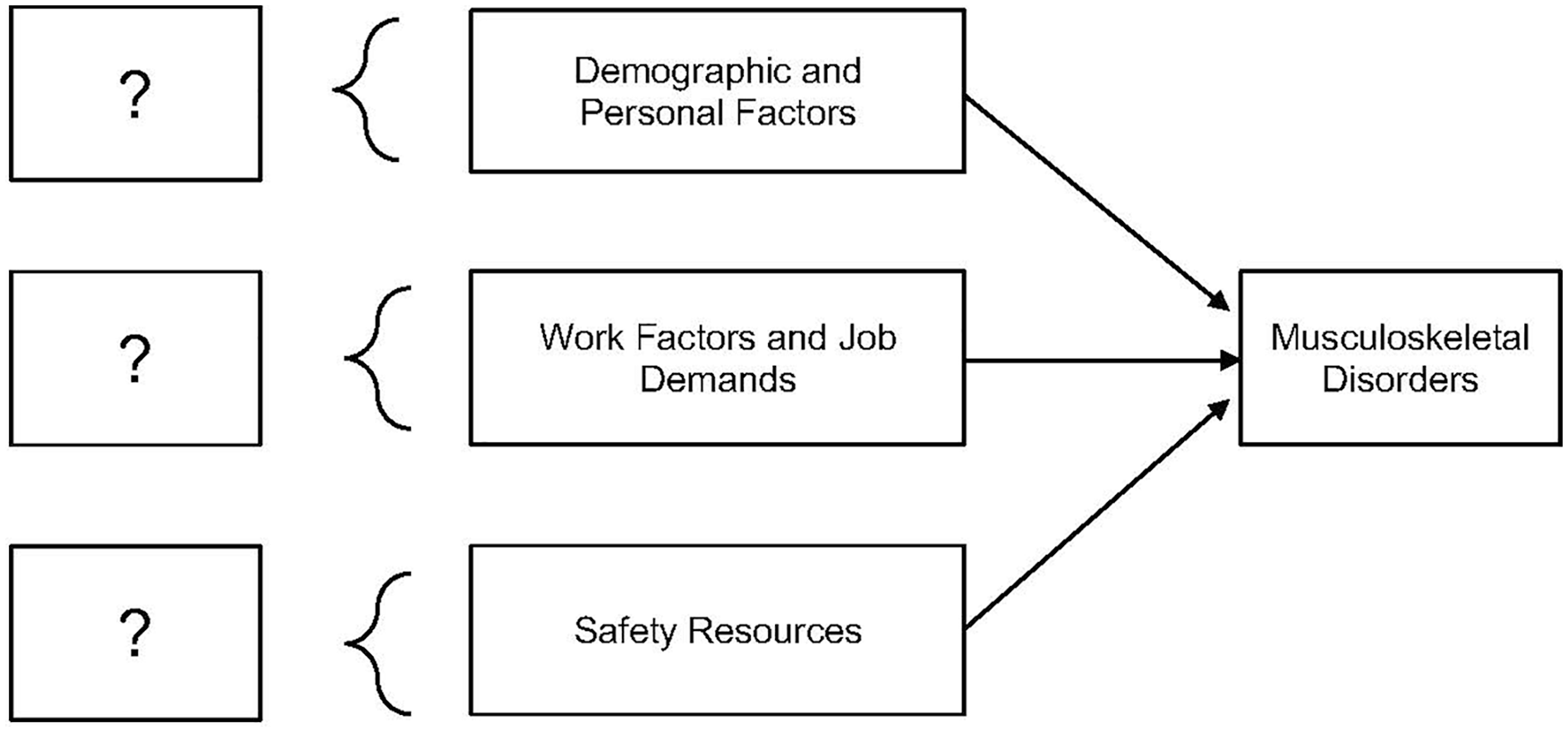
Focus group model.
With the research model guiding the research, the moderator asked participants to respond to three questions, which were the three main themes for the analysis. The questions presented by the moderator included: (a) What demographic or personal factors do you think are associated with musculoskeletal disorders in SSGM operations? (b) What jobs, work tasks, work characteristics, work factors, or job demands do you think are associated with musculoskeletal disorders in SSGM operations? (c) What safety resources do you think would help curtail, buffer, or control the factors you mentioned were associated with MSD in the SSGM operations?
The questions were not asked concurrently. After a question was asked, discussion by the participants continued until the responses were not distinctively different or when no other comments were offered by participants. At this point, the moderator went to the next question.
Deductive content analysis processes follow a standardized exploratory process, where the main themes have already been identified. Thus, our main themes included demographic and personal factors, work characteristics and job demands, and safety resources. To complete the deductive content analysis, three research members analyzed the transcribed focus group recording following guidance related to completing deductive content analysis (Curtis et al., 2001; Hsieh & Shannon, 2005; Schreier, 2012). Each of the three research members identified and recorded what they believed were the dominant subcomponents to each theme. Research members recorded each subcomponent, identified its context in relation to the subcomponent area and then identified the page and line where the content was highlighted. Themes and subcomponents were highlighted using varying colors. Following the submission by the three researchers, the lead investigator recorded the findings, documenting subcomponent topics associated with each theme, which were consistent between the researchers to ensure consensus of findings related to the content analysis. Following this compilation, the lead investigator and research members examined the overall findings to ensure agreement among the identified subcomponents and the context in which the content related to each subcomponent fit into the research model. Table 1 presents a summary of the final results and findings.
Themes and Identified Subcomponents.
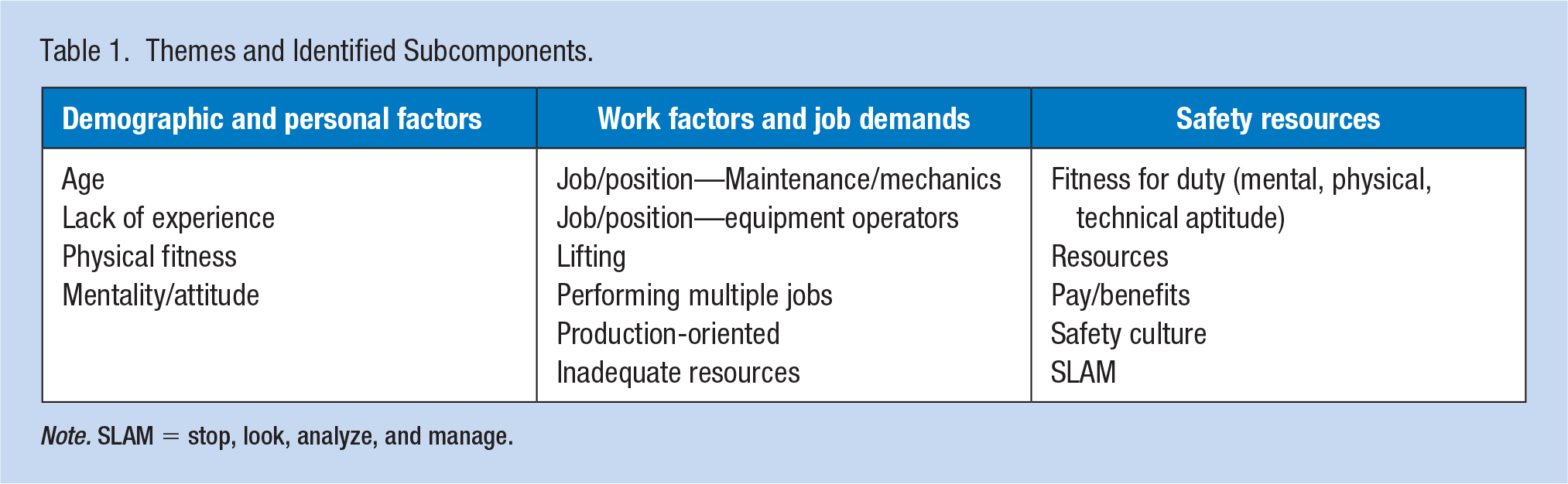
Note. SLAM = stop, look, analyze, and manage.
Participation in the focus group was voluntary. Consent was obtained from all participants. Prior to the initiation of this study, Institutional Review Board approval for the study was obtained through the lead researcher’s university.
Findings
The research team determined there were four main subcomponents to the Demographic and Personal Factors theme. These included age, lack of experience, low levels of physical fitness, and personal attitudes toward risks. For Work Factors and Job Demands, six factors emerged from the focus group discussion. These factors included working in maintenance or as a mechanic, working as an equipment operator, excessive lifting, a production-focused orientation, lack of adequate resources and performing multiple job tasks, particularly beyond traditional job roles and responsibilities. Finally, five subcomponents emerged in the context of Safety Resources and Protective Factors. These included fitness for duty, equipment/resources, pay/benefits, safety culture, and the SLAM process. SLAM is a mining-focused safety initiative initiated by the Mine Safety and Health Administration to address human factors and decision-making (Cable, 2005; Griffin et al., 2018). Insights into each of the subcomponents identified for each of the themes were presented in the remainder of this section. Quotes from focus group participants were presented to provide context for the findings.
Demographic and Personal Factors
Focus group participants overwhelmingly agreed that age was a potential risk factor for MSD. They believed older workers had lower levels of flexibility and were at risk from material handling activities. In a general statement, a participant commented that “Physical labor is a little bit more taxing on them.” This may be a potential concern within the sector as the mining workforce is aging (Fotta & Bockosh, 2000). This may also be a concern as participants commented on the low turnover rates and long employment history of workers in SSGM companies. A participant noted that “most people that get into our industry don’t leave it. So, they are here for a while. It’s not like they jump back and forth. They are in it. They stay in it until they get older.”
In relation to age, focus group participants also believed younger workers were at risk as well; however, as this topic was further explored, it was evident that the participants were more concerned with lack of experience versus age. Participants mentioned the risk was with “time on the job” and “inexperience.” For instance, one participant stated “Our younger guys go out there, guns a blazing, not exactly sure what they are doing, but they are trying to put out the most effort they can. You see more injuries with those guys.” Beyond inexperience, it may fall back to tenure or time on the job as it relates to seniority. One participant indicated “It goes back to that seniority thing. If you’ve been there long enough, you’re not doing any of the work.” Another interjected, replying “That’s right, it’s your young guys that are doing it.”
Additional discussions around demographic and personal factors found that focus group participants were concerned with physical fitness and physical preparedness. One participant indicated “You have a lot of people who aren’t really physically ready to come into these types of environments.” Given the complexity of job demands, participants indicated that good physical health is necessary to curtail MSD. It appears it may be problematic when workers are not physically ready or able to perform required job tasks associated with SSGM operations.
In addition, mentality and attitude emerged as a subcomponent. In this context, participants felt that workers’ perceptions of invincibility were problematic as these workers may place themselves at risk. One participant said, “You got some people that think they are invincible when it comes time to lift something.” Participants indicated that administrators need to remind workers that they do not have to be “rock stars” and that “they need to perform the job as expected and not try too hard.”
Work Factors and Job Demands
With regard to work factors and job demands, the focus group participants pointed to two main job categories they believed were problematic and placed workers at higher risk for MSD. They felt maintenance workers or mechanics were at higher risk for MSD and they also indicated that heavy equipment operators/drivers were more likely to suffer MSD at work. Participants indicated that maintenance workers or mechanics performed frequent and heavy material handling and that the jobs performed by these workers were “physically demanding.” In addition, there was some discussion about specific job tasks performed by those working in maintenance or as mechanics. A participant mentioned that these employees sometimes performed electrical work, which required “pulling wire.” This task was deemed a potential exposure. They also mentioned work tasks that involved the use of hands/arms, including what one person referred to as “hand shuffling.” This includes repetitive use of hands, wrists, and arms, often with deviation of the wrists, and pronation and supination of the wrists and hands. Cleaning tasks performed by these same workers was also a noted point of concern.
As mentioned, participants believed heavy equipment operators or drivers were more likely to suffer MSD at work. Participants attributed this to a variety of exposures. They indicated that these workers may suffer knee injuries “when they get off the steps.” Similar knee-related sprains and strains or injuries reportedly occurred when workers jumped off or out of equipment. A participant said that operators “jump from the equipment without using the ladder.” It was indicated “they just jump down.” In addition to this potential exposure, participants indicated that these operators or drivers were often exposed to “constant jarring around” and “repetitive body movement” that occurred from getting shifted “back and forth.” Some of this was attributed to poor road conditions. It was indicated that because of these exposures, operators or drivers had low back MSD. Comments seem to allude to whole-body vibration (WBV), which has been identified as an occupational risk associated with operators or drivers in the mining industry (Burström et al., 2016; Eger et al., 2006; Smets et al., 2010; Wolfgang & Burgess-Limerick, 2014). WBV exposure may be worsened as administrative controls did not appear to be in place to limit exposures. A participant commented that “Some operators never get out of their cabs” implying some operators remain seated in vehicles for long periods of time, thus increasing WBV exposures throughout the entire shift.
With regard to specific job tasks or activities, participants commented on heavy lifting as a concern. When asked about who may be at risk for MSD, a participant stated, “Well, anybody that does any lifting, because there’s always lifting in this industry.” A concern specifically noted by several of the participants was the lifting and carrying of buckets by quality control personnel. Participants indicated that these workers collect samples by filling 5-gallon buckets with the product. One participant estimated that “you’re probably at 25 to 30 pounds.” This person also indicated that the exposure was worsened by how the load is handled. He indicated “Worst case scenario, they carry it on one side of their body.” In addition to this job task, participants also talked about blasting and shooting, which refers to mining techniques that use controlled explosives. According to one participant, these workers “handle 50 pounds very often.”
In addition to lifting, participants commented about concerns with workers performing multiple job duties. They mentioned that it was not uncommon for many workers to perform multiple job tasks, including those outside of their normal job. A participant commented “Well yeah, it’s not conventional stuff. The ones out there, operating machinery all day long, all of a sudden they got to jump off and help with a maintenance project that they’re not in tune with.” This same participant also noted “We’ve had, unfortunately, two injuries this year, both of them instances like that. Guys not doing what they normally do.” This seemed to be a significant concern among small employers, particularly those with limited resources. One person stated, “It is those small operators (companies) that don’t have the resources.” Workers performing multiple job tasks beyond their normal job role seemed to exist when work boundaries were not clearly defined. This may be confusing for workers and may lead to role ambiguity, which has been associated with negative safety outcomes including musculoskeletal symptoms and disorders (Malchaire et al., 2001). This problem may be exacerbated as many SSGM operations were production-oriented according to participants. This is illustrated by a participant stating,
We are basically manufacturing or production, so everything, the wheels of production are moving. But when something happens, you have to get the wheels of production going again. If it’s the pressure or ripping a belt, then everyone’s jumping in to get things back going so they’re doing something that they normally don’t do. If they’re on belt repair or digging out a crusher, I mean that’s not a daily job. It has to be done to get back going.
Unfortunately, resource adequacy among smaller mine operations, appeared to be a fairly broad safety concern and not just one that needed to be addressed to minimize musculoskeletal disorders. A participant stated,
You take a look at the fatalities, the bad things that happen in our industry, it’s those small operators that don’t have training resources, that don’t know any better than what they’re doing. They do it this way because they’ve always done it that way.
In this context, it was obvious that resource adequacy extended beyond personnel to include training resources. Although training programs did not directly abate and control hazards, effective training and worker development was an important aspect of managing safety. Safety-focused training has been associated with enhanced occupational safety outcomes in work organizations (Burke et al., 2006; Robson et al., 2012; Zacharatos et al., 2005) and has been associated with reduced harmful incidents, injuries, and illnesses (Burke et al., 2006; Dong et al., 2004; Gauchard et al., 2006). It should be noted that although safety training was important for all workers, consistent, frequent, and effective training was especially necessary for high-level job skills that were performed infrequently as these skills can quickly deteriorate (Colligan & Cohen, 2004). This was particularly relevant to those workers in SSGM operations who were performing job duties outside their normal work activities.
Safety Resources and Protective Factors
With regard to safety resources and protective factors, having adequate resources and equipment to address previously noted concerns, was obviously of particular importance, especially for those smaller operations. Examples of how equipment and resources may be protective included using “skid steers instead of shovels” and using equipment so that catwalks were not used or were eliminated altogether. Catwalks or elevated walkways present access and fall hazards and may require workers to climb or descend stairs. One participant stated, “We had a huge push recently about eliminating catwalks and using man lifts to access certain things because you get people walking up and down catwalks you are asking for it. Especially low back, legs, knees, ankles.”
With regard to safety programs and resources, the participants provided good insights into programs and initiatives important and necessary to prevent MSD. The participants spoke supportively to the benefits of having a positive safety culture and how it improved overall safety. There was an interesting discussion with regard to what factors were part of a positive safety culture. Participants spoke about the importance of open communication, caring leadership, and having a family atmosphere. Also, a positive safety culture was one that was more focused on the worker than on production. It was indicated that “Safety culture would be a good resource. The fact that you work for a company that is more geared on you going home safe instead of production.” Again, a major driver of a positive safety culture within SSGM operations was the family atmosphere. A participant indicated “It’s more like a family atmosphere. It really is. It’s, uh, kind of like a large family. We come together like family and work together and all that, so they feel a part of something.” This was confirmed by another participant, stating “I think a lot of it has to do with the culture and that family feeling.”
Participants also spoke to the benefits of the SLAM process, which has been promoted and used in the mining industry for many years (Cable, 2005; Griffin et al., 2018). They felt the application of this process was a positive and illustrated an organization’s commitment to safety, which has been a key determinant of safety culture and safety climate for nearly four decades (Clarke, 2010; DeJoy et al., 2004; Flin et al., 2000; Guldenmund, 2000; T. D. Smith et al., 2019; Zohar, 1980). A participant spoke to the benefits of SLAM stating “It actually just gives people the opportunity to organize themselves and often, the efficiency of that organization, can sometimes give them the opportunity to prevent something from happening. It makes them stop and think is what it does.” Another said, “The SLAM also allows for the inexperienced and experienced to be talking.” Another participant agreed, saying “It allows everybody to come together and at least on projects be at the same level or talk through that and put one person in charge.” Given this information, SSGM organizations that have not yet implemented and/or trained on SLAM may explore this program to determine if it could be implemented to bolster safety practices, curtail musculoskeletal disorders among other occupational injuries and illnesses, and bolster perceptions of safety climate and the overall safety culture. With implementation, administrators need to make sure the process was properly implemented and that it was not used as a tool that places the burden solely on workers.
Along with culture, focus group participants addressed the importance of pay and benefits. Participants concurred that pay and benefits within SSGM operations were very good. Comments included the following: “It’s a very good job,” “bright future too,” “with benefits and everything,” and “yeah, with benefits.” Although participants felt this was a positive in that it helped maintain an experienced workforce, it was noted that it may impact MSD in the long term as pay and benefits resulted in reduced turnover and they believed older workers may be at increased risk of MSD. In addition, given these workers were mostly hourly workers, the high pay may be attributed to longer work hours and overtime. This was a concern given the relationship between extensive overtime and musculoskeletal symptoms within SSGM operations (Balogun & Smith, 2020).
As noted earlier, within the discussion surrounding personal and health factor risks, the focus group participants concurred that lower levels of physical fitness may increase the likelihood of MSD within SSGM operations. From a health protection and promotion standpoint, the participants were also in agreement that being healthy and physically fit was essential to prevent MSD. This perception is supported by current research. Smith and colleagues found that SSGM workers who reported their health as very good to excellent were less likely to suffer low back and knee musculoskeletal symptoms and those who were considered obese were more likely to experience knee musculoskeletal symptoms (T. D. Smith et al., 2020). Potential programs to bolster fitness within the industry may include what two different participants termed “stretch and flex” programs. These programs focused on enhancing physical fitness and flexibility. Beyond this, the discussion was limited. It appears SSGM operations, based on our participants, have not adopted extensive health promotion programs that may be beneficial to curtailing MSD.
Participants also felt that being fit for work also meant having the right mental attitude and what some described as having an appropriate “aptitude” for performing the type of work commonly found at SSGM sites. The participants felt this was important to perform the job properly and safely, which helps minimize the likelihood of MSD. A participant mentioned that the industry could “assess someone’s aptitude for a certain job” and that hiring procedures, within the context of the law, could focus on hiring workers that “fit with the type of work available.” One participant commented that they try to hire individuals with a technical background and vocational aptitude because “they just learn how to do things, and they learn what not to do.”
Discussion
The use of focus groups is an appropriate tool for conducting ergonomics-focused research (Caplan, 1990). This study collected basic qualitative data from focus group participants comprised of administrators and management professionals working for SSGM organizations. These participants primarily identified factors under the control of or the responsibility of management. There was a little assignment of blame toward workers. Participants did mention that some workers might take unnecessary risks because of the mistaken perception that they are “invincible” or not at risk. For instance, equipment operators sometimes jump from equipment versus following procedures for properly dismounting equipment.
In this type of study, in which laborers and lower-level workers did not participate, there are concerns that responses may not address management-level or organizational-level factors and might suggest the workers were mostly at fault. DeJoy (1994) has suggested, in the context of workplace safety, that injury causation conclusions might be biased. Attribution theory suggests that top management may be more inclined to blame workers and workers may be more inclined to blame management for workplace injuries (DeJoy, 1994; Zacharatos et al., 2005). In the present study, this does not appear to be the case as administrators and professionals participating in the focus group delineated factors that need to be addressed by administrators and management across multiple ergonomic-related domains.
The conceptual framework of this study was based on job demands-resources theory (Bakker & Demerouti, 2007; Demerouti et al., 2001; Schaufeli & Bakker, 2004) and associated frameworks, particularly those more focused on workplace safety (Nahrgang et al., 2011; T. D. Smith & Dyal, 2016). The emergent outcomes do align with this framework. In addition, it is also evident that the findings represent multiple aspects commonly identified in the context of work-systems, including person, organization, tools and technology, tasks, and environment (Carayon, 2006; Carayon & Smith, 2000). This context provides additional insights into factors that must be controlled, abated or initiated from a safety and human factors perspective to prevent musculoskeletal disorders among workers in the SSGM sector of the mining industry.
The ultimate goal of this research was to improve safety and to protect workers in SSGM operations. Particularly, this research was intended to inform future research related to preventing MSD, particularly to inform programs, policies, and practices enacted by administrators, occupational health and safety professionals and ergonomists working in the SSGM industry.
It was evident that the participants were well versed on safety, safety programs, safety policies, and initiatives that are designed to prevent and control MSD within their operations. This expertise is likely cultivated by working in an industry heavily regulated by the Mine Safety and Health Administration. Although these participants had significant expertise in safety, it seemed that knowledge of and application of programs and policies that promoted health were not as well developed. Focus group participants clearly understood that physical fitness and health was important to prevent MSD, but discussions around initiatives to curtail this exposure were more limited. And, it did not appear that many programs have been enacted. There was some discussion about the use of “stretch and flex” programs, but beyond this initiative, other programs appeared to be lacking.
There was no real discussion about health promotion programs, particularly those related to Total Worker Health or TWH (CDC, 2020b). While the use of TWH approaches is new to the mining industry, these integrated programs, which have successfully integrated health protection (safety) and health promotion (Anger et al., 2015; Bradley et al., 2016; Feltner et al., 2016) may be beneficial within the SSGM industry. Particularly, an application of the TWH Hierarchy of Controls (CDC, 2020a) may assist with reducing MSD. These approaches would include the elimination of hazardous equipment and processes, the reorganization or redesign of work, providing consultation to workers to address ergonomic hazards and the implementation of preventive health promotion and physical activity programs (CDC, 2020a). It is important to note that there is a dearth of information regarding what an effective TWH program would look like within SSGM operations. To address this knowledge gap, future research associated with the development, implementation, and evaluation of a TWH intervention is suggested.
As with all research, some limitations exist that should be considered when evaluating the present study and its findings. This aspect of our research was a single qualitative study, which included the deductive content analysis of a single, albeit large focus group. Despite having enough participants to complete multiple focus groups, we were only able to complete one focus group meeting with our participants because of time and space constraints. Multiple sessions may have resulted in more robust findings as they may have allowed more discussion within smaller groups. In all, we had good participation; however, a common concern related to focus group activities is that some participants may not provide views that are in contrast to other participants and responses may not be representative of the broader industry. In addition, our focus group was targeted on gathering information from administrators and leaders in the SSGM industry, particularly those with experience in safety. Responses from workers may have differed if a worker-only session was completed. In addition, focus groups can be somewhat challenging to analyze. Different approaches may be appropriate. This study focused on a deductive content analysis.
As noted above, one future research objective would be to conduct focus groups with workers instead of management personnel. This would allow employees to express their thoughts and opinions on the topic and the results may point to additional factors related to leadership and management. In addition, based on the results in this study, it seems more research needs to be completed with maintenance workers and mechanics. The focus group participants identified these workers as potentially at risk for musculoskeletal disorders. Balogun and Smith (2020) recently determined these workers were more likely to report low back and knee musculoskeletal symptoms. Qualitative research with these workers could include semistructured interviews and focus groups to identify which job tasks associated with maintenance operations are most problematic and specific safety and ergonomic analyses could be completed to further identify risk factors and possible means to control or abate the hazards.
Finally, future research needs to examine the impact of ergonomic and safety programs on the prevention of MSD among workers in the SSGM industry. These interventions should incorporate scientific approaches to truly evaluate the influence of programs over time. These results then need to be properly disseminated so that they can be translated and incorporated into practice by mining administrators, safety professionals, or others working to protect workers in the SSGM industry.
Applications to Professional Practice
This qualitative research garnered management perspectives on musculoskeletal disorder risk factors that may be targeted by practitioners to enhance safety. Additionally, the study identified protective safety resources that should be further evaluated and considered by practitioners. Although more research is needed, the preliminary findings in the present study suggest a broader approach to safety is needed to curtail MSD within SSGM operations. The integration of both health protection (safety) and health promotion programs, such as those within TWH approaches (CDC, 2020a) may prevent MSD and may bolster SSGM worker safety, health, and well-being. These might include initiatives that would simultaneously promote health and fitness, implement safety and ergonomic programs, redesign work tasks and jobs and integrate other Total Worker Health best practices (Anger et al., 2015; Bradley et al., 2016; Feltner et al., 2016).
Footnotes
Acknowledgements
The authors would like to thank Dr. Kevin Slates, Mr. Kenny Arnold, and Ms. Natalia Walker for assisting with focus group activities and thank the Indiana Mineral Aggregates Association for help with recruiting participants and for use of their facilities to conduct the focus group meeting.
Conflict of Interest
The author(s) declared no potential conflicts of interest with respect to the research, authorship, and/or publication of this article.
Funding
The author(s) disclosed receipt of the following financial support for the research, authorship, and/or publication of this article: This study [AFC719-34] was sponsored by the Alpha Foundation for the Improvement of Mine Safety and Health, Inc. (Alpha Foundation). The views, opinions, and recommendations expressed herein are solely those of the authors and do not imply any endorsement by the Alpha Foundation, its directors and staff.

Author Biographies
Todd D. Smith, PhD, CSP, ARM, is an associate professor in the Department of Applied Health Science at the Indiana University School of Public Health—Bloomington. He conducts research related to occupational safety and health and teaches courses in the areas of safety management, ergonomics/human factors and research methods.
Abdulrazak O. Balogun, PhD, is an assistant professor at Keene State College, teaching courses in the Department of Safety and Occupational Health Applied Sciences. He conducts research related to occupational health and safety.
Abby L. Dillman is a recent graduate of Indiana University—Bloomington. She earned her BS in Applied Health Science with a major in Safety. Abby is now working as a construction safety professional in Cincinnati, OH.