




Abstract
Background:
Despite the growth and popularity of gig work, limited information exists about the occupational health and safety concerns faced by individuals who are employed through ridesharing online applications. In this qualitative study, we characterized the perceived health and safety concerns of drivers employed by rideshare companies.
Methods:
During September–October 2019, we requested car rides, using digital rideshare platforms. During the ride, drivers responded verbally to a brief closed-end sociodemographic and work characteristics survey. A semi-structured interview script was used to collect rideshare driver perceptions on health and safety risks.
Findings:
A total of 35 rideshare drivers of group mean age of 43.1 ± 11.2 years were interviewed, of whom 77.1% were male and 82.9% identified as Latino. Sixty percent of participants reported rideshare as their primary job, working an average of 47.9 ± 19.6 hours weekly (minimum = 6 hours, maximum = 84 hours). Drivers enjoyed job autonomy yet faced stressors such as passenger risky behavior, car accidents, and lack of policies that protect the driver. Rideshare drivers also raised concerns about their current health status, economic pressures, and worker safety.
Conclusion/Application to Practice:
Drivers are forced to extend work hours to support themselves financially, exacerbating their current health concerns and safety risks as it means more time spent working in their sedentary job, compromising their mental and physical health as well as their safety. Occupational health and safety programs geared toward workers in the gig economy are needed.
Background
During the past decade, the gig economy has grown exponentially in accordance with the increase of on-demand services (Istrate & Harris, 2017; Tran & Sokas, 2017). In the United States alone, gig workers account for approximately 34% (55 million) of the U.S. workforce (Abraham & Houseman, 2020). Many individuals who work in the gig economy are hired to complete a particular task for a certain period of time and get paid for the completion of that task or project (Rockmann et al., 2018; Tran et al., 2017). Gig workers can be online platform workers, contract firm workers, on-call workers, temporary workers, or independent contractors (Rockmann et al., 2018). Currently, the gig economy is specifically characterized by online platform businesses (Watson et al., 2021). Companies facilitate gig workers with an innovative digital platform (e.g., mobile device applications) in which workers can find a quick and temporary job and are then connected to and paid by the consumer (Bajwa et al., 2018). Work mediated by these types of platforms can be done locally, for tasks such as driving, or globally, in the case of online tasks such as audio transcription (Istrate & Harris, 2017; Tran et al., 2017). Nonetheless, despite the growth and popularity of gig work, limited information exists about the occupational health and safety concerns faced by individuals who engage in this type of work arrangement.
The ridesharing industry (e.g., companies such as Uber or Lyft) is a type of gig economy that allows individuals to provide car transportation or food delivery services to consumers based on geographical location (L. Chen et al., 2015; M. K. Chen et al., 2019; Penn & Wihbey, 2016). Rideshare businesses operate under an intermediary digital platform (i.e., mobile application or website) that connects workers to customers who pay for the services requested while the intermediary company retains a percentage of the paid task (L. Chen et al., 2015; Duggan et al., 2020). This type of gig is often referred to as “app-work,” which is a form of labor where work is conducted through digital applications and managed by intermediary businesses that set the quality standards of the service and manage individuals who perform the work (Burtch et al., 2018; Duggan et al., 2020). To attract potential workers, rideshare companies promote themselves as an easy way to make extra income (Bartel et al., 2019). However, once hired, these types of companies tend to classify their workers as “drivers/partners” or “independent contractors” (Munn, 2017). This employee classification in the United States limits employment status (i.e., full-time or part-time employment) and work-related benefits (e.g., paid sick days; Berneking et al., 2018; Burtch et al., 2018; Munn, 2017). This type of work arrangement has been shown to promote occupational stress due to job insecurity, market saturation, wage instability, lack of proper employee benefits, and costly vehicle maintenance expenditures (Geisser, 2015; Wirtz & Lovelock, 2020).
The app-based rideshare industry shares several characteristics with for-hire drivers such as taxi or truck drivers (Bartel et al., 2019; Burgel et al., 2012). Previous scientific evidence on the for-hire driving industry has identified health and safety risks such as fatigue, violence and verbal abuse, obesity, hypertension, type II diabetes, and musculoskeletal pain (Bartel et al., 2019; Burgel et al., 2012; Caban-Martinez et al., 2020; Davidson et al., 2018). It has also been documented how the taxi driver occupation can promote stress and anxiety due to nonstandard working conditions (Burgel et al., 2012; Davidson et al., 2018). Although rideshare drivers might share similar characteristics with for-hire drivers, little is known about how this type of nonstandard work arrangement can affect the health and safety of rideshare drivers. Therefore, we aimed to describe the overall perceived health and safety concerns of drivers employed by the rideshare industry.
Methods
Study Design
The Rideshare Drivers in the Health/Safety Investigation Among Non-Standard Workers in the Gig Economy (HINGE) pilot study was conceptualized using a convergent study design. This mixed-methods approach involved a parallel descriptive qualitative and quantitative data collection phase (Fetters et al., 2013; Zheng, 2015). Data were collected between September and December 2019 in the United States. Qualitative data were collected through key informant interviews and quantitative data were collected through the administration of a onetime survey. The qualitative design was used to obtain an in-depth look at the health and safety concerns among rideshare drivers. The quantitative approach was employed as a supplementary data source. This article focuses on the qualitative data gathered. The study’s data collection methods were reviewed and approved by the university institutional review board (#20190676).
Participant Recruitment and Eligibility Criteria
Our research team members (n = 7) requested individual transportation in Florida, North Carolina, Colorado, and California, using a rideshare mobile app–based platform to recruit study participants randomly. Team members did not have a prior established relationship with study participants and vice versa. Although all research team members had previous experience conducting qualitative interviews and had at least a master’s degree, they participated in a mandatory training workshop to ensure consistency across interviews and data collection procedures. Two research team members were male, and five were female.
The ride requested by each team member was paid through the rideshare app utilized. Once the rideshare driver arrived to pick up the team member, the researcher explained the pilot study’s purpose to the driver and obtained verbal consent before initiating any research activity. All components (i.e., survey or interview) of the pilot study were voluntary and available in English or Spanish. Participant eligibility criteria included adults ≥18 years of age who could speak in Spanish or English and worked as a rideshare driver. Participants were compensated with a monetary incentive of US$10 cash for their time and participation.
Data Collection Procedures
Prior to initiating the interview, the researcher asked the participant to respond verbally to a survey containing 24 closed-end items. The survey instrument included standard questions assessing sociodemographic and work characteristics adapted from the U.S. National Health Interview Survey (NHIS) and the NHIS Occupational Health Supplement (National Center for Health Statistics, 2020). All questions were read out loud in the language of preference by the participant, and responses were recorded on paper by the researcher. Following survey completion, the key informant interview began. Interviews included one rideshare driver and lasted a maximum of 30 minutes. Team members purposely selected routes that ensured enough time for a conversation. All researchers used a semi-structured interview guide, which consisted of a mix of four to nine open- and closed-end questions for each of the study domains. The interview domains included (a) aspects of ridesharing job, (b) health concerns about rideshare-related work, and (c) safety concerns about rideshare-related work. The research team developed the interview guide using the existing qualitative literature on taxicab drivers, with guidance and feedback from the two rideshare company regional managers. Face validity of the semi-structured interview guide was assessed with four rideshare drivers prior to use in the pilot study (Gilbert, 2011; Orleans et al., 2019). The interview guide for interviews is included as supplemental material in this article (Appendix A). All interviews were audio-recorded utilizing audio recording software on electronic devices (i.e., mobile phones or tablets). Thematic saturation was determined by exploring and analyzing similarities and differences across and within key informant interviews.
Data Analysis
The quantitative data collected as part of the survey were analyzed using statistical software (i.e., Statistical Package for the Social Sciences [SPSS] V26, IBM Corp). We calculated descriptive statistics for continuous variables, expressed as means with its standard deviation, and for categorical variables, expressed as frequency and percentage of the sample. Participant interviews were transcribed verbatim in the recorded language using Microsoft Word. Interview transcripts were then imported into the qualitative data analysis program QSR NVivo 12. Two bilingual research team members (P.L.F. and K.S.) analyzed the qualitative data through the constant comparative method (Olson et al., 2016). The constant comparative method allowed for relevant categories of meaning and relationships between categories to be derived from the data itself, rather than initiating the process with predefined categories. A preliminary codebook was developed after the first five interviews were completed. The principal investigator (PI; A.J.C.M.) and Co-PI (N.S.S.) reviewed the coding for consistency. Once the final coding frame was established, the 35 transcripts were coded to identify themes and patterns individually and collectively. Spanish quotes included in the final thematic analysis were then translated to English.
Results
Participant Demographics
Among the 35 rideshare drivers who participated in the HINGE pilot study, 77.1% were male, 82.9% Hispanic, 68.5% had a college degree, and there was a group mean age of 43.1 ± 11.2 years (minimum = 23 years, maximum = 68 years; Table 1). Sixty percent of participants reported rideshare as their primary job, working an average of 47.9 ± 19.6 hours weekly (minimum = 6 hours, maximum = 84 hours).
Sociodemographic and Work Characteristics Among Rideshare Drivers Participating in the HINGE Pilot Study (n = 35), September–December 2019
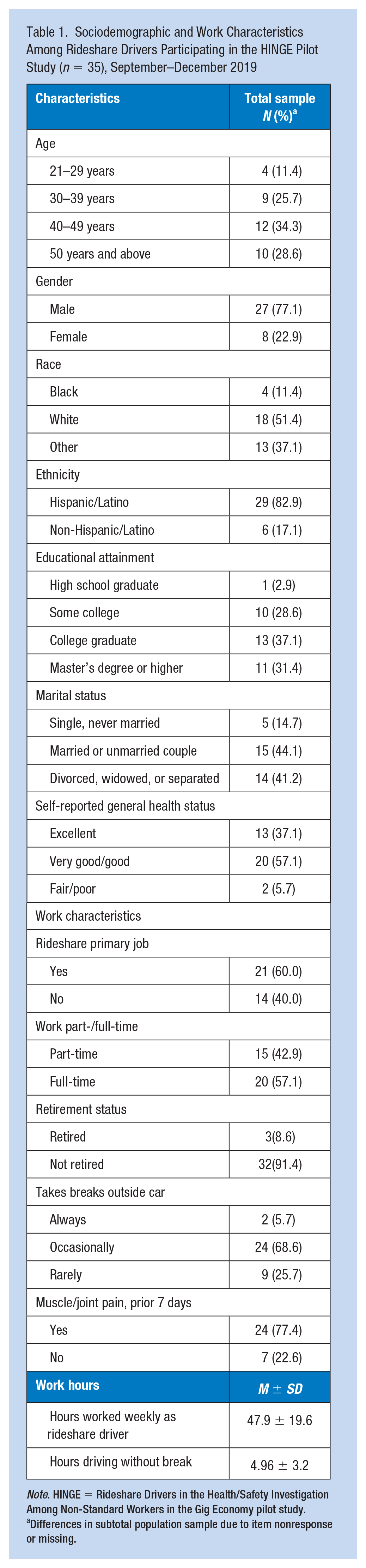
Note. HINGE = Rideshare Drivers in the Health/Safety Investigation Among Non-Standard Workers in the Gig Economy pilot study.
Differences in subtotal population sample due to item nonresponse or missing.
Qualitative Findings
Three main themes describing the health and safety concerns among rideshare drivers were derived from the key informant interviews. Main themes were summarized into seven subthemes (Table 2). Overall, drivers expressed a positive attitude toward their rideshare job. Drivers had the notion that they are their own boss and find it convenient that they get to create their own work schedules. The vast majority of study participants work for multiple rideshare companies and this mechanism of work is their main source of income. Participants expressed that they learned about ridesharing companies from a friend or a family member and indicated that the application to work in this type of company is “straightforward” and “easy to complete.” Nonetheless, drivers highlighted factors that concerned their health and their safety as a rideshare driver. Participants shared that this is a job that should not be made into a career because of the long-term consequences.
This is a job you cannot do forever, because you lose more than you gain. (P25)
Summary of Thematic Findings, HINGE Pilot Study, September–December 2019
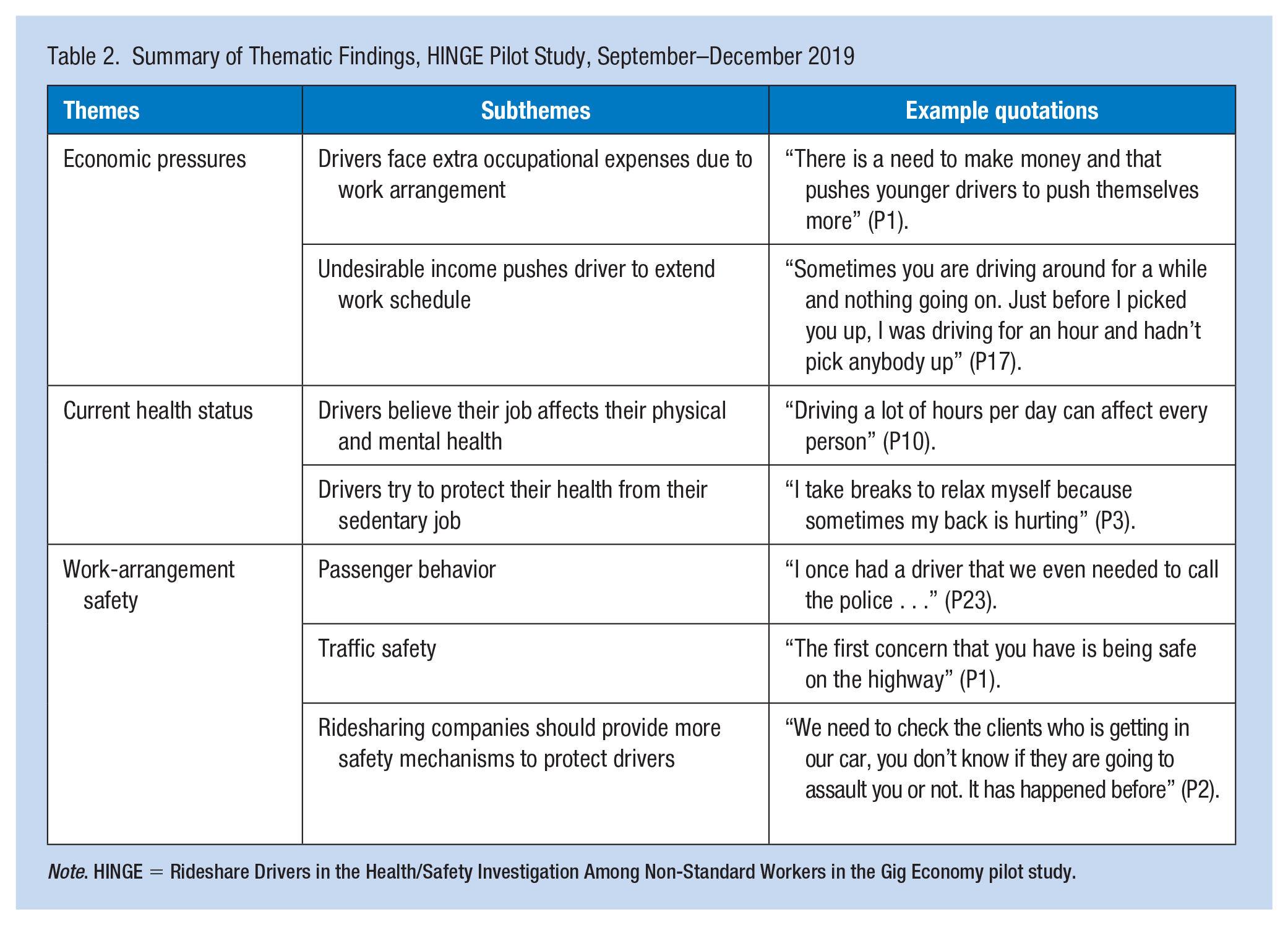
Note. HINGE = Rideshare Drivers in the Health/Safety Investigation Among Non-Standard Workers in the Gig Economy pilot study.
Theme 1: Economic Pressures
Economic issues were one of the primary concerns expressed by participants. When study participants were asked to broadly describe their work as a rideshare driver, this conversation drifted to a discussion on how financial security impacts a rideshare driver’s schedule, often exceeding the number of hours they should work in a day, and thus drivers recognizing how this could burden their health.
Subtheme 1: Undesirable income pushes drivers to extend work hours
Drivers explained that individuals who use a rideshare work platform as a main source of income do not get paid at an hourly rate and that they get paid per ride on a weekly basis. For participants working full-time as a rideshare driver, this means that, in locations where these types of work mechanisms are saturated, rideshare drivers must work extensively to see a financial benefit. Across interviews, it was normal to hear participants express how income pushed them to work more hours, which is why they need to get more rides to get paid enough.
I hate that they [referring to the rideshare company] pay really bad, you have to work a lot to make something [referring to money]. (P3) . . . when you are driving for an hour and there are no clients, you stress out . . . (P4) I have to work longer and harder to make the money that I’m used to, a lot of hours. (P5) Now I work more than 40 hours a week to make the same money as a 40-hour week . . . (P13) I have become very stressed, because this job is not secure, today you can make $200.00 dollars and tomorrow nothing, these companies do not guarantee you a salary. (P25)
Subtheme 2: Drivers face extra occupational-related expenses due to work arrangement
Most participants complained about the extra occupational expenses they endure due to how the rideshare companies they currently work for only cover traffic tolls but do not help with fuel or extra costs for vehicle maintenance. Consequently, drivers must pay for these expenses if they want to work under a rideshare company. This extra expense exacerbated the stress felt by participants as they are already working in a saturated market where they are forced to drive for longer hours, therefore incurring more vehicle expenses. This also made the drivers feel that there was an imbalance between the income they get paid per ride versus the extra expenses as they have to deduct those expenses from the income rideshare companies pay them.
I feel stressed because for example in 5 hours of driving, I have only made $30.00 dollars, about $5 per hour, imagine how much this leaves me with after you deduct gas and tear on the car. (P24)
Theme 2: Current Health Status
Study participants were asked to describe their perceptions on how their job as a rideshare driver could impact their personal health and whether they had noted any health changes since they started working as a driver. Across interviews, participants expressed limited long-term health concerns due to their job as a rideshare driver, however, they did conceptualize health symptoms experienced after completing a rideshare work shift and health issues that extended beyond work hours. Drivers are aware they need to protect their health and mentioned factors/activities they partake in to stay healthy.
Subtheme 1: Drivers believe their work arrangement can affect their physical and mental health
Drivers expanded on their discussion on how the organization of work impacts their health through economic pressure, longer work hours, and being often forced to spend more time sitting down in their vehicle. This sedentary part of their work arrangement affects rideshare drivers both physically and mentally. Participants emphasized that they felt certain symptoms and body aches after shifts. In regard to physical symptoms, drivers described it as normal to feel body aches such as neck, back, and leg pain.
Your legs hurt, your back hurts. (P3) You spend too much sitting down. Sometimes I spend 9 hours in the same position, I get back pain. (P12) If your body is sitting for long, your body will start aching. (P15) I have pain in my back, muscle pain, mental strain, and more stress. (P24)
Some drivers stated they might also suffer from “headaches” (P18) or eye strain from driving.
If you are driving in the sun, it will cause eye strain. If your body is sitting for long, your body will start aching. (P1) If I’m driving in the sun, it will cause eye strain. (P15) I am overworking my eyesight because of the constant sun exposure. (P18) Last night, I had to do a ride that was 2½ hours and the road you go across has no streetlights, and my eyes were straining. (P17)
Drivers reported that health issues extend beyond work hours. Some of the main highlighted issues were stress, changes in sleeping behavior, weight gain, and digestion issues.
I have been gaining weight, I have sleep problems, I can’t sleep good, I get used to work in the night, I go to bed at like 3-4 am. (P3) I’m gaining weight because of how much time I spent sitting down and then when you get home, all you want to do is rest because of how hectic and stressful your day has been. (P4) My sleeping pattern has changed. (P5) I finish [referring to when the work shift ends] stressed. (P11) The stress of sitting here all day, can constipate you. (P14)
Subtheme 2: Drivers try to protect their health from their sedentary job
Drivers emphasized that their rideshare job was mainly sedentary. For this reason, participants mentioned that it was up to them to protect their health from the type of job they had. When asked what they do to protect their health, the majority of participants mentioned that they mainly take breaks to move around, stand up, and stretch throughout the day. Breaks usually occurred when drivers stop to get gas or eat.
I would stop and stretch, you have to get out of your car, it’s not a great position to be on for hours, you need to get your circulation going. Just for your general health you need to get out of your car and walk. (P1) I try to stop and stand up as much as I can. (P2) I get out and walk around. (P5) You need to exercise, walk, you cannot be sitting down for so many hours, a person needs to rest and take care of their spinal column. (P20) You need to take breaks throughout the day. (P22) I take breaks throughout the day and I also exercise. (P25)
Theme 3: Work Arrangement Safety
Rideshare drivers identified various safety risks as part of their job. The main safety hazards highlighted included the potential to be involved in a car accident and passenger behavior. Drivers also provided insights on how they believe the rideshare companies can protect their safety.
Subtheme 1: Passenger behavior
Passenger behavior was a concern for drivers because (a) it could affect their safety, and (b) it could also impact their job. Participants shared detailed stories of passenger behaviors that affected their safety as a rideshare driver, “. . . there are clients that behave badly . . .” (P6), “sometimes passengers make me feel unsafe” (P9). Some drivers highlighted enduring passenger violence, “I had a passenger try and break the window of my car” (P24). Drivers are also concerned about passengers who request rides while being under the influence of drugs or were inebriated. One participant shared, “. . . due to the nature of how ridesharing works, a passenger can request a ride and be drugged or smell like marijuana” (P19). Other participants shared,
I had to pull over because I picked up a girl from a rally and she was going to throw up in my car. (P17) I once had a passenger that we even needed to call the police because the drunk rider had indicated the wrong address, any person can request a ride and that is really concerning. (P23)
Having passengers in this physical state worries drivers because they don’t know the behaviors the passenger will demonstrate during the ride. Participants also mentioned being disrespected by passengers. Participants shared,
A lot of people need to learn how to behave inside the car. People eat and leave the trash; they touch the car with their oily hands. Sometimes the people who is using the application as passengers need to know, they need to behave in the best way. I provide the best I service I can. (P10) Passengers believe the ride-sharing car is their car and are sometimes disrespectful. (P22)
Subtheme 2: Traffic safety
Rideshare drivers shared that one of their main safety concerns they have is suffering a car accident. One participant shared, “The first concern that you have is being safe on the highway” (P1). Given the geographic location area where interviews were conducted, drivers emphasized that the “traffic here is crazy, car accidents worry me” (P2). Participants also mentioned that they worry about traffic safety because even if they are driving safely and taking the precautions necessary, they have “exposure to bad drivers all the time and that can lead to an accident” (P24). Drivers mentioned that, sometimes, they have to pick up a passenger in an area where parking or stopping is not allowed, and this exacerbates their risk from suffering a car accident. One driver said “I recommend Uber/Lyft restrict areas where we pick up or drop off riders” (P17).
Subtheme 3: Ridesharing companies should provide more safety mechanisms to protect drivers
Driver safety mechanisms was a topic discussed across interviews. Most drivers made the case that ridesharing companies focus only on protecting the rideshare passenger, but do not protect the driver enough. Participants emphasized that there was a need to verify who the passengers are getting into their cars were because if they go through a background check to let individuals get into their personally owned vehicles, why can’t companies also make this a requirement for the passengers utilizing the service. The reasoning behind this was due to the experiences shared previously with passengers.
You don’t know who is getting in your car, this stresses me out, these companies should check who their clients are, so that we minimize the chance of having a passenger with a criminal background . . . (P2) They do a background check on me, but they don’t do a background check on you [referring to the passenger] so I don’t know who I’m putting in my car. (P3) Have a picture about what the passenger is going to look like, the passenger has a picture of me, but I don’t have one of them. The passengers are being covered [referring to safety measures], but the drivers should be covered as well. (P5)
Discussion
The goal of this pilot study was to characterize the overall perceived health and safety concerns of drivers employed by the rideshare industry. This research project focused on rideshare drivers, a specific subgroup of the gig economy that works through nonstandard employment. Findings suggest that ridesharing drivers feel obligated to work for extended periods of time to make enough money to cover both personal and work-related expenses. Feeling economic pressure and thus a commitment to work more is consistent with Mehri et al., who explored the phenomenology of for-hire drivers in Iran and reported that participants also had extra occupational expenses and felt forced to work for longer periods of time (Mehri et al., 2019). Due to this need to work extensively, rideshare drivers spend more time in a sitting/sedentary position, which led to participants describing a myriad of health symptoms suffered during and after completing a work shift. This finding is also consistent with studies exploring the health concerns of rideshare drivers in Canada. For example, Bartel et al. (2019) reported that rideshare drivers identified they suffer from health symptoms or issues consistent with prolonged sitting, such as muscle pain or weight gain due to their job as a rideshare driver.
In regard to protecting their health, the drivers interviewed mainly talked about taking breaks throughout their work shifts and didn’t think much of the health consequences their current job as a rideshare driver may cause in the long term. This is concerning as rideshare drivers who work full-time might be at risk of developing chronic conditions/disorders, given the time they spend in a sedentary work environment. Although rideshare drivers differ from taxi drivers, it is important to note that scientific studies have reported that taxi drivers are prone to developing musculoskeletal system disorders and gastrointestinal disorders, given their sedentary working conditions (Murray et al., 2019; Ueda et al., 1989). Therefore, rideshare drivers should be educated on the long-term health risks they might suffer from working in the ridesharing business as extensive hours of work in a sedentary position can be a contributing factor to developing chronic health conditions.
Rideshare drivers reported safety concerns such as traffic safety and passenger behavior. Participants indicated that, due to the geographical location where they work, they encounter a higher risk of suffering a vehicle accident, which can exacerbate the stressors they face daily. Participants also shared passenger experiences that made them feel unsafe such as intoxicated and violent passengers. This finding is consistent with studies looking at for-hire drivers’ work perceptions, which also report encountering violent and disrespectful passengers (Burgel et al., 2012). Finally, drivers also felt that rideshare companies protect passengers more than drivers. They would like companies to develop safety mechanisms in which future users of rideshare apps are screened similarly to the drivers. Participants felt that this would be a way they could feel safer when transporting passengers.
Limitations and Strengths
This pilot study was developed to explore and understand a unique population’s perspective and experiences within a specific background in a particular setting, limiting its generalizability. Participants were mainly recruited from South Florida, an ethnically diverse population; however, our study sample was largely small and predominantly male. Thus, the woman’s perspective on occupational health and safety risks for rideshare drivers might not be represented in our findings. Despite limitations, this study has several strengths. The limited research on the perceptions of rideshare drivers in the United States means that our findings are particularly pertinent to occupational health and safety research as little is known about certain aspects of the ridesharing job. Study findings can contribute to the development of unique health and safety policies for this occupational group.
Implications for Occupational Health Practice
Rideshare drivers raised concerns about their current health status, economic pressures, and worker safety. Drivers are forced to extend work hours due to the need to support themselves financially, which exacerbates their current health concerns and safety risks as it means more time spent working in their sedentary job, compromising their mental and physical health as well as their safety. Future research should focus on how to diminish the health concerns raised by this occupational group and develop workplace interventions that promote health within this unique sedentary work arrangement. For example, rideshare companies could offer health programs that motivate workers to engage in more physical activity by offering monetary incentives or monthly stipends for workers who join a gym or use an app to attend specific fitness classes. Rideshare drivers also expressed safety concerns specific to how the rideshare companies’ app-based platform operates. Our findings could serve as a starting point to rideshare companies, transportation policy makers, and occupational scientists for the development of a work-based app platform that considers not only the safety of the consumer but also the safety of the worker.
Applying Research to Occupational Health Practice
Data collected between September through December 2019 as part of the HINGE pilot study identified rideshare driver concerns regarding their current health status, economic pressures, and work safety. Drivers are forced to extend work hours, which exacerbates their current health concerns and safety risks as it means more time spent working in their sedentary job, compromising their mental and physical health as well as their safety. Occupational health and safety researchers and policy makers should focus on how to diminish the health concerns raised by these gig workers and develop workplace interventions that address safety concerns and promote health within this unique sedentary work arrangement. Furthermore, public health policy makers need to consider access to occupational health services for workers, such as app-based rideshare drivers.
Supplemental Material
sj-docx-1-whs-10.1177_21650799221076873 – Supplemental material for Characterizing the Health and Safety Concerns of U.S. Rideshare Drivers: A Qualitative Pilot Study
Supplemental material, sj-docx-1-whs-10.1177_21650799221076873 for Characterizing the Health and Safety Concerns of U.S. Rideshare Drivers: A Qualitative Pilot Study by Paola Louzado-Feliciano, Katerina M. Santiago, Kemi Ogunsina, Hannah E. Kling, Lauren A. Murphy, Natasha Schaefer Solle and Alberto J. Caban-Martinez in Workplace Health & Safety
Footnotes
Acknowledgements
The authors would like to acknowledge all the rideshare drivers who participated in this pilot qualitative study.
Author Contributions
All authors had access to all the data in the study and had final responsibility for the decision to submit for publication. A.J.C.M., N.S.S., P.L.F., K.M.S., H.K., and K.O. conceived the study and participated in its design and coordination. A.J.C.M., P.L.F., K.M.S., H.K., L.A.M., and K.O. collected field data, entered study data, and assisted in data analysis and interpretation of study results. P.L.F., A.J.C.M., and K.M.S. performed final analyses and co-drafted the manuscript. All authors read, revised, and approved the final manuscript and agree to be held accountable for all aspects of the work related to its accuracy and integrity.
Conflict of Interest
The author(s) declared no potential conflicts of interest with respect to the research, authorship, and/or publication of this article.
Funding
The author(s) disclosed receipt of the following financial support for the research, authorship, and/or publication of this article: Support for this research is, in part, by the University of Miami, Miller School of Medicine Department of Public Health Sciences Faculty Discretionary funds (Principal investigator [PI]: Alberto J. Caban-Martinez).
Institution and Ethics Approval and Informed Consent
Review of the study protocol and approval was by the University of Miami Institutional Review Board (# 20190676).

Supplemental Material
Supplemental material for this article is available online.
References
Supplementary Material
Please find the following supplemental material available below.
For Open Access articles published under a Creative Commons License, all supplemental material carries the same license as the article it is associated with.
For non-Open Access articles published, all supplemental material carries a non-exclusive license, and permission requests for re-use of supplemental material or any part of supplemental material shall be sent directly to the copyright owner as specified in the copyright notice associated with the article.
