




Abstract
Background
Recent workplace homicide investigations have noted that the Census of Fatal Occupational Injuries (CFOI) has several limitations that reduce our ability to understand who dies as part of a workplace homicide incident. We sought to assess the magnitude of nonworker deaths associated with workplace homicide incidents.
Methods
Using National Violent Death Reporting System (NVDRS) data from 2003 to 2017, we employed a descriptive epidemiological investigation. The counts of worker and nonworker deaths during a workplace homicide incident were ascertained, as well as other characteristics (e.g., gender, age, mechanism of death, and race/ethnicity). We used multiple logistic regression to estimate the relationship between incident characteristics and the odds of having a nonworker death.
Results
Across the study period, there were 2,020 workplace homicides. The number of deaths associated with workplace homicide incidents increased 8.2% when considering nonworker deaths (n = 2,186). Including those nonfatally shot as part of a workplace homicide incident increased causalities by 18.2% (n = 2,388). If a firearm was used during perpetration, the odds that a nonworker was killed during a workplace homicide incident increased 3.76 times (95% confidence interval: 2.03, 6.96).
Conclusion/Application to Practice
Considering nonworkers killed as part of workplace homicide incidents is essential to understanding the true magnitude of violence associated with these incidents. Likely, it is the lethality of firearms that greatly increases the likelihood that nonworkers are killed as part a workplace homicide incident. To best understand the epidemiology of workplace homicide incident, we recommend CFOI adopt an incident-based method for coding workplace deaths.
Introduction
In 2018, 5,250 workers died on the job (Census of Fatal Occupational Injuries [CFOI], 2019b). While the majority of these deaths occurred as part of what we might consider to be job-related tasks, such as operating a motor vehicle or exposure to harmful substances, a portion of deaths resulted from intentional violence. Of the workers that died on the job, 453 were intentionally killed as part of a homicide, with 351 (77.4%) of those deaths committed with a firearm (CFOI, 2019b).
Examinations of the etiology of and prevention measures for workplace homicides have existed for several decades (Bell, 1991; Davis, 1987; Davis et al., 1987). National-level epidemiologic investigations have largely used data from the Census of Fatal Occupational Injury (CFOI) surveillance data (Doucette, Bulzacchelli, et al., 2019; Fayard, 2008; Hendricks et al., 2007; Konda et al., 2014; Menéndez et al., 2013; Peek-Asa et al., 1999; Tiesman et al., 2012). CFOI is national injury surveillance system of all workplace deaths compiled by the Bureau of Labor Statistics. CFOI’s scope includes employees and employers who are killed as part of a traumatic injury event (CFOI, 2012). CFOI compiles count data of all fatal occupational injuries by gathering and cross-referencing multiple records to validate fatal workplace injuries (CFOI, 2012). Records include death certificates, workers compensation reports, and medical examiner reports. CFOI provides comprehensive information on victim occupation, violence typology, and other characteristics, such as weapon used in crime (CFOI, 2019a). Researchers can access the CFOI Micro Fatality Research file (CFOI-Research file) (CFOI, 2019c), which contains detailed records of worker deaths, through an application process. The National Safety Council deemed CFOI the authoritative account of work-related fatalities in the United States in 1992 (CFOI, 2012).
An examination of workplace homicide epidemiology from 2011 to 2015 detailed a shift in workplace homicides away from those associated with robberies toward other crimes, indicating that a change in firearm exposure in the workplace, and the public writ large, may be driving this change (Doucette, Bulzacchelli, et al., 2019). A 50-state panel analysis using CFOI data found that right-to-carry laws, or laws that remove restrictions for carrying a concealed handgun in public, increased the incidence of workplace homicides committed with firearms by 29% over a 26-year period (Doucette, Crifasi, et al., 2019). Yet, both of these analyses raised the same limitations surrounding CFOI data, limitations that likely underestimate the true magnitude of violence associated with a workplace homicide incident (Doucette, Bulzacchelli, et al., 2019; Doucette, Crifasi, et al., 2019).
The use of the CFOI-Research file to conduct workplace homicide research contains several limitations: (a) the data file does not contain a variable that links deaths that occur as part of the same incident (Doucette, Bulzacchelli, et al., 2019) meaning researchers are not able to understand person-level characteristics of a workplace homicide “incident” that contains multiple worker deaths, and (2) the data file only accounts for the deaths of workers, meaning deaths of nonworkers go unaccounted (Doucette, Crifasi, et al., 2019). The first limitation restricts the researcher’s ability to have full context of victim characteristics, such as race/ethnicity, age, and gender, when there are multiple victims in a single event. As 9% of workplace homicides were considered a mass shooting event between 2011 and 2015, this is a significant limitation (Doucette, Bulzacchelli, et al., 2019). The second limitation restricts our ability to understand the true magnitude of violence associated with a workplace homicide incident. Without an accounting of nonworker deaths or nonfatal injuries, evaluations of the effect of laws or other prevention measures on workplace violence are not measuring the true burden. Rather they are a reflection of the deaths to workers only, missing a potentially large number of nonworkers also killed as part of the same event or those nonfatally injured in an incident of workplace violence.
The National Violent Death Reporting System (NVDRS) potentially offers a way to address these limitations. NVDRS, a state-based active surveillance system for violent deaths, contains a detailed accounting of all violent deaths that began with a select number of states in 2003 (Steenkamp et al., 2006). NVDRS provides information at the person and incident level, meaning deaths associated with a specific event are linkable (Steenkamp et al., 2006). NVDRS collects and links data from death certificates, coroner/medical examiner records, and law enforcement reports. NVDRS has been used to conduct prevalence examinations of homicides (Bossarte et al., 2006; Logan et al., 2008), suicides (Peterson et al., 2018), and various other violent outcomes such as child maltreatment (Hunter et al., 2019) though never to examine general workplace homicides. Importantly, NVDRS also provides the number of nonfatal shootings associated with a given incident and contains a binary variable pertaining to whether or not a victim was working when killed (NVDRS, 2015). Given the level of specificity available in NVDRS, it is a potential source of data to address CFOI’s limitations around understanding the true magnitude of violence associated with workplace homicides.
We sought to assess the magnitude of fatal and nonfatal injuries among workers and nonworkers associated with workplace homicide incidents using NVDRS data. More specifically, we aimed to (a) quantify the number of worker and nonworker deaths associated with workplace homicide incidents, as well as the number of nonfatal shooting victims; (b) present select victim characteristics of these deaths by whether or not someone was a worker or nonworker; (c) identify characteristics of workplace homicide incidents that increase the likelihood that a nonworker is killed as part of the event.
Methods
This epidemiologic investigation consisted of a description of violence associated with workplace homicide incidents as well as an estimation of characteristics that increased the odds of an incident including a nonworker. To accomplish both tasks, we used NVDRS restricted access data (NVDRS-RAD) (NVDRS, 2017). This data set was made available by the Centers for Disease Control upon application.
NVDRS started collecting data in 2003 with six states reporting violent deaths (MD, MA, NJ, OR, SC, & VA). New states began reporting violent deaths at various times from 2003 to 2019, with all states reporting to NVDRS starting in 2019 (NVDRS, 2019). NVDRS-RAD data used for this project contained reporting years 2003–2017 for a total of 247 state-year indices.
NVDRS codes Person IDs as a unique number to identify each victim, and codes Incident IDs as a unique number for each incident within the data set (NVDRS, 2015). For violent incidents involving more than one person, each victim is provided a unique Person ID and each of the associated victims is provided the same Incident ID. This allowed us to link individual-level deaths by incident. NVDRS codes victim’s age in years as integers and codes race/ethnicity together to capture each racial category with Hispanic ethnicity. NVDRS contains variables for injured while at work (yes/no), marital status (yes, if the victim was married, in a civil union/domestic partnership, or widowed and coded marital status, no, if the victim was divorced, single, or never married), and gender (male/female). From NVDRS, race/ethnicity was provided as American Indian, Asian, African American, Hispanic, Unspecified, More than one race, Unknown, and White. Age was coded into eight categories of 10-year intervals starting with 10–19 years old and ending at 80–89 years. For the underlying cause of death, the International Classification of Diseases (ICD-10-CM) Clinical Modification code was provided (Centers for Disease Control and Prevention, 2020). NVDRS also contains a variable for the number of nonfatal shootings associated with a given incident. To identify if a firearm was the mechanism of injury, we used ICD-10CM codes, X93, assault by handgun discharge, X94, assault by rifle, shotgun, and larger firearm discharge, or X95, assault by other and unspecified firearm and gun discharge. In addition, we coded region based on incident’s location.
Data Analysis
After capturing all of the nonworker and worker deaths associated with a workplace homicide, we aggregated the total number of worker deaths, nonworker deaths, nonfatal shootings, and calculated the percent increase in causalities (fatal and nonfatal outcomes) compared with just the total number of workplace homicides. As per NVDRS rules, we excluded several reporting states as they did not report violent deaths for their entire state during the study period of 2003 to 2017 (California, Illinois, Pennsylvania, & Washington) (Jack et al., 2018). All data management and analysis was performed using STATA version 15.0 (StataCorp, 2017).
We calculated the counts and percents of fatal violence by whether the victims were workers or nonworkers stratified by select characteristics and tested differences between groups using chi-square (χ2) test of statistical independence. Counts were examined by demographic characteristics and mechanism of death.
To understand if certain characteristics of the workplace homicide events were associated with a higher odd of having a nonworker killed, we constructed a logistic regression model. We collapsed the data to the Incident ID level, meaning the computed odds ratio (OR) and 95% confidence intervals (CI) as part of the multivariate analysis represented characteristics of the incident, rather than one individual death. Therefore, the produced ORs pertained to whether certain characteristics impacted the odds that a workplace homicide incident also included a nonworker death. We included several variables in the regression model at the incident level: Firearm (if a firearm was used to kill at least one person as part of the incident versus if any other weapon was used); Female (if at least 1 female was killed as part of the incident versus if only males were killed; Married (if at least 1 person killed as part of the incident was married versus if no one was married) Region, using the North East as reference; and Non-White (if at least 1 person killed as part of the incident was non-White versus if all victims were non-Hispanic, White). A continuous age variable was included, centered at 43 (the average age of victims) to ease interpretation, as well as a categorical variable for incident year, to control for any time-invariant trends.
Results
Table 1 provides characteristics of all deaths associated with workplace homicide incidents from 2003 to 2017. From 2003 to 2017, there were 2,020 workplace homicides, defined as a death of a worker while in the duty of work. The 2,020 deaths were spread over 247 state-year indices, with some states having 13 reporting years (i.e., 2003–2017) and others having as little as one reporting year (NVDRS, 2019). In addition to the 2,020 workplace homicides, there were 166 additional nonworker deaths associated with a workplace homicide incident. The total magnitude of intentional deaths associated with workplace homicide incidents then was 2,186, representing a roughly 8.2% increase compared with only considering workers killed in workplace homicides. During the same time period, there were 202 nonfatal shootings associated with these workplace homicides incidents (data not shown). Combining fatal and nonfatal events of workers and nonworkers during these events resulted in 2,388 workplace violence victims, representing an 18.2% increase in victims compared with only considering worker deaths as part of workplace homicide incidents.
Males accounted for approximately 80% of worker deaths, and fatalities overall, but consisted of only 50% of nonworker deaths. While a firearm was the mechanism of death approximately 75% of the time for both total deaths and worker deaths, nonworker deaths involved firearms 87% of the time, a 16% increase. Around 80% of all deaths occurred among people aged 20 to 59 years. Non-Hispanic Whites (n = 1,069) accounted for 48.9% of fatalities, non-Hispanic Blacks (n =559) accounted for 25.6% of fatalities, and Hispanics (n =223) accounted for 10.2% of fatalities. Except for non-Hispanic Whites, all race/ethnicities had similar proportions of deaths by whether or not the victim was a worker or nonworker. Workers who died were 47.9% non-Hispanic White (n = 968), whereas nonworkers were 60.8% non-Hispanic White (n = 101).
Select Characteristics of Worker and Non-Worker Deaths Associated With a Workplace Homicide by Demographics and Mechanism of Death, NVDRS 2003–2017
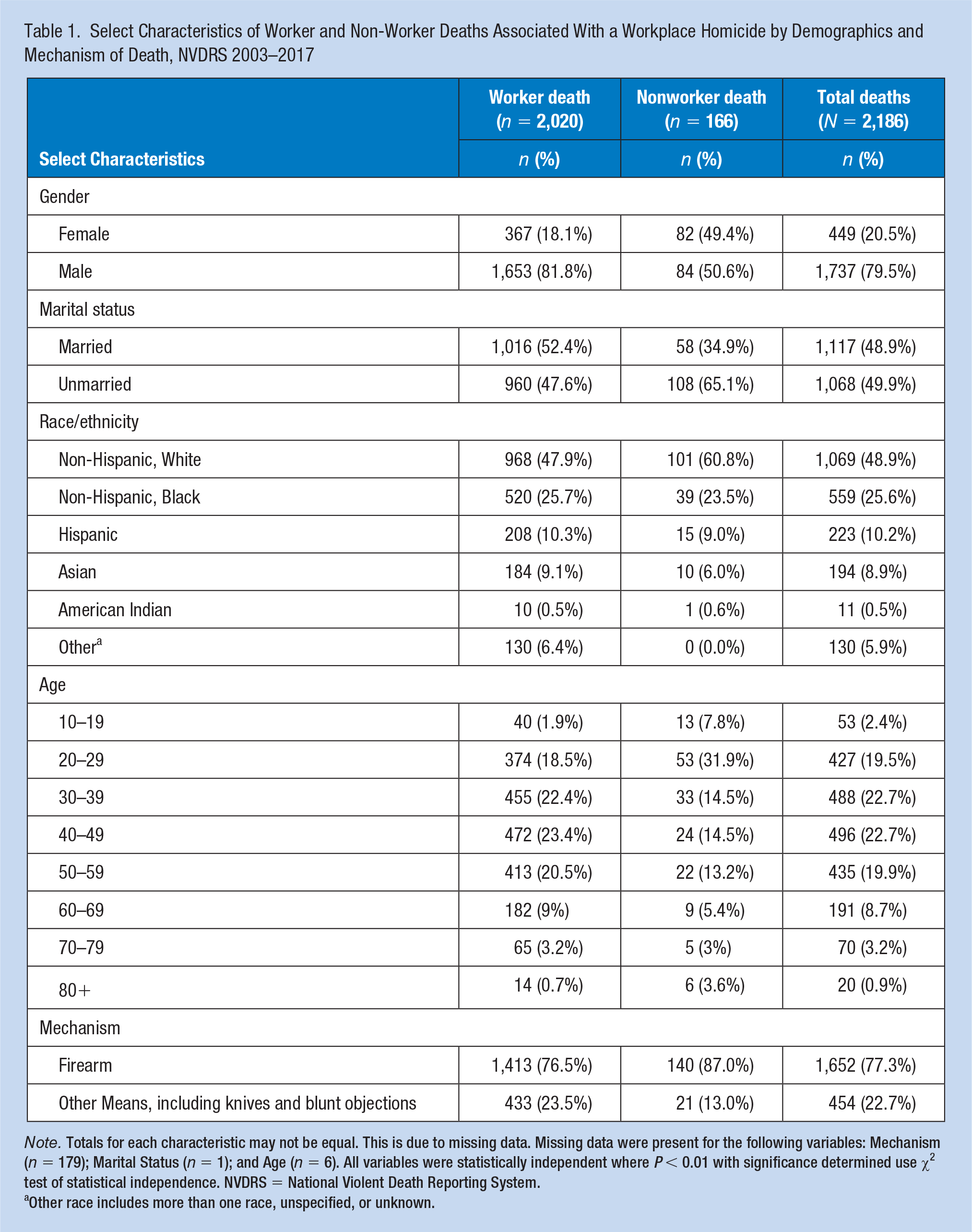
Note. Totals for each characteristic may not be equal. This is due to missing data. Missing data were present for the following variables: Mechanism (n = 179); Marital Status (n = 1); and Age (n = 6). All variables were statistically independent where P < 0.01 with significance determined use χ2 test of statistical independence. NVDRS = National Violent Death Reporting System.
Other race includes more than one race, unspecified, or unknown.
Table 2 provides a multivariate model examining the odds of a workplace homicide incident involving a nonworker death. Controlling for relevant variables, a workplace homicide incident was 3.76 (95% CI: 2.03, 6.96) times more likely to include a nonworker if a firearm was used. If a married individual was killed as part of the incident, a nonworker was 3.23 times more likely to be killed (95% CI: 2.07, 5.04). If a female was killed, the incident was 6.49 (95% CI: 4.32, 9.75) times more likely to involve a nonworker. Despite previous research suggesting there are regional differences for workplace homicides (Menéndez et al., 2013), geographical region was not a contributing factor in whether or not a workplace homicide incident involved a nonworker death. The race/ethnicity of victims during the event did not impact of the odds of a nonworker being killed as well (OR = 1.20; 95% CI: 0.81, 1.79).
Multivariate Model Examining the Odds That a Workplace Homicide Incident Involved a Nonworker Fatality, 2003–2017 Using NVDRS Data (n = 1,256)
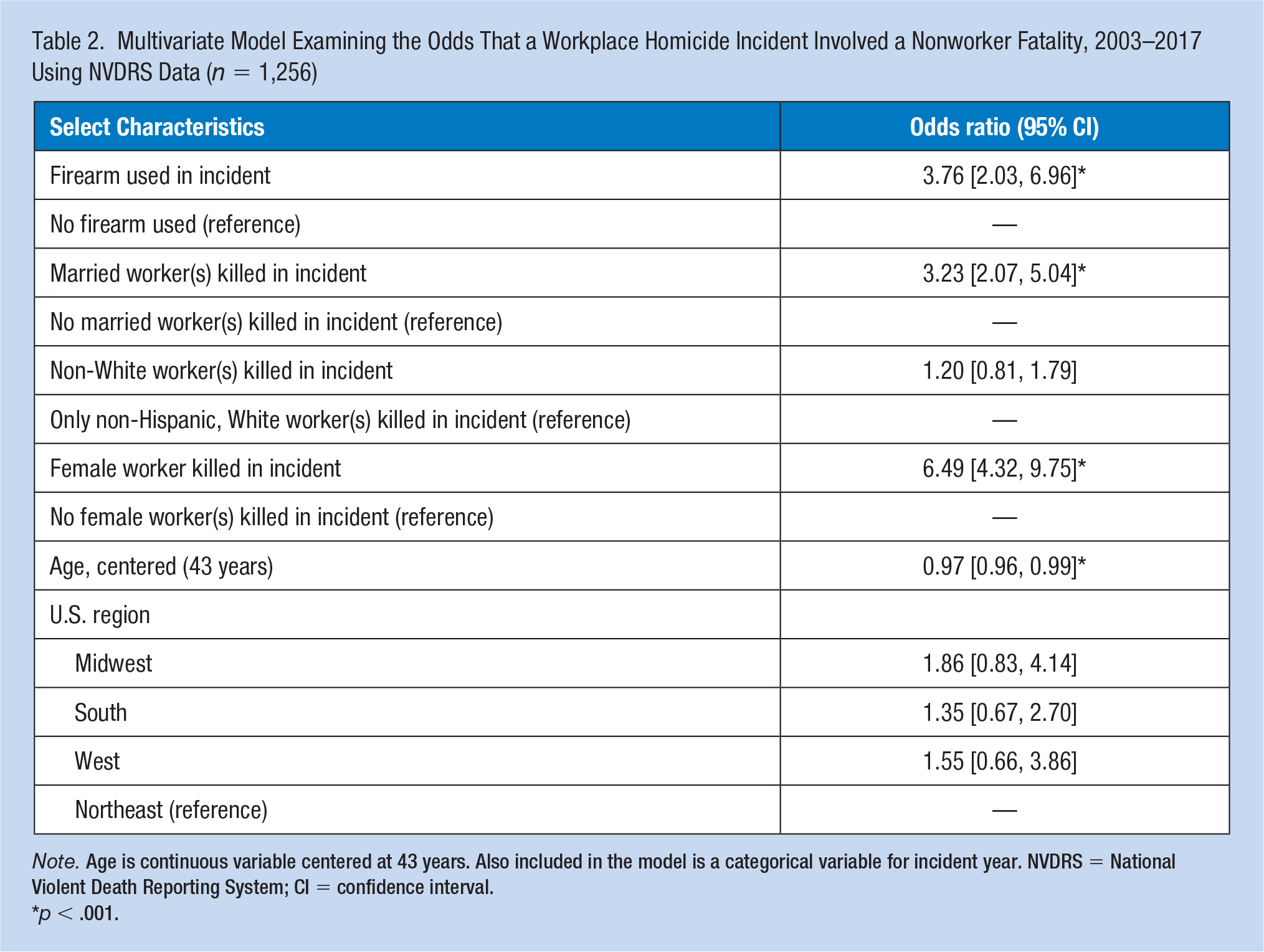
Note. Age is continuous variable centered at 43 years. Also included in the model is a categorical variable for incident year. NVDRS = National Violent Death Reporting System; CI = confidence interval.
p < .001.
Discussion
This article is the first examination of the number of nonworkers killed during a workplace homicide. Using data from NVDRS, we identified that considering nonworker fatalities increases the magnitude of violence associated with a workplace homicide incident by 8.2%. If nonfatal shooting victims are also considered, the magnitude of violence increased 18.2%. Extrapolating these figures to the most recent data available from CFOI, which noted there were 351 workplace homicides in 2018 (CFOI, 2019b), suggests a likely underestimation of fatal and nonfatal injuries.
We provided characteristics of victims by worker/nonworker status. Of note, the characteristic profile of workplace homicides found in this article matches previous characteristics found from nationally representative epidemiologic investigations using CFOI data (Doucette, Bulzacchelli, et al., 2019; Menéndez et al., 2013; Tiesman et al., 2012). Regardless of worker/nonworker status, males were far more likely to be victims during a workplace homicide incident and firearms were by far the most common mechanism of injury. In addition, our findings are consistent with existing literature that the majority of deaths occurred for individuals ranging from 20 to 60 years of age.
When firearms were used as the mechanism of death, the odds of a workplace homicide incident involving a nonworker increased threefold. This is significant and likely due to the instrumentality. Firearms are extremely lethal and increase an individual’s capacity to cause harm to multiple individuals. Importantly, when any victim was female, the likelihood of a workplace homicide incident involving a nonworker greatly increased. These characteristics are likely linked to some degree.
Previous research has identified that female workers are more likely to be killed as part of an intimate partner violence incident (Doucette, Bulzacchelli, et al., 2019; Tiesman et al., 2012). When a domestic abuser is armed, the risk of an intimate partner homicide increases greatly (Vigdor & Mercy, 2006; Zeoli & Webster, 2010). Perpetrators use places of work as a means to locate their desired target. It is plausible that perpetrators are willing to cause harm to others, including nonworkers, in their attempt to reach their target. This evidence provides further rationale as to why laws that attempt to limit firearm access for intimate partner violence perpetrators are essential in violence prevention (Zeoli et al., 2019). Efforts to prevent intimate partner abusers from obtaining or owning firearms not only have a positive impact on the safety of their victims (Vigdor & Mercy, 2006; Zeoli & Webster, 2010) but can potentially also protect others from collateral violence. Future work should attempt to quantify the collateral deaths associated with intimate partner violence homicides.
Strengths and Limitations
This article has several limitations. First, this article is subjected to the selection bias present in the NVDRS data source and thus is not nationally representative. As states self-selected into NVDRS participation, it is possible that early adopter states were different than those added in later years or that early data included states that were actively working to reduce violent deaths. As such, states that did not participate in NVDRS until 2018 (data unavailable at time of analysis) may have different experiences with violent deaths over the past decade and a half. If true, it is plausible that our extrapolations are an underrepresentation of the true number of nonworker deaths that occurred, as our findings come from a select cross-section of states actively investing in violent death surveillance. While the NVDRS is an established surveillance system with a robust coding process (Steenkamp et al., 2006), there is still a possibility of misclassification. Random misclassification would likely have little effect on our results; however, systematic misclassification could affect our results away or toward the null. Efforts to assess misclassification in NVDRS, though, have found little misclassification with respect to suicides (Huguet et al., 2014), providing confidence in the result presented.
Another limitation of this article is our inability to account for differences by occupation. We attempted to present counts and proportions of worker and nonworker deaths by industry. However, industry information was missing for 92% (n = 1,858) and 88% (n = 146) of worker and nonworker deaths, respectively. Thus, this information was not included in the article. We hypothesize that a large majority of the companies that had a nonworker fatality as part of a workplace homicide incident were part of the retail industry, either a bar or a store, but we are unable to confirm this hypothesis from the available data. Further work is needed to understand where this violence takes place.
This article is among the first to examine workplace homicides from an incident perspective rather than an individual victim perspective. It is also among the first to use the NVDRS to conduct epidemiologic research on workplace homicides.
Implications for Occupational Health Practice
Based on the research conducted here, it is apparent that it is not just workers who die when a workplace homicide is committed. To ensure we best understand the magnitude of violence associated with these incidents moving forward, we recommend CFOI consider adopting an incident-based approach to coding victims as part of their national data set. Currently, CFOI is the gold standard of occupational death data due to its national representativeness as well as its emphasis on occupational safety and health. CFOI provides comprehensive information on victim occupation and violence typology, two elements NVDRS does not. The inability to understand deaths related to the same incident and the lack of accounting for collateral deaths to nonworkers limits the usefulness of CFOI to the workplace homicide field. Adopting these changes, and assessing the true magnitude of violence associated with workplace homicides, could well position CFOI to account for the recent changes in violence etiology noted by Doucette, Bulzacchelli, and colleagues (2019). As such, more resources should be devoted to CFOI to adopt these proposed changes. Results of a more comprehensive surveillance effort around workplace homicides may assist in development of prevention techniques.
Conclusion
This is the first attempt to quantify violence associated with workplace homicide incidents. We have identified that the magnitude of deaths associated with workplace homicide incidents increases around 8% when accounting for nonworkers killed. Considering both nonworker deaths and nonfatal shootings associated with workplace homicide incidents increases the magnitude of violence by 18%, a considerable increase. The CFOI should consider adopting an incident-based approach to coding deaths to facilitate a greater understanding of the true magnitude of violence associated with workplace homicide incidents, in particular intimate partner homicides of workers.
Applying Research to Occupational Health Practice
In response to recent research examining workplace homicides, this assessment was the first to examine the true magnitude of deaths associated with workplace homicide incidents. This study shows that when workers are murdered on the job, nonworkers are killed too. When a firearm is used, the odds that a workplace homicide incident involves a nonworker increase threefold. It is necessary to understand the characteristics of all those who die as part of these incidents so as to create better, more informed, prevention strategies. As such, we encourage the U.S. Bureau of Labor Statistic’s Center for Fatal Occupational Injuries to adopt an incident-based coding strategy, with an emphasis on understanding all deaths associated with workplace homicides, to better inform researchers, policy makers, and the public.
Footnotes
Acknowledgements
Author M.L.D. would like to acknowledge Dr. Amy Hunter for her assistance on this project.
Author Contributions
Both authors conceived of the project. Author M.L.D. acquired the data and performed the analysis. Both authors equally contributed to the manuscript drafting.
Declaration of Conflicting Interests
The author(s) declared no potential conflicts of interest with respect to the research, authorship, and/or publication of this article.
Funding
The author(s) disclosed receipt of the following financial support for the research, authorship, and/or publication of this article: Author M.L.D. received stipend support from the American Public Health Association’s 2019 New Investigator Award.

Author Biographies
Mitchell L. Doucette is an assistant professor at Eastern Connecticut State University and a research scientist at Connecticut Children’s Medical Center’s Injury Prevention Center. He is an injury epidemiologist with a focus on firearm violence in the workplace.
Cassandra K. Crifasi is an assistant professor at the Johns Hopkins Bloomberg School of Public Health. She is a deputy director of the Johns Hopkin Center for Gun Policy and Research and a core member of the Center for Injury Research and Policy.