




Abstract
Background: The purpose of this project was to evaluate both health-related quality of life (HRQoL) and cost-utility associated with care for employees with musculoskeletal disorders who received vocational physiotherapy at a North London National Health Service (NHS) Foundation Trust in the United Kingdom. Methods: A pre- and post-physiotherapy EuroQol 5 Dimension (EQ-5D) questionnaire was administered to employees presenting to the vocational physiotherapy service (VPS) with musculoskeletal disorders. The cost-utility analysis of the physiotherapy service was calculated using cost data provided by VPS billing information and benefits measured using Quality-Adjusted Life Years (QALYs). Findings: Overall, there was a significant improvement in the EQ-5D index from baseline to discharge in all HRQoL domains. The visual analog scale (VAS) improved from a mean of 31.5 (SD = 18.3) at baseline to 73.2 (SD = 18.5) at discharge. A cost-utility analysis indicated that the VPS would continue to be cost-effective until the cost per employee increased by 82.5%. Conclusion/Application to Practice: The project supports integration of vocational physiotherapy services into an occupational health department.
Keywords
Background
The Vocational Rehabilitation Association (VRA) of the United Kingdom defines vocational rehabilitation as “any process that enables people with functional, physical, psychological, developmental, cognitive or emotional impairments to overcome obstacles to accessing, maintaining or returning to employment or other occupation” (Vocational Rehabilitation Association, 2019). In the United Kingdom, vocational rehabilitation can be performed by a range of healthcare professionals, such as physiotherapists and occupational therapists, and are governed by standards, code, and scope of practice produced by the VRA. This includes practicing in one or more areas of vocational rehabilitation, not practicing outside areas of competence, and increasing scope of practice by undergoing appropriate education and training (Vocational Rehabilitation Association, 2019).
Vocational physiotherapy has long been accepted as an intervention to improve functional capacity and hasten the employee’s return to work (Addley et al., 2010; Chetty, 2009). However, the paucity of health outcomes and cost-effectiveness evidence has led to uncertainty about the value of vocational physiotherapy. This study reports on both health-related quality of life (HRQoL) and cost–utility outcomes associated with employees who were experiencing musculoskeletal disorders and who were attending a vocational physiotherapy service (VPS) implemented within a North London National Health Service (NHS) Trust in the United Kingdom.
Methods
The North London NHS Trust consists of three designated acute care hospitals serving over 10,000 employees. The employees include both clinical and nonclinical staff providing services in maternity care, accident and emergency, orthopedic, general medicine and surgery, and child health. The Trust has educational links through academic partnerships. The VPS is an in-house service located within the occupational health department on the Trust’s premises.
A retrospective cohort project was conducted utilizing a pre- and post-physiotherapy HRQoL measure among employees who presented to the VPS with musculoskeletal disorders. The pre-measurement was taken at initial physiotherapy assessment and the post-measurement was taken following discharge.
Employees were referred to the physiotherapy service if they experienced a musculoskeletal disorder resulting from, or impacting their work. All employees who attended the VPS from January 2018 to December 2018 were included in this project. Those who did not attend/complete their rehabilitation were excluded. The VPS provided six sessions of rehabilitation. An additional two sessions could be added at the discretion of the physiotherapist. The VPS was delivered by a senior chartered physiotherapist adhering to a procedural manual. This standard intervention included a physical, psychosocial, and functional capability assessment. The VPS service consisted of graded strengthening exercises, aerobic exercises, flexibility exercises, and work conditioning. Professional advice pertaining to activity management for the early resumption of avoided activities was offered as a way to facilitate self-management and safe working practices. Employees who were on medical/sick leave commenced a graded return to work program concurrent with the VPS.
The English version of the EuroQol 5 Dimension (EQ-5D) questionnaire was used as the HRQoL measure. The EQ-5D consisted of the descriptive system and the visual analog scale (VAS).
The descriptive system had five dimensions: mobility, self-care, usual activities, pain/discomfort, and anxiety/depression. Each dimension is further divided into five levels: no problems, slight problems, moderate problems, severe problems, and extreme problems. The participant was asked to indicate their health status by marking the box against the most appropriate statement in each of the five dimensions which were scored. For example, within each of the five dimensions, an employee received a score from 1 to 5, where a score of 1 indicated no problems and 5 indicating extreme problems for that dimension. The digits for each of the five dimensions were combined into a five-digit number describing the employee’s health state (for example, the health status of an employee was described as “21354”). It should be noted that the numerals 1 to 5 have no arithmetic properties.
The VAS measured self-reported health by asking: “How is your health today”? Participants were asked to mark on a 20 cm vertical VAS with endpoints labeled “the best health you can imagine” and “the worst health you can imagine.” This numeric number on the VAS was recorded for this measure.
The cost–utility analysis of the physiotherapy service was calculated using cost data provided by VPS billing information submitted to the Trust for payment of services and the benefits were measured by translating the gain in health status, as measured by the EQ-5D, to Quality-Adjusted Life Years (QALYs). QALYs were utilized in the cost–benefit analysis assessed by the National Institute of Health and Clinical Excellence (NICE). These cost data were determined according to whether cost/QALY was within acceptable limits according to the funding/decision-making body. For NICE, the threshold was understood to be £20,000 (US$24,960) QALY, where interventions that exceeded this threshold were not deemed a cost-effective use of NHS resources (Phillips et al., 2012). Data were analyzed using the EQ-5D calculator (Chartered Society of Physiotherapy, 2011).
Findings
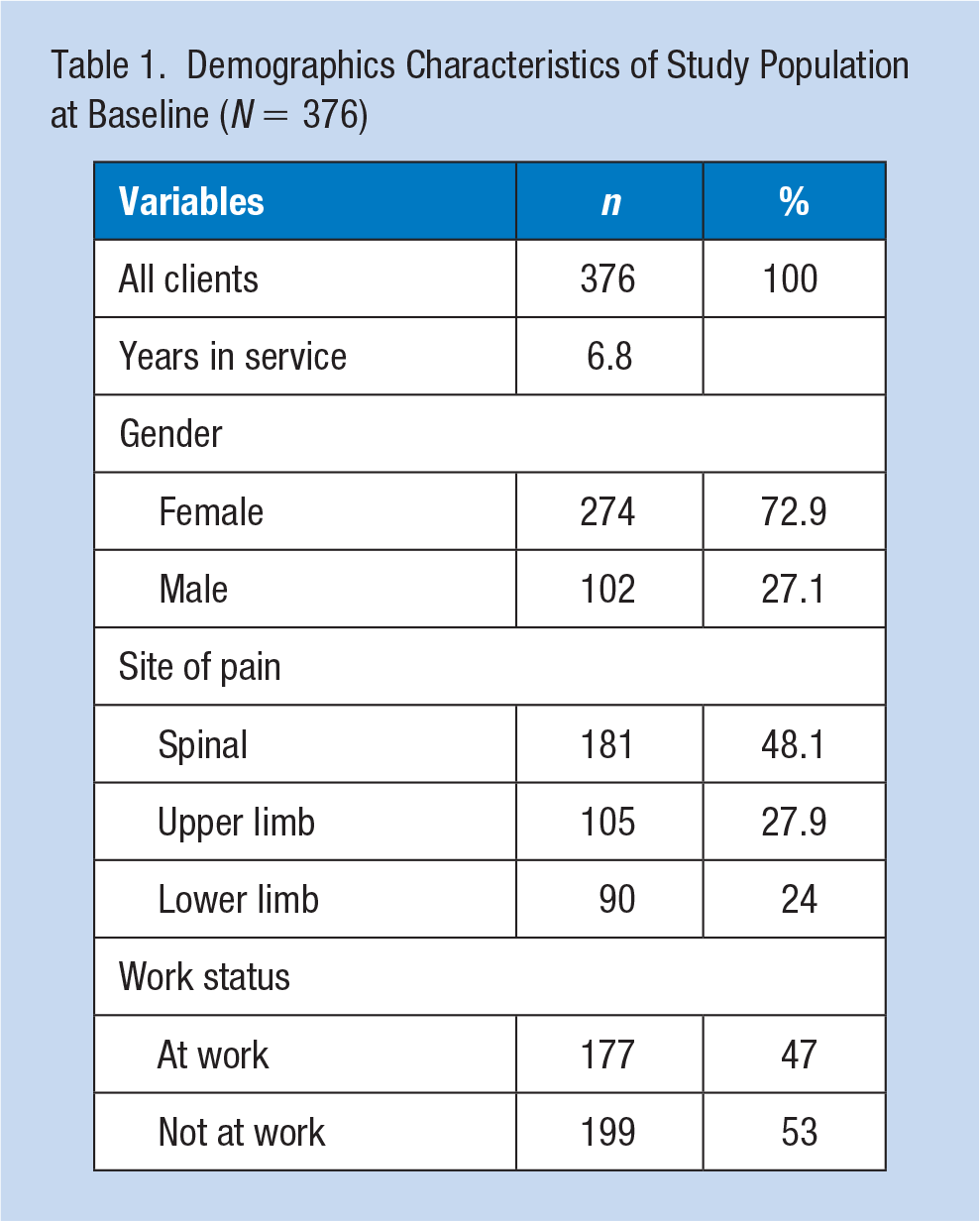
Overall, 376 (80.5%) employees consented and completed both the pre- and post-physiotherapy EQ-5D questionnaires and were included in the analysis (Table 1). The mean age of the employees overall was 42.9 years, and the mean years of employment was 6.8 years. More females (72.9%) received physiotherapy intervention than males (27.1%). The most common site of pain was reported as spinal pain (48.1%), followed by upper limb (27.9%), and the least reported site was the lower limb (24%). There were more employees attending the VPS who were not at work (53.0%), with more female employees taking time off work (78.4%) than males (21.6%).
Demographics Characteristics of Study Population at Baseline (N = 376)
Overall, the EQ-5D index improved significantly from baseline to post-physiotherapy by 0.638 (p < .001) (Table 2). Females improved by a mean of 0.638 (p < .001) and males by a mean of 0.611 (p < .001). Of the nonresponders, males showed a smaller proportion of nonresponders (31.9%) compared with females (68.1%). There was a significant increase in EQ-5D for employees in all sites of reported pain (spinal: 0.693, p < .001; upper limb: 0.688, p < .001; lower limb: 0.532, p < .001). In terms of work status, the largest proportion of employees showing a clinically meaningful increase in EQ-5D was found in those who were not at work (0.647, p < .001). The VAS improved from a mean of 31.5 at baseline (SD = 18.3) to 73.2 at discharge (SD = 18.5), a statistically significant improvement of 41.7 (p < .001).
EQ-5D at Baseline and Post-Physiotherapy (N = 376)
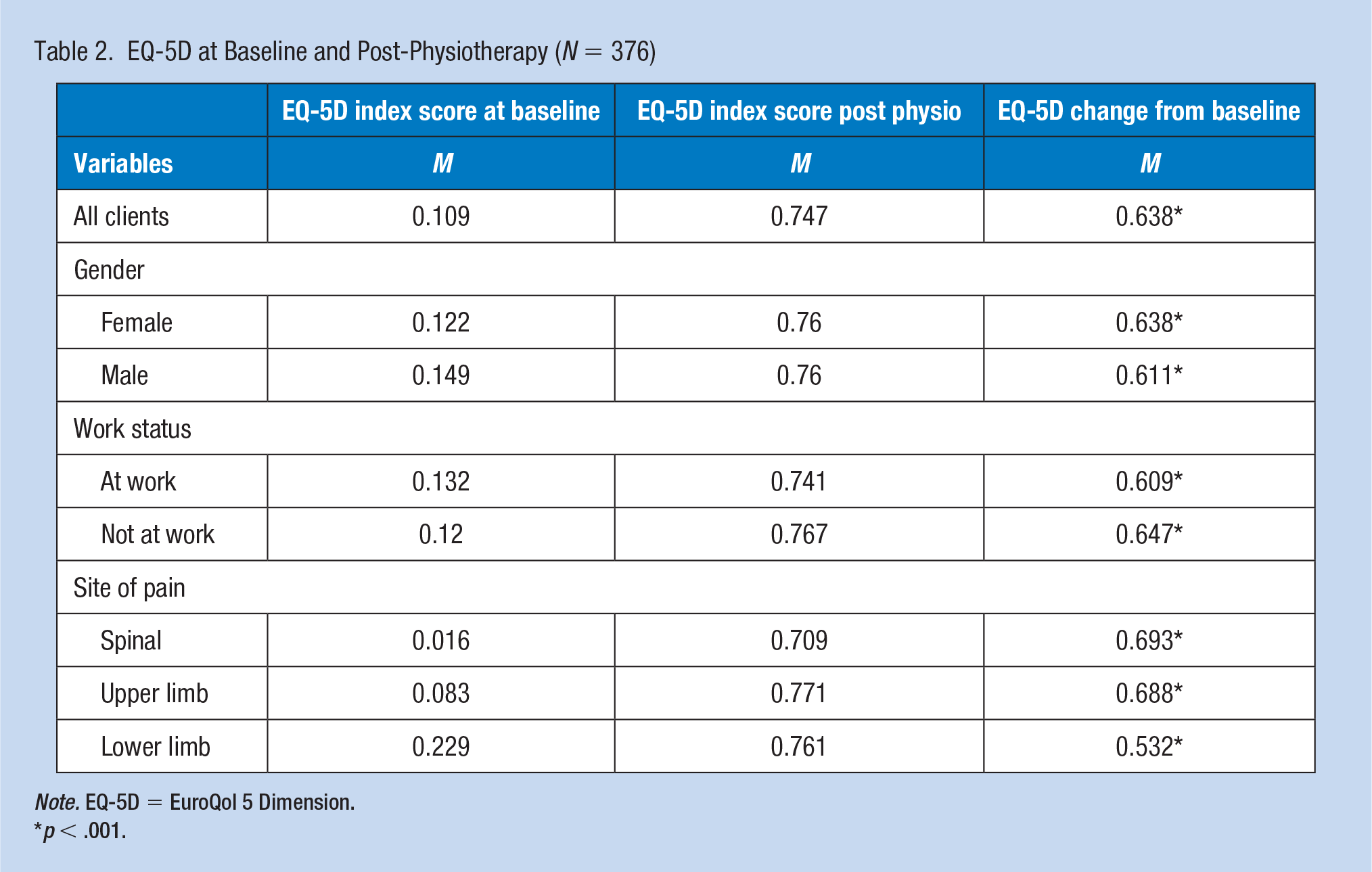
Note. EQ-5D = EuroQol 5 Dimension.
p < .001.
Those who were on medical/sick leave from work reported a more clinically meaningful improvement, supporting a sustainable return to work. However, 28 of 227 employees who were on medical/sick leave continued to take sick leave and did not complete a post-physiotherapy EQ-5D questionnaire. These employees accounted for 12% of VPS absence. A detailed case review of the 28 employees who continued to remain absent revealed ongoing, nonphysical health issues impacting their work.
The calculated unit cost per employee amounted to £84 (US$103) per hour. Based on the cost per hour, it was estimated that the cost per employee attending the VPS for six to eight sessions amounted to £504 to £512 (US$617–US$627), respectively. The gain in health status between initial assessment and discharge amounted to 0.638 as measured by the EQ-5D, which translates to a gain of 0.16 QALYs, if the beneficial effect was terminated at discharge. In this case, the estimated cost/QALY would be between £3,150 (US$3858) (when cost = £504 and QALY gain = 0.16) and £3,200 (US$3919) (when cost = £512 and QALY gain = 0.16), and would be well within the bounds of cost/QALY estimates of NICE to represent value for costs incurred. For the cost/QALY to be equivalent to NICE’s cost-effectiveness threshold of £20,000, there would have to be an increase of 82.5% in the cost per employee. If one assumes that the value society places on a QALY is equivalent to the NICE threshold of £20,000, then the net benefit (i.e., total benefits minus total costs) generated by the VPS was between £2621 and £2662 (US$3210–US$3260) per employee participant.
Discussion
Vocational physiotherapy was more than simply a provision of symptomatic relief, but a process of active rehabilitation to hasten recovery and return to work (Addley et al., 2010; Hunter et al., 2006). The results of this project indicated that the VPS achieved a significant improvement in the musculoskeletal health of participants. The majority of employees who were not at work reported a more clinically meaningful improvement following physiotherapy, supporting a sustainable return to work. The few employees who continued to take medical/sick leave revealed ongoing, nonphysical health issues impacting their work, such as conflict with their manager and/or work colleagues, bullying, discrimination or harassment, unmanageable workload, and stress.
In addition to clinical benefits of the VPS, a cost–utility analysis indicated economic and QALY gains. The VPS was provided at an acceptable cost for the level of benefit. The analysis indicated that the service would continue to be cost-effective until the cost per employee increased by 82.5%. A major limitation of this project was the lack of a control group. It was not possible to conclude to what extent the changes were due to the physiotherapy intervention or natural recovery. However, it was not in the interest of the service to withhold treatment, which was reported in the literature to hasten recovery and return to work (Addley et al., 2010; Chetty, 2009, 2011; Phillips et al., 2012; Pizzari & Davidson, 2013).
Conclusion
In conclusion, the findings of this project suggested that VPSs can play an important role in improving the HRQoL of employees with musculoskeletal disorders and in supporting return to work at a cost–benefit. The project recognized the quality of life and economic value of VPSs within occupational health departments.
Applications to Professional Practice
This project provided innovative information about the impact of vocational physiotherapy on musculoskeletal disorders among employees at a health care Trust in North London, United Kingdom, many of whom provided direct care to patients. Musculoskeletal health of employees was essential to ensure productivity in the workplace and reduce absenteeism due to injury. Findings from this project provided preliminary humanistic, clinical, and cost evidence needed to demonstrate the value of vocational physiotherapy within occupational health services. This project served as a benchmark set of data for other occupational health departments establishing a vocational physiotherapy service.
Footnotes
Declaration of Conflicting Interests
The author(s) declared no potential conflicts of interest with respect to the research, authorship, and/or publication of this article.
Funding
The author(s) received no financial support for the research, authorship, and/or publication of this article.

Author Biography
Laran Chetty is a senior physiotherapist working in the Occupational Health Department at the Royal Free London NHS Foundation Trust, United Kingdom. He has worked in the occupational health arena for more than 10 years in corporate and public sectors.