




Abstract
Chronic hepatitis C virus (HCV) can lead to serious health consequences or even death if titers are misinterpreted during screening. Occupational health nurses (OHNs) need to understand HCV titers to prevent adverse health outcomes among workers.
An estimated 2.4 million individuals in the United States have chronic Hepatitis C virus (HCV; Centers for Disease Control and Prevention [CDC], 2018a). According to the CDC, in 2016, “. . . 2,967 cases of acute hepatitis C were reported from 42 states” (CDC, 2018a, para 2). The 2016 HCV incidence rate increased to 1.0 case per 100,000 persons, which is up from 0.8 cases per 100,000 persons in 2015 (CDC, 2018a). Approximately 15% to 25% of individuals are able to clear an acute HCV infection from their bodies without any treatment and do not develop a chronic infection (CDC, 2018a). Many people do not present with any symptoms of chronic hepatitis C; infected individuals are not aware of their status (CDC, 2018b). The median age of chronic HCV is increasing, current screening recommendation are the baby boomer generation (Surjadi, 2018).
HCV can be an acute or chronic infection causing liver inflammation. However, a cure exists for HCV; its goal is to sustain virology response, which signifies no virus (HCV RNA) detectable in the blood after 12 weeks of treatment. Complications of chronic HCV may include cirrhosis, liver cancer, or even death. It is primarily transmitted through parenteral exposures from infectious blood or body fluids that contain the virus. Individuals at risk for HCV infection include former or current injection drug users, those with known exposures to HCV, such as health care workers after needle stick injuries, individuals with HIV infection, children born to HCV-positive mothers, and chronic hemodialysis individuals (CDC, 2018). Clinical manifestations of acute HCV are flu-like symptoms, low-grade fever, malaise, weakness, cough, chills, nausea, vomiting, and dull pain over the upper right quadrant of the abdomen.
Screening for HCV is recommended for health care workers who suffer a needle stick exposure. The CDC (2018) also recommends testing drug users, HIV-positive individuals, or everyone born between the years 1945 to 1965. In addition, chronic hemodialysis individuals should be screened for HCV.
No single risk factor, history, and signs and symptoms can rule out the diagnosis of HCV. However, a diagnosis can be verified with specific serologic testing (CDC, 2018a). Screening tests for antibody to HCV (anti-HCV) are enzyme immunoassay (EIA) and enhanced chemiluminescence immunoassay (CIA). Qualitative tests to detect the presence or absence of the virus (HCV RNA polymerase chain reaction [PCR]) and quantitative tests to detect the titers of the virus (HCV RNA PCR) are also useful (Table 1).
HCV Testing: Results and Recommendations
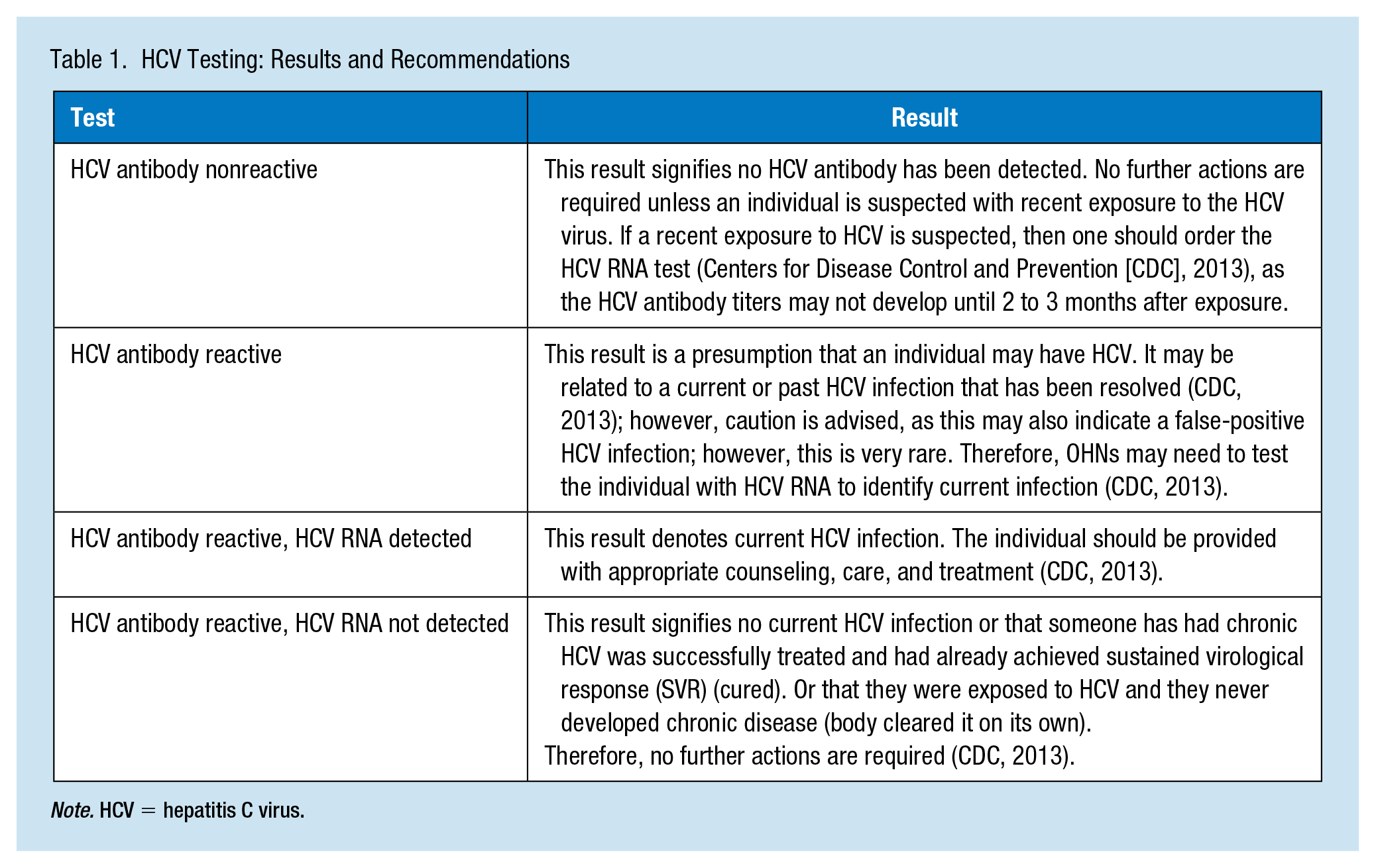
Note. HCV = hepatitis C virus.
Implications for Practice
The American Association for Occupational Health Nurses (AAOHN) recently led the AAOHN HCV Outreach Project with the goal to increase one-time HCV screening of employees/retirees born between 1945 and 1965 (Surjadi, Nuchols, Souza, Wolfe, & Burgel, 2019). To reach this goal, the Outreach Project conducted an educational intervention for OHNs to increase their competency regarding HCV risk factors, screening, and treatment. Comprehensive details about HCV risk factors, screening, and treatment are outlined in the study by Surjadi et al. (2019), which can be retrieved at: https://journals.sagepub.com/doi/full/10.1177/2165079919841637.
OHNs should understand how to interpret HCV titers in a comprehensive manner. These titers, in addition to evaluating risk factors, history, and clinical presentation, are crucial to diagnosing HCV (CDC, 2018). They can not only screen those at risk of HCV but also educate those living with this condition. Most importantly, OHNs can counsel individuals with positive results for HCV and teach them about care and curative treatments including target-specific drugs that disrupt the viral replication cycle of HCV such as NS5A inhibitors, NS5B inhibitors (i.e., nucleoside and non-nucleoside), and NS3 protease inhibitors (Surjadi, 2018).
Conclusion
OHNs need to know the importance of HCV screening, and treatment, as well as understanding how a diagnosis of HCV is established or excluded based on the correct interpretation of the test results.
Footnotes
Conflict of Interest
The author(s) declared no potential conflicts of interest with respect to the research, authorship, and/or publication of this article.
Funding
The author(s) received no financial support for the research, authorship, and/or publication of this article.

Author Biography
Myriam Jean Cadet, PhD, is a full time assistant professor at Bronx Community College (CUNY).