




Abstract
Employer-supported volunteerism has the potential to benefit employees and ultimately have a positive business impact. Volunteerism has been linked to improved quality of life, reduced morbidity, and higher self-rated health. This study was designed to understand what small, rural worksites are doing with regard to volunteerism, and what their barriers are to such activities. An online survey was distributed to worksites using the social network of a Resource, Conservation, and Development Council, a rural nonprofit entity. Analyses included descriptive statistics, and for qualitative data, review and summary of common themes. Thirty-eight worksites responded, representing a wide range of worksite types. Volunteer activities requiring less time and resources to organize were more commonly employed versus group-based activities. Identified barriers included time, costs, small staffing numbers, perceived employee lack of interest, worksite policies, distance to volunteer sites, language barriers, and lack of awareness of opportunities. Despite a variety of challenges, some forms of employer-supported volunteerism seem feasible even in very small rural worksites. Worksite type, culture, and leadership are likely to be determinants of the extent and nature of employer-supported volunteerism. Strategies to encourage greater volunteerism need to be tailored to the interests and resources of each site. Occupational health nurses should consider incorporating some form of employee volunteerism activities within their health promotion programming, as it is consistent with an overall strategy of enhancing employee well-being. This could lead to positive business impacts such as increased employee engagement, improved recruitment and retention, and improved productivity.
Keywords
Background
Volunteerism is critically important to the social and economic fabric of communities. The services provided through volunteer work significantly ease the burden of social service agencies, especially in rural areas where resources may be scarce and populations are often older and in greater need (Corporation for National and Community Service, 2018; Crosby, Wendel, Vanderpool, & Casey, 2012). About 25% of adults in the United States engaged in formal volunteerism at least once in 2015, averaging 52 hours/year (Bureau of Labor Statistics, 2016). Those in mid-life were more likely to volunteer, but they volunteer for fewer hours compared to older adults, and women tended to volunteer more than men (Bureau of Labor Statistics, 2016; Van Willigen, 2000). There is strong evidence that serving as a volunteer is beneficial for adults. For instance, volunteerism has been linked to improved quality of life, reduced morbidity, and higher self-rating of health, though the exact mechanisms for these associations remain unclear (Corporation for National and Community Service, 2007). Healthy people may be more inclined to volunteer, but some longitudinal studies also suggest a causal pathway from volunteerism to increased well-being (Corporation for National and Community Service, 2007; Musick & Wilson, 2003). For example, volunteering has been associated with decreased risk for depression, a greater sense of well-being and self-esteem, and greater levels of social support (Cattan, Hogg, & Hardill, 2011; Corporation for National and Community Service, 2007; Musick & Wilson, 2003). Various theoretical frameworks have been applied to understand the mechanisms by which psychological benefits occur, including Activity Theory (creating social ties), Role Theory (providing a meaningful role), and the development of “psychosocial resources” (e.g., increased meaning or purpose and reduced isolation) (Van Willigen, 2000). The construct of generativity, originally described by Erikson and Erikson (1997) and expanded upon by McAdams and de St. Aubin (1992), is also applied to understand motives for altruism (Ehlman & Ligon, 2012). Generativity refers to an adult’s concern for, and commitment to, the well-being of future generations and communities (McAdams, 2006). Research suggests that the benefits of volunteerism come largely independent of demographic and socioeconomic characteristics, though study populations have not always been representative (Brown, Consedine, & Magai, 2005; Corporation for National and Community Service, 2007).
Volunteerism can become a lifelong activity. While much of the research on volunteerism is focused on adults over the age of 65 years, studies suggest that interest and participation in volunteer activities often starts at much younger ages (Corporation for National and Community Service, 2007). Spending time as a volunteer may be difficult for employed adults who have less flexible work hours, who function as caregivers, or have transportation challenges. In general, persons with fewer social resources are also less likely to volunteer (Cattan et al., 2011). Another potential barrier to volunteering is simply a lack of awareness of community needs and opportunities to volunteer. In a national government survey, 41% of volunteers stated they became involved in volunteerism because someone from a nonprofit organization invited them to do so (Bureau of Labor Statistics, 2016). Some large companies have encouraged volunteerism by allowing paid time for such activities, but this represents only about 20% of employers in the United States (Society for Human Resource Management, 2013). The benefits to employers who offer opportunities to volunteer (on paid time or not) tend to be framed in terms of improved public relations and employee satisfaction or loyalty as opposed to a health benefit (“Corporate Volunteering,” 2014; Ford, 2016). There are also data suggesting that younger workers have come to expect employer-supported volunteerism as a work benefit, and consider it in their career decisions (Deloitte Development, 2011). Owing to the potential health benefits, increasing employer-supported volunteerism is consistent with the National Institute of Occupational Safety and Health (NIOSH) concept of Total Worker Health©, a holistic approach to worker well-being that melds worker safety with broader health promotion policies, programs, and practices (Chari et al., 2018; NIOSH, 2018). The NIOSH framework for worker well-being is comprehensive and includes work and nonwork settings and the communities in which a worker resides. Thus, promoting community volunteerism among workers fits well within this framework (Chari et al., 2018).
Overall, there appears to be consensus that volunteerism can be beneficial to both employers and employees. However, national and international reports assessing employer-supported volunteer activity and its associated challenges tend to focus only on large corporations (“Corporate Volunteering,” 2014; Deloitte Development, 2010, 2011, 2017; Ford, 2016). The purpose of this study was to better understand what small- and mid-sized worksites were doing regarding philanthropic and volunteerism activities, as well as what their barriers were to such activities, especially in lower resource rural areas.
Methods
For this study we conducted a cross-sectional, online survey of small- and mid-sized worksites in rural areas of the state of Iowa.
Sample Determination and Survey Distribution
Resource Conservation and Development (RC&D) Councils across the country are nonprofit organizations that work to create jobs, preserve the environment, and improve quality of life in rural communities. They depend heavily on volunteers to complete their mission (National Association of Resource Conservation & Development Councils, 2018). This study was conducted in collaboration with the Northeast Iowa RC&D Council. The Council’s region consists of seven rural counties with a population that is predominantly White, but also includes some worksites where a large number of employees are Latino. All counties meet the U.S. Census definition of rural, in which they had fewer than 50,000 residents, and none were adjacent to a metropolitan area (U.S. Bureau of the Census, 2018). The poverty rate for each county was between 10% and 15% (State Data Center–Iowa, 2016). The Council Director was approached about the project in the summer of 2017 and they agreed to endorse the project, offered suggestions for approaching the task, and facilitated the survey distribution process. The project was discussed in an RC&D meeting of development and chamber of commerce directors who represented all seven of the counties in this area. A paper draft of the questionnaire was provided, and it was explained to them that the focus of the study was on small- and mid-sized worksites (not “large corporations”) with at least 20 employees. All seven present agreed to forward the Qualtrics©-based (Qualtrics, n.d.) online survey link along with a short description of the survey purpose to a contact person of their choice at eligible worksites within their county. The study description also included contact information for the principal investigator, assured the confidentiality of the survey, and assured that findings would not identify any individual or worksite but would present a summary of results. The University of Iowa Institutional Review Board (IRB) ruled that the study did not require IRB approval or oversight, given the questions were focused on worksites rather than individuals. The criteria of worksites having at least 20 employees was selected in anticipation that smaller worksites may be less stable and would not have the resources to devote to volunteerism. This process of survey distribution used existing social networks, expecting that this would result in greater cooperation than cold-contact from a researcher.
Measures
The research team first assembled the survey items based on a review of the research literature, as well as media stories about how various worksites incorporated philanthropy and volunteerism into their missions. To help establish face and content validity, a draft of the questionnaire was shown to owners of five rural worksites similar to the type of worksites intended for the final survey. The owners completed the questionnaire online and offered suggestions for improvement, which were incorporated. Prior to distribution, the questionnaire was also reviewed by the Director of the Northeast Iowa RC&D who suggested minor changes.
The survey instrument asked respondents to provide their job title and to indicate the county of their main work office, and the number of employees in their business. They were asked to indicate whether the worksite was for-profit or nonprofit, and to indicate which of the 20 listed worksite categories from the North American Industry Classification System (U.S. Bureau of the Census, 2017) best represented their worksite’s primary business activity.
The second section of the survey began with an item asking whether there was a regional or national office that determined their policies with regard to philanthropy or volunteerism (yes/no). Next, a series of items (yes/no) asked about the following: whether the company/agency donated money or in-kind gifts to charitable organizations at least once per year; whether employees raised money or collected other donations at least once per year; whether employees participated together in at least one volunteer event per year without pay; whether employees participated together in at least one volunteer event per year with pay; whether employees were encouraged to volunteer for charitable organizations of their choice (not company organized) and on their own time (unpaid); and whether employees were encouraged to volunteer for charitable organizations of their choice (not company organized) and if this was on company time (paid). If a respondent answered “yes” to any of these items, they were additionally prompted to indicate the number of times per year this occurred (once per year; 2-3 times/year; more than 3 times/year), and whether the worksite had a written policy on this. For items that involved group activities, the respondent was asked to estimate how many employees typically participated.
The final section of the survey included two open-ended items where respondents were asked what the barriers were, if any, to promoting paid or unpaid volunteer activities in their workplace and an open-ended question asking them to provide anything else they wanted to tell us about their company/agency’s involvement with charitable organizations or volunteerism.
Data Analysis
Data were analyzed using the Qualtrics platform (Qualtrics, n.d.). Frequency distributions were examined for all variables. Means, standard deviation, and ranges were calculated where appropriate. Qualitative data derived from the two open-ended items, consisting largely of very short statements by respondents, were reviewed and summarized by common themes.
Results
Characteristics of Responders and Worksites
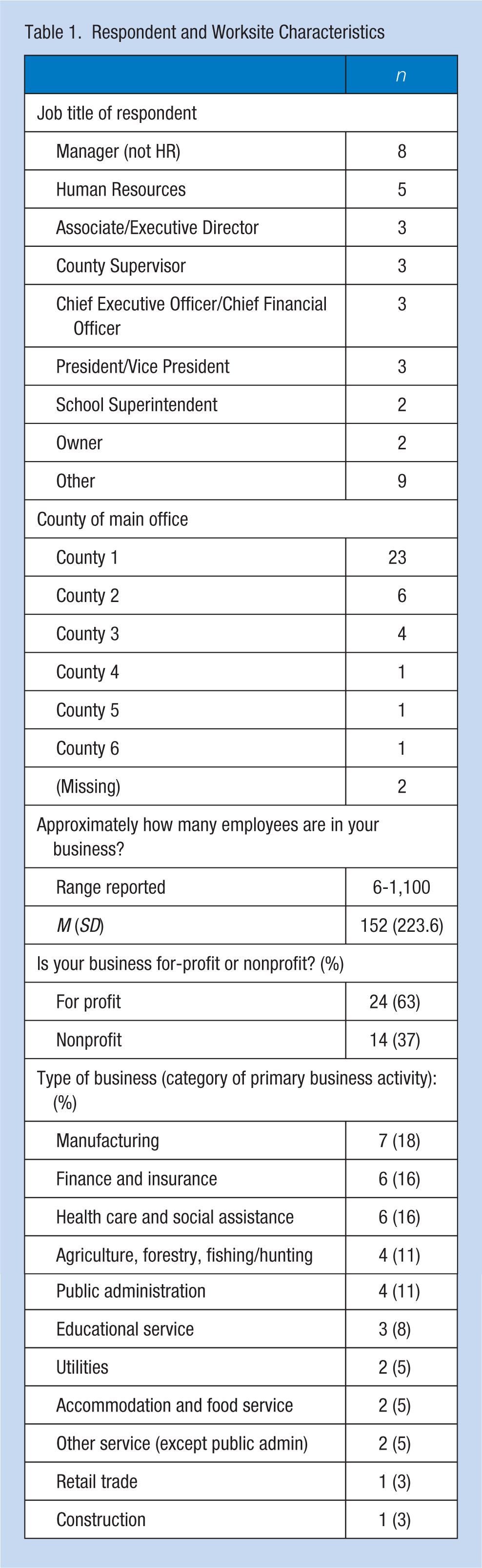
Table 1 shows characteristics of responders and worksites. There were 38 responses, one from each of 38 worksites. One respondent disengaged from the survey after completing the first section and the first two questions in the second section. Respondents represented a wide range of worksites and were primarily high-level administrators, with 23 (61%) from one more highly populated county, smaller numbers from five other counties, and two from counties not identified. Twenty-four (63%) worksites were for profit, 14 (37%) nonprofit, and the mean number of employees was 152 (SD = 223.6; range, 6-1,100). Six worksites reported having less than 20 employees, and two of these reported less than 10 employees.
Respondent and Worksite Characteristics
Philanthropy and Volunteerism
Table 2 presents results regarding philanthropy and volunteerism. Twenty-eight (74%) respondents indicated that there was no regional or national office that determined their policies with regard to philanthropy or volunteerism. Most respondents reported that their worksite donated money or in-kind gifts to charitable organizations (84%), raised money or collected donations (62%), and encouraged employees to volunteer for charitable organizations of their choice and on their own time (unpaid; 64%). Fewer reported that employees participated together in a volunteer event without pay (43%) or with pay (43%). A minority (27%) also indicated that employees were encouraged to volunteer for organizations of their choice on paid time. The frequency with which all of these activities took place varied from once per year to more than three times per year, and group activities tended to involve small numbers of employees. Very few respondents indicated their worksite had a written policy for any of the activities.
Philanthropy and Volunteerism Activity

Barriers and Additional Comments
There were 30 brief comments regarding barriers to prompting paid or unpaid volunteer activities. Six respondents simply stated that there were no barriers. Many mentioned lack of time for volunteerism whether it is during or after work hours. Some indicated that employees were free to volunteer on their own time outside of work, suggesting employers did not really need to be involved, while others stated that giving back to the community was part of their mission, and they encouraged employees to be similarly engaged. With regard to paid time for volunteerism, several respondents commented that they had a small staff and were not able to accommodate this. Multiple comments suggested a perceived lack of interest on the part of employees—that there is “no incentive” to participate and that this may be especially challenging when trying to find group volunteer activities that appeal to everyone. For a few, the worksite is not legally allowed to pay for volunteer time and/or other policies make it difficult to carry out. Other barriers mentioned include distance to volunteer sites in rural communities, language barriers, and lack of information on available opportunities.
There were 12 responses when asked to provide anything else about volunteerism at their organization. Many described how they and their employees donate time and materials to multiple charitable organizations and that this is engrained in the culture of their workplace. One mentioned that “there are costs associated with doing these activities, even if nobody is paid for the time.” Another noted that the arrival of new leadership who live outside of the area resulted in less attention to community engagement and volunteerism.
Discussion
The study results suggest that, despite some challenges, many of these worksites were involved in some form of employer-supported volunteerism. Activities that required less time and resources to organize (e.g., encouraging volunteerism or taking up collections) were more common than group-based activities. Twenty-seven percent of worksites reported that employees were encouraged to volunteer for organizations of their choice on paid time. This is higher than the 20% reported nationally among larger corporations in 2013 (Society for Human Resource Management, 2013); however, the small sample size, time frame, and geographic location may all contribute to this disparity. National data suggest that volunteerism in general is higher in some states than others, with Midwestern states having higher rates than many other parts of the country (Corporation for National and Community Service, 2018).
A number of barriers to employer-sponsored volunteerism were revealed in this study, and some are consistent with a study by the Points of Light Foundation that focused on barriers to volunteerism, in general, in low resource rural areas (Schresth & Cihalar, 2004). Lack of transportation, professionalism and an inconsistent community infrastructure were among the barriers noted. In these environments, leadership and involvement from worksites of all types may be especially important.
Many of the comments provided by respondents suggest that worksite type, culture, and leadership could be strong determinants of the extent and nature of employer-sponsored volunteerism that takes place. Similar to any other worksite programs, strategies to encourage greater volunteerism need to be tailored to the interests and resources of each site. Manufacturing worksites with many low-wage earners, for example, may find it more difficult to engage workers in activity that is not on paid time and/or that requires some personal expense (e.g., donations). These employers might consider donating money or in-kind gifts to charitable organizations, and sharing their reasons for doing so with employees, helping them to become more aware of community needs. Many nonprofits make available brochures, posters, or template communication materials that worksites could also use to raise awareness of community needs and opportunities for volunteer service. It seems plausible that such exposure to volunteer opportunities during working years could predispose one to engage in volunteerism upon retirement when time, at least, may be less of a barrier.
This study has a number of limitations. The small sample size, location, and selection process suggest caution should be used to generalize findings to other settings. While a wide variety of worksites were represented, there were insufficient numbers to compare results across worksite types. A larger, national sample of worksites would be helpful to more specifically characterize the nature and extent of employer-supported volunteerism across worksite types in rural communities. The worksites were not randomly selected and may not be representative of worksites in each county. The study relied on the county representatives to identify eligible worksites, resulting in responses from some that had fewer employees than specified by the research team. Owing to the already-limited sample size, these were included in the analysis. In addition, the denominator of worksites was not known since the county representatives did not reveal which worksites they contacted; however, there were likely few eligible worksites in many of these counties, and use of existing social networks may have resulted in greater cooperation than would have been attained through cold contact by a researcher.
Implications for Occupational Health Nursing Practice
The study provided a helpful assessment of employer-supported volunteerism among worksites in rural areas. It is clear that despite some challenges, and typically without any formal policies in place, many worksites were contributing in meaningful ways to their community through philanthropic and volunteer activities that could serve as a role model for others. As mentioned previously, community volunteerism fits very well within the NIOSH Total Worker Health approach and their framework of worker well-being, which supports programs connecting the work and nonwork environments of adults, as opposed to focusing solely on the worksite (Chari et al., 2018; NIOSH, 2018). Occupational health nurses should consider incorporating some form of employee volunteerism activities within their health promotion programming, as it is consistent with an overall strategy of enhancing employee well-being. This could lead to positive business impacts such as increased employee engagement, improved recruitment and retention, and improved productivity.
Future studies could explore which strategies for increasing employer-supported volunteerism are most effective and sustainable in different rural worksite types.
Applying Research to Practice
Prior research supports the benefits of volunteerism for both the recipients and the volunteers themselves. This study suggests that despite some barriers, employer-supported volunteerism was at least feasible, even in smaller rural worksites. This activity may take many different forms depending on the worksite type, culture, leadership, and available resources. Common barriers included time, costs, small staff, perceived employee lack of interest, worksite policies, distance to volunteer sites, language barriers, and lack of awareness of opportunities. Occupational health nurses should consider incorporating some form of employee volunteerism activities within their overall well-being strategies, as this could lead to positive business impacts such as increased employee engagement, improved recruitment and retention, and improved productivity.
Footnotes
Declaration of Conflicting Interests
The author(s) declared no potential conflicts of interest with respect to the research, authorship, and/or publication of this article.
Funding
The author(s) received no financial support for the research, authorship, and/or publication of this article.

Author Biographies
Faryle Nothwehr, MPH, PhD, is an associate professor in the Department of Community and Behavioral Health, College of Public Health, University of Iowa. Her research interests include health-related behavior change in adults, behavioral epidemiology, and volunteerism.
Diane Rohlman, MA, PhD, is an associate professor in the Department of Occupational and Environmental Health, College of Public Health, University of Iowa. She is also the Director of the NIOSH-funded Healthier Workforce Center of the Midwest.