




Abstract
Current research highlights the need to critically examine the factors that can reduce the relationship between work stress and burnout to improve employee health and well-being, as well as to create healthier workplaces. The objective of this study was to enhance insight into the association between stress and job burnout by testing the moderated moderating effect of off-job physical activity (PA) and intrinsic motivation for off-job PA on this association. A total of 369 university staff (70% females) completed a web survey comprising measures of perceived stress, job burnout, PA, and intrinsic motivation for PA. A three-way conditional process model revealed that the “Stress × PA” interaction was significant for cognitive weariness, and that the three-way interaction between “Stress × PA × Intrinsic Motivation for PA” was significantly related to job burnout, and to cognitive weariness. The results highlight (a) that stress was associated with higher levels of job burnout; (b) that under a high stress condition, PA was negatively linked to cognitive weariness; and (c) that intrinsic motivation for PA reinforced the positive moderating effect of PA on the stress–burnout relationship, especially when stress is high.
Work is at the very core of contemporary life for most people, providing financial security, personal identity, and an opportunity to make a meaningful contribution to community life. Nevertheless, there is a growing awareness of the role of work in the development of stress and burnout. Workplace stress and burnout affect between 19% and 30% of employees in the general working population (Finney, Stergiopoulos, Hensel, Bonato, & Dewa, 2013). Grounded in the conservation of resources (COR) theory (Hobfoll, 1989; Hobfoll, Halbesleben, Neveu, & Westman, 2018), the objective of the present study was to enhance insight into the association between stress and job burnout by testing the moderating effect of off-job physical activity (PA) and intrinsic motivation for off-job PA on this association (i.e., the three-way interaction between stress, PA, and intrinsic motivation for PA).
The COR Theory
COR theory (Hobfoll, 1989; Hobfoll et al., 2018) assumes that people strive to retain, protect, and build resources and feel threatened by the potential or actual loss of these valued resources. Stress is the psychological strain or distress resulting from exposure to unusual or demanding situations, known as stressors (Schabracq, Winnubst, & Cooper, 2004). Occupational stress, specifically, is the response to occupational stressors in the workplace environment that pose a perceived threat to an individual’s well-being or safety (Schabracq et al., 2002). Specifically, the definition of stress derived directly from COR theory considers that psychological stress is a reaction to the environment in which there is (a) the threat of a net loss of resources, (b) the net loss of resources, or (c) a lack of resource gain following the investment of resources. Both perceived and actual loss, and lack of gain are envisaged as sufficient to produce stress. The theory predicts that when confronted with stress, individuals strive to minimize net loss of resources, and when not actually confronted with stressors, people strive to gain resources to offset the possibility of future losses. Based on this theory, job burnout is viewed as an affective reaction to prolonged exposure to stress at work, that is, to situations in which the demands imposed by the job exceed individuals’ adaptive resources (Shirom, 2003). Empirical evidence suggests that exposure to stressors is related to a number of adverse outcomes, such as job burnout (Lourel, Abdellaoui, Chevaleyre, Paltrier, & Gana, 2008). Job burnout comprises three facets: (a) physical fatigue, which refers to feelings of tiredness and low levels of energy when carrying out daily work-related tasks, like getting up in the morning to go to work; (b) emotional exhaustion, which refers to feeling too weary to display empathy to clients and coworkers, and lacking the energy needed to invest in relationships with other people at work; and (c) cognitive weariness, which refers to perceptions of thinking slowly and reduced mental agility (Shirom, 2003).
The Role of PA in Preventing Job Burnout Under High Stress Working Conditions
A large body of research has examined the factors contributing to job stress and burnout, and there is a growing need to critically examine factors that are able to mitigate this relationship to improve employee health and well-being, as well as create healthier work environments. Past research has demonstrated that engaging in recovery strategies or having recovery experiences following the workday, such as “psychological detachment” and “mastery,” for example, can reduce fatigue and enhance mental health at work (Kinnunen, Feldt, Siltaloppi, & Sonnentag, 2011; Sawhney, Jennings, Britt, & Sliter, 2017). Recent studies using cross-sectional, longitudinal, or experimental designs have suggested that off-job PA, which is considered to be one of the possible recovery experiences, can play a central role in the prevention of job burnout (Gerber, Lindwall, Lindegård, Börjesson, & Jonsdottir, 2013; Jonsdottir, Rödjer, Hadžibajramović, Börjesson, & Ahlborg, 2010; Lindwall, Gerber, Jonsdottir, Börjesson, & Ahlborg, 2014; Sane, Devin, Jafari, & Zohoorian, 2012; Toker & Biron, 2012).
What If Motives Matter? The Buffering Influence of Motivation for Off-Job PA
Motivation for engaging in PA seems to play a substantial role in determining the recovery potential of PA. Indeed, it is suggested that recovery is more likely to occur when employees find their off-job activities enjoyable (Sonnentag & Natter, 2004; Sonnentag, Venz, & Casper, 2017). A theoretical justification for this idea is provided by theories on motivation, especially by the self-determination theory (Ryan & Deci, 2017). Motivation is thought to play an important role in employee well-being and positive affect (Ryan & Deci, 2017). Thus, while individuals who are intrinsically motivated to do an activity derive more pleasure from doing the activity, and feel free and relaxed, extrinsically motivated individuals who engage in activities because of external pressure experience more negative feelings such as anxiety, tension, and negative affect (Vallerand et al., 1997).
Self-determination theory explains how intrinsic motivation for off-job PA can increase the recovery potential of this activity. Motivation literature suggests that intrinsically motivated individuals are more absorbed in doing PA (Ryan & Deci, 2017; Vallerand, 2007), making it more likely that they forget about work, and stressors are inhibited. Furthermore, individuals who are intrinsically motivated for off-job PA may derive more pleasure from the activity than extrinsically motivated individuals (Vallerand, 2007). Thus, more personal resources that contribute to recovery (e.g., vitality, positive affect, and self-esteem) are obtained when performing an off-job PA for which one is intrinsically motivated. Finally, intrinsically motivated individuals will put more effort into the off-job PA, increasing the chance of successfully replenishing their personal resource reservoir. Consistent with these assumptions, in the only study on the recovery potential of intrinsically versus extrinsically motivated off-job activities, ten Brummelhuis and Trougakos (2014) report that the positive relationship between leisure activities and next morning recovery was more pronounced among employees with greater inherent intrinsic, in comparison with extrinsic, motivation for the activity. Moreover, intrinsic motivation attenuated the positive relationship between high-duty tasks and next morning exhaustion.
Although previous studies have shown a negative association between off-job PA and job burnout (e.g., Lindwall et al., 2014), and the potential role of motivation for off-job PA on this relationship, knowledge about the protective effect of off-job PA on the stress–burnout relationship at work can be deepened in at least three ways. First, (a) past studies that examine the moderators of the stress–burnout relationship focused only on employees’ psychological characteristics (e.g., emotional intelligence and coping, Görgens-Ekermans & Brand, 2012; Mearns & Cain, 2003) and the contextual characteristics of the work (e.g., presence of social support, work characteristics; Etzion & Westman, 1994; Sonnentag, Brodbeck, Heinbokel, & Stolte, 1994). As far as we know, no studies have examined the moderating effects of behavioral health habits assumed to have a beneficial impact on physical and mental health, such as off-job PA. Second, (b) to the best of our knowledge, no studies have examined the combined influence of off-job PA and the motivation for engaging in it on the stress–burnout relationship. Finally, (c) the majority of the previous studies on the relationship between off-job PA and job burnout at work measured job burnout as a one-dimensional construct, and did not take into account the multidimensional perspective proposed by Shirom (2003).
In the present study, we aim to enhance insight into the association between stress and job burnout by addressing these three issues, and testing the moderated moderating effect of off-job PA and intrinsic motivation for off-job PA on this association. Investigators of this study assume (a) that stress is positively related to job burnout (Hypothesis 1); (b) that regular off-job PA will mitigate this relationship (i.e., moderation, Hypothesis 2); and (c) that the intrinsic motivation for off-job PA will strengthen the moderating effect of regular engagement in off-job PA on the stress–burnout relationship (i.e., moderated moderation, Hypothesis 3).
Method
Participants and Procedure
After having secured ethical approval from the Joseph Fourier University (Grenoble, France) Ethics Committee for Non-Interventional Studies, the questionnaire was distributed as a web survey to approximately 1,500 administrative and technical university staff. These staff members held jobs as engineers, project managers, administrative managers and assistants, human resources managers and assistances, technicians, and logistics operators.
Measures
Perceived stress
Perceived stress was measured with the French short form Perceived Stress Scale (PSS-4; Lesage, Berjot, & Deschamps, 2012; Warttig, Forshaw, South, & White, 2013). The PSS-4 is a brief self-report scale of four items. People are asked to rate on a 5-point scale the extent to which they experienced each of the feelings and thoughts listed, in the past month (from 0 = never to 4 = very often). In the present sample, the Cronbach’s α values of the PSS-4 was .83.
Job burnout
Job burnout was measured with the French version of the Shirom Melamed Burnout Measure (Sassi & Neveu, 2010; Shirom & Melamed, 2006). This scale contains 14 items representing the three dimensions of job burnout (i.e., physical fatigue, six items, Cronbach’s α = .93; cognitive weariness, five items, Cronbach’s α = .93; and emotional exhaustion, three items, Cronbach’s α = .75) with response options anchored on a 7-point Likert-type scale varying from 1 (almost never) to 7 (almost always). The average of the scores obtained in each of the dimensions was calculated to determine a job burnout score.
PA
PA was assessed with the one-item 4-level Saltin Grimby Physical Activity Level Scale (SGPALS; Grimby et al., 2015; Rödjer et al., 2012) in the prior year. In this scale, a single question was used: “How much physical activity do you engage in during your leisure time? If the level of activity varies greatly, for example, between summer and winter, try to estimate an average. The question concerns the last year.” Four options were given as possible answers: (a) physically inactive: being almost completely inactive, for example, reading, watching television, watching movies, using computers or doing other sedentary activities, during leisure time; (b) some light PA: being physically active for at least 4 hours/week, for example, riding a bicycle or walking to work, walking with the family, gardening, fishing, table tennis, bowling, and so on; (c) regular PA and training (moderate PA), for example, spending time gardening, running, swimming, playing tennis, badminton, doing calisthenics, and similar activities, to a demanding level for at least 2 to 3 hours/week; and (d) regular hard physical training for competition sports (vigorous PA), for example, spending time in running, orienteering, skiing, swimming, playing soccer, and so on, several times per week.
Intrinsic motivation for PA
Intrinsic motivation for PA was measured with the Intrinsic Motivation subscale of the Sport Motivation Questionnaire II (SMS-II; Pelletier, Rocchi, Vallerand, Deci, & Ryan, 2013). The Intrinsic Motivation subscale consists of three items (in the present study, the Cronbach’s α was .84) measuring the motivation for acting that derives from satisfactions found in the behavior itself. In this questionnaire, researchers of the present study modified the anchor to measure the overall intrinsic motivation for PA by providing the following statement: “Generally, when I do sports or other physical activities, I do so for the intense enjoyment that I feel while I am doing my sport.” It is assumed that general intrinsic motivation for PA would be more decisive for how engagement in the activity is experienced than other everyday influences, and thus, the present study focused on people’s inherent intrinsic motivation. Participants’ motivation was assessed using a 7-point Likert-type scale ranging from 1 (does not correspond at all) to 7 (corresponds completely).
Covariates
Demographic data were also collected including years of age, gender (i.e., 1 = female and 2 = male), and educational level (i.e., 1 = no diploma, 2 = high school education, and 3 = university education). These measures were relevant in our study given that research on job burnout has shown that women are more likely to report job burnout than men (Purvanova & Muros, 2010). Moreover, age has been found consistently to be associated with job burnout (Schaufeli & Enzmann, 1998). Finally, educational level was controlled following a body of evidence linking socioeconomic status (SES) to negative emotions (Gallo & Matthews, 2003) and to coping ability with stress (Baum, Garofalo, & Yali, 1999).
Data Analysis
Initially, descriptive and correlation analyses were carried out with all the variables of the study. Univariate and multivariate normality were examined for stress, job burnout, and intrinsic motivation for PA. PROCESS macro (model 3; see Figure 1) developed by Hayes (2012, 2013) in SPSS was used to estimate the three-way conditional process model and to calculate the simple slopes for the moderation (two-way interaction) and the moderated moderation (three-way interaction). A conditional process model is a modeling strategy undertaken with the goal of describing the conditional nature of the mechanism(s) by which a variable transmits its effect on another, and testing hypotheses about such contingent effects. In multiple regression, moderation is presented as a linear by linear interaction between the independent variable and the moderator variable. This macro uses an ordinary least squares regression–based path analytical framework for estimating the effects. Bootstrap methods were implemented for inference from indirect and conditional indirect effects (Hayes, 2012, 2013). The three-way interaction moderation model was tested for each outcome variable such that the relationship between stress, and the job burnout and each of the three dimensions of job burnout was moderated by two variables (PA and intrinsic motivation for PA). In a three-way interaction, inference is undertaken by selecting values of the second moderator (i.e., intrinsic motivation for PA), and testing whether the conditional interaction between the independent variable (i.e., stress) and the first moderator (i.e., PA) is statistically significant at those values. This modeling method allowed us to test the relationship between stress and burnout (Hypothesis 1); (b) the moderation effect of PA on this relationship (Hypothesis 2); and (c) the three-way interaction between stress, PA, and intrinsic motivation for PA (Hypothesis 3). As previously mentioned, three control variables were included (sex, age, and educational level) across all analyses. The projected values of dependent variables for which the three-way interaction was significant under each of the eight conditions were then calculated and plotted.
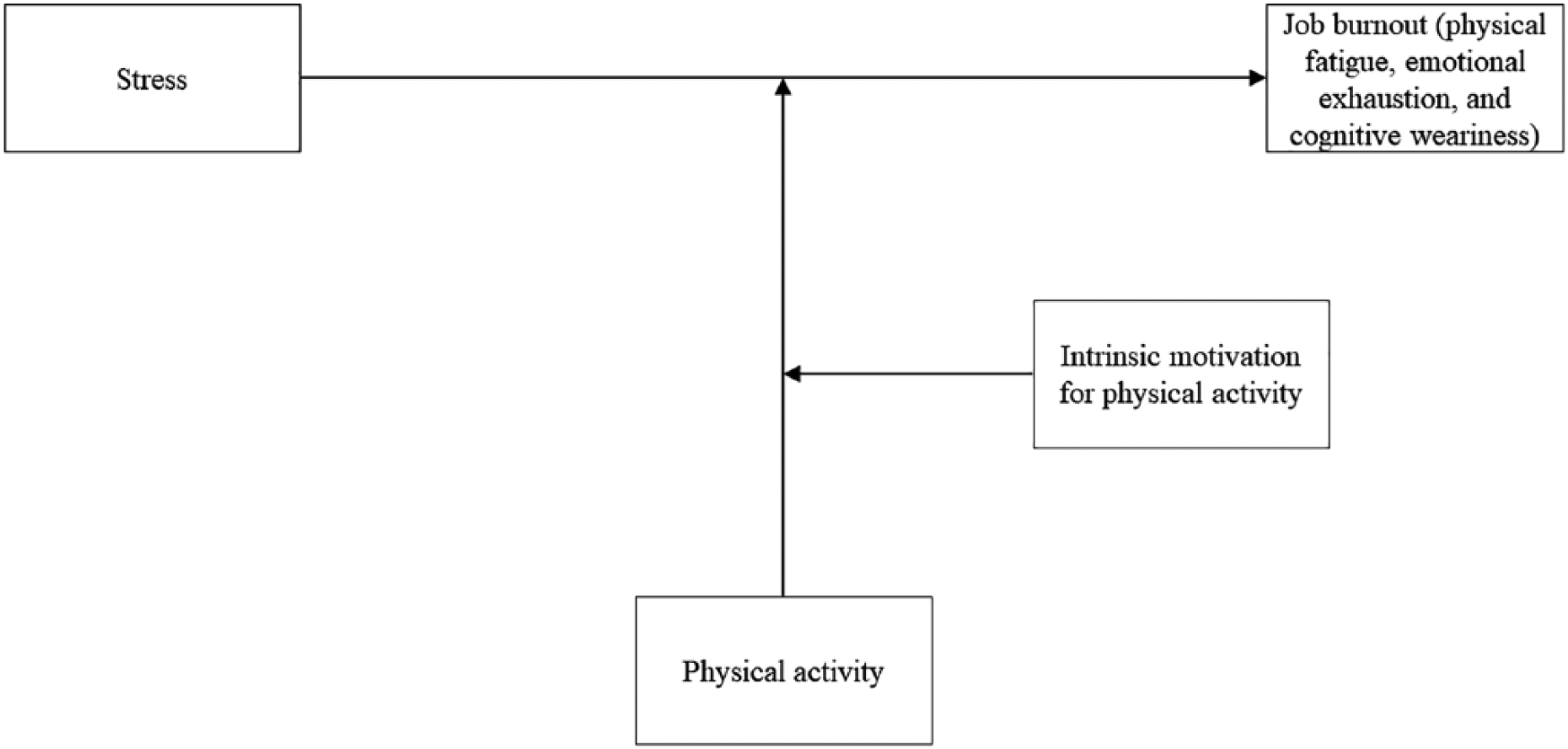
Three-way interaction modeling between stress, physical activity, and intrinsic motivation for physical activity on job burnout.
Results
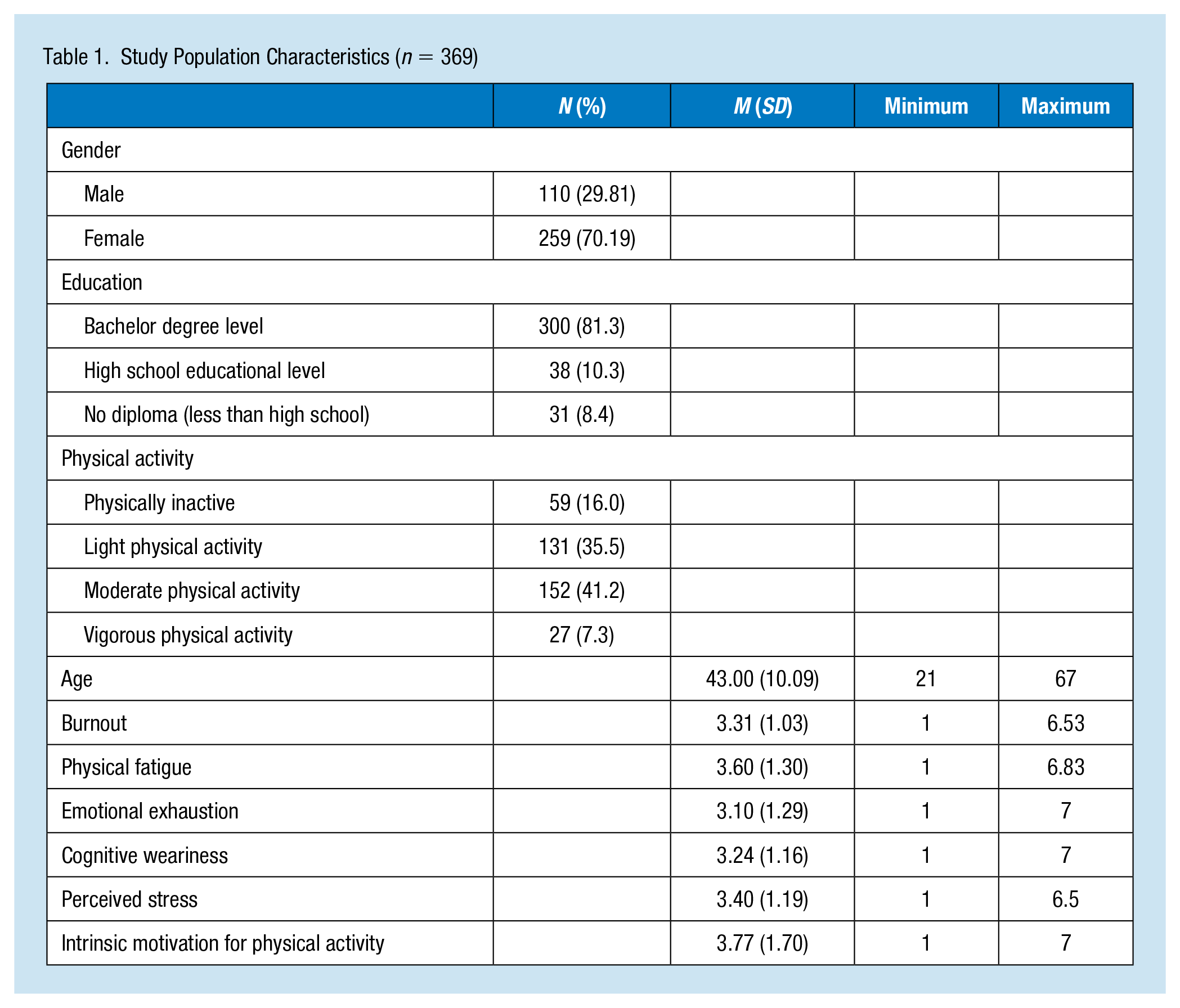
Among the 1,500 administrative and technical university staff, 369 completed the questionnaire, giving a response rate of 24.6%. The participants (259 females and 110 males) who completed the survey had a mean age of 43.00 years (SD = 10.09, [minimum 21-maximum 67]; see Table 1). The majority (81.3%) had a bachelors degree, 10.4% had a high school diploma, and 8.3% had no diploma. Regarding PA, 16.1% of the participants reported being physically inactive, 35.6% reported some light PA, 41.1% reported moderate PA, and 7.2% reported regular hard physical training for competition sports.
Study Population Characteristics (n = 369)
The results showed that univariate skewness and kurtosis values ranged from .01 to .95 and Mardia’s multivariate skewness and kurtosis values were lower than 3. Table 2 presents the bivariate correlations between the study variables. Stress, the three job burnout dimensions, and the job burnout score were significantly and positively correlated with each other. The level of PA and intrinsic motivation for PA were significantly and positively correlated. Finally, the level of PA was negatively and significantly correlated with stress and physical fatigue.
Correlations Between Stress, PA, Intrinsic Motivation for PA, Burnout, and Demographic Variables
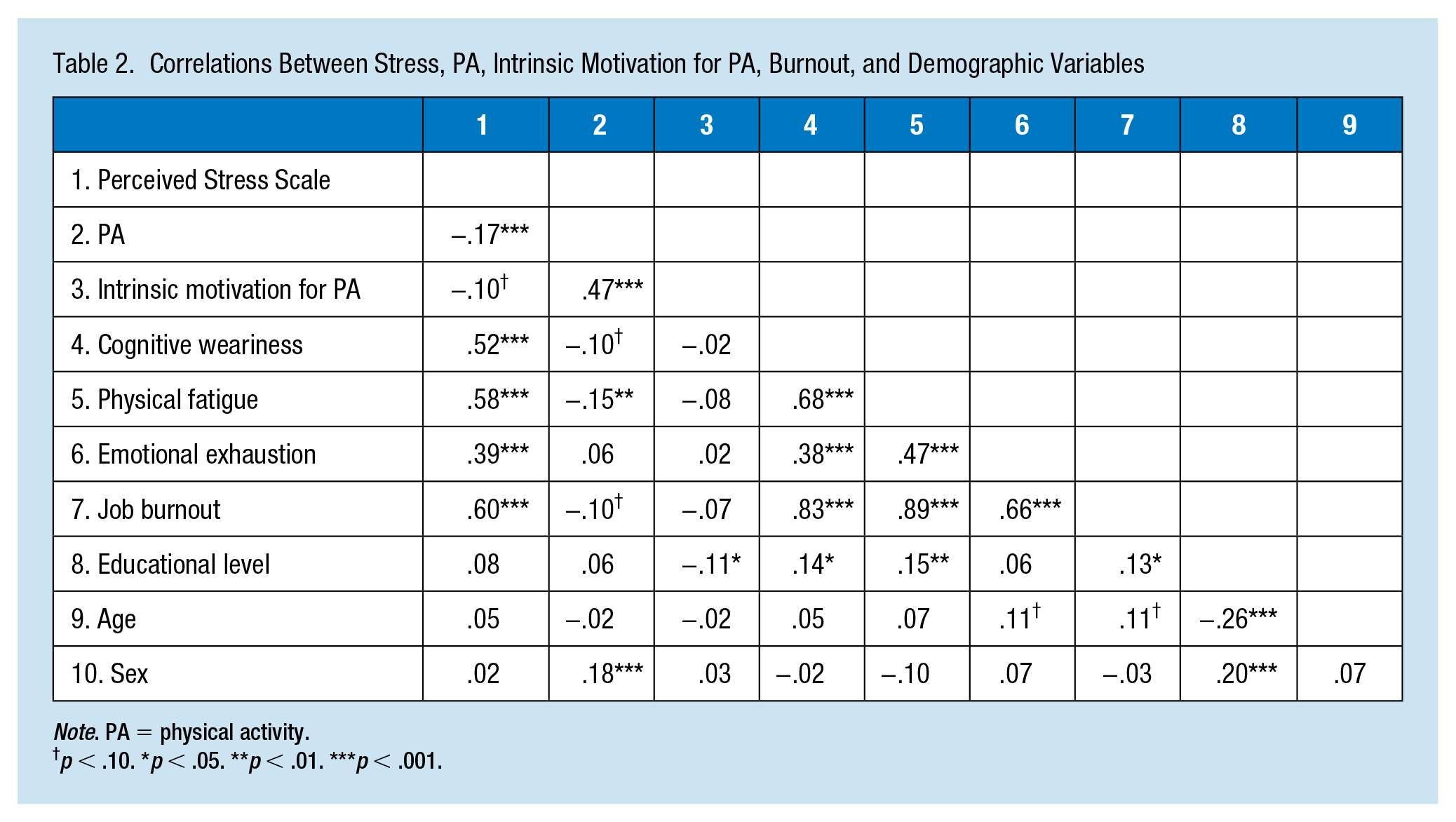
Note. PA = physical activity.
p < .10. *p < .05. **p < .01. ***p < .001.
Moderated Moderation (Three-Way Interaction) Analyses
Table 3 shows the results of the conditional process analysis. In these analyses, B means that a one-unit increase in the independent variable resulted in a one-unit increase/decrease in the dependent variable. Moreover, when there was a significant moderating variable, it indicates that it changed the magnitude or the direction of the relationship between the two variables. First, stress was positively associated with job burnout (B = .62, SE = .14, p < .001), cognitive weariness (B = .83, SE = .15, p < .001), and physical fatigue (B = .60, SE = .15, p < .001). These results and the correlations between the stress and job burnout dimensions support our first hypothesis that higher levels of stress are associated with higher levels of job burnout. Second, the “Stress × PA” interaction was significant for cognitive weariness (B = −.15, SE = .06, p < .01) and for emotional exhaustion (B = .14, SE = .06, p < .05). Results of the conditional process model for cognitive weariness provided support to our second hypothesis positing that regular engagement in off-job PA could mitigate the stress–burnout relationship. Finally, the three-way interaction between stress, PA, and intrinsic motivation for PA was significantly related to job burnout (B = .11, SE = .06, p < .05) and to cognitive weariness (B = .17, SE = .06, p < .01).
Findings From the Conditional Process Model
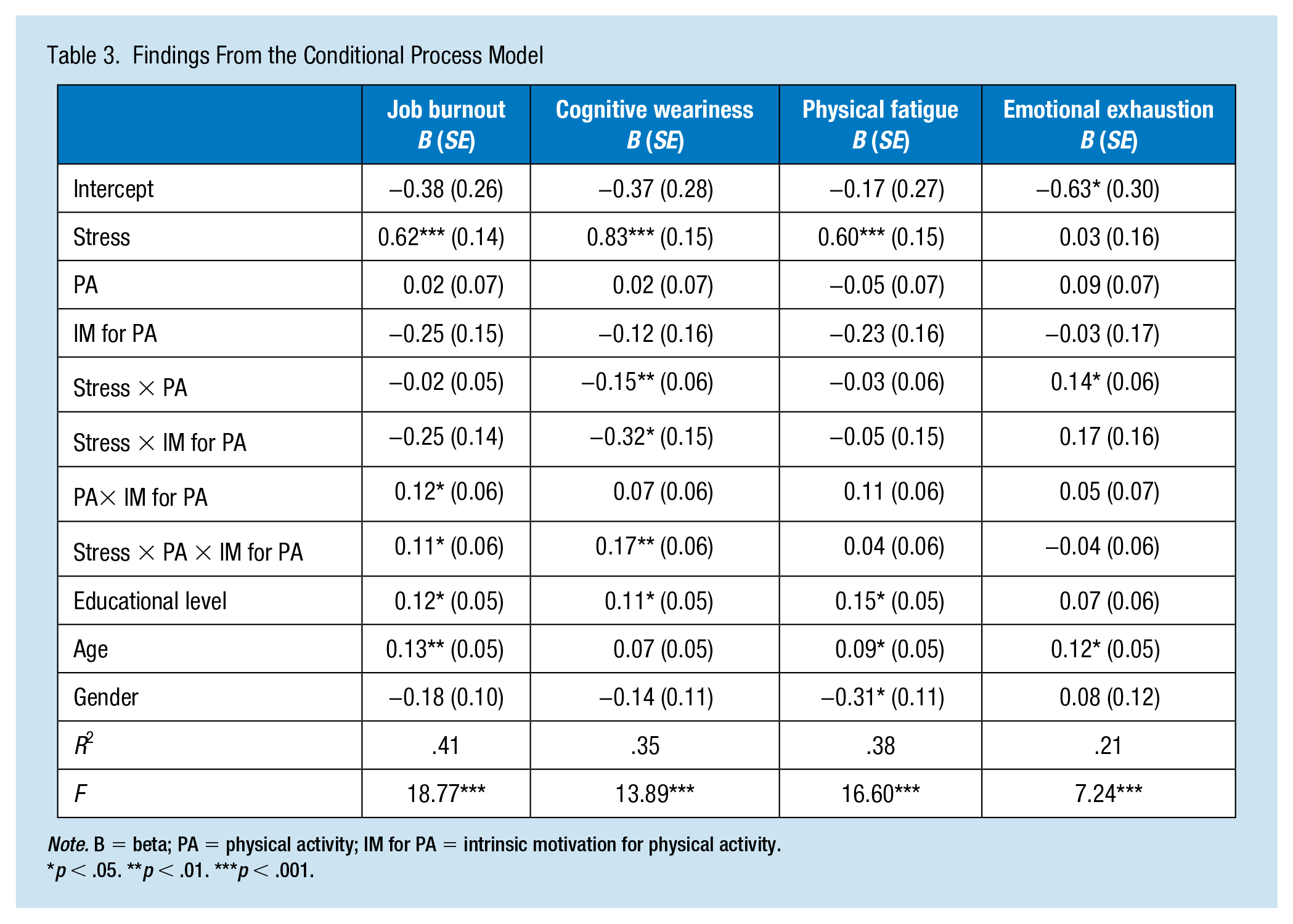
Note. B = beta; PA = physical activity; IM for PA = intrinsic motivation for physical activity.
p < .05. **p < .01. ***p < .001.
The relative positions of the dots in Figures 2 and 3, as well as the simple slopes, demonstrate consistent patterns with our hypothesis that the intrinsic motivation for off-job PA could increase its recovery potential and reinforce the positive moderating effect of regular engagement in off-job PA on the stress–burnout relationship. Results suggest that when employees perceive low levels of occupational stress, PA and intrinsic motivation for PA do not have an impact on job burnout and cognitive weariness scores. However, if occupational stress levels are high, a buffering effect occurs showing that employees with low PA and low intrinsic motivation for PA have the highest levels of job burnout and cognitive weariness. Specifically, when PA and intrinsic motivation for PA were low, the simple slope between stress and job burnout was .65 (SE = .08, p < .001), and the simple slope between stress and cognitive weariness was .65 (SE = .09, p < .001). When PA was high and intrinsic motivation for PA was low, the simple slope between stress and job burnout was .43 (SE = .11, p < .01) and the simple slope between stress and cognitive weariness was .12 (SE = .11, ns). When PA was low and intrinsic motivation for PA was high, the simple slope between stress and job burnout was .51 (SE = .11, p < .001) and the simple slope between stress and cognitive weariness was .55 (SE = .11, p < .001). When PA and intrinsic motivation for PA were high, the simple slope between stress and job burnout was .65 (SE = .08, p < .001) and the simple slope between stress and cognitive weariness was .53 (SE = .08, p < .001). Moreover, “PA × Intrinsic Motivation for PA” interaction was significant at high levels of stress for job burnout (effect = .25, SE = .10, p < .05) and for cognitive weariness (effect = .24, SE = .08, p < .01). “PA × Intrinsic Motivation for PA” interaction was not significant at low levels of stress for job burnout (effect = −.09, SE = .08, ns) and for cognitive weariness (effect = .01, SE = .08, ns). These results support our third hypothesis, intrinsic motivation for PA reinforces the positive moderating effect of PA on the stress–burnout relationship especially when stress is high.
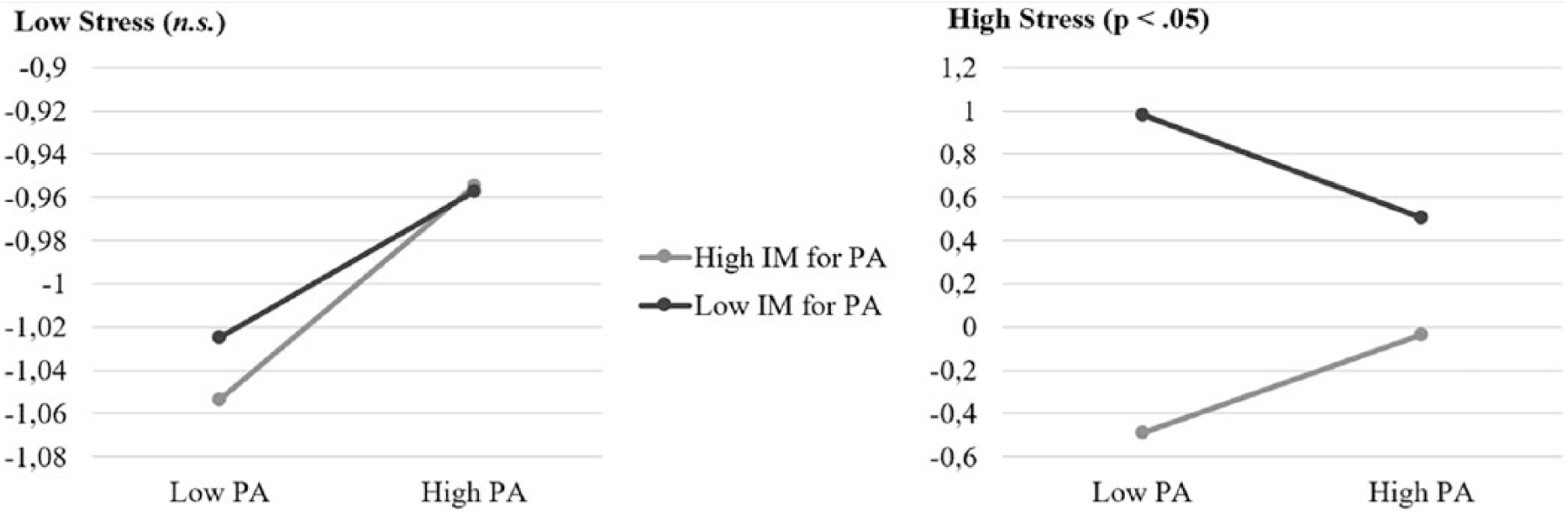
Three-way interaction between stress, PA, and IM for PA on job burnout.
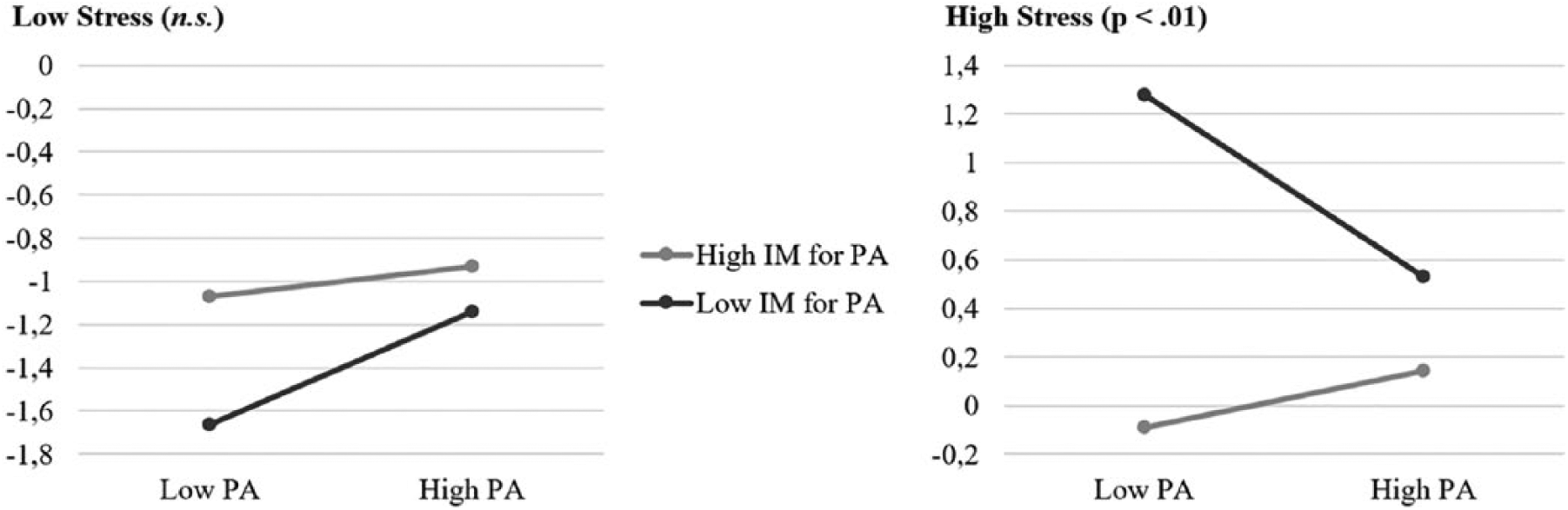
Three-way interaction between stress, PA, and IM for PA on cognitive weariness.
Discussion
The aim of the present study was to test the moderated moderating influence of PA and intrinsic motivation for off-job PA on the stress–burnout relationship. First, it was hypothesized that stress will be positively related to job burnout. This first hypothesis was confirmed by positive correlations between stress and job burnout, and with each of the three dimensions of job burnout. Second, it was hypothesized that regular off-job PA could mitigate the stress–burnout relationship. This hypothesis was supported only for cognitive weariness. Finally, it was hypothesized that intrinsic motivation for off-job PA would reinforce the positive moderating effect of PA on the stress–burnout relationship. This last hypothesis was confirmed for cognitive weariness and job burnout; results showed that intrinsic motivation for PA reinforces the positive moderating effect of PA on the stress–burnout relationship especially when stress is high.
With respect to Hypothesis 2 (i.e., stress is positively related to job burnout), it was found that stress was positively associated with job burnout, and to each of the three job burnout dimensions. This result is congruent with the basic tenets of COR theory (Hobfoll, 1989; Hobfoll et al., 2018), in which job burnout is viewed as an affective reaction to prolonged exposure to stress at work (Shirom, 2003) and is also consistent with previous research which found that exposure to stressors is related to job burnout (Lourel et al., 2008).
In line with Hypothesis 2 (i.e., regular off-job PA will mitigate the stress–burnout relationship), it was found that the “Stress × PA” interaction was significant for cognitive weariness and for emotional exhaustion. However, with regard to emotional exhaustion, the relationship must be interpreted with caution as stress and PA are not significantly linked to this dimension in the conditional process model suggesting a suppression effect 1 (MacKinnon, Krull, & Lockwood, 2000). Nevertheless, the negative interaction term of the “Stress × PA” interaction when cognitive weariness is considered as the outcome revealed that when stress is high, cognitive weariness is higher among workers who engage in less PA compared with workers who engage in more PA. This finding is consistent with previous research suggesting that positive recovery experiences can enhance mental health at work (Kinnunen et al., 2011; Sawhney et al., 2017), and that PA can play a central role in the prevention of job burnout (Gerber et al., 2013; Jonsdottir et al., 2010; Lindwall et al., 2014; Sane et al., 2012; Toker & Biron, 2012).
Finally, in accordance with Hypothesis 3 (i.e., intrinsic motivation for off-job PA will strengthen the moderating effect of regular engagement in off-job PA on the stress–burnout relationship), the present study revealed that the three-way interaction between stress, PA, and intrinsic motivation for PA was significantly related to job burnout, and to cognitive weariness. Specifically, when stress is high, job burnout and cognitive weariness were higher for workers who engage in low levels of PA and have low intrinsic motivation for engaging in it, compared with workers with low levels of PA but high intrinsic motivation for engaging in it, high levels of PA but low intrinsic motivation for engaging in it, and high levels of PA and intrinsic motivation for engaging in it. Thus, these results highlight that intrinsic motivation for PA strengthen the positive moderating effect of PA on the stress–burnout relationship especially when stress is high. These results support past studies suggesting that higher levels of recovery occur (particularly) when people enjoy their off-job PA (Sonnentag & Natter, 2004; Sonnentag et al., 2017). Moreover, the findings of our study are in line with motivation literature suggesting that intrinsically motivated individuals are more absorbed in doing the PA, derive more pleasure from the activity (Vallerand, 2007), and, thus, derive more personal resources that contribute to recovery when involved in off-job PA for which they are intrinsically motivated. Our study also confirmed the results of ten Brummelhuis and Trougakos (2014), showing that the positive relationship between leisure activities and next morning recovery was more pronounced among employees with greater inherent intrinsic, in comparison with extrinsic motivation for the activity. In our study, the “Stress × PA × Intrinsic Motivation for PA” interaction is significant for job burnout (i.e., the average of the three dimensions of job burnout). This result is linked to the studies presented earlier that examined job burnout as a one-dimensional construct. However, when the results for each dimension are examined independently, the “Stress × PA × Intrinsic Motivation for PA” interaction is significant only for the cognitive weariness dimension. To explain this result, a number of suggestions can be made. Based on the recovery mechanisms proposed by Sonnentag and Fritz (2007), it can be assumed that the greater effect on cognitive weariness is linked to the fact that PAs make it possible to restore and/or build new cognitive resources, in particular by leaving work behind and forgetting about it when one is not at work (i.e., psychological detachment), by performing tasks that allow new skills to be learned and succeeded in (i.e., mastery), and by performing tasks that have been chosen freely (i.e., control). These mechanisms would then play a greater role in the restoration/building of cognitive resources than physical and emotional resources. However, future studies will then have to examine the relationships between PA, recovery experiences during PA, and the different dimensions of burnout to confirm these hypotheses.
Limitations and Future Directions
The findings of the present study should be interpreted in light of several limitations. First, because the participants self-selected to participate in the study, they may not be representative of the larger population. It is possible that the employees who participated in our study were more motivated to manage their well-being at work. Hence, the findings of this study may not be generalizable to all workers. Second, all findings are based on cross-sectional data, which precludes an interpretation about cause and effect. Future research should use a longitudinal study design to assess the interactive effect of stress, PA, and intrinsic motivation for PA on symptoms of job burnout. Longitudinal studies could also better capture the specific dynamics of resources loss and gain that are the underlying propositions of COR theory. Third, all data are based on self-report measures which not all used the same time frames (i.e., stress and burnout ask about last month’s feelings while PA asks about PA in the past year). Thus, it might be relevant to replicate this study with an objective measure of PA and a focus on a specific time frame for the self-reported measure (e.g., last month). Indeed, past studies have shown that self-reported PA methods are often inadequate with issues of recall and response bias (e.g., social desirability, inaccurate memory) and the inability to capture the absolute level of PA (Prince et al., 2008). Reassuringly, however, previous studies have shown that the SGPALS successfully discriminates sedentary and active individuals regarding their maximal oxygen uptake (Saltin, Henriksson, Nygaard, Andersen, & Jansson, 1977).
Conclusion
The present study enhances knowledge on the association between stress and job burnout by (a) being the first study to examine the moderating effects of behavioral health habits assumed to have a beneficial impact on physical and mental health, such as off-job PA, and on the stress–burnout relationship; (b) being the first to examine the combined influence of off-job PA and the motivation to engage in off-job PA on the stress–burnout relationship; and (c) being one of the first to take into account the multidimensional perspective of job burnout proposed by Shirom (2003).
The results of the present study highlight that stress is positively linked to the three job burnout dimensions; that under a high stress condition, PA is negatively linked to cognitive weariness; and that intrinsic motivation for PA emphasizes the positive moderating effect of PA on the stress–burnout relationship especially when stress is high.
Implications for Occupational Health Nursing Practice
These results should encourage occupational health nurses to identify and assess their workers’ burnout levels, and provide wellness programs to address burnout and promote PA where warranted. Using established and validated burnout and stress assessment scales as an integral part of a worksite wellness program adds an informative and relevant dimension to the benefits of PA and overall worker health.
Applying Research to Practice
The relationship between stress and burnout needs to be reduced to improve employee well-being. The objective of the study was to examine physical activity (PA) and motivation for PA on the stress–burnout relationship. The results of a three-way interaction revealed that (a) stress was associated with higher burnout; (b) under a high stress condition, PA was negatively linked to burnout; and (c) intrinsic motivation for PA reinforced the positive moderating effect of PA. These results reinforce the importance of the occupational health nurse in assessing stress, burnout and physical activity among workers using validated scales, and promoting physical activity as a method for reducing stress and ultimately preventing burnout.
Footnotes
Acknowledgements
The authors thank the Joseph Fourier University to have provided the opportunity to conduct this study among the University staff members.
Conflict of Interest
The author(s) declared no potential conflicts of interest with respect to the research, authorship, and/or publication of this article.
Funding
The author(s) received no financial support for the research, authorship, and/or publication of this article.
Notes

Author Biographies
Sandrine Isoard-Gautheur is an associate professor at the Sport and Social Environment Laboratory of the University of Grenoble Alpes. She conducts research on the determinants of and barriers to the practice of physical activity for health purposes, particularly within the workplace.
Clément Ginoux is a PhD student in the Sport and Social Environment Laboratory at the University of Grenoble Alpes. His thesis focuses on the development and implementation of a physical activity program based on the self-determination theory and aimed at improving well-being in the workplace.
Markus Gerber is a professor at the Department of Sport, Exercise and Health of the University of Basel. He conducts research on the impact of physical activity and fitness on stress reactivity, depression, burnout, executive function, and brain activity.
Philippe Sarrazin is a professor at the Sport and Social Environment Laboratory of the University of Grenoble Alpes. He conducts research on motivation for physical activity and sports in education (physical education and sport), and sports in therapeutic (physical activity for health purposes) contexts. His main questions focus on the variables and processes that regulate engagement and disengagement in these activities, and more generally on the mechanisms of behavior change.