




Abstract
The body of research pertaining to work-related stress and health among Turkish workers is sparse. It was the aim of this study to test the feasibility of two work stress scales of the Turkish short version of the Effort–Reward Imbalance (ERI-SV) questionnaire among staff and faculty in an academic university setting. We also assessed and examined if work stress was associated with depressive symptoms, using Center for Epidemiological Studies–Depression (CES-D) scale. The two ERI-SV scales and the CES-D scale were distributed to 170 study subjects employed at a southern university in Turkey, in which 67% (n = 114/170) responded. We examined Cronbach’s alpha coefficients for the internal consistency of the two main work stress scales of the ERI-SV, and scale structural validity was assessed using exploratory factor analysis. Logistic regression was performed to test the hypothesis of associations of work stress with depressive symptoms. Cronbach’s alpha coefficients were .75 and .76 for the scales “Effort” and “Reward,” respectively. Two separate factors were extracted according to the theoretical assumption of the ERI model. Associations between ERI and depressive symptoms were significant (odds ratio [OR] = 3.80 for Effort–Reward [E-R] ratio with an increase per SD, and 7.39 for the high work stress group as defined by an E-R ratio > 1.0). This study provides evidence of the feasibility of the short version of the Turkish ERI questionnaire by pointing to a strong association of stressful work with depressive symptoms in this group of academic workers. Further psychometric properties of the ERI questionnaire are required before its wider application in research and practice.
Introduction
In times of economic globalization and far-reaching technological innovations, work stress has become a widely prevalent experience of working populations in economically developed and rapidly developing countries (Siegrist & Wahrendorf, 2016). Although employed people with lower levels of education are more likely to be affected by rising work pressure and job insecurity (Hoven & Siegrist, 2013), an increase in competition and workload has also been documented in academic settings, in particular, among teachers and researchers in academic universities (Gomes, Faria, & Gonçalves, 2013; Hogan, Carlson, & Dua, 2002; Kinman, 2001; Montgomery, 2017; Taris, Schreurs, & van Iersel-Van Silfhout, 2001; Winefield et al., 2003). Compared with workers with fewer years of education, those who are highly trained have been found to cope better with stressful situations and protect themselves against negative health consequences (Montgomery, 2017). Yet, given the chronicity and intensity of stressful experiences in the academic setting, research findings indicate a high prevalence of negative emotions, feelings of burnout, and depressive symptoms among these workers (Gomes et al., 2013; Taris et al., 2001; Winefield et al., 2003).
Effort–Reward Imbalance (ERI)
Among a variety of concepts of a stressful psychosocial work environment, three theoretical models have received special attention in international research: (a) the concept of “organizational justice” (Greenberg, 2010), focusing mainly on procedural and interactional injustice in organizations; (b) the concept of “job strain” that defines stressful work in terms of high psychological demands in combination with low levels of job control (Karasek & Theorell, 1990); and (c) the model of “effort–reward imbalance” (ERI; Siegrist, 1996) that pertains to unjust exchanges at work in terms of high “cost” expended and low “gain” received on the part of the worker. For each model, robust evidence regarding associations with elevated risks of poor mental health has been demonstrated (Ndjaboué, Brisson, & Vézina, 2012; Rugulies, Aust, & Madsen, 2017; Theorell et al., 2015). Among these three, the ERI model measures aspects most closely aligned with academic faculty job tasks, as demonstrated in prior studies that examined work-related stress in teachers, physicians, and nurses whose jobs involve personal interactions (Derycke, Vlerick, van de Ven, Rots, & Clays, 2013; Li, Yang, & Cho, 2006; Siegrist, 2017). Furthermore, the model focuses on three dimensions of reward (money, promotion prospects/job security, esteem/recognition) that reflect the characteristics relevant to academic occupations. In fact, the model’s core hypothesis states that stressful experiences result from investments in activities that are gainful for other people but that are not reciprocated with adequate rewards. If experienced recurrently, this imbalance is expected to trigger negative emotions of frustration and depressed mood among the worker (Siegrist & Wahrendorf, 2016).
The purpose of this study was to examine ERI among academic workers using the short version of the Effort–Reward Imbalance (ERI-SV) questionnaire (Siegrist, Wege, Pühlhofer, & Wahrendorf, 2009), focusing on the two scales of “Effort” and “Reward,” together with the Turkish version of the Center for Epidemiological Studies–Depression (CES-D) scale. In the context of this pilot study, we tested the internal consistency of the scales and performed an exploratory factor analysis. To assess an aspect of criterion validity, we examined associations of the work stress scales with depressive symptoms. Moreover, we also examined associations between ERI and the risk of depressive symptoms.
Method
We employed a cross-sectional survey among social sciences faculty and staff at a university in southern Turkey. The survey was mailed to all faculty. They were informed that participation was anonymous.
Measures
Demographic and occupational data were collected including age, sex, level of education, occupational position within the university (e.g., lecturer, research assistant, assistant professor, associate professor, and full professor), and years of employment.
Work stress
In accordance with standard requirements for translation of scales (Harkness et al., 2010), a Turkish version of the short ERI questionnaire (ERI-SV) was developed. Two scales of the short version of the ERI questionnaire were utilized including three items of “Effort” (example item: “I have constant time pressure due to a heavy work load”) and seven items for “Reward” (example item: “Considering all my efforts and achievements, my salary/income is adequate”). Each Likert-type-scaled item had a 4-point response option ranging from strongly disagree to strongly agree. The summary scores of each scale were calculated after appropriate reverse scoring of select items, so that for all items a higher score reflected higher effort or higher reward, respectively. In addition to single scales measures, a ratio of “Effort” and “Reward” was constructed according to an established procedure to provide a quantitative assessment of the degree of imbalance between effort and reward. As a result, a value close to zero indicated a favorable condition (low effort and high reward), whereas values beyond one indicated a stressful situation (high effort and low reward; Siegrist et al., 2009).
Depressive symptoms
In this study, depressive symptoms were assessed by the Turkish version (Tatar & Saltukoğlu, 2010) of the 20-item CES-D scale (Radloff, 1977). The items (example item: “I was bothered by things that usually don’t bother me”) had a 4-point response option ranging from rarely or none of the time (less than 1 day) to most or all of the time (5-7 days), with a score range from 0 to 60, with a higher score indicating greater depressive symptoms (Radloff, 1977). The standard cut point 16 or more indicates clinically relevant depressive symptoms (Tatar-Saltukoğlu, 2010).
Statistical Analysis
Descriptive analyses were conducted to describe the sample population characteristics. Cronbach’s alpha coefficients were examined to assess the internal consistency of the ERI scales, and exploratory factor analysis was performed to test the structure of the scales, using maximum likelihood extraction and varimax rotation. Logistic regression analysis was performed to examine associations between work stress and depressive symptoms. Odds ratios (ORs) and 95% confidence intervals (CIs) were calculated with an increase per SD of continuous measures of effort, reward, and E-R ratio, as well as dichotomized measure of mismatch between effort and reward (⩽1: low effort, high reward vs. >1: high effort, low reward). All analyses were performed using SAS 9.4 program. The study was approved by the Ethics Committee of the University.
Results
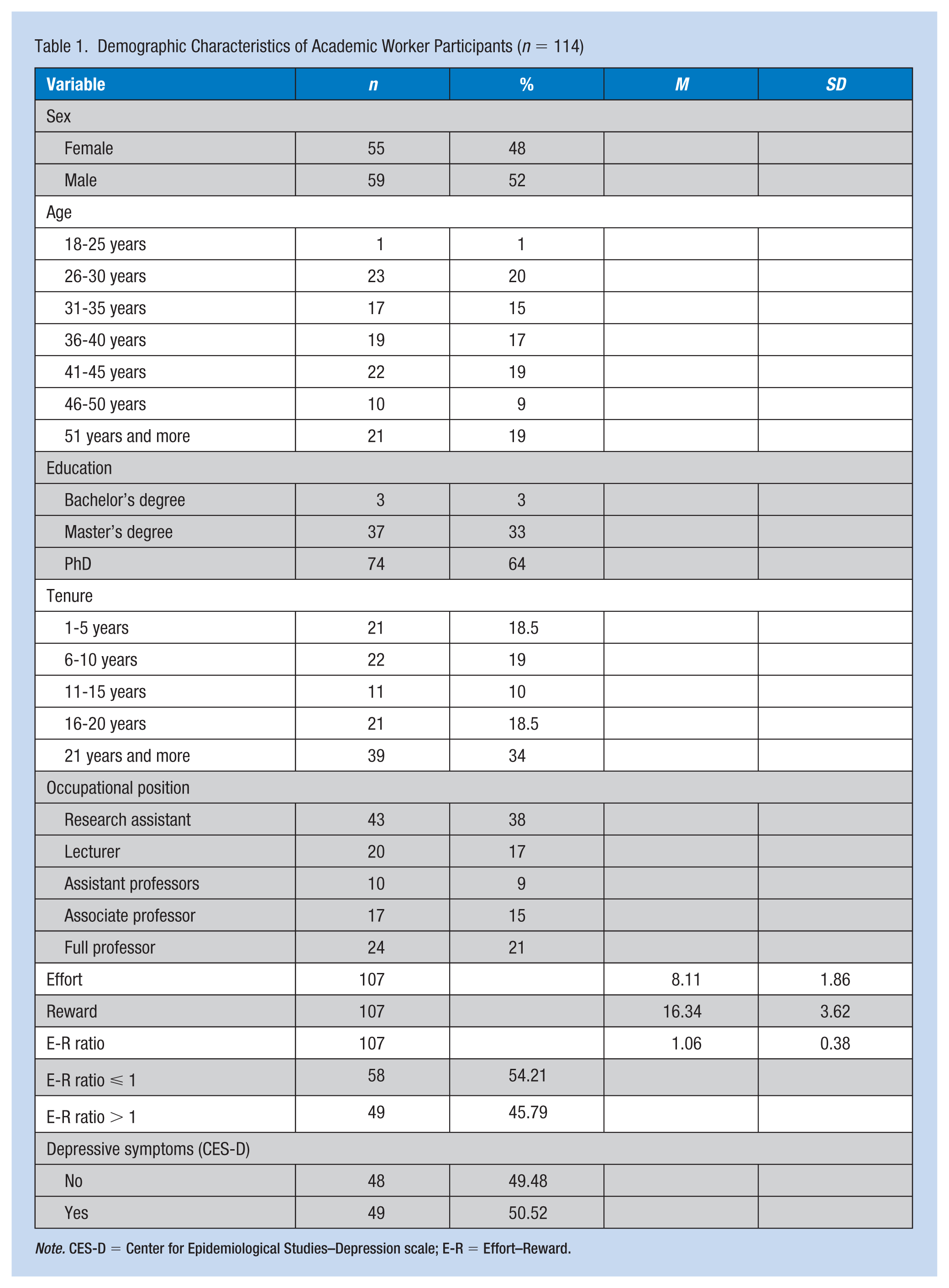
Table 1 provides a description of the study sample. A total of 114 of 170 (67%) responded to the survey. Of the respondents, there was a similar distribution of male and female workers (~50% each), with a consistent distribution across age groups. The majority of participants (64%) had a doctoral degree and were tenured. Research assistants accounted for the largest group (38%), followed by a similar distribution (15%-21%) of lecturers, associate professors and full professors, as well as 9% assistant professors.
Demographic Characteristics of Academic Worker Participants (n = 114)
Note. CES-D = Center for Epidemiological Studies–Depression scale; E-R = Effort–Reward.
The mean score of E-R ratio in this sample was 1.06, resulting in 45.8% with an E-R ratio > 1, indicating that the mean stress level in this sample was high. In addition, more than half of the participants reported having depressive symptoms.
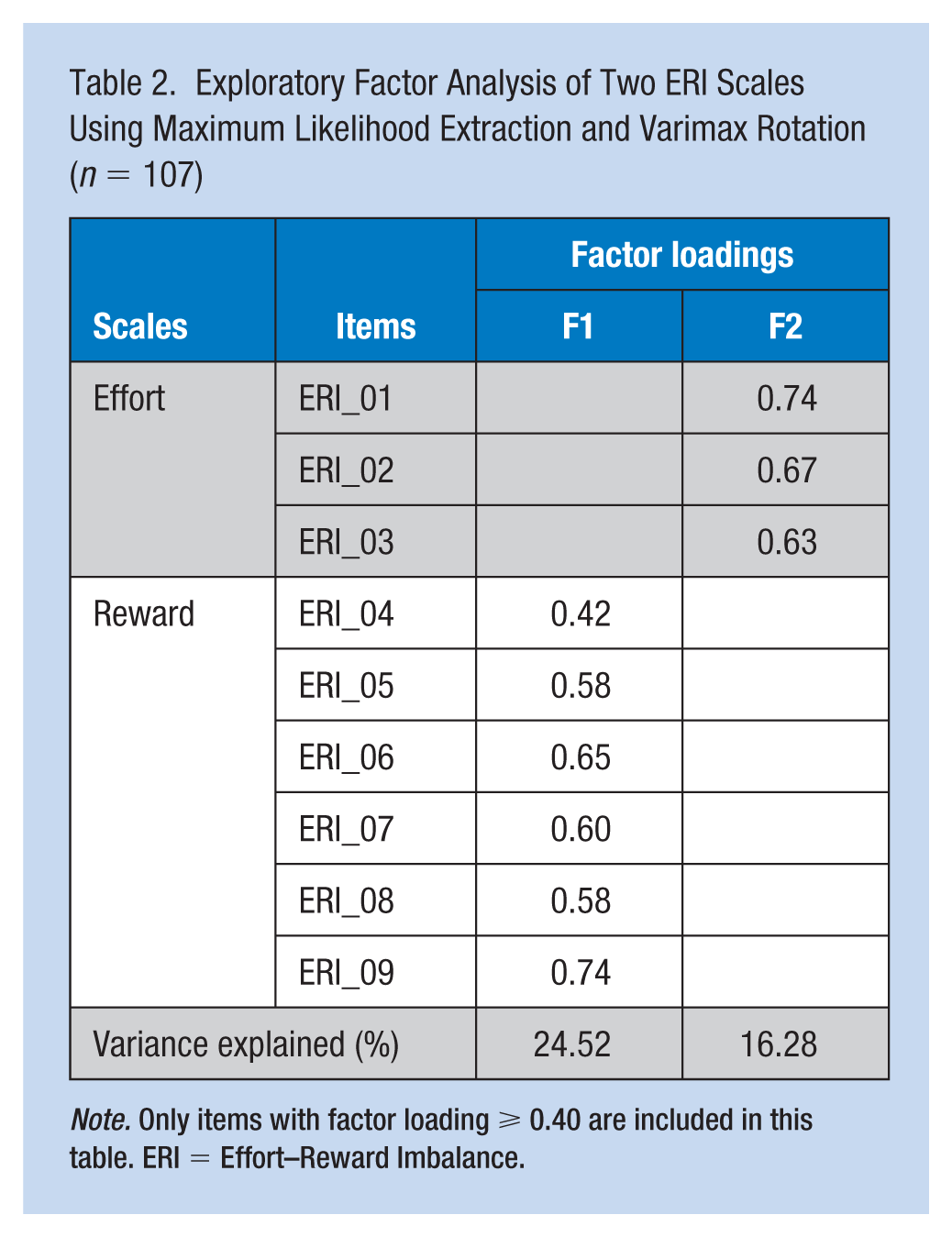
In Table 2, the results of this exploratory factor analysis are displayed. The two ERI scales showed satisfactory internal consistency (Cronbach’s α: Effort = .75; Reward: .76). However, one item of the scale “Reward” (considering all my efforts and achievements my salary/income is adequate) had to be removed, given its extremely low item to total scale correlation (–.09).
Exploratory Factor Analysis of Two ERI Scales Using Maximum Likelihood Extraction and Varimax Rotation (n = 107)
Note. Only items with factor loading ⩾ 0.40 are included in this table. ERI = Effort–Reward Imbalance.
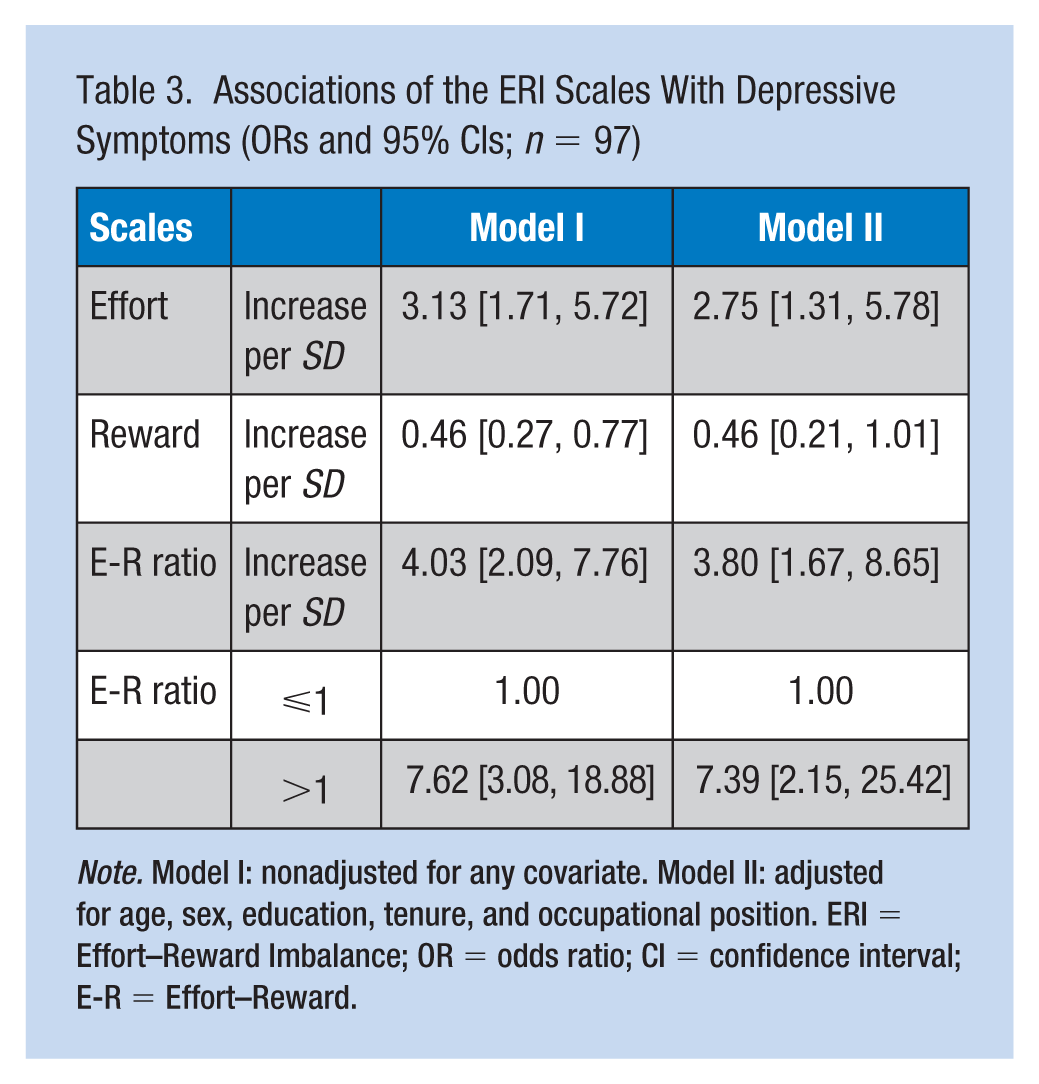
Table 3 includes associations between ERI scales and depressive symptoms. A positive association was observed between the effort scale and depressive symptoms, with an elevated odds (OR: 2.75; 95% CI: [1.31, 5.78]) of depressive symptoms for every SD increase in the effort score. Conversely, there was a decreased odds (0.45 (95% CI: [0.21, 1.01]) of depressive symptoms for every SD increase in the reward score. The association of the combined measure (E-R ratio) was much stronger (OR: 7.39, 95% CI: [2.15, 25.42]) than the association of the single scales. Findings from the multivariate models indicate that the associations were somewhat attenuated after adjustment for covariates.
Associations of the ERI Scales With Depressive Symptoms (ORs and 95% CIs; n = 97)
Note. Model I: nonadjusted for any covariate. Model II: adjusted for age, sex, education, tenure, and occupational position. ERI = Effort–Reward Imbalance; OR = odds ratio; CI = confidence interval; E-R = Effort–Reward.
Discussion
In this study, an internationally established theoretical model of stressful work, ERI, was used to examine associations with depressive symptoms among a group of academic workers in a Turkish University. This pilot study is part of a larger initiative to test the psychometric properties of all three scales of the short version of the ERI questionnaire in Turkish language. The findings indicated consistent associations of the single scales, namely “Effort” and “Reward,” and in particular of the theoretically important summary measure of the E-R ratio, with elevated risks of depressive symptoms in this sample. The elevated odds observed in this group seem quite remarkable given the expectation that these workers have available resources that would support coping (Montgomery, 2017). In this study, we were not able to investigate the sources and intensity of stressful working conditions in the university context. Yet, the results are in line with a majority of previous investigations of stressful work among academic persons and their associations with poor mental health (Gomes et al., 2013; Taris et al., 2001; Winefield et al., 2003). Moreover, it is worth noting that the mental health outcome in our study, depressive symptoms, was measured by the well-established CES-D scale, and it has been successfully adapted in the Turkish culture (Tatar-Saltukoğlu, 2010).
This study has a number of limitations. First, given its cross-sectional study design, a causal association cannot be established. We cannot exclude the possibility that participants experienced a high level of depressive symptoms irrespective of their work experience and that high depressive mood biased the answers of items measuring stressful work. A second limitation relates to the small sample size and the fact that it was restricted to members of one faculty within one single university. Therefore, findings cannot be generalized beyond this scope. Third, we restricted this pilot study to the two extrinsic components of the ERI model, but further studies will supplement it by including the intrinsic component “overcommitment.” Future studies would benefit from investigating specific work-related stressful conditions combined with overall workplace stress, as demonstrated in a recent German study (Vu-Eickmann, Li, Müller, Angerer, & Loerbroks, 2018). Within this study sample, it was not possible to conduct subgroup analyses, although it would be of interest to see whether the observed associations are particularly strong among research assistants who experience higher job insecurity.
In conclusion, this is one of the first investigations addressing the psychosocial work environment of academic university personnel and their mental health in a country with substantial investments in tertiary education and research. In view of a large academic workforce in this country, these results may point to a need for addressing the health-adverse and health-conducive aspects of academic working conditions in terms of distinctive preventive measures. Yet, more in-depth research will be needed to guide such efforts into health-promoting work environments.
Implications for Occupational Health Nursing Practice
The high prevalence of stressful work in terms of the ERI in this study and its association with depressive symptoms were rather strong and support the need for offering measures of stress prevention within the occupational contexts. Such measures include the personal level of strengthening individual coping capacities, the interpersonal level of improving communication and leadership behavior, and the structural level of job redesign, as well as personnel and organizational development (Bourbonnais, Brisson, & Vézina, 2011). As was shown in a recent systematic review, combining these levels of intervention is likely to produce significant benefits on the health and well-being of workers exposed to stressful work (Montano, Hoven, & Siegrist, 2014). We recommend that occupational health nurses in the academic setting seek out methods for examining stress in their population through the use of the ERI survey and using these findings to inform stress-reduction interventions.
As a pioneer study in Turkey, the findings of our research demonstrated high levels of work stress measured by the internationally well-established effort-reward imbalance questionnaire, and a strong association with depressive symptoms, among university workers. Based on the theory of effort-reward imbalance, several intervention measures have been tested for their effectiveness, with a focus on reducing workers’ efforts and demands and simultaneously improving reward in the workplace. Specifically for university workers’, their work overload and exceeding job demands should be restricted, such as excessive over-time teaching, research work, and excessive student supervision load. As for the increased reward, respective measures should focus on improved career prospects based on training and achievement of professors and scientists, particularly providing non-material rewards (such as recognition of their valuable work, positive feedback regarding their contributions) from superiors and university leaders, as well as material rewards including higher wages and performance-based subsidy.
Footnotes
Declaration of Conflicting Interests
The author(s) declared no potential conflicts of interest with respect to the research, authorship, and/or publication of this article.
Funding
The author(s) received no financial support for the research, authorship, and/or publication of this article.

Author Biographies
Aşkın Keser is a Professor of Work Psychology at the, Faculty of Economics and Administrative Sciences, University of Bursa Uludağ, Turkey. His research interests are, job/life satisfaction, effort-reward imbalance model, workload, job insecurity, stress at work, burnout and job strain.
Jian Li is a senior researcher at the Institute of Occupational, Social and Environmental Medicine, Faculty of Medicine, University of Düsseldorf, Germany. His research interests are occupational health and epidemiology, especially work stress measurement, health effects, and intervention.
Johannes Siegrist is a professor emeritus of Medical Sociology at the Faculty of Medicine, University of Düsseldorf, Germany. With his long-standing research he made significant contributions to the analysis of health-adverse effects of stressful modern working conditions.