



Abstract
Stairwell use is a cost-effective opportunity to increase physical activity. Although stairwell use can integrate moderate physical activity in daily work routines, little information is available to guide architects and engineers on how to design facilities that promote stairwell use. This study examined the reasons behind using stairwells versus elevators through a case study at a teaching hospital. A broad range of physical design recommendations were evaluated to understand how the design of stairwells can encourage hospital staff and students to use them. An online survey was used to collect data. Findings indicated travel distance and travel direction as primary reasons for preferring elevators. Design recommendations such as motivational signs and physical movement reinforcements (e.g., cardio indicators) are discussed.
Millions of Americans suffer from illnesses that could be prevented through regular physical activities (Coleman & Gonzalez 2001; Reiner, Niermann, Jekauc, & Woll, 2013). Using stairwells instead of escalators or elevators is one way to become more active. Encouraging stairwell use at work can improve fitness, body composition, and blood pressure, and is a simple way to significantly reduce cardiovascular disease risks for those individuals with sedentary lifestyles (Meyer et al., 2010). Nevertheless, researchers and practitioners still need to understand the factors that encourage regular use of stairwells.
The literature adequately explains the health benefits of using stairwells. Research to encourage stairwell use over elevator use has been conducted in various settings. Howie and Young (2011) used campaigns, such as rotating stairwell prompts in dormitories, competition with rewards on stair climbing, and a scavenger hunt in the stairwell. Stairwell use increased from 24.9% at the baseline to 33.2% during the campaign, but stairwell use returned to baseline levels of 25.4% after the campaign. Their study revealed the weakness of using incentives as behavioral reinforcement. Brownell, Stunkard, and Albaum (1980) examined the effects of a health promotion sign placed adjacent to stairwells and escalators in urban settings. The researchers found that use of stairwells almost doubled while the health promotion sign was actively displayed and remained elevated even 1 month after removal of the sign. Meyer et al. (2010) researched a 12-week promotional campaign for stairwell use by using posters and floor stickers between stairwells and elevators on each floor of a university hospital building. For 77 selected employees with an inactive lifestyle, baseline, 12-week, and 6-month measures were collected on physical activity, aerobic fitness, anthropometrics, blood pressure, lipids, insulin sensitivity, and C-reactive protein. This study showed that encouraging healthy adults to use stairs instead of elevators at work is effective in improving cardiorespiratory fitness and reducing cardiovascular disease risk factors. Blamey, Mutrie, and Tom (1995) investigated whether Scottish commuters or shoppers would respond to motivational signs encouraging them to walk up stairs rather than take an escalator. The study showed that the motivational sign positively influenced stairwell use in a safe and well-lit venue. However, the improvement in stairwell use was only slightly greater than that found in similar American studies.
One of the most common locations for stairwell use is the workplace. Most people spend half of their waking life at work (Eves, Webb, & Mutrie, 2006). Many workplaces have more than one floor and usually offer both stairwells and elevators. Using stairwells at the workplace provides a potentially cost-effective and accessible means of increasing physical activity. Moreover, workers can use stairwells without any special equipment, changing clothes, or membership fees (Nicoll, 2006). The health benefits of moderate physical activity among office workers can be supported by designing buildings that facilitate and encourage stairwell use. Despite the evidence for the benefits of using stairwells in workplaces, little is known about strategies that effectively increase stairwell use. Building aesthetics, location of stairwells, and characteristics of the target population are some factors to consider in studying the promotion of stairwell use (Smith, 2011).
Nicoll (2006), to understand the role of the physical environment in stairwell use, studied architectural designs that might encourage stairwell use. Findings suggested that stairwell use was predicted by eight key spatial variables: (a) located along the main paths of circulation, (b) a visible point of entry, (c) close proximity and highly visible to workers, (d) visible from the largest area, (e) entrance doors oriented toward the first stair step, (f) sufficient stair width, (g) accessible to floors at all levels, and (h) increased visibility via open stairs.
Boutelle, Jeffery, Murray, and Schmitz (2001) reported that at a school of public health building, using just a stairwell prompt that read “Take the stairwells for your health” increased stairwell use, but when the prompt was accompanied by stairwell music and artwork, stairwell use further increased. Kerr, Eves, and Carroll (2001a, 2001b) reported two studies in different office buildings. They investigated the effects of intervention signs on stairwell climbing and stairwell descent. In both studies, no increase in stairwell climbing was observed, but the interventions increased stairwell descent. Van Nieuw-Amerongen, Kremers, De Vries, and Kok (2009) considered environmental changes (e.g., green paint in stairwells, speckled carpeting, and glass doors) to the stairwells of a university building to heighten visibility along with stairwell prompts and footprints leading to the stairwells. These modifications increased stairwell use after a 4-week intervention. Marshall (2004) reported a modest increase in hospital stairwell use by using an intervention poster, but the effect was not sustained after removing the intervention. Lewis and Eves (2012) reported that a stairwell prompt placed in the elevator did not increase stairwell use.
Although several studies have postulated design interventions for promoting stairwell use, workers’ feedback to these interventions were not satisfactorily investigated and addressed. Identifying which strategies and engineering design changes can persuade sustained active use of stairwells is necessary.
Research Objectives
The aim of this study was to understand if use of elevators is more attractive for staff and students at a teaching hospital and then identify strategies to promote the culture of stairwell use. An online survey was administered to hospital staff to determine how often they use stairwells or elevators, reasons for their preference in using elevators rather than stairwells, and suggestions about changes in stairwells that could promote stairwell use. Physical layout recommendations for design of the stairwells and motivational features to promote stairwell use are also discussed.
Research Methodology
The case study approach was selected as the preferred research strategy to facilitate the identification of the main concepts involved and investigate the problem “within its real-life context” (Yin, 2003). The study was conducted in a teaching hospital in the Midwestern United States. This hospital is a multi-building institution (i.e., pavilions) having five to eight floors each with access to each floor provided by stairwells and elevators. Currently, stairwells are often hidden, and many hospital staff are not aware of their locations, even though identification of stairwell locations may prove critical in an emergency situation and the institution’s ability to comply with fire codes. Moreover, directions to any location in the hospital are usually given based on the letter of the elevators, as all elevators are given a letter name and alphabetized from the north end of the hospital to the south end. Throughout the hospital, signs provide the direction to various elevators. Stairwells are located close to each elevator. However, stairwells do not have names, or signs to direct patients, visitors, and staff to them. This study was conducted in the general hospital pavilion where four elevators are located.
Survey
An online survey was administered to hospital staff and students asking them to provide the frequency at which they use stairwells and elevators. The underlying reasons for preferring stairwells and elevators were also investigated. Participants also provided their perception of the physical changes that would motivate them to use stairwells.
The survey had three sections. The first section gathered information on participant demographics. The second section studied the familiarity of the participants with the location of closest stairwells to the participant’s unit/work area, the number of times participants use stairwells or elevators per day, and their preference for use. Furthermore, participants were asked to choose reasons they preferred stairwells or elevators from provided options (Figures 1 and 2).
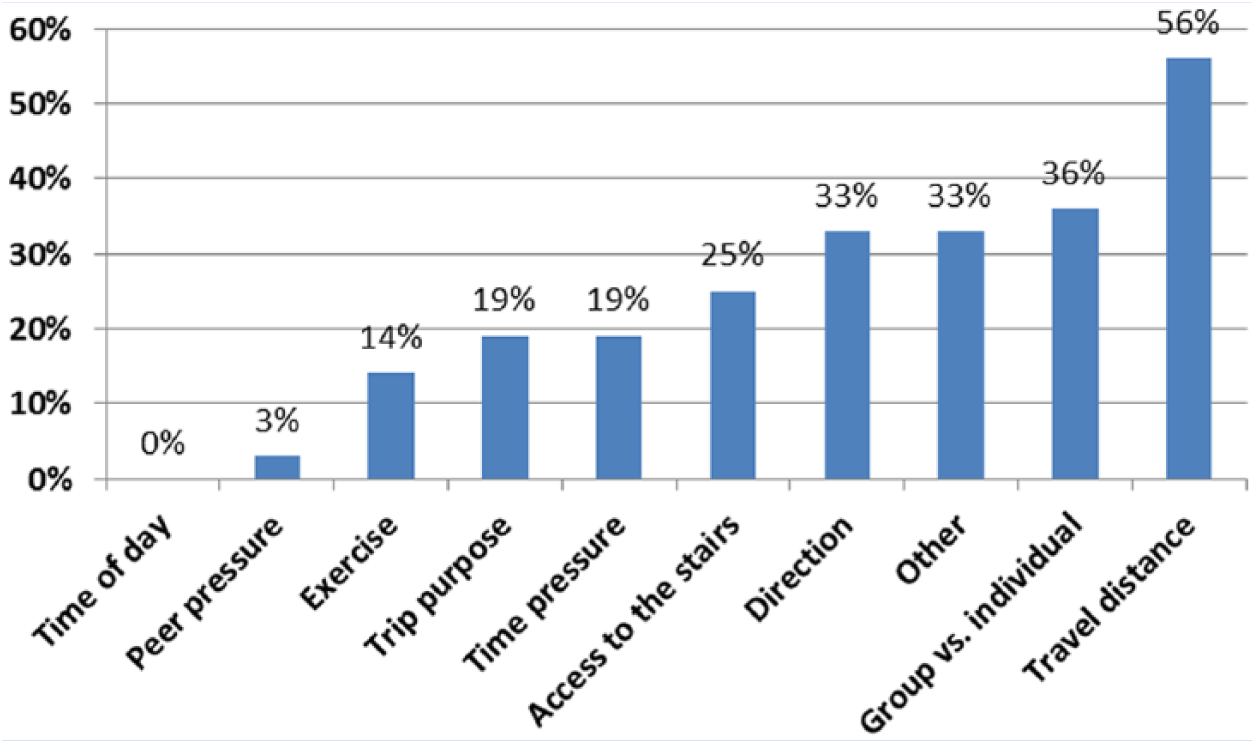
Reasons for preferring stairwells to elevators.
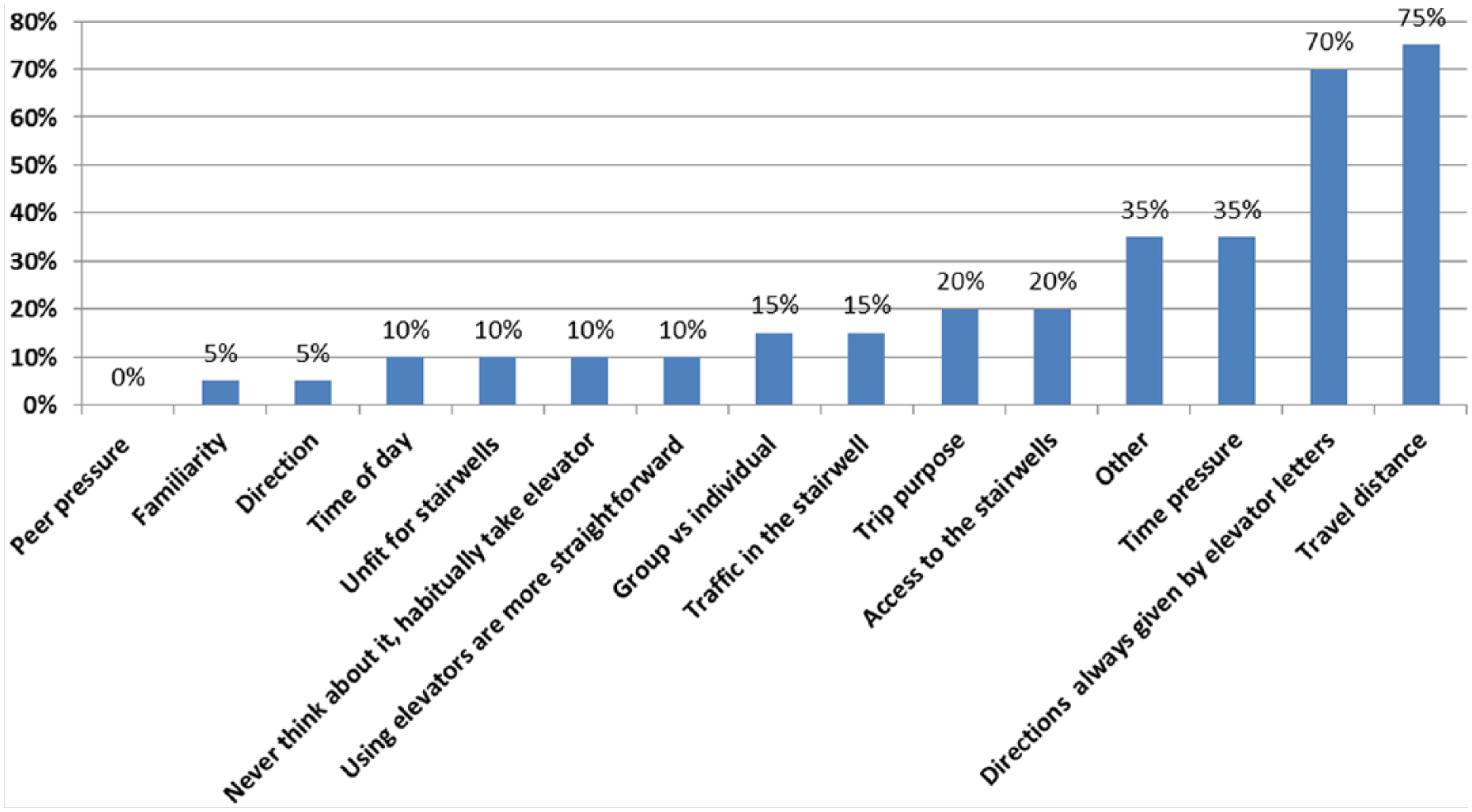
Reasons for preferring elevators to stairwells.
The third section of the survey focused on how to promote stairwell use. Respondents were asked about the maximum number of flights they would consider climbing. They were also asked to rank the motivational influences of design changes (see list below) in the stairwells. Participants ranked the design suggestions from 1 to 5, with 1 being not at all influential and 5 being very influential.
Map of the closest stairwells near the elevators
By posting a map near the elevators showing the closest stairwells, elevators users were better informed about the stairwells and where they were situated.
Naming or numbering the stairwells
Assigning a name or number to each stairwell provided directions based on the stairwells.
A “you are here” plan at the exit of stairwells to each floor
Posting such a plan assisted staff to understand where they would exit when they used the stairwells.
Footstep marks from elevators to stairwells
Posting marks provided the direction from elevators to stairwells to encourage stairwell use.
Motivational sign
Posting motivational signs near elevators (e.g., “No waiting one door over”) as well as stairwells (e.g., “free gym”) can indicate the positive impact of stairwell use on health.
Artworks on the stairwell walls
Decorating stairwell walls with artwork, and changing them every month can help enliven the stairwells and promote their use.
Creative lighting
Changing stairwell illumination by applying creative styles of lighting can increase stairwell use.
Music
Music, changed daily, can influence stairwell use.
Graffiti
Assigning a section of the stairwell walls (e.g., on the last floor) as the graffiti section, allows staff to draw, write, or sign on the wall and encourages staff to climb more floors.
Themed-painted stairwells
Similar to hanging artworks and using creative lighting, themed painting of stairs and walls (e.g., writing encouraging sentences or painting a picture of nature) can also encourage stairwell use.
Progressive numbering of each stair in the stairwell or cumulating stair miles
By using stair miles or marking the number of each stair throughout the stairwell, staff know how far or how many stairs they climbed.
Cardio indicators
Providing a cardio indicator guideline or device to measure calories burned by climbing stairs can help staff recognize the influence of using stairwells on their health.
Demographics
Personnel on multiple units in the general hospital pavilion received the online survey. However, respondents were not asked to limit their answers to the elevators in their areas. Fifty-five participants responded to the survey. The majority of respondents were female (91%) and included 33 nurses (60%), 13 administrative staff (24%), 2 physicians (4%), and a researcher (2%). The other 6 respondents (11%) specified as others, included a nurse manager, an information technology professional, a nursing unit clerk, and two nursing assistants. The majority of respondents were 50 to 59 years old (44%), 27% were 40 to 49 years old, 20% between 20 and 29 years old, and only 9% were above 60 years old. Eighty-four percent of respondents reported more than 5 years work experience at this hospital; 11% of them reported 1 to 3 years, and 5% worked less than a year at the hospital; they were less familiar with the environment.
Results of Using Stairwells Versus Elevators
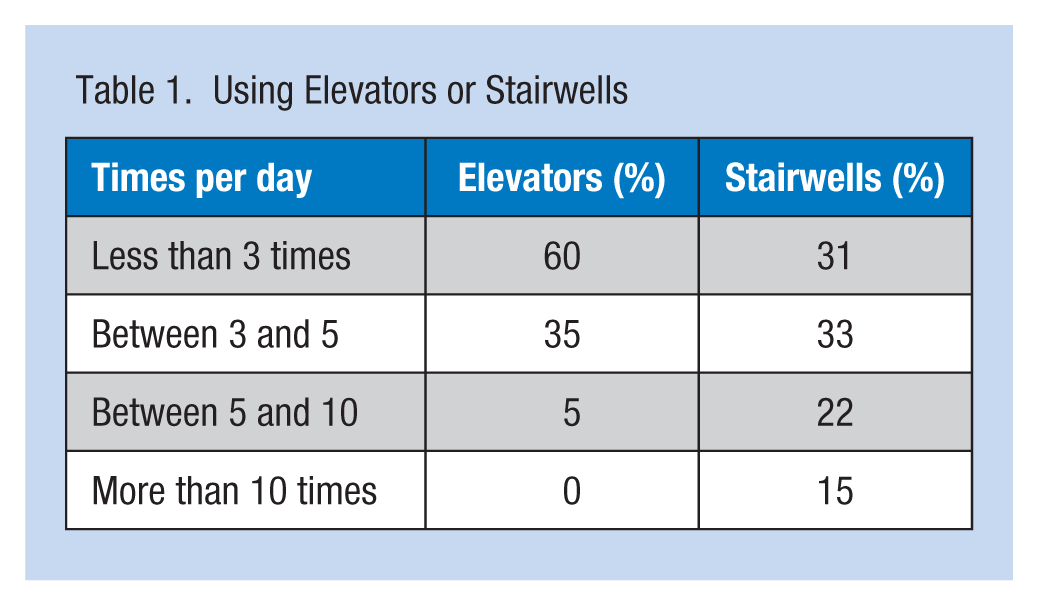
All the respondents knew where the stairwell closest to their work unit was located. Table 1 shows a comparison of the responses regarding the approximate number of times participants used elevators or stairwells per day. Interestingly, when the frequency of usage per day was lower, elevators were used more often by staff. In contrast, those who traveled between hospital floors more than 10 times a day reported using stairwells more often (Table 1).
Using Elevators or Stairwells
Sixty-four percent of respondents stated that they preferred to use stairwells rather than elevators. Motivation for preferring stairwells to elevators (Figure 1) or elevators to stairwells (Figure 2) was analyzed. Travel distance (number of floors) and travel direction (going up or down) significantly influenced choosing stairwells or elevators. Time pressure and emergencies also influenced elevator use. When workers traveled in groups, they preferred stairwells.
Other reasons that hospital staff reported using elevators included the following:
Hands full (e.g., large number of or heavy items, carrying equipment, supplies, mail, and even a coffee cup) and not able to open stairwell (fire) doors
Transporting patients. One of the staff mentioned, I work on the 7th floor and I use the stairwells whenever possible: when I come in, when I run labs, when I go down to the café, etc. The only time I use the elevator is if I am transporting a patient.
Physical limitations. As an example, one referred to the trouble with knees, particularly arthritis, osteoarthritis of the feet, and other injuries. In such cases, using elevators minimizes the physical efforts for the hospital staff and can be less painful and/or tiring. One of the nurses noted, As a nurse you are on your feet all day and have to walk all day on poorly padded concrete floors. The stairwells are sometimes out of the way and are very narrow. If you are carrying items it is hard to walk up the stairwells without tripping on the material on the stairwells and you cannot hold on the rail very easy. If you are on your feet 12 to 14 hours a day, the elevator is a nice break and sometimes the only time you get a moment to yourself.
Another respondent remarked, “I try to go up the stairwells as much as possible. However having had knee surgery, going down is harder than going up, so if it is more than 3 to 4 floors, I will take an elevator down.”
Environmental issues of stairwells (e.g., smells, roaches, poorly lighted, or dirty with dust bunnies everywhere). Concerning this issue, one of the participants stated, “If I am heading toward lunch, I do not use the stairwells because they are dirty and there is not a sink available to wash my hands once I reach my food destination.”
Some pavilion floors do not line up or cannot be accessed via stairwells in a restricted area. For instance, one of the respondents mentioned,
The stairwell to the north of elevator G has an area open to the outside that you must walk through to get to the stairwells. Who would want to walk in there when it is extremely hot or cold outside?
The survey also investigated the maximum number of floors one would consider climbing when using stairwells (see Figure 3). Twenty-six percent of staff reported they would climb up or down the stairwells to the destination floor. For the staff who use stairs, most will climb up to the fourth floor, but beyond that, fewer staff are willing to take the stairs. The average number of flights that hospital staff are willing to climb is four floors.
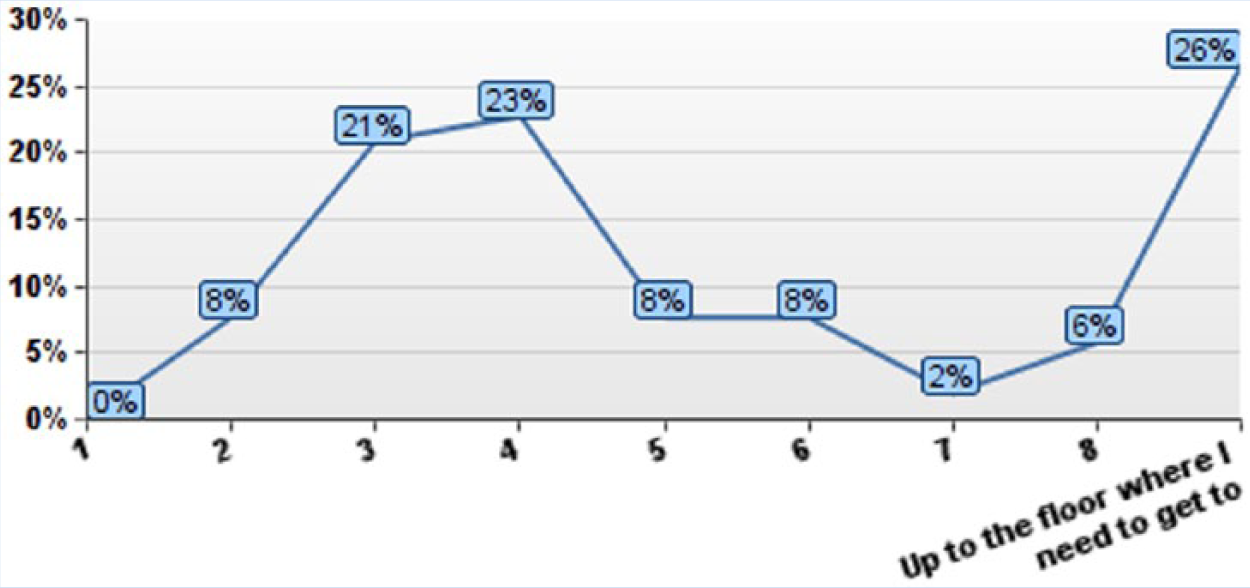
Maximum number of floors one would climb using stairwells.
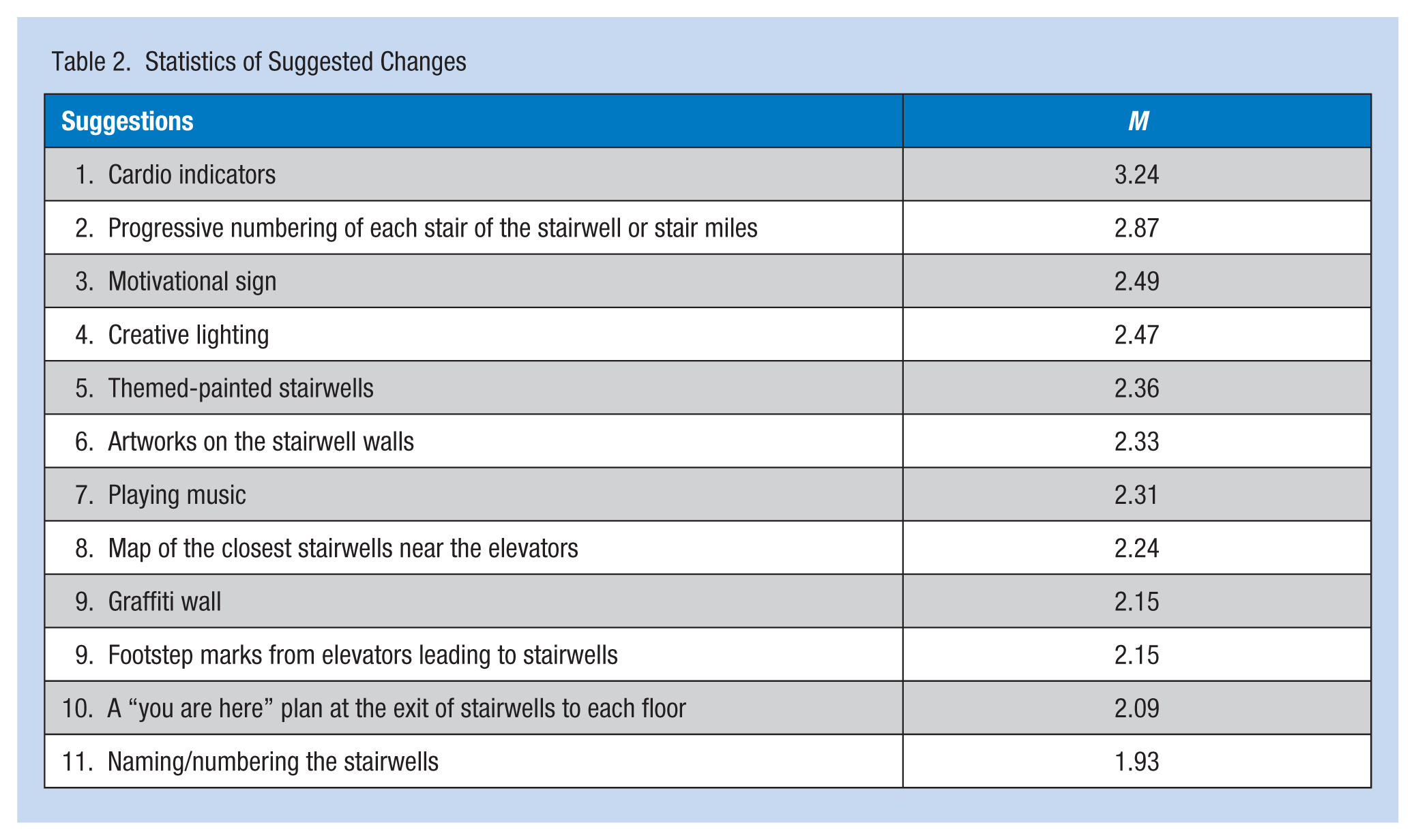
Hospital staff participants were asked to rate 12 suggestions to improve stairwell use, including physical layout and stairwell design changes. The mean value for each suggestion was calculated and shown in Table 2. Implementing cardio indicators generated the most interest among staff. These indicators could be installed in existing stairwells so that users could identify the number of burned calories based on the number of floors they climbed up or down. Progressive numbering of each stair or stair miles ranked second in promoting stairwell use. This strategy could encourage stairwell users by showing them the number of stairs they had climbed and how far they had climbed. Posting motivational signs at the elevators or stairwell doors was the third most influential factor. Independent of reasoning on the sign, this option simply encourages staff to open stairwell doors and use them. Creative and artistic physical design changes, including creative lighting, wall paintings, and hanging artworks throughout the stairwells were other choices. These artistic changes could encourage staff to climb the stairs even if it is only to enjoy the artwork.
Statistics of Suggested Changes
Discussion: Promoting Stairwell Use
Stairwell use is a lifestyle strategy that can increase physical activity and improve health. However, building regulations designate stairwells primarily for emergency exiting from buildings. Due to this safety focus, building and fire codes influence the design and architecture of buildings and stairwells. These regulations do not dictate or encourage the awareness of their location for daily use. The only requirement is the provision of illuminated exit signs (Nicoll, 2006).
The results of this case study indicated that all the survey respondents were familiar with the location of stairwells. Considering that more than 80% of the results were from staff with more than 5 years of experience at the hospital, their familiarity with the location of stairwells is logical. This finding demonstrates that stairwell use is already prevalent among hospital staff; 64% of respondents prefer to use stairwells rather than elevators. This finding means that using stairwells is already a common habit among hospital staff and students in the study hospital. Encouraging more stairwell use when moving about the hospital could lead to even greater health improvements.
Survey results showed that respondents generally preferred climbing up to four floors but were less inclined to use the stairs if they were climbing more than four flights. Design and aesthetic changes in the stairwells could promote the use of stairs beyond the four floors preferred. Changes to be considered include creativity in physical design of stairwells, reinforcement signs encouraging a healthier lifestyle by using the stairs, offering a well-maintained environment throughout the stairwells, and offering a scheme to combine elevator and stair travel. This latter suggestion stems from one of the survey respondents who stated, “I always take the stairwells and zigzag across the stairwells in different pavilions, if I have too many floors to go at once.”
During this study, survey respondents suggested several engineering changes for stairwells; however, these changes can only be implemented if they satisfy building and fire codes for hospitals.
Redesigning the Doors
Easier ways to open stairwell doors could promote stairwell use. Some of the door handles are hard to grasp, press, push, or turn, discouraging staff from taking stairs when their hands are full. Besides, some workers may not use stairwells because they do not want to touch the door handle. As one of the survey respondent mentioned, I prefer using the stairwells in most situations and immediately use the CHG product when exiting the stairwell. I do not use the stairwells if I am headed to lunch because I have to touch the very dirty door handle prior to leaving the stairwells.
Installing Footpulls, devices that allow users to open doors using their feet instead of their hands, is one possible solution. However, Footpulls are mainly used for swinging doors without a latch. Another recommendation is to have handicap accessible doors throughout the hospital.
Stairwell Repairs
Not all stairwells were in good condition and could potentially lead to safety and trip hazards. Many stairwells needed repair because the stairwell treads were loose or the tiles on the stairwells were broken or worn. One of the respondents said, “I use the stairwells because I need and want to exercise. I think before we push everyone to try using stairwells, we first need to ensure that they are repaired on a consistent basis so that they are safe.”
Windows in Stairwells
Installing windows with outside views, wherever possible, could increase stairwell use. Moreover, larger windows in stairwell doors could allow users to see others who are exiting and entering the stairwells.
Wider Stairwells
Some stairwells were noted to be narrow, making it difficult when two people try to pass each other in the stairwells. One of the respondents commented, “There is not enough room to pass except at the landings of the stairwells, and it is awkward. The stairwell near BW elevator can be named as an example.”
Environmental Changes in Stairwells
The stairwells need regular cleaning to be more appealing. The dirty stairwells were an issue for many of the survey respondents: I have walked in the stairwells and seen things spilled that are still there a week later and are dried up. I have seen cobwebs, dirty tissues, and partial cups of coffee sitting there for several days. I do not have gloves with me, so will not touch those things to pick them up.
Besides the dirt, dust bunnies, and spider webs in the stairwells, unpleasant odors also make stairwells uninviting. Numbering the stairwells would improve reporting their condition routinely to housekeeping. Moreover, pleasant lighting could greatly improve some stairwells. One of the respondents said, “The stairwells are quite dreary; sprucing them up with light and fun paint would be a great idea.” Another person said, “Stairwells are dark and gloomy with few windows.” Artificial lighting and natural lighting through windows are advantageous. Participants also reported temperature control as an issue. Some stairwells are very cold (vented), and others are too warm as one climbs to higher floors. Moreover, not all the stairwells are connected within the buildings.
Clear Signage in Stairwells
Clearly marking stairwells could promote their use. Currently, they are hidden in many locations of the hospital. Using simple signage, such as “Stairwells are right behind you” or “Why not take the stairwells?” is suggested. The results from Grimstvedt et al. (2011) study strengthen this recommendation. Their study examined stair visibility as a variable apart from a stair prompt in academic buildings, and the outcomes showed a 12% increase in the use of stairwells.
Most staff members are motivated to take the stairwells for exercise and to avoid significant delays in availability of elevators. The experience of one of the respondents was interesting: “I tend to walk up 2 to 3 floors and then cross over to another stairwell and again go up 2 to 3 floors depending on where I need to go.”
Some staff expressed little willingness to take the elevator unless its doors were open. The main reason was the delay in elevators reaching the destination due to stopping on every floor. As one of the staff said, “I rarely use the elevator and know where most of the stairwells are. I hate waiting for an elevator. The only time I take an elevator is if I am with the staff that cannot climb stairwells.” Nevertheless, the primary purpose of the elevators should be reserved for transferring patients.
Generally, respondents were positive about the effect of physical and design changes recommended in the survey. They indicated that they would take the stairwells for all the floors just to see the artwork and cardio indicators. For instance, one of the participants mentioned “I often take different routes to the same place just to explore the art on different floors. Making the trip less routine with art and music would make me consider stairwells over the elevators.” Nevertheless, individual motivation had the greatest influence. Boutelle et al. (2001) encouraged redesign changes when they found that more participants used the stairwells when music and artwork were used compared with when prompt signs alone were used.
Implications for Occupational Health Nurses
Occupational health nurses in academic medical centers and smaller hospitals evaluate employees for a variety of health conditions, many of which are related to inadequate physical activity. Recommendations to employees often include gradual strategies for improving strength and conditioning, as well as cardiopulmonary performance. Use of stairs while at the worksite is a simple, low-cost strategy that most ambulatory employees can use if properly encouraged and instructed on how to locate stairs and gradually walk up and down them throughout the day as a health promotion strategy. Occupational health nurses can also consider the many ideas suggested in this article for enhancing stairwell use and become strong advocates and role models by taking the stairs themselves. Promoting stairwell use is completely aligned with other efforts and initiatives for promoting employee health and wellness in the hospital where this study was conducted. At least two researchers have been hired to study worksite interventions (e.g., Tucker et al., 2011; Carr et al., 2014), which include creative strategies for reducing sedentary work activities and increasing overall energy expenditure at work.
Although designing aesthetically pleasing stairwells may increase interest and frequency in using them, design changes alone may not motivate workers to use stairwells. Stairwell use is a healthy lifestyle behavior and requires individuals to be willing and motivated to improve their health.
Conclusion
Stair climbing is an inexpensive and simple physical activity that can be done in most workplace. This article presents reasons for using stairwells or elevators at a teaching hospital. The researchers recommend physical design changes to promote stairwell use based on 55 online survey responses. The main reasons for using elevators included travel distance, direction, and time pressure in emergencies. Other reasons such as having one’s hands full, transporting patients, physical limitations, environmental issues, and accessibility to stairwells were also reported. Top-rated design changes to promote stairwell use included installing cardio indicators, progressive numbering of each stair or stair miles, motivational signs, and creative and artistic physical design changes. Moreover, stairwell door redesign, windows for outdoor views, wider stairwells, and regular cleaning and repair of stairwells may increase stairwell use.
The results of this study are interpreted cautiously, given the small sample size. Collecting information from a larger study group could strengthen these research findings. Future research should investigate the applicability of suggested redesign changes. For that, input from architects on potential design changes must be taken into account. Specific stairwells across the hospital should be targeted based on characteristics such as frequency of use and visibility to users.
Applying Research to Practice
At every hospital, staff are often presented with a choice between using the stairwell and taking an elevator. Choosing the stairs instead of the elevator is a quick way for the staff to add physical activity to their day. This research presented various physical design recommendations which can be used to promote using stairwells at hospitals.
As part of a large-scale workplace health campaign, if applying one or several of these design recommendations can encourage even a small percentage of hospital staff to use the stairwell, it could be of significance to hospital staff health outcomes.
Nevertheless, design changes need to be conveyed to hospital leadership with cultural changes of hospital staff that can ensure a healthy lifestyle behavior.
Footnotes
Acknowledgements
The authors acknowledge the support from all the survey participants during this study.
Conflict of Interest
The author(s) declared no potential conflicts of interest with respect to the research, authorship, and/or publication of this article.
Funding
The author(s) received no financial support for the research, authorship, and/or publication of this article.
Author Biographies
Afrooz Moatari-Kazerouni has a PhD in Industrial Engineering from Polytechnique Montreal, Canada. Her research focuses on planning and designing facility layouts, occupational health and safety, and process improvements. She has worked on different projects within the healthcare settings and in collaboration with hospitals in Canada and the U.S.
Priyadarshini Pennathur, PhD, is a faculty in the Department of Mechanical and Industrial Engineering at the University of Iowa. She received a doctoral degree in Industrial and Systems Engineering from the University at Buffalo in 2010. She was a post-doctoral research fellow at Armstrong Institute for Patient Safety and Quality at the Johns Hopkins University School of Medicine. Her research interests are in understanding cognitive artifacts and how humans create and use information in complex work systems. Her work is primarily in the healthcare systems.
Sharon J. Tucker, PhD, RN, FAAN, PMHCNS-BC, is the Director for Nursing Research, Evidence-Based Practice and Quality in the Department of Nursing at the University of Iowa Hospitals and Clinics. Her research focuses on behavioral strategies to promote health and wellness, prevent disease, and reduce stress and risks, particularly among working women and children. Increasing physical activity through worksite interventions is one behavioral/environmental strategy she and colleagues are studying.
Luke A. Leyden, AIA, LEED AP BD+C, is a registered architect with the University of Iowa Hospitals and Clinics. He has spent the last 12 years focused on the design of health care facilities, looking for ways to improve patient and visitor experience.