




Abstract
Traffic accidents are a major public health problem, leading to death and disability. Although pertinent studies have been conducted, little data are available in Iran. This study explored the experiences of truck drivers and their perspectives regarding factors contributing to traffic accidents. Eighteen truck drivers, purposively sampled, participated in semi-structured interviews. Data were analyzed using qualitative content analysis. A main theme, lack of ability to control stress, emerged as a factor influencing the incidence of traffic accidents. This main theme was found to have three subthemes: poor organization of the job, lack of workplace facilities and proper equipment, and unsupportive environment. Although several factors were found to contribute to traffic accidents, their effects were not independent, and all were considered significant. Identifying factors that contribute to traffic accidents requires a systematic and holistic approach. Findings could be used by the transportation industry and community health centers to prevent traffic accidents.
Traffic accidents are a major global health problem, leading to death and disability, and adverse socioeconomic outcomes (Dhondt, Macharis, Terryn, Van Malderen, & Putman, 2013). Based on available annual statistics, 1.24 million individuals die due to traffic accidents each year (Pandey et al., 2008), with another 20 million to 50 million individuals injured or disabled (Luo, Wang, & Gao, 2012). The rate of traffic accidents in Iran is higher than in many other countries (Bahadorimonfared et al., 2013; Banakar & Fard, 2012; Bhalla, Naghavi, Shahraz, Bartels, & Murray, 2009; Figure 1).
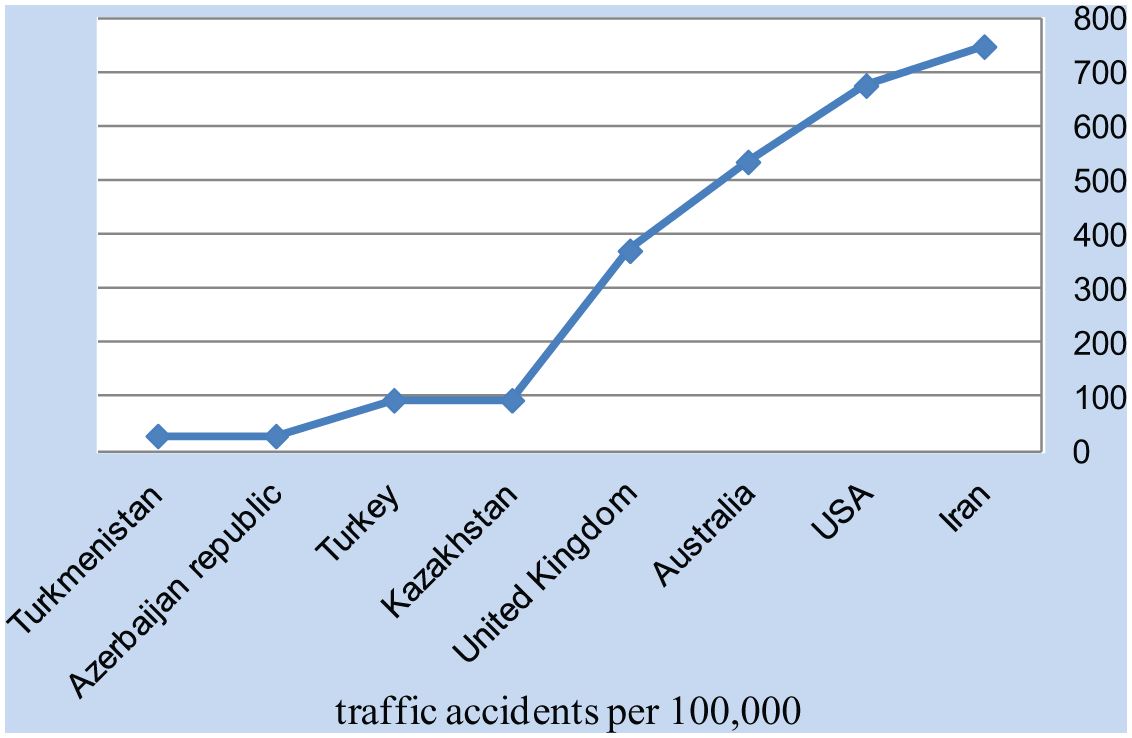
Traffic accidents per 100,000 population by country.
Studies have shown that human error and road, vehicle, and weather conditions influence the occurrence of traffic accidents (Attarchi, Dehghan, Seyedmehdi, & Mohammadi, 2012; Özkan, Lajunen, & Summala, 2006; Zhang, Yau, & Chen, 2013), of which truck drivers are at increased risk (Attarchi et al., 2012; Khorasani-Zavareh et al., 2009; Özkan, Lajunen, & Summala, 2006). Currently, more than 300,000 truck drivers, a vulnerable group because they are at greater risk of adverse health events and have less access to health care facilities (Renner, 1998; Wong, Tam, & Leung, 2007), work in Iran (IRAN Road Maintenance & Transport Organization, 2010). Therefore, research is essential to protect these drivers, their families, and their communities.
According to previous studies, Iranian truck drivers sometimes engage in behaviors such as driving for extended periods of time (Attarchi et al., 2012), driving at night or early morning (Heydari et al., 2013), and experiencing poor sleep quality (Halvani, Nodoushan, & Nadjarzadeh, 2012) that increase their risk of traffic accidents (Ketabi, Barkhordari, Mirmohammadi, & Mehrparvar, 2011); traffic safety culture, lack of traffic law enforcement, and a poor transportation system (Khorasani-Zavareh et al., 2009) also contribute to traffic accidents in Iran. Studies conducted in other countries have identified age (Duke, Guest, & Boggess, 2010; McCall & Horwitz, 2005; Saltzman & Belzer, 2007), sex, socioeconomic status and income (Zhang et al., 2013), education, and the physical condition of drivers as contributing to traffic accidents (Fort et al., 2010). However, it is still unclear how Iranian truck drivers understand and experience traffic accident risks.
Traffic accidents are a complex social phenomenon, influenced by several factors that should be carefully studied (Ketabi et al., 2011). Existing research has identified factors contributing to traffic accidents using quantitative approaches; qualitative research studies are needed to enhance understanding of this complex social phenomenon. Furthermore, remarkable local and regional differences between drivers’ understanding of and experiences with traffic accidents in a variety of communities may also be better studied using qualitative approaches (Özkan, Lajunen, Chliaoutakis, Parker, & Summala, 2006). Therefore, to bridge the present research gap and better understand the study phenomenon, this study used an inductive qualitative approach to explicate Iranian truck drivers’ understanding and experiences regarding the factors influencing traffic accidents.
Method
In this qualitative descriptive research study, 18 truck drivers working in the transportation system of Khorasan Razavi province chose to participate with the approval of their employers. Inclusion criteria were (a) working in the transportation system of the study province, (b) at least 1 year of experience driving a truck, and (c) interest in participating in the study.
The corresponding researcher was referred to the drivers’ association, located in the Mashhad cargo terminal, for permission to use their office when approaching potential participants and as a suitable space for conducting interviews. If those approached were willing and eligible to participate, informed consent was secured and interviews arranged. The participants were initially selected via purposeful sampling based on age, job, and education, which provided the researchers with an extensive range of experiences and perspectives.
Purposeful sampling based on diversity of sample characteristics and experiences supported both the exploration of information-rich stories and the identification of common patterns across individuals’ experiences (Patton, 1990); as great variety in individuals’ experiences was found, the shared nature of these themes suggest they are core to understanding the topic of interest. Participant recruitment was sequential: Following each interview, the next participant was selected based on characteristics the researchers wished to explore to clarify issues identified in the analysis of data thus far. This process continued until saturation (i.e., no new themes) was achieved.
Individual 35-minute to 140-minute semi-structured interviews were used to collect data. The interview schedule was designed to ensure the aims of the study were met. Interviews were begun with an open-ended question: “Please describe your working conditions when driving.” Then, the researcher asked additional questions based on the content of participants’ responses but focused on the main research question: “How do truck drivers understand and experience factors affecting traffic accidents?” All interviews were recorded using a digital recorder and were transcribed verbatim.
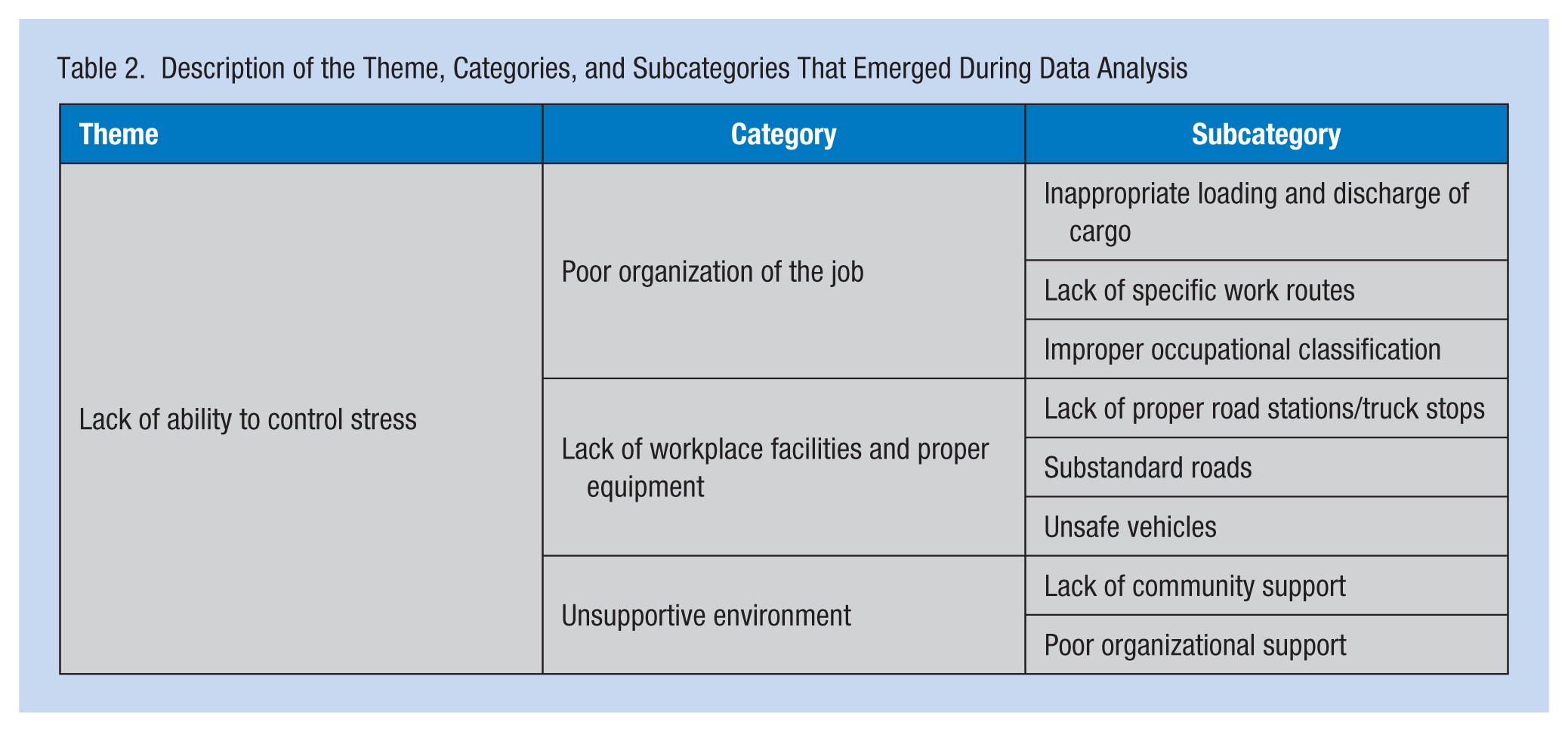
Data were analyzed based on Graneheim and Lundman’s (2004) qualitative content analysis approach; immersion was achieved by the researchers carefully reviewing each auditory interview several times to identify latent meanings in the content until the researchers were intimately familiar with the content of the interviews (Polit & Beck, 2013). Through an iterative process, codes (labels assigned to significant aspects of the text) were developed and, using the constant comparison method, researchers identified similarities and differences between codes. On this basis, codes were consolidated into subcategories (small clusters of codes), categories (a group of content sharing a communality), and themes (a recurring feature that cuts across categories; Table 2).
Several methods were used to confirm trustworthiness of the results. Peer checking was accomplished by two nursing faculty members independently analyzing the data; the data were then compared for codes and themes. When issues were identified, concepts were clarified through group discussions until a final consensus was reached. This process demonstrated dependability of the findings (Krefting, 1991). The researchers also used member checking, a process by which some parts of the interviews and researchers’ interpretations of the data are given to participants for their review. Member checking was conducted with six participants; this process continued until researchers and participants reached agreement on the meaning of the data. The researchers used this technique throughout the research for clarifying and validating the data. Furthermore, prolonged engagement with the data, more than 2 years, ensured the researchers could check participants’ perspectives and explore recurring themes, a reasonable means of becoming immersed in the data, discovering latent content, and enhancing the credibility of findings (Kielhofner, 1982; Krefting, 1991).
This study was approved by the Ethics Committee of Mashhad University of Medical Sciences (MUMS; Approval code: 910379, 02-10-2012). All participants were informed about the purpose and design of the research, that participation in the research was voluntary, and that they could refuse to provide information or withdraw from the research at any time. Written permission for the interviews to be audiotaped was obtained from each participant. Moreover, the drivers were assured that their responses were confidential and anonymous. Finally, the drivers who agreed to participate in the research signed a written MUMS informed consent form.
Findings
All drivers (18) who participated in this study were male and worked in the transportation system of Khorasan Razavi Province. The characteristics of the truck drivers are presented in Table 1.
Demographic Characteristics of Truck Drivers
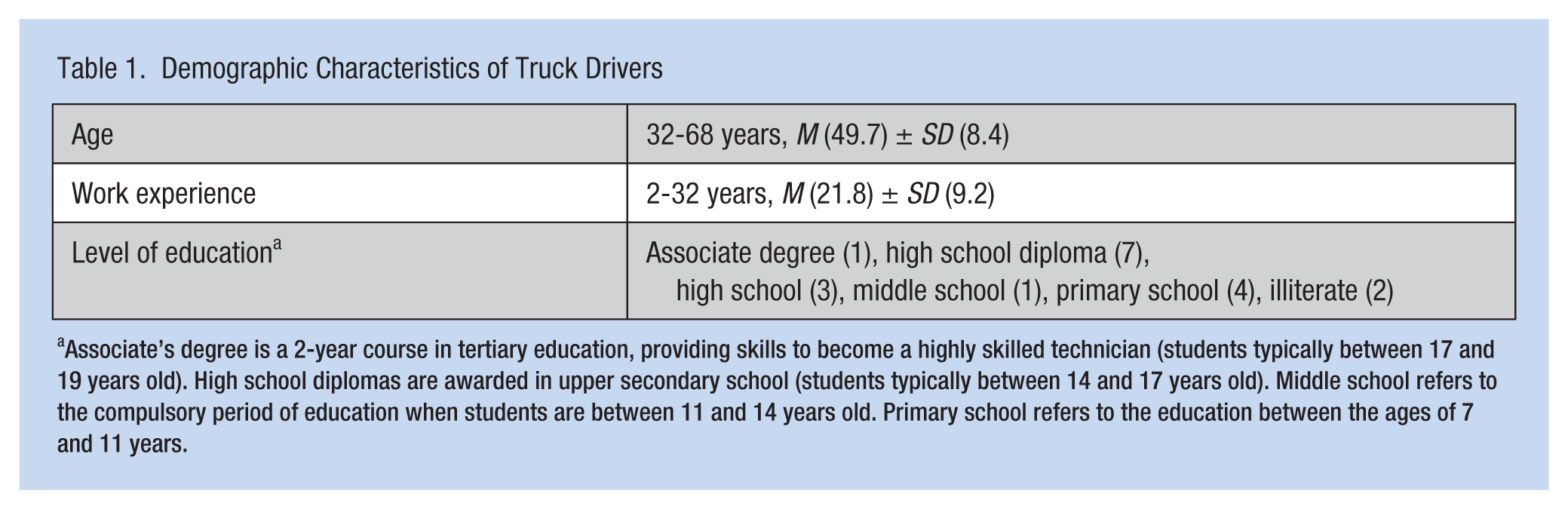
Associate’s degree is a 2-year course in tertiary education, providing skills to become a highly skilled technician (students typically between 17 and 19 years old). High school diplomas are awarded in upper secondary school (students typically between 14 and 17 years old). Middle school refers to the compulsory period of education when students are between 11 and 14 years old. Primary school refers to the education between the ages of 7 and 11 years.
The main theme of lack of ability to control stress emerged as influencing traffic accidents. The drivers emphasized that stress can cause drivers to drive recklessly (i.e., take risks) and not observe traffic laws. They reported that many factors including personal, family, and community issues, and the work environment cause stress. The drivers declared that they could not overcome these stressors unless the underlying issues that caused the stress were resolved. This over-arching theme of uncontrolled stress was further defined by three subthemes: poor organization of the job, lack of workplace facilities and proper equipment, and unsupportive environment (Table 2).
Description of the Theme, Categories, and Subcategories That Emerged During Data Analysis
Poor Organization of the Job
Currently, working conditions and driver tasks are not clearly defined. No clear planning of routes or arrangements for accommodation while on the road was evident. The truck drivers emphasized that these situations existed because of poor organization in the transportation network. Therefore, they reported these existing conditions create stress and resulting job hazards for drivers, their families, and their communities. This subtheme includes three categories: inappropriate loading and discharge of cargo, lack of a specific work route, and improper occupational classification.
Inappropriate Loading and Discharge Cargo Status
Truck drivers often spend substantial time waiting to receive or discharge cargo, especially in cities with no cargo terminals. This situation raises economic, personal, and family concerns as drivers do not usually receive payment for cargo until it has been delivered and must finance costs of living on the road for long periods of time. Therefore, the longer drivers must wait for their cargo to be discharged, the less money they earn, the longer they are away from their families, and the greater the incentive to get to the cargo’s next destination quickly. This situation leads many participants to feel anxious and worried about finances for themselves and their families, and to find ways of reaching their destinations as quickly as possible. These factors may contribute to traffic accident incidence.
Sometimes I have to wait a week to get the load, so when my load goes onto the truck I’m just anxious to get to the destination as soon as possible. (Participant No. 9)
Lack of a Specific Work Route
Truck drivers explained that their work was often disorganized, with little obvious planning by the company. Without careful planning, the drivers often had no planned route for their trips so they traveled many hours and kilometers away from their homes. They believed that the lack of planned routes increased accident risk and potential adverse outcomes for themselves and their cargo, and even affected their families and society.
I mostly face situations in which I am far from home for 20 days or even a month at [a] time; I must keep an eye on home while ensuring I still concentrate on driving properly to my destination. (Participant No. 8)
Improper Occupational Classification Status
Truck driving in Iran is classified as a semi-heavy job, rather than a difficult and dangerous job. The truck drivers felt that this classification does not reflect the nature of their work and resulting job demands, which may contribute to traffic accidents. The drivers reported that because their jobs were not classified as difficult and dangerous, they could not use the advantages afforded difficult and dangerous jobs (e.g., younger retirement age).
My mind is occupied by my job. Although our work conditions are difficult, it is classified as a semi-heavy job or a touring job, so my family and I are anxious. (Participant No. 5)
Lack of Workplace Facilities and Proper Equipment
Truck drivers emphasized that they spend most of their life on the road working so it is necessary to access facilities and equipment in their workplaces that could be used when needed. Fatigue and monotony resulted from a lack of such facilities, which participants reported increased their risk of traffic accidents. This subtheme was further defined by three categories: lack of proper road stations, substandard roads, and unsafe vehicles.
Lack of Proper Road Stations/Truck Stops
One of the most important issues mentioned by all participants was lack of special, dedicated places for drivers to sleep, eat, or rest.
I am frequently anxious about my night’s sleep. Sometimes I get sleepy during driving and I have to drive for two hours to arrive in a suitable place. If I drive, I will be sleepy and this driving is then very risky for me. (Participant No. 2)
Lack of proper road stations/truck stops was particularly significant in rural and low traffic areas. Participants said they needed more help in finding facilities in areas where truck stops are scarce.
You see, some roads are near deserts such as LUT (KAVIR-E-LUT). On these roads, there is no place for resting after driving some kilometers, so when I am driving alone, where could I stop to rest? (Participant No. 5)
Although road stations are few, their effect was so great that they are appreciated and prayed for by drivers.
We are a group that is away from our family 20 to 25 days. It is expected to have facilities on the roads. Recently, some prayer houses have been built. Before that there was no place for praying. Now, some mosques are accessible all the time. (Participant No. 17) God bless them, there are some good conditions on the roads. One of them is the emergency medical services. When an accident has occurred, they are on the scene. The other is the mosques. Many mosques are constructed along roads. We can stop and pray whenever we like. The last one is road stations for drivers to rest; however, there are too few. (Participant No. 2)
Substandard Roads
Some roads were poorly built or in need of repair. Driving is risky on these roads, especially during nighttime hours, so drivers reported changing their schedules to safely drive on these routes.
Some roads are narrow; the bridges are ruined and reach to the asphalt edge. If two cars could not keep their distance, one of them will fall down. We plan our schedule to have rest and sleep there by evening. We stop driving there due to narrow roads. I try to drive just in the daytime and prefer to sleep at night time there. (Participant No. 10)
Unsafe Vehicles
Improperly maintained vehicles were mentioned by drivers as another problem. Their trucks were crucial for their livelihoods; if they lost their trucks due to an accident, they could no longer work, which was another source of job stress. The lack of safe and comfortable vehicles was another source of stress for the drivers, and maintaining and repairing their vehicles were essential expenses for the participants.
My truck has worked for 38 years (1975 model). It is old, so when I’m driving I hope nothing will ever happen, such as a tire blowout. I pray I will arrive healthy and transport the truck load. (Participant No. 10) When I want to start driving in the morning, I take a look at my tires, and when I see one of my tire’s tread is low, this is always on my mind and makes me so tired . . . . (Participant No. 7)
Unsupportive Environment
The absence of support was regularly mentioned by the drivers. They believed that they needed greater support from their communities and employers, as they spend much of the year working alone on the road; they felt that greater support both for themselves and their families would alleviate their stress. This support in turn would help them drive more safely, and their families feel more confident that they could cope with problems while their husbands and fathers were away for long periods of time. This subtheme included two categories: lack of community support and poor organizational support.
Lack of Community Support
Participants frequently mentioned concern for their families because they were away from home so much. They were particularly anxious because few had resources to assist their families while they were away.
You see . . . I am away from home most days of the year. Everybody who is living has problems—families solve their problems in their own way. There is no place for them to call me and say: We have a problem, help us to solve it or help us to prevent the problem. (Participant No. 16)
Poor Organizational Support
Truck drivers reported they had experienced limited organizational support. They believed that greater support in various areas, particularly personal and familial, could reduce their stress. The drivers have limited financial security, and so they are tentative as they go about their daily duties, activities that are accompanied by anxiety and occupational hazards.
It happens quite commonly in our chats with other drivers; we warn each other “Your vehicle needs repairs! You need to service the brakes! Your tires are bald!” The usual response is, “After this trip, God willing! When I return, I shall fix it.” They go and on many occasions, never return. So, if we are helped, it would really be great. (Participant No. 7)
Discussion
According to these participants, occupational stress is a critical issue for truck drivers, preventing them from driving safely. Participants also identified working conditions, economic status, and familial concerns as negatively affecting their health and work. These factors place drivers at risk of traffic accidents.
Research by Taylor and Dorn (2006) suggested that driving requires attention to complex and dynamic work tasks, and sensitivity to driving conditions to identify potential risks. They found that drivers’ stress, especially for commercial drivers, is due to continuous interaction between internal and external factors such as life and work events (Taylor & Dorn, 2006). This finding is supported by this research, which identified multiple concerns, both personal and occupational, that can contribute to occupational stress for drivers and in turn can affect driving ability and approach. Other studies have confirmed that job stress among truck drivers, who are away from family, friends, and other supportive networks, is more severe than occupational stress in other jobs and can be a factor in traffic accidents (Saltzman & Belzer, 2007; Shattell, Apostolopoulos, Collins, Sönmez, & Fehrenbacher, 2012; Shattell, Apostolopoulos, Sönmez, & Griffin, 2010).
Lack of ability to control stress is a new finding, which has not been clearly mentioned in previous studies. Stressful events and stress-producing factors must be eliminated or managed to reduce the risk of traffic accidents among truck drivers in Iran. Lack of facilities and proper equipment when away from home and unplanned travel were other stressors identified by truck drivers. Participants mentioned lack of road stations prevented them from stopping when convenient and when they needed to sleep, eat, or rest. The drivers reported feeling forced to drive for long periods of time when fatigued before they arrived at an appropriate place to stop, increasing their risk of accident. Previous Iranian studies supported this finding; increased work hours (Attarchi et al., 2012) and driving when tired or sleepy (Ayati, 2004; Halvani et al., 2012; Hasanzadeh et al., 2009) were found to be related to accident incidence.
Substandard roads were another factor contributing to traffic accidents (Ketabi et al., 2011). Other studies have reported that lack of road markings, need for road repair, substandard roads, lack of traffic signs, and lack of illumination at night are all underlying problems (Khorasani-Zavareh et al., 2009; Mohammadi et al., 2012). These findings support the present study; unsafe vehicles were mentioned by participants as another contributor to traffic accidents. Drivers also frequently experienced stress due to the need for vehicle maintenance, and the high expense of maintaining their vehicles, frequent fines, and fear of their trucks being removed from the road, which would be economically devastating for them. The work of Khorasani-Zavareh et al. (2009) confirmed this finding. They reported that traffic accidents were due to significant numbers of old unmaintained vehicles; the high rate of traffic accidents in Iran could be decreased by replacing outdated vehicles and improving roads.
Another source of stress for Iranian truck drivers was absence from their families. The drivers stated that nowadays, they could learn of their families’ concerns quickly because of cell phones. However, they were often absent when emergencies arose and could do little to help. Being absent and unable to garner support from others in the community created stress for the drivers; this stress in turn affected their driving.
Unsupportive environments were the other important and exclusive finding of this study. Previously, this finding has been ignored by many scholars, but the present study suggests it is a professional and social aspect of trucking to which more attention should be paid.
Recommendations
Consistent with other research (Hill, Hudson, Lantz, & Griffin, 1997; Renner, 1998; Zvonkovic, Solomon, Humble, & Manoogian, 2005), this study found that truck drivers’ families need support from time to time when the driver is away. Truck drivers’ families could be provided with direct or online support by organizations, which provide emergency services to truck drivers after accidents, social or support groups of women with similar experiences, or special classes to assist women in coping with their husbands’ absences.
The findings of this study show that truck drivers are concerned with stress in their workplace and family life. This situation should be recognized by nurses who can support this workforce. However, in current Iranian nursing education programs, only 9 of the 130 units required for nursing students’ (BSc) education are devoted to community health nursing (CHN). From these nine units, five are assigned to theoretical courses and four to practical courses (Ministry of Health and Medical Education, 1992).
Nursing students enrolled in MSc nursing courses can specialize in community health nursing but not occupational health nursing. Furthermore, community health nurses (MSc) must often work in schools of nursing (for training) and hospitals after graduation because no positions are available in community health centers. The higher council of planning in Iran must change its strategy regarding student admission to occupational health nursing courses, as these courses could provide both theoretical content and practice experience in providing support to truck drivers and other workers. In addition, community health centers should attract graduate occupational health nurses. These nurses could provide services (e.g., caring, supporting, and counseling services) to workers in the workplace.
Limitations
Although the researchers purposely sampled Iranian truck drivers with maximum diversity, the lack of female drivers in this field was a limitation because female drivers may have different experiences and attitudes about traffic accidents. The findings of this study may not reflect their experiences. Participants in this study were experienced and knowledgeable. Moreover, this study only focused on the understanding and experiences of Iranian truck drivers; conducting further studies in other cultures is needed to expand this body of knowledge.
Conclusion
According to the findings, Iranian truck drivers’ inability to control stress contributes to traffic accidents. Poor job organization, lack of facilities on the road, and an unsupportive environment all contribute to occupational stress. No single factor explained the high rate of traffic accidents in Iran, but all factors appeared to contribute to the phenomenon. Drivers, their families, companies, and supportive workplaces should be engaged simultaneously to better develop effective interventions that will reduce traffic accidents and improve the health and safety of truck drivers.
Applying Research to Practice
Identifying factors that contribute to traffic accidents should be used by the transportation industry and community health centers though a systematic and holistic approach to prevent traffic accidents.
Drivers, their families, and supportive workplaces should be engaged simultaneously to better improve the health and safety of truck drivers and their families.
The higher council of planning in Iran could change its strategy regarding student admission to occupational health nursing courses, as these nurses could properly provide support to truck drivers and other workers.
Community health centers should attract graduate community health nurses (MSc) who specialize in providing services to clients in the workplace.
Footnotes
Acknowledgements
This article was extracted from a PhD dissertation approved and financially supported by Mashhad University of Medical Sciences, Iran (No. 910379). Hereby, the authors would like to acknowledge the researchers from Mashhad Universities who collaborated in this study. Thanks also go to the participants of this research without whose help, this study would not have been possible.
Conflict of Interest
The author(s) declared no potential conflicts of interest with respect to the research, authorship, and/or publication of this article.
Funding
The author(s) received no financial support for the research, authorship, and/or publication of this article.
Author Biographies
Hossein Karimi Moonaghi is an associate Professor at Mashhad University of Medical Sciences. He is interested in the field of nursing research particularly in Medical-Surgical Nursing, Evidence-Based Caring, and qualitative studies.
Hossein Ranjbar is now an assistant professor at Torbat Heydarieh University of Medical Sciences. He is interested in aspects of nursing research such as community health nursing, evidence-based practice, and qualitative research.
Abbas Heydari is an associate Professor at Mashhad University of Medical Sciences. He is interested in the field of nursing research particularly in Evidence-Based Caring and Qualitative studies.
Laura Scurlock-Evans is currently a PhD research student at the University of Worcester. Her research interests are varied, but she is particularly interested in sexual violence research.