




Abstract
This case study was done in 2018 per request of UNLV Athletics. Pricing recommendation for UNLV Football tickets for the home side of the new Allegiant stadium were generated using a survey of 598 adults, the majority of whom were UNLV alumni. Pricing recommendation was based on the responses with football as their first or second favorite sport (n = 304). Sections C109-C115 showed the highest willingness-to-pay and highest recommended price. Sections 101-105 had the lowest willingness-to-pay and recommended price. The chance of purchasing a parking pass was higher for those interested in buying a ticket in sections C109-C115.
Introduction
The opening of a new sports arena for a university is a rare and unique event in the life of a campus. College sports in the U.S. earn both money and prestige for the university (Vanover & DeBowes, 2013); the hiring of a new coach or the recruitment of a top athlete are considered newsworthy events (e.g., Myerberg, 2021). Indeed, the shared culture of college sports is often considered a unifying force both for the college and local community (Martin & Christy, 2010). As urban universities strive to understand their role and identity in the 21st century (Addie et al., 2019), bolstering college sports has been an important agenda item for many of these universities (Fisher et al., 1996).
For the University of Nevada at Las Vegas (UNLV), increasing the profile of the sports teams goes hand in hand with Las Vegas’s transformation to a sports destination (Schenfeld, 2021). The addition of professional sports to the Las Vegas market has added a new demand factor for the city (Okada, 2020) but is has also allowed UNLV to move their football team to the $1.9 billion Allegiant Stadium at a cost of $150,000 per game (Snel & Albera, 2021). Allegiant Stadium is located west of Mandalay Bay (Nusca, 2017) and is 3.2 miles from UNLV’s main campus (Allegiant Stadium, 2021), while the old stadium was 7.7 miles from main campus (UNLV, 2021). Allegiant Stadium opened for the 2020 to 2021 season, which was complicated by the COVID-19 pandemic. However, demand for sports returned with the reopening of the stadium in fall 2021 and season ticket demand for UNLV games increased to a record number for the move to Allegiant stadium (Akers, 2020).
For the UNLV football team, the move to the new stadium created new demand (Akers, 2020). The pricing of the season tickets for the professional football team housed in this venue, the Las Vegas Raiders, is considered cost-prohibitive for many local residents who may simply want to experience the new arena (Belson, 2021). Therefore, the demand for football tickets is not only impacted by students and college sports fans but by the amenities of the stadium itself. This creates a unique challenge in determining the price of season tickets when the previous demand models are not reliable. The current study employed a quantile analysis to examine the results of a survey of 598 adults, of which 304 Football was their first or second favorite sport, to understand what influenced willingness-to-pay (WTP) for season tickets for the inaugural season of college football at Allegiant Stadium.
Materials and Methods
History of Football at UNLV and Allegiant Stadium
UNLV was founded in 1957 as Nevada Southern University (UNLV, 2021), and the first season for its football team was in 1968 (UNLV Digital Archives, 2021). UNLV started playing their games at Sam Boyd Stadium in 1971 and was renovated in 1999 (UNLV Digital Archives, 2021). Over the years, this stadium also hosted a variety of events including high school football teams, a soccer team, an XFL team, a rugby team, and the Las Vegas Bowl (Munsey & Suppes, 2021). The stadium also hosted numerous concerts (Munsey & Suppes, 2021).
In 1967, Nevada Southern University announced that they would field a collegiate football program. The UNLV Rebels football team was fielded in 1968. The team was a Division II Independent, and Bill Ireland was their first head coach. In 1978, after ten years playing as a Division II independent, the program was promoted to the Division I, independent of any conference affiliation. An athletic conference is a collection of sports teams, playing competitively against each other in a sports league. The 1982 season was a big year in UNLV football history as the Rebels became affiliated with a college athletic conference when they joined the Pacific Coast Athletic Association (PCAA) (McCurdie, 1985). In 1999, the Rebels made headlines by leaving the WAC with seven other schools to form the Mountain West Conference. On the same year the program hired legendary collegiate and professional coach John Robinson as their eighth head coach (UNLV, 2021). Before the start of the 2001 season, the Rebels received national attention as the team was ranked No. 25 in Sports Illustrated’s preseason Top 25 and No. 24 in Football Digest’s rankings (NUsports, 2001).
Since 2011, the UNLV rebels had been trying to replace Sam Boyd Stadium with a new facility. Finally in 2016, a new domed stadium design was approved to replace the Sam Boyd Stadium for Las Vegas that would be the home to the Las Vegas Raiders of the National Football League (NFL) (after the team relocated to Las Vegas from Oak-land, California) and UNLV Rebels (Anderson, 2016). Construction of the $1.9B stadium began on November 13, 2017 and was finished on July 31, 2020. On October 31, 2020, the Rebels opened their new home, Allegiant Stadium (Snel, 2020). The new stadium is located on the west of Mandalay Bay, with more than 62 acres of land. Allegiant Stadium is scheduled to host Super Bowl LVIII in February 2024. Since December 11, 2019, Marcus Arroyo is the new head coach of the Rebel football program (Crepea, 2019). UNLV has played in four bowl games in 1984, 1994, 2000, and 2014. In 2021, UNLV Rebels’ Mascot Hey Reb! was retired, as an attempt to acknowledge the campus’ rich diversity. UNLV was named nation’s most diverse campus in 2021 (Allen, 2021).
Willingness-to-Pay and College Sports
Willingness-to-pay (WTP) is defined as the amount of money a consumer is willing to pay for a product or service, and this is often different than the actual price of the product or service (Wong & Kim, 2012). WTP is measured in a variety of ways, but one of the ways hospitality researchers and professionals use is looking at the impact of individual attributes on WTP (e.g., Wong & Kim, 2012). This allows companies and researchers to calculate the value of individual attributes and the levels of attributes to understand their influence (Wong & Kim, 2012). For example, sometimes the presence of an attribute does not increase WTP, but its absence will decrease it (Wong & Kim, 2012). Loyal customers are also less likely to be price sensitive (Nieto-García, et al., 2020), which can be important for sports pricing.
Researchers have previously examined what impacts WTP for college sports. In 2012, Rosas and Orazem examined what impacts WTP for college basketball and found a strong preference for Men’s basketball over Women’s basketball. For college football, researchers found that WTP increased for rivalry games, where the home team was playing a traditional rival (Sanford & Scott, 2016). Researchers have also investigated the WTP for college football in general and found that state residents had a slightly lower WTP for college football games than did other alumni (Dixon & Oh, 2012). For secondary markets (i.e., StubHub) for college bowl games, researchers found that pent-up demand, distance traveled, and seat quality all impacted WTP (Rishe et al., 2015). Researchers have even attempted to quantify the dollar value of traditions associated with college sports (Interis & Taylor, 2017). However, researchers have yet to examine what impacts WTP for a sports team moving to a new stadium shared with a professional team.
Methods
To examine this day, a quantile regression was used. Quantiles are points that divide the sample into the groups that contain the same number of datapoints. In this method, datapoints are sorted in an ascending order and divided based on their order. For instance, in a 1-quantile, that quantile is equal to the median (the datapoint that is exactly in the middle) of the data. In this case study, 5-quintiles were used. This means that data points were split in a way that divided them into six groups with the same number of observations. Exhibit 1, shows an example of 1-quantile (on the left) and 3-quantiles (on the right). Say we have seven data points: 2, 4, 5, 8, 9, 11, and 13. The goal is to find the 3-quantiles of this sample. In this scenario 8 is the datapoint that divides the sample into two equal subsets, each with three observation. Therefore, 8 is the median or third quantile. Further, 4 and 11 split the sample into subsets with equal size of one each. Hence, 4 is the first quantile and 11 is the third quantile.
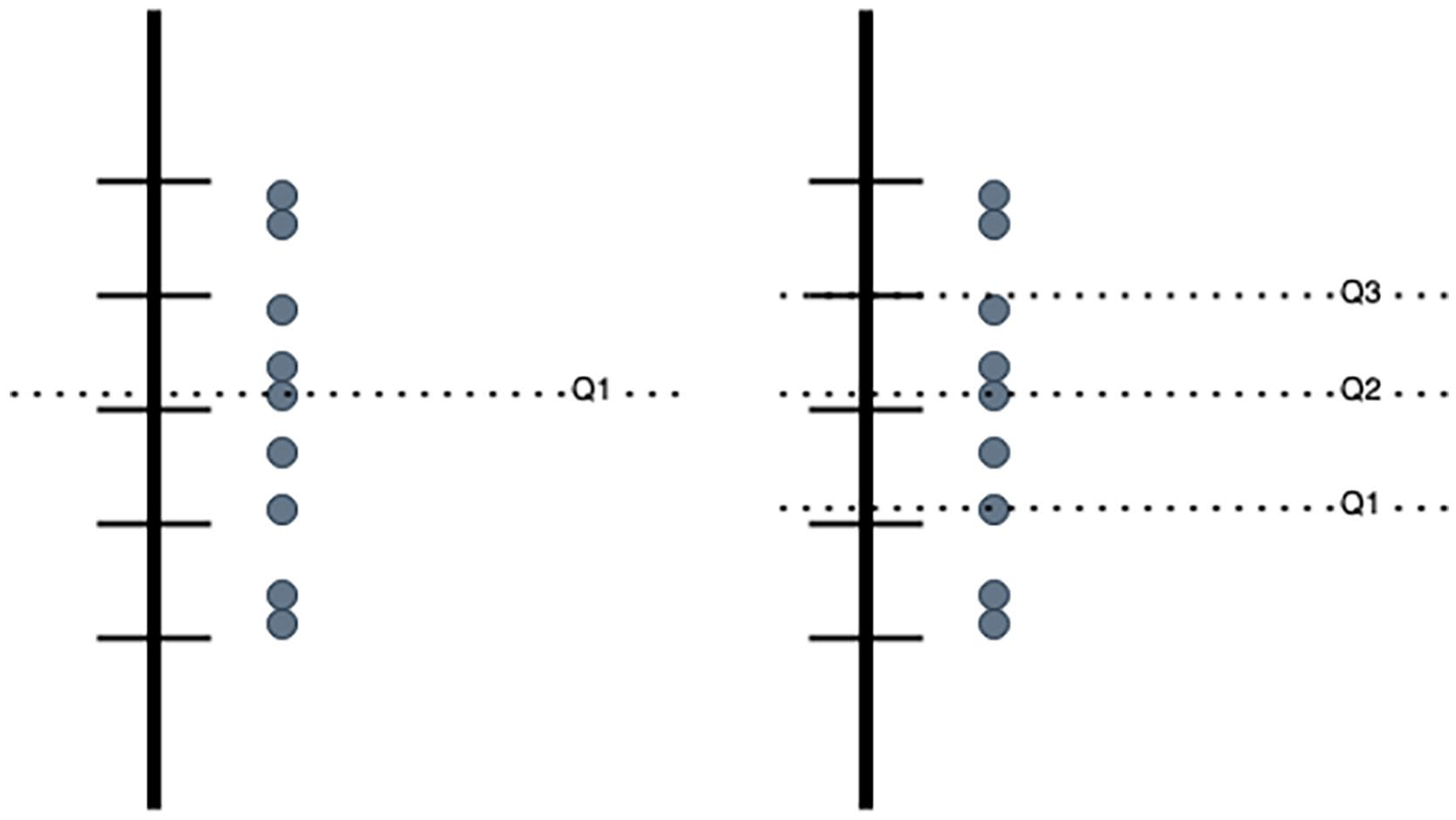
Example of dividing datapoints into 1 quantile and 3-quantiles.
The Case
The opening of the new stadium was exciting for UNLV team and fans alike. However, unlike the previous stadium which had been donated, UNLV had to pay more than $150,000 per game to play in the new stadium (Snel, 2020). Therefore, it was highly important to UNLV to make sure that the games will make profit. Subsequently, UNLV Athletics commissioned a study to be conducted to measure the willingness-to-pay (WTP) for UNLV Football games in the new stadium. Exhibit 2, shows a mock-up of the new allegiant stadium layout that was used in the survey.
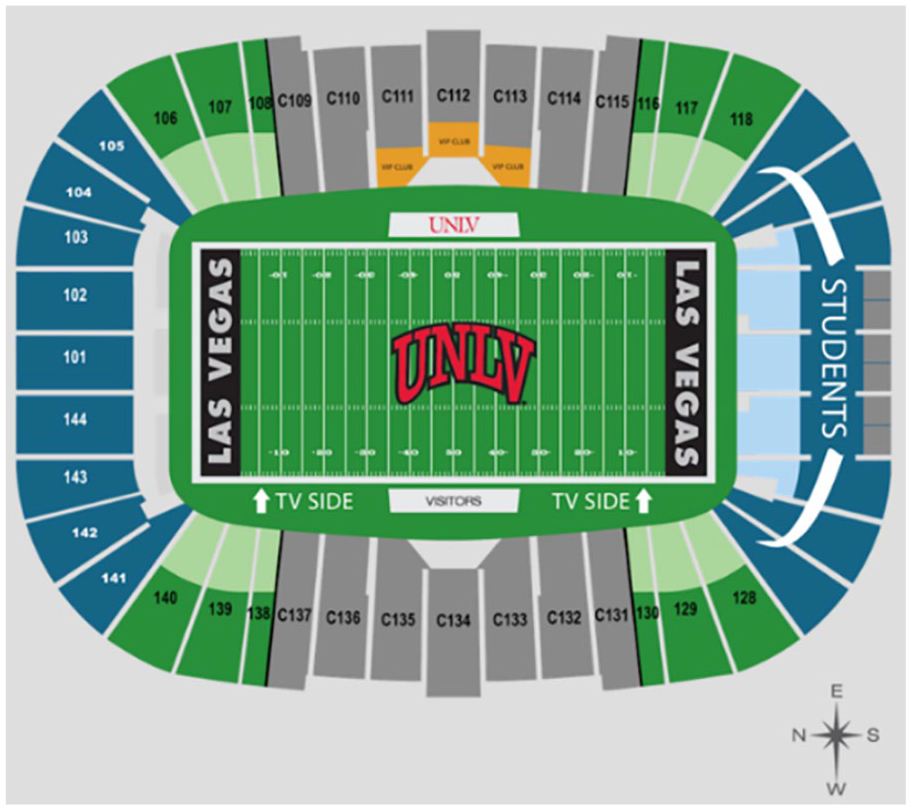
Mock-up used in survey.
In 2018, a survey was conducted of UNLV Alumni and UNLV Season Ticket holders. A total of 595 participants were surveyed. All participants were 18 years and older. The survey collected demographic information, favorite sports, UNLV Football pass participation, and intention to pay for UNLV Football pass at the new stadium. The football ticket section asked respondents whether the held the UNLV Football season ticket, the side they prefer to buy tickets for, parking bundle and intention to purchase tickets for UNLV Football at new stadium. The ticket preference data were collected by “yes” and “no” answers. Respondents were surveyed the intention to pay for UNLV Football pass in four main sections on the home side of the stadium: 101-105, 106-108, Non-VIP sections C109-115, and sections 116-118. WTP was measured by asking the respondents three main questions: “what would you expect to pay for the cost of a single ticket to attend the event?,” “at what price would the cost of a single ticket be expensive, but you would still buy a ticket and attend the event?,” and “at what price would the cost of a single ticket be so expensive, that you would not attend the event?” for each of the sections on the home side. All three questions were open-ended. Outliers (data points that differ significantly from the other observations) were detected and removed. Data analysis was done in JMP SAS and Excel.
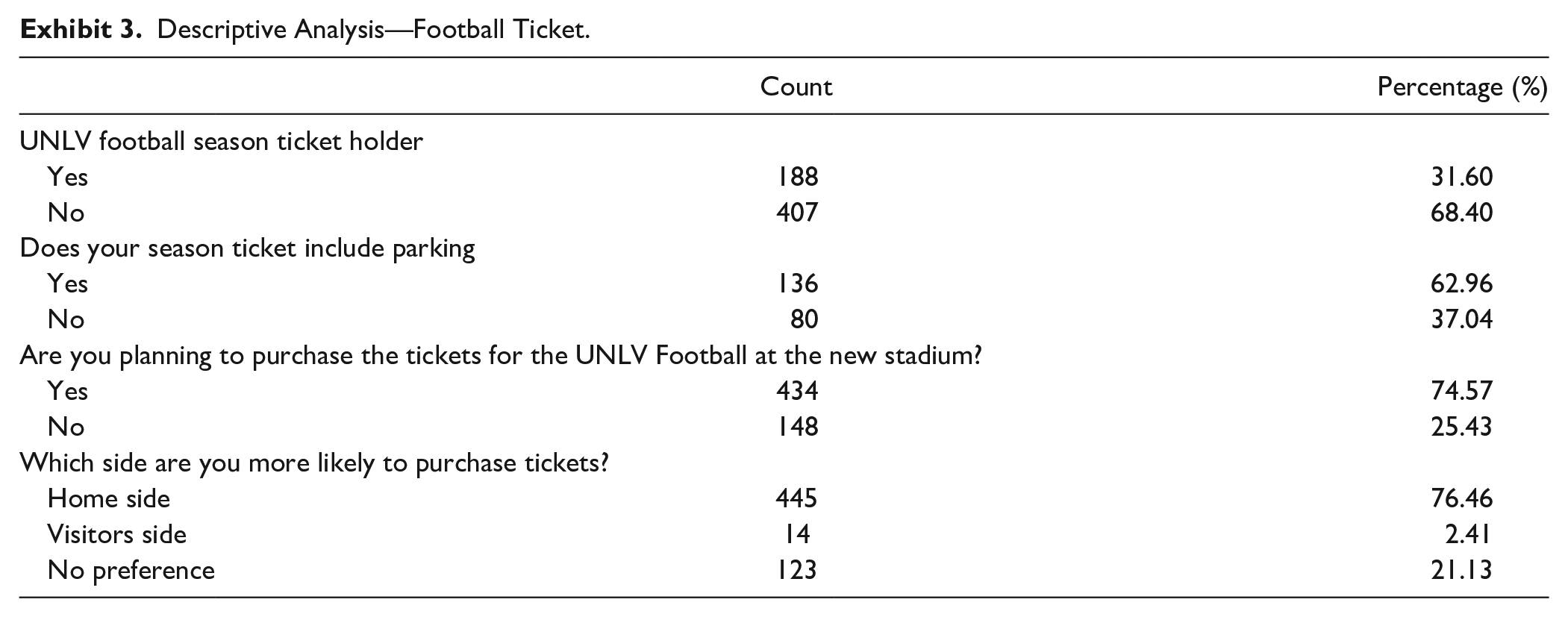
The majority of the sample were male (68.91%), over 35 years old (86.75%) and white (68.24%). About 36% of the sample were alumni, 33.11% were UNLV fans, but never studied there, and 23.87% were personal donors to the university. Only 3.7% had no past or present affiliation with UNLV. Moreover, additional analysis was conducted to better understand the sample based on their preferences for football ticket (Exhibit 3). Only one third of the 595 participants held a football season ticket. Out of those that held a season ticket for UNLV Football, 62.96% also bought parking pass. Also, 74.57% of the participants showed interest in buying the ticket for the UNLV Football at the new stadium. Not usurping, majority of the respondents stated that they were interested in buying the tickets for the home side of the new stadium. Given the importance of this side of the stadium to the UNLV fans, further analysis was done on this side of the new stadium.
Descriptive Analysis—Football Ticket.
For further analysis, only those who said football was their first or second favorite sport were retained (n = 304). Exhibit 4 shows the summary of the statistics for three questions “what would you expect to pay for the cost of a single ticket to attend the event?,” “at what price would the cost of a single ticket be expensive, but you would still buy a ticket and attend the event?,” and “at what price would the cost of a single ticket be so expensive, that you would not attend the event?” for each of the sections on the home side. Non-VIP Sections C109-C115 showed the highest mean among all sections ($68.18, $76.61, and $89.72, for expected price for one ticket, expensive but would attend, and too expensive to attend, respectively). The Non-VIP Sections C109-C115 also show the highest maximum price customers were willing to pay ($425) and highest standard deviation in price. Standard deviation shows how scattered and far apart the datapoints are. These Non-VIP Sections C109-C115 also showed the highest median price ($60, $70, $65) and mode ($50) for all three questions. The minimum price participants were WTP for these sections was $5.
Summary of Statistics.
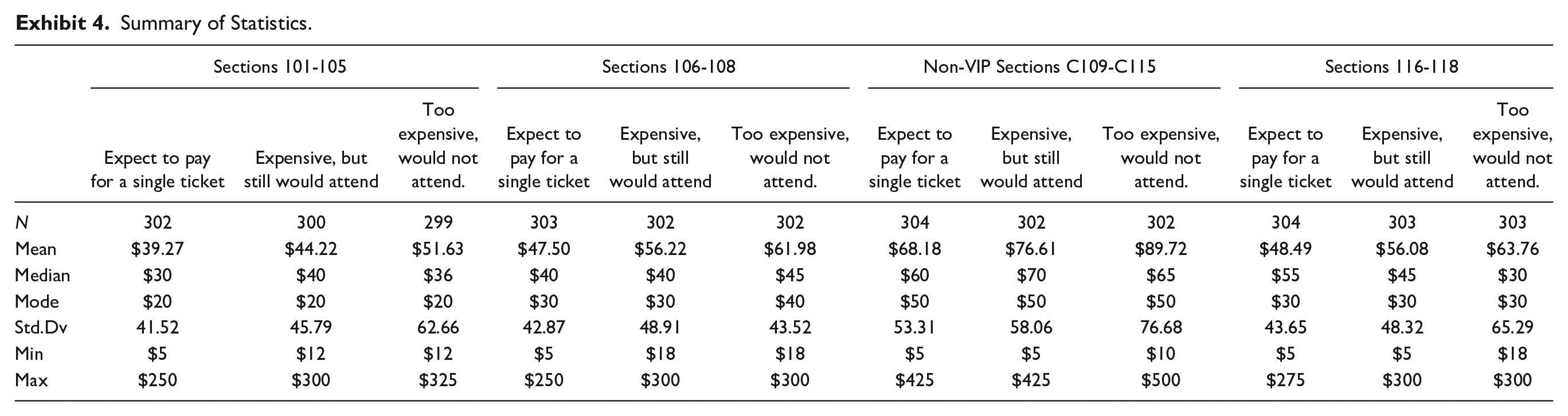
On the other hand, sections 101-105 display the lowest mean ($39.27, $44.22, and $51.63) for expected price for one ticket, expensive but would attend, and too expensive to attend, respectively. The median response for expected price for one ticket and too expensive to attend in these sections was the lowest of all other sections with $30 and $36, respectively. The lowest respondents’ median response to the question regarding the highest price they customer would pay for a ticket belonged to sections 101-105 and sections 106-108 ($40). Overall, the minimum expected price to pay for a ticket was $5 among all sections and the maximum was $425 for Non-VIP Sections C109-C115.
Also, the price recommendation was generated using quantile analysis (Exhibit 5). It can be seen that Non-VIP Sections C109-C115 were the sections with highest expected price to pay for a single ticket; $35, $50, $75, $100, and $120 for quantiles 1 to 5, respectively. The pricing recommendation also shows that the highest average price recommended for these sections is $75 for a single game, $525 for seven games and $450 for six games. Sections 116-118 are the second most expensive seats that respondents are expected to pay. The quantile prices of one ticket show $25 for the first quantile, $45 for the third quantile and $90 for the fifth quantile for these sections. On average, participants expected to pay $70, $490, and $420 for a single ticket, for seven games and for six games in these sections.
Pricing Recommendation.
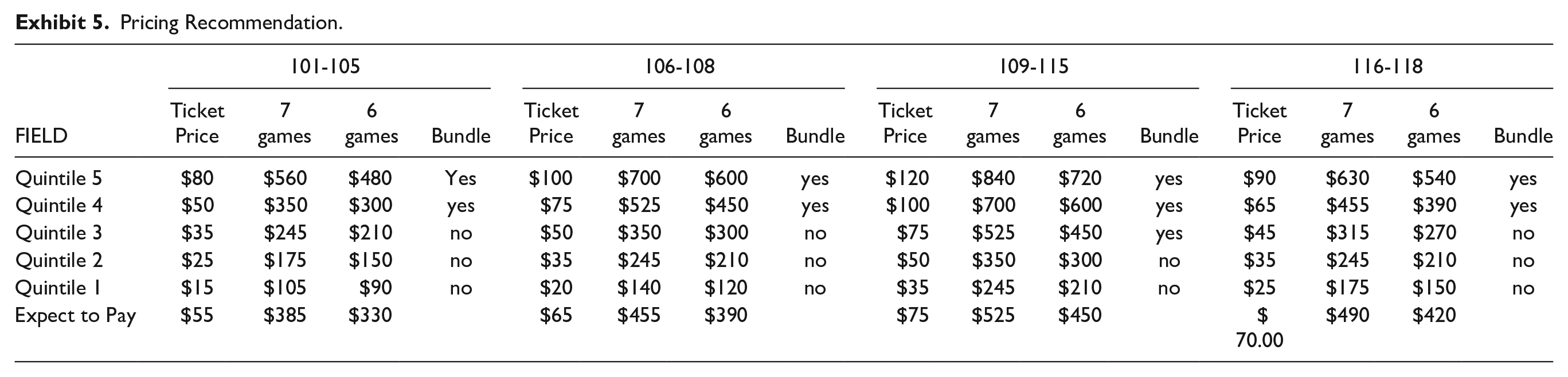
Finally, sections 101-105 were the sections with lowest willingness to pay. In this section respondents typically expect to pay $55 for a single ticket, and $385 for seven games. In all sections, the fourth and fifth quantiles were most likely to buy a parking pass in addition to the season pass in all sections. In the Non-VIP Sections C109-C115 also the participants in the third quantile expressed interest in buying the parking pass. Overall, sections 109-115 were the highest likely to purchase the parking pass along with the season pass.
Further, sections 101-105 (the sections with the lowest prices) were selected for a more in-depth analysis as often these are also the most sought-after tickets. Data was used to generate graphs based on three main questions mentioned earlier (Exhibits 6–8). The results show that 80% of the participants think $75 was too expensive to buy the ticket (Exhibit 6). The median price for these sections was $36, which is lower than all the other sections. Interestingly, 35% stated that $27 was too expensive to buy the tickets (Exhibit 6). However, 90% of the participants stated that $90 would be expensive but now enough to dissuade them from purchasing a ticket (Exhibit 7). Moreover, looking at exhibit 5, 49.3% of the respondents expect to pay $25. This shows that asking the willingness to pay questions from different angles could lead to more realistic results. Furthermore, 83.1% of the respondents would expect a ticket to cost $50 (Exhibit 8). The same graph shows that 92.4% stated that they would expect to pay up to $95 for a ticket. This supports the findings from exhibit 4, showing that 95.3% of the respondent said they would pay $100 to attend the games.
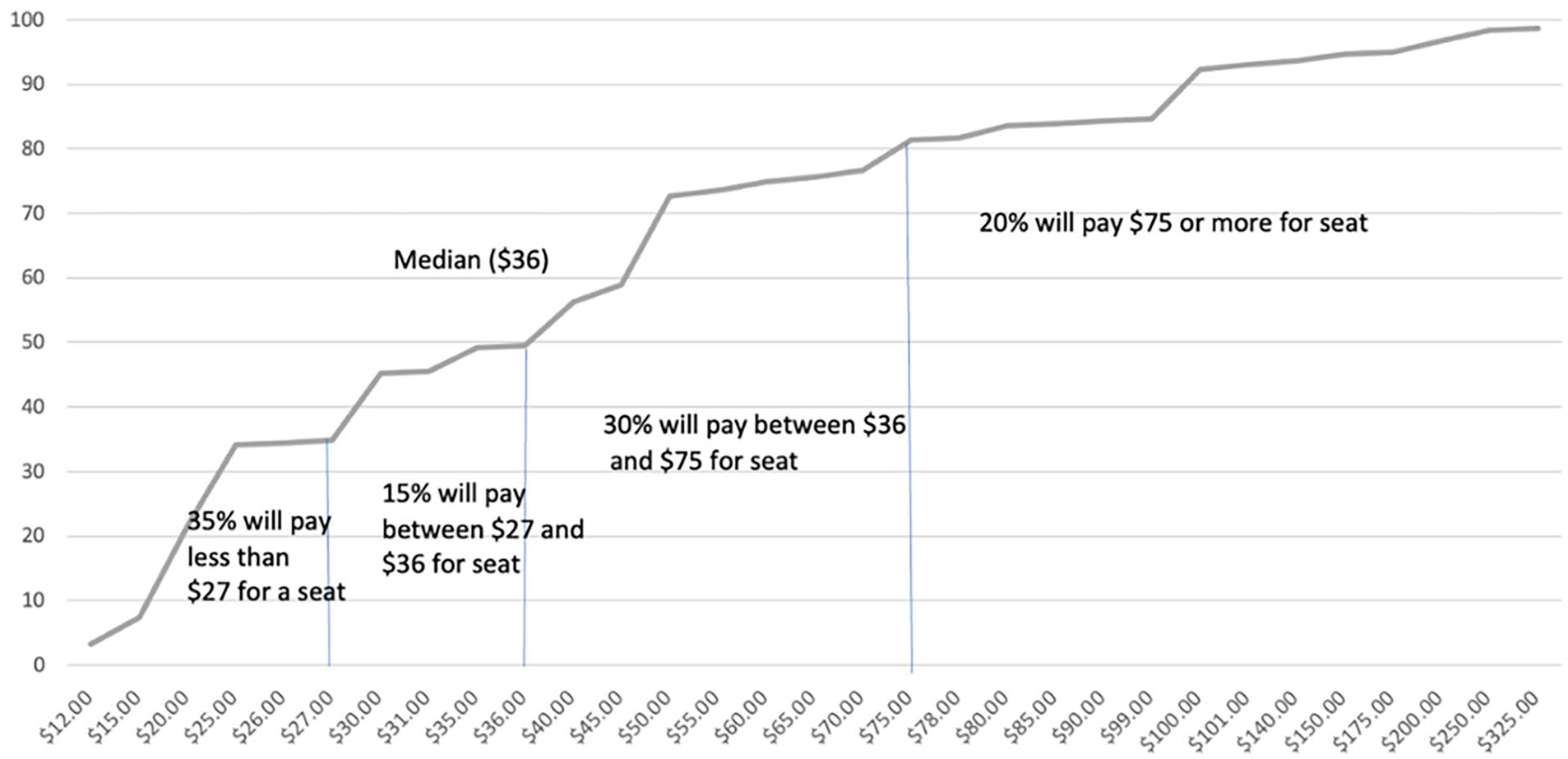
Sections 101-105: at what price would the cost of a single ticket be so expensive, that you would not attend the event?
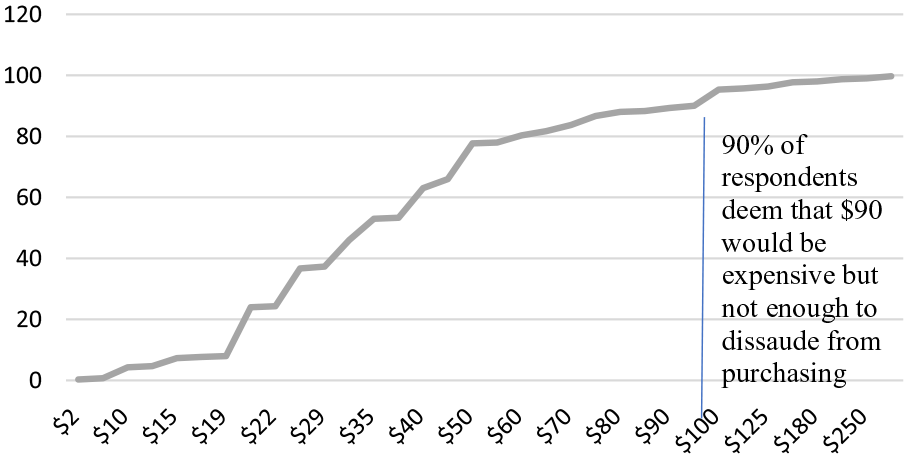
Sections 101-105: at what price would the cost of a single ticket be expensive, but you would still buy a ticket and attend the event?
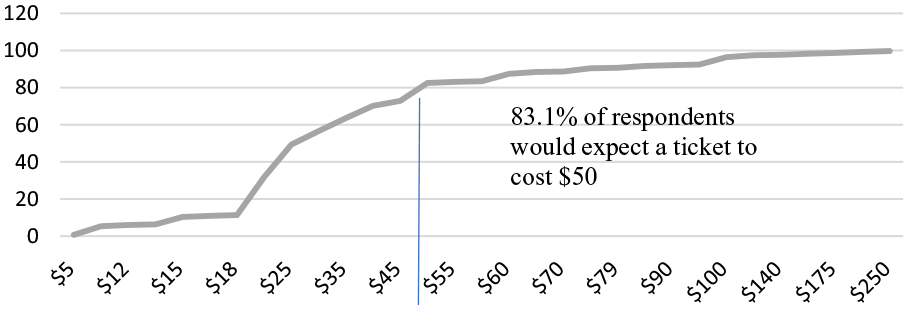
Sections 101-105: what would you expect to pay for the cost of a single ticket to attend the event?
Conclusion
This case study illustrates how academic research can be used to provide practical solutions for industry. In this instance, research methods used in revenue management research were employed to determine the appropriate pricing for a new football stadium. When it was announced that UNLV would permanently relocate their football team to the new Allegiant stadium, UNLV Athletics sought to understand what would impact the WTP for season ticket holders. In 2018, a survey was conducted of 595 UNLV Alumni and UNLV Season Ticket holders. Majority of the respondents were UNLV alumni, followed by UNLV fans that never studied at UNLV. Using the mock-up of the new Allegiant Stadium, participants were asked to answer to questions about their interest in purchasing ticket to UNLV Football games at the new stadium. The questions were asked for each of the sections on the home side of the new stadium; sections 101-105, 106-108, 109-115, and 116-118. The final analysis of the WTP was done on the 304 respondents that stated football as their first or second favorite game. Non-VIP Sections C109-C115 had the highest mean, median, and maximum expected price to pay among all sections. These sections also were those that respondents showed the highest interest in paying higher price for a ticket. The Non-VIP Sections C109-C115 has the highest maximum price customers were willing to pay ($425) and showed the highest standard deviation in price.
In contrast, sections 101-105 were those with lowest mean, median, and overall minimum expected price to pay for a ticket. Overall, the minimum expected price to pay for a ticket was $5 among all sections and the maximum was $425 for Non-VIP Sections C109-C115. Finally, the recommended pricing strategy was generated using 5-quintiles method. Sections C109-C115 were the sections with highest willingness to pay, whereas sections 101-105 were those with the lowest willingness to pay among respondents. Moreover, the fourth and fifth quantiles in each section were the highest likely to purchase a parking pass with their season pass. The chance of purchasing a parking pass was higher for those interested in buying a ticket in non-VIP sections C109-C115.
Based on the findings, the research team recommended medium prices for the UNLV Football games at the new stadium. However, not long after conducting the survey COVID-19 hit the globe by storm. Consequently, UNLV Athletics were forced to offer the tickets at a lower price than initially planned. This shows the importance of external factors of pricing strategies for a sports event. While opening a new stadium is a rare occurrence, changes in demand are a more common occurrence. As a result, demand and WTP can be affected by external factors such as economic crisis, war, and this case COVID-19. On the other hand, when a team starts winning games again after a losing streak, the demand for the tickets increases (Borland, 2003). That would also be a good time to look at re-pricing tickets. Conversely, when a famous coach retires, demand for tickets may decrease and ticket prices may need to be adjusted (Borland, 2003). Regardless, the methods used in this case study can be applied to other types of pricing. This type of analysis can be applied to any situation that meeting certain criteria: a change in demand, a long-lead time before the consumers begin booking, and a database of potential consumers. In those circumstances, duplicating this study would provide practical pricing advise for the venue. Future studies could look at the WTP for merchandise and food and beverage. Finally, future studies can look at how different packages for season ticket holders would be impacted by the competitors they are playing.
The results of this case study have several direct implications for universities and colleges when they open new sporting venues. First, this study provides a template that can be used for determining consumer WTP for differentiated pricing in a sports venue. Second, this study provides insight into what influences WTP for alumni and season ticket holders. The season ticket prices for the new venue (Allegiant) were significantly higher than for the old venue (Sam Boyd), even though there was no increase for existing season ticket holders (UNLV Athletics, 2021). Therefore, moving to a new venue may increase the WTP for this core group of consumers. Finally, this study supports the idea that different sections of a sporting arena can garner different prices (Shapiro & Drayer, 2012). While this is commonly employed for arenas, the current study found that this holds true even for teams without a winning record.
Discussion Questions
1) Considering the information in Exhibit 3, how did the factors in the table affect the pricing and willingness to pay? Is parking important to the fans?
2) Exhibit 4: Summary of statistics. Please use the results to provide a pricing strategy for each section of the home side of the new stadium. How can it be interpreted? Which sections are showing the highest level of willingness to pay?
3) Exhibit 5: What is the best pricing strategy for a single ticket in each section? How about 6 and 7 games? Which sections should be included in bundles?
4) Using Exhibit 5, which sections show the highest willingness to pay? Which one shows the lowest? How do you interpret these results?
5) Exhibit 6 to 8 sections 101-105: Interpret the best pricing strategy for those sections. Please use evidence from these graphs to support your conclusion.
6) Look online at recent statistics related to UNLV’s football team. How do you think the current success of the football team would impact the WTP for season tickets?
7) Do you think that there is a similar arc of WTP for single game tickets as there are for season tickets? Why or why not? What factors would impact WTP for single game tickets?
If you are an ICHRIE member, you can access the Teaching Notes for this case study here: https://ichrie.memberclicks.net/jhtc. If you are not an ICHRIE member, the Teaching Notes will be published in a future Sage Business Cases (SBC) annual collection: https://sk.sagepub.com/cases. For more information, please contact
Footnotes
Declaration of Conflicting Interests
The author(s) declared no potential conflicts of interest with respect to the research, authorship, and/or publication of this article.
Funding
The author(s) received no financial support for the research, authorship, and/or publication of this article.