




Abstract
Society faces several major interrelated challenges which have an increasingly profound impact on global health including inequalities, inequities, chronic disease and the climate catastrophe. We argue here that a focus on the determinants of wellbeing across multiple domains offers under-realised potential for promoting the ‘whole health’ of individuals, communities and nature. Here, we review recent theoretical innovations that have laid the foundations for our own theoretical model of wellbeing – the GENIAL framework – which explicitly links health to wellbeing, broadly defined. We emphasise key determinants across multiple levels of scale spanning the individual, community and environmental levels, providing opportunities for positive change that is either constrained or facilitated by a host of sociostructural factors lying beyond the immediate control of the individual (e.g. social cohesion and health-related inequities can either promote or adversely impact on wellbeing, respectively). Following this, we show how the GENIAL theoretical framework has been applied to various populations including university students and people living with neurological disorders, with a focus on acquired brain injury. The wider implication of our work is discussed in terms of its contribution to the understanding of ‘whole health’ as well as laying the foundations for a ‘whole systems’ approach to improving health and wellbeing in a just and sustainable way.
Introduction
Wellbeing causally affects health and longevity after controlling for health and socioeconomic status at baseline. 1 At a biological level, there is now compelling evidence for the interconnectedness of pathways subserving physical and mental health.2,3 Therefore, discussions about ‘whole health’ are wholly inadequate without the inclusion of wellbeing. The aim of this article is to highlight the importance of wellbeing towards ‘whole health’ by introducing theoretical insights from wellbeing science, including our own work. We then describe how we have applied this theory within the healthcare and education sectors in the UK, which in turn have helped to further clarify key concepts of our framework. Guided by social ecological theory,4,5 we argue for a more inclusive approach to whole health that encompasses concepts of individual, collective and planetary wellbeing and their interconnectedness. We begin by casting a critical eye on wellbeing as a ‘wicked problem’, 6 providing the motivation for and context within which we have sought to develop our GENIAL theoretical framework.
Problematising Health and Wellbeing
The knowledge and practices of modern medicine are founded, organised and influenced by extreme mind–body dualism, an approach that constrains thinking and approaches to treatment, while contributing to scepticism of non-biological explanations for illness such as social determinants. 7 By contrast, the World Health Organisation appears to advocate for materialistic monism, referring to health as ‘complete mental, physical and social wellbeing’. Professor Skrabanek reportedly joked that by this standard, health could only occur at the moment of mutual orgasm, 8 pointing out that the WHO definition also constrains opportunities for whole health, especially for the increasing numbers of people who must live with a chronic condition. The limitations of these two competing approaches – extreme dualism vs materialistic monism – highlight the utility of what has been described as ‘interactive dualism’, emphasising an interaction between body and mind, a consideration that has implications for treating the ‘whole person’ rather than a ‘diseased body’. 9 While research shows that people living with chronic conditions have tremendous potential for wellbeing,10,11 this potential is constrained by the pernicious impacts of social, economic and political power structures. This broader sociostructural context has led to a critique of wellbeing labelled as ‘pollyannaism’, 12 referencing the fictional character Pollyanna, an orphan girl who played ‘glad games’ to manage loss and social prejudice. In this regard, neoliberalism – a dominant political and economic ideology in many parts of the world, especially in the west – has contributed to gross socioeconomic inequalities and inequities. 13 Recent research has reported that neoliberal ideology increases the perception that one is in competition with others, increasing the sense of social isolation, which adversely impacts on individual wellbeing. 14 Such ideology has contributed to a commercialisation of wellbeing (e.g. ‘McMindfuness’), in which ‘wellbeing’ is stripped to its bare bones, and torn from its philosophical (and religious) foundations. This hijacking of wellbeing has led to criticisms arguing that ‘positive psychology is for rich white people’ 15 and that wellbeing is a casualty of modern consumer society. 16
The climate emergency 17 brings to light the glaring inconsistency between harnessing nature in service of individual health and wellbeing, while ignoring the impact of unrelenting business as usual, contributing to the unfolding climate catastrophe.18,19 Despite the economic slowdown associated with the COVID-19 pandemic, greenhouse gasses including carbon dioxide, methane and nitrous oxide have all set new records; Greenland and Antarctica show new all-time record low levels of ice mass; ocean heat content and acidification have set new records; and livestock numbers now represent more mass than humans and wild mammals combined. 17
These issues emphasise the considerable complexity surrounding the construct of wellbeing – a ‘wicked problem’ 6 – that is difficult to define and avoids straightforward solutions. When considered in a wider context – a systems context – whole health cannot be achieved without planetary wellbeing, a concept recently defined as ‘the highest attainable standard of wellbeing for human and non-human beings and their social and natural systems’. 20 The newly coined concept of ‘planetary wellbeing’ is closely aligned with the United Nations Sustainable Development Goals (UNSDGs), which recognise that human wellbeing is unachievable unless the Earth’s systems are preserved.
Theoretical Innovations
Psychological science is the discipline with which we are most familiar and are actively engaged; however, we have been inspired by and drawn on recent developments in the heterogeneous discipline of wellbeing science, characterised by a move beyond individual people, discipline, method and culture. 21 The impacts of the COVID-19 pandemic have reinforced the need to focus on self-transcendence, 22 social identity 23 and nature connectedness, 24 and related reflections on how wellbeing might be promoted within the context of the unfolding climate catastrophe. 25 Historically, psychological science has been restricted to individual wellbeing, but recent literature has emphasised interventions that target increasingly higher levels of scale beyond the individual including schools and universities (e.g. wellbeing literacy), workplaces (e.g. positive leadership), communities (e.g. volunteering, arts, culture, identities), cities (e.g. the ‘happy city’ initiative) and even nations (e.g. wellbeing public policy; UNSDGs).20,26 This work reflects efforts to support wellbeing through the development of nurturing environments at multiple levels and multidisciplinary contributions.
The recently proposed tridimensional model of behaviour, 27 including personal (self-care), social (caring for others) and physical environment (caring for the environment) components – consistent with our own GENIAL framework – emphasises that individuals must first recognise and satisfy their own needs in order to be able to care for others and protect the environment. Therefore, initiatives to improve wellbeing at an individual level contribute to increased wellbeing at the community and environmental level. This model is also consistent with the recently proposed concept of ‘planetary wellbeing’, 20 which encompasses three interconnected dimensions focused on individual (e.g. health, education, economic capacity and other elements required for a good life), social (including a focus on human rights, justice and grounds for a life of dignity and self-respect) and planetary dimensions, emphasising concern for the wellbeing of, in and for the planet. These multidisciplinary developments must now be synthesised in such a way that leads to interdisciplinarity and even transdisciplinary ways of working, 28 in order to produce new knowledge and ultimately, more effective interventions to promote whole health. Social ecological models may provide a means to better understand the complexity of wellbeing, by placing the individual within their social and natural ecologies.5,29 The individual is positioned within increasing phenomenological scales, extending to the ecosystem and the life course, highlighting systemic influences on wellbeing that also change over time (i.e. the chronosystem). This temporal dimension was explicit in earlier iterations of our framework, 3 while more recent iterations have emphasised the multi-levelled domains of wellbeing.18,19,30 Adopting a social ecological approach to wellbeing requires entrenched disciplinary and organisational silos to be overcome through silo-busting techniques that include a focus on values, reward and development of people, collaboration and leadership.18,31
Our Contributions to a Modern Science of Wellbeing
The GENIAL model
A Summary and Overview of the GENIAL Framework (Kemp et al, 2018; fisher et al, 2019; mead et al, 2019, 2021), Emphasising a Multi-Levelled Approach to Promote Individual, community and Planetary Wellbeing.

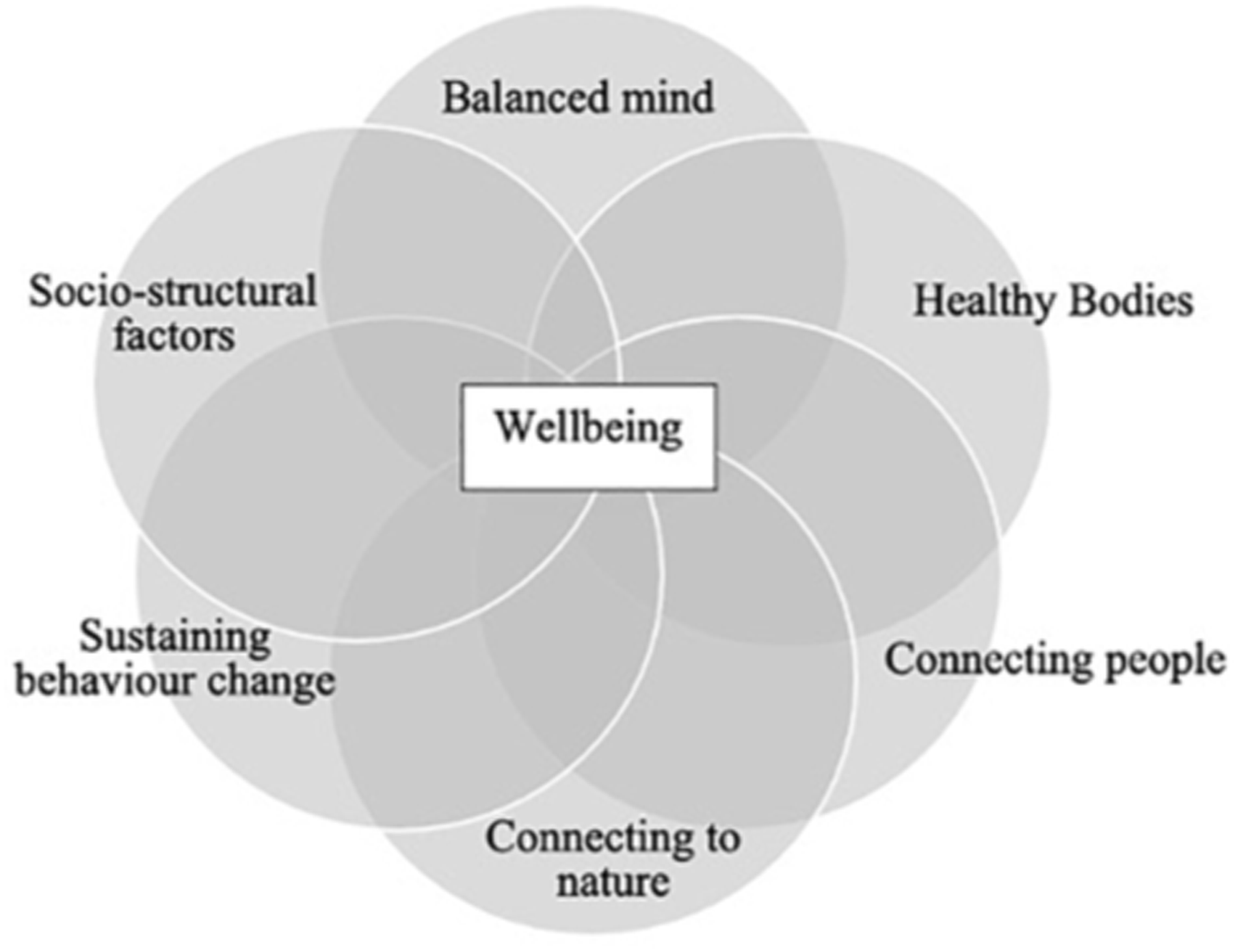
Summary of the core theoretical components underpinning our interventions, integrating insights from psychological science with developments across multiple disciplines spanning the individual, community and the environment.
Mapping Education and Healthcare Sector Interventions Onto our Theoretical Model of Wellbeing.

aKemp A, Mead J, Sandhu S, Fisher Z. Teaching wellbeing science. Framework OS, ed. Published online 2021. https://doi.org/10.17605/osf.io/e7zjf
bKemp AH, Fisher Z. Application of Single-Case Research Designs in Undergraduate Student Reports: An Example From Wellbeing Science. Teach Psychol. Published online 2021:009862832110299. doi:10.1177/00986283211029929
cTulip C, Fisher Z, Bankhead H, et al. Building Wellbeing in People with Chronic Conditions: A Qualitative Evaluation of an 8-Week Positive Psychotherapy Intervention for People Living With an Acquired Brain Injury. Front Psychol. 2020; 11:66.
dWilkie L, Arroyo P, Conibeer H, Kemp AH, Fisher Z. The Impact of Psycho-Social Interventions on the Wellbeing of Individuals With Acquired Brain Injury During the COVID-19 Pandemic. Front Psychol. 2021;12:648286. doi:10.3389/fpsyg.2021.648286
eGibbs K, Fisher Z, Wilkie L, Kemp A. Riding the Wave into Wellbeing: A Qualitative Evaluation of Surf Therapy for individuals Living with Acquired Brain Injury. Submitted. 2021.
fWilkie L, Arroyo P, Conibeer H, Kemp AH, Fisher Z. The Impact of Psycho-Social Interventions on the Wellbeing of Individuals With Acquired Brain Injury During the COVID-19 Pandemic. Front Psychol. 2021;12:648286. doi:10.3389/fpsyg.2021.648286.
gHoward J, Fisher Z, Kemp AH, Lindsay S, Tasker LH, Tree J. Exploring the barriers to using assistive technology for individuals with chronic conditions: a meta-synthesis review. Disability & Rehabilitation Assistive Technology. Published online 2020:1-19. doi:10.1080/17483107.2020.1788181
hHoward J, Tasker L, Fisher Z, Tree J. (2021). Assessing the use of co-design to produce bespoke assistive technology solutions within a current healthcare service: a service evaluation.Submitted.
Application to Education
A focus on wellbeing, broadly defined, in university student populations is important because students are a high-risk population for mental health conditions. Critically, levels of mental distress are increasing, and have been doing so even prior to the COVID pandemic. 38 Depression and suicide-related outcomes in university undergraduate students have a pooled prevalence of 21%, 39 which is considerably higher than the point prevalence estimate of depression in the general population, estimated at 12.9%. 40 In response, we have developed a five-week module on wellbeing science that has been structured around the GENIAL framework.41,42 This module promotes a sense of connectedness to self (individual wellbeing), others (collective wellbeing) and nature (planetary wellbeing), consistent with social ecological theory. Students are introduced to the concept of ‘sustainable’ happiness and wellbeing, which has been defined in several different – yet complementary – ways. Students learn how to ‘sustain’ improvements to wellbeing by drawing on theories of behaviour change 43 while also placing happiness and wellbeing within the context of environmental ‘sustainability’, 44 in which strategies to promote wellbeing do not involve the exploitation of other people, the environment or future generations. Students are encouraged to identify activities to promote their mental and physical wellbeing (through interventions to increase positive affect 32 and/or positive health through, for example, physical activity 33 ); community wellbeing (e.g. orientation to promote good 45 ) and planetary wellbeing (e.g. nature-based mindfulness 46 ) while reflecting on how they might work towards overcoming the many sociostructural constraints to wellbeing through, for example, contributions to social change (e.g. volunteering; civic engagement; activism) through commitment to something greater than oneself (i.e. self-transcendence). 22 Wellbeing is therefore broadly defined and characterised by a focus on multi-levelled perspectives, ensuring that there is scope to improve the wellbeing of students themselves, while also encouraging students to reflect on how they might contribute to collective and planetary wellbeing, supporting efforts for positive societal change.
The impact of the intervention was evaluated during the COVID pandemic when university students faced a unique set of stressors. 41 As well as individual student reports of impact, we have now reported promising group-wise evidence for the beneficial effects of our module on student wellbeing during the COVID-19 pandemic. 41 This includes evidence from pre-post within-subject comparisons and convergent findings relating to comparisons with nationally representative samples. Together, these findings demonstrate the beneficial impact our module has had on student wellbeing during the COVID-19 pandemic. Emerging research has highlighted a variety of factors to have protected wellbeing during the pandemic, 47 including tragic optimism, gratitude, meaning in life, physical health, social cohesion and identity and nature connectedness, all concepts that have been integrated into our module, amongst others. Importantly, we are continuously improving our module based on student feedback and recent developments in the field, consistent with an action research approach to curriculum development, professional development and a scholarly research agenda to improving wellbeing in university student populations. 42 This process also led us to incorporate ideas on how individuals might contribute to positive societal change (e.g. volunteering; activism; psychological boosting) leading to further development of our theoretical model. (See Table 1 for summary of key principles). Our own findings together with those published in the wider literature highlight the capacity of the individual to promote their own wellbeing within the context of their lived environment, while also contributing to collective and planetary wellbeing. Although individuals play a relatively small role in improving collective and planetary wellbeing, adopting a relational approach to wellbeing by connecting to self, others and nature will be instrumental for driving much needed societal transformation in response to major societal challenges. Critically, ‘bottom up’ approaches will be rendered much more efficient if accompanied by ‘top down’ initiatives and strategies at multiple levels of scale, including, for example, community-led change (e.g. the Transition movement), policy-led change (e.g. Wellbeing Public Policy) and legislative-led change (Wellbeing for Future Generations Act).
Application to Healthcare
We recently described several factors that have constrained the long-term care of people living with chronic conditions
30
including definitional issues focusing on complete mental, physical and social health, a goal that is seldom possible for people with long-term chronic conditions and inadequate models of healthcare including the ‘acute medical model’, which is underpinned by a ‘find’ and ‘fix’ deficit reduction approach that is incongruent with a ‘whole health’ approach because the absence of impairment is not representative of whole health. Cartesian dualism is often inherent in the way that health systems define, treat and design services which can lead to siloed thinking and narratives that actually attenuate health-sustaining behaviours.
48
Factors such as these ultimately result in failure of public healthcare to meet the long-term needs of those living with chronic conditions. We have applied core principles from our GENIAL framework (Table 1) to inform a more holistic approach to the rehabilitation of people living with Acquired Brain Injury (ABI), in particular. This has involved designing more holistic models of health care within our clinical service and developing collaborations with community providers to bridge the gap between the health service and the community. This is needed as many people with chronic conditions struggle to access their local communities independently post-discharge,
49
leading to social isolation and loneliness – major determinants of ill-health and premature mortality.
3
We have now established a healthcare hub networked to the university and a wide range of local area initiatives that together better support sustainable community integration and wellbeing, in keeping with local top down initiatives advocating for a systems approach (i.e. A Regional Collaboration for Health, ARCH: http://arch.wales/en/index.htm). Table 2 summarises these initiatives which include positive psychotherapy, assistive technology co-design, nature-based exercise and local conservation projects. By means of example, we describe in more detail one of these initiatives: a Surf-Therapy collaboration between academics, clinicians, patients and the local Community Interest Company, Surfability (https://surfabilityukcic.org). At an individual level, surf therapy involves explicitly promoting the benefits of exercise while clinicians work to facilitate feelings of positive emotion, meaning and achievement. At a community level, exercise provides a context for creating positive social relationships and eliciting feelings of belongingness and acceptance (social cohesion). Surf therapy brings together individuals with ABI (and their families) from diverse backgrounds, helping to promote (bonding and bridging) social capital and a strong social identity. At an environmental level, participants are engaged in nature-based exercise, facilitating the experience of wellbeing, which has also been shown to promote the emergence of pro-environmental behaviours.
50
Mindful of the need to overcome sociostructural constraints to participation, clinicians and community providers have secured competitive grant funding to develop and deliver an intervention that would otherwise be inaccessible to many participants. Figure 2 provides a theoretical model for the benefits of surf therapy in people living with ABI, illustrating relationships between identified themes from unpublished qualitative analysis and potential underlying mechanisms identified from the available literature. A proposed theoretical model for the benefits of surf therapy in people living with Acquired Brain Injury, illustrating potential relationships between identified themes and potential underlying mechanisms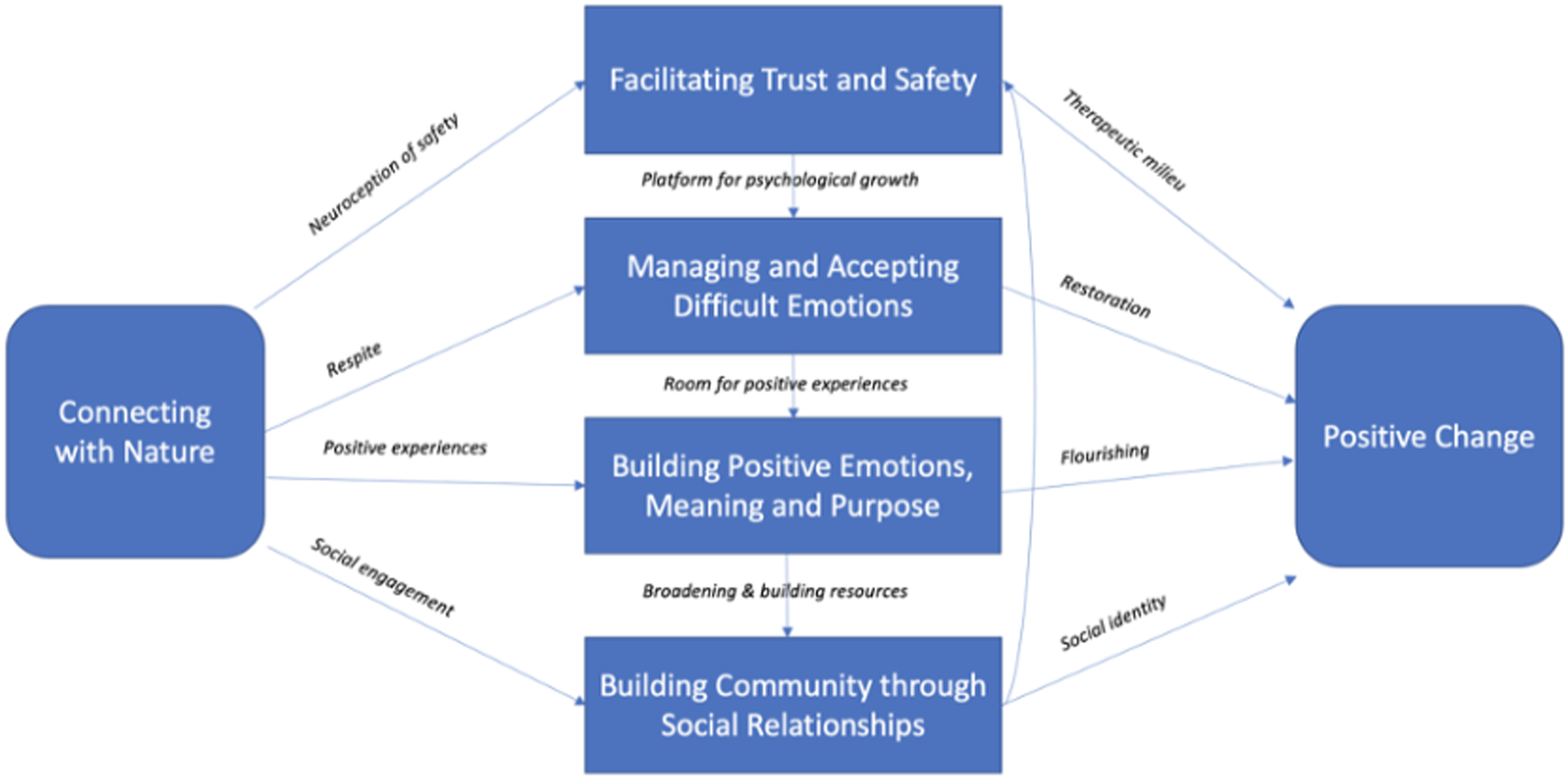
Discussion and Conclusion
We have sought to promote ‘whole health’ in a coordinated way by moving from theory to application and back to theory. Our work in the education sector has focused on building wellbeing in university students, providing opportunities to flourish through connections to self, others and nature, and a commitment to something greater than oneself (i.e. self-transcendence). 22 Our service evaluation work demonstrates how new interventions based on our theoretical framework have been translated into clinical practice and tailored to meet the needs of specific populations, providing opportunities for the experience of multiple determinants of wellbeing despite life changing conditions. Evaluations of our interventions have helped to refine our model, and these refinements subsequently led to further improvements in interventions themselves, through co-creation, abduction and action research methods.
Our GENIAL framework has helped to frame and contextualise the construct of wellbeing, laying the foundations for thinking differently about how ‘whole health’ might be promoted by reflecting on individual, collective and planetary wellbeing. We have been inspired by recent developments in wellbeing science including a move beyond individual people, discipline, method and culture, encompassing developments in psychological science, 21 wellbeing public policy 51 and the pursuit of sustainable development goals in higher education. 20 Our GENIAL model has provided a useful framework for reflecting on action at multiple levels, that include the individual, but also extend into what Bronfenbrenner described as the ‘exosystem’, 4 which refers to settings or structures that function independently of the individual, but that nevertheless impact on settings in which the individual lives.
In conclusion, we have argued that wellbeing plays a key role in ‘whole’ health and have shown how the GENIAL framework provides a strong basis on which health and wellbeing might be improved at multiple levels of scale in a just and sustainable way. Our work has involved: 1) developing a theoretical framework (the GENIAL model) to better frame our understanding of the complexity of wellbeing and develop novel interventions, 2) identifying funding and collaborative opportunities across organisations and disciplines to overcome barriers and practical challenges, 3) co-creating and co-delivering innovative interventions alongside community partners, 4) evaluating outcomes through multi-pronged research methods to inform continued refinement of our framework and interventions and 5) engaging with multiple stakeholders. This work provides a step toward a transdisciplinary model of wellbeing and way of working that has facilitated a reimagining of what it means to experience health and wellbeing, which often includes hardship and great suffering.
Footnotes
Acknowledgements
We would like to thank our PhD Students, Jessica Mead, Katie Gibbs, Jonathan Howard, Lowri Willkie and Sanjeev Sandu whose work as part of our GENIAL science team has contributed to our knowledge and thinking. We would like to thank our colleagues at Swansea University, Swansea Bay University Health Board and Fieldbay Ltd, who have co-funded our PhD students and recognised and promoted our work through various awards including the University Research and Innovation Award for Outstanding Impact on Health and Wellbeing (2018), the Swansea Bay University Health Board Chairman’s VIP Award for Commitment to Research and Learning (2018) and Swansea University Morgan Advanced Studies Institute (MASI) Summer of Hope Award (2021) to host a 2-day student-led wellbeing symposium. Finally, we would like to express our heartfelt thanks for the support of our service users, students and community partners who have worked with us and given so much of their time and energy to support our research agenda.
Declaration of Conflicting Interests
The author(s) declared no potential conflicts of interest with respect to the research, authorship, and/or publication of this article.
Funding
The author(s) disclosed receipt of the following financial support for the research, authorship, and/or publication of this article: We have built a novel and innovative positive psychotherapy intervention that is based on our GENIAL theoretical framework. This intervention was supported by grant funding from the Health and Care Research Wales through the Research for Public Patient Benefit Scheme (RfPPB-18-1502).
