




Abstract
Anxiety is highly reported during the COVID-19 pandemic. The use of acupressure for anxiety is a common practice in integrative medicine, and previous literature has shown that acupressure can be an effective and feasible alternative treatment for decreasing anxiety. Given the social distancing requirements during the COVID-19 pandemic, it appears reasonable to assume that acupressure may be especially suited to treat anxiety under these circumstances. However, there has been relatively little reported use of acupressure for anxiety during the pandemic. This viewpoint aims to highlight the possible role of acupressure as a self-administered therapeutic approach for anxiety amidst the COVID-19 pandemic and to outline key areas for future research.
As 1 of the greatest pandemics in modern history, Coronavirus disease 2019 (COVID-19), has spread to more than 220 countries, areas, and territories, with 228 807 631 confirmed cases and 4 697 099 confirmed deaths 1 as of September 21, 2021. During this pandemic, individuals may experience multiple stressors including but not limited to fear of infection, uncertainty, moral distress, dread, grief, despair, as well as the social-economic consequences of inadequate testing supplies, disrupted regular health care, unemployment, and financial losses. Because of social distancing requirements, these stressors are often experienced alone, leading to a sense of isolation, highlighting the urgent need for strategic approaches for coping with the resulting anxiety.
Anxiety is a feeling characterized by tension, worriedness, and physical changes such as increased sweating, trembling, dizziness, elevated blood pressure, or a rapid heartbeat. Anxiety can suppress the immune system leading to increased vulnerability to viral infections. People with excessive anxiety are more inclined to engage in public disruptive behaviors, such as compulsive handwashing, panic buying, and unnecessary surging into medical facilities when they misinterpret their minor ailments as signs of serious infection. A recent review indicated that the prevalence of anxiety in the general population during the COVID-19 pandemic reached 15.15%. 2 Front line medical health care providers have been reported to have high anxiety with prevalence rates of 11.4% among physicians and 27.9% among nurses. 3 Given the fact that anxious reactions might trigger social behavioral responses to viral outbreaks—both mitigating as well as facilitating the spread of infection, the mental health of people during the COVID-19 outbreak has received widespread attention. It is critical that health officials and health care providers understand that heightened levels of anxiety call for optimal self-care and accessible mental health services.
Given that little empirical attention has been devoted to this issue, it is not surprising that there has been no optimal guideline developed specific to the treatment of anxiety during COVID-19. Treatments need to be based on our knowledge of how to manage anxiety in medically ill, as well as physically healthy, individuals while taking into consideration the effects of social distancing, travel restriction, quarantine, case isolation, and uncertainty of the magnitude, duration, and speed of the pandemic. The optimal anti-anxiety interventions should be implemented mainly as a home-based practice to augment the patient’s own resiliency in coping with the COVID-19 pandemic.
Overview of Previous Literature Investigating the Impact of Acupressure on Anxiety.

Note: RCT = Randomized Controlled Trials.
aLevels of evidence based on the Quality Rating Scheme for Studies and Other Evidence modified from the Oxford Centre for Evidence-Based Medicine(OCEBM) for rating of individual studies; available online at https://www.cebm.net/2016/05/ocebm-levels-of-evidence/.
The COVID-19 pandemic has had a detrimental impact on global healthcare systems with a remarkable ripple effect on every aspect of life as we know it, resulting in a series of subsequent social-economic consequences including social distancing, travel restriction, self-isolation, shortage of medical resources, lack of personal protective equipment, economic crisis, and recession. Convenient, secure, and cost-effective medical care services for millions of people are needed. Acupressure, if effective, is a safe, economic, and easily accessible technique that could provide anxious people with a tool to help control and manage their emotional and mental health concerns during this epidemic as well as in the future. Due to its simplicity and accessibility, acupressure can be self-administered without physical contact with practitioners or healthcare providers. Successful self-treatment administrated by the participants indicates that this approach is useful in reducing anxiety without seeking help from others.
Therefore, we hypothesize that acupressure can be of benefit in decreasing the anxiety among people in the shadow of COVID-19 in addition to other related symptoms and signs such as stress, pain, fatigue, insomnia, vomiting, and nausea. Acupoints of Yin Tang (EX-HN3), Shenmen (HT7), Neiguan (P6), Hegu (LI4), Taichong (LV3), Jianjing (GB21), Zu San Li (ST36), Sanyinjiao (SP6), Neiting (ST44), Auricular Shenmen acupoint (inferior lateral wall of the triangular fossa), and Relaxation point (superior lateral wall of the triangular fossa) are the most frequently used points to treat anxiety. Intermittent pressure can be used on the selected acupoint for 3–10 minutes per point, 2–3 points per session, twice daily. “Intermittent acupressure” here means pressure moderate pressure resulting in mild distention of De Qi on a point every .5 seconds. “Deqi” refers to a traditional Chinese medicine term indicating the achievement of satisfactory therapeutic effects of acupoint stimulation of suan (aching or soreness), ma (numbness or tingling), zhang (fullness, distention, or pressure), and zhong (heaviness) felt by the patients. (Figure 1) Acupressure could open an attainable avenue of medical care for patients to directly reduce their anxiety in a safe, comfortable, and cost-effective manner. Developing this intervention may aid healthcare professionals, researchers, and policymakers to gain more feasible information on how to deal with anxiety related to the COVID-19 crisis. Distribution of common points for acupressure.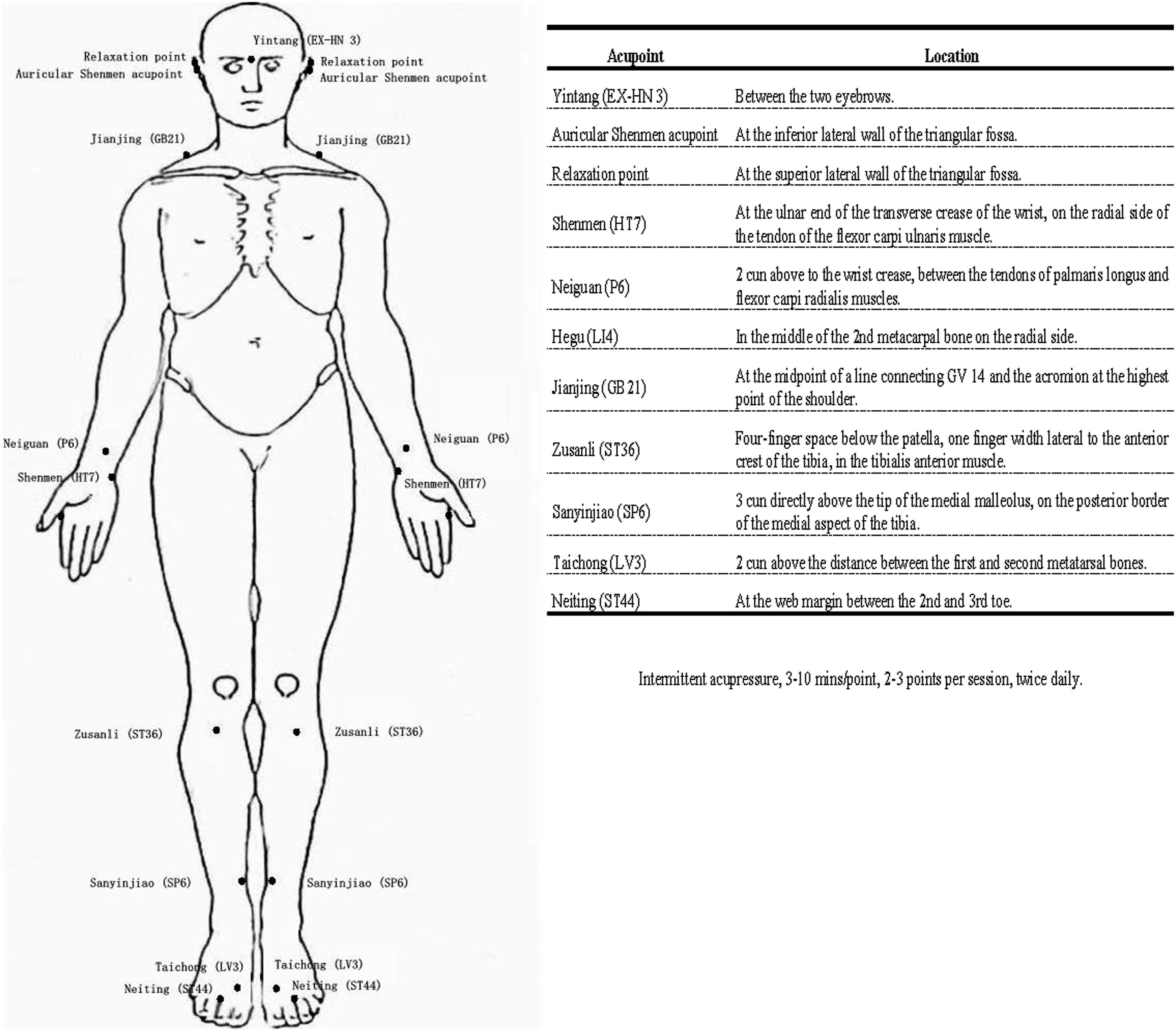
When interpreting our recommendation, several limitations must be considered. Future research into acupressure intervention should be focused on the following 3 main areas. First and foremost, while there are a few studies examining acupressure for anxiety thus far, we are not aware of any trials specifically evaluating acupressure on patients with anxiety under the pandemic conditions of COVID-19. Second, the most frequently used acupoints recorded in literature are predominantly distributed on different superficial parts of the head, trunk, hand, and foot of the human body, whereas their detailed effects and mutual interactions are not known yet. Finally, except for sparse reports, the actual underlying mechanisms of acupressure therapy are still not fully known, and there is a clear need for more laboratory and clinical research to confirm the magnitude of the effect of acupressure on anxiety during COVID-19 pandemic. In conclusion, preliminary data regarding the use of acupressure for anxiety supports our hypothesis that acupressure can effectively reduce anxiety during the COVID-19 pandemic. We therefore recommend that health care providers consider applying this noninvasive method to address anxiety. While further studies regarding this practice are needed, the existing evidence suggests that acupressure may be safe and effective in the interim.
Footnotes
Acknowledgments
We gratefully acknowledge the valuable support of The HEAD Foundation, Singapore for this work.
Author Contributions
BB contributed to the conception and design of the work. JY collected the data and prepared the first draft of the manuscript. BB and DW revised the manuscript critically for important intellectual content. AD, MM and TC revised the last version of the manuscript.
Declaration of Conflicting Interests
The author(s) declared no potential conflicts of interest with respect to the research, authorship, and/or publication of this article.
Funding
The author(s) received no financial support for the research, authorship, and/or publication of this article.
