




Abstract
Objectives
The aim of this study was to compare the stress reduction effects of spending 25 minutes reclining in a SolTec™ Lounge between 2 intervention groups. Group 1 experienced the Lounge with multilayered music on an external speaker, while group 2 experienced the Lounge with multilayered music and synchronous vibration and magnetic stimulation from within the chair.
Subjects
In total, 110 participants with a self-reported stress level of 4 or higher on a 0- to 10-point scale were recruited from the local community including employees. Participants were randomized into receiving 1 of the 2 interventions. There were no significant differences between the group’s average stress levels prior to the interventions.
Interventions
Both groups received a 25-minute session in a dimly lit, quiet area on the Lounge with multilayered music. The second group also received vibration and magnetic stimulation that were synchronized with the music.
Design
Current stress level as well as ratings or feelings of anxiety, tenseness, energy, focus, happiness, relaxation, nervousness, creativeness, and being rested were recorded before and after the session.
Results
Both groups of participants reported equivalent decreased feelings of stress after using the Lounge. Participants receiving the synchronous multilayered music, vibration, and magnetic stimulation did report significantly reduced feelings of tenseness, feeling more relaxed, and feeling more creative when compared with the group that received music only.
Conclusion
Spending 25 minutes in the SolTec™ Lounge with multilayered music is an effective way to reduce self-reported stress in individuals who self-report having a high stress level. If confirmed by future studies, including synchronous vibration and magnetic stimulation with the multilayered music might be an effective stress reduction strategy.
Introduction
Prolonged periods of stress can have dire consequences to our overall health and wellness. 1 It has been noted that more than one-third of American workers rate their job as “often” or “always” stressful. 2 In 2014, more than 1 in 5 Americans were experiencing “extreme stress.” 3 Stress has also been shown to reduce performance in the workplace, and work stress has been shown to be a major risk factor for cardiovascular morbidity.4,5 Therefore, stress reduction is vitally important for many individuals, but especially those who work in jobs that could potentially put themselves and others at risk such as surgeons and airline pilots. 6 Recent investigations have focused on mind-body practices (eg, meditation, yoga, guided imagery, etc) as one of the key strategies to mitigate the negative health impacts of stress. These interventions have generally been found to be effective in reducing stress when routinely practiced.7,8 Unfortunately, many Americans find it difficult to engage in such practices on a regular basis. The discipline to develop a regular practice (where positive effects can be felt) is not common in U.S. adults and only a relatively small proportion of individuals adhere to a resiliency practice over a lifetime, where the benefits would be clinically meaningful.9–11 Thus, the availability of a device such as the SolTec™ Lounge that could induce the same relaxation response as these practices would be a significant addition to the range of stress management techniques that can be offered to an individual.
The SolTec™ Lounge (SolTec Health, Eden Prairie, Minnesota) uses multilayered music and vibrations to attempt to induce a meditative state. 12 The manufacturer’s goal with this device was to silence the brain’s vigilance mechanism (scanning the external environment for potential danger), which is primarily served by senses of vision, hearing, and touch. 13 When we listen to typical music, there is usually 1 melody and the listener will tend to follow it, remaining consciously aware of it and making judgments about it. As such, they tend to be actively engaged in listening. It has been well established that music can have effects on our brain and emotions.14,15 However, because multilayered music is more difficult to follow, it can cause auditory habituation followed by auditory inhibition. 13 This can cause the auditory cortex to stop processing this music and as such becomes less sensitive to auditory cues. 13 Similar to the effect on the auditory system, having the user close their eyes, has the same effect on vision, and the relative constancy of the vibrations has the same effect on the sense of touch (Figure 1).

SolTec™ Lounge.
The theoretical framework of the SolTec™ Lounge is that since the user is instructed to relax and is informed that it is okay to fall asleep (however, initiating sleep is not the intention of this stress intervention); the external surveillance mechanism is considerably muted by a habituated/inhibited vigilance mechanism. As a result, the entire vigilance mechanism in terms of surveying the outside world is significantly habituated and far less diligent. Because of this, the user typically moves into a deeply relaxed and possibly drowsy (depending on their level of sleep deprivation) state of being. The volume of the music provided is periodically modulated to rouse the user, in case they have fallen asleep. 13
Stress has been quantified in many different ways, including questionnaires, blood tests, electroencephalogram, saliva, blood pressure, heart rate variability, and galvanic skin response.16,17 Questionnaires are not only easy to use, low cost, and reduce interviewer bias but also have previously been shown to be valid for assessing an individual’s stress and quality of life (QOL).5,18
Anecdotal evidence (from participants using the Lounge in various spas and wellness centers) suggest that a 20-minute session can have significant effects, including induction of a deep relaxation response. 12 If validated, the SolTec™ Lounge could potentially have applications in medical environments where stress is an impediment to optimal care (eg, chemotherapy suites, preprocedure areas, etc). Given the passive nature of the intervention, it may also be a viable option to expand stress reduction to a large patient/consumer market where current offerings that require active participation are not meeting the needs of many individuals.
Participants and Methods
Participants
One hundred and ten healthy women (n = 90) and men (n = 20), with an average age of 41.5 years, were recruited from the local community including employees via printed and electronic classified advertisements. Group 1 (External Speaker) experienced music played on an external speaker while in the SolTec™ Lounge. Group 2 (Lounge Speaker) experienced the Lounge with multilayer music, vibration, and magnetic stimulation via the Lounge. Participant characteristics are noted in Table 1.
Participant Characteristics.

Abbreviation: NS, not significant.
This study was approved by the Mayo Clinic Institutional Review Board. Inclusion and exclusion criteria are noted in Table 2.
Inclusion and Exclusion Criteria.
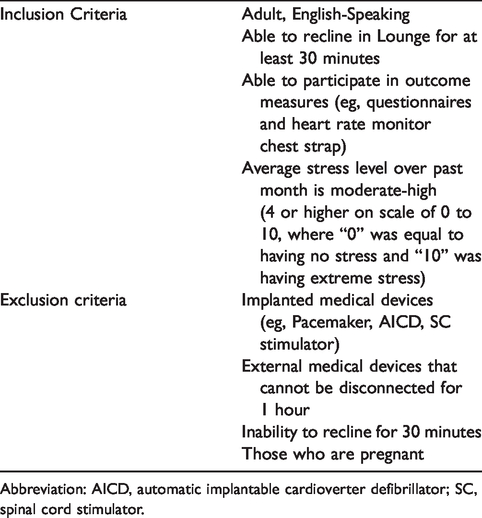
Abbreviation: AICD, automatic implantable cardioverter defibrillator; SC, spinal cord stimulator.
Procedure
Prior to using the SolTec™ Lounge, participants filled out the study prequestionnaire. Participants were given instruction on the use of the Lounge. The study staff explained to the participants that certain features of the device may be turned on or off depending on which intervention arm they were randomized to. Therefore, participants “may feel sound, movement, or vibration from the SolTec™ Lounge during their time on the device.” The participant randomization list was created by the quality and research analyst on the study team. First she created a list containing each study id number from 1 to 110. Then for each study identification (id) number, a random number was generated using Microsoft Excel’s (Microsoft Corporation, Redmon, Washington) random function. The list was then sorted by the random number. The 55 lowest random numbers were assigned to the External Speaker group and the 55 highest random numbers were assigned to the Lounge Speaker group. The list was then resorted, this time by study id number. Each potential participant was screened, and those who met the criteria for enrollment were consented. After the participant was consented, the study consenter assigned the participant the next sequential study id number. A separate document contained the randomization schedule, which linked the study id and the study group. The quality and research analyst, who generated the random schedule, was not involved in screening, consenting, or assigning a study id number to the participants.
Half (n = 55) of the participants were randomized into the External Speaker group, where the multilayer music track was played through a separate external speaker arrangement (iPod, Apple Inc, Cupertino, California and Bose SoundDock, Bose, Framingham, Massachusetts). This speaker was placed within 1 meter from the Lounge. The other participants (n = 55) were randomly assigned to the Lounge Speaker group, where the same multilayer music was played via the Lounge speaker. All participants experienced the Lounge in a private, dimly lit room, located in the Mayo Clinic Healthy Living Program spa and assessment area in the fall of 2017. Similar to a medical setting, the area around the Lounge was not sound proof, and therefore could be subjected to distracting background or disruptive noise. Participants were offered blankets and pillows, as well as the ability to adjust the sound level, to increase comfort. Participants spent 5 minutes on the Lounge for acclimation purposes, and then were asked again if they would prefer any adjustment to the Lounge or sound level before the study period began. After the 25-minute experience, and before exiting the Lounge, participants repeated the questionnaire. Upon completion of the study, participants received a book on stress management as remuneration for their participation.
Instruments
All participants completed the electronic questionnaire consisting of current stress level, QOL, mood, and descriptive demographic measures (eg, age and gender). Study data were collected electronically (iPad, Apple Inc) and managed using REDCap electronic data capture tools hosted at our institution. REDcap is a secure, web-based application designed to support data capture for research studies providing (1) an intuitive interface for validated data entry, (2) audit trails for tracking data manipulation and export procedures, (3) automated export procedures for seamless data downloads to common statistical packages, and (4) procedures for importing data from external sources. 19 The study questionnaire for stress level, QOL, and mood that asked participants to rate their feelings on a 0 to 10 scale was based on previous work that had been shown to be valid in medical patients and employees of an academic medical center.5,20,21 Participants were asked about their current ratings or feelings of stress, anxiety, tension, nervousness, energy, focus, happiness, relaxation, creativeness, and being rested. Participants were also asked after their experience to rate whether they would use the SolTec™ Lounge again and whether they would recommend the Lounge to others.
The SolTec™ Lounge is 185-cm × 52-cm lounge has two 75-watt and one 150-watt transducers that produce synchronized sound and vibration. The SolTec™ Lounge is formed as a 1-piece “zero gravity recliner,” with 2 adjustable arm cushions and the ability to pivot on its base to change the level of incline. 12 Due to a 1-pound mass-loaded transducer cone located in the seat of the SolTec™ Lounge, the Lounge produces dynamic magnetic stimulation with the same frequency as the musical content. The SolTec™ Lounge has a variable gain adjuster, allowing for various music sources to be plugged in. Any music can be chosen to produce the frequencies reflected in the sound, vibration, and magnetic stimulation.
Multilayered music, where multiple melodies are played at the same time, is recommended by the manufacture. 12 Multilayered music consists of multiple sound tracks of original, instrument-only melodies, played simultaneously; intended so that the listener would have difficult tracking any 1 melody. According to the manufacturer, multilayered music is designed to promote rapid listener fatigue, which tends to cause inattention. Intermittently, the volume of the recorded music changes causing some level of listener reengagement in an attempt to prevent sleep and maintain wakefulness or drowsiness. The music that was used in this study is freely available on the manufacture’s website (https://soltechealth.com/music-instructions/). 12
Data Analysis
The primary outcome measure for this study was self-reported current stress level before and after the SolTec™ Lounge session. With this in mind, a 2-sample screening trial was proposed to confirm the hypothesized impact. In the absence of paired data for change in stress levels, before and after an intervention, there are published data showing the standard deviation (SD) of stress level for a single time point (SD = 2.2) and the SD of the difference for correlated measures should be smaller than the SD at a single time point.22,23 Therefore, we believe that an intervention that decreases stress level by 1 point on the 0 to 10 scale would be considered clinically meaningful. Under these assumptions, we have determined that a sample size of N = 45 per study group was required to have statistical power of 80% using a 2-sample, 1-sided, α = .10 level test to assess whether the use of the sound and vibration emanating from the SolTec™ Lounge can decrease stress levels. As we anticipate a portion of eligible participants may have a baseline current stress level of < 4 (eg, low stress level) on the day of their intervention, we increased the sample size by 20% to ensure a sufficient sample for the data analysis. Therefore, we enrolled 110 participants in the study. To assess whether there were differences between the control group and the study group, a 2-sample t test was computed. Analyzing the change from pre- to postintervention was completed using a 2-sample t test, where statistical significance was associated with a P value of ≤ .1. The data analysis for this article was generated using SAS software. Copyright, SAS Institute Inc SAS, and all other SAS Institute Inc product or service names are registered trademarks or trademarks of SAS Institute Inc, Cary, North Carolina.
Results
A total of 110 individuals participated in this research study. Participant characteristics are noted in Table 1. Half of the participants (n = 55) were randomized to the External Speaker group, which experienced the multilayer music through a separate external speaker arrangement while reclining in the SolTec™ Lounge. In the prescreening 0 to 10 stress scale, a score of 4 to 6 is indicative having a moderate stress level, whereas a score of 7 or higher indicates a high stress level. These participants began the study with an average prescreening stress score of 6.6 (Table 1). Participants in this group reported a statistically significant improvement in stress, anxiety, tension, nervousness, relaxation, and the perception of being creative and rested after using the SolTec™ Lounge (Table 3).
Self-Reported Scores.

Abbreviations: CI, confidence interval; SD, standard deviation.
aOne-sided t test based on measure.
bMean difference (post-pre) significantly different than 0, tn–1, α=.1.
The other half of the participants (n = 55) were randomized to the Lounge Speaker group, where multilayer music was played via the SolTec™ Lounge speaker, and thus receiving synchronous vibration and magnetic stimulation. This group began the study with an average prescreening stress score of 6.4 (Table 1). After using the SolTec™ Lounge, participants in this group reported a statistically significant improvement in stress anxiety, tension, nervousness, happiness, relaxation, and the perception of being creative and rested (Table 3).
There were no significant differences between each group in age or prescreening stress scores (Table 1). When comparing between the 2 groups, only the feelings of tenseness, relaxation, and creativity were shown to be significantly different in the Lounge Speaker group compared with the External Speaker group (Table 3).
Each group was asked their opinions of whether or not they would consider another session in the lounge chair and whether or not they would recommend a session to others. In the External Speaker group, 70.4% indicated they would use the lounge chair again and 78.0% said they would recommend the lounge chair to others. Similarly, in the Lounge Speaker group, 78.2% indicated they would use the lounge chair again and 83.0% said they would recommend it to others. There were no significant differences between groups on their rating of using the lounge chair again or recommending the lounge chair to others (Table 4).
Lounge Satisfaction Scores.

Abbreviations: NS, not significant; SD, standard deviation.
Discussion
Novel approaches to stress management are needed. In this study, 110 participants spent 25 minutes reclining in a SolTec™ Lounge with multilayered music. Half of the participants also received synchronous vibration and magnetic stimulation. Both groups of participants reported positive effects from using the device, including statically significant differences between pre- and postintervention in the areas of stress, anxiety, tenseness, nervousness, relaxation, creativity, and feelings of being rested. Interestingly, energy and focus were not improved for either group. Playing the multilayer music through the Lounge speaker (Lounge Speaker group) induced significantly greater changes in how tense participants were, how relaxed they felt, and their current level of creativity. These results align with the manufacture’s goal of inducing a meditative state with the lounge chair.
The External Speaker group was subjected to almost the same situation as the Lounge Speaker group, minus the vibration and magnetic stimulation. Even though the External Speaker group did not receive vibratory stimulus, they had constant sensory contact with the SolTec™ Lounge. These participants actually experienced less of the ability to be roused, as the changing vibrations related to the multilayer music changes were not present. Therefore, they probably had almost the equivalent “dose” of habituation/inhibition, which is possibly why they also reported positive effects.
Inducing a meditative state, through several weeks of meditation practice, has previously been shown to have positive improvements on anxiety, depression, pain, but with low evidence for improvements in the areas of stress- and health-related QOL. 24 The SolTec™ Lounge participants mirrored these results, but noticed a significant improvement in the areas of lower evidence. It is currently unknown whether spending time in the Lounge chair on a weekly basis, over the course of several weeks, could increase these results compared having to a standard meditation practice.
Because the participants were allowed to close their eyes during the session or even fall asleep, the benefits of the SolTec™ Lounge could be similar to quiet wakefulness (awake, but resting with the eyes closed) and napping. Both have been demonstrated to be positive in increasing an individual’s neurobehavioral performance after the activity, especially in those who are sleep deprived. 25 Since more than one-third of American adults report sleeping less than the current recommendation of 7 hours per night, 26 and many individuals who do not get sufficient sleep reporting frequent mental stress (≥14 days of the 30 days), 27 time spent resting, such as in the SolTec™ Lounge, could have further benefits beyond a inducing a meditative state. Future studies should examine the individual’s sleep habits and impact of the SolTec™ Lounge on mood.
The feasibility of using a device, such as the SolTec™ Lounge, to induce a meditative state seems promising as enrollment into this study was feasible. In addition, most participants rate the session highly and would recommend the lounge chair to others. Using self-reported questionnaires to gather information before and after a session also seems realistic in a clinical setting. Therefore, it seems that a majority enjoyed the experience, independent of which intervention group they participated in.
Limitations
This study was completed with only 1 type of multilayered music in this study, so it is possible that other types of music may also produce similar results. For some individuals, the space surrounding the room where the device was located was going through construction; therefore, it is possible that some participants experienced more disruptive noises not related to the study and multilayered music. Just prior to the participant’s arrival for the intervention (up to 1 day prior), the study group was revealed via the fully generated randomized participant list created by the quality and research analyst, so the study coordinator could set up the intervention. As this study was originally designed as a pilot, the study coordinator did have access to the whole randomized allocation list prior to the participant’s arrival. Therefore, allocation was not fully concealed, which does lead to the possibility of unintentional bias during the intervention. We did not record our participant’s racial, ethnic, or socioeconomic background, but our participants were mostly Caucasian and employed. Therefore, how these results apply to the underserved population is unknown. This study also did not measure the chair’s effect compared with other types of relaxation techniques or mind-body practices, nor did this study investigate using a different type of lounge chair. These are areas of future study and study design that should be addressed. In addition, future studies should assess different seating positions and different music with larger, more diverse groups. Including heart rate variability as a measure of stress during the intervention may also provide objective data on the Lounge’s influence on stress reduction.
Conclusions
Spending 25 minutes in a SolTec™ Lounge with multilayered music with or without vibration and magnetic stimulation seems to be an effective way to reduce self-reported stress in individuals who self-report high stress. Participants receiving the vibration and magnetic stimulation additionally reported feeling significantly less tense, more creative, and more rested.
Footnotes
Acknowledgments
The authors thank the staff of the Health Living Program for facilitating recruitment and wayfinding for this study. The authors express a truly heartfelt “thanks” to all the participants who gave their time and attention to this study. The Mayo Clinic Healthy Living Program, located in Rochester, Minnesota, provides transformative lifestyle and behavior change experiences for Mayo Clinic patients and visitors. Developed and delivered by Mayo Clinic experts, this experiential program is science-based, outcomes-focused, and centered around three domains—nutrition, physical activity, and resiliency. Participants in the program receive a personalized wellness plan that addresses their goals and needs and uses their overall health status as foundational information for plan development. The Mayo Clinic Healthy Living Program model combines the personalized, immersive experience of working with Mayo Clinic experts in a state-of-the-art wellness facility with follow-up support from nationally certified Mayo Clinic wellness coaches to help individuals stay on track long after their visit to Mayo Clinic. The authors would also like to acknowledge Dan Cohen, MD and Ellen Cohen for their gracious use of the SolTec™ Lounge and guidance on best practices. The authors also thank Sara Mansfield for her insight and support. Finally, the authors would like to acknowledge Darrell Schroeder for his statistical guidance.
Declaration of Conflicting Interests
The author(s) declared the following potential conflicts of interest with respect to the research, authorship, and/or publication of this article: Matthew M. Clark is consultant to Roche Diabetes Care. Paul J. Limburg serves as Chief Medical Officer for Exact Sciences through a contracted services agreement with Mayo Clinic. Dr. Limburg and Mayo Clinic have contractual rights to receive royalties through this agreement. The rest of the authors declare no potential conflicts to this study. SolTec™ Health (Dan Cohen, MD and Ellen Cohen) provided use of the SolTec™ Lounge for this study. No financial or conflicts of interest exist between the SolTec™ Health and any of the authors. The authors have full control of all data, and neither the data nor the manuscript from this research study was provided to SolTec™ Health prior to publication.
Funding
The author(s) disclosed receipt of the following financial support for the research, authorship, and/or publication of this article: The authors acknowledge the Mayo Clinic Healthy Living Program and the Mayo Clinic Center for Clinical and Translational Science (UL1TR002377) for funding this trial.
