




Abstract
A growing number of patients and consumers are seeking integrative medicine (IM) approaches as a result of increasing complex medical needs and a greater emphasis on prevention and health promotion. Health-care professionals need to have knowledge of the evidence-based IM resources that are safe and available to patients. Medical institutions have acknowledged the need for education and training in various IM modalities and whole-health approaches in medical curricula. There is a strong need to develop and incorporate well-structured IM curricula across all levels of learning and practice within medicine. This article provides an example of the development, implementation, impact, and assessment of IM education curricula across all learner levels at a large academic medical center.
Introduction and Background
Integrative medicine (IM) aims to combine conventional medical approaches with complementary medical approaches in an organized way. It has been defined as a principle of medicine that reaffirms the importance of the relationship between practitioner and patient, focuses on the whole person, is informed by evidence, and makes use of all appropriate therapeutic and lifestyle approaches, health-care professionals, and disciplines to achieve optimal health and healing.1,2 According to a 2012 National Health Interview Survey report,3,4 more than one-third of the adult population within the United States uses some form of complementary and integrative modality for their health and symptom or disease management.
Use of complementary and alternative medicine approaches, now commonly referred to as IM, has consistently increased in the United States in the past 4 decades. 5 Some reasons for this observed growth include increasing complex medical needs and the need to focus on prevention and wellness promotion, cultural values and beliefs, and a philosophical orientation toward holistic and whole-person care.6,7 Data suggest that U.S. adults spend more than $14.9 billion out of pocket for visiting IM practitioners and for the purchase of complementary products. 8 Because of the increased use of forms of IM, there is a strong need for education and training in various IM modalities and whole-health approaches in medical curricula across all levels of learning and practice. 9 This article reviews the development, implementation, impact, and assessment of IM education curricula across all learner levels at a large academic medical center.
IM Education Programs at Our Academic Center
Our institution, Mayo Clinic in Rochester, Minnesota, is an active member of the Academic Consortium for Integrative Medicine and Health. The Academic Consortium, established in 2008, consists of more than 70 leading U.S. academic medical centers. Its mission is to advance IM in academic medical institutions and health systems. The consortium’s goals are to support and mentor academic leaders, faculty, and students through IM education, research, and clinical care.
Our Integrative Medicine and Health section was established in 2004 and consists of an interprofessional group of health-care professionals including physicians, massage therapists, licensed acupuncturists, registered nurses, and advanced practice providers. They are all actively engaged in providing innovative educational experiences for learners and practitioners within and outside our institution through structured teaching and learning activities in a shared community. These activities and programs were established after a vigorous needs assessment and have carefully developed educational content, delivery methods, and evaluation methods at different learning and practice levels. The outline of activities and evaluation instruments provided in the article is intended to serve as a framework for developing IM educational curriculum at other medical centers.
Medical School Curriculum
Because of the increasing need for IM education among medical students and physicians, several studies have evaluated potential models and processes for curricular implementation and engagement and attitude of students.10–18 Frye et al. 19 and other investigators have described ways in which medical students can acquire knowledge about IM, including evidence-based courses,20,21 literature reviews, 22 active learning mechanisms, 23 learner-driven activities, 24 and other approaches. 25 Medical students are interested in and enthusiastic about having IM in their curriculum.26,27 Also, most believe that this information is important to their future practice and that educating themselves about patients’ beliefs and ways to address health-care behaviors could improve patient care.21,28–35
On the basis of evidence regarding effectiveness of curricular development and implementation, we created a mandatory 4-year medical school curriculum in IM that is taught by IM professionals and physicians. This curriculum has evolved and grown over the past decade and covers the breadth and depth of IM through creative formats of blended curriculum, including opportunities for self-study, didactics, small-group interaction, interest-group activities, and wellness groups. The first year (didactic series) focuses on IM basics, the evidence base behind the use of IM, and physiologic and pharmacologic mechanisms underlying the key principles. The second and third years include intersession lectures and the opportunity for hands-on learning in community with the IM medical student–led interest group. The fourth year provides an overview of IM with a focus on clinical practice readiness. In addition, all 4 years have content focusing on resilience and wellness and monthly student life and wellness committee offerings.
Postcurricular evaluations have confirmed the feasibility of this curricular integration, and surveys completed by students indicate an improvement in medical students’ knowledge of IM practice and improvement in their personal health. 36 A barrier to overcome for this curriculum is sustaining dedicated time for the content in a busy medical school training program. These evaluations help to show the continued need and benefits.
IM Elective Rotations for Residents and Fellows
Our IM section offers a flexible 1- to 4-week elective clinical rotation opportunity focused on experiential learning of IM in the clinical setting to residents and fellows across specialties. During this time, residents and fellows work with IM physicians and allied health-care staff to gain knowledge regarding general IM consults, herb and supplement consultations, individual and group stress management consultations, hypnosis in the outpatient setting, massage, acupuncture, and animal-assisted therapy in the inpatient and outpatient settings. In postrotation evaluations and feedback forms, residents and fellows described an appreciation for the broad exposure to different modalities and education on evidence-based indications and contraindications for IM. From 2015 to 2017, residents were surveyed before and after rotation. The average number of residents per year is 40, and most residents were from IM or Family Medicine practices. The responses showed an improvement in resident knowledge (Figure 1). Similarly, the percentage of time residents spent counseling patients on IM therapies increased from before to after the rotation (Figure 2).

Self-Rated Assessment of Resident Knowledge of Integrative Medicine. (a) Before rotation. (b) After rotation.

Self-Assessment of Amount of Time Residents Talk to Patients About Integrative Medicine Therapies. (a) Before rotation. (b) After rotation.
At the end of their rotations, residents were asked to rate their confidence with regard to knowledge in various IM disciplines (rating scale of 1–10, 10 being extremely confident). Residents’ mean ratings of confidence in acupuncture were 5.87 ± 2.85 in 2015, 8.00 ± 1.04 in 2016, and 8.04 ± 1.98 in 2017. Their mean ratings of confidence in massage therapy were 6.75 ± 2.71 in 2015, 7.41 ± 2.53 in 2016, and 8.18 ± 1.29 in 2017, and those of stress management were 8.75 ± 1.38 in 2015, 8.33 ± 1.07 in 2016, and 8.04 ± 1.98 in 2017. In residents’ postrotation feedback, acupuncture and massage were commonly identified as being an important part of chronic pain management that may benefit a patient’s prognosis. Overall, the data highlight how clinical experience in IM can improve learner knowledge and counseling on integrative therapies and possibly add value to patient care. As stated above, carving out time for residents to obtain these experiences can be difficult, and thus continuing to evaluate the outcomes is important. Currently, 17 residency programs in the United States offer board-certified fellowships (by the American Board of Integrative Medicine or the Academic Consortium for Integrative Medicine and Health) in IM with opportunities for elective residency experiences.37,38
IM Fellowship
Mayo Clinic in Rochester, Minnesota, offers a 1- to 2-year clinical research fellowship in IM within the Division of General Internal Medicine, enabling trainees to develop skills as IM specialists. Trainees participate in focused clinical rotations within IM and other subspecialty divisions in which the trainee aims to develop enhanced expertise as a future IM consultant. The curriculum covers basic and advanced principles within IM and allows for balanced development of clinical, research, education, and quality improvement skills. There are opportunities to develop expertise as an educator through completion of a Master Class Teaching Skills Workshop, leading IM rotating resident teaching rounds, and presenting at IM Grand Rounds, General Internal Medicine Grand Rounds, Patient Education Symposiums, and Mayo Clinic Continuing Medical Education courses. Trainees are required to complete a quality improvement project and obtain institutional Quality Academy Certification at the Bronze and Silver levels (a pathway toward external qualification from the American Society for Quality). 39 Considerable flexibility is incorporated into the fellowship curriculum to accommodate trainee interests in academic medicine, including research and education opportunities. IM fellowships must meet eligibility requirements toward board certification from the American Board of Integrative Medicine, an emerging requirement for IM practice at U.S. academic centers. 40
IM Grand Rounds
Grand rounds (large-group presentations of recent advances in clinical practice, interesting cases, and current research) are an integral part of the practice of medicine. 41 Each year, the IM team devotes considerable time educating on and disseminating topics related to IM to colleagues, nurses, residents, medical students, and other learners. IM grand rounds are a monthly series and feature invited Mayo Clinic staff and various professionals in the field of IM from around the country. The goal is to educate and inform health-care professionals on the ever-growing field of IM and expand the evidence base of IM modalities. To maintain the education intent of the grand rounds series and to meet the needs of the audience, potential presentations are reviewed to ensure that topics meet the educational criteria set forth. Publicity is achieved through e-mails, web-based announcements, and institutional digital announcement displays. For persons who are unable to attend, presentations are archived in the Integrative Medicine and Health website for viewing at a later time. Various topics are presented, including IM and infertility, animal-assisted therapy, integrative headache care, IM in survivorship, IM and chronic pain, IM in the care of the elderly, clinical hypnosis, wellness coaching intervention, acupuncture, and use of probiotics. The average number of in-person attendees for grand rounds is 24, and viewing of videos varies depending on the topic. A year-end electronic survey completed by attendees showed that they attended grand rounds several times a year to keep up-to-date with standards of care and new IM research. Additional reasons for attendance were learning and practice enhancement through case discussions and didactic presentations, collegial interaction, and networking. Busy calendars and other competing commitments were the biggest barriers to attendance.
IM Mini-case Presentations
Held monthly, the IM mini-case series provides a unique faculty-development opportunity through cross-disciplinary dialogue among allied health-care professionals, advanced practitioners, physicians, residents, fellows, and administrative program staff. The welcoming environment fosters engagement and reinforces learning through communities of practice in which staff contribute their knowledge, experiences, and skills in the field of IM. 42
The series is primarily led by IM allied health-care professionals (massage therapists, acupuncturists, licensed clinical counselor, and registered nurses), nursing students, and residents and fellows completing special projects or rotations within IM. Presenters self-select topics of interest and facilitate learning by sharing rare and challenging patient cases, current or recently completed research studies, and novel IM modalities and techniques. Learning is enhanced through experiential learning formats, engagement, and mentorship among cross-disciplinary teams. Benefits for participants are enhanced knowledge and sharing diverse perspectives, leading to improved patient care. Topics have included hypnosis, new advances in acupuncture, animal-assisted therapy research, meditative practices including paced breathing, humanities in medicine, and challenging cases and case studies in IM.
Continuing Medical Education
Each year the IM team at Mayo Clinic brings together experts within the field to present and discuss the most up-to-date evidence-based research and clinical practice guidelines relating to IM. The Updates in Integrative Medicine and Health continuing medical education course includes speakers from within and outside Mayo Clinic to provide clinicians and learners with general working knowledge of IM, familiarity with the common therapies, and evidence-based, practical, and safe application of these therapies to their patients.
The continuing medical education activity spans 3 days and includes large-group didactics, small-group sessions, and hands-on and interactive activities. The audience is comprised of physicians (57%), nurse practitioners or physician assistants (39%), and other IM practitioners (4%). The range of topics is broad and covers basic IM principles; latest updates in nutritional supplements, acupuncture, and massage therapy; integrative therapies for specific diagnoses and life events (eg, menopause, headaches, and cancer); stress and pain management; resilience; and effective communication strategies with patients. For the most recent conference (2018), 97% of attendees rated it as very good or excellent, and 98% stated that they would recommend the conference to others.
At the completion of the course, attendees are asked to self-report how the conference helped them increase their knowledge, competence, performance, and impact on patient outcomes. Evaluations have indicated changes in all 4 domains (Figure 3). In the most recent course (2018), 57% of attendees responded that they gained substantial knowledge in IM and also had an increase in their confidence to discuss IM modalities with their patients.
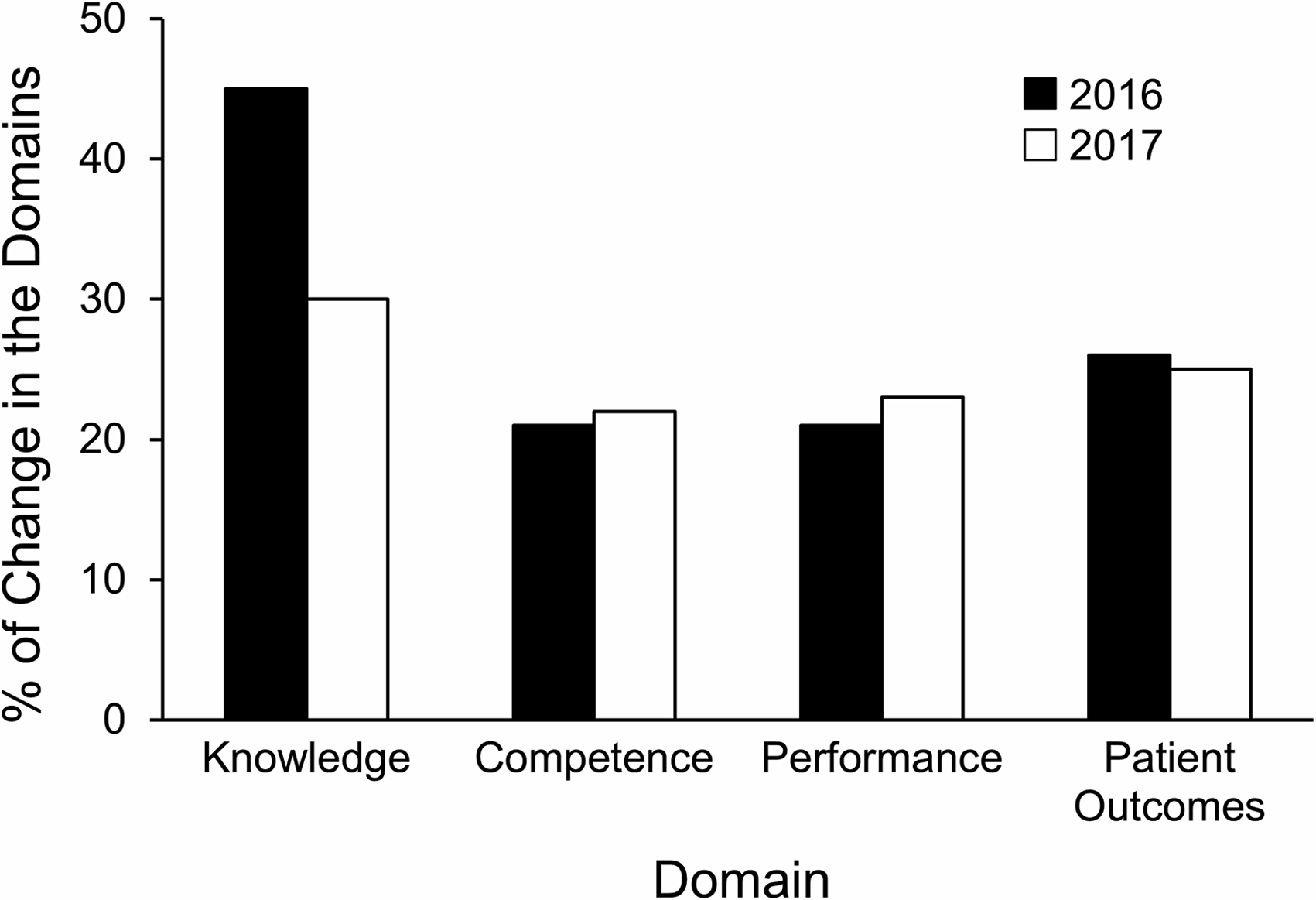
Self-Assessment by Attendees of Integrative Medicine Course Regarding Increases in 4 Domains.
The availability of information about integrative therapies for patients and consumers and the Joint Commission standards for nonpharmacologic pain management are expected to increase the need for continued education on IM modalities for health-care professionals. This yearly course helps them sort through the growing data and implement integrated therapies into their everyday practice.
In addition, the Department of Nursing offers several continuous nursing educational events including a biyearly Holistic Health and Well-being conference that is directed by nursing staff working within IM. This conference is a collaborative effort between the Department of Nursing, the section of Integrative Medicine and Health, Humanities in Medicine, and the Mayo Healthy Living Program. For the most recent conference, 92% of attendees rated it as very good or excellent (82% response rate). The top 2 contributing factors for the high rating were educational content (31%) and speakers (30%). Topics for this conference focus on health and wellness essentials, such as diet and exercise, and on integrative health topics such as meditation, mindfulness, yoga, aromatherapy, and animal-assisted therapy. Attendees are largely staff nurses (49%) but also nurse leaders, allied health-care staff, IM allied health-care staff, wellness professionals, and physicians interested in topics for personal or professional well-being. Similar to our medical school curricula, the nurse residency program at our institution offers resilience training for all new nurses. Research on the impact of this program for the nurse residency indicated improvements in nurse resident stress, anxiety, resilience, and mindfulness over time. 43
Discussion
There is increasing demand for IM services and consults to help manage complex patient symptoms and to enhance health and wellness. The leading U.S. medical institutions need to continue to expand the practice and educate and train health-care professionals on IM modalities and whole-health approaches. This article reviewed the development, implementation, impact, and assessment of IM education curricula across all learner levels at 1 large academic medical center. There is much to be gained by academic medical centers sharing best practices and challenges in education and curricular development for IM.
Curricular development for IM should exemplify these principles: actively seek to develop a community of health-care professionals at all levels; have a balanced approach that includes content that addresses knowledge, skills, and attitudes; include evaluation at multiple levels; and include informal learning and community building. New social learning theories of medical education suggest that learning is a social activity and takes place in community. Therefore, curriculum should include formal components and experiences but also informal experiences, discussion, and sharing of ideas and resources. 42 Interprofessionals engaged in the IM program at Mayo Clinic, Rochester, Minnesota, have consciously constructed an interdisciplinary community of practice by offering various opportunities and venues for learning, sharing, practicing, and discussing IM approaches.
In our experience, for development of curriculum for IM approaches, it is incredibly important to have clear outcome measures that drive efforts to continuously improve content and the processes of learning. The curricular approaches at our center have engaged the community of learners in evaluation and have shown an increase in knowledge and a substantial interest in learning. Although it is desirable to have formal and structured curricular evaluations, as we have been able to achieve and share at our institution, there is additional gain from informal programmatic feedback and learner comments through open dialogue.
Although there are challenges with developing and sustaining IM educational curriculum, there remains a strong need, as shown by learner evaluations and feedback. A continuous effort must be made to explore innovative and mixed-method approaches for learning that are flexible and sustainable. Future opportunities for IM curricular development and enhancement include expanding online platforms and programs such as the Foundations in Integrative Health through the National Center for Integrative Primary Healthcare. 44 Some imminent challenges for IM programs and curricular development include lack of trained professionals within IM, support for teaching time, leadership support of educational programs, and ongoing faculty development.
Medical education teaches and reaffirms “do no harm” and use the least toxic, least invasive, and most effective treatments first—that is an IM approach. It is time to transform medical education by solidifying learning and teaching of content specific to an integrative approach that focuses on the practitioner-patient relationship, and on the whole person, is evidence-based, uses all appropriate therapeutic and lifestyle approaches and health-care professionals and disciplines to achieve optimal health, and includes opportunities for the social nature of learning.
Footnotes
Declaration of Conflicting Interests
The author(s) declared no potential conflicts of interest with respect to the research, authorship, and/or publication of this article.
Funding
The author(s) received no financial support for the research, authorship, and/or publication of this article.