




Abstract
This paper examines the attitudes of South Korean university students towards the increasing diversity and multiculturalism in their country. Using the tenets of critical discourse analysis, the researchers examined 227 student responses. The findings suggest that multicultural interactions are often interpreted in socioeconomic terms. A deeper interpretive analysis also reveals a conflicted notion of multiculturalism, underscoring the anxiety that stems from potential intercultural conflict and the loss of tradition. This paper contributes to the growing literature on the dominant view of multiculturalism in Korea by demonstrating conflicting motivations for accepting ethnic diversity while respecting traditional identities.
Plain Language Summary
Aims: South Korea’s growing ethnic diversity has brought affordances and challenges. Our aim is to document and analyze student attitudes towards the multicultural changes in their country. Specifically, our study focuses on the acculturation expectations of Korean students towards newcomers. Through this research, we determine if there has been a shift in Korean students’ perceptions toward multiculturalism and how government multicultural policies in education have influenced their views. Background: Traditionally, Korea has been viewed as an ethnically homogeneous society and its education system reinforces this idea. However, with recent demographic changes as more non-Koreans become a part of Korean society, educators and academics have advocated for Koreans to adopt a multicultural approach in government policies and schools. Methods: This research utilized questionnaires, semi-structured interviews, and student artifacts. The researchers asked Korean students about their interactions with the international student community on campus. Using critical discourse analysis, we analyzed students’ responses. Findings & Significance: The findings indicate that multicultural interactions are often interpreted in socioeconomic terms. Deeper analysis shows that students have a conflicting notion of multiculturalism. Some students have anxiety over potential intercultural conflict and a sense that they will lose Korean traditions and values as Korea becomes more multicultural. The value of our research is in demonstrating the conflicting student motivations for accepting other cultures while respecting Korean traditional values.
Introduction
In response to the increased multicultural diversity worldwide, John Berry (2017) stated that managing cultural relations is the most pressing issue for multiethnic societies as many developed countries become more diverse. Without the amiable participation of all members, there is a high degree of marginalization among minorities and decreased well-being for those who are excluded. According to Berry (2020), in pluralistic societies, the question is: How should everyone live together?
Education may provide a potential solution. The classroom is the location where immigrant children must adapt to the dominant culture, where the challenges facing diverse populations have become increasingly prevalent (Banks, 2008). Educators should adopt a transformative role in fostering the values of democracy, equality, equity, and inclusivity as a positive response to diversity (Banks, 2008). However, the question arises as to the appropriateness and viability of promoting such values outside North America.
In the case of South Korea (hereinafter, Korea), managing multicultural issues has become a significant concern (J.-H. Kim & So, 2018; Seol, 2015, 2018). The increased presence of immigrants has been met with mixed results: there appears to be preferential treatment for newcomers who belong to cultures that are similar to Korea’s (Denney & Green, 2021) and an expectation that newcomers conform to Korean values and norms (Ghazarian, 2018; N. Kim & Yoon, 2025; Seol, 2018; Walton, 2020). A further complication is Korea’s shrinking population (OECD, 2023), which has fueled an exclusionary, reactionary force that seeks to limit ethnic and cultural diversity in the Korean milieu (Kang, 2020a, 2020b; Lee et al., 2023). Even as many young Koreans forgo marriage and children (Walton, 2020), the vested interest in recruiting internationals to address Korea’s declining population further increases the anxiety over a loss of cultural coherence and traditional identity (Seol, 2018). This tension has been identified as a problem requiring ethical intervention. Lee et al. (2023) argued that current Korean policies have a limited scope for equity and justice, reducing foreigners to mere assets rather than persons of dignity. Such a reduction has serious consequences. Marginalization and the threat to well-being are visceral experiences suffered by those excluded in Korea, as immigrant children are subject to overt and micro forms of aggression such as discrimination and racism (H. A. Kim, 2020; J.-H. Kim & So, 2018; Walton, 2020). The problem of multicultural acceptance in Korea is both a social question, as stated by Seol (2018), Denney and Green (2021), and Kang (2020a) and an ethical task of reconciling the public need for social coherence and recognizing the humanity of the other (J.-H. Kim & So, 2018; H. A. Kim, 2020; Lee et al., 2023). For some scholars, Koreans must recognize multiculturalism through reconciliation and understanding (J.-H. Kim & So, 2018; Lee et al., 2023). The resistance to a more diverse Korean conception of identity has motivated scholars to promote the tenets of social justice and racial equity (H. A. Kim, 2020), broadening the scope of multiculturalism in Korea (Ghazarian, 2018; Lee et al., 2023; Lim, 2020; Watson, 2012).
In response to Korea’s growing diversity, we examine the discourse of Korean university students to identify their attitudes towards multiculturalism. Although we agree with Berry (2017) and Banks (2008) on the importance of intercultural understanding and the promotion of diversity, we believe a reflective analysis is necessary, given that the government's multicultural initiatives have been hierarchical and assimilationist (Ghazarian, 2018; Seol & Seo, 2014). Many have called for the development of a transformative education based on social justice (H. A. Kim, 2020; J.-H. Kim & So, 2018; Jo & Jung, 2017; Lee et al., 2023). Before advocating for radical change, we chose to let the examined discourse shape the appropriate ethos to adopt. Using critical discourse analysis, as outlined by Martin and Rose (2007), our goal is to navigate a path towards a tenable multicultural approach compatible with public sentiment. Examining the chosen language of Korean university students, we critically analyze their discourse to uncover how they interpret their multicultural horizon.
Literature Review
South Korea’s Shifting Multicultural Horizon
In South Korea, multiculturalism is not just a response to socioeconomic concerns and cultural issues but a potential source of growth and innovation. There is an ideological divide in Korea’s multicultural vision. This divide can be understood as how multiculturalism is often viewed as a form of economic, cultural, and biological capital. Multicultural policies are typically framed as contributing to Korea’s epistemic and cultural capital, a necessary response to globalization and internationalization (Ghazarian, 2018; Lim, 2020; Seol, 2015; Watson, 2010). For Korea to become a hub of innovation, the free movement of cultural and academic knowledge is required to encourage exchange, dialogue, and collaboration (Seol, 2015). Officially, the direction of Korean progress is outward, as government officials interpret research and development for international markets (Choi, 2021; Choi et al., 2021; Seol, 2015, 2018).
Adopting a more global outlook, the traditional narrative of Korea’s homogeneity is at odds with the cosmopolitan view espoused by technocratic government officials (Lim, 2020). The expectation is that, as Korea participates in a more globalized world, its citizens can achieve prestige and economic capital only if they expand their socio-cultural horizons through English bilingualism and become familiar with different cultures (Choi, 2021). This cosmopolitan view may contradict Koreans' traditional view of national identity (Ghazarian, 2018; Lim, 2020; Ryu, 2021; Seol, 2018). However, from the same ideological perspective, multiculturalism is a blessing, as an open Korean society empowers the country’s scientists, artists, and athletes to share their achievements with the rest of the world (Rüdiger, 2020). Hallyu is a term that encapsulates the global aspirations of the Korean social imaginary, aiming to have Korean artifacts, assets, and products consumed and celebrated by other nations (Rüdiger, 2020).
Although no causal connection can be established with certainty, the popularization of Korean cinema, music, cuisine, and language has coincided with Korea’s growing acceptance of diversity and pluralism. By emulating Western multiculturalism, Ryu (2022) described how even Korean conservatives support cultural assimilation policies that tolerate migrants as long as they respect the central tenets of Korean values. The Korean government’s national plan to expand the country’s global outreach also addresses its economic challenges, including labor shortages and a declining domestic population (Ryu, 2021; Seol, 2015; Watson, 2010). Seol and Seo (2014) reported how both Korean liberal and conservative administrations have advocated for more inclusive multicultural policies. For both liberals and conservatives, cultural diversity is inextricably linked to the country’s socioeconomic concerns (Watson, 2012). Multiculturalism has been a tool for conservative governments to justify neoliberal policies such as recruiting foreign laborers (Chung, 2020; Ryu, 2021). A consequence of Korea’s rapid urbanization and industrialization is the mass migration of domestic citizens to cities, resulting in the depopulation of the Korean countryside (Seol, 2018). Labor shortages in critical sectors have led to a shortage of workers in agriculture and manual labor. The Korean government’s policies are hardly revolutionary; they followed the trend set by Western and European countries of recruiting migrant workers. Seol (2015) explained how Korean administrations have defended a largely neoliberal platform when adopting multicultural policies. This neoliberal view is not limited to economic capital.
While men are recruited for manual labor, international women, specifically women from Southeast Asia, are lured, bought, and sold for marriages and reproduction (Chung, 2020; Lim, 2020; Watson, 2012). A whole industry of foreign brides has become an integral conduit for Korean men to fulfill their domestic mission of marriage and procreation, a critical issue for a country that has made its declining population its top concern (Chung, 2020; Watson, 2012). For the past two decades, their struggles against racism and discrimination have become a significant focal point for activists and researchers to rally public support (Lim, 2020). Women from international marriages have formed social groups that advocate for expanding their legal and civil protections (Chung, 2020; Lim, 2020). While instances of discrimination and abuse remain, women like Jasmine Lee, a Filipina immigrant married to a Korean national, garnered sufficient public sympathy and recognition for the Korean public to realize the pressing issue of gender and racial equality in Korean society (Kang, 2020b). Lim (2020) has argued that, although imperfect, the continued dialogue about the malleability of Korean citizenship has paved the way for a more accepting conception of identity. Due to their roles and functions as wives, mothers, residents, and contributors, these women have shifted the conversation, casting irrevocable doubt on the idea of returning to a strictly homogeneous Korean nation (Watson, 2012).
Despite progress toward fairer treatment for foreigners, resistance to multiculturalism persists. Denney and Green (2021) reported that Koreans consider an immigrant’s language capacity and employment crucial for multicultural acceptance. Their analysis also revealed that a prospective immigrant’s willingness to adhere to legal norms and culture was as significant as economic status in participants’ assessment of who was acceptable in Korean society. Multicultural acceptance is determined by the immigrant’s willingness to conform, and such conformity might be insufficient. Denney and Green (2021) found that Koreans who reported a strong ethnocentric attitude held discriminatory or prejudicial views toward culturally distant countries. Their report was corroborated by Kang’s (2020a) report of online commentaries by Korean citizens concerning immigrants in their country. Kang reported how many Koreans voiced their suspicion and resentment of immigrants in their country and how multicultural acceptance was limited to women and children as long as they remained subservient to Korean men. These online posts indicated a growing trend among Korean males complaining of unfair welfare opportunities given to newcomers.
Racism in Korea, as in other developed countries, continues to shape international experiences, even as Korea seeks to diversify and expand its concept of citizenship (Lim, 2020). Although the evidence does not establish the absolute purity of Korean consanguinity, the myth persists (Lim, 2020; Ryu, 2021; Seol, 2018; Watson, 2012). Seol argued that Koreans must think of their national identity beyond consanguinity and purity, and only by widening the scope of inclusion can Koreans live in a rich culture of harmony and diversity (2018). However, attempts to broaden the local population's cultural repertoire have remained challenging, both socially (Denney & Green, 2021) and educationally (Walton, 2020).
Korea’s Multicultural Education Policy: Assimilation Over Acceptance
In 2023, the Korean Ministry of Education stated its goal to aid multicultural families and their children. In ex-President Yoon Seok Yeol’s administration, the official goal was to empower immigrants by addressing their unique needs and challenges (Ministry of Education, 2023, p. 1). The document pledges to recognize diverse cultures, thereby preventing the marginalization of immigrants and fostering a harmonious society (Ministry of Education, 2023, p. 2). The Ministry of Education appears to be an integrative entity. However, a closer examination of the document reveals that protecting immigrants from discrimination and racism is not mentioned until the latter part of the document (on page 9). Reducing and preventing discrimination is less of a priority compared to their harmonious integration into the Korean milieu. Although the language appears to be a call for respecting differences, the official stance is to foster harmony by having immigrants and their children learn Korean as quickly as possible.
In a qualitative study, Walton (2020) analyzed the experiences of multiracial Korean children, providing important anecdotal evidence for why the government would want immigrant children to learn Korean and pass as Korean. From Walton’s observation, the environment in Korean schools fostered an ethos that minimizes difficulties for multiethnic children by encouraging the assimilation of the embodied differences of mixed children while stigmatizing the differences represented by multiethnic identities. Walton’s work revealed the local examples of racism and microaggressions in Korean schools experienced by mixed children. Walton (2020) stated that because of educational policies being primarily assimilationist, mixed children adopted the strategy of trying to pass for Korean. Children of mixed heritage in Korea must practice strategic invisibility, including passing for Korean, to adapt to their local environment. The school system instructs migrants and their children that experiences of racism and discrimination are often derived from the hierarchical privileging of Korean national identity (Seol, 2018; Seol & Seo, 2014; Ryu, 2021). In Korea, many sojourners learn that not all racism is equal. Korean racism toward non-whites has been documented by H. A. Kim (2020), who argued for critical race theory as the necessary pedagogical intervention to transform the binary conception of race that ideologically permeates the discourse in Korean education. H. A. Kim (2020) described the discourse of conceptualizing whiteness with aesthetic and economic superiority and stigmatizing Blackness.
There is a fundamental flaw in Korean multicultural education, characterized by an exclusionary ideology that treats minorities as the “other” (J.-H. Kim & So, 2018; Lee et al., 2023). To overturn its current state, Korean multicultural education must be more equitable, inclusive, and open (H. A. Kim, 2020; J. Kim & Jeon, 2017; Lee et al., 2023). J. Kim and Jeon (2017) emphasized the need to recognize multicultural education as a lifelong learning process. It would be an ongoing process of promoting social equality and integration for newcomers. This call is in response to reports of microaggressions faced by mixed Koreans and non-Koreans in classrooms. Researchers have advocated for more equitable treatment of minorities (J.-H. Kim & So, 2018; Lee et al., 2023; Watson, 2010), with educators playing a crucial role in reconciling and embracing ethnic and cultural differences (J.-H. Kim & So, 2018; Lee et al., 2023).
Advocating for reform in Korean multicultural education is far from dramatic. Ghazarian (2018) analyzed Korea’s multicultural education policies. His principal finding was that the education system emphasized assimilation without considering the immigrants’ perspective (Ghazarian, 2018, p. 30). The Korean government’s approach, with its goals of internationalization and global prestige, betrays the lingering influence of nationalism. This view shapes students' attitudes in the education system. N. Kim and Yoon (2025) reviewed school policies in communities in Korea with large immigrant populations, and their findings suggest that Ghazarian’s (2018) conclusion remains unchanged. As of 2025, at the schools where large migrant families send their children, educators and administrators prioritize the assimilation of these children rather than recognizing their unique values and differences. N. Kim and Yoon (2025) report that integrating immigrant students into Korean society remains an overlooked issue. In Korean schools, a gap appears between the promise of integration and the actual practice of integrating multicultural children.
Given resistance to accepting cultural differences and a more pressing lack of consideration for immigrant values, this paper presents a two-fold examination of Korea’s multicultural horizon from the perspective of those who were ideologically shaped by these policies. The first part examines whether there has been a shift in Korean attitudes toward multiculturalism, which has been relatively narrow and limited (Denney & Green, 2021; Ghazarian, 2018; H. A. Kim, 2020; Watson, 2012). Do the findings from the literature present a consensus that ultimately suggests that Korea’s multicultural horizon remains fundamentally narrow in scope? The second is to analyze the outcome of Korean multicultural education: How do Koreans interpret their multicultural interactions? Such an analysis contains an opportunity to challenge the validity of the consensus and provide a positive account of multicultural interactions (J.-H. Kim & So, 2018; Lee et al., 2023).
By analyzing the discourse of participants, we believe we can arrive at a deeper understanding of multiculturalism in Korea by answering the following questions:
Methodology
Reporting on Koreans’ multicultural understanding required a specific target population. Denney et al. (2020) found that Koreans aged 18 to 29 were less inclined to feel a sense of ethnic solidarity than other population groups. It was less important for young Koreans to identify collectively and assert their Korean ethnicity as a rallying point for their identity. We chose Korean university students as an ideal population to study changes in multicultural attitudes, as they are situated in an environment that is becoming increasingly diverse—Korean universities. In a study of international students in Korea, C. D. Jung (2023) highlighted the struggles they face due to barriers that hinder their acculturation. This research was designed to complement C. D. Jung’s (2023) findings and to provide a broader context for understanding local Koreans’ attitudes towards internationals.
Our study used three data sources: questionnaires, semi-structured interviews, and post-project reflection papers. Our sample population was drawn from a pool of university students at a tertiary institution in Daejeon, Korea. These students were enrolled in English conversation courses and participated in a multicultural project as part of their curriculum. They were instructed to use English outside of class and were incentivized to participate in clubs with international students with merit points. We believed that reporting on the perspectives of Korean students over two consecutive semesters would be advantageous. Frequent and sustained contact with international students gave us confidence that the responses would be more reliable and comprehensive.
We asked the English department to send the questionnaires to students enrolled in their program, and 227 Korean students completed a short questionnaire about their interactions with members of their local international community. To encourage student participation, we allowed responses in English or Korean. For these responses, a professional translator was consulted to help uncover the nuances in the students’ responses. All participants were Korean university students who self-reported having low to high English fluency (See Table 1).
Participant Information.

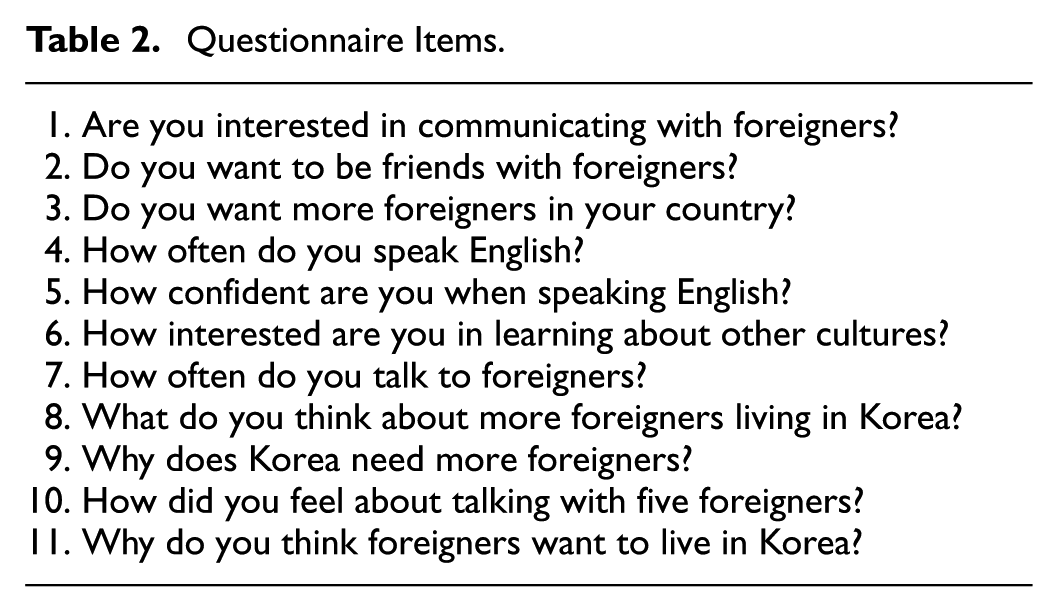
We modified Berry’s (2017) Mutual Intercultural Relations survey to make it suitable for English learners by simplifying their questions (see Table 2). We chose Berry’s scale as an appropriate measure because his work enabled us to assess the attitudes of the dominant group (Koreans). We modified Berry’s questions to focus on expectations and attitudes of Korean students towards the acculturation of newcomers and the growing diversity of their environment.
Questionnaire Items.
After collecting and analyzing the anonymous survey questions, we contacted the instructors of the classes in which students took the survey to request permission to visit their classes and conduct interviews. Through purposive sampling, we sought to identify participants based on the survey responses that met the following requirements: full-time Korean undergraduate students who had taken an EFL credit course that required a multicultural presentation project for one semester. We considered recruiting volunteers based on their attitudes towards multiculturalism to have a balanced representation of both supportive and skeptical opinions about diversity in Korea. However, we decided against this approach because the recruitment process might prompt students to withhold their genuine opinions and answer our questions in ways that make them appear more favorable. It was more important that the subjects could sincerely express their views without being influenced by our judgment.
Among the volunteers, twelve were selected for semi-structured interviews because of their English proficiency (intermediate). Because more than half of the sample population was female, ten women were interviewed, and only two men demonstrated sufficient proficiency in English.
Before collecting data, ethical approval was obtained from the university, and informed consent was obtained from the students. We followed ethical procedures, ensuring participants' privacy and anonymity would be respected. After a preliminary examination of the questionnaire responses, we generated question prompts for the subsequent interviews. During the semi-structured interviews, we discussed students' answers with them. The interviews were recorded using the first author’s laptop and saved on his personal hard drive to ensure student privacy and security. After the interviews, the audio recordings were transcribed by both researchers.
Researcher Bias and Positionality
Following the guidelines laid by J.-H. Kim and So (2018), we approached this study of multicultural understanding as a call to bridge and reconcile differences. For J.-H. Kim and So (2018), multicultural education begins with recognizing the other in ourselves. We were motivated to explore Korea’s multicultural landscape, as we both grew up in multicultural environments in Toronto, Canada. Our formative experiences were shaped by the negotiations, struggles, and decisions that made Toronto an imperfect marriage of incommensurate embodiments. We believe that diverse individuals can coexist in harmony and thrive together.
From our professional experiences as English-as-a-Foreign-Language (EFL) teachers, we have held a unique position as cultural ambassadors, explaining Canada’s social milieu to students and why we identified as Canadians, as we did not fit the traditional white male stereotype of an expatriate EFL teacher. Over the last two decades, Korea’s social landscape has undergone significant shifts, with traditional patriarchal norms giving way to a growing diversity of identities and English becoming increasingly integral to its cultural identity. Although our student demographics have remained essentially unchanged, our students' personalities have evolved.
Perhaps the most significant factor is that we are both parents of multicultural children. We are personally invested in the question, as the study participants’ perceptions enable us to understand and, therefore, position ourselves with the necessary insight to participate in a more informed dialogue regarding the direction Korean multicultural policies should take. From both the etic and emic perspectives, we are part of the multicultural dialogue, the general narrative of Korea’s multicultural becoming.
Critical Discourse Analysis
After reading the transcripts and spending hours reflecting and discussing, it became apparent that discourse analysis was appropriate for interpreting and thematizing the qualitative data. We decided to use the approach proposed by Martin and Rose (2007) to categorize and thematize students' attitudes toward multiculturalism in terms of appraisal and ideation. Martin and Rose’s (2007) work empowered us to identify how participants construed their encounters with internationals, how students defined their multicultural encounters, and how their words potentially reinforced and challenged attitudes that embody a dominant ideology behind the proliferation of multicultural understanding in Korea. Our confidence in using discourse analysis was reinforced while reading Lim’s (2020) study on multiculturalism. Lim (2020) recognized the importance of public discourse in bridging cultural gaps between Koreans and members of the international community in Korea. Through dialogue and language struggles, Koreans and non-Koreans can arrive at a position of fair and equal recognition (J.-H. Kim & So, 2018). This is possible because multiculturalism has become a principal concern within the Korean milieu (Lee et al., 2023; Seol, 2015).
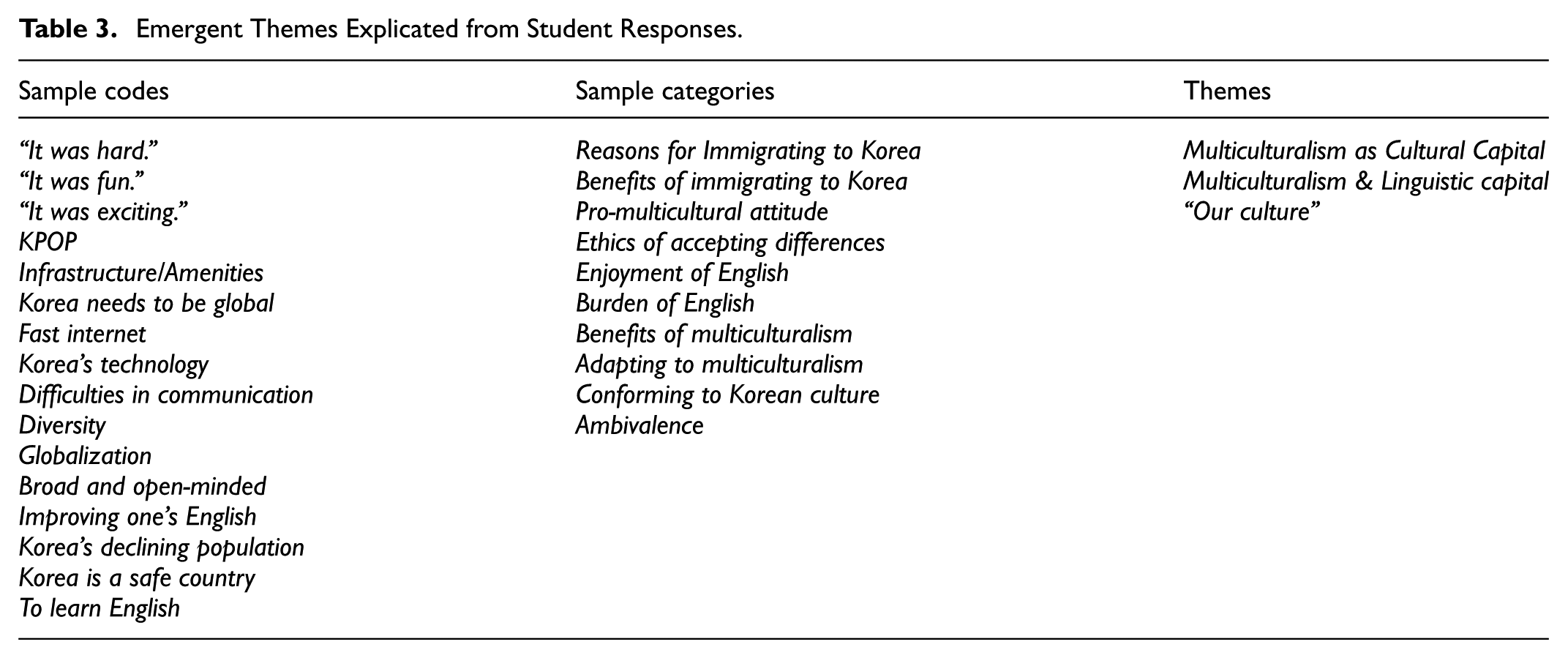
To arrive at the final codes and themes for this study, macro- and micro-level analyses of the data were conducted (Chang et al., 2013). The first coding process involved both authors conducting an independent macro analysis of the data to arrive at a holistic overview of the material. The first author used manual coding while the second author utilized MAXQDA 2022. Each researcher independently analyzed the data and created labels and subsequent codes. These labels and codes were created through a combination of in vivo analysis and informed by key concepts and vocabulary derived from a thorough review of the current literature on multiculturalism in Korea. In the second stage of analysis, the micro analysis, the researchers met to compare their codes and further reduce them through merging and deleting repetitive codes. After several iterative coding cycles, the codes were further narrowed into key categories, yielding overarching themes. Changes and decisions made in the coding process were documented and dated each time they were made on a research log to ensure transparency and credibility. To ensure the reliability of our analysis, we established feedback loops to minimize our own biases. For example, for the code “broad and open-minded,” we discussed whether it was different from “globalization” because they appear, on the surface, quite similar. However, we reached a consensus that these two codes should be independent of each other due to the nuances inherent in both.
Our analysis followed Martin and Rose’s (2007) concept of compliant reading. We examined the participants’ discourse assuming that their words had a trajectory of meaning that should not be resisted or manipulated. In that sense, we practiced fidelity to the discourse while deriving themes from the categories; the process of arriving at the principal themes was guided by the goal of reducing unconscious bias that might obfuscate participants' intentionality in their language. Table 3 summarizes the codes, categories, and significant themes that capture the sentiment of our target population, established after hours of extensive discussion.
Emergent Themes Explicated from Student Responses.
Themes
After a deep analysis, we present two principal themes that best exemplify participants’ ideation and appraisal of their country’s growing diversity. These two themes emerged despite differences in gender, year of study, and English competence.
The Burden and Necessity of English Communication in Korea’s Multicultural Space
Most students were candid about their perceived shortcomings in English fluency and understanding. Participant #171 confessed, “I felt that my English was still not good enough.” In total, 227 participants completed the questionnaire, and 26% reported difficulty or hardship communicating in English with non-Koreans, expressed concerns about their limited English skills, and described speaking with international students as challenging. Although these comments often took the direct form, as Participant #160 stated, “It was hard,” more than a few students were willing to look past the linguistic hurdle and rationalize some benefit. Participant #33 wrote:
I realized my English level could be higher, and I want to study diligently to improve it so that I can converse with foreign friends more effectively. Learning about foreigners' perspectives on our country’s culture is also lovely.
This student did not see the limitation as a barrier but as a signal for further improvement and an opportunity to expand one’s sociocultural horizon. Participant #34 reflected how “it was hard to talk to foreigners at first, but it got better as time passed. I think it is essential to practice both listening and speaking.” The feeling of progress was inseparable from students realizing the pivotal role language plays in their lives. English, as the primary mode of communication in this multicultural space, was both a threshold and a barrier to intercultural competence: recognizing profound differences and similarities among individuals required the acquisition of everyday English speech. Participant #42 commented:
I want to study and speak English well, and I want to make friends with people of various nationalities, including Chinese, Mexican, and Russian. Moreover, foreigners’ pronunciation was good.
There is an ideological affirmation of English as the lingua franca, the international means of communication. However, English is also the lingua franca of international friendship. The student’s compliment on the foreigner’s pronunciation is insightful because it highlights the reason to befriend non-Koreans: to emulate their speech and sounds. However, not all students felt compelled to adopt English in Korean society. This was evident when we interviewed students about their feelings regarding the increased prevalence of English signs in Korean cities. H.M., a second-year student who has lived abroad and is fluent in English, complained that excessive reliance on English prevented international students from learning Korean, thereby reducing their chances of integration into Korean society.
English is not our native language, but it has become an integral part of Korean culture, enabling foreigners to feel at home. We must encourage them to use Korean, as using only English will discourage its use. They need to communicate with the Korean people. Koreans would not understand them if foreigners used English.
H.M.’s perceived need for linguistic integration highlights a critical difference between the interviews and the questionnaire responses. The sample population’s aggregate statements about English fluency primarily focused on how conversations were initially difficult but became more pleasant over time. The comments indicated that the population wanted to learn English to communicate with international visitors. When explicitly asked about their language preferences, all twelve interviewed students unanimously supported the need to defend Korea’s linguistic identity. Y.N. explained the necessity of the Korean language for Koreans: “For my parents, English is a foreign language and difficult to learn.” Our mainstream culture will always be Korean.” Beneath the surface of idealizing English fluency lies the need to defend Korean culture against encroaching change. J.Y. uses a simile to symbolize how English has become an integral part of the social fabric.
English is like an automated service kiosk; we all need to adjust, but cannot turn back in time because English is the future trend.
J. Y.’s conception of English use with technology reflects the broader association of English fluency with progress. The perceived need for English is attributed to its association with sociocultural capital and Korea’s destiny. J.Y. helps us understand why so many students feel pressured to improve their communication skills and believe that achieving native English fluency is of great value; its acquisition is closely tied to a key factor in Korea’s economic future and global influence.
The Korean View of Multiculturalism as Economic, Social, and Biological Capital
The second central theme is the same pattern of positive language with conflicting interests. The first iterations of the discourse analysis revealed a prevalent association with multiculturalism, characterized by additive conceptual metaphors. When asked about the prospects of the increased number of foreigners living in Korean society, G.Y. explained how Koreans would benefit from this trend.
The influx of foreigners to Korea is positive because an increase in population will lead to a corresponding rise in the labor force, ultimately revitalizing the economy. There were many times when I was frustrated while living in Korea, particularly with the difficulty of acknowledging others. Still, there will be positive changes as foreigners with diverse cultures live in Korea. Of course, we must respect each other’s cultures.
Framing multiculturalism as a positive phenomenon was common in many comments. Still, when listened to as an audio recording and read as a transcript, G.Y.’s words highlighted the equivocal nature of Koreans’ opinions. Cultural openness is inseparable from economic benefits as Koreans navigate the challenges posed by a shrinking domestic population. G.Y.’s words reaffirmed the ideological rationale for increased diversity. Although multiculturalism offers an economic fix and enriches Korea’s cultural reservoir, G.Y. is frustrated that other Koreans do not value diversity. Y.N. held the same opinion when asked about the benefits of multiculturalism:
I think positively. If more foreigners visit Korea, the country is expected to gain greater recognition, as foreigners will have the opportunity to experience Korean culture. As opportunities to interact with foreigners increase, local people's language skills will also improve. We will be able to cultivate the global mindset of the next generation.
For both students, diversity and differences positively contribute to Korea’s growth and expansion. Word choices such as “more,”“increase,”“improve,” and “revitalized” convey a sense of multiculturalism's progressive momentum and positive direction. Both Y.N. and G.Y.’s sentiments represent the sample’s cheerful disposition toward Korea’s future of having “more foreigners.” It is tempting to read the comments and transcripts with the assumption that young Koreans have a more culturally open perspective than their predecessors. However, especially during the interviews and the focus group discussion, it was clear that multiculturalism's increased social and financial capital also brings disadvantages. G.Y. admitted that her family members disagreed with her.
My family members see multiculturalism as negative. They think of it as dividing the country into classes. They believe that foreigners should perform physically demanding work, while Koreans should undertake tasks that require mental effort. They also worry that the country’s identity will collapse if more foreigners live in Korea than Koreans. Foreigners visiting Korea should be aware of the importance of learning Korean.
G.Y. described how, for some Koreans, multiculturalism serves a socioeconomic purpose: increasing the nation’s economic capital through foreign labor. Her words indicated the discriminatory ideology of reducing foreign bodies to physical labor, that technical expertise resides in a critical Korean capacity that only requires the bodily work of internationals. This privileged view of Korean status is inseparable from the fear that increased diversity is detrimental to Korean identity. This assimilationist perspective is a normative judgment shared by H.M., who explained that she was frustrated when reading negative comments made by internationals about life in her country.
Korea has an older cultural identity. I think we should only accommodate immigrants who are willing to embrace Korean culture. Accommodating foreigners is a burden when those foreigners judge Korean culture unfairly. For example, when I read about Muslims judging Koreans for eating pork. It makes me mad.
H.M. had lived abroad and interacted with international students and teachers on campus, but she believed in the narrative of Korea’s homogeneity. Her view aligns with how Korean citizenship is dictated legally and socially by the concept of consanguinity. Similarly, H.M.’s multicultural view is not significantly different from those of her parents.
My parents feel the same way about foreigners who expect special treatment but are not willing to adapt to life in Korea. They believe foreigners are attempting to alter Korea to suit their needs. I am the same. We need to preserve Korean culture as more foreigners enter the country. My parents and I are open-minded, but we are also wary of multiculturalism. We do not like change. Sometimes, we do not like how immigrants and non-ethnic Koreans look.
Although she was grateful to have lived in two other countries and has acquired the ability to speak three languages, H.M.’s attitude toward multiculturalism in her country is conditional. Even if Koreans have the responsibility to aid integration, for H.M., foreigners must follow the normative conditions of Korean life if they want to reap the benefits of living in the country. She states, “They should not complain about things if they are unwilling to learn the language. If they want to be included, they must possess the necessary skills.” Even if participants reported positive attitudes towards multiculturalism, candid interview responses revealed how multicultural acceptance is far from absolute. Her words were emblematic of a cultural anxiety of losing her heritage. Another student confirmed this. Y.N. explained:
If more foreigners come to Korea, the number of multicultural families will increase, leading to population growth. However, as many cultures are accepted, problems such as cultural assimilation may arise, and Korea's unique culture will change.
Y.N. and H.M. were culturally open students who confidently stated that Korea’s openness towards differences should also have an assimilationist dimension that requires immigrants to comply with Korean norms. Even if internationals do conform, there is a sentiment that Koreans will lose something essential as Korea becomes more diverse.
Discussion
The participants’ language revealed that, despite a positive orientation towards differences, many were generally ambivalent towards multiculturalism and their country’s growing diversity. Data from questionnaires and interviews revealed how the participants associate English with internationalization and English as the preferred mode of multicultural communication (Choi, 2021). Many have conflicting feelings about linguistic norms when considering the normative definition of multiculturalism in Korea. The proliferation of English signs and speech constitutes a de-territorializing process in the Korean socio-cultural landscape, manifesting as tension not limited to language but in the conflicted concept of identity as more international participants participate in the Korean milieu (Choi et al., 2021). The burden of English communication confirmed the linguistic preference for Korean competence, with many students apologizing for their limited English proficiency (Choi, 2021). For less confident English speakers, the need for international students to learn Korean was more apparent. The insistence that internationals acquire appropriate Korean competency indicated a strong preference for newcomers to conform to Korean society's norms (Denney & Green, 2021). Student interpretations of multiculturalism were generally favorable and generous toward internationals, but candid statements from student interviews often favored an assimilationist view (Seol, 2018). More than a few participants supported the government's ideological outline (Ghazarian, 2018; Seol, 2018), and many expressed the need to preserve their Korean culture amid growing diversity. Students’ conceptualizations of multiculturalism aligned with the Ministry of Education’s stated goal: that immigrants should conform to Korean culture to foster a harmonious society (Ministry of Education, 2023). Student views also did not deviate from the values and tenets proposed by Seol (2015), who argued for a Korean form of diversity that exalts and preserves Korean values —a version of multiculturalism that is ideologically closer to the American melting pot or the German assimilationist program (Seol, 2018). For many participants, diversity should be pursued so Koreans can reap the socioeconomic and cultural benefits of differences and export Korean cultural assets (Rüdiger, 2020).
While many participants expressed a positive disposition towards interacting with international students, a closer examination of their orientation reveals a more profound ambivalence. H.M.’s statements confirmed the ideological limits of diversity reported in the literature. As a student who had lived abroad and was fluent in English and Spanish, she believed in preserving the uniqueness of her heritage. Her speech exemplified the persistence of the Korean myth of homogeneity (Lim, 2020; Ryu, 2021; Seol, 2018; Walton, 2020). She explained why Koreans should accommodate internationals and remain committed to expanding their cultural horizons through English bilingualism and familiar interactions with people of different cultures (Choi, 2021). However, her discursive agency established an uneasy alliance between cosmopolitan values and a traditional view of Korean identity among Koreans (Ghazarian, 2018; Lim, 2020; Ryu, 2021; Seol, 2018). Instead of extending generous hospitality that acknowledges new identities within the Korean milieu (Lee et al., 2023), H.M. would like to retain her sense of Korean identity within the limits of consanguinity, exclusive of other ethnicities and races (Denney & Green, 2021; Jo & Jung, 2017). Her chosen language exemplified the dominant view of the Korean community. The friendly disposition belied the entrenched perception of multiculturalism as a transactional affair (Kang, 2020a). Examining the words of a few selected participants, their words conveyed a narrow acceptance of differences, characterized by a conditional form of multiculturalism.
It can be said that in Korea, an international student—or any newcomer—will be expected to conform to linguistic and cultural norms; only those who assimilate will be welcomed (Denney & Green, 2021; Ghazarian, 2018; Seol, 2018).
Limitations and Future Research
An explicit limitation of this study is our appropriation of Martin and Rose’s (2007) compliant reading. We begin and end with a faithful reading of the participants’ discourse. Our fidelity to their voices could be interpreted as validation and justification of the reactionary statements shared by a few participants. The examined exemplars discussed in this text could be construed as a critique of multicultural diversity. Thus, a fundamental limitation of our work is that we may not push for multiculturalism in Korea enough, given the constraints we discussed. Our data analysis rests on discursive exchanges in which young Koreans were given a platform to express their doubts and suspicions about embracing ethnic and cultural differences.
To overcome these limitations, future research on multicultural perceptions in Korea should focus on the hegemonic ideology that naturalizes the belief in Korean consanguinity. Ghazarian (2018), Lim (2020), and Seol (2018) have addressed the need to question the myth of Korean homogeneity. The myth that sustains the cultural discourse of Korean ethnicity often underlies the suspicion towards diversity, as if consanguinity is the essence of Korean uniqueness. Our work corroborates prior literature, demonstrating that the myth persists in the social imagination of Korean university students. Future research should move beyond our compliant reading and explore ways to resist the ideological framework of Korean essentialism. This type of tactical resistance has been voiced by J.-H. Kim and So (2018), Lee et al. (2023), Lim (2020), and Walton (2020). Our work serves as a preliminary step in that direction. However, such a tactical and resistant interpretation requires a framework of educational and social policies to expand Korean citizens’ interpretation of their identity beyond consanguinity. Thus, future research could focus on creating such a framework, which would lead to a positive step towards a more inclusive and multicultural society in Korea.
Conclusion
The results of this study demonstrate that university students' perceptions of multiculturalism in Korea exhibit an underlying ambivalence. Although Korean university students are a small niche in Korean society, the findings of this study indicate a need to implement policies that promote inclusivity for non-Koreans. This is crucial, as Korean higher education is currently at a pivotal crossroads, where globalization is a necessity for survival in our neoliberal environment (C. D. Jung, 2023).
By creating conditions that nurture inclusivity, Korean higher education can become an exemplar of a more inclusive and equitable space for Korea’s multicultural community. Aforementioned conditions include sports and other activities that have been demonstrated in recent studies to be effective cultural bridges for Koreans to overcome their initial fear and prejudice toward internationals, specifically people of color (Kim et al., 2021a; Kim et al., 2021b). Higher education has been a hub of international recruitment, expanding Korea’s global outreach as Korean universities seek to attract students (Park, 2022). Given the declining numbers of domestic students, Korean universities have a vital role in reducing acculturative stress and promoting Korean hospitality to ensure their survival (B. E. Jung, 2022). The market demand for students has forced universities to promote Korean experiences abroad, and the current numbers indicate that Korean universities are at least succeeding (Kazakova et al., 2021). A positive development is evident in government policies and university mandates that give more opportunities for these internationals to stay in Korea. At least, it is possible to suggest that Korean universities serve as models of the virtues necessary to promote intercultural understanding (Choi et al., 2021). Due to economic pressure from a declining domestic population, internationals play a more vital role in Korean society (Jon et al., 2020; J. Jung, 2018; Park, 2017), helping alleviate some of the anxiety expressed by the local population.
Given the recent interpretation of government multicultural policies, the participants position themselves ambivalently amidst cultural shifts and increased encounters with ethnic differences. Their words demonstrate that multicultural discourse is irreducible to a single, satisfying definition. As a litmus test, the Korean multicultural experience differs from that of Canada (Denney & Green, 2021). Universal inclusivity often eludes the vividness of lived experiences: we have immediate connections to a group, our tribe, and the universality of cosmopolitanism is often distant and abstract. The participants’ discursive agencies only reinforced their own robust Korean identities. Their encounters with international students made them more conscious and even protective of their Korean heritage. However, it is also true that the students understand why multiculturalism is necessary. To paraphrase our findings, our students appear to say, “We need internationals insofar as we benefit from their biological, cultural, and economic contributions.”
For some Korean students, the benefits of multiculturalism come at a high cost, as they must sacrifice the uniqueness of their heritage, with many interpreting the rationale for a multicultural society along neoliberal lines (Kang, 2020b). Multiculturalism subtracts from Korean society, even as internationals contribute to it. Advocating for intercultural understanding and diversity in a manner that aligns with Banks’ (2008) principles or the ethical imperatives of J.-H. Kim and So (2018) and Lee et al. (2023) challenges the sacred myth of consanguinity. Although the purity of the Korean race is a fiction (Lim, 2020; Ryu, 2021; Seol, 2018; Watson, 2012), the participants insist on the reality of this narrative. Some students believe that as more foreigners arrive, they risk losing their heritage.
This sentiment of losing one’s culture is hardly an exception. Skepticism towards multiculturalism correlates with the growing resistance to globalization, as numerous local populations retreat from cosmopolitan ideologies and adopt nativist identities (Moghaddam, 2024). Further research is needed to determine the actions that will reconcile the needs of newcomers and Koreans alike—to make the acceptance of intercultural relations less sacrificial. Until then, Berry’s (2017) aspiration to promote integration and Banks’ (2008) aim for global diversity will face resistance and doubt. After a faithful interpretation of the examined discourse, we have reached the provisional stance that an appropriate multicultural approach requires an ethos of pluralism that retains the virtues of a cohesive tradition.
Footnotes

Ethical Considerations
Institutional ethics approval was received by the authors from the Institutional Review Board at the research location, Woosong University (Approval no. 1041549-220712-SB-144).
Consent to Participate
All participants provided written and oral informed consent prior to enrolment in the study. Consent from the participants was acquired before the data collection process to audio-record the interviews for the purposes of transcribing and analyzing the data. All research procedures and steps taken by the authors complied with the 1964 Declaration of Helsinki and its later addenda.
Funding
The authors received no financial support for the research, authorship, and/or publication of this article.
Declaration of Conflicting Interests
The authors declared no potential conflicts of interest with respect to the research, authorship, and/or publication of this article.
Data Availability Statement
Due to confidentiality restrictions, the data that support the findings of this research are not publicly available, but can be provided upon request to the corresponding author.