



Abstract
The symbolic space of an organization can be analyzed as Foucault’s heterotopia and described using his six principles of heterotopia. The premise of this study is that the symbolic space of an organization fulfills the heterotopian compensation function concerning other spaces when trying to balance the world’s complexity by “arranging” it. This article aims to identify the scope of this function in the symbolic space created by online discourses of two youth organizations: AIESEC and ATD Fourth World. The article discusses the results of an analysis of the Polish discourse of these two internationally recognized organizations. Critical Discourse Analysis and a discursive approach to institutions are used for analysis. The material included in the analysis comprised all texts produced in 2018 and published by the organizations on their websites and Facebook accounts in Polish. The research results contribute to knowledge situated at the intersection of research on formalized social activity among youth, research on organizational identities in a critical approach, and organizational identities created online. They demonstrate how youth organizations construct their “offer,” what world “arrangement” they present, and what shortages/problems they tend to highlight in today’s world. Furthermore, in the field of organizational discourse studies, they illustrate how particular ideas defined at the programmatic level can be translated into the discourse of “solutions.”
Plain Language Summary
A youth organization is a type of social activity that reflects young people’s interests and how they engage with society and their community. It also addresses current problems and needs. A youth organization creates a plan to “put the messy world in order.” They suggest ways to organize society and make the world better by setting goals, finding ways to achieve them, and solving problems. They have a vision that speaks to young people. This article looks at what two well-known organizations, AIESEC and ATD Fourth World, say about their goals in 2018 on their websites and Facebook pages in Polish. The article tries to find out what kind of world these organizations are trying to create and how they do it. The results of the study show how these organizations build their “offer” and what problems they focus on in today’s world. Additionally, it shows how certain ideas are presented in formal documents and texts and how they change when describing everyday activities.
Introduction
A youth organization, that is, an organization associating young people and working for and/or with young people, is a form of social activity and a present-day version of young people’s model of operation. On the one hand, it reflects their interests and types of social and civic engagement, and on the other, the currently identified social problems and needs, including those concerning the development of youth. A youth organization proposes some kind of “arranging” the “disarranged” world and “putting it in order.” The latter applies to not only structural order but also the identification of goals and ways to achieve them, as well as problems and ways to resolve them, besides the promise that they can be resolved. A youth organization embodies a coherent “offer” that attracts certain people and makes them want to join it and stay for a short or long time. It is a proposal that appeals to young people and their needs, offers a vision that speaks to them and is either important to them or presented as such.
What kind of world “arrangement” do youth organizations “offer”? How do they express it on their websites and social media discourses? These are the questions behind the scientific interest and direction of analysis unfolding in this article. Given that a youth organization can be analyzed as a social construct (Berger & Luckmann, 1966), produced, reproduced, and altered through language and other semiotic systems (Bourdieu & Passeron, 1990), a discursive approach is adopted for analysis purposes. This study focuses on the symbolic space of two organizations operating in Poland. To be more precise, it is not the entire symbolic space of these organizations, but a part of it which is visible through the documents and texts published on their websites and Facebook pages. Questions posed in this paper are addressed through the lens of Foucault’s heterotopia of compensation (Foucault, 1994; Foucault & Miskowiec, 1986), based on the premise that discourses analyzed in this article are part of the organizations’ symbolic space with heterotopian characteristics. However, the unfolding analysis does not merely seek to answer the question of whether the symbolic spaces created in the organizations’ discourse fulfill the function of compensation. It goes beyond closed-ended (“yes/no”) questions. The article aims to identify and describe the scope of the compensatory function understood as a principle of Foucauldian heterotopia.
The aim so posed seems important for several reasons.
First, the research is a contribution to that part of youth studies that focuses on formalized activity. While quite a lot is known about the motivation of young people to engage in formalized activity (Li, 2017; Pirk & Nugin, 2016), reversing the optics to focus on organizations’“offers” as a certain response to the needs of young people deepens the knowledge on this subject. However, this is not an analysis of an organization’s offer understood in terms of an enumerative catalog of proposed activities, but rather an in-depth analysis of the self-representation of collective identity understood, on the one hand, as a strategic tool for attracting members, and on the other hand, as a power to construct specific identities for young people in the identity exploration status (Luyckx et al., 2006).
Second, the research contributes to critical research on identities constructed by organizations in online discourse. However, the focus is not on the use of technology itself in organizational activities, but on the construction of online collective identities. While research on organizational identities is already well established, combining it with critical research on online discourse is not yet well represented (Barros et al. 2023). Concerning young people using the Internet as a “way of being” (Markham, 2017), this seems crucial.
In summary, the presented research fits into the research gap arising at the intersection of studies of formalized youth social activity, research on organizational identities in a critical approach, and organizational identities created online. The heterotopian function of compensation reconstructed based on the discourse created by online youth organizations has not been the focus of researchers so far. It could be inferred indirectly based on studies that touched in some way on the collective identity of youth organizations.
The present research provides structured knowledge based on two cases. Although the research material included Polish-language discourse, the selected organizations are international and operate in many countries. This opens the field for comparative analysis. Besides, it may be interesting to see how their discourses are differentiated based on the local context and events, particularly those of critical meaning (Kopińska, 2024), what their internal dynamics are, and how they change over time.
Theoretical Framework and Basic Assumptions
The starting point for this article is the concept of heterotopia. Heterotopias are “spaces that provide an alternate space of ordering while paradoxically remaining both separate from and connected to all other spaces” (Topinka, 2010, p. 55). Foucault argues that heterotopias exist probably in every culture and “are formed in the very founding of society—they are something like counter-sites, a kind of effectively enacted utopia in which the real sites (…) are simultaneously represented, contested, and inverted. Places of this kind are outside of all places, even though it may be possible to indicate their location in reality” (Foucault & Miskowiec, 1986, p. 3–4). Foucault describes heterotopias using six principles: (1) They are universal, although their forms are heterogeneous; (2) Society can make heterotopias function in vastly different ways, refashioning their use over time; (3) Heterotopias juxtapose many real, incompatible spaces in one space; (4) They are connected with time (accumulation, fleetingness of time); (5) They require a system of opening and closing that isolates them from other spaces while retaining their penetrability; (6) Heterotopias have a function concerning all other sites: there are heterotopias of illusion and compensation (Foucault, 1994; Foucault & Miskowiec, 1986). In this study, the concept of heterotopia refers to the symbolic space of youth organizations. In this context, the last of the six principles listed above emerges as particularly interesting. Foucault explains that the function of heterotopia is to create a space of either illusion or compensation.
“Either their role is to create a space of illusion that exposes every real space, all the sites inside of which human life is partitioned, as still more illusory (…). Or else, on the contrary, their role is to create a space that is other, another real space, as perfect, as meticulous, as well arranged as ours is messy, ill-constructed, and jumbled. This latter type would be the heterotopia, not of illusion, but of compensation (…)”. (Foucault & Miskowiec, 1986, p. 27)
Foucault’s description of heterotopias of illusion and compensation implies that they are two opposite and mutually exclusive concepts. However, research shows that despite their opposing vectors, heterotopias can simultaneously play the role of both illusion and compensation for other spaces (Kopińska, Forthcoming; Roux et al., 2018). The premise of this study is that the symbolic space of an organization fulfills the compensation function concerning other spaces when trying to balance the world’s complexity by “arranging” it. This implies that the world’s “disarranged” state is recognized and, albeit not always directly, perceived as a problem. “Order” and “arrangement” emerge as the symbolic aspects of space, and in discourse, can refer to the order of ideas, values, norms, and social practices, both at the programmatic and policy solutions levels. Previous research (Kopińska, Forthcoming) has shown that the online discourses of youth organizations can provide for the function of compensation. However, they may differ in the scope of the latter and the configuration of its specific components. Accordingly, the research presented in this article aims (as indicated in the Introduction) to identify and describe the scope of the compensation function in the analyzed discourses of selected organizations. Consequently, the objective is to ascertain what is compensated in these discourses and what “arrangements” are offered here.
The research aim posed in this way seems particularly important as it refers to the “offer” addressed (also) to youth. The proposed “well-arranged” symbolic space is, at least to a certain extent, related to the place attributed to youth in the social world. Research on youth engagement shows that they can have various motives to be civically engaged—both personal and non-personal, ludic, and hubristic. They include the willingness to develop competencies and establish contacts perceived by respondents as important for their future careers and better navigation of the labor market. They can also be non-personal, such as responsibility, loyalty, and the well-being of the community (Ho et al., 2011; Li, 2017; Pirk & Nugin, 2016; Sveningsson, 2016). In addition, having fun does not preclude the pursuit of “serious” goals (Ho et al., 2011; Li, 2017; Pirk & Nugin, 2016; Sveningsson, 2016). Developmental needs related to identity search also play a role. A youth organization can provide answers to what is important, who one wants to be, what to strive for, and why. It can offer certain rules that provide a sense of security and reduce the feeling of being lonely and lost. It can serve as a field for experimentation and exploration in breadth, exploration in depth, and commitment making (Luyckx et al., 2006).
I am not claiming that only youth organization provides such opportunities. However, it is one possible area of youth functioning from which it is possible to look for answers to questions about its compensatory function
A discursive approach is adopted in this analysis of youth organizations. The application of this approach is linked to the assumption that organizations can be analysed as socially constructed phenomena (Berger & Luckmann, 1966). This social construction is also accomplished through discursive practices and acts of languaging. The symbolic spaces of organizations are defined as shared discursive spaces where meanings are attributed and understood by actors, events, actions, and contexts (Brown et al., 2005). In this research, I refer only to this part of the symbolic space of each organization that was constructed by online discourses. The symbolic spaces of organizations are never monoliths. They are polyphonic spaces featuring a myriad of diverse interpretations and linguistic practices occurring both simultaneously and sequentially (Humphreys & Brown, 2002). Since discourses constructed online are considered a permanent and at the same time evolving fixture that is essential to the contemporary experience of organizational life (Barros et al. 2023), their analysis is expected to contribute to a deeper knowledge of the discursive functioning of organizations. It is not only about how certain technologies are used in an organization but also about how collective identity is constructed online and what the dynamics of individual and collective identity are (Bonneau et al., 2023; Eddington et al., 2023; Louis & Mielly, 2023), how boundaries between professional and personal roles are managed in social networks (Fieseler et al., 2015), how collective identities are negotiated by insiders and outsiders and through interactions between them (Coupland & Brown, 2004).
Organizational online discourses can be understood as another layer of organizational functioning, knowledge of which provides at least partial insight into the organization. They can also be read as an integral part of the practices that construct the contemporary organization and its identity, not necessarily easy or possible to separate from other components. It seems that critical studies of the discourses of organizations constructed online are particularly important concerning young people. This has to do, on the one hand, with the need for belonging and the search for one’s own identity and, on the other hand, with the online “immersion” of young people and the understanding of the Internet as a “way of being” (Markham, 2017). In my research, I focus on discourses that have the character of an organization’s self-presentation. Thus, they are a strategic tool for attracting new members, participants in programs and projects implemented by the organization. Furthermore, they construct and reinforce a certain image and identity of the organization, carrying out an ongoing collective identity work. Critical analysis, therefore, reveals the mechanisms that contribute to the coherence of the “offer” of the “ordered” world, to look beneath its surface, and to study the heterotopian compensation in everyday online content.
A review of recent research indicates a paucity of exploration of the “well-arranged space” offered by youth organizations. Nonetheless, the extent to which an organization’s symbolic space performs a compensatory function can be inferred indirectly. These organizations “offer” a diverse set of “responses” concerning politics and democracy, providing a platform for redefining one’s life and planning for the future in a manner consistent with their values (García & Aymerich, 2024; Sandoval & Carvallo, 2017). They can compensate for political and social polarization, offering a foundation for identity formation grounded in values such as democracy, freedom, and the rule of law (García & Aymerich, 2024). They can compensate for the lack of opportunities for self-expression and the need for agency by providing tangible tools that can facilitate the realization of these needs (Lee & Schoonover, 2020). Furthermore, these organizations can foster opportunities for individuals to articulate their stance in opposition to dominant discourses (Yea, 2018). The “well-arranged” space proposed by these organizations may not only be a response to the “disarranged world” as perceived from a youth perspective; other perspectives may also come to the fore. In other words, the ordering of space can be a “response” not only to youth problems but also to problems with youth. “Ordering” is then controlling, such as in terms of gender and sexuality norms (Williams et al., 2017), or, for example, in terms of a particular vision of citizenship (Rodrigues et al., 2019).
The aforementioned findings provide some insight into the heterotopian compensatory function of organizations’ symbolic space. However, there is a lack of research that analyzes this function in depth. Although research on organizational identities, including critical studies, is well established (Brown, 2022), there is a gap, especially at the intersection of research on youth organizations and the collective identities discursively created by these organizations.
This study focuses on statements and texts published online by the two selected organizations The characteristics of the symbolic space of these organizations are reconstructed based on texts of different genres. They should help us not only see the polyphony but also capture the internal dynamics of the symbolic spaces. The latter is enabled through the approach of discursive institutionalism. It offers insights into the dynamics of institutional change, revealing how the concepts produced in the discourse are represented and explained, and how they change on various levels (Schmidt, 2008, pp. 309–314). Schmidt identifies three levels of idea formation: the level of public philosophies, the programmatic level, and the level of policy solutions (Schmidt, 2008, p. 306–308) The most general one, the level of public philosophies, refers to worldviews, foundations, and the hardly-ever-questioned background of policies and programs (Campbell, 2002; Schmidt, 2008). The second level is more detailed and comprises programs that form the basis for policy ideas. This is where problems are defined, followed by goals to be achieved, as well as methods and instruments to be used in the process. The programmatic level emerges in the space between worldviews and specific political ideas, providing a framework for specific solutions and actions. At the third level, the declared goals, and methods to achieve them are translated into the language of practical solutions (Schmidt, 2008).
While these levels relate to political ideas, their distinction can have a broader analytical potential. For example, Wahlström, Sundberg (Wahlström & Sundberg, 2018) and Nordin (Nordin & Sundberg, 2018) applied them in their curriculum studies. In this article, they are used to explore the symbolic spaces of youth organizations. The polyphony of the organization’s discursive space reveals itself not only concerning the authors or addressees of the utterances but also in the level of the discourse. The discourse analysis at different levels reveals how specific ideas and paradigms are translated into the programmatic language and modified at the level of specific solutions. In this research it is possible to capture two levels of organizational discourse: the programmatic level and the level of (policy) solutions, which should allow us to capture the internal dynamics of the organizations’ symbolic spaces.
In the analysis, I assume the existence of a relationship between the scope of the function of compensation and organizational identity orientation (OIO). The latter answers the question of who we are as an organization vis-a-vis others (Brickson, 2005; Langer & Feeney, 2022) and it consists of a locus of self-definition, social motives, values, and comparison referents, which vary depending on how the organization defines itself relative to others (Langer & Feeney, 2022). The OIO represents the core values and commitments (Albert & Whetten, 1985; Whetten, 2006) related to the fundamental nature of independence and interdependence (Brickson, 2007).
Organizations have three distinct identity orientations: individualistic, relational, and collectivistic (Brickson, 2005). Individualistic orientation focuses on, inter alia, being unique and extraordinary, standing out. Organizations with this orientation appear to be the best and are primarily interested in maximizing their prosperity. Ambitious and motivated to pursue their interests, they encourage their members to compete with each other. Not perceived as a goal, relations among members in such organizations play an instrumental role. Hence, individualistic organizations may be characterized by weak internal ties (Brickson, 2007; Langer & Feeney, 2022). In contrast, relational organizations promote relational values such as honesty, empathy, and compassion. They focus on loyalty and mutual care, supporting, understanding, and being sensitive to one another. Interactions in such organizations are shaped by strong dyadic ties aimed at benefiting both parties (Brickson, 2007; Langer & Feeney, 2022). Collectivist organizations strive for the maximization of the well-being of a larger group, the work for a community, or a cause. They concentrate on building a consensus around problems, ideological goals, and shared values. They are characterized by the excellence, passion, and commitment of their members/employees oriented toward a certain set of goals, principles, values, deep humanism, and a strong sense of fellowship (Brickson, 2007; Langer & Feeney, 2022).
I assume that the OIO explains, perhaps not entirely but in part, the scope of the organizational function of compensation. The question about the latter in youth organizations is associated with questions about social problems identified by an organization, how they are communicated and addressed, and the vision of the (at least partially) “arranged” world. Nevertheless, the “world arrangement” offer is also a set of assumptions, values, and organizational goals aligned with the OIO.
Research Questions, Materials, and Methods
Given the aim of the research, the following question was framed: What is the scope of the Foucauldian function of compensation performed by the discursive symbolic spaces of the selected organizations? This question prompts further ones: What is compensated in organizations’ discourses? What “arrangements” of the world are offered here? To delineate the scope of heterotopia of compensation in the analyzed discourses, it is necessary to identify, using Foucault’s language, what is constructed as a “mess”; what “order” is offered; and who makes a “messy” space “well-arranged.” Empirically, I translate these questions into three basic categories of analysis: (1) social problem(s) identified by the organization; (2) ways of dealing with these problems, and (3) collective identity.
Two international organizations, AIESEC Poland and ATD Fourth World Poland, were selected for this study. AIESEC (Association internationale des étudiants en sciences économiques et commerciales; in English: International Association of Students in Economics and Business) is one of the largest student organizations. Founded in 1948, it currently operates in more than 120 countries worldwide. As AIESEC Poland (hereinafter: AIESEC), it has been present in my country since the 1960s. Today, it can be found at over 50 Higher Education Institutions across Poland (AIESEC_About_us_aiesec.pl). Its membership is open to both students and graduates (up to one year from graduation or interruption of studies), who are actively involved in AIESEC’s activities (AIESEC_Articles of Association_aiesec.pl). ATD Fourth World is also an international organization. In 1957, Joseph Wresinski, a Catholic priest, founded an association, “Aide à Toute Détresse” (Help All In Distress), with families in an emergency homeless camp outside Paris, which later became ATD Fourth World (ATD, n.d.-a). Currently, the organization operates in more than 30 countries in Europe, North America, South America, Africa, and Asia (ATD, n.d.-b). In Poland, the movement began in the late 1990s in Kielce, where volunteers met with people facing the crisis of homelessness at the railway station and in a night shelter. In Warsaw, the ATD Movement started in 2004 with the organization of the 8th European Universal University, where the poorest people, volunteers, and politicians from all over Europe met to discuss human dignity and the fight against poverty and social exclusion. In 2005, the association was formally registered as ATD Fourth World (hereinafter: ATD) (ATD, n.d.-c).
Both organizations are members of the Polish Council of Youth Organizations (in Polish: Polska Rada Organizacji Młodzieżowych, PROM), which brings together youth organizations and organizations gathering youth. The former are defined as associations “co-managed by persons under 35 years of age, where at least two-thirds of members are under 35 years of age” (PROM, 2017). The latter are associations “whose organizational bodies, set out in the Articles of Association, are at least in two-thirds composed of members under 35 years of age” (PROM, 2017). PROM recognizes the principle of equality and independence of its member organizations and respects the Universal Declaration of Human Rights (PROM, 2017). Its objectives include participation in youth policy development, promotion of youth participation in public life, representation of member organizations in the public sector and other communities, advocacy of youth interests, dissemination of information, support for cooperation, and exchange of information and experiences between organizations (PROM, 2017).
The material included in the analysis comprised all texts produced in 2018 and published by the organizations on their websites and Facebook accounts in Polish. In total, there were 215 texts of various genres, such as Articles of Association, financial statements, audit reports, rules and regulations, journals of resolutions, and content posted on websites and Facebook. To capture the dynamics of the discourse, I analyzed the categories identified for research purposes, using the discursive institutionalism approach. The characteristics of the collected texts made it possible to identify two discourse levels: the programmatic level and the levels of solutions. The former was reconstructed based on the organizations’ official documents about their programs (Articles of Association, rules, and regulations, and journals of resolutions) or the website elements describing the organization’s mission and/or containing direct declarations regarding its goals (aims/objectives). The reconstruction of the level of solutions was based on the remaining texts published by both organizations. In this study, I use the Critical Discourse Analysis approach. More specifically, I study the use of discursive strategies described by Reisigl and Wodak (2016). The research procedure included the following steps:
(1) Text encoding based on the use of descriptive codes referring to three interrelated discursive categories: (a) social problem(s) identified by the organization, (b) dealing with the problem(s), and (c) collective identity of the organization (organizational identity).
(2) Analysis of the application of discursive strategies (Reisigl & Wodak, 2016) concerning the categories listed in Point 1 involves a search for answers to the following questions:
Regarding (a). What are the social problems identified in the texts? How are they phrased, based on both direct communication of the problems and that inferred from the text (nomination strategy)? Are the problems evaluated? What features are attributed to them (predication strategy)? Do the texts present any arguments regarding the problems (argumentation strategy)? What perspective is adopted (perspectivation strategy)? Do the statements intensify the issue at hand or mitigate it (intensification/mitigation strategy)?
Regarding (b). How does the organization handle the problems? What phrases are used when dealing with the problems? How are they evaluated and justified and from what perspective? Are the statements intensified/mitigated?
Regarding (c). How is the organizational identity constructed? How is it evaluated? How are the cases of its evaluation justified and from what perspective? Are the statements related to the organizational identity intensified/mitigated?
(3) Analysis of text excerpts encoded with the use of descriptive codes (Point 1) and codes referring to discursive strategies (Point 2) at the programmatic level and the level of solutions. Comparison of the analysis results.
(4) Identification of links between codes. Reconstruction of the discourse models.
(5) Formulation of conclusions.
The procedure delineated herein follows the concept of four-level context (Reisigl & Wodak, 2016, pp. 30–31). Points (1) and (2) correspond to the first dimension of “context” (“the immediate, language or text-internal co-text”). The second dimension of “context,” relating to intertextual and interdiscursive analyses (Reisigl & Wodak, 2016), is present in points (3) and (4). In these points, the approach of discursive institutionalism is also included in the analysis (Schmidt, 2008). The third and fourth dimensions of “context,” which incorporate references to institutional frameworks and theoretical assumptions of different scope (Reisigl & Wodak, 2016), intersect points (3), (4), and (5).
Findings
AIESEC
The analysis at the programmatic level of the discourse revealed that no social problem is articulated directly, which does not mean that the organization does not notice the problems at all. For example, among the goals identified in its Articles of Association, the organization seeks “to increase the knowledge about and awareness of socio-economic problems.” The strategy adopted at this level of the discourse can be described as goal-oriented, rather than problem-oriented. AIESEC’s mission is “to strive for peace and fulfillment of humankind’s potential” (AIESEC_About_us_aiesec.pl). Using the opposite logic, the problem can be identified as the lack of peace and fulfillment of humankind’s potential. The analysis of the organization’s texts at this level indicates that, as a problem, the lack of peace must be considered in the historical context at the time of AIESEC’s foundation.
(1) “AIESEC was founded in 1948 in response to the conflicts caused by World War II. According to the representatives of the AIESEC states, the world needed leaders and young people were the ones who had the responsibility for a better tomorrow.
Since then, AIESEC has striven for peace and fulfillment of humankind’s potential.
We believe that every young person deserves a chance to develop their potential, through which they positively impact their environment. AIESEC provides youth worldwide with hands-on experience through international exchanges that enable them to learn about the world and discover what really matters to them”. (AIESEC_ About_us_aiesec.pl)
This statement refers to the post-World War II context rather than the ongoing conflicts in the world, including armed conflicts, or post-conflict reconstruction. The fulfillment of humankind’s potential involves tapping into the potential of youth and making them responsible for improving the socio-political situation. In this sense, the original OIO, deduced from the organization’s mission, could be described as collectivist. In the second paragraph, the text emphasizes the said potential, rather than the quest for peace. A shift can be observed, where the goal is no longer about “striving for peace” but about “having a positive impact on [their] environment,” which essentially broadens the problem category. The latter is “cleansed” from the political context, while the focus is shifted from goal to action. What ultimately emerges as the fundamental problem is the non-fulfillment of the young people’s potential or, more specifically, the lack of opportunities for them to do so. The underlying issue is not to use their potential primarily to “have a positive impact on the environment,” but to develop it as an inalienable individual right of every young person, in which the emphasis shifts from social to individual needs. This conclusion may require a slight reinterpretation upon the analysis of the goals (aims/objectives) set out in the Articles of Association and values listed by AIESEC. Although not articulated directly, the major problem can be inferred—insufficient knowledge and awareness of socio-economic problems. It is a meta-problem whose resolution may require the implementation of educational activities. However, the latter are not to solve the problem(s) per se, but only make people aware of them as a prerequisite for planning and taking action toward the proper problem resolution.
The analysis of the organization’s goals implies that another problem can lie in the insufficient cooperation and understanding between countries. While this problem appears to be the closest to that of the lack of peace the mission entailed, it is given a “universal” tone. The unfulfilled potential of young people, surfacing both in the context of social activities (“for the surroundings,”“impact on the environment”) and the lack of or insufficient opportunities for personal development, can also be derived from the values articulated by AIESEC, with neither of the versions (social or individual) emerging dominant. In fact, there is a third version—acting for the good of the organization.
The discursive response to dealing with the problem at the programmatic level focuses on the development of competencies in participants of AIESEC’s activities, while social problems become less significant.
(2) “We develop leadership qualities in young people through hands-on experience in international exchanges and projects supporting their implementation.
We cooperate with 15 most significant academic centers in Poland, where, through initiatives implemented as teams, we create leaders who responsibly impact their surroundings”. (AIESEC_About_us_aiesec.pl)
The expert perspective and the perspective of professionals-practitioners dominate concerning both the problems and the manner of dealing with them. It is a “top-down” approach, where statements are made from the viewpoint of those who not only know “what” but also “how,” and who have extensive “hands-on experience” and can achieve the intended results.
How does this discourse change when we move to the level of solutions? First, unlike at the programmatic level, social problems can be easily spotted as they are articulated in direct terms. They include problems related to (1) both physical and mental health (being overweight, obesity, suicides, late diagnosis of cervical cancer), (2) climate (air pollution, wasting food), (3) gender inequality, (4) violence against women, and (5) lack of or unequal access to education. However, in most cases their articulation focuses on informing about the problems or encouraging people to learn more about them, which does not correspond to the organizational function of compensation. The organization does not respond to the problem; neither does it make an “offer” that could be considered a way of dealing with this social problem.
Some of these directly articulated problems are related to the offer of participation in AIESEC’s programs. However, only four posts characterize these problems in detail and indicate remedial actions (teaching English to children in Brazil, educating people about women’s rights in Turkey, etc.), while others are very general. Regardless of their specificity, the discourse of action, impact, and effectiveness prevails (Examples 3 and 4).
(3) “Volunteer in Turkey this summer and act for gender equality by participating in the “Women in Power” project”. (AIESEC_ Facebook_7 March 2018)
(4) “Make your next holidays unforgettable. Volunteer in India and support one of our two projects in Chennai. You can’t even begin to imagine what these 6 weeks of your life can mean to the local community. Don’t think too long, give the world a piece of yourself”. (AIESEC_Facebook_6 March 2018)
Second, certain problems, when not articulated directly, can also be inferred from the organization’s discourse at the level of solutions. They include (1) lack of tolerance, respect, open-mindedness, and understanding concerning other cultures and (2) problems that resulted in the establishing of the Sustainable Development Goals. Also in this case some statements (posts) are informative and cannot be analyzed in the context of the organization’s symbolic space and the function of compensation. Others correspond to the general discourse of action (Examples 5 and 6), impact (Example 7), and effectiveness (Example 8).
(5) “Don’t be afraid to act! An ounce of action is worth a ton of theory”. (AIESEC_Facebook_4 May 2018)
(6) “Build a sustainable world with us”. (AIESEC_Facebook_22 January 2018)
(7) “Have an impact on your local environment”. (AIESEC_Facebook_7 January 2018)
(8) “Are you at the Open’er Festival? So are we! Come and visit us in the NGO zone. Bogusia, Błażej, Asia, and Ola will give you ideas on how you can participate in solving the most important problems in the world – because you can”. (AIESEC_Facebook_7 July 2018)
A characteristic feature of this discourse level is its focus on the competencies of the current/future participants in AIESEC’s programs and activities—primarily those learned by action and through experience. Interestingly, a shift can be observed in the focus. What comes to the fore are the competencies (to be) acquired by the AIESEC members and their needs that can be met. The “impact on the surroundings” is pushed to the background. It is something that happens as if besides the primary reason—just one more argument to convince people to join or, at best, one that is valued as equally important in terms of personal development gains.
(9) “Have you ever thought about volunteering? Would you like to experience an amazing adventure? Have you ever wished to have a real impact on the world around you? If you thought “YES” even for the briefest of moments, the Global Volunteer program is for you! Take part in the competition, change your life, and have an impact on your environment together with AIESEC”. (AIESEC_Facebook_22 January 2018)
(10) “What if you could experience something wonderful while helping others at the same time?” (AIESEC_Facebook_5 March 2018)
(11) “When planning your time, do you also think about who you would like to spend it with? Holidays are coming. Remind your friends that soon you will be relaxing, traveling, enjoying the sun and each other’s company. Perhaps this year you’d like to do something together for others?” (AIESEC_Facebook_30 May 2018)
The effect of emphasizing personal development, experience, and needs is additionally achieved through the discourse that refers to the collective identity of the AIESEC members. Its characteristic feature, emerging from AIESEC’s texts, is power defined as organizational reach, exceptionality, and uniqueness (Kopińska & Wolniewicz-Slomka, 2025). How collective identity is articulated varies, depending on the level of the discourse. At the programmatic level, it is built into the perspective of formal aspects based on:
(1) References to the organization’s size and scope, for example, “the world’s largest (…) organization”; “operating in 122 countries at the local, national, and global levels”; “We cooperate with 15 most significant academic centers in Poland” (AIESEC_About_us_aiesec.pl); the use of the adjective “global” to describe programs implemented by the organization, and
(2) The implied universal character of the organization’s activities by repeating the words “everyone” (regarding the addresses of activities), “the world and entire Poland.”
At the level of the solutions, the discourse is constructed in the perspective of actions based on the following:
(1) References to the organization’s size and scope—at this point, the emphasis shifts from data about the organization to figures—number of participants in specific activities, for example, “360 of them have joined us”; “60 people from all over the world”; “more than 100 ambitious young people”; the use of the adjective “global” in a broader sense, for example, “the organization operating at the global level,”“global practices,”“a global voice of young people”;
(2) The exceptionality and uniqueness of the collective identity achieved through: - Individual narratives (signed with first name and surname or only first name and/or function) in the first- or third-person singular as a description of experiences from AIESEC’s programs; - The “join us” discourse constructed in the second person singular.
The discourse of the exceptional and unique collective identity dominates at the level of solutions and creates a fundamentally uniform image of an “AIESECer” as a person interested in personal and professional development, a “discoverer” of the world, and a traveler having various adventures. Many intensifiers are used in the form of strong adjectives (“amazing” journey, adventure, people) and superlatives (“the best,”“the largest,”“the most important”), as well as metaphors that create the image of a wonderful time and unforgettable moments experienced by participants. The dynamics of AISEC’s discourse discussed in this section are presented in Figure 1.
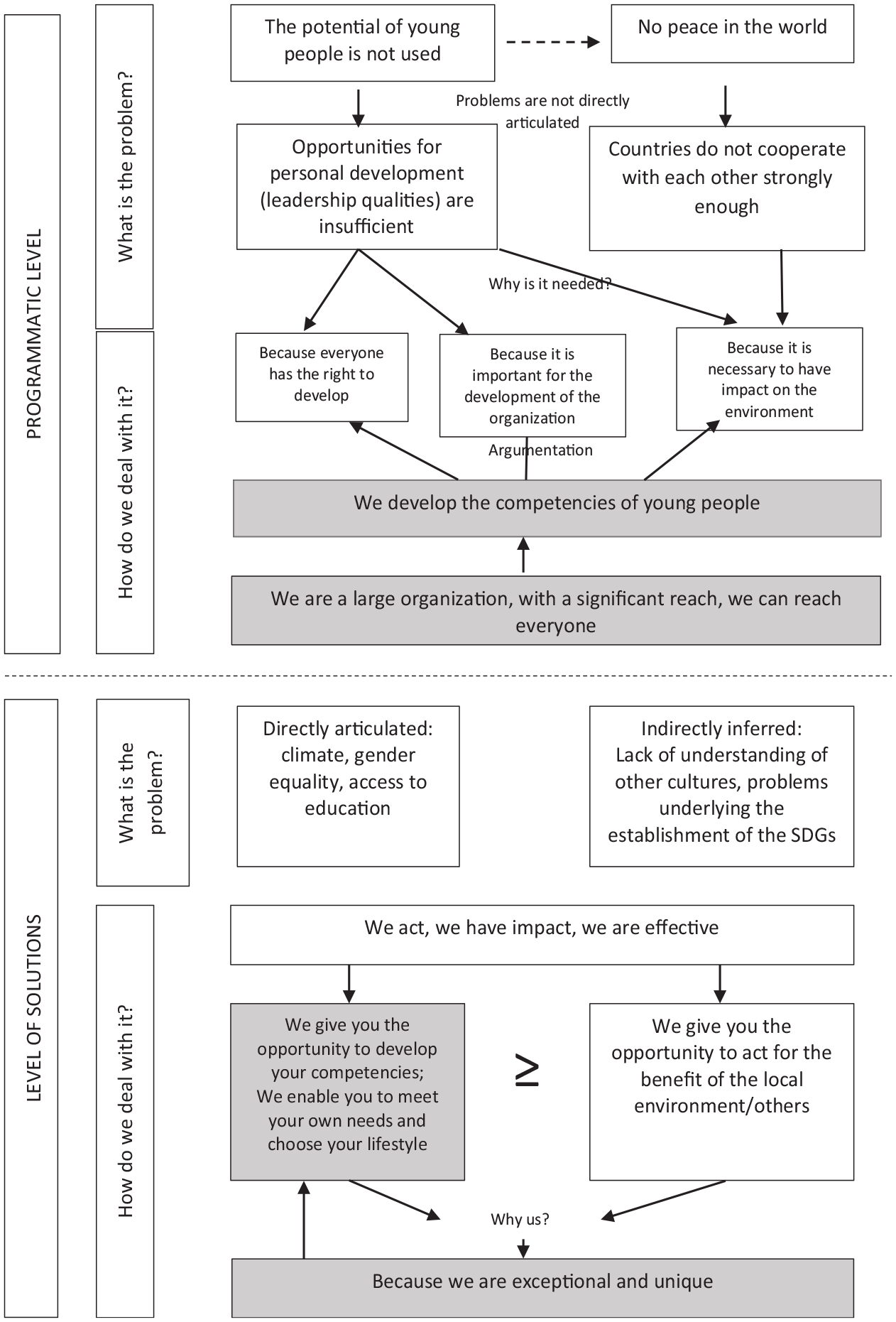
The dynamics of the discourse related to the compensation function of AIESEC’s symbolic space.
Based on the analysis, it can be concluded that AIESEC’s discourse is undergoing quite a significant change that can be considered both in terms of time dynamics (AIESEC’s mission should be interpreted in the historical context) and internal dynamics. It is evident that the transition from the programmatic level to the level of solutions somewhat alters the focus of the discourse. The OIO, initially interpreted as collectivist because of the organization’s mission highlighting its excellence and development around a specific social goal, has clearly evolved towards an individualistic orientation (Brickson, 2007; Langer & Feeney, 2022). The latter can be particularly recognized at the level of solutions, although certain elements of relationality are also present. Another interesting aspect is the internal dynamics of the discourse concerning the perspective in which it is constructed. There is the “top-down” perspective of experts and effective professional practitioners at the programmatic level. While admittedly visible at the level of solutions, it is accompanied by the distinctive participatory and empowerment perspective of the individual. This implies that AIESEC’s discourse is as much about “what” and “how” as about inviting people to act, providing them with development opportunities, and highlighting their importance as the addressees of the discourse while maintaining confidence as to the effectiveness of their activities.
ATD Fourth World Poland
Two interrelated problems are directly articulated at the programmatic level of ATD’s discourse: poverty and social exclusion (Example 12). The link between them is implied in the Preamble to the Articles of Association (Example 13), which clearly indicates the organization’s focus on the type of social exclusion associated with poverty.
(12) “The ATD is a voluntary association of people established to fight extreme poverty and social exclusion” (ATD_Articles of Association_atd.org.pl)
(13) “Extreme poverty is a disgrace. The injustice, helplessness, shame, humiliation, hunger, and social exclusion experienced by people living in extreme poverty can no longer be tolerated” (ATD_Articles of Association_atd.org.pl)
Example 13 also highlights other phenomena linked to poverty such as injustice, helplessness, shame, humiliation, and hunger. Poverty is evaluated in clearly negative terms and is called “a disgrace.” The argumentation behind such an unambiguous assessment refers to a standard—in this case, epitomized by human rights. Persons living in poverty are referred to as “the first victims of human rights violations” (ATD_Articles of Association_atd.org.pl). Based on the Preamble, the organization considers poverty a violation of the principle of equality and inalienable human dignity. Among persons/groups excluded or at risk of poverty and social exclusion are large families, people with the experience of homelessness, the unemployed, drug addicts, the disabled, and their families (ATD_Articles of Association_atd.org.pl). Social exclusion refers also to the exclusion of the poor from the debate on how to resolve their problems and from participation in decisions on issues that directly affect them (ATD_Who_are_we_atd.org.pl).
Notably, similar to AIESEC, the problem indicated in the ATD’s discourse is also placed in the historical context. The Preamble states,
(14) “The founder of the International Movement ATD Fourth World was Father Joseph Wresinski. Born into great poverty, he was aware of the long history of human suffering and hope. Together with the families of the Homeless Camp in Noisy-le-Grand, France, and others who joined him, he founded the International Movement ATD Fourth World in 1957. The participants of the Movement agree with the thought of Father Joseph Wresinski that people have created the conditions for extreme poverty and social exclusion: “Extreme poverty is the work of mankind and only mankind can destroy it. We will not eliminate the problem of poverty by giving the poor what we have in abundance.” Long-term commitment is needed to ensure that no human being is left behind. Accepting this responsibility should be a source of pride for everyone”. (ATD_Articles of Association_atd.org.pl)
However, unlike in AIESEC’s case, the ATD’s discourse on the problem at the programmatic level is extremely coherent. The organization’s mission is translated into the language of the Articles of Association without shifting the focus of the discourse. It remains consistent as a problem-oriented discourse. The ATD’s OIO can be termed collectivist (Brickson, 2007; Langer & Feeney, 2022).
The question about the function of compensation in the ATD’s symbolic space concerns the ATD’s discursive response to identified problems. At the programmatic level, the discourse focuses on the personal, social, and systematic engagement and work for people and groups who experience or are at risk of poverty and social exclusion. The pursuit of the organization’s goal, the prevention of social exclusion, is not only about working for these people and groups but also about working with them. A transformative meta-strategy is applied to induce change in the direction determined by the speaker (Wodak et al., 2009). A collectivist orientation is evident also in the case of this organization (Brickson, 2007; Langer & Feeney, 2022). However, it also has the characteristics of the idealistic, if not utopian, discourse of agency constructed from the political perspective. The latter is most apparent at the level of the Preamble to the Articles of Association. The ATD identifies a social problem and knows how to resolve it.
(15) “As long as money remains the highest value, the world will be threatened by poverty and violence. However, if a human being becomes our highest value, the world will change, and humankind will be able to enjoy peace”. (ATD_Articles of Association_atd.org.pl)
(16) “This is why it is important to change our views, create bonds between families, learn to listen to each other, and share knowledge. This will allow everyone to find the strength to take their place in society, accept responsibility for their own life, and participate in building the future of their country and the world” (ATD_Articles of Association_atd.org.pl)
Certain features emerge in the programmatic discourse that somewhat revise the organization’s idealistic promise to fix the world. The ATD emphasizes the necessity of systematic involvement in the pursuit of its goals. While it is never clearly stated that the latter may be difficult, if not impossible to achieve, its focus on the consistency of action, long-term nature of activities (Example 17), responsibility therefore, and the necessary effort (Example 18) slightly mitigate the perspective of certainty as to the effects of the activities.
(17) “Long-term commitment is required”. (ATD_Articles of Association_atd.org.pl)
(18) “The International Movement ATD Fourth World strives to make the poorest people the most important partners in the fight against extreme poverty and in building a world that respects the dignity of every human being. It also seeks to make it easier for the poorest to have a voice in the public debate on contemporary social problems and enable them to participate in decisions on issues that directly affect them”. (ATD_Who_are_we_atd.org.pl)
At the programmatic level, the discourse is built using the “top-down” approach. While it is all about “including,” the statements are constructed from the perspective of those who “do the including.”
How does the discourse change when translated into the level of solutions? The principal problems remain the same; however, they are articulated differently. Besides general statements, they are also referred to in more specific contexts (Example 19) or about a specific group they may concern (Example 20).
(19) “The migration of people from smaller to larger cities does not always bring social advancement, and frequently, it even carries the risk of homelessness, poverty, and exclusion. This risk increases in the face of other adverse phenomena that often accompany migration: being unemployed for a long time, lack of qualifications currently in demand in the labor market, or the lack of support from family and loved ones”. (ATD_Workshops_“Wresinski”: Poverty and migrations_Facebook_23 April 2018)
(20) “A project developed with young people in mind, particularly those who remain invisible to the rest of society and are isolated and lonely. In particular, we want to reach out and give a chance to speak their mind to those who have never had such an opportunity due to poverty, social exclusion, and other difficulties in life” (ATD_Major_activities_atd.org.pl)
Gender inequality also emerges among the problems articulated by the ATD. While the argumentation for the general need to solve these problems is largely founded on human rights and needs, the discourse becomes more concrete at the level of solutions. Specific actions are proposed or planned to deal with the problems. Despite the concretization in the form of activities, the discourse retains its partly idealistic character and makes unsupported promises regarding problem resolution (Example 21). Interestingly, these rather universal claims are juxtaposed with very specific forms of activity, adding to the contrast of “general” vs. “detailed and specific.” The latter can be seen in Example 21, where the explicit and concrete information about the celebration of the International Day for the Eradication of Poverty is confronted with the idealistic purpose of such celebrations. Such phrasing essentially puts the pompous part of the information in the “excessive” spotlight.
(21) “Dear Friends, the 17th of October, the International Day for the Eradication of Poverty, is approaching. (…) With this year’s celebrations, we want to highlight the importance of uniting with those most excluded, to build a world where human rights and dignity are universally respected. We can’t do it without you! We are planning to meet on the 22nd of August with everyone who wants to be a part of these celebrations. Together, we will share ideas and make plans. We cordially invite all those interested to join us on 22 August 2018 at 5.00 p.m. in our office at 34 Grenadierów Street. We look forward to seeing you!” (ATD_Celebrations_17th October: Let’s do it together!_Facebook_22 August 2018)
The discourse of agency is additionally intensified in how the organization builds its collective identity. On the one hand, a large part of the discourse is constructed fairly homogeneously, using the personal pronoun “we.” On the other, numerous specifications appear, typically related to the roles and functions performed in the organization. The most important aspect is the discursive “WE,” constructed concerning the predicate of power, perceived as the efficiency, and the organization’s uniqueness resulting from its professionalism (Kopińska & Wolniewicz-Slomka, 2025). Consequently, the ATD emerges perhaps not as the largest or the best organization, but one whose professionalism is presented as a feature that distinguishes it from others.
Besides this part of the discourse, we have another variation that mitigates the agency and the promise of solving the problem of poverty and social exclusion. This is the first time the ATD is presented as an organization that, despite its professionalism, also struggles with difficulties and does not always succeed in achieving its goals (Example 22).
(22) “We are constantly overlooked in social dialogue and policymaking”. (ATD_Major_activities_atd.org.pl)
(23) “In December last year, we were pleased when we received permission from the Office for Foreigners to continue the activities implemented as part of the Backyard Libraries project. In January, we launched a campaign to look for new volunteers—unfortunately without much success. (…) In early March, a decision was made to terminate the Backyard Libraries project”. (ATD_Report 2018_atd.org.pl)
At the level of solutions, similar to AIESEC, the ATD’s discourse of dealing with the problems also introduces the participatory perspective next to the “top-down” perspective, inviting everyone to join and act together (Example 21).
The dynamics of the ATD’s discourse discussed in this section are presented in Figure 2.
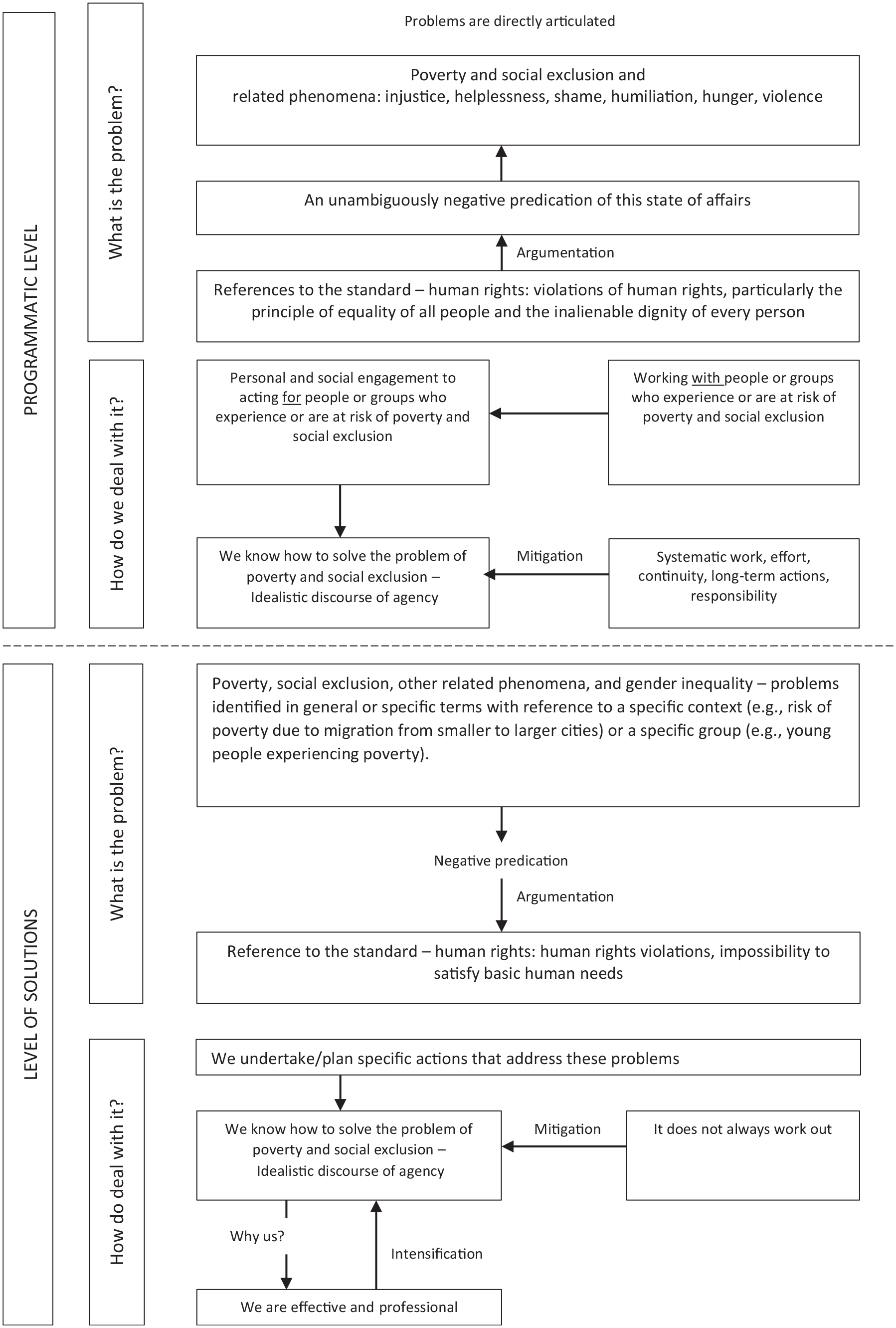
The dynamics of the discourse related to the compensation function of ATD’s symbolic space.
The analysis shows that the translation of the ATD’s discourse from the programmatic level to the level of solutions does not yield changes as significant as those seen in AIESEC’s discourse. While the collectivist orientation of the organization is evident at both levels (Brickson, 2007; Langer & Feeney, 2022), the organization appears in the discourse as professional and distinctive from others. Professionalism is understood as both knowledge and experience; however, the latter is not limited to the experience of those who “know” but includes those who have “been there themselves.” This is the form of professionalism that considers the opinions of formal experts on par with those of life experts, that is, people who have experienced the problems around which the organization builds its operations. While the ATD’s discourse is extremely consistent in its articulation of major social problems, the discursive response to these problems is not so uniform. The discourse seems to have two versions. The first is rather stiff and formal. While the language used to describe the problems may change with the level of the discourse, that used to deal with these problems remains unaltered. Immersed in general terms, it makes for a striking contrast to the otherwise rather detailed context. This version of the discourse promotes the language of certainty and agency, which, contrary to assumptions, can be considered overly idealistic and therefore unrealistic. The second version of the discourse undergoes a change that is adequate to the level—the general language of the description is transformed into a more detailed language. This is where we come across the articulation of difficulties indicating that not everything always works and actions do not always bring the intended results. These statements mitigate the previous promise of fixing the world. The “top-down” discourse at the level of solutions is complemented by the participatory perspective which, however, is less pronounced than in the case of AIESEC. The individualized empowerment perspective is absent from the ATD’s discourse.
Discussion and Conclusions
What is compensated in the symbolic space of the studied organizations? What “arrangements” are offered in the online discourses of these organizations? The answers to these questions differ for both organizations.
1) In the case of AIESEC, the following interrelated areas can be identified: - First, it is a symbolic space that extends a clear “offer” for the development of leadership competencies, corresponding to the needs of both personal and professional growth, while providing, intentionally or incidentally, the opportunity to impact one’s surroundings. A characteristic feature is the discursively guaranteed agency and effectiveness. Emphasis is placed on impact, rather than the purpose of the activities (resolution of specific social problems). This implies that what comes to the fore is the sense of agency and effectiveness which is constructed in the symbolic space and can be interpreted as a promise to balance shortages in these areas. - Secondly, it is a symbolic space that stimulates emotionally and is a source of experience(s), adventure, and external excitement. It promises all these benefits and provides “evidence” in the form of accounts of specific people. It could be called lifestyle space (based on the concept of lifestyle migration: (Benson & O’Reilly, 2016), that is, a space that (1) is chosen voluntarily, and although it seems to be available to everyone, is actually not (one must meet certain socio-economic criteria to be able to participate in AIESEC’s programs); and (2) is chosen because of the specific lifestyle it offers (easier, better life, filled with adventures and new experiences). While the motive of choice is important, it is not exclusive. A space constructed this way appeals to young people in the identity exploration status (Luyckx et al., 2006), presenting them with a path laid out clearly to determine their identity narrative. - Third, it is a symbolic space that ensures the satisfaction of the need for meaning, being a person who matters, and being exceptional, as evidenced by slogans, such as “The world at
2) In the case of the ATD, the following areas can be identified: - First, it is a symbolic space that deals with specific problems that disturb the balance in the world. It is a space that negatively evaluates the current “arrangement” of the world that generates poverty. The symbolic space of the organization shows which problem lies at the center of its interest and that it knows how to deal with it and restore the “balance.” It presents the “top-down arrangement” of the world—a framework built, on the one hand, on the critical analysis of the problem and, on the other, on the previous experience. Such a top-down framework order appears to be stable professional and generally effective; however, it requires systematic and responsible commitment and effort. - Second, it is an inclusive symbolic space that compensates for the confusion and imperfection of the world with an idealistic framework. It assumes the inclusion of not only those who accept this offer but also those affected by a given problem. It assures them a voice and a chance to be listened to and participate in the activities. - Third, it is a space that gives a sense of agency in terms of solving social problems and satisfying the need for meaning and for being someone, for people from disadvantaged backgrounds too.
The discursive symbolic spaces of both organizations serve the Foucauldian function of compensation for other spaces. In AIESEC’s case, it is the compensation for a flawed and disorganized space for the developing identities of economically and socially privileged young students. This discourse tells them where to go and who to be. It presents them with the possibility of exploration in breadth, exploration in depth, and commitment making (Luyckx et al., 2006, 2008). It promises to satisfy their need for meaning while also serving ludic purposes. It refers to both the (future) professional life and the sphere of personal fulfillment and self-expression. This goal-oriented discourse at the programmatic level is dynamically translated at the level of solutions into an action-oriented one, where social goals become less significant while personal development emerges as a top priority. It is an individual-oriented discourse that defines agency in terms of a person’s development, both professional and personal, own needs, and lifestyle choices.
In contrast, ATD’s symbolic space emerges not only as a response to a flawed and disorganized space and a search for one’s identity; nor does it solely concern the disorder of the world as perceived by youth. This discourse remains problem-oriented, both at the programmatic level and the level of solutions. It does not provide a direct answer to the question of who to be, but rather how to solve the problem. The solution comes in the form of a framework, at which point the discursive “arrangement” ceases to pay attention to detail. Constructed around inclusivity, it can intensify the sense of agency and satisfaction of the need for meaning. It is a community-oriented discourse that defines agency in terms of solving social problems. Consequently, the ATD’s symbolic space provides young people with an opportunity to search for an answer to the question of who to be; however, rather than impose a ready-made identity narrative on them, it enables them to gain the experience that can help them build it on their own.
In summary, the scope of the Foucauldian function of compensation fulfilled by both organizations is discursively differentiated, depending on to whom the “offer” is addressed, that is, who the potential addressee of the organization’s “arrangement offer” may be, which is associated with the OIO. A collectivist organization (Brickson, 2007; Langer & Feeney, 2022) tends to identify the social problems that are the core of its operations in direct, decisive terms, and is equally strong-minded in its evaluation and own argumentation. While closely related to these problems, compensation is not always adapted to the level of the discourse and may appear rather general and idealistic. An individualistic organization (Brickson, 2007; Langer & Feeney, 2022) is likely to focus on social goals rather than problems, but at the same time, it tends to dynamically push them out of the foreground and replace them with individual goals. It primarily compensates for individual problems/shortages/needs which may indirectly contribute to the achievement of social goals/resolution of social problems. In the studied symbolic spaces of both organizations, differences can also be observed in the construction of the discourse of dealing with the problem. While both organizations use the “top-down” and participatory perspectives, that of individual empowerment can be found only in AIESEC’s discourse. What both organizations have in common is the discourse of agency and the desire to build on what is unique about the organization.
In this article, I have posited that youth organizations are heterotopias of compensation in Foucault’s terms, which means that they perform a compensatory function in relation to other spaces and that they attempt to create a space that is “as well-arranged as ours is messy, ill constructed, and jumbled” (Foucault & Miskowiec, 1986, p. 27). I also conjectured that what makes these organizations different is the scope of the compensation function. I assumed that reconstructing this scope is possible if we ask: 1) What is constructed as a “mess” in an organization’s discourse? 2) What “order” is offered by an organization? and 3) Who makes “messy” space “well-arranged”? Empirically, I translated this into three basic categories of analysis, respectively: 1) social problem(s) identified by the organization; 2) how these problems are dealt with; and 3) organizational identity. By analyzing the Polish-language discourses of two international organizations, AIESEC and ATD Fourth World, published on their websites and Facebook pages, I identified and described the scope of these functions. The results of the analyses presented and discussed above allow for the reconstruction of the features of Foucauldian heterotopias of compensation grounded in the data. These are presented in Table 1.
The Characteristics of the Heterotopias of Compensation Reconstructed from the Analysis of the Organizations’ Discourses.
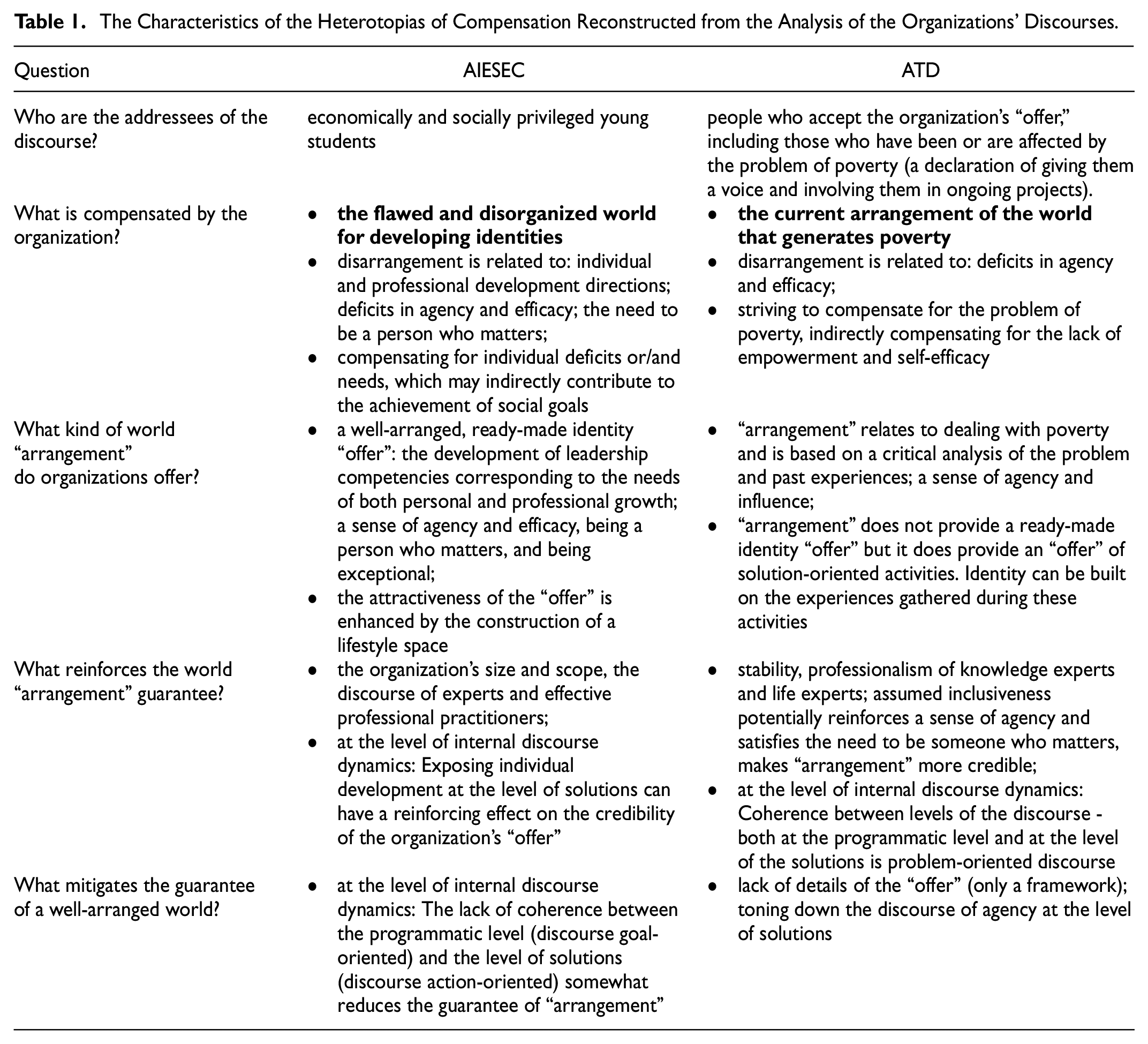
It is worth noting that the two heterotopias differ not only in what is compensated and, therefore, what “arrangement” is offered. They also vary in the degree of “arrangement”.
In the case of AIESEC, it is a ready-made structured identity “offer” aimed at a specific group. This “offer” is boosted additionally with lifestyle elements. The organization’s self-presentation is therefore strategic here. In this case, the vision of a “well-arranged” world is equipped with components that allow young people to combine individual, social, and hubristic goals. This integration is a significant aspect of young people’s organizational activity, as evidenced by previous research (Li, 2017; Pirk & Nugin, 2016). A potential limitation of this offering is the absence of alignment between the goals articulated at the programmatic level and those reconstructed from the level of solutions. Conversely, it appears that the level of solutions in the organization’s discourse aligns more closely with the recipient, thereby demonstrating consistency with the organization’s main “offer.”
In the case of ATD, the heterotopia of compensation is problem-oriented, but the “well-arranged space offer” demonstrates less detail, thereby significantly reducing the perceived “power” of the compensation function. Nevertheless, the compensation “offer” is remarkably consistent and inclusive, potentially appealing to younger recipients due to its idealistic language.
Both heterotopias of compensation operate with a discourse of agency, and efficacy constructed largely from the perspective of experts, and professionals.
The research conducted herein enables a systematic analysis of the intentional elements present within organizations’ self-presentation. Furthermore, it facilitates the reconstruction of heterotopias of compensation that integrate discourse dynamics. The analyses demonstrate how the online discourses of youth organizations construct a vision of the world and its order, to whom these discourses are addressed, and the discursive strategies applied to construct specific identity narratives intended for young people.
It would be interesting to compare the degree of consistency of these organizations in other countries. A limitation of the research presented here is that the representation of the heterotopian function of compensation described here applies only to the discourse presented in the media. However, it is currently an important part of the discourse not only in the context of recruiting new members of the organization but also in the context of constructing, changing, and negotiating the identity of the organization (Barros et al., 2023).
Footnotes

Funding
The author disclosed receipt of the following financial support for the research, authorship, and/or publication of this article: This work was supported by the National Science Centre in Poland under Grant Number 2019/35/B/HS6/01365.
Declaration of Conflicting Interests
The author(s) declared no potential conflicts of interest with respect to the research, authorship, and/or publication of this article.
Data Availability Statement
Data sharing not applicable to this article as no datasets were generated or analyzed during the current study.