



Abstract
Internationally recognized expertise draws global attention, and expatriate academics represent an important part of this expertise within the increasingly globalized landscape of higher education. This study explores the phenomenon of being an expatriate academic in Turkey focusing on the motivations behind continuing their careers in Turkey or leaving the country. Using Interpretative Phenomenological Analysis (IPA), the thematic analysis of interviews with ten diverse expatriate academics reveals insights into the factors influencing their retention or return decisions. The alignment between their perceptions of being expatriate academics in sociocultural and professional dimensions and their experience within Turkish higher education, notably in intercultural competence development and career advancement opportunities, serves as a significant pull factor and leads them to stay in Turkey. However, the discrepancy between their perceptions and actual experiences, particularly regarding issues of inequality, acts as a push factor and motives them to leave Turkey.
Plain Language Summary
Internationally recognized expertise draws global attention, and expatriate academics represent an important part of this expertise within the increasingly globalized landscape of higher education. This study explores the phenomenon of being an expatriate academic in Turkey focusing on the motivations behind continuing their careers in Turkey or leaving the country. Using Interpretative Phenomenological Analysis (IPA), the thematic analysis of interviews with ten diverse expatriate academics reveals insights into the factors influencing their retention or return decisions. The alignment between their perceptions of being expatriate academics in sociocultural and professional dimensions and their experience within Turkish higher education, notably in intercultural competence development and career advancement opportunities, serves as a significant pull factor and leads them to stay in Turkey. However, the discrepancy between their perceptions and actual experiences, particularly regarding issues of inequality, acts as a push factor and motives them to leave Turkey.
Introduction
In an increasingly globalized education landscape, internationally recognized expertise has risen (Altbach, 2015), and countries worldwide introduced regulations to promote international mobility (Fahey & Kenway, 2010). However, it varies significantly across regions, shaped by institutional strategies, national policies, and labor market needs. For instance, while many international academics cluster in leading universities in English-speaking countries, others are recruited in countries such as Switzerland, Hong Kong, and Singapore as part of strategic higher education policies, or employed as a solution for the shortages of local staff, such as in the Gulf countries and parts of Africa. Moreover, some academics migrate permanently or pursue entire careers abroad after doctoral or postdoctoral training (Altbach & Yudkevich, 2017). Nevertheless, despite such regional differences, the overall prevalence and importance of academic mobility have steadily increased (Niemczyk, 2024; Seggie & Çalıkoğlu, 2023), and studies have examined its effects on academics’ research productivity, career development, and collaboration and research networks (Abramo et al., 2019; Knight, 2007; Luczaj, 2020; Wang et al., 2019), motivations behind the mobility (Fernando & Cohen, 2015; Oliveira et al., 2023), or the challenges of international academic mobility (Kurek-Ochmańska & Luczaj, 2021).
Most of this literature has focused on Western destinations because of the dominating role of English-speaking countries in the international academic mobility (Oliveira et al., 2023; Seggie & Çalıkoğlu, 2023). However, restrictive migration policies and xenophobia in Western countries (Marginson, 2017) and increased investment in internationalization in non-Western countries (Kim, 2016) have changed this pattern. Consistent with this change, the number of international academics in regions, such as Asia, the Middle East, and Turkey has increased, and these regions have increasingly become hosting destinations rather than traditional sending countries (Lee & Kuzhabekova, 2018). Since the 1990s, Turkey has actively pursued the recruitment of expatriate academics as a key strategy to improve the quality of higher education and enhance its international research capacity. To support this goal, an internationalization policy to improve employment procedures and attract highly qualified, research-oriented international scholars was introduced, (YOK, 2017, 2021). Consequently, the number of expatriate academics rose by 39.4%, from 2,372 in 2014 to 3,306 in 2020 to 2021 (YOK, 2022). However, by 2023 to 2024, this number declined by 12.1%, falling to 2,906 (YOK, 2024).
Despite a gradual increase in the number of expatriate academics in the early years of internationalization strategy, a sudden decline in recent years indicates the probability of certain issues regarding the academic migration in Turkey (Seggie & Çalıkoğlu, 2023). Situated at the crossroads of the Middle East and Eastern Europe, Turkey occupies a unique position in regional higher education systems, acting both as a source of outgoing academics and as a destination for international academics. Turkey’s strategic measures to enhance its position in the global education market, including the recruitment of expatriate academics, provide a unique context to investigate the mobility patterns and retention factors of international academics. However, existing studies in the internationalization of higher education in Turkey widely concentrated on internationalization policies and practices (e.g., Özer, 2017; Selvitopu & Aydın, 2018) and international students (e.g., Yılmaz & Güçlü, 2021). Yet, limited research (e.g., Alpaslan Danisman, 2017; Seggie & Çalıkoğlu, 2023) is available on expatriate academics in Turkey despite their increasing significance in the global education market (Koh & Sin, 2020). To address this gap, this study aims to explore in depth, from an interpretive perspective, the phenomenon of being an expatriate academic in Turkey, focusing on the motivations behind continuing their careers in Turkey or leaving the country. While previous research has primarily emphasized professional experiences, non-work and cultural aspects of academic migration have remained underexplored. Addressing these dynamics not only illuminates the Turkish case but also provides insights that can inform academic migration policies and enrich theoretical frameworks in other national contexts.
Literature Review
Academic Migration
Individuals shape their careers by building portable skills, aligning work with personal goals, and developing their identity and human capital. This process of career development is not only shaped by personal initiatives but also changing life contexts influenced by geographical, social, and cultural factors (Hoekstra, 2011). Academic migration is regarded as a crucial component of career development for academics, as well as enhancing their productivity (Jaroszewicz et al., 2025). In contemporary society, more careers including academics are expanding beyond national boundaries (Doherty et al., 2013) in search of better career opportunities (Seggie & Çalıkoğlu, 2023) as well as enhancing their productivity.
Academic migration—a form of spatial mobility—sometimes involves crossing national borders, which leads to considerable changes in social and professional environments and causes several challenges for migrants. These challenges sometimes become permanent and lead to fundamental alterations in migrants’ life situations, which are often considered costly (Aybek et al., 2015; Malmberg, 2020).
Push and pull factors of spatial mobility determine whether individuals perceive migration as worthwhile or not, influencing their decision to pursue or abandon it. Thus, migration is a decision-making process influenced by push factors driving individuals away from their place of origin and pull factors attracting them to a new destination (Lee, 1966). Research reveals that inadequate career opportunities (Altbach, 2004), insufficient research infrastructure (Kim, 2010), economic and political instability (De Villiers & Weda, 2017), political pressures on academic freedom (Bauder, 2012), economic disparity and sometimes war and conflict (Mendoza et al., 2020) serve as pushing factors, while better research facilities and prestige (Morley et al., 2018) are the main pull factors in academic mobility. Therefore, the decision to migrate is complex and multifaceted context.
International migration of academics has a strategic function in the competitive global education landscape offering economic, social, cultural, academic, and political benefits (Bauder, 2012; Han, 2022; Wang et al., 2019), such as intercultural competence (Knight, 2007), international perspectives in academia (Luczaj & Kurek-Ochmanska, 2021), and global professional networks (Wang et al., 2019).
However, increase in the number of expatriate academics leads to work-related problems, resulting from differences in organization and management culture in the host country (Han, 2022; Luczaj, 2020), variations in teaching styles (Kensington-Miller, 2021), linguistic disparity (Altbach & Yudkevich, 2017), and unsystematic bureaucratic processes (Alpaslan Danisman, 2017). Furthermore, challenges related to non-work aspects including cultural adjustment, acculturation (Chen, 2022), managing diversity (Shin & Gress, 2018), and social alienation (Romanowski & Nasser, 2015) trigger complexities.
Intercultural Competence
Cultural norms and societal expectations can significantly shape the decision-making process of international mobility (Han, 2022). Curiosity about other cultures and the excitement of the new motivate academics to pursue their careers in different landscapes (Rey et al., 2020). However, language barriers (Alpaslan Danisman, 2017; Han, 2022) and cultural adaptation challenges (Seggie & Çalıkoğlu, 2023) impact their experiences, influencing their ability to integrate into new academic environments and establish professional networks.
Migration may result in epistemic exclusions, perceptions of otherness, and isolation for expatriate academics in the host countries (Morley et al., 2018). Thus intercultural competence, referring to the ability to show effective and appropriate behavior and communication in intercultural situations (Deardorff, 2011), is crucial for the integration of expatriate academics and the internationalization of work life (Whaley & Davis, 2007), and thereby for successful integration into a foreign cultural geography (Altbach & Yudkevich, 2017). As expatriate academics work in countries where cultural norms and values are different from their own, intercultural competence helps them understand and integrate into this new environment (Ward et al., 2001).
Theoretical Framework and Present Study
In this study, we proposed a dynamic approach by combining Lee’s (1966) push and pull theory and Argyris and Schön’s (1976) theories of action conceptualization for understanding expatriate academics’ preferences for staying in or leaving the host country. The push and pull theory was used as a guiding framework to reveal the reasons behind the migration of expatriate academics to Turkey. The theories of action were used to interpret the tendency of expatriate academics to pursue their careers in Turkey and their decisions to stay or return.
Push and pull theory is a widely used framework in migration studies and human geography to analyze migration patterns (Erdal & Hagen-Zanker, 2023). According to push and pull theory, while factors at the origin push, factors at the destination pull people towards migration or non-migration (Lee, 1966). However, in this study, we take a different approach by focusing on the push factors in the host country instead of those in the country of origin. In this context, push factors refer to the challenges and drawbacks of working in Turkey, while pull factors represent the benefits and opportunities. Pull and push factors together influence academics’ decisions to migrate. However, push factors associated with the host country lead them to leave, while pull factors encourage them to stay.
The theories of action, focusing on the integration of thought and action, consist of espoused theory and theory-in-use. Espoused theories are based on cognition and describe how individuals behave in certain situations according to their norms and assumptions. However, the theory-in-use refers to individuals’ practical actions that produce outcomes. Espoused theories eventually form theories-in-use, but they may not always align (Argyris & Schön, 1976; Chen, 2022). This framework facilitates the investigation of expatriate academics’ perception of being an expatriate academic in general and in Turkey, based on their perceptions and experiences of working in Turkey, identifying the sociocultural and professional aspects that lead to the alignment or misalignment between their cognitive attitudes and actual practices. This, in turn, provides a deeper understanding of expatriate academics’ preferences for either staying in Turkey or leaving the country. Thus we can interpret the relationship between mobility expectations and the real experiences in the host country.
Despite the large number of expatriate academics in Turkey, there is limited understanding of their experiences and the factors that influence their decisions to stay or leave. This study explores the phenomenon of being an expatriate academic in Turkey by examining both professional and non-work experiences in Turkish universities. Using Lee’s (1966) push and pull framework and Argyris and Schön’s (1976) theories of action, it focuses on how these experiences shape participants’ decisions to stay in or leave the country. The push and pull framework allows for the consideration of a broad range of work-related and sociocultural factors, while action theory provides insight into how participants interpret and respond to their experiences. By integrating these perspectives, the study aims to contribute to the understanding of expatriate academics’ experiences and offer implications for policy and practice in higher education.
Methods
The study employed Interpretative Phenomenological Analysis (IPA), which is rooted in phenomenology, hermeneutics, and idiography (Smith et al., 2009; Smith & Osborn, 2015) and investigates how individuals make sense of their experiences. By including participants’ perspectives, IPA allows for a more holistic understanding and enables a more detailed examination of lived experiences (Gong et al., 2025). Accordingly, this study aims to uncover what it is like to be an expatriate academic in Turkey and to identify the motives of expatriate academics for retention or return based on their perceptions and experiences. This approach is particularly well suited for exploring participants’ perceptions, motivations, and preferences regarding retention or return based on their professional and non-work-related dimensions of academic migration, allowing the study to capture the nuanced, context-dependent meanings embedded in their lived experiences.
Research Participants
IPA studies use context-specific samples and are conducted on relatively small sample sizes to allow for in-depth exploration of each participant rather than aiming for broad generalizability (Smith et al., 2009). Sample sizes vary depending on the study’s objectives, ranging from 3 to 10 (Dukes, 1984), 1 to 15 (Pietkiewicz & Smith, 2014), or 5 to 20 participants (Creswell, 2007). Consistently, prior IPA research has utilized relatively small sample sizes. For instance, Li et al. (2025) recruited fourteen participants, while Gong et al. (2025) recruited eight to their IPA investigations. In line with these recommendations, the present study collected data from 10 participants.
To explore the phenomenon of being an expatriate academic in Turkey and to capture a wide range of experiences and perspectives, we adopted purposive sampling to recruit participants from diverse demographic backgrounds, including nationality, career experience, gender, and field of study, supplemented by a snowball sampling method. Data collection continued until data saturation was achieved, ensuring that the richness and depth of participants’ lived experiences were fully captured (Patton, 2015).
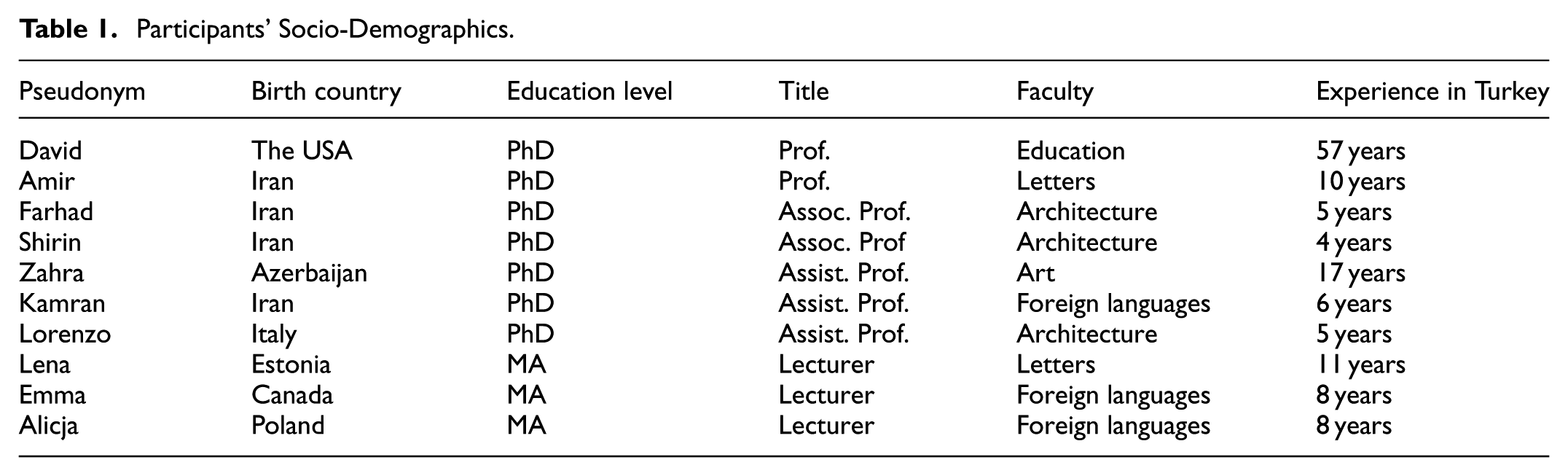
To collect data, we conducted ten semi-structured in-depth online interviews with an equal number of male and female participants. Amid those participants, three were lecturers, three were assistant professors, two were associate professors, and two were full professors. Three participants were from the School of Foreign Languages, two from the Faculty of Letters, two from the Faculty of Architecture, one from the Faculty of Education, one from the Faculty of Arts, and one from the Faculty of Engineering and Natural Sciences. The participants’ national origin covered Iran, Azerbaijan, the USA, Canada, Italy, Poland, and Estonia. In terms of discipline, six participants researched or taught in social sciences, three in sciences, and one in art. The experience (E) of the participants as expatriate academics ranged between 4 and 57 years (Emean = 13.1 years), and two of the participants had previous international experience. This reflects a broader trend showing academics with prior international experience did not prefer Turkey as a work destination, likely due to political, academic, and economic conditions of the country. Despite these limitations, the group reflected a variety of professional trajectories and levels of experience both in Turkey and their home countries. Table 1 below presents the full socio-demographic details of the participants:
Participants’ Socio-Demographics.
Data Collection and Analysis
In this study, a semi-structured interview form was used as the data collection instrument. Semi-structured interviews allow participants to elaborate on their perspectives while enabling the researcher to ask follow-up questions when necessary to gain a deeper understanding of the data (Creswell, 2007).
The interview form was designed to explore participants’ perspectives of being expatriate academics in Turkey, and their motives to retain or leave the country regarding their experiences. It was developed based on a comprehensive literature review and was reviewed by a subject matter expert and a qualitative research specialist to ensure content validity. The final version included four open-ended questions, categorized under the following themes:
Experiences and perceived impact of being an expatriate academic in Turkey.
Push factors influencing career retention in Turkey.
Pull factors influencing decisions to leave Turkey.
We collected data through individual semi-structured interviews. As participants worked in different universities across the country, all interviews were conducted online and recorded. All interviews were transcribed verbatim and analyzed using Braun and Clarke’s (2006) six-phased thematic analysis with an inductive approach, including familiarization with data, coding, searching for initial themes, reviewing themes, defining and naming the themes, and writing the report using NVivo, a qualitative data analysis program. The researchers conducted the coding and theming together to ensure coding agreement. The researchers also obtained ethical clearance and ensured confidentiality and anonymity throughout the study. Pseudonyms were used for the participants. In addition, informed consent was obtained from the participants. Prior to data collection, the participants were provided with detailed information about the study, the potential risks, and their rights. Participation was entirely voluntary, and participants were free to withdraw at any time.
Findings
Aligned with the conceptual framework and the research questions, analyses focus on two areas: socio-cultural aspects of being an expatriate academic and professional aspects of being an expatriate academic (see Figure 1).

Emerged themes regarding the conceptual framework.
As illustrated in Figure 1, expatriate academics’ perceptions regarding socio-cultural and professional aspects (espoused theories) interact with their experiences in Turkey (socio-cultural conditions, career development, income, and workplace conditions). Alignment or misalignment between their perceptions and experiences, effected by pull or push factors, shapes their decisions to continue working in Turkey or returning to their home countries (theories-in-use).
All participants in this study conceptualized the experience of “being an expatriate academic” through two primary aspects: socio-cultural and professional. The following section provides detailed explanation about being an expatriate academic in terms of socio-cultural and professional aspects.
Being an Expatriate Academic: Socio-Cultural Aspect
The participants conceptualized being an expatriate academic primarily through socio-cultural aspects, as the role inherently required navigating a foreign country, culture, and contextual environment before professional considerations came into play. Consequently, they highlighted that being an academic in a foreign country required openness to diverse cultural elements, respect for differences, and the ability to integrate the host culture with their own, referring to intercultural competence. For instance, Lorenzo (Italy) noted that working abroad required not only professional expertise but also “curiosity, open-mindedness, and a genuine desire” to engage with and understand different cultures. Similarly, Leno (Estonia) highlighted cultural respect, acknowledging living in a different country demanded working and living with people who had different ways of thinking and understanding. The degree to which their expectations aligned with their experiences in Turkey appeared to play a critical role in their decision to stay, whereas misalignments led to considerations of returning to their home countries. In other words, participants indicated that socio-cultural features—such as openness to diverse cultural elements, respect for differences, and the development of intercultural competence—were perceived as core components of being an expatriate academic. When participants’ expectations regarding social inclusion and cultural engagement aligned with their experiences in Turkey, these socio-cultural conditions functioned as strong pull factors encouraging them to remain in the country; when misaligned, they instead became push factors that encouraged them to leave the country.
Pull Factors
Participants emphasized that intercultural competence served as a significant pull factor in their willingness to continue working in Turkey. Rather than viewing cultural adaptation as a one-time adjustment, they described it as an evolving process of negotiation between cultures, leading to a gradually developing competence over the years. David (USA), for instance, acknowledged struggles he faced in the initial phase of his migration and explained his early perception of Turkey was like “coming to a different planet,” which gradually gave way to a more differentiated understanding, recognizing that difference and similarity could coexist, which reflected the intercultural competence developing over time. In fact, his occasional preference for speaking in Turkish instead of his native language, English, illustrated not only his linguistic adaptation but also his sense of integration into the local cultural environment. Similarly, Alicja (Poland), who had been living in Turkey for 8 years at the time of the interview, illustrated her sense of belonging in Turkey resisting the idea of “returning home” when she was asked whether she planned to go back home, Poland. She noted that Turkey itself had become home and she was “at home in Turkey,” underscoring how intercultural competence could reshape identity and rootedness.
In addition, the participants emphasized that cultural differences act as pull factors, offering them opportunities to gain new perspectives by living in an unfamiliar cultural environment. For instance, Kamran (Iran) described his experience as an expatriate academic using the metaphor “migratory bird,” noting that “when you just distance yourself from where you are, it’s just like you’re flying and you can just view things, see things differently,” underscoring how living in Turkey contributed him to get new life perspectives. He further highlighted his personal development to embrace cultural diversity and foster appreciation for differences stating “you become more tolerant of the ambiguities that exist between the cultures.”
Moreover, the cultural richness of Turkey itself served as a pull factor encouraging expatriate academics to stay in the country. Emma (Canada), for example, noted the “tremendous cultural experience” and “extraordinarily interesting” cultural life she experienced in Turkey contributed her personal awareness about cultural diversity in the country. Lorenzo (Italy), likewise, noted that even thought there were various cultural differences between Turkey and his home country, these differences were not entirely distinct and helped him understand that there were certain aspects of life “that were the same all around the world,” reflecting all cultures share key similarities despite apparent differences. Similarly, Farhad (Iran) highlighted that the similarities between Turkish culture and his own culture made him feel less foreigner, and was important for him to “keep staying” in Turkey.
Push Factors
On the other hand, participants highlighted the challenges they faced due to cultural differences, feeling alienated, and poor socio-cultural activities, which could act as push factors, motivating them to leave the country if remained unresolved or in the absence of developed intercultural competence. For instance, Lena (Estonia) acknowledged experiencing cultural challenges at the beginning but explained that she took “them as learning experiences” to continue living in Turkey. Zahra (Azerbaijan), in contrast, noted the differences in Turkey and her home country in terms of socio-cultural facilities. She stressed that the availability of limited social and artistic activities compared to Azerbaijan created serious difficulties for her in adapting Turkey as an artist, particularly after moving from a large metropolitan context in Azerbaijan to a small provincial city in Turkey. Recalling her first impression, she admitted thinking, “where she came” in shock. She further noted that the integration became even more difficult when local people “expected different things” during the events they organized open to public at the beginning phase of her immigration. However, improvements in the city’s socio-cultural life and alternative opportunities within the university facilitated her stay over time, which might otherwise have acted as push elements.
Being an Expatriate Academic: Professional Aspect
Participants highlighted the importance of employment conditions, career development opportunities, income, and workplace culture as essential professional aspects of being an expatriate academic. For example, Kamran (Iran) highlighted the expectation for higher academic qualifications from expatriate academics, noting that they “should bring in something that a native might not be able to offer” considering they were preferred over local academics. Zahra (Azerbaijan) further explained that while professional expertise came first, effective communication skills also played a key role for expatriate academics “to overcome cultural and linguistic barriers.” They also noted that being an expatriate academic should provide opportunities for expanding their professional networks and supporting their academic productivity. For instance, Zahra (Azerbaijan) noted that expatriate academics “produced more abroad compared to their home countries” as universities expected international academics to contribute actively to research output. The degree to which professional expectations of being expatriate academics aligned with their experiences in Turkish higher education appeared to play a critical role in their decision to continue their career in Turkey, whereas misalignments led to considerations of leaving the country. In other words, employment conditions, career development opportunities, income, and workplace culture were perceived as fundamental professional aspects of being an expatriate academic. When participants’ expectations regarding professional stability, recognition, networks, and institutional support aligned with their lived experiences, these factors functioned as strong pull factors encouraging them to remain in Turkey; when misaligned, they instead became push factors that encouraged them to leave the country.
Pull Factors
Participants emphasized that diverse employment options and practical recruitment procedures served as a significant pull factor in their willingness to continue working in Turkey. When compared to other countries in Europe, the high number of universities—particularly private universities in Turkey—was perceived as a significant advantage, especially by early-career academics. For instance, Lorenzo (Italy) noted that there was nearly “a market of university employment” with a “very large variety of options” across public and private institutions in diverse locations, which was not available in many other countries. Emma (Canada) further highlighted the advantage of recruitment as an expatriate academic, noting that the country provided certain job opportunities that were “not open to Turkish colleagues” and broadened their recruitment options. Furthermore, participants emphasized that simplified recruitment processes further reduced employment difficulties. For example, Alicja (Poland) emphasized that much of the administrative burden of “the work permit and the renewal of the permit” was handled by human resources department of the university. Not having to navigate complex bureaucratic systems themselves was “good and easy,” reducing the stress of securing legal employment in a foreign country and reinforcing the perception of Turkey as a more accessible and supportive recruitment environment.
In addition to recruitment procedures, economic income was also perceived as a significant pull factor for expatriate academics working in Turkey. Participants highlighted stable income, the option of receiving part of their salary in foreign currency, and comparatively higher salaries especially for novice academics as key advantages of academic employment in the country. Emma (Canada), for instance, emphasized that some private universities “pay the internationals in euros or dollars,” which she considered an important advantage as an academic with organic ties to different countries, particularly in facilitating travel and related expenses. Kamran (Iran) also highlighted that income in Turkey was considerably more favorable compared to the financial situation following American sanctions in his home country, Iran. Similarly, Lorenzo (Italy) compared the salary he received during his doctoral studies in Italy with the salary he earned after he moved in Turkey, noting that in Italy he could hardly cover his rent, whereas in Turkey, “the rent of the apartment that he stayed in was 1/6 of his salary,” which he stressed that especially early-career academics working in Turkey “definitely have a comfortable life.” In line with Lorenzo’s views, Alicja (Poland) also underlined that “a regular and decent salary was available” for academics in Turkey, noting that the stability of a steady income discouraged her from considering leaving the country or changing her institution.
The participants indicated that career development opportunities were the third pull factor for expatriate academics in Turkey. The number of universities in Turkey increased particularly after 2000s, and the universities began to prioritize the professional development of their academics to remain competitive in both national and international academic environments. Consequently, they did not only require expatriate academics to possess certain professional expertise during the recruitment process but also initiated various measures to support the ongoing professional development of their existing academic staff. At this point, Alicja (Poland) noted that “a lot more was required of expatriate academics” at their university, which in turn motivated them to participate in various national and international training programs. Through these programs, they had “the opportunity to train” themselves continuously and got certain qualifications they “maybe never would have.” Similarly, Lena (Estonia) highlighted that due to the internationalization efforts in Turkey, universities employed academics from different countries, enabling all academics interact “with international colleagues” and “share their values, experiences, and knowledge,” which in turn contributed to the gain of international perspectives in academia in Turkey. In addition to continuous professional development, the participants emphasized that being an international academic in Turkey was advantageous in terms of academic productivity. For instance, Shirin (Iran) noted that working as an expatriate academic contributed not only to the development of one’s professional network but also allowed academics to approach their research from a broader perspective. As an expatriate academic, they tended to design studies that contribute to both their home and host countries, which made their work “more comprehensive and more global.” Zahra (Azerbaijan), comparing Turkey to her home country, remarked that Turkey provided a more supportive academic environment for research. She expressed that “when they talked to each other, it always came up as a research topic,” enhancing motivation for academic production in Turkish higher education. Similarly, David (USA) explained that in the US, academics were “supposed to conduct some public service” in addition to teaching and research, which could limit the time available for research and publication. In contrast, the absence of mandatory community service allowed academics to “have more time here in Turkey to focus on research and teaching activities.”
Finally, participants highlighted that workplace culture, particularly trust, collegial support, and sense of being valued acted as a pull factor of Turkish higher education. For instance, Lorenzo (Italy) noted that especially for him as an early-career academic, being granted “trust and the possibility to offer three courses” fostered a strong sense of professional value and inclusion. He further highlighted the unique “privileges” of being an expatriate academic, such as exemption from the ALES exam (a mandatory exam for Turkish nationals pursuing graduate studies or academic careers) and relief from administrative duties due to limited Turkish proficiency, which he metaphorically described as “valuable fish.” Likewise, Alicja (Poland) noted the privilege of being an expatriate academic stating she did not pursue citizenship in Turkey just because “not to take the ALES exam,” reflecting certain institutional exemptions functioned as advantages that differentiate foreign academics’ professional trajectories from those of local scholars. Lena (Estonia) also reflected on the exceptional trust and esteem expatriate academics received, characterizing it as being treated like a “beloved child,” who was well cared for and supported in ways that fostered both personal and professional development. David (USA) also noted that he never felt like “an outsider” as his colleagues and administrators consistently demonstrated a supportive and inclusive attitude and always welcomed him into the academic community. He further described an incident from a politically turbulent period when, after being appointed to an administrative position, students boycotted the courses he taught. Feeling personally responsible, he intended “to resign from the position.” However, both his colleagues and administrators reassured him that the situation was not related to his actions and “did not accept the resignation,” demonstrating the strong institutional and collegial support he received. Likewise, Emma (Canada) noted that especially native English speakers were regarded “a valued commodity here in Turkey,” and they were considered as key attractions especially of English-medium “private universities.” Alicja (Poland) further emphasized that being a foreign academic was valued not only within the academic environment but also in social life in Turkey. She noted that locals were “very kind to foreigners in general” and highlighted even they did not know English, they demonstrated their positive perception with “just a smile.” She added that she felt “respected,” not only in the university but in social life as well. Furthermore, participants highlighted the advantage of working in Turkey regarding peaceful and comfortable physical conditions. For instance, Amir (Iran) noted that he could “concentrate and selfishly work” on his academic research as the campus where he worked was like a “peaceful heaven,” and the colleagues were always understanding and helped him to organize his class hours as “fit to his own preference.” Similarly, Alicja (Poland) highlighted the advantages of physical infrastructure, noting features such as newer and “spacious offices” and “accessible and centralized” campuses, in contrast to older and gloomier buildings, “dispersed across the city” in other European countries.
Push Factors
On the other hand, participants noted certain challenges associated with working in Turkish higher education, which could act as push factors in the long run. They particularly emphasized unequal working conditions, including salary disparities resulting from short-term contracts and the absence of incentives for additional workload compared to local academics, although these conditions could vary from institution to institution. For instance, Kamran (Iran) stated someone with a BA was “given some incentives for additional courses” as they were required to teach 12 hr weekly, whereas this was not the case for expatriate academics and they were contracted for at least 20 hr per week, describing it as a clear “inequality.” Similarly, Shirin (Iran) emphasized that due to short-term contracts, the salary of an expatriate associate professor was equivalent to that of a Turkish assistant professor and expatriate academics had to “work twice as much as other faculty members,” emphasizing a significant “unfair” working condition for the expatriates. Zahra further highlighted the situation as a form of structural inequality, noting that while local academics had longer-term stability, expatriate academics faced the insecurity of “yearly contracts,” which resulted in constantly working like “ants” to sustain their place within the institution. In contrast, David (USA) noted that there was no disparity between the working conditions among expatriate and local academics, acknowledging “whatever facilities were available to Turkish staff were available” for expats as well. Furthermore, participants drew attention to unfair administrative practices, such as exclusion from decision-making processes and restrictions on holding managerial positions, which contributed to feelings of isolation and professional limitation. They highlighted their exclusion from decision-making as a key aspect of professional inequity. Regarding this, Shirin (Iran) noted that due to contractual restrictions, they “cannot be the head of a department” and have “no official say in the meetings,” illustrating the limited participation of expatriate academics into institutional governance. This structural isolation was reinforced by experiences of professional underappreciation, as Amir (Iran) reflected that although his work had been “appreciated” in his previous academic contexts abroad, he had not “had that feeling yet in Turkey,” referring to the lack of recognition of expatriate academics in Turkish higher education context. Zahra (Iran) further highlighted this limitation and expressed she hoped that international academics could “have a say in curriculum design, schedules, and juries” more for the benefit of the institution.
In addition, participants expressed concerns over Turkey’s worsening economic climate, noting that high inflation and financial instability created growing uncertainty that could act as push factors and influence expatriate academics’ willingness to remain in the country over time. For instance, Amir (Iran) highlighted that already modest salaries were further eroded, noting that “now inflation is also biting,” which considerably heightened financial pressures that could influence their long-term commitment to working in Turkey. Similarly, Emma (Canada) also noted that she wouldn’t say this if “it was 8 years ago,” but that “the state of the lira of course affected everybody” in recent years, and the economic situation of expatriate academics had begun deteriorating, emphasizing that the country should “pay more” if wished to attract “international academics” to Turkey. Lorenzo (Italy) further emphasized that the lucrative salaries he initially enjoyed as an early-career academic in Turkey had deteriorated and his purchasing power declined over the years, noting that “the same problems that the Turkish population has also faced” since 2019 affected expatriate academics as much as locals, a situation that eventually contributed to his decision to leave the country following the data collection period.
Furthermore, participants emphasized that language barrier created a significant challenge to expatriate academics, affecting their professional interactions and access to institutional resources, which could act as a push factor eventually. Lorenzo (Italy), for example, noted that work processes could become “longer and harder because of the language barrier,” as not all colleagues could communicate in English, or were unwilling to do so. Emma (Canada) further described the challenges of language barrier, referring to her experiences of professional exclusion during meetings, where expatriate staff were asked to participate only the English part of the meetings for a short time and then being asked to leave. She explained this situation resulted in “being segregated” and “cut off from her own department.” Similarly, Alicja (Poland) highlighted practical difficulties with administrative and digital systems, noting that some university platforms and announcements were available only in Turkish, which created barriers even for those with limited Turkish knowledge, let alone those who did not speak the language at all. Thus she suggested that communication should be provided in at least two languages to enhance accessibility and integration of expatriate academics to professional contexts.
The final prominent push factor identified was safety, particularly in the aftermath of the July 15 coup attempt, which created a politically tense atmosphere and contributed to perceptions of Turkey as an insecure environment for expatriate academics. For instance, Emma (Canada) noted that some foreign academics working in the same university with her “were scared” and decided to return to their home countries. Those who remained, however, described the need for heightened caution in both professional and social settings, avoiding “discussing certain things in the classroom,” which restricted the areas of inquiry and intellectual exploration in academia. Thus she noted that universities needed to take certain actions to “reassure faculty that Turkey was safe” in order to address this threat.
Discussion and Conclusion
Based on the push and pull theory and the theories of action, in this study, we first explored expatriate academics’ perceptions of being an expatriate academic and then investigated their experiences in Turkey in terms of pull and push factors. Consequently, we explained how these experiences shaped participants’ decisions to stay in Turkey or leave the country.
The study suggested that participants perceived sociocultural features, including openness to diverse cultural elements, respect for differences, and developing intercultural competence, as fundamental aspects of being expatriate academics and as pull factors of the foreign labor geography, a view that was in line with previous studies (Knight, 2007; Luczaj & Kurek-Ochmanska, 2021). However, despite the awareness of cultural differences and the willingness to adapt to a new culture, they often faced certain challenges due to a lack of knowledge on cultural norms. Nevertheless, their intercultural competence tended to improve over time, which supported the findings of previous studies (Knight, 2007; Luczaj & Kurek-Ochmanska, 2021). In other words, the initial push factors, such as lack of knowledge on cultural norms and social isolation, did not remain static in their impact. These deterrents could gradually transform into pull factors as expatriate academics developed intercultural competence and social adaptation skills. For instance, engagement with peer networks, social environments, and supportive communities could enable academics to reinterpret initial challenges as opportunities for personal growth, belonging, and cross-cultural learning. As academics became more familiar with local norms, developed social and professional networks, and gained greater cultural competence, the negative influence of these factors could diminish. Put differently, developing intercultural competence acted as a pull factor, enhancing their willingness to remain in Turkey by enabling them to navigate cultural differences effectively and perceive cultural adaptation as a gradual, manageable process. In contrast, insufficient intercultural competence deepened the impact of social and cultural push factors, such as feelings of alienation, cultural misunderstandings, and limited socio-cultural engagement opportunities, which was consistent with findings from previous studies (Alpenidze et al., 2022). Consequently, the alignment between their expectations regarding the socio-cultural aspects of being an expatriate academic and their actual experiences encouraged them to stay, whereas experiences of cultural mismatch, social isolation, or limited engagement with the Turkish community motivated them to consider leaving the country. To put it in another way, intercultural competence either buffered against negative push factors or strengthened the attractiveness of pull factors, making the decision to stay or leave based on the academic’s evolving ability to negotiate between cultures.
In addition, participants considered employment conditions, career development opportunities, income, and workplace culture as essential professional aspects of being an expatriate academic, a finding that mirrored findings from previous studies (Luczaj & Kurek-Ochmanska, 2021). A systematic literature review on migration studies by Kumpikaitė-Valiūnienė et al. (2025) also corroborated our findings, highlighting job opportunities, as the predominant macro-level pull drivers. Meso-level drivers underscored the significance of career development ambitions. Micro-level drivers emphasized the importance of financial gains. In addition, host universities often expected expatriate academics to demonstrate research productivity as a means of enhancing their global reputation (Larbi & Ashraf, 2019) and professional networks (Wang et al., 2019), while expatriate academics perceived inadequate career opportunities (Altbach, 2004) and insufficient research infrastructure (Kim, 2010) as push factors driving them away from their home country. However, the availability of these same aspects in host countries served as pull factors, attracting migrant academics to these countries. In other words, expatriate academics sought improved career development opportunities through mobility (Alpaslan Danisman, 2017). For many academics, the phenomenon of academic migration involved attempts to establish international networks in both academic and social life and to contribute to community-building activities in the host country (Aydemir, 2025).
The current study suggested that expatriate academics, particularly novice academics, gained career advantages through increased research output, expanded professional networks, and enhanced collaboration opportunities, which acted as pull factors of the Turkish higher education context. This finding confirmed earlier studies in the field that concluded the mutual benefit of international mobility both for academics and their institutions, especially in terms of professional development, international collaboration, and academic productivity (Gimenez & Morgan, 2017; Han, 2022; Kensington-Miller, 2021). As a result, when expatriate academics benefitted from career development opportunities during their tenure in Turkish higher education, their perceptions of being an expatriate academic aligned with their actual experiences. This alignment fostered a stronger intention to remain in Turkey and to recommend the country to prospective expatriate academics. However, expatriate academics faced certain challenges due to unequal working conditions, a deteriorating economic climate, language barrier, and safety concerns, resulting from the changing political context in the country. This result aligned with earlier studies suggesting that expatriate academics faced inequality in terms of payment and working conditions (Altbach & Yudkevich, 2017; Luczaj, 2020), exclusion from decision-making processes and managerial positions (Han, 2022), and geopolitical tension (Duffy, 2025). When expatriate academics encountered aforementioned professional challenges, these factors counteracted the existing pull elements, such as better recruitment options, career development opportunities, positive workplace culture, and enhanced economic opportunities, and instead functioned as significant push factors motivating them to consider leaving Turkey. Consequently, the disparity between expatriate academics’ expectations of the professional aspect of being an expatriate academic and their actual experiences in Turkish higher education discouraged them from pursuing their careers in Turkey and motivated them to leave the country. Yet, these professional challenges could also evolve into pull factors when expatriate academics were supported by induction and mentoring opportunities, collaborative working environment, and inclusive institutional practices that enabled them to develop resilience, expand professional networks, and gain institutional value. Under such supportive conditions, initial deterrents could gradually become incentives for the decision to stay in the host country.
By focusing on the expatriate academics’ perceptions regarding being an expatriate academic and their actual experiences in Turkey, the study reached two key findings. Firstly, the alignment between their perceptions of being expatriate academics regarding sociocultural and professional dimensions and their real experience within Turkey, notably openness to diverse cultural elements, respect for differences, developing intercultural competence, career development opportunities, favorable income, and positive workplace culture acted as pull factors, encouraging them to remain in Turkey and recommend it to prospective expatriate academics. Secondly, the discrepancy between their perceptions of being expatriate academics and their actual experiences, in terms of insufficient intercultural competence, unequal working conditions, a deteriorating economic climate, language barrier, and safety concerns served as push factors, increased expatriate academics’ intention to leave the country, and dissuaded them from recommending Turkey to prospective foreign academics.
In conclusion, expatriate academics’ professional motivations and actions are shaped by the interaction between their internal belief systems, what Argyris and Schön (1976) described as “theories of action” and their real experiences, based on the external push and pull factors, which was conceptualized by Lee (1966). When their perceptions of being an expatriate academic align with external pull factors, expatriate academics are more likely to remain in the host country. However, when these perceptions conflict with external pull factors, their guiding frameworks lose effectiveness and turn into a push factor, and thereby they are motivated to leave the country.
Implications and Limitations
This study highlights the critical role of alignment between expectations and experiences of expatriate academics in Turkey in influencing retention decisions, suggesting the need for targeted macro and micro policies to support expatriate academics’ integration and professional development. Future research may aim to identify ways to ensure their retention in the host country by addressing push factors and thus enhancing expatriates’ adaptation to social and professional life. In addition, future research could further explore how push factors could be transformed into pull factors or vice versa for different groups of expatriate academics.
We also acknowledge the limitations of the study. A key limitation of this study is the small sample size and the focus on academics with limited international experience as the majority of the participants (80%) initiated their academic career in Turkey. We believe that this situation may stem from the country’s political and economic conditions, which may be inadequate in attracting internationally experienced academics. These characteristics may influence the findings as academics with extensive international exposure might have different perspectives. Therefore, the results should be interpreted as context-specific insights rather than broadly generalizable conclusions. Thus, further studies are needed to explore the views of expatriate academics with prior international academic experience.
Footnotes
Acknowledgements
We are sincerely grateful to all academics for their willingness to participate in our study and for their invaluable contributions.

Ethical Considerations
Ethical clearance was provided by the first researcher’s university (Alanya University-former Alanya Hamdullah Emin Paşa University, 18/04/2022). In addition, informed consent was obtained from all individual participants included in the study. Prior to data collection, participants were provided with detailed information about the study’s aims, procedures, potential risks, and their rights. Participation was entirely voluntary, and participants were free to withdraw at any time.
Funding
The authors received no financial support for the research, authorship, and/or publication of this article.
Declaration of Conflicting Interests
The authors declared no potential conflicts of interest with respect to the research, authorship, and/or publication of this article.
Data Availability Statement
The data that support the findings of this study are available from the corresponding author upon reasonable request.*