




Abstract
This paper examines how institutional narratives of corruption shape moral judgment and trust. Using a sequential, exploratory mixed-methods design grounded in pragmatic epistemology, we first analyze public texts from three European cases (Airbus, FIFA, and Sarkozy) to identify four recurring frames: reformism, deferral, externalization, and minimization. We then translate these frames into controlled manipulations in a transparent Python simulation featuring two evaluator profiles: a rule-based, justice-motive agent and a narrative-sensitive, heuristic agent parameterized from behavioral-ethics theory. With underlying events held constant and only the narrative tone altered, Monte-Carlo summaries show a consistent ordering: punitive frames depress trust and heighten organizational blame, reformist frames have the opposite effect, and neutral frames fall in between. Effects are larger for the heuristic agent and minimal for the rule-based agent, consistent with the hypotheses on moral-disengagement cues, framing consequences, and dual-process moderation. Results are interpreted descriptively, not inferentially, and all materials are publicly available for replication. Theoretically, the study extends moral disengagement from an intrapsychic to a communicative mechanism, showing how rhetoric transmits ethical leniency to audiences. It proposes a four-frame audit tool that regulators, boards, and journalists can use to detect “narrative laundering” in accountability statements. Limitations include stylized agents, a European focus, and text-only stimuli, motivating human-participant and cross-cultural validation.
Plain Language Summary
Facts may be fixed, but stories are not. This study demonstrates how the way institutions describe corruption can influence moral reactions, even when the underlying events remain the same. We examined public communications from three prominent European cases involving Airbus, FIFA, and former French President Nicolas Sarkozy. From these texts, we identified four common rhetorical strategies. Reformism highlights improvement and moral renewal; deferral shifts responsibility to prior leaders or “bad apples”; externalization frames misconduct as a product of broader industry or systemic pressures; and minimization downplays scope or harm. To explore how these strategies might affect audience judgment under controlled conditions, we conducted a transparent computer simulation using short, factually identical vignettes written in three styles: reformist, punitive/responsibility-focused, and neutral. The simulation compared two kinds of evaluators: a rule-based reader focused on violations and institutional agency, and a narrative-sensitive heuristic reader that adjusts blame and trust in response to rhetorical cues. The pattern was clear. Responsibility-forward/punitive language produced lower trust and higher organizational blame. Reformist language moved judgments in the more forgiving direction, and neutral wording tended to fall between these poles. The narrative-sensitive evaluator showed substantial shifts across frames, while the rule-based evaluator remained relatively stable. Why it matters: Polished reform language is not evidence of accountability on its own. It may soften reactions and reallocate blame without changing facts. We offer a four-frame checklist that regulators, journalists, boards, and investors can use to spot “narrative laundering” and to distinguish credible reform from rhetorical deflection. This manuscript is a theory-guided, descriptive simulation based on European, text-only materials. Future research should test these pattern.
Keywords
Introduction
Institutional corruption, the systematic misconduct embedded within organizations, undermines market legitimacy, erodes stakeholder trust, and compromises public accountability. Transparency International (n.d.) defines corruption as “the abuse of entrusted power for private gain”. Extensive research has linked corruption to reduced investment and slower economic growth, as it functions as a “grabbing hand” that misallocates resources and undermines governance efficiency (Boly & Gillanders, 2023; Mauro, 1995). Although some early scholars proposed a “helping-hand” hypothesis suggesting that bribery might temporarily ease bureaucratic rigidity (Huntington, 1968; Leff, 1964), empirical evidence overwhelmingly shows that corruption erodes market confidence, weakens rule-of-law systems, and deepens social inequality (Ashforth & Anand, 2003; OECD, 2024). Moreover, corruption and institutional trust form a mutually reinforcing cycle: corruption reduces public trust, which in turn lowers compliance and creates conditions for further misconduct (Rothstein & Stolle, 2008; Seligson, 2002).
Recent evidence highlights the need to re-examine corruption through behavioral and communicative lenses. Studies highlight how discourse and organizational culture jointly shape ethical behavior and governance outcomes (Belloumi & Alshehry, 2021; Němec et al., 2022; Yao et al., 2022). The OECD Anti-Corruption and Integrity Outlook 2024 also emphasizes that institutional messaging and perceived sincerity have a significant impact on the effectiveness of compliance. However, few studies empirically test how narrative framing alters stakeholder moral appraisal or trust, despite advances in computational modeling and agent-based ethics research (Xie et al., 2024). This study addresses that gap by linking behavioral-ethics theory with simulation to isolate the cognitive-affective impact of institutional rhetoric.
While extensive research has examined the structural and macroeconomic dimensions of corruption, recent behavioral and communication studies emphasize that how misconduct is narrated can be as consequential as what occurred (Boly & Gillanders, 2023; OECD, 2024; Sauvé et al., 2023). However, the cognitive and affective mechanisms through which institutional narratives recalibrate moral judgment and trust remain untested. These “accountability narratives” influence whether audiences perceive corruption as systemic, excusable, or reformable (Bandura, 1999; Entman, 1993). The cognitive and affective mechanisms through which these narratives modulate moral evaluation remain underexplored. Limited empirical research links behavioral ethics (Ariely, 2012; Bazerman & Tenbrunsel, 2011) with discourse analysis approaches to institutional communication (Fairclough, 2010).
Modern organizations operate in a “reputation economy,” where stakeholder perception can determine survival as much as legal sanction. Whether a company regains legitimacy after exposure or continues to face skepticism depends on how the story of corruption is told. Narrative framing can mitigate backlash—by emphasizing reform and compliance—or backfire if perceived as manipulative. Understanding this discursive power has implications for regulators crafting transparency policies, journalists reporting on misconduct, and corporate leaders seeking to rebuild trust (Sauvé et al., 2023). Advances in computational modeling now enable the analysis and simulation of moral reasoning processes, allowing researchers to examine how rhetorical framing influences cognitive appraisals in controlled environments (Yu et al., 2019; Tenbrunsel & Smith-Crowe, 2008).
This study examines the impact of framing institutional corruption narratives on moral judgment, blame attribution, and stakeholder trust. We analyze three emblematic cases—Airbus’s bribery settlement, FIFA’s ethics scandal, and former French President Sarkozy’s trial on political finance—to capture cross-sectoral variation in corporate and political domains. Cases were selected based on media salience, documented textual richness across corporate, regulatory, and media domains, and comparability in timing. All three are European-centered, which strengthens internal comparability but limits cross-cultural generalizability—a limitation we acknowledge and revisit in the Discussion. This comparative design enhances the ecological and narrative diversity of our data, allowing for an examination of whether framing strategies operate similarly across different institutional contexts.
Empirically, the paper adopts a two-stage mixed-methods design grounded in a pragmatic epistemology that integrates qualitative interpretation and computational experimentation. In Phase 1, a comparative discourse analysis of public documents (press releases, legal filings, and media reports) identifies dominant rhetorical frames: reformism (moral renewal), deferral (blame-shifting), externalization (systemic justification), and minimization (downplaying harm). In Phase 2, these frames are operationalized within a behavioral simulation featuring a deterministic rule-based agent and a narrative-sensitive behavioral agent (NSBA) coded in Python (Bîzoi & Bîzoi, 2025). The NSBA is a hand-specified evaluator that mimics human-like moral judgment by applying simple, theory-driven heuristics to how it weights rules, blame, and trust in response to narrative cues.
These agents emulate human-like variability in moral reasoning by applying cognitive heuristics derived from the behavioral ethics literature (Bazerman & Tenbrunsel, 2011). This hybrid approach systematically tests how reformist versus punitive framings influence simulated moral judgments and institutional trust. The simulation is thus used as a theory-explicating instrument that isolates the causal logic of framing under controlled conditions, motivating subsequent human-participant validation rather than replacing it.
This paper makes three contributions when responding to recent calls for integrative, data-transparent research that connects behavioral ethics with communication analytics (OECD, 2024; Sauvé et al., 2023; Xie et al., 2024). First, it extends moral disengagement theory (Bandura, 1999) to the institutional level by demonstrating how rhetorical strategies embed cognitive rationalizations within organizational communication. Second, it introduces a transparent simulation methodology for moral-judgment research that avoids reliance on large language models, enabling full replicability and interpretive control. Third, it provides converging empirical (discourse) and computational evidence (simulation) that narrative framing is a cognitive-affective lever influencing stakeholder perceptions of legitimacy and fairness. The remainder of this paper proceeds as follows: Section 2 reviews the theoretical background in behavioral ethics, framing theory, and moral psychology; Section 3 details the methodological design; Section 4 presents empirical findings; Section 5 discusses theoretical and practical implications; and Section 6 concludes by reflecting on how discursive framing can either restore or erode institutional trust.
Theoretical Background and Literature Review
Behavioral Ethics and Moral Disengagement
Institutional corruption seldom involves outright denial of wrongdoing; rather, it is sustained through moral disengagement—a process in which individuals and organizations deactivate their moral self-regulation to justify or neutralize unethical behavior (Bandura, 1999, 2018). Executives might describe bribery as “facilitating business under complex regulations” or refer to misconduct as “legacy issues,” thereby minimizing culpability.
Prior organizational studies demonstrate how these rationalizations become embedded in institutional culture. Ashforth and Anand (2003) describe how corruption becomes normalized when ethical transgressions are framed as routine problem-solving. Campbell and Göritz (2014) found that organizational climates emphasizing performance and results over integrity foster moral rationalization.
The Fraud Triangle Theory (Cressey, 1953) expands this perspective by tracing misconduct to three key drivers: pressure, opportunity, and rationalization. In our analysis, we translate these drivers into patterns of language that make them visible within institutional narratives.
Pressure appears through context-loading discourse, as phrases that highlight external constraints, such as “intense competition,”“geopolitical headwinds,” or “regulatory uncertainty.” By framing misconduct as a response to systemic pressure, these cues normalize necessity and shift responsibility outward, encouraging externalization or deferral.
Opportunity takes the form of control-gap discourse: language that minimizes oversight lapses or reframes them as already resolved—“legacy process,”“isolated control deficiency,”“no material impact.” This phrasing lowers the perceived risk of detection and aligns with minimization or “fix-is-done” reformist narratives.
Rationalization surfaces through moral-licensing discourse, manifesting in reformist tropes such as “culture change” or “ethics training,” euphemisms like “facilitation” or “legacy conduct,” and familiar excuses like “a few bad apples.” These provide the moral justifications that, as Bandura notes, deactivate self-sanction.
These rhetorical cues displace intent (softening blame), downplay severity, and supply reasons for forgiveness. This linguistic mapping grounds the study’s frame taxonomy and informs the agents’ evaluative rules.
The concept of bounded ethicality (Bazerman & Tenbrunsel, 2011) expands on moral disengagement by emphasizing that ethical lapses occur unintentionally, driven by contextual pressures and cognitive blind spots. Research in decision psychology explains these tendencies through heuristics and biases, such as overconfidence, short-termism, and status quo bias, that distort ethical judgment (Monteverde, 2023). Experimental evidence shows that individuals’ willingness to engage in corrupt acts responds systematically to deterrence structures. In controlled bribery games, Banerjee and Mitra (2018) find that a low audit probability, combined with a high fine, suppresses bribe demands. In contrast, a high audit probability with a low fine has a negligible impact.
In contrast, ethics training yields only short-lived reductions in the frequency of bribery. Complementing these findings, Bahník and Vranka (2022) demonstrate that the probability and magnitude of punishment shape corrupt decision-making, highlighting bounded rationality in moral cost–benefit evaluation. These results reinforce the behavioral-economic premise that moral disengagement operates within probabilistic reasoning about sanction risk rather than as normative failure.
Moral psychology highlights that moral judgment arises from intuitive rather than deliberative reasoning. Haidt’s (2001)social intuitionist model posits that moral evaluations are primarily emotion-driven, with reasoning serving a post-hoc role. Emotions, such as anger, disgust, and sympathy, are triggered by narrative framing, where characters are portrayed as victims, villains, or reformers, and these affective cues shape moral and trust judgments. Gino et al. (2009) demonstrated that unethical behavior is socially contagious: individuals who observe others benefiting from unethical acts without sanction are more likely to emulate them. Over time, this contagion normalizes corruption, embedding it within the moral ecology of organizations (Anand et al., 2004; Moore, 2008).
Sauvé et al. (2023) reinforce these insights, emphasizing that organizational culture is pivotal in sustaining or preventing corruption. When new employees enter a culture where rule-bending is routine and tacitly accepted, they quickly internalize those norms. As these rationalizations circulate, they create a self-reinforcing cycle of normalization: the perception that “everyone does it” diminishes moral inhibition and legitimizes unethical acts.
Narratives emphasizing external pressures (e.g., “industry norms,”“systemic failures”) lead to more forgiving judgments, whereas those attributing misconduct to individual greed or intent prompt moral condemnation. These attributional dynamics underpin framing effects in communication (Entman, 1993), where language choices shape moral evaluations by highlighting certain aspects of events over others.
From a communication perspective, the Narrative Transportation Theory (Green & Brock, 2000) suggests that stakeholders immersed in institutional narratives may temporarily suspend critical evaluation, accepting the story’s moral logic. Similarly, Strategic Ambiguity Theory (Eisenberg, 1984) posits that vague language enables organizations to maintain flexibility and manage divergent stakeholder expectations while appearing accountable. Both mechanisms allow institutions to regulate moral salience and maintain legitimacy amid scrutiny.
Integrating these perspectives, institutional narratives function as cognitive and emotional scaffolds that shape how stakeholders assign moral meaning and responsibility. Moral disengagement provides the psychological micro-foundation, bounded ethicality contextualizes decision-making constraints, Fraud Triangle Theory situates rationalization within organizational opportunity structures, and framing and attribution theories explain how these mechanisms manifest discursively. They establish a theoretical model linking:
Because euphemism, justification, and blame diffusion reduce perceived intent and severity and supply reasons to forgive, we expect narratives that contain these cues to yield systematically more lenient appraisals than narratives that foreground culpability. These theories converge on a shared claim: language is descriptive and constitutive of moral meaning. Institutional narratives embed cues that can activate or mute moral emotion, redirect causal attribution, and recalibrate trust.
The following hypotheses formalize the theoretical expectations as directional propositions to be examined descriptively through simulation rather than statistically tested on empirical data. Based on these linkages, we posit the following hypothesis:
Narrative Framing and Accountability Discourse
Institutional corruption is interpreted through collective meaning-making, not just individual cognition. In corruption discourse, organizations, regulators, and media routinely craft frames that diffuse blame, claim reform, or reposition moral standing—without direct admission of guilt. Building on this foundation, we treat four recurrent rhetorical strategies—reformism, deferral, externalization, and minimization—as discursive instruments that can enable moral disengagement (Bandura, 1999, 2018). Reformist language (e.g., ethics training, culture change) signals forward movement while sidestepping responsibility; deferral shifts agency to predecessors or “rogue employees”; externalization attributes wrongdoing to systemic pressures (“industry norms,”“geopolitical constraints”); and minimization downplays scope or harm (e.g., “isolated incident,”“facilitation payments”). These moves overlap with classic accounts (excuses/justifications) that acknowledge an act but deny full responsibility (Scott & Lyman, 1968) and with image repair bolstering and shifting blame tactics (Benoit, 1995).
Our four frames thus provide the discursive face of the Fraud Triangle: externalization/deferral operationalize pressure; minimization (coupled with tidy “fix” statements) indexes opportunity by signaling weak or now-trivialized controls; and reformism/euphemism instantiate rationalization. In attribution terms, pressure pushes cause outward, opportunity lowers perceived detectability/harm, and rationalization supplies normative cover. The simulation tests whether these linguistic realizations affect blame and trust even when the facts remain constant.
These frames shape attribution and, with it, accountability. Attribution theory predicts that audiences assign harsher blame when misconduct stems from stable, internal causes (e.g., greed) and greater leniency when the misconduct is framed as situational (Heider, 1958; Weiner, 1985). These attributions interact with psychological tendencies, including just-world beliefs (Lerner, 1980), which are threatened when institutions appear to evade consequences. Framing effects are powerful because presentation, not content changes, can alter judgment (Tversky & Kahneman, 1981). Labeling a legal outcome as an “organizational reform agreement” rather than a “fine for wrongdoing” highlights remediation instead of transgression, potentially tempering moral condemnation. Governance and ethics research emphasizes that durable integrity necessitates a clear tone at the top and consistent enforcement to counteract ambiguous signaling (Bussmann & Niemeczek, 2019).
Because trust underpins cooperation in economic systems (Mayer et al., 1995), its post-scandal trajectory is especially sensitive to narrative context. Persistent corruption undermines legitimacy and compliance, reinforcing cycles of distrust (Boly & Gillanders, 2023). Frames perceived as evasive can increase cynicism, whereas frames perceived as candid and accountable can partially restore legitimacy, even when the underlying facts are constant. Framing can spill over into economic behavior—influencing cooperation, investment, and sanctioning decisions in ways documented across behavioral and experimental economics (Ben-Ner & Putterman, 2009; Kocher et al., 2015). We synthesize these four rhetorical strategies as recurrent framing devices in institutional corruption narratives in Table 1. These are not mutually exclusive and co-occur:
The Four Main Rhetorical Strategies.
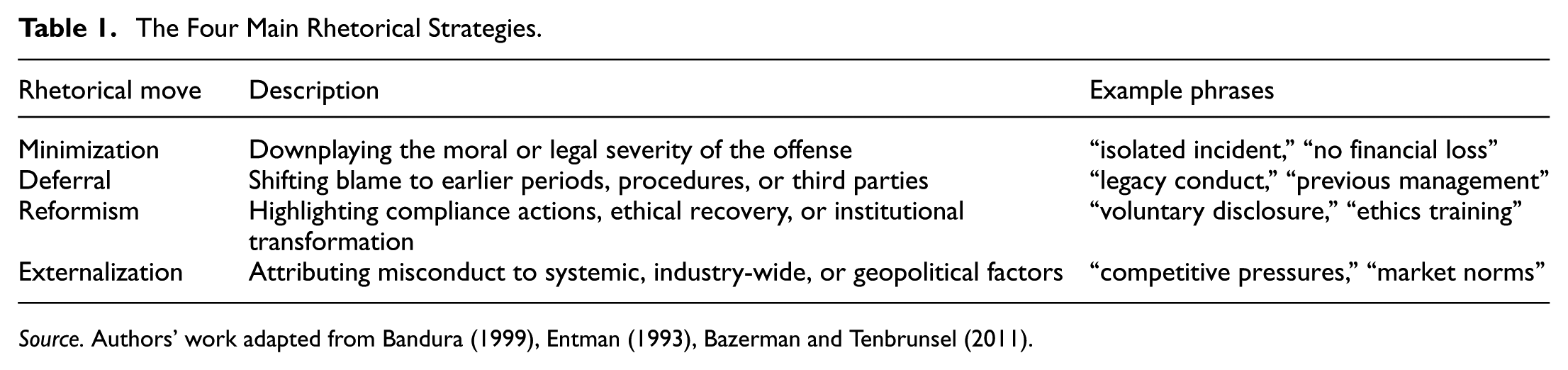
Source. Authors’ work adapted from Bandura (1999), Entman (1993), Bazerman and Tenbrunsel (2011).
Mitigating frames (reformism, deferral, externalization, minimization) make situational explanations salient and mute moral affect, pushing attributions away from the organization; responsibility-forward frames do the opposite, foregrounding rule-breaking and institutional agency and thereby amplifying internal attributions and near-term distrust (Entman, 1993; Heider, 1958; Weiner, 1985). Because presentation, not facts, can flip judgments—and because strategic ambiguity can recode sanctions as “reform” while disclosure can be used as impression management (Eisenberg, 1984; Loewenstein et al., 2014)—we expect systematic attributional and trust differences across frames. Because frames shift whether audiences see wrongdoing as systemic or agentic, they influence how blame and trust are allocated. Thus, reformist frames emphasizing remediation and context should yield higher trust and lower organizational blame than punitive frames.
In line with the above, we posit
The following Conceptual Framework integrates these claims by linking specific rhetorical cues to moral-disengagement mechanisms and attributional shifts and specifying expected effects on stakeholder outcomes (perceived severity, organizational/individual blame, trust). These mappings then guide operationalization of narrative frames as experimental interventions in the study’s methodology.
Neuroscience and Cognitive Processing of Moral Narratives
Understanding how corruption narratives influence moral evaluations benefits from linking discourse-level analysis to the neurocognitive architecture of moral judgment. Cognitive neuroscience suggests that moral appraisal arises from dual-process dynamics: rapid, affect-laden responses associated with limbic and ventromedial systems, and slower, deliberative reasoning supported by executive control regions, including the dorsolateral prefrontal cortex (dlPFC) (Greene, 2009; Greene et al., 2001). Which pathway dominates can be modulated by how information is linguistically framed.
Language is a lever on moral salience. Contextual and lexical cues can amplify or dampen empathic engagement and perceived norm violation (Decety & Cowell, 2014). Euphemistic or bureaucratic formulations (e.g., “legacy issues,”“enhanced compliance procedures”) are likely to reduce affective arousal and facilitate cognitive reframing, aligning with mechanisms of moral disengagement whereby self-sanctioning is deactivated through justification, diffusion of responsibility, or advantageous comparison (Bandura, 1999, 2018). Related neuroimaging evidence suggests that justificatory narratives and sanitizing labels can reduce activation in networks associated with guilt and empathy, thereby supporting psychological distance from the transgression (Vezich et al., 2017).
Neuroscience adds that positive, forward-looking frames preferentially engage reward and approach systems, whereas punitive, loss-focused frames heighten vigilance and threat processing (Wang et al., 2016). Thus, labeling a legal outcome as “organizational reform” versus “penalty for wrongdoing” plausibly biases downstream appraisal toward optimism versus condemnation.
Discourse also interacts with attention and memory. Narratives that foreground remediation can alter how events are encoded and emotionally tagged, promoting cognitive consonance and sustained affiliation with the institution (Waldman et al., 2017). These processes are context-dependent. Cultural neuroscience reveals that moral thresholds and affective reactivity vary in relation to social norms (Han et al., 2014). Behavioral evidence shows that baseline trust is lower in high-corruption environments and punitive responses can be attenuated—consistent with moral habituation to systemic deviance (Salmon & Serra, 2017). Identical frames may yield different appraisal profiles across cultural settings. Dual-process accounts of moral judgment and narrative-transport perspectives imply systematic individual differences in susceptibility to framing. When affective, intuitive processing dominates, narrative cues should exert stronger influence on blame and trust; when executive control and rule-based evaluation dominate, the same cues should be discounted (Green & Brock, 2000; Greene, 2009; Haidt, 2001), leading us to formulate
The operationalization of these profiles is outlined in the “Methodology” section.
We do not measure neural activity; we synthesize mechanistic insights that ground our Conceptual Framework. Figures 1 to 3 are theoretical diagrams (not empirical) that illustrate how rhetorical choices are expected to engage cognitive-affective mechanisms and, in turn, shape stakeholder judgments.

Conceptual framing-to-appraisal pathway in institutional corruption narratives. The diagram illustrates how mitigating frames (reformism, deferral, externalization, minimization) and responsibility-forward/punitive framing are theorized to activate moral-disengagement cues, attributional shifts, and differential reliance on affective versus rule-based processing, shaping perceived severity, organizational versus individual blame, and post-scandal trust. Dashed elements indicate potential moderators (e.g., perceived sincerity, strategic ambiguity, cultural expectations) and longer-run feedback to legitimacy. This figure is theoretical and does not display empirical or simulation data.

Conceptual map linking rhetorical cues to mediating mechanisms and predicted stakeholder outcomes. The figure links four narrative cues—reformism, deferral, externalization, and minimization—to theorized mediators including moral disengagement (euphemism, justification, diffusion of responsibility), strategic ambiguity, attributional reallocation, and dissonance reduction. The resulting directional expectations include softened organizational blame, more individualized blame under deferral, reduced perceived severity, and short-run trust preservation that may erode if credibility is later questioned. Dashed elements indicate moderators (e.g., perceived sincerity, media counter-framing, cultural expectations) and longer-run feedback to legitimacy. This figure is theoretical and does not display empirical or simulation data.

Affective–deliberative architecture of moral reframing under corruption narratives. The diagram summarizes the theorized dual-process logic by which responsibility-forward/punitive frames preferentially engage affect-laden, justice-motive processing, yielding higher perceived severity, stronger organizational blame, and lower trust. In contrast, mitigating frames (reformism, deferral, externalization, and minimization) are expected to facilitate reappraisal and attributional shifting, resulting in more lenient judgments. Moderator lanes (e.g., prior trust, perceived sincerity, cultural habituation to corruption) indicate conditions that may adjust thresholds between affect-dominant and control-dominant processing. This figure is theoretical and does not display empirical or simulation data.
Figure 1 illustrates how the four mitigating frames (in contrast to responsibility-forward/punitive framing) are theorized to activate moral-disengagement cues, shift causal attributions toward situational or “bad-apple” accounts, and recalibrate the emphasis on affective versus rule-based judgment. These mechanisms are expected to shape perceived severity, the organization–individual blame split, and post-scandal trust. Dashed elements indicate moderators (e.g., perceived sincerity/strategic ambiguity, cultural expectations) and longer-run feedback to legitimacy. The model summarizes the causal logic operationalized and examined descriptively through H1 to H3.
Figure 2 links four narrative cues—reformism (e.g., “enhanced compliance,”“culture change”), deferral (e.g., “prior management,”“rogue actors”), externalization (e.g., “industry-wide pressures”), and minimization (e.g., “isolated incident,”“no material harm”)—to psychological mediators and then to stakeholder outcomes. In the mediator layer, cues activate moral-disengagement pathways (euphemism, justification, diffusion of responsibility), strategic ambiguity (polysemy that sustains multiple readings), attributional shift (from organizational to situational/individual causes), and dissonance reduction (narratives that ease discomfort). Arrows lead to predicted outcomes: softened organizational blame, reallocation of blame to individuals under deferral, lower perceived severity, and recalibration of trust (short-term trust preservation, with possible long-term erosion if insincerity is inferred). Dashed boxes indicate moderators (perceived sincerity, media counter-framing, cultural expectations) and a feedback loop to institutional legitimacy. The figure operationalizes the causal logic proposed by H1 and H2.
Figure 3 depicts how frames bias the engagement of dual systems in moral judgment. Inputs are punitive/responsibility-forward frames versus mitigating frames (reformism, deferral, externalization, minimization). Punitive frames preferentially engage affective circuitry (amygdala/insula/vmPFC) and a justice-motive route, yielding higher moral salience, stronger organizational blame, and lower post-scandal trust. Mitigating frames increase recruitment of deliberative control (dlPFC/ACC (anterior cingulate cortex)) and reappraisal processes, dampening affect, facilitating attributional shifts, and producing leniency (lower perceived severity, reduced organizational blame, partial trust retention). Moderator lanes (e.g., cultural habituation to corruption, prior trust, perceived sincerity) adjust thresholds between affect-dominant and control-dominant processing.
In light of this literature, our study is positioned at the crossroads of behavioral ethics, economic psychology, and communication studies. We leverage established theories but move beyond prior work by simulating the causal logic of narrative framing and its influence on stakeholder judgments in a controlled environment. The hypotheses (H1–H3) are examined as directional propositions through mixed-method and simulation procedures.
Table 2 summarizes the core contributions across behavioral ethics, communication, and moral psychology, as well as how the present study differs—linking discourse analysis to a transparent simulation that varies rhetoric while holding facts constant.
Literature Summary Highlighting Study Focus, Methods, Key Findings, and How the Present Study Differs.

Source. Authors’ work based on the cited references.
Methodology
The study adopts an interpretivist–constructivist orientation within a pragmatic mixed-methods framework. From an interpretivist view, meaning is co-constructed between institutional actors and observers through language, and corruption narratives are treated as socially situated sense-making practices rather than objective events. The constructivist layer assumes that moral judgment and trust are contextually produced but systematically structured, allowing these qualitative meanings to be formalized as rules and explored through simulation as an analytic instrument rather than a positivist estimator.
The design follows a sequential, exploratory logic that links comparative discourse analysis with a controlled behavioral simulation. In Phase 1, public documents are analyzed to identify how institutions narrate wrongdoing. In Phase 2, these frames are implemented as interventions in vignettes whose factual content is held constant, enabling a descriptive examination of the directional effects on moral judgment and trust. This sequencing constitutes a methodological triangulation: insights from the discourse analysis guide the construction of the simulation’s rules, while the simulation’s outputs, in turn, refine the interpretive categories.
Epistemologically, the study integrates qualitative interpretation and computational experimentation within an interpretivist–pragmatic logic of inquiry, emphasizing theory-guided exploration rather than positivist hypothesis testing.
Figure 4 maps the pipeline from data collection → text preparation → frame coding → simulation → analysis, linking Phase 1 discourse analysis to Phase 2 behavioral simulation.

Methodological flow linking Phase 1 discourse analysis to Phase 2 simulation. The figure summarizes the sequential, exploratory pipeline from data collection and text preparation through frame coding and topic-model diagnostics (Phase 1) to vignette construction, agent-based simulation, and descriptive analysis (Phase 2). The diagram visually represents the study’s interpretivist–pragmatic triangulation, in which corpus-derived frame typologies inform the simulation rules and the simulation outputs refine interpretive categories. This figure is a methodological schematic and does not display empirical or simulation data.
Phase 1: Corpus, Selection, and Analytic Approach
The corpus comprises publicly available texts from three emblematic European cases—Airbus’s bribery settlement, the FIFA ethics scandal, and the Sarkozy campaign-finance proceedings—selected for their media salience, cross-sector comparability, and textual richness across institutional, legal, and media sources. This design maximizes rhetorical diversity while maintaining institutional comparability; the European scope enhances internal consistency but limits cross-cultural generalizability (addressed elsewhere in the paper). Texts were included only if they contained explicit narrative accounts of wrongdoing, responsibility, sanction, or reform, with verifiable provenance.
The four frame dictionaries (reformism, deferral, externalization, minimization) were implemented as compiled regex with word boundaries and common variants. For each file, we tokenize sentences, record every match with its key phrase and sentence excerpt, and aggregate to document-level counts and source-type totals. A helper map (source_map.csv) assigns each filename to Corporate, Legal, or Media and (optionally) a case label. Length statistics (words, sentences) support rate normalization.
We parameterized the frame screen to ingest a folder of texts and a source_map.csv file (categorizing each document as Corporate, Legal, or Media) and to emit auditable outputs: per-document and source-aggregated frame counts, document length statistics, and a ledger of matched sentences for precision checks and length-normalized reporting (per 1,000 words). These CSV outputs (counts_by_doc_and_frame.csv, counts_by_source_and_frame.csv, doc_stats.csv, instance_matches.csv, instance_samples.csv) serve as the reproducible basis for all figures.
Guided by framing theory and Critical Discourse Analysis, we applied the four frame dictionaries to the corpus using regex screens. We complemented the dictionary analysis with a brief topic-modeling pass (non-negative matrix factorization, k = 6), implemented via topic_modelling_revised.py, to assess coverage and lexical coherence. This script vectorizes the texts using TF–IDF, deduplicates the inputs, outputs the top terms, document–topic assignments, and exemplar plots. These computational checks were used descriptively to verify that the codebook captured salient rhetorical fields; they did not replace interpretive analysis or the design of the Phase-2 simulation.
Phase 2: Vignette Construction and Agents
Phase 2 translates the rhetorical frames identified in Phase 1 into controlled and manipulable elements. Using simulated evaluators rather than human participants serves two methodological aims. First, it allows the study to hold factual content constant while orthogonally varying rhetoric in a way that would be hard to achieve in field or survey settings, isolating the conceptual effect of frames rather than contextual noise. Second, specified agents provide an inspectable testbed for theory: the rules connecting moral-disengagement cues to appraisal shifts are explicit, modifiable, and reproducible, enabling cumulative refinement before committing resources to higher-stakes human experiments. The results are interpreted descriptively as theory-explicating patterns rather than population estimates. The Corporate, Legal, and Media source distinctions used in Phase 1 informed the frame taxonomy but did not structure Phase 2. In the simulation, all vignettes utilize controlled, stylized text based on the abstracted frame types, regardless of the source category.
We crafted three base vignettes, corporate, sports/governance, and political, each approximately 150 to 200 words in a flat, procedural style. Reformist and punitive versions were derived from each base by changing only the rhetoric; the facts, actors, and outcomes remained constant, yielding three cases × three frames = nine stimuli. Scenario–frame presentation was randomized in code to avoid ordering artifacts.
Two agent families model distinct cognitive styles. The rule-based agent represents a justice-motive evaluator that prioritizes rule violations and institutional agency, adjusting minimally for rhetoric. The heuristic agent (a hand-coded, non-neural model) incorporates behavioral-ethics mechanisms—moral disengagement, attributional shifts, and framing sensitivity—and adds small Gaussian perturbations to mimic human variability. All frame multipliers and noise parameters were set a priori based on theory-driven expectations and not fitted to the data, consistent with the study’s exploratory design.
The heuristic agent includes controlled Gaussian perturbations to emulate variability in narrative-sensitive moral appraisal. To ensure that the reported directional patterns are not artifacts of a single random draw, we implemented a Monte Carlo design that iterates across multiple documented random seeds and resamples per seed. Importantly, all heuristic frame multipliers and noise parameters were held fixed a priori and were not fitted to any empirical data. Across seeds, the qualitative ordering of outcomes remains stable—punitive < neutral < reformist for trust and the inverse ordering for organizational blame—indicating that the main conclusions reflect the designed theoretical logic of the two architectures rather than idiosyncratic stochastic noise. These results are interpreted descriptively as theory-explicating patterns. This step constitutes a robustness check for stochastic variability; a full parameter sensitivity analysis is a natural next extension and would require systematically varying the frame multipliers and noise terms.
Table 3 contrasts these architectures—a deterministic rule-based agent (if–then logic), a generic LLM-based agent (illustrative only), and the heuristic agent implemented here—showing that the present study’s agents are fully rule-transparent Python simulations, differing primarily in how they process rhetorical cues (fixed logic vs. probabilistic weighting).
Architectural Comparison of Evaluator Types Used to Situate the Present Simulation.

Note. The table contrasts a deterministic rule-based, justice-motive agent and a narrative-sensitive behavioral agent (NSBA; heuristic, hand-coded) with a generic LLM-based approach shown for contextual illustration only. The present study implements the two rule-transparent Python agents and does not rely on LLM inference. This table is a conceptual/architectural comparison and does not display empirical or simulation outcome data.
“*” denotes conditional reproducibility: The heuristic agent is stochastic by design (Gaussian perturbations and Monte Carlo resampling), so single draws can differ across seeds, but the outputs are exactly reproducible when the reported seeds and parameters are held fixed. We also clarify that the LLM-based column is illustrative only and not used for inference in this study.
Source. Authors’ work.
We set the heuristic agent’s decision rules and frame multipliers based on behavioral ethics and attribution theory (e.g., reformist language reduces perceived severity and reallocates blame away from the organization), rather than fitting them to data, consistent with the study’s exploratory aim.
Frame cues were parameterized to map monotonically to appraisals in the directions implied by established theory. Concretely:
Punitive/responsibility-forward framing foregrounds rule violation and organizational agency → increases perceived severity and organizational blame, and reduces post-incident trust (framing/attribution and affect primacy: Entman, 1993; Haidt, 2001; Heider, 1958; Tversky & Kahneman, 1981; Weiner, 1985).
Reformist framing (remediation, culture change, “legacy conduct”) activates moral-disengagement mechanisms (euphemism, justification, advantageous comparison) and narrative transportation, which dampen moral salience, shift causal attributions away from the organization, and raise trust when taken as sincere (Bandura, 1999; Green & Brock, 2000; Loewenstein et al., 2014).
Deferral of blame (prior management/rogue actors) shifts the locus of causality to individuals/ex-ante actors, reducing organizational blame while increasing individual blame (attribution theory and “accounts”: Benoit, 1995; Heider, 1958; Scott & Lyman, 1968; Weiner, 1985).
Externalization (industry norms, systemic pressures) emphasizes situational causes, lowering perceived intent/stability, and reducing organizational blame, with a possible side effect of generalized cynicism (attributional discounting: Heider, 1958; Weiner, 1985).
Minimization (euphemisms such as “isolated incident” or “no material harm”) downplays perceived severity and, secondarily, organizational blame (moral disengagement: Bandura, 1999, 2018).
Strategic ambiguity affords flexibility but weakens trust when unaccompanied by explicit responsibility; however, a clear acceptance of agency strengthens trust in the medium term (Eisenberg, 1984; Loewenstein et al., 2014; Mayer et al., 1995).
Negativity asymmetry losses from punitive framing are at least as large as gains from reformist framing (framing effects/negativity bias: Tversky & Kahneman, 1981).
Moderator gate (face-validity only in this version): if the credibility/sincerity flag is “low,” we attenuate reformist gains (transportation requires perceived plausibility; Green & Brock, 2000; trust antecedents: Mayer et al., 1995).
Agent differentiation: the rule-based agent anchors to rule violation and organizational agency and applies at most small tie-break adjustments for framing; the heuristic agent applies monotone multipliers to trust, perceived severity/acceptability, and the organization-versus-individual blame split, plus small Gaussian noise to mimic human variability (dual-process logic: Greene, 2009; Greene et al., 2001; Haidt, 2001).
These assumptions impose signs and orderings (e.g., for trust: punitive < neutral < reformist; for organizational blame: reformist < neutral < punitive).
To assess whether the core patterns hinge on stochastic variability rather than the agents’ directional structure, we implemented a Monte Carlo design that iterates across multiple random seeds and resamples the heuristic agent while holding all frame multipliers and noise parameters fixed a priori. In the current implementation, the simulation uses 100 seeds and 10 resamples per seed.
Across these draws, the qualitative ordering of outcomes for the heuristic agent remains stable (punitive < neutral < reformist for trust; reformist < neutral < punitive for organizational blame), while the rule-based agent continues to show minimal frame sensitivity, indicating that the main conclusions reflect the designed theoretical logic of the two architectures, with dispersion arising from controlled simulation noise rather than from parameter fitting.
Tables 4 and 5 display the resulting magnitudes (e.g., heuristic trust ≈ 0.50 for reformist vs. 0.15 for punitive; organizational blame ≈ 34% for reformist vs. 48% for punitive), reflecting the chosen multipliers. We report these descriptively as effect directions, not as inferential estimates.
Mean Trust, Organizational Blame, Acceptability, and Moral-Disengagement Index (MDI) by Agent Type and Frame.

Source. Authors’ work.
Mean Frame Effects (Δ Relative to Punitive Frame, Averaged Across Scenarios).

Source. Authors’ work.
The improved overlay module automatically normalizes text (Unicode, punctuation, spacing) and tags Pressure, Opportunity, and Rationalization cues using tolerant regular expressions that capture plural and hyphenated variants. When a vignette contains these tagged cues, the heuristic agent applies small, theory-consistent nudges: Pressure↓intent weight (→−org-blame, +trust), Opportunity↓severity weight and ↑moral-hazard risk (→−acceptability unless paired with explicit sanction), and Rationalization↑justification weight (→−org-blame, +acceptability, +trust if credibility high). The rule-based agent intentionally ignores these nudges. All multipliers are fixed a priori and listed in the parameter file for replication, with the overlay dictionaries used to generate triangle_overlay_matches.csv and its summary.
After each vignette, agents return (i) ethical acceptability on a 1 to 7 scale, (ii) a blame split between Organization and Individuals that sums to 100, (iii) post-incident trust on a 0 to 1 scale, and (iv) a brief Moral Disengagement Index (MDI) used descriptively. The MDI is a model-internal composite that summarizes the extent to which mitigating narrative cues (reformism, deferral, externalization, minimization, and related euphemistic/justificatory signals) shift the heuristic agent’s appraisal toward leniency—lower perceived severity and organizational blame and higher trust—relative to responsibility-forward language. Conceptually, higher MDI values represent stronger activation of moral-disengagement-consistent processing at the scenario level; the index is not a psychometric trait measure and is interpreted only as an audit trace of the simulation’s theoretical mechanisms.
The rule-based agent is designed to be deterministic. The heuristic agent adds small Gaussian perturbations to trust, acceptability, the organizational blame share, and the disengagement index. Frame-sensitivity multipliers and noise sigmas are fixed in the script and applied consistently across cases. Each run iterates over multiple random seeds (Monte Carlo design), producing a distribution of responses for every case × frame × agent combination and saving the stacked panel to vignette_simulation_results_mc.csv. The analysis script aggregates these draws to 1.1. simulation_summary.csv (means/dispersion) and 1.2. frame_effects_by_agent.csv (frame deltas), which provides the data for the figures and tables reported.
Because one agent is deterministic, while the other includes simulation-induced variance, we report descriptive statistics: means, Monte Carlo dispersion by frame and agent, and frame-to-frame deltas (e.g., Reformist vs. Punitive). Where variance partitioning was informative, we computed two-way factorial ANOVA (Agent × Frame) for each outcome and exploratory Tukey contrasts on Frame within Agent. These diagnostics are reported in Tables A1 and A2 and were programmatically exported as 1.3. anova_tables.csv and 1.4. tukey_contrasts.csv. Given the design’s non-independent and identically distributed (non-IID) structure, we include them as illustrative checks only and do not interpret p-values as confirmatory evidence. All summaries and plots were generated automatically from 1.1. simulation_summary.csv and 1.2. frame_effects_by_agent.csv.
Findings
The Monte-Carlo summaries show pronounced frame sensitivity for the heuristic agent and stable outputs for the rule-based agent. Averaged across scenarios, Reformist framing increases trust and reduces organizational blame compared to Punitive framing, with Neutral framing falling between the two. These effects are observed as stable distribution shifts across different random seeds (see full results in the supplementary dataset).
Variance partitioning mirrors these patterns: Frame explains most of the variation in Trust and Organizational Blame for the heuristic agent, with smaller Agent × Frame components; for the rule-based agent, frame contributions are modest.
Tables 4 and 5 summarize mean outcomes and frame-specific contrasts. Reformist language consistently raises trust and reduces blame for the heuristic agent, while the rule-based agent remains stable. In Table 4, higher MDI values for the heuristic agent under reformist wording indicate stronger activation of disengagement-consistent processing in the simulation, consistent with the model’s directional expectations.
Triangle-overlay diagnostics confirm expected directional effects across Pressure, Opportunity, and Rationalization cues. Figure 5 and Table 6, drawn from the Phase 1 corpus, show corresponding lexical fields and rhetorical frequencies that reinforce the qualitative codebook. Rhetorical framing recalibrates simulated moral judgments: heuristic, discourse-sensitive evaluation amplifies these shifts, whereas rule-based evaluation constrains them. The directional outcomes align with theoretical expectations (Table 7) and are interpreted descriptively rather than inferentially.

Length-normalized frequencies of reformism, deferral, externalization, and minimization (per 1,000 words) across Corporate, Legal, and Media texts in the Phase-1 corpus, providing descriptive triangulation for the qualitative codebook. Bars represent descriptive corpus counts derived from the released coding outputs; no inferential statistics are reported.
Topic Model: Label Hints and Top Terms (Phase-1 Corpus).

Source. Authors’ work.
Summary of Hypothesis Outcomes.
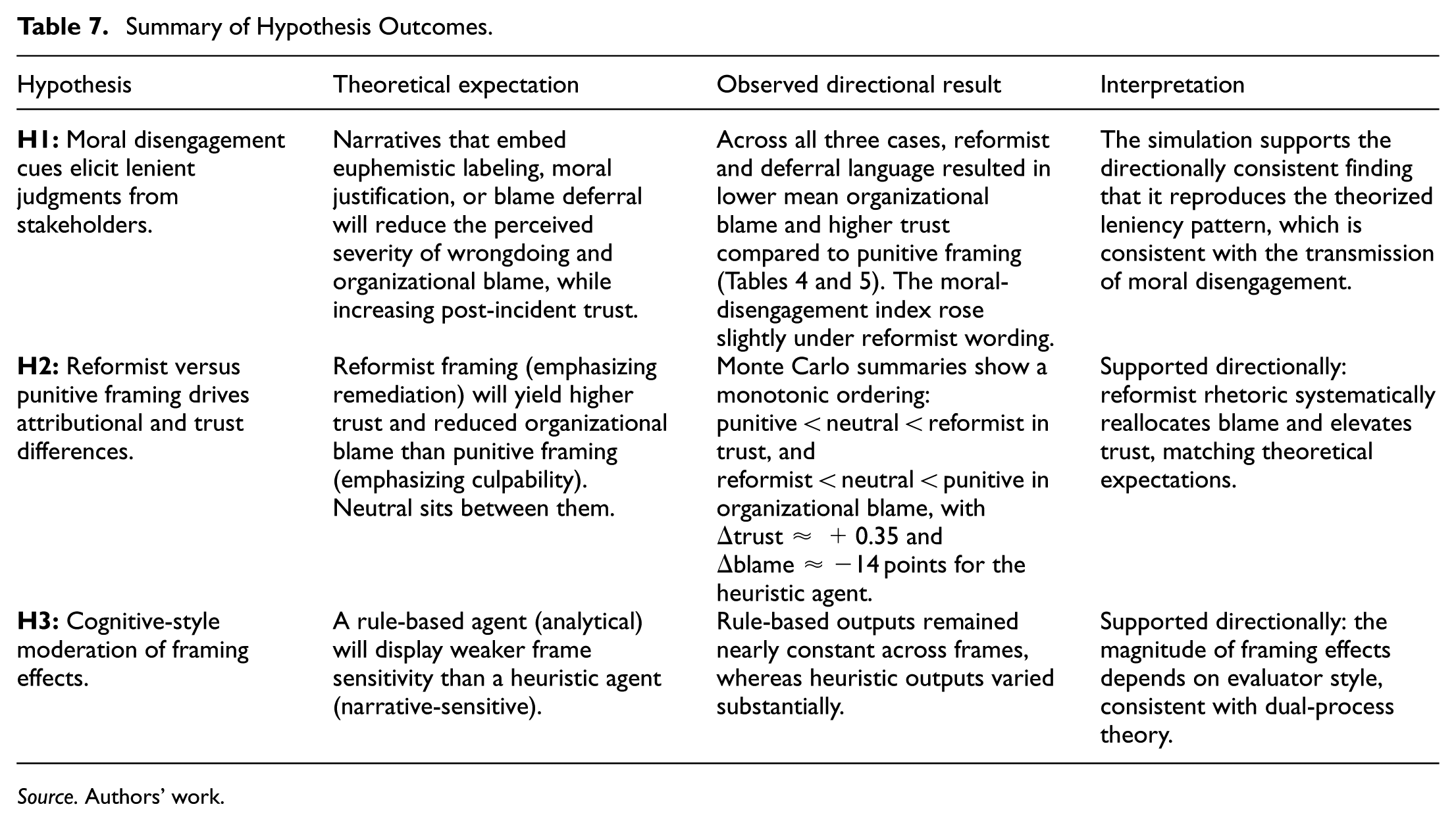
Source. Authors’ work.
Across the 20 labeled texts (Corporate = 6; Legal = 8; Media = 6), corporate materials display the strongest reformism signal even after normalization—approximately 11 per 1,000 words (≈230 instances in ≈20,800 words)—compared with 0.3 per 1,000 in Legal and 0.6 per 1,000 in Media sources. Deferral averages around 1 per 1,000 across sources, while externalization and minimization remain rare (<0.5 per 1,000). These counts are length-normalized and auditable in the released dataset. Topic-modeling diagnostics on the same corpus recover lexical fields consistent with the dictionary screen—for example, ethics/compliance language under reformism and legal/procedural terms under punitive or neutral contexts. These computational summaries serve as descriptive triangulation for the qualitative codebook, rather than as the primary analytic engine.
The simulation reproduced the predicted signs and orderings for all three hypotheses: moral-disengagement cues and reformist framing attenuated condemnation and preserved trust, while punitive framing amplified blame; the rule-based agent’s limited responsiveness confirmed the moderating role of cognitive style. These findings validate the internal logic of the conceptual model and establish a baseline for subsequent human-participant validation.
Discussion
Theoretical Implications
This study links institutional discourse to moral judgment by translating a qualitative frame typology into a transparent behavioral simulation. Holding facts constant while varying rhetoric demonstrates that reformist language—remediation, “legacy conduct,” and compliance emphasis—systematically raises trust and lowers organizational blame for a narrative-sensitive evaluator, whereas punitive wording produces the reverse. These effects clarify that framing alone can steer moral inferences, extending Bandura’s moral-disengagement mechanisms from intrapsychic regulation to communicative transmission.
This study reframes institutional corruption as a moral-cognitive coordination problem enacted through language by synthesizing behavioral, attributional, and communicative accounts.
The simulation shows how the Fraud Triangle’s components travel through language:
Pressure reallocates causality through externalization and deferral,
Opportunity downplays harm via minimization or “fix-is-done” reformism, and
Rationalization normalizes intent through justificatory discourse.
These linguistic mechanisms shift accountability without altering facts.
The rule-based agent anchors judgments to explicit violations and makes minimal adjustments. In contrast, the heuristic agent integrates rhetorical cues in line with dual-process theory—affective when punitive, deliberative when reformist. Phase-1 corpus analysis supports these mechanisms: compliance and ethics lexicons (reformism) and legal/procedural tokens (punitive) align with the designed frames. The mapping in Table 8 demonstrates how institutional communication operationalizes the Fraud Triangle, turning internal rationalizations into public justifications.
Fraud Triangle ↔ Discourse Mapping and Predicted Appraisal Shifts.

Source. Authors’ work adapted from Cressey (1953).
Reformist rhetoric, therefore, functions as a short-term trust lever, effective only when credible. Theoretically, this connects moral-disengagement, attribution, and trust-repair literatures: language shapes whether accountability is perceived as sincere recovery or narrative laundering.
Practical Implications
Because framing can reallocate blame without altering facts, enforcement and compliance communications should:
Avoid euphemism, separate sanction from remediation, and explicitly name institutional responsibility.
Align reformist messaging with verifiable reforms—audits, incentive redesign, leadership accountability—to prevent credibility loss;
Use the four-frame typology (reformism, deferral, externalization, minimization) as an audit tool to expose rhetorical blame-shifting.
Treat reform narratives as signals to verify, not as evidence. Responsibility-forward disclosures that pair admission with a measurable remedy offer stronger long-term legitimacy.
Limitations and Future Research Agenda
Findings derive from theory-guided counterfactual simulations, not population estimates. Human-participant studies using the same vignettes should calibrate observed effect sizes. The European corpus enhances internal consistency but limits cross-cultural generalization; future work should test whether reformist softening weakens in low-trust environments or strengthens where remediation is credible.
Subsequent studies should examine mixed and sequential frames, source credibility, and behavioral outcomes, such as investment or consumption decisions. Extending stimuli to multimodal formats will test whether vaguer reformist messages invite charitable gap-filling. The study demonstrates that language, independent of facts, reweights moral appraisal, offering a reproducible pipeline from qualitative interpretation to transparent simulation and a cautionary insight: reformist rhetoric can earn short-run forgiveness, but enduring legitimacy demands congruence between words and deeds.
Conclusion
Institutional corruption is fought through sanctions, reform, and language. By holding facts constant and varying rhetoric, this study demonstrates that narrative framing—specifically, the use of reformist versus punitive wording—systematically reweights moral appraisal in a controlled setting. In the simulation, a narrative-sensitive (heuristic) evaluator responded to reformist cues with higher trust and lower organizational blame, whereas punitive language produced the opposite effect. A rule-based evaluator, on the other hand, anchored judgments to rule violations and moved little. These patterns, obtained through transparent rules rather than black-box inference, suggest that discursive choices can influence stakeholder interpretation even when the underlying events remain unchanged.
Methodologically, the paper contributes a phase-linked pipeline: a qualitative frame typology derived from public texts is translated into explicit, testable manipulations and evaluated with inspectable Python agents. The approach treats narratives as variables, not just artifacts, supporting cumulative and reproducible inquiry.
Beyond the specific corruption cases modeled here, making the simulation code, parameter files, and CSV outputs publicly available illustrates how behavioral-ethics research can align with growing expectations for reproducibility in computational social science. By exposing the value-laden assumptions embedded in agent rules and frame multipliers to scrutiny and revision, the model helps distinguish robust theoretical regularities from potential artifacts. In this sense, simulation transparency not only enables replication but also supports broader debates about open, auditable modeling practices in behavioral ethics.
The results clarify how organizational communication can transmit “moral disengagement” to audiences, softening organizational attribution in the short run. The implication is not that words replace accountability, but rather that they shape how accountability is perceived and understood.
For practice, the lesson is twofold. First, reformist framing can facilitate near-term trust repair when paired with credible remedial action; second, overreliance on euphemism or deflection risks eroding legitimacy if later facts contradict the story. Regulators can counter narrative laundering by separating sanctions from remediation and naming the institutional agency in enforcement communications. Journalists and civil society can utilize the four-frame typology (reformism, deferral, externalization, and minimization) as a straightforward audit lens for evaluating post-scandal statements. Boards and investors should treat reformist language as a signal to verify, looking for concrete changes in governance and controls rather than accepting rhetoric at face value.
A practical extension is feasible: a lightweight “narrative audit” utility that flags euphemism density, blame shifting, or strategic ambiguity in crisis statements and anticipates reception given the observed effects. Used responsibly, this tooling could nudge communicators toward clearer accountability while helping watchdogs and regulators focus attention where framing most obscures responsibility.
Several scope conditions remain. The agents are stylized cognitive profiles, not people, and the dispersion in the heuristic agent is a simulation-induced effect. Because the heuristic agent is parameterized based on theory rather than estimated from behavioral data, the reported effect sizes should be treated as illustrative; what appears most robust is the sign and ordering of frame effects, rather than their precise numerical magnitude. We present patterns descriptively and propose direct human-participant validation using the same vignettes, along with cross-cultural replications that vary baseline trust and corruption expectations. Future work should also examine mixed and sequential frames, source credibility, and behavioral outcomes (e.g., investment or purchase decisions), extending beyond text-only messages.
In conclusion, accountability depends on what happened and how it is told. The strongest path to restored legitimacy aligns the right words with the right actions: clear acknowledgment of institutional responsibility, verifiable reform, and communication that neither overpromises nor obscures the truth. Trust is likely to recover and endure when language and actions move in tandem.
Supplemental Material
sj-zip-1-sgo-10.1177_21582440261417024 – Supplemental material for Framing Institutional Corruption: A Behavioral Simulation of Moral Judgment and Accountability Narratives
Supplemental material, sj-zip-1-sgo-10.1177_21582440261417024 for Framing Institutional Corruption: A Behavioral Simulation of Moral Judgment and Accountability Narratives by Alexandra-Codruţa Bîzoi and Cristian-Gabriel Bîzoi in SAGE Open
Footnotes
Appendix A
TUKEY.

| DV | Agent | Group1 | Group2 | Meandiff | p-Adj | Lower | Upper | Reject |
|---|---|---|---|---|---|---|---|---|
| Trust | Heuristic | Neutral | Punitive | −0.1996 | FALSE | |||
| Trust | Heuristic | Neutral | Reformist | 0.1486 | FALSE | |||
| Trust | Heuristic | Punitive | Reformist | 0.3482 | FALSE | |||
| Trust | Rule | Neutral | Punitive | −0.05 | FALSE | |||
| Trust | Rule | Neutral | Reformist | 0.02 | FALSE | |||
| Trust | Rule | Punitive | Reformist | 0.07 | FALSE | |||
| OrgBlame | Heuristic | Neutral | Punitive | 8.001 | FALSE | |||
| OrgBlame | Heuristic | Neutral | Reformist | −5.9837 | FALSE | |||
| OrgBlame | Heuristic | Punitive | Reformist | −13.9847 | FALSE | |||
| OrgBlame | Rule | Neutral | Punitive | 5 | FALSE | |||
| OrgBlame | Rule | Neutral | Reformist | −2 | FALSE | |||
| OrgBlame | Rule | Punitive | Reformist | −7 | FALSE | |||
| Acceptability | Heuristic | Neutral | Punitive | −1.4938 | FALSE | |||
| Acceptability | Heuristic | Neutral | Reformist | 1.0035 | FALSE | |||
| Acceptability | Heuristic | Punitive | Reformist | 2.4973 | FALSE | |||
| Acceptability | Rule | Neutral | Punitive | −0.5 | FALSE | |||
| Acceptability | Rule | Neutral | Reformist | 0.2 | FALSE | |||
| Acceptability | Rule | Punitive | Reformist | 0.7 | FALSE |
Source. Authors’ work.

Ethical Considerations
Not applicable. The study is based exclusively on publicly available documents and media reports and did not involve human participants, human data, or human tissue. Therefore, ethical approval was not required.
Funding
The authors disclosed receipt of the following financial support for the research, authorship, and/or publication of this article: This article was supported by UVT 10 00 DEVELOP Fund of the West University of Timisoara.
Declaration of Conflicting Interests
The authors declared no potential conflicts of interest with respect to the research, authorship, and/or publication of this article.
Data Availability Statement
All sources used in the analysis are publicly accessible and cited in the manuscript. No proprietary or confidential data was used. Full citation information is provided in the reference list. In addition, the dataset supporting this study is available in Mendeley Data: Bîzoi & Bîzoi (2025).
Identifying Information
This manuscript has been anonymized to ensure a double-blind peer review. No identifying information related to the authors, their institutions, or affiliated funders is included in the manuscript file.
Data and Code Availability
All materials—corpus, codebook, Python scripts, vignettes, and CSV outputs—are available in Mendeley Data (DOI: 10.17632/p7zffz7rv8.3).
Supplemental Material
Supplemental material for this article is available online.
References
Supplementary Material
Please find the following supplemental material available below.
For Open Access articles published under a Creative Commons License, all supplemental material carries the same license as the article it is associated with.
For non-Open Access articles published, all supplemental material carries a non-exclusive license, and permission requests for re-use of supplemental material or any part of supplemental material shall be sent directly to the copyright owner as specified in the copyright notice associated with the article.
