




Abstract
Although employee motivation and organizational outcomes often hinge on leadership behaviors, little empirical research has examined how leadership styles influence the links between distributive justice, goal clarity, and turnover intention in the public sector. Employing equity theory and goal-setting theory, the present study investigates how distributive justice and goal clarity relate to turnover intention. Based on social exchange theory, it also explores transactional and transformational leadership as moderating factors. Relying on a survey of South Korean government employees, the findings reveal that distributive justice is negatively associated with turnover intention, whereas goal clarity exhibits no significant direct effect. Furthermore, transactional leadership diminishes the negative link between distributive justice and turnover intention, while transformational leadership mitigates the positive link between goal clarity and turnover intention. These findings indicate that leadership styles shape how fairness perceptions and goal management relate to employees’ intentions to stay, providing insights into the complex motivational processes underlying workforce stability in public organizations.
Plain Language Summary
Why do some government employees consider leaving their jobs while others stay? This study looks at two important reasons: whether employees feel they are treated fairly (distributive justice) and whether they clearly understand their organization’s goals (goal clarity). We also examine how different leadership styles affect these relationships. We used survey data from public employees working in South Korea’s central and local governments. The results show that employees are less likely to think about leaving when they feel rewards are fair and when their work goals are clearly communicated. In addition, we found that leadership plays an important role in shaping how these factors influence employees’ intentions to stay or leave. Specifically, leaders who follow rules and reward employees based on performance (transactional leadership) make fair treatment even more effective in reducing turnover intention. Meanwhile, leaders who inspire and motivate employees (transformational leadership) make clear goals even more powerful in encouraging employees to stay. These findings suggest that it’s not just about being fair or setting clear goals—leaders also need to use the right leadership style to support those efforts. Public organizations can benefit by matching leadership approaches with employee motivation strategies to reduce turnover and retain talent.
Keywords
Introduction
Turnover intention poses a growing concern for organizations in the public sector, as higher turnover intention is often linked to lower organizational performance (An, 2019). When public employees are willing to leave their organizations, they must devote considerable time and effort to seeking new jobs, which reflects a low emotional attachment to their organizations and reduces their job performance (Moon, 2017; Wynen et al., 2019). Moreover, since turnover intention powerfully predicts actual turnover (Cohen et al., 2016), high levels of turnover intention can harm organizational effectiveness by depleting human resources and raising recruitment and training expenses (Moon, 2017).
Consequently, scholars have examined which managerial practices help public organizations retain employees and reduce turnover intentions, focusing on factors such as organizational rules (Kaufmann et al., 2023), organizational support (Ki & Lee, 2025), and merit-based promotion (Ryu & Jinnai, 2021). Despite this growing interest, few studies have explored the relationships between two critical practices—distributive justice and goal clarity—and turnover intention in public sector organizations.
Two motivation theories offer valuable perspectives for understanding these relationships. Equity theory posits that when individuals perceive a mismatch between their contributions and rewards, they experience distress stemming from perceived inequity, leading them to consider leaving their organization (Chordiya, 2022). In contrast, goal-setting theory posits that individuals who clearly understand the goals they are expected to achieve develop stronger goal commitment, which motivates them to remain in the organization (Jung, 2014). Based on these, we expect that both distributive justice and goal clarity will negatively relate to turnover intention.
However, these factors not act alone; their effects are shaped by leadership behaviors. Because followers often perceive leaders as representatives of organizational values and missions (Potipiroon & Ford, 2017), leadership style can serve as a moderating factor that either amplifies or diminishes the effects of managerial practices on employees’ work attitudes (Lai et al., 2021). From the standpoint of social exchange theory, leadership behaviors foster exchange relationships that influence how employees respond to perceived fairness and clarity (Heine et al., 2023; Jeong, 2025). Accordingly, transactional and transformational leadership can function as key boundary conditions for understanding turnover intention.
This study helps enrich motivation and leadership literature in two major ways. First, it empirically examines how distributive justice and goal clarity shape turnover intention in the public sector, clarifying the motivational mechanisms through which perceptions of fairness and goal clarity encourage employees to stay. Second, by the integration of motivation and leadership theories, it investigates whether leadership styles strengthen the beneficial effects of these managerial practices. The findings provide both management scholars and practitioners with a more detailed understanding of how motivational processes and leadership behaviors interact to reduce turnover intention. Finally, this study extends the predominantly Western literature by analyzing these relationships within South Korea’s highly institutionalized and rule-bound public bureaucracy. By situating the analysis in this distinct administrative and cultural context, the study highlights how national institutional characteristics condition the effects of fairness and leadership on employee retention, offering context-specific insights into motivation and leadership in non-Western public sectors.
The next sections present the theoretical framework and hypotheses, describe the data and variables, and report the empirical findings, concluding with implications for both theory and practice.
Theories and Hypotheses Development
Distributive Justice, Goal Clarity, and Turnover Intention
Several organizational behavior studies suggest that motivating employees through effective human resource management strategies enhances their emotional attachment to the organization (Barrutia & Echebarria, 2021). Work motivation is the psychological force that shapes how strongly individuals exert effort (force), where they focus such effort (relevance), and how long they sustain that effort (duration) in organizational settings (Pinder, 2014). Given its importance in promoting desirable work-related outcomes, many researchers have sought to understand what motivates employees in the workplace (Rainey, 2014). Of the many theoretical frameworks, equity theory and goal-setting theory have been extensively utilized to elucidate how organizational policies and environments influence employees’ willingness to exert effort (Adams, 1965; Locke & Latham, 1990). Accordingly, distributive justice and goal clarity, grounded in equity theory and goal-setting theory respectively, are particularly relevant to this study.
Distributive justice reflects employees’ judgments regarding the fairness of organizational rewards and outcomes (Colquitt, 2001). Individuals evaluate fairness by weighing the balance between their inputs (such as effort) and outcomes (such as pay) against that of their peers (Adams, 1965). When employees perceive proportionality between their own and others’ input–outcome ratios, they experience a sense of equity (Haar & Spell, 2009). Conversely, when they feel under- or over-rewarded, they perceive distributive injustice and often attempt to restore fairness by adjusting their inputs, outcomes, or both (Rubin et al., 2023). For instance, employees who feel undercompensated may reduce their work effort to reestablish perceived balance. Such perceptions of inequity are often associated with lower job satisfaction, weaker organizational attachment, and diminished trust toward the organization, which may in turn increase the likelihood that employees consider leaving (Haar & Spell, 2009).
Empirical evidence supports this reasoning. For example, Poon (2012) found that employees who perceived unfair rewards in Malaysian universities showed reduced organizational commitment. Similarly, Chordiya (2022) found that perceptions of distributive justice in employment outcomes, particularly fairness in pay and promotion decisions, were associated with lower turnover intentions among U.S. federal employees. These findings demonstrate a negative association between employees’ perceptions of distributive justice and turnover intention.
According to goal-setting theory, the clarity of an organization’s goals helps determine employees’ motivation to stay (Jung, 2014). Goal clarity denotes how explicitly and precisely organizational goals are communicated and structured (Cho & Park, 2011). Locke and Latham (1990) argue that the specificity and difficulty of goals enhance employee motivation more effectively than vague or easily attainable goals. When employees clearly understand what is expected of them, they can better align their efforts with organizational objectives, thereby improving their likelihood of achieving these goals (Bipp & Kleingeld, 2011). Achieving clear and challenging goals also fosters pride and self-efficacy, fulfilling employees’ needs for growth and belonging (Rainey, 2014). Accordingly, greater levels of goal clarity are associated with greater levels of job satisfaction and a stronger intention to stay within the organization.
Prior studies have also found a negative association between goal clarity and turnover intention (Bellamkonda et al., 2021; Jung, 2014; Rainey, 2014). For instance, Jung (2014) demonstrated that clear organizational goals in the U.S. federal government reduce employees’ intentions to leave their agencies. Similarly, Bellamkonda et al. (2021) showed that managerial employees in India with a high degree of goal specificity—a construct conceptually similar to goal clarity—exhibited stronger job engagement and lower turnover intentions. Taken together, these findings suggest that goal clarity reduces employees’ intentions to leave their organizations.
Leadership Styles as Moderators
Leaders influence followers to act in ways that enhance organizational outcomes (Backhaus & Vogel, 2022). Accordingly, research on leadership styles has focused on identifying ways to foster employee commitment and engagement (Peng et al., 2020). The Full Range Leadership Model (Bass, 1996; Oberfield, 2014) provides a theoretical lens through which to understand how different leadership styles affect organizational outcomes in public administration. However, no single leadership approach works effectively in every context (Fiedler, 1967). Leadership effectiveness is contingent on managerial practices and contextual factors influencing employee outcomes (Backhaus & Vogel, 2022). Building on this contingency perspective, this study investigates whether leadership styles moderates the relationships between distributive justice, goal clarity, and turnover intention. Specifically, we explore how two styles within the Full Range Leadership framework—transactional and transformational leadership—moderate these relationships.
Transactional leadership centers on an exchange relationship where rewards are provided in response to performance (Oberfield, 2014). It comprises two core behaviors: contingent reward and management by exception (Bass, 1996). Contingent reward motivates followers by establishing clear performance expectations and providing rewards accordingly (Jacobsen et al., 2022). This exchange-based process fosters positive leader–follower relationships because leaders helps allocate desirable rewards including pay and promotion (Aryee & Chen, 2006). The promised rewards within this transactional relationship enhance followers’ willingness to engage and perform (Young et al., 2021). In addition, transactional leaders use management by exception, taking corrective actions to prevent deviations from established performance standards (Howell & Hall-Merenda, 1999). This behavior involves routine monitoring of followers’ task performance to ensure compliance with agreed-upon goals (Bass, 1996). Followers may interpret such monitoring as managerial support, since feedback and corrective actions can improve performance (Vieira et al., 2018).
Transformational leadership, in contrast, influences deeper changes in followers’ values and beliefs while fostering commitment to the organizational goals (Aryee & Chen, 2006). It is characterized by four core behaviors to be explained below (Bass & Avolio, 1994). Idealized influence captures the leader’s exemplary behavior that builds followers’ confidence and encourages them to place organizational interests above personal gain (Bass & Riggio, 2006). Inspirational motivation centers on expressing a clear and inspiring vision that motivates followers to pursue organizational objectives (Oberfield, 2014). Intellectual stimulation encourages creativity and innovative problem-solving (Bass, 1996), while individualized consideration reflects attention to followers’ personal growth and development (Bass & Riggio, 2006).
Social exchange theory provides a valuable framework through which to understand how different leadership styles influence the linkage between distributive justice, goal clarity, and employees’ turnover intentions (Herman et al., 2013; Howell & Hall-Merenda, 1999). Blau (1964) categorized leader–follower exchanges into economic and social forms. Economic exchanges involve short-term, transactional relationships based on tangible rewards such as pay or bonuses (Blau, 1964). Social exchanges, in contrast, are long-term, relational interactions involving trust, respect, and socioemotional support (Cropanzano & Mitchell, 2005). Both exchanges elicit a sense of reciprocity, prompting followers to respond with positive attitudes and behaviors (Walumbwa et al., 2009).
Because reciprocity in economic exchanges relies on rational calculation and external rewards, distributive justice aligns naturally with transactional leadership (Kuvaas et al., 2020). Leaders who communicate clear performance standards and equitable reward systems strengthen followers’ perception of fairness and loyalty. When followers perceive fair outcome distribution consistent with their contributions, they are likely to reciprocate through greater organizational commitment. Prior studies also indicate that transactional leadership may produce negative outcomes in public organizations when it overemphasizes control, sanctions, or extrinsic rewards (Ahmad et al., 2024; Jacobsen & Jensen, 2017). In highly rule-bound bureaucracies, such practices can be perceived as excessive external regulation rather than supportive guidance, potentially crowding out intrinsic motivation (Corduneanu et al., 2020; Nielsen et al., 2019). Nonetheless, transactional leadership is expected to reinforce the negative linkage between distributive justice and turnover intention.
Likewise, transformational leadership is theorized to intensify the inverse linkage between goal clarity and turnover intention by fostering exchanges with followers (Lai et al., 2021). Transformational leaders who communicate inspiring visions, stimulate creative thinking, and show genuine concern for followers’ development encourage stronger identification with organizational goals and greater loyalty (Peng et al., 2020; Vieira et al., 2018). The social bonds formed through transformational leadership intensify the motivational effects of goal clarity, as employees are more likely to stay with their organizations to reciprocate the support extended by their leaders.
Figure 1 visualizes the theoretical framework and hypothesized relationships, demonstrating that distributive justice and goal clarity are expected to have negative effects on employee turnover intention (
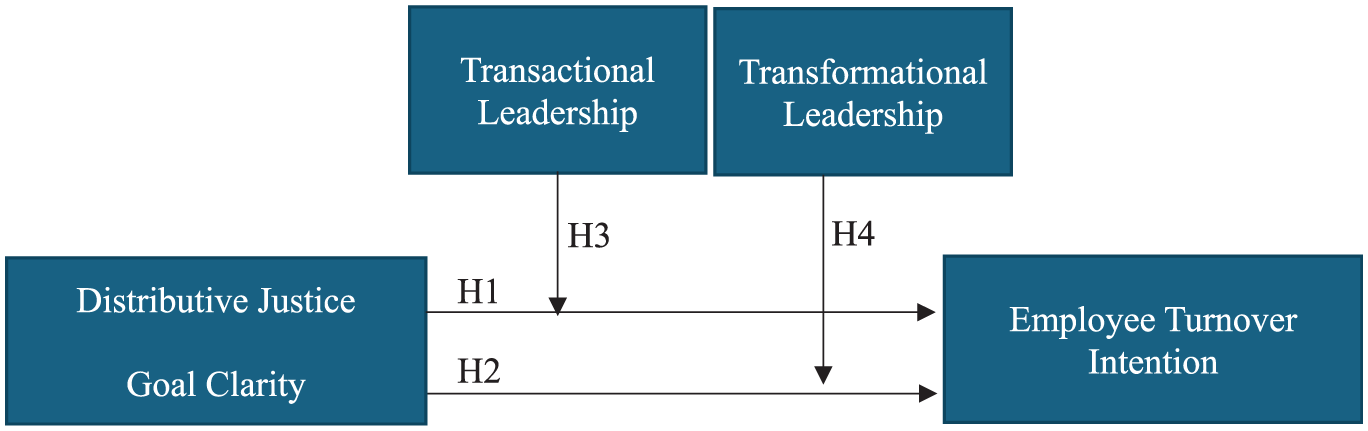
Hypothesized research model.
Model Specification
Data and Sample
For hypothesis testing, we employed data from the 2020 Korean Public Employee Viewpoints Survey (PEVS). The PEVS has been broadly employed in research on public administration. To evaluate the attitudes of Korean public employees regarding key organizational issues and workplace conditions, KIPA designed and implemented a large-scale survey targeting employees across 46 central government and 17 local government organizations. The survey explored employees’ attitudes regarding human capital practices, covering leadership, workplace conditions, job features, and performance-based compensation.
The selection of survey participants followed a two-stage stratified cluster sampling design. The population was stratified according to employees’ roles and task characteristics, focusing specifically on general-service public employees who had attained their positions by passing civil service exams at grades 9, 7, or 5. These employees are primarily responsible for policy-making and administrative duties. Individuals in political or administrative appointments and those engaged in specialized occupations—such as teaching, policing, firefighting, or prosecuting—or in frontline positions were excluded from the sample. In the first stage of sampling, divisions or teams within each agency and local government were identified using systematic sampling based on organizational charts. In the second stage, approximately 10 employees were selected from each division or team roster through another systematic sampling procedure. The final sample size was determined using a square-root proportional allocation method, allowing each stratum to be represented in proportion to the square root of its population size.
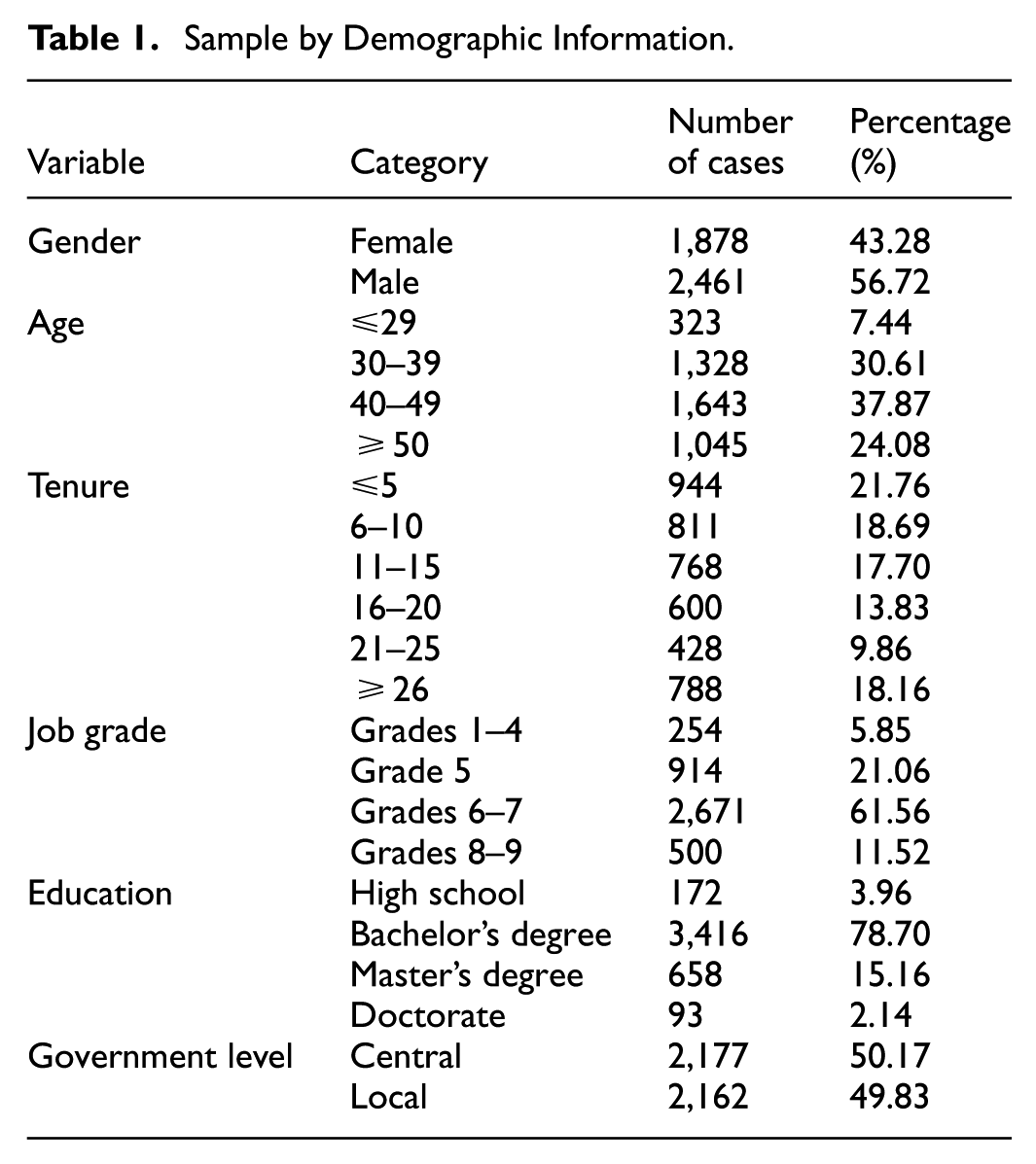
This methodology produced a final dataset of 4,339 respondents, including 2,177 representing central government agencies and 2,162 representing local governments. To enhance representativeness and adjust for potential biases—such as gender, organizational affiliation, and supervisory status—and to compensate for non-response, sampling weights were applied. This weighting procedure ensured that the survey results accurately reflected the population distribution of Korean public employees. Responses were collected on a five-point Likert scale (1 = strongly disagree; 5 = strongly agree), and the mean of relevant items was used to construct each latent variable (Table 1).
Sample by Demographic Information.
Measures
Turnover Intention
It captures an employee’s intention to leave their organization (Liao & Sun, 2020). It consists of a single item: “I am willing to quit my job if I have a chance.” Although turnover intention was a single-item measure, this approach is not uncommon in organizational research. Previous research indicates that single-item measures can reliably and validly capture clear and unidimensional constructs such as turnover intention (Gardner et al., 1998; Hsu & Lu, 2024). Because the PEVS is a secondary dataset, the available items were predetermined and standardized across government agencies. Therefore, it was not feasible to include a multi-item scale. Despite this limitation, the item used in this study is conceptually consistent with those employed in previous public management research (e.g., Caillier, 2021) and has demonstrated satisfactory reliability in large-scale government surveys.
Distributive Justice
It reflects employees’ perceptions of fairness in the allocation of organizational rewards (Colquitt, 2001). It consists of four items: (1) “My pay level is appropriate given my job performance,” (2) “My pay level is appropriate compared with those in the private sector (such as large corporations) who perform comparable tasks,” (3) “I am justly compensated given the degree of job difficulty,” and (4) “I am justly compensated given my job responsibilities.”
Goal Clarity
It captures how clearly and explicitly organizational goals are defined, helping employees understand what to achieve and how to achieve (Rainey, 2014). It consists of four items: (1) “I am clearly aware of the organizational goals of my agency,” (2) “The priority among organizational goals is clear in my agency,” (3) “The organizational goals of my agency provide clear guidelines for work performance,” and (4) “My agency can objectively measure the degree of goal achievement over the past year.”
Transactional Leadership
It captures leader behaviors that motivate followers through performance-based rewards and rule compliance (Jensen et al., 2019). Three items were used to assess the two dimensions of transactional leadership—contingent reward and management by exception: (1) “My supervisor makes clear what I can expect to receive when performance goals are achieved” (contingent reward), (2) “My supervisor gives me specific instructions about what I have to do to receive rewards for my job performance” (contingent reward), and (3) “My supervisor regularly provides me with feedback about my performance” (management by exception).
Transformational Leadership
It entails inspiring and motivating employees through an appeal to higher values and the promotion of personal development (Bass & Avolio, 1994). It consists of four items: (1) “My supervisor provides me with a clear vision of the direction I need to take” (inspirational motivation), (2) “My supervisor motivates me to work hard” (idealized influence), (3) “My supervisor encourages me to perform my work by incorporating new perspectives” (intellectual stimulation), and (4) “My supervisor helps me pursue my own development” (individualized consideration).
Using a single item per dimension was a methodological constraint arising from the design of the PEVS. The survey instrument was developed to comprehensively assess diverse aspects of organizational life across government agencies, but the breadth of topics necessarily limited the number of items allocated to each construct. This abbreviated structure aligns with prior large-scale administrative studies that adopted shortened leadership measures when questionnaire space was constrained (e.g., Oberfield, 2014). The four selected items captured the conceptual essence of each transformational leadership dimension and demonstrated acceptable reliability and discriminant validity in the confirmatory factor analysis. Nonetheless, relying on one item per dimension remains a key limitation, as it restricts the depth of construct measurement. Future research should employ established multi-item instruments, such as the Multifactor Leadership Questionnaire (MLQ), to improve construct validity and measurement precision.
Control Variables
Several individual-level variables were included as controls because they may influence turnover intention among public employees. We controlled for gender, as prior research indicates that female public servants in Korea often face distinct career barriers and family–work role expectations that may shape turnover decisions (Jeon, 2025). Age and tenure were also included because longer organizational experience and proximity to retirement generally reduce turnover intention (Lee & Youm, 2024). Education level was controlled to account for differences in external labor market opportunities. In the Korean civil service, highly educated officials—particularly those with graduate degrees—are more likely to seek career advancement outside the bureaucracy due to limited promotion slots and rigid seniority-based pay structures (Kyeong & Kim, 2022). Their higher employability in the private or academic sectors may increase turnover intention relative to less-educated counterparts. Job grade reflects hierarchical position within Korea’s bureaucratic system, which is characterized by a steep hierarchy and seniority-driven promotion. High-ranking officials (Grades 1–4) enjoy stable career paths and strong organizational commitment due to their proximity to decision-making authority and long-term tenure (Jeon, 2025). In contrast, lower-grade employees (Grades 6–9) often encounter slower advancement and heavier clerical workloads, which can heighten frustration and turnover intention. Government level (central vs. local) captures structural and institutional variation across different administrative tiers. The Korean public sector is highly centralized, and central government employees generally handle complex, policy-oriented tasks under strong political oversight and accountability pressures. Conversely, local government officials typically perform citizen-facing service delivery under relatively flexible managerial conditions. These environmental and institutional contrasts may shape employees’ satisfaction and willingness to remain in public service (Wynen et al., 2019). Taken together, these controls reflect not only demographic characteristics but also the distinctive institutional and hierarchical features of Korean public administration, helping to prevent systemic variations in employment conditions from biasing the estimated effects.
Measurement Validity and Reliability
We assessed the validity and reliability of the latent constructs using multiple methods. First, confirmatory factor analysis (CFA) was performed to evaluate both convergent and discriminant validity. Table 2 shows that the proposed six-factor model—comprising transactional leadership, transformational leadership, goal clarity, distributive justice, organizational commitment, and job satisfaction—achieved a considerably better data fit than any of the alternative models. The indices demonstrated a superior model fit: the root mean square error of approximation (RMSEA = 0.06) and standardized root mean square residual (SRMR = 0.04) were both below the recommended threshold of 0.08, while the comparative fit index (CFI = 0.96) and Tucker–Lewis index (TLI = 0.96) were above the conventional 0.90 criterion. Compared with the five-factor and more constrained models, the six-factor model showed substantially lower χ2 values and improved fit indices, confirming that each construct is empirically distinct. These results demonstrate satisfactory convergent and discriminant validity, supporting the distinctiveness of the six latent variables.
Results of Confirmatory Factor Analyses.

Note. TAL = transactional leadership; TFL = transformational leadership; DJ = distributive justice; GC = goal clarity; JS = job satisfaction; OC = organizational commitment.
p < .01.
Moreover, all items exhibited factor loadings above 0.50 and were significant, further confirming item reliability. To ensure measurement reliability, Cronbach’s alpha coefficients were calculated for all latent constructs. The results demonstrated high reliability across all constructs, with alpha values exceeding the recommended threshold of .70. Specifically, the coefficients were 0.934 for transformational leadership, 0.866 for transactional leadership, 0.941 for distributive justice, and 0.884 for goal clarity. These results indicate that all measurement items within each construct exhibited satisfactory internal consistency.
Finally, to check for possible common method variance (CMV) due to using a single data source, Harman’s single-factor test was applied. The first unrotated factor accounted for 47% of the total variance, which falls below the standard 50% cutoff, suggesting that CMV did not pose a major problem.
Findings
Table 3 exhibits descriptive statistics and correlations. The main independent variables were all significantly correlated. These correlations offer initial support for the study’s hypotheses.
Descriptive Statistics and Correlations.
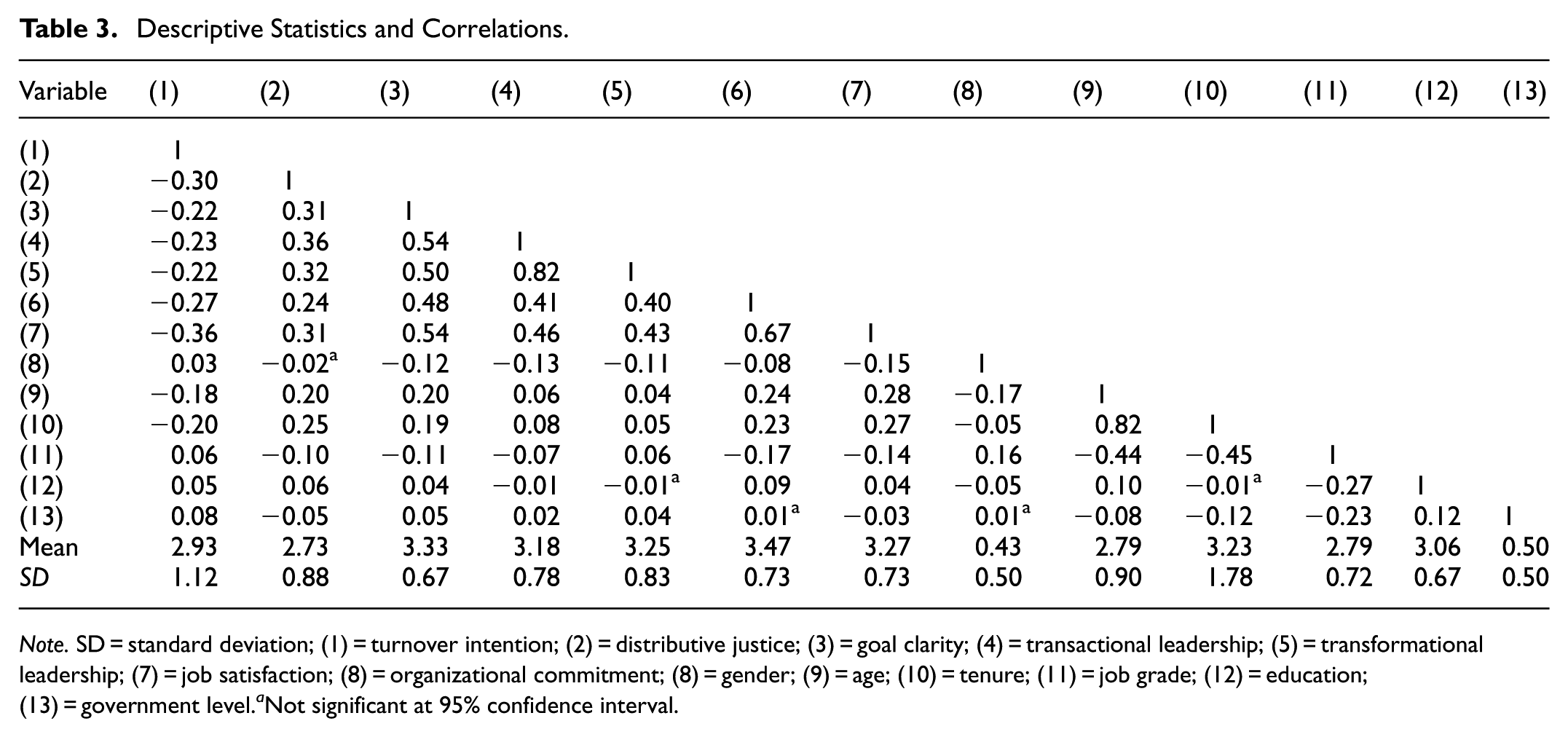
Note. SD = standard deviation; (1) = turnover intention; (2) = distributive justice; (3) = goal clarity; (4) = transactional leadership; (5) = transformational leadership; (7) = job satisfaction; (8) = organizational commitment; (8) = gender; (9) = age; (10) = tenure; (11) = job grade; (12) = education; (13) = government level.
Not significant at 95% confidence interval.
To test our hypotheses, we utilized an ordered logistic regression model using STATA 17, as the dependent variable was an ordinal measure. The analysis proceeded in three steps. First, a base model encompassed control as well as moderating variables. Next, we tested the separate effects of distributive justice and goal clarity on turnover intention. Finally, the moderating effects of transformational and transactional leadership were assessed.
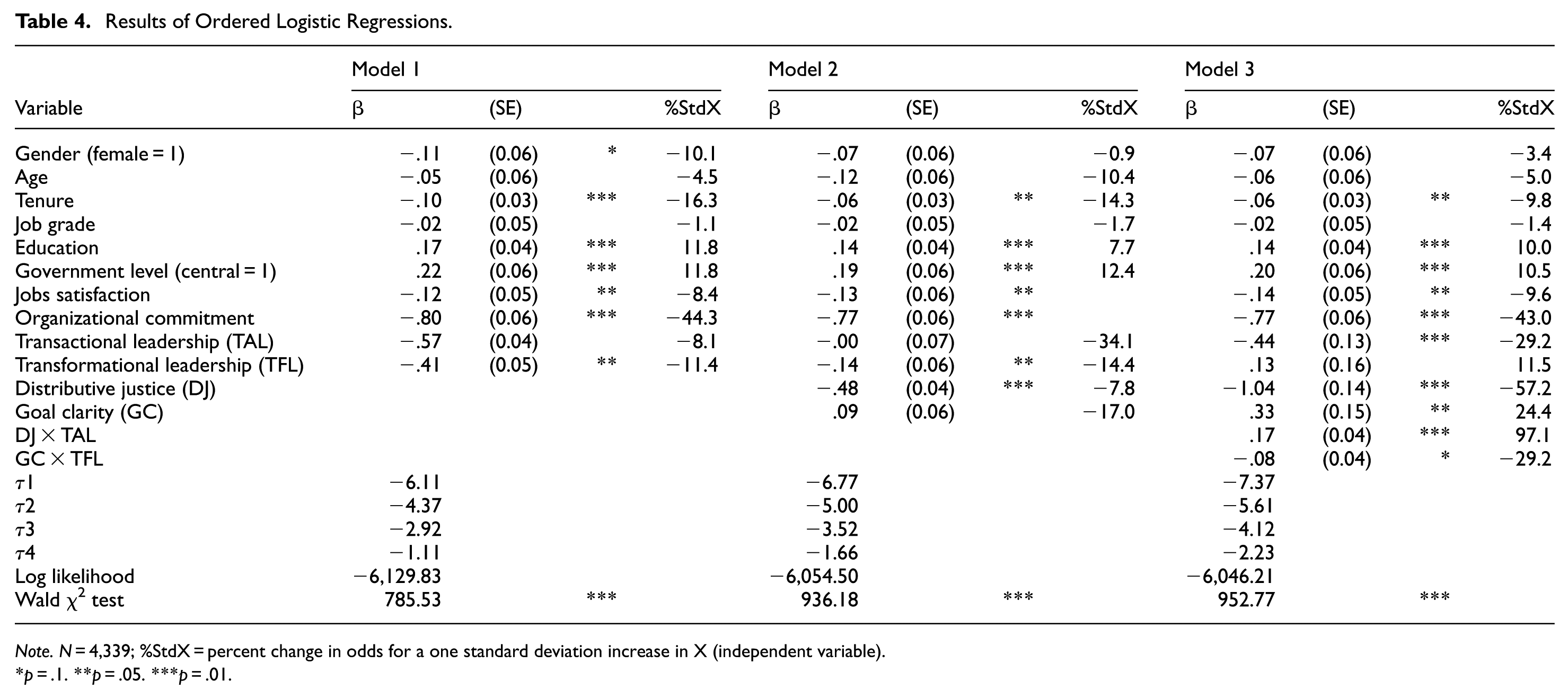
Table 4 presents the results of the regression analyses. Because the use of ordered logistic regression with a single five-point Likert-type measure of turnover intention can be considered methodologically debatable—given that a single-item ordinal variable may limit the precision of parameter estimation—we additionally performed multiple linear regression (OLS) analyses to assess the robustness of the results (Harpe, 2015). The OLS estimates were consistent in both direction and significance, confirming that the main findings are stable and not sensitive to the estimation method (see Appendix 1 for details). The results of Model 1 indicate that several control and moderating variables significantly related to turnover intention.
Results of Ordered Logistic Regressions.
Note. N = 4,339; %StdX = percent change in odds for a one standard deviation increase in X (independent variable).
p = .1. **p = .05. ***p = .01.
In particular, older and longer-tenured employees tend to remain in their organizations, reflecting the higher salaries and financial benefits they receive relative to younger or less experienced employees (Kim & Stoner, 2008). Additionally, employees with higher education levels tend to report stronger intentions to leave their organizations. This may be because they have more options and are better positioned to find attractive job opportunities elsewhere (Nawrocka et al., 2021). Central government employees tend to show higher turnover intention, reflecting the greater workload and work intensity they experience relative to local government employees. As for the moderating variables, both leadership styles exhibited significant negative associations with employees’ turnover intentions. As anticipated, transactional leadership ties rewards to performance, reinforcing perceptions of organizational support and lowering turnover intention (Jackson et al., 2013). Transformational leaders, through their four core behaviors, can inspire emotional attachment among employees, encouraging them to remain in their current organizations (Herman et al., 2013).
Model 2 confirms that distributive justice (β = −.48; p < .01) is significantly and negatively related to turnover intention, supporting
To assess the integrative motivation–leadership framework, we added two interaction terms—distributive justice (DJ) × transactional leadership (TAL) (β = .17; p < .01) and goal clarity (GC) × transformational leadership (TFL) (β = −.08; p < .10)—to Model 3. The odds ratio for the DJ × TAL interaction indicates that a one standard deviation increase in this interaction raises the odds of turnover intention by approximately 97.1%. The findings indicate that, inconsistent with
To better grasp how leadership styles influence turnover intention, we visualized the interaction effects, showing how the probability of turnover intention changes with different degrees of leadership styles. Figure 2 illustrates that employees perceiving high levels of transactional leadership (one standard deviation above the mean; solid line) exhibit a higher predicted probability of turnover intention than those perceiving low levels of transactional leadership (one standard deviation below the mean; short-dashed line).

Predicted probability of turnover intention being “very likely” depending on the levels of distributive justice and transactional leadership.
Unlike transactional leadership, transformational leadership significantly strengthens the moderating effect of goal clarity on turnover intention, consistent with
Figure 3 demonstrates the opposite pattern. The predicted probabilities of turnover intention being “very likely” decrease as goal clarity increases, but those probabilities are significantly reduced when transformational leadership is high. The negative link between distributive justice and turnover intention weakens under high transactional leadership, whereas the negative link between goal clarity and turnover intention strengthens under high transformational leadership.
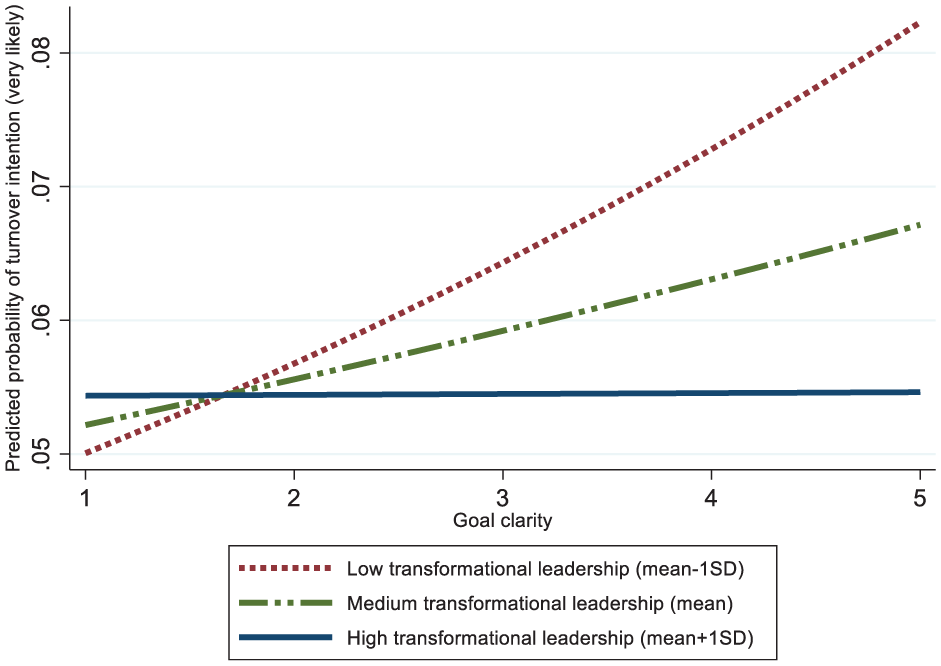
Predicted probability of turnover intention being “very likely” depending on the levels of distributive justice and transformational leadership.
Conclusion
Although recent years have witnessed increasing scholarly attention to distributive justice and goal clarity in public organizational contexts (Bellamkonda et al., 2021; Ripoll, 2022), empirical investigations into how these managerial practices influence employee turnover intention remain limited. Furthermore, leadership theorists have long argued that leadership styles serve as key contextual factors shaping employees’ interpretations of, and reactions to, managerial practices. To address these gaps, this study integrates equity, goal-setting, and social exchange theories to explain the motivational and relational mechanisms driving turnover intention.
Together, equity theory and goal-setting theory explain the motivational underpinnings of how employees direct and sustain their behavior at work Fair outcome distribution satisfies employees’ equity needs and strengthens organizational justice perceptions, thereby decreasing turnover intention. In contrast, the motivational role of goal clarity may depend on contextual factors—its impact may be muted in highly formalized bureaucratic settings where goals and procedures are already standardized. Nonetheless, goal clarity remains an important managerial condition that can enhance retention when reinforced by transformational leadership behaviors that provide meaning, vision, and encouragement to align employees’ goals with organizational purpose.
Motivation in public organizations does not occur in a vacuum—it is embedded in leader–follower exchange relationships, as explained by social exchange theory. Leadership behaviors determine whether these motivational conditions are interpreted as part of an economic exchange (based on external rewards and control) or a social exchange (based on trust, reciprocity, and shared values). Within this integrated framework, distributive justice serves as a key motivational driver, whereas leadership styles define the relational context that moderates its effects. When transactional leadership dominates, economic exchange cues may crowd out intrinsic motivation derived from fairness, leading to weaker retention effects even under just conditions (Georgellis et al., 2011; Perry & Hondeghem, 2008). Conversely, transformational leadership strengthens the motivational value of goal clarity by embedding it in a social exchange environment characterized by inspiration, trust, and mutual commitment, thereby amplifying employees’ intention to stay (Donkor et al., 2022; Lai et al., 2021; Peng et al., 2020).
Through this synthesis, the study moves beyond parallel theoretical applications and demonstrates how motivation theories (equity and goal-setting) interact with a relational theory (social exchange) to provide a more nuanced explanation of how fairness, clarity, and leadership jointly shape turnover intention in public organizations.
Our findings have multiple practical implications. First, public organizations should consider ensuring fair and transparent compensation practices to reinforce employees’ sense of distributive justice. Because public employees value fairness over profit, compensation systems need to emphasize equity and clarity rather than rigid performance-based metrics. While performance-based pay systems may serve as one possible tool, their design and implementation should be carefully adapted to the institutional and cultural context of each organization.
Second, although goal clarity was proved to be not associated with turnover intention, it remains an important managerial condition for fostering alignment and communication within organizations. Managers can strengthen goal clarity by clearly articulating objectives, translating them into actionable steps, and providing regular feedback on progress. Such communication practices may not directly predict employees’ retention decisions but can help sustain shared understanding, coordination, and engagement across organizational levels.
Third, leadership development initiatives could focus on strengthening transformational leadership among managers. Training that develops leaders’ four core behaviors such as idealized influence can foster stronger employee commitment and reduce turnover. However, the success of transformational leadership training can differ depending on cultural and institutional environments, indicating that leadership development should be context-sensitive.
These implications should be viewed as tentative and context-specific, given that they are based on correlational evidence from the Korean public sector. Even so, they offer practical insights for managers seeking to strengthen fairness, enhance communication, and build motivation within their organizations, underscoring the importance of leadership development and human resource management in sustaining a committed and high-performing workforce.
Theoretically, this study advances an integrated motivation–leadership framework that explains how fairness perceptions and leadership behaviors jointly influence turnover intention, even when the motivational effects of goal clarity are less pronounced. Empirically, the study employs a large-scale, nationally representative dataset of Korean public employees, providing robust evidence from an underexplored non-Western context. In addition, the surprising finding that transactional leadership reduces—rather than reinforces—the effect of distributive justice on turnover intention adds new insight to the study of leadership and employee motivation. This counterintuitive result points to a possible motivation crowding-out mechanism in bureaucratic settings where distributive fairness is already institutionalized.
Additionally, this study contributes contextual originality by examining how distributive justice and leadership interact within South Korea’s hierarchical and rule-oriented public bureaucracy—a setting rarely explored in prior turnover research. As one of the first empirical studies to jointly test these leadership effects in the Korean context, it extends the applicability of Western-based motivation and leadership theories to non-Western administrative systems. This contextual perspective not only broadens the theoretical scope of public management scholarship but also deepens our understanding of how institutional and cultural conditions shape employee motivation and retention across governance settings.
However, certain limitations should be acknowledged. First, these findings may not be fully generalizable beyond the Korean public sector. Cultural, institutional, and administrative characteristics unique to Korea—such as its hierarchical bureaucracy and rule-based personnel systems—may shape how employees perceive distributive justice, goal clarity, and leadership styles. Future research should therefore conduct cross-cultural validation using comparative data from other countries to determine whether the observed relationships hold across different administrative traditions and cultural settings. Second, the use of 1-year, cross-sectional data prevents causal inference and restricts the ability to capture actual turnover behavior. While turnover intention may reliably predict actual turnover, the two may diverge depending on labor market conditions and institutional constraints. Longitudinal research designs that track employees over time would allow for more accurate identification of causal relationships and a clearer understanding of how leadership and motivation influence real turnover behavior. Third, the study’s measurement strategy involves certain limitations. Turnover intention was assessed with a single-item indicator, and the leadership constructs were measured using abbreviated scales, with one item representing each transformational leadership dimension. Although these operationalizations were constrained by the secondary nature of the dataset, they inevitably restrict the depth and reliability of measurement. In particular, the leadership items were not derived from standardized instruments such as the MLQ, which may weaken construct validity. These limitations are common in studies utilizing secondary data such as the PEVS, which are designed to capture broad organizational perceptions rather than detailed psychological constructs. Future research should employ validated multi-item instruments to improve construct validity and allow for a more comprehensive assessment of turnover intention and leadership behaviors. Fourth, CMV may still be present, as the data were drawn from a single source. Although Harman’s single-factor test revealed no significant common method bias (47% covariance) and the PEVS was anonymous, the study does not fully validate the empirical model’s findings. Future studies should use multiple data sources to address potential CMV issues. Finally, future studies should investigate the extent to which distributive justice and goal clarity shape a wider range of employee outcomes beyond turnover intention, such as performance and innovation. As performance is a critical concern in public sector organizations, investigating how leadership styles moderate these relationships would provide further theoretical and managerial insights.
Footnotes
Appendix
Results of Ordinary Least Squares (OLS) Regression Models.

| Model 1 | Model 2 | Model 3 | |||||||
|---|---|---|---|---|---|---|---|---|---|
| β | (SE) | β | (SE) | β | (SE) | ||||
| Gender (female = 1) | −.06 | (0.06) | * | −.04 | (0.03) | −.04 | (0.03) | ||
| Age | −.03 | (0.06) | −.03 | (0.03) | −.03 | (0.03) | |||
| Tenure | −.16 | (0.03) | *** | −.04 | (0.02) | ** | −.04 | (0.02) | ** |
| Job grade | −.01 | (0.05) | −.01 | (0.03) | −.01 | (0.03) | |||
| Education | .10 | (0.04) | *** | .08 | (0.02) | *** | .08 | (0.02) | *** |
| Government level (central = 1) | .12 | (0.06) | *** | .1 | (0.03) | *** | .10 | (0.03) | *** |
| Jobs satisfaction | −.06 | (0.05) | ** | −.06 | (0.03) | ** | −.07 | (0.03) | ** |
| Organizational commitment | −.41 | (0.06) | *** | −.39 | (0.03) | *** | −.38 | (0.03) | *** |
| Transactional leadership (TAL) | −.05 | (0.04) | .00 | (0.04) | −.22 | (0.07) | *** | ||
| Transformational leadership (TFL) | −.08 | (0.05) | ** | −.07 | (0.03) | ** | .06 | (0.08) | |
| Distributive justice (DJ) | −.24 | (0.02) | *** | −.52 | (0.07) | *** | |||
| Goal clarity (GC) | .05 | (0.03) | .16 | (0.08) | ** | ||||
| DJ × TAL | .09 | (0.02) | *** | ||||||
| GC × TFL | −.04 | (0.02) | * | ||||||
| 4.86 | (0.17) | *** | 5.13 | (0.17) | *** | 5.45 | (0.30) | *** | |
| R-squared | .16 | .18 | .18 | ||||||
| F-value | 80.36 | *** | 80.05 | *** | 69.97 | *** | |||
Note. N = 4,339.
p = .1. **p = .05. ***p = .01.

Funding
The authors disclosed receipt of the following financial support for the research, authorship, and/or publication of this article: This work was supported by Inha University Research Grant (2025).
Declaration of Conflicting Interests
The authors declared no potential conflicts of interest with respect to the research, authorship, and/or publication of this article.