



Abstract
Stress adversely affects physical and mental health, particularly among nursing students. This study examined a serial mediation model in which mindfulness promotes gratitude and self-compassion, which in turn mediates the effect of life stress on stress response and mental well-being among nursing students in South Korea. A cross-sectional study design was employed, utilizing a convenience sample of 89 junior and senior nursing students from a university in Seoul, South Korea. Data were collected using self-report questionnaires, assessing life stress, stress response, mindfulness, gratitude disposition, self-compassion, and mental well-being. Descriptive statistics, t-tests, Pearson’s correlations, and bootstrapping analyses were conducted to test the hypothesized serial mediation model. The results revealed a significant pathway linking life stress to stress response through the serial mediation of mindfulness and gratitude disposition, as well as the pathway through mindfulness and self-compassion. Moreover, mindfulness’s indirect effect was not significant. These findings indicate that mindfulness, gratitude disposition, and self-compassion mediate life stress, stress response, and mental well-being. Consequently, developing integrated intervention programs that combine these psychological resources may assist nursing students in managing stress more effectively and enhance their overall well-being.
Plain Language Summary
Nursing school can feel like a pressure cooker—tight deadlines, long clinical shifts, and constant exams. Such daily stress often leaves students exhausted in both body and mind. To find simple ways that might cushion this strain, we asked 89 nursing students at a Seoul university to fill out brief questionnaires. These surveys measured three inner qualities that anyone can practice: • Mindfulness – paying warm, non-judgmental attention to the present moment. • Gratitude – noticing and appreciating the good things, however small. • Self-compassion – treating yourself with the same kindness you would offer a friend when things go wrong. We also recorded how much everyday stress they felt, how strongly their bodies and emotions reacted to it (stress responses), and how healthy and upbeat they felt overall (mental well-being). Here is what the answers showed: • Mindful students tended to feel more grateful and were gentler with themselves. • When mindfulness led to greater gratitude, students reported fewer headaches, tension, and negative moods caused by stress. • Mindfulness by itself did not give a clear mental-health boost. Its benefit appeared only when it sparked either gratitude or self-compassion. • A second helpful chain emerged: mindfulness encouraged self-compassion, which in turn was linked to higher mental well-being. Put simply, awareness needs a partner—thankfulness or self-kindness—to turn stress into resilience. Why does this matter? High stress drives some nursing students to burn out or even leave the profession at a time when hospitals urgently need them. Short, blended programs that teach students to pause, notice the present, count their blessings, and speak to themselves kindly could be a practical, low-cost way to keep future nurses healthier and more engaged—both in the classroom now and at patients’ bedsides later.
Introduction
Nursing students experience high levels of stress related to academic demands, clinical performance, and personal challenges throughout their education while preparing for their professional careers (Dogham et al., 2024). This can adversely affect their health, interpersonal relationships, and learning processes. Additionally, it may undermine their confidence, hindering their ability to adequately prepare for their future nursing roles (Welch, 2023). Therefore, emphasizing the importance of understanding how undergraduate nursing programs support students in managing stress. Stress management is not only critical for student well-being, but also foundational to preparing future nurses for high-pressure clinical environments (Olvera Alvarez et al., 2019).
Studies increasingly emphasize the importance of identifying factors that mediate the impact of life stress on outcomes such as mental well-being and stress response. However, few studies examined how multiple personal resources jointly operate in a single model, particularly among nursing students. Therefore, this study addressed this gap by testing a serial mediation model.
According to the transactional model of stress and coping (Lazarus & Folkman, 1984), individuals’ stress responses depend on how they appraise stressors and access coping resources. Mindfulness and positive psychology have recently obtained increased interest as personal resources that promote well-being and enhance adaptation to stressful experiences (Allen et al., 2021).
Mindfulness is a cognitive ability, commonly defined as an awareness of and a non-judgmental attitude toward present-moment experiences (Tomlinson et al., 2018; Van Dam et al., 2018). By reducing automatic emotional reactivity and promoting adaptive appraisal (Brown & Ryan, 2003), mindfulness strengthens self-regulation and supports more effective responses to stress. Moreover, mindfulness reduces stress and promotes psychological adjustment among nurses and nursing students (Ramachandran et al., 2023; Van der Riet et al., 2018). Additionally, increasing empirical evidence suggested that mindfulness positively impacts psychological functioning (Giluk, 2009; Reangsing et al., 2023).
Positive psychology offers additional insight into internal strengths that buffer stress. Gratitude disposition reflects the tendency to recognize and appreciate positive aspects of one’s life and is related to improved stress coping and well-being (McCullough et al., 2008). Previous empirical studies found that individuals who exhibited high gratitude tended to report better adaptation and lower stress (Calleja et al., 2024; Lee et al., 2021).
Self-compassion, a core concept of positive psychology, refers to treating oneself with kindness and understanding during times of suffering or failure (Neff, 2003). It involves being open to one’s own pain and responding with empathy rather than judgment. Previous studies found self-compassion to be a protective factor against stress across diverse populations (Han & Kim, 2023; Winders et al., 2020).
This conceptual framework (Figure 1) integrates Lazarus and Folkman’s (1984) transactional model of stress with emerging evidence from positive psychology, proposing that internal cognitive and affective resources, such as mindfulness, gratitude, and self-compassion, operate sequentially to buffer stress’s effects.
Although previous studies examined these traits individually, few studies examined their combined or sequential effects. Particularly, whether mindfulness operates by fostering gratitude and self-compassion, which, subsequently, influence stress response and mental well-being, remains unclear. Addressing this question can advance theoretical understanding and guide practical interventions.
This study proposed a serial mediation model in which mindfulness influences gratitude and self-compassion, which mediates the effects of life stress on outcomes. Some scholars considered mindfulness as a foundation for developing positive psychological traits, whereas others conceptualized it as a component of positive psychology (Kim & Kim, 2021; Neff, 2003). Therefore, exploring these interconnections is timely and relevant.
Accordingly, this study hypothesized the following:

Conceptual framework of the hypothesized serial mediation model linking life stress, mindfulness, gratitude disposition, self-compassion, stress response, and mental well-being.
This study contributes to a deeper understanding of stress management among nursing students by examining the mediating role of mindfulness and positive psychological resources. By testing a serial mediation model with multiple mediators, this study provides novel insight into psychological mechanisms that may inform stress management education and mental well-being promotion in nursing contexts.
Methods
Participants and Procedure
This study included junior and senior nursing students enrolled in baccalaureate programs at a university in Seoul, South Korea. The inclusion criteria required participants to understand the purpose and content of the questionnaire. The exclusion criteria included a history of severe psychiatric illness, current use of psychotropic medication, or participation in similar research studies. After obtaining approval from the Institutional Review Board of Sungshin Women’s University (SSWUIRB-2023-021), participants were recruited using structured announcements posted on an online student community between September 2023 and January 2024. To ensure voluntary participation, no faculty members or staff from the participating university were involved in the recruitment process or data collection. Before the study commenced, the researcher provided a detailed explanation of the study’s purpose and methodology via an online information sheet. Students voluntarily provided informed consent. Participants were informed that they could withdraw from the study at any time without penalty, that their identity and confidentiality would be strictly protected, and that the collected data would be used solely for research purposes. Data was collected using an online questionnaire. The required sample size was determined using G-Power 3.1.9.7. Based on a significance level of .05, a statistical power of 80%, and a medium effect size of 0.15 for multiple regression (Cohen, 1988), the minimum required sample size was calculated as 77 (Faul et al., 2009). A total of 89 students agreed to participate, and all were included in the final analysis.
Variables and Instruments
Demographic Characteristics
The demographic variables included sex, age, and grade.
Life Stress
The Revised Life Stress Scale for College Students, developed by Chon et al. (2000), was used to assess the participants’ life stress. The internal consistency, with a Cronbach’s alpha ranging between .75 and .88, and validity were confirmed through factor analysis and criterion-related validity. This scale comprised 50 items spanning various interpersonal dimensions, including same-sex friendships, opposite-sex friendships, relationships with professors, family relationships, economic concerns, future concerns, values, and academic problems. Responses were measured on a four-point Likert scale, with higher total scores indicating greater levels of life stress. Cronbach’s alpha was .95 in this study.
Stress Response
Stress responses were assessed using a shortened version of the tool developed by Choi et al. (2006), which was originally developed by Koh et al. (2000) for adults; its reliability and validity have been verified for nursing students (Kang, 2018; Shin et al., 2023). This inventory comprises 22 items categorized in three dimensions: somatization, depression, and anger. Each item was measured on a five-point Likert scale, with higher scores indicating greater levels of stress response. The scale demonstrated high internal consistency, with a Cronbach’s alpha of .93, which was identical to that reported by Choi et al. (2006).
Mental Well-being
The Korean version of the Mental Health Continuum Short Form (K-MHC-SF (Lim et al., 2012)), validated in Korea based on the original MHC-SF (Keyes et al., 2008), was used to assess mental well-being. The K-MHC-SF was validated for its factor structure, convergent validity, and discriminant validity. The scale comprises 14 items rated on a six-point Likert scale, including “every day,”“almost every day,”“approximately once a week,”“approximately 2–3 times a week,”“once or twice,” and “never.” It measures three dimensions of well-being: psychological, social, and emotional, with higher scores indicating greater perceived mental well-being. Lim et al. (2012) reported a Cronbach’s alpha of .93, whereas that of this study was .89.
Mindfulness
Mindfulness was assessed using the Korean version of the Five-Facet Mindfulness Questionnaire (FFMQ), validated by Cheong et al. (2017). This instrument is an abbreviated and validated version of the Korean adaptation developed by Won and Kim (2006), which was based on the original FFMQ, developed by Baer et al. (2004). The scale comprises 15 items categorized in five domains: non-reactivity, observing, acting with awareness, describing, and non-judging of experience. Each item was rated on a seven-point Likert scale, with higher scores indicating greater mindfulness. In Cheong et al. (2017), the scale demonstrated a Cronbach’s alpha of .75, which was .76 in this study.
Gratitude Disposition
Gratitude disposition was assessed using the Gratitude Questionnaire (GQ-6) developed by McCullough et al. (2002) and applied in this study with the validated Korean version of the GQ-6 by Kwon et al. (2006). This scale comprises six items rated on a seven-point Likert scale, with higher scores indicating a stronger gratitude disposition. The Cronbach’s alpha was .85 in the study by Kwon et al. (2006) and .87 in this study.
Self-compassion
Self-compassion was assessed using the Korean version of the Self-Compassion Scale Short Form (SCS-SF), validated by Kim et al. (2008), based on the original SCS-SF by Neff (2003). The scale comprises 12 items categorized in six dimensions, rated on a five-point Likert scale, with higher scores indicating greater self-compassion. The Cronbach’s alpha was .87 in the study by Kim et al. (2008) and .75 in this study.
Data Analysis
Data analysis was performed using SPSS (version 25.0) and R with the lavaan package (Rosseel, 2012) for path analysis. Percentages, means, and standard deviations (SDs) were calculated to summarize participants’ general characteristics. To examine variations in life stress, stress response, mental well-being, mindfulness, gratitude disposition, and self-compassion, the means, SDs, and score ranges were obtained. Pearson’s correlation coefficients were computed to identify relationships between stress response, mental well-being, and other key variables, including life stress, mindfulness, gratitude disposition, and self-compassion. The scales’ reliability was assessed using Cronbach’s alpha. Path analysis was used to examine the hypothesized serial mediation model involving the observed variables. This method is suitable for simultaneously testing multiple indirect pathways (Hayes, 2018). To assess the indirect effects’ significance, a bias-corrected bootstrapping with 10,000 resamples was applied. Bootstrapping is recommended for mediation analysis, particularly concerning small to moderate samples, given that it does not assume normality and yields more accurate confidence intervals (Shrout & Bolger, 2002).
Results
Participants’ General Characteristics
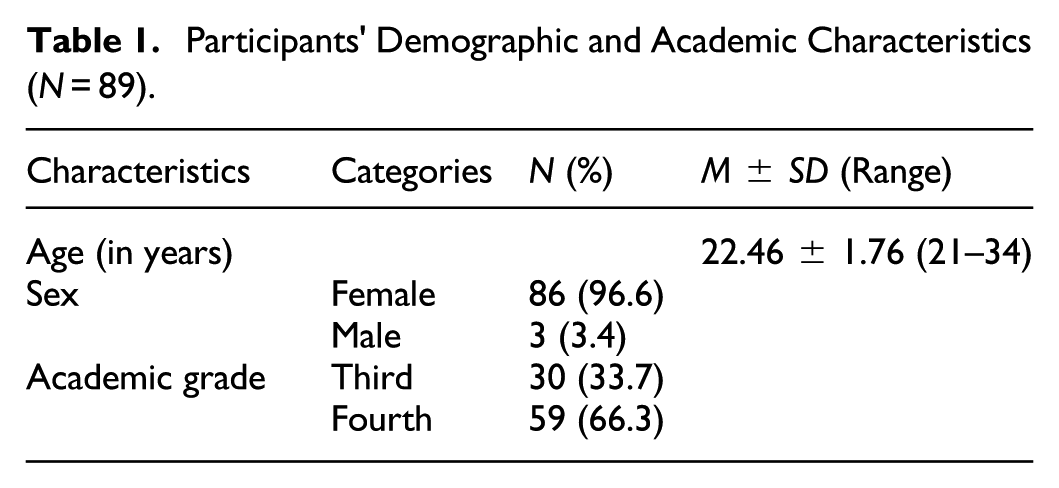
The participants’ average age was 22.46 ± 1.76 years (Table 1). Among the participants, 86 (96.6%) were female, and 59 (66.3%) were in their 4th year of university.
Participants’ Demographic and Academic Characteristics (N = 89).
Descriptive Statistics and Correlations Among Variables
The mean score for life stress was 86.15 ± 20.54. Regarding mindfulness, awareness received the highest score, at 14.08 ± 3.65, whereas observation received the lowest, at 11.25 ± 3.83. The average gratitude disposition and self-compassion scores were 33.09 ± 5.46 and 39.90 ± 7.17, respectively. Stress response, which measured physical reactions related to somatization, depression, and anger, had an average score of 20.71 ± 14.70. Mental well-being, assessed based on emotional, social, and psychological well-being, had an average score of 35.06 ± 11.23 (Table 2).
Descriptive Statistics of Study Variables (N = 89).

Stress responses were significantly and negatively correlated with mental well-being (r = −0.50, p < .001), mindfulness (r = −0.42, p < .001), gratitude disposition (r = −0.46, p < .001), and self-compassion (r = −0.41, p < .001). Conversely, stress responses exhibited a significant positive correlation with life stress (r = .75, p < .001). Moreover, mental well-being was negatively correlated with life stress (r = −0.49, p < .001) and positively correlated with mindfulness (r = .55, p < .001), gratitude disposition (r = .57, p < .001), and self-compassion (r = .56, p < .001; Table 3).
Correlations Among Study Variables.

p < .001.
Testing the Serial Mediation Model: Path Analysis
Path analysis was performed to examine how life stress influences stress responses and mental well-being through mindfulness, gratitude disposition, and self-compassion (Table 4 and Figure 2). The overall model fit indices were χ2(5) = 61.39, CFI = .76, TLI = .29, RMSEA = .36, and SRMR = .09. Some indices did not meet conventional thresholds; however, this is common in path models using observed variables with low degrees of freedom (Bentler & Bonett, 1980; Kenny et al., 2015). Accordingly, model evaluation emphasized the significance and theoretical consistency of the path coefficients, rather than absolute fit values.
Standardized Regression Coefficients for the Serial Mediation Model.

p < .05. **p < .01. ***p < .001.

Final serial mediation model showing significant pathways among study variables.
The results indicated that life stress negatively affected mindfulness (b = −0.23, p < .001). Additionally, mindfulness positively influenced gratitude disposition (b = 0.31, p < .001) and self-compassion (b = 0.43, p < .001), suggesting that nursing students with higher levels of mindfulness also exhibited greater gratitude disposition and self-compassion. Gratitude disposition negatively influenced stress responses (b = −0.81, p = .008) and positively influenced mental well-being (b = 0.49, p = .002), indicating that stress responses decreased and mental well-being improved as gratitude disposition increased. Self-compassion had a significant positive effect on mental well-being (b = 0.31, p < .001), suggesting that nursing students with higher self-compassion experienced better mental well-being.
Testing the Statistical Significance of the Indirect Effects of Gratitude Disposition and Self-compassion in the Relationship Between Life Stress and Stress Response
This study examined the statistical significance of the serial mediating effects of mindfulness, gratitude disposition, and self-compassion in the pathways between life stress, stress responses, and mental well-being (Table 5). The results indicated that the pathway through which life stress influenced stress responses and mental well-being via the serial mediation of mindfulness and gratitude disposition was statistically significant, given that the 95% confidence interval did not include zero (effect = 0.06 [0.003, 0.13]). This suggests that an increase in life stress leads to a decrease in mindfulness, which subsequently reduces gratitude disposition and heightens stress responses.
Indirect, Direct, and Total Effects in the Serial Mediation Pathways.

Regarding the mediating effects of mindfulness, gratitude disposition, and self-compassion on the relationship between life stress and mental well-being, the indirect effect of mindfulness was not statistically significant (effect = −0.04 [−0.10, 0.02]). However, the serial mediating effect of mindfulness and gratitude disposition on this relationship was statistically significant (effect = −0.05 [−0.09, −0.02]). Additionally, the serial mediating effect of mindfulness and self-compassion was statistically significant (effect = −0.05 [−0.10, −0.01]). These results indicate that an increase in life stress results in a decrease in mindfulness, which reduces gratitude disposition and mental well-being.
Discussion
This study examined the interrelationships among mindfulness, self-compassion, and gratitude disposition, which emerged as effective stress management resources. It further examined their direct and indirect effects on nursing students’ stress responses and mental well-being, as well as their serial mediation effects.
The results indicated that life stress was negatively associated with stress responses and mental well-being. Among the psychological resources, gratitude and self-compassion emerged as significant mediators, whereas mindfulness indirectly influenced outcomes through these variables.
Two key pathways were supported. First, regarding life stress, mindfulness promoted a greater disposition toward gratitude, which reduced stress responses and improved mental well-being. Second, mindfulness fostered self-compassion, which contributed to mental well-being; however, it did not significantly reduce stress responses. These findings demonstrate how internal cognitive and affective traits function sequentially to buffer the effects of stress.
Furthermore, this study suggested that mindfulness did not directly affect stress response or mental well-being. Instead, its influence was channeled through gratitude disposition and self-compassion. This aligned with previous studies suggesting that mindfulness facilitates emotional and cognitive transformation, which affects stress outcomes (Baer, 2018; Gu et al., 2015). A possible explanation is that the participants were not formally trained in mindfulness techniques. Therefore, their trait mindfulness may not have been sufficient to directly influence outcomes. Alternatively, mindfulness may predominantly exert its effects through the cultivation of adaptive traits, such as gratitude and self-compassion (Kim & Kim, 2021).
Gratitude disposition was associated with stress response and mental well-being, whereas self-compassion only influenced mental well-being. Although both are rooted in positive psychology, this difference emphasizes that gratitude may have a more immediate and outward impact on stress regulation, whereas self-compassion may function more internally to support emotional resilience. This distinction has been noted in previous studies; however, it is often overlooked in interpretation (MacBeth & Gumley, 2012; Neff, 2011). This study emphasized that self-compassion did not significantly affect stress responses, possibly owing to emotional self-soothing not always translating into reduced physiological or behavioral reactions in the short term.
The results supported a model in which mindfulness serves as a foundational trait associated with gratitude disposition and self-compassion, which influences how individuals respond to stress. This supports the integration of mindfulness and positive psychological traits in stress theories (Creswell, 2017; Fredrickson, 2001). Individuals with higher mindfulness are more capable of observing emotions without reactivity, allowing them to adopt more positive attitudes and coping mechanisms (Zou et al., 2020).
However, given that this study employed a cross-sectional design, it cannot establish causal relationships or the effectiveness of interventions. Although the findings suggested possible benefits of integrating mindfulness and positive psychology in nursing education, the implications are presented with caution, avoiding prescriptive claims. Further longitudinal or experimental studies are required to evaluate training effects.
This study contributes a theoretically grounded model that explains how psychological resources interact to mediate the impact of life stress on outcomes. By identifying a sequential structure (mindfulness → gratitude/self-compassion → outcomes), it provides novel insight into potential stress management mechanisms.
However, this study has some limitations. First, the participants were recruited from a single nursing college and consisted of a relatively small and demographically unbalanced group. These characteristics limit the representativeness of the participants and reduce the generalizability of the findings to the broader population of nursing students, including those from other regions or educational systems. Moreover, the localized and limited sample may have influenced the strength and direction of the observed associations. Future studies should include a larger and more diverse group of participants across multiple colleges. Second, the cross-sectional design restricted the ability to establish causal relationships among the variables. To clarify the temporal and directional mechanisms, future studies should adopt longitudinal or experimental designs.
Practical Implications
This study’s findings have meaningful implications for nursing education and the development of stress management interventions. Incorporating mindfulness, gratitude, and self-compassion into the nursing curriculum can assist students in cultivating emotional awareness, psychological resilience, and adaptive coping strategies in academic and clinical contexts. Structured learning activities, such as brief mindfulness practices, reflective gratitude journaling, and compassion-based group discussions, can be embedded into existing courses on health promotion, mental health nursing, or professional development. Furthermore, faculty training is essential for fostering a supportive educational climate. Educators who are equipped to model and facilitate mindfulness and positive psychology practices can help students manage academic stress more effectively while enhancing empathy and communication in clinical practice. In addition, extracurricular or co-curricular programs, such as mindfulness-based stress reduction (MBSR) sessions or gratitude and self-compassion workshops, may be implemented as preventive strategies to promote mental well-being and professional readiness. Integrating these approaches into nursing curricula and institutional support systems may improve students’ mental health and stress management capacities while contributing to the development of compassionate, self-aware, and resilient nurses who can provide holistic care in diverse healthcare environments
Footnotes

Ethical Considerations
This study was approved by the Sungshin Women’s University Institutional Review Board (Approval Number: SSWUIRB-2023-021).
Consent to Participate
Informed consent was obtained from all participants prior to participation. Participants were informed of their right to withdraw from the study at any time without penalty, and confidentiality was maintained throughout.
Author Contributions
All authors have accepted responsibility for the entire content of this manuscript and approved its submission. Conceptualization: Young Im Cho, Dong Hee Kim. Methodology: Young Im Cho, Dong Hee Kim. Validation: Young Im Cho, Hyo Jin Kim, Dong Hee Kim. Formal analysis: Hyo Jin Kim, Dong Hee Kim. Investigation: Young Im Cho, Dong Hee Kim. Data curation: Young Im Cho, Hyo Jin Kim. Writing—original draft preparation Young Im Cho, Hyo Jin Kim, Dong Hee Kim. Writing—review and editing: Young Im Cho, Hyo Jin Kim, Dong Hee Kim. Supervision, Project administration, Funding acquisition: Dong Hee Kim.
Funding
The authors disclosed receipt of the following financial support for the research, authorship, and/or publication of this article: This work was supported by Sungshin Women’s University Research Grant 2023 (Grant Number: H20230061).
Declaration of Conflicting Interests
The authors declared no potential conflicts of interest with respect to the research, authorship, and/or publication of this article.
Data availability Statement
Data from this study are available from the corresponding author upon reasonable request.